There is no universal schedule for opening windows. The decision depends on why the home needs ventilation, whether outdoor air is suitable at that moment, whether a safe inlet and outlet can be created, and what condition will trigger a review. Check current smoke or hazard alerts, temperature, humidity, weather, pollen conditions, security, and opening safety before using outdoor air. Close or change the plan when outdoor conditions worsen, indoor moisture rises, or the air path begins spreading the source. When windows should remain closed, use appropriate local exhaust, indoor-air movement, filtration, or building-level support instead.
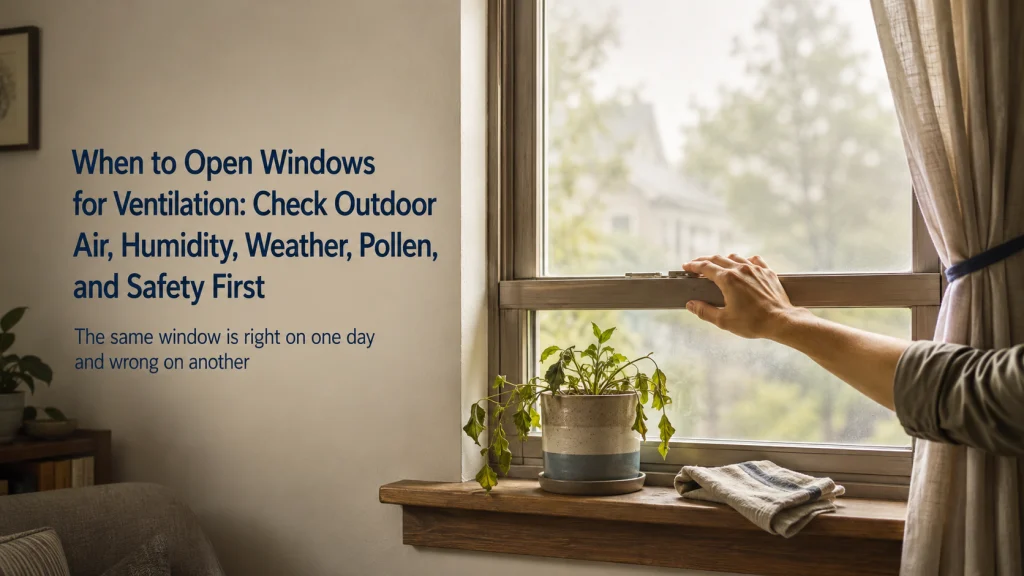
The Same Pair of Windows Can Be Helpful on One Day and the Wrong Choice on Another
It is easy to want one reassuring rule: open the windows every morning, air out the rooms for a set period, and consider the job done. The difficulty is that the same habit can feel sensible on one day and bring the wrong outdoor condition inside on the next.
Imagine the same living-room windows under four different conditions.
On the first day, the weather is mild, outdoor air is clear, and several guests have just left. On the second, wildfire smoke has moved into the area. On the third, the air outside is hot and humid while indoor surfaces already feel damp. On the fourth, the weather is cold and dry, but a recent indoor painting activity has left an odor in one room.
| Day | Indoor reason for ventilation | Outdoor condition | First decision |
|---|---|---|---|
| Mild, clear day | Guests have left and the room feels stale | Outdoor air is comfortable and no current hazard is apparent | Consider a controlled inlet and outlet, then review the room |
| Wildfire-smoke day | The home feels closed and cooking occurred earlier | Outdoor smoke or a local alert makes outside air unsuitable | Keep windows closed and use an indoor fallback |
| Hot, humid day | Indoor moisture is already noticeable | Outdoor air would add heat and moisture | Use source control or local exhaust instead of adding humid air |
| Cold, dry day after painting | A strong source remains in one room | Outdoor air may be suitable, but comfort and freezing risks matter | Use a targeted path with a review point rather than a fixed routine |
The windows did not change. The source, outdoor condition, and safe alternative did. That is why “open them every day” and “keep them closed all season” are both too simple.
The guide to creating a practical air path explains how inlet and outlet placement work. This article decides whether outdoor air is an appropriate input at that time.
Define Outdoor-Air Ventilation, AQI, Smoke Events, Humidity Load, Pollen Conditions, Source Events, and Review Points
The decision becomes easier when each variable has a specific job.
| Term | Practical meaning | Why it matters |
|---|---|---|
| Outdoor-air ventilation | Outdoor air enters while indoor air leaves through planned openings or equipment | The outside air must be suitable for the household and source event |
| AQI | A public air-quality indicator used with current local information | It helps identify periods when outdoor pollution may make window ventilation unsuitable |
| Smoke event | A period when wildfire or other outdoor smoke affects local air | Opening windows may bring the outdoor source indoors |
| Humidity load | The moisture added to the home by outdoor air or indoor activity | Ventilation can remove moisture in one condition and add it in another |
| Pollen condition | The current outdoor presence of pollen relevant to the person and location | The decision may need to follow individual medical guidance and local conditions |
| Source event | The indoor activity or condition creating the need for dilution or removal | A strong active source may call for local exhaust or stopping the activity first |
| Review point | A planned condition for checking whether the windows should remain open | It replaces an arbitrary timer with observation of weather, moisture, odor, comfort, and safety |
A review point might be the end of a source activity, a change in weather, the arrival of rain, a shift in outdoor smoke, a noticeable rise in indoor moisture, or the moment the room no longer needs the same air path. The point is to make ventilation responsive instead of automatic.
Identify Why the Home Needs Ventilation Now
Opening windows without naming the indoor event can create a ritual instead of a solution. Start with one sentence: “The bathroom remains damp after a shower,” “Cooking effects are moving into the hallway,” “Several people have been in a closed room,” or “A cleaning or painting activity has created an odor.”
Then decide whether the source is still active. A running shower, smoking pan, uncovered chemical product, or ongoing dusty activity should be stopped, reduced, isolated, or handled at the source when safe before relying on outdoor-air dilution.
Use the following questions:
- Which room contains the source?
- Is the source continuing?
- Can it be stopped, covered, removed, or reduced safely?
- Does local outdoor exhaust already serve the activity?
- Which occupied rooms should remain outside the air path?
- What observable condition will show that the plan should be reviewed?
A crowded room after guests leave is different from active cooking, a damp bathroom, or an indoor project. Each one creates a different source strength, location, and fallback.
The broader indoor air quality guide places ventilation after source identification rather than treating open windows as the first answer to every condition.
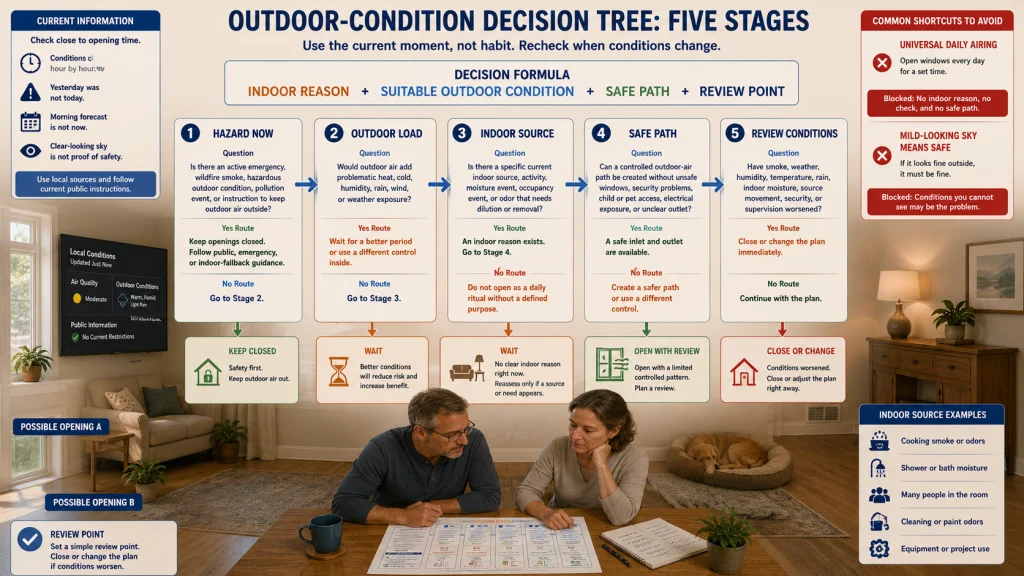
Check Current Air Quality, Smoke or Hazard Alerts, Temperature, Humidity, and Weather
The outdoor check should happen close to the time the windows will be used. Yesterday’s clear air, the morning forecast, or a cool-looking sky may not describe the conditions now.
- Is there an active emergency, smoke event, hazardous outdoor condition, or local instruction to keep outdoor air out? Keep openings closed and follow the appropriate public or emergency guidance.
- Would outdoor air add problematic heat, cold, humidity, rain, or wind exposure? Use a different control or wait for a more suitable period.
- Is there a clear indoor source that outdoor air can help dilute? Continue to the path and safety check.
- Can a safe inlet and outlet be created without leaving an unsafe opening? Use a controlled pattern and define a review point.
- Did conditions change after opening? Close or change the plan.
Check current AirNow information, local smoke or hazard alerts, weather conditions, outdoor humidity, rain, wind, and extreme temperatures. Local public information should take priority over a general airing habit.
This step may feel cautious when the room simply feels stale, but it prevents a small indoor problem from being replaced by a larger outdoor one. A mild-looking sky does not rule out smoke or pollution, and a cool evening can still carry high humidity.
Consider Pollen and Individual Medical Guidance Without Turning Ventilation Into Allergy Treatment
Pollen conditions can change the usefulness of outdoor-air ventilation for some people. The relevant question is not whether pollen is universally good or bad. It is whether the current outdoor condition fits the household and any medical guidance the person already follows.
Keep the decision general:
- Review current local pollen information when it matters to the household.
- Notice whether the proposed inlet faces a nearby source such as flowering vegetation, mowing, or disturbed outdoor material.
- Use individual medical guidance for allergy or respiratory concerns.
- Do not use a household ventilation test to diagnose the cause of symptoms.
- Close or change the plan if symptoms worsen while windows are open.
A screen may keep insects and larger debris out, but it should not be assumed to remove every outdoor particle. A product marketed around pollen may change the setup burden or the opening itself without making the outdoor air appropriate for a particular person.
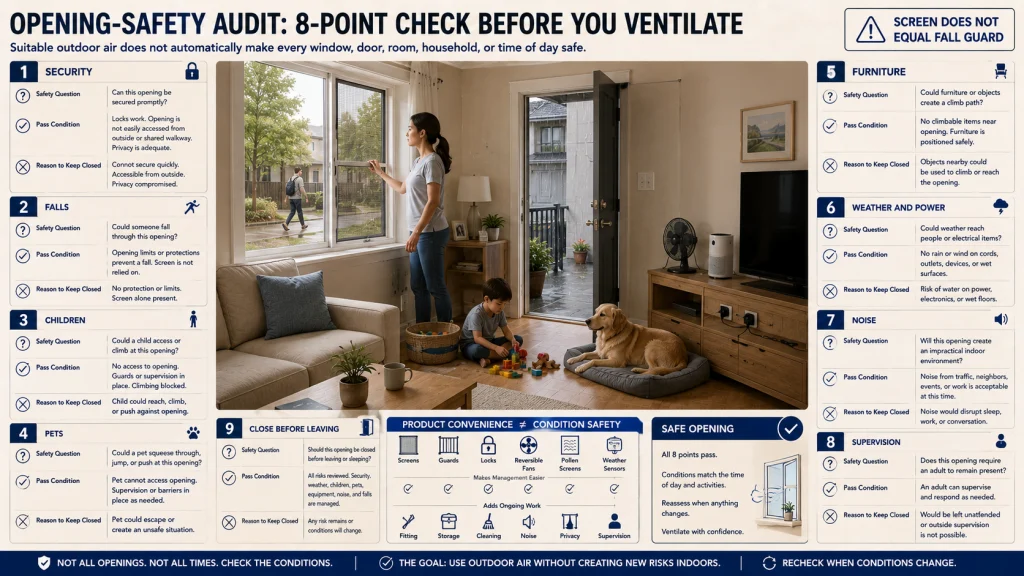
Check Security, Falls, Children, Pets, Noise, Rain, and Unattended Openings
A good outdoor condition does not make every opening safe. The window, room, household, and time of day still matter.
- Check window and door security before opening.
- Do not rely on an ordinary screen as a fall guard.
- Use child and pet protections appropriate to the opening and room.
- Keep furniture and climbable objects away from unsafe window access.
- Check whether rain, wind, or weather can reach electrical equipment, cords, or outlets.
- Consider outdoor noise, traffic, shared walkways, and nearby activity.
- Do not leave an opening unattended when the situation requires active supervision.
- Close the path before leaving home or going to sleep when security, weather, children, pets, or equipment make unattended use unsuitable.
Nora’s practical comparison is that screens, guards, locks, reversible fans, pollen screens, and weather sensors can make a particular setup easier to manage. They also add fitting, storage, cleaning, privacy, noise, and supervision questions. A product can make opening a window more convenient without making the outdoor air appropriate.
That distinction matters because the purchase is visible while the condition check is easy to skip. The household still needs to decide whether the outdoor input is suitable before using the opening.
Choose Brief or Extended Ventilation From Conditions, Not One Universal Number
There is no single answer to how often or how long to air out a house. A small room after a brief source event, a large connected space after guests, and an active moisture or odor source do not need the same decision.
Choose the review pattern from five variables:
- Source strength: How much indoor material or moisture is being generated, and whether it is still active.
- Room and path: The room size, layout, inlet, outlet, and whether air can cross the source area.
- Outdoor stability: Whether smoke, humidity, temperature, rain, or wind may change soon.
- Safety: Whether the opening can remain supervised and secure.
- Observable result: Whether moisture, odor, comfort, or the original event has changed enough to reassess.
A brief opening may be the reasonable starting point when weather is harsh or supervision is limited. A longer period may be workable when conditions remain suitable and the source requires more dilution. Neither should become a universal prescription.
Ask, “What will make us check again?” The answer might be the end of cooking, a dry bathroom mirror, a change in the local alert, incoming rain, a drop in temperature, or a rise in indoor humidity.
Create Cross-Flow or Use Source Exhaust Instead of Opening Every Window
Opening every window can make the path harder to understand. Air may take short routes near the easiest openings while the source remains in another room.
| Indoor condition | Outdoor condition | Better first pattern | Review question |
|---|---|---|---|
| Guests have left one main room | Mild and suitable | Separated inlet and outlet across the occupied area | Is air crossing the room rather than short-circuiting near one wall? |
| Cooking is active | Suitable or unsuitable | Use outdoor-vented kitchen exhaust when available and appropriate | Is the source being captured before it spreads? |
| Bathroom moisture is active | Outdoor humidity is high | Use outdoor-vented bathroom exhaust rather than adding humid air | Is indoor moisture decreasing? |
| One room contains a temporary odor source | Suitable and safe | Create a path through that room while limiting connection to other rooms | Is the source moving toward the outlet or into the home? |
| Outdoor smoke is present | Unsuitable | Keep windows closed and use an indoor fallback | Has the public information identified a better period? |
Local exhaust often provides the clearest route because it acts near the source. The guide to kitchen ventilation covers room-specific source control in more detail.
When outdoor air is suitable, use the fewest openings needed to create a clear inlet, source path, and outlet. More openings are not automatically better.
Close the Windows or Change the Plan When Conditions Worsen
Ventilation should be reversible. The household needs a reason to open and a reason to stop.
Close or change the plan when:
- Outdoor smoke, pollution, pollen, odor, or a hazard alert worsens.
- Rain, strong wind, or weather begins reaching the opening or equipment.
- Indoor humidity or condensation rises.
- The indoor temperature becomes unsafe or impractical.
- The indoor source begins moving into bedrooms or unrelated rooms.
- Noise, security, children, pets, or fall risk makes the opening unsuitable.
- The original source event has ended and the room no longer needs the same path.
Do not keep windows open simply because a timer has not finished. The review point exists so the plan can respond to the room, the weather, and the people in the home.
Emergency boundary: A sounding smoke or carbon monoxide alarm, visible fire or smoke, or a suspected gas leak requires leaving the area when safe and contacting emergency or utility services as appropriate. Severe breathing difficulty, chest pain, fainting, confusion, blue or gray lips, or other emergency signs require immediate appropriate help. Do not stay inside to test whether opening windows changes the condition.
Persistent or worsening symptoms require qualified medical guidance. Suspected asbestos, lead, radon, major mold, combustion backdrafting, hazardous chemicals, or building-system defects require appropriately qualified assessment rather than repeated window tests.
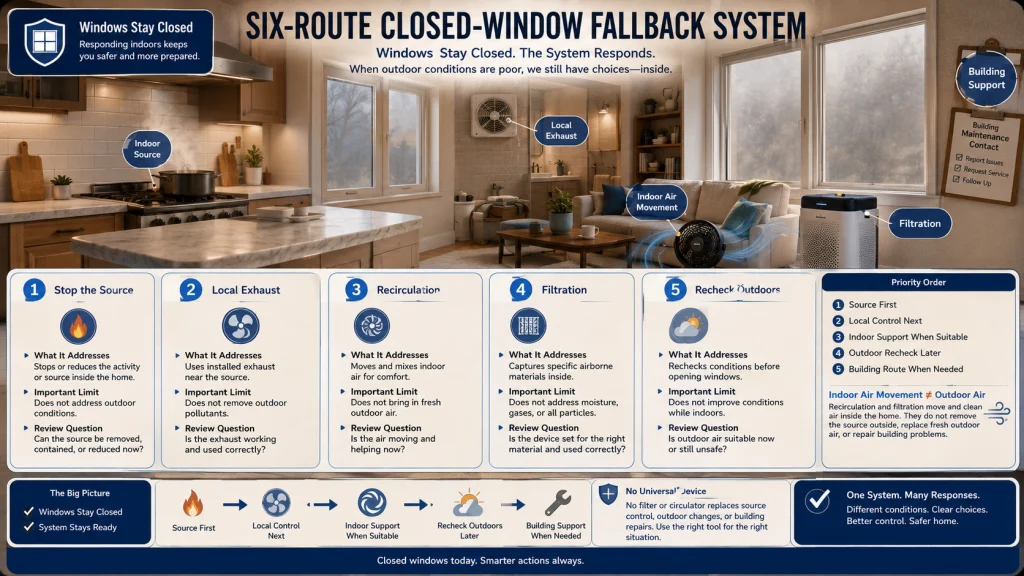
Use Local Exhaust, Recirculation, or Filtration When Outdoor Air Is Unsuitable
Keeping windows closed can feel frustrating when the room still needs attention. It does not mean the household has no options. It means the next step must address the indoor source without bringing the outdoor condition inside.
- Stop or reduce the source: End the activity, close the container, move the source when safe, or reduce unnecessary generation.
- Use local outdoor exhaust: Operate kitchen or bathroom exhaust according to the installed feature and its instructions.
- Use recirculation deliberately: Indoor-air movement may improve mixing or comfort, but it does not replace outdoor-air exchange.
- Use suitable filtration: Match filtration to the intended pollutant and follow the exact equipment guidance without assuming one device addresses every source.
- Wait for a better outdoor period: Recheck local air, smoke, weather, temperature, and humidity rather than following a fixed schedule.
- Escalate building problems: Report damaged exhaust, unsafe windows, shared-system issues, or building defects to the responsible owner, manager, contractor, or qualified professional.
Ceiling fans and portable circulators can move indoor air, but movement alone does not remove the source from the building. Filtration may help with selected airborne material, but it should not be presented as a universal substitute for source control or safe exhaust.
The healthy home environment guide helps connect these fallbacks with moisture, cleaning, maintenance, and building responsibilities.
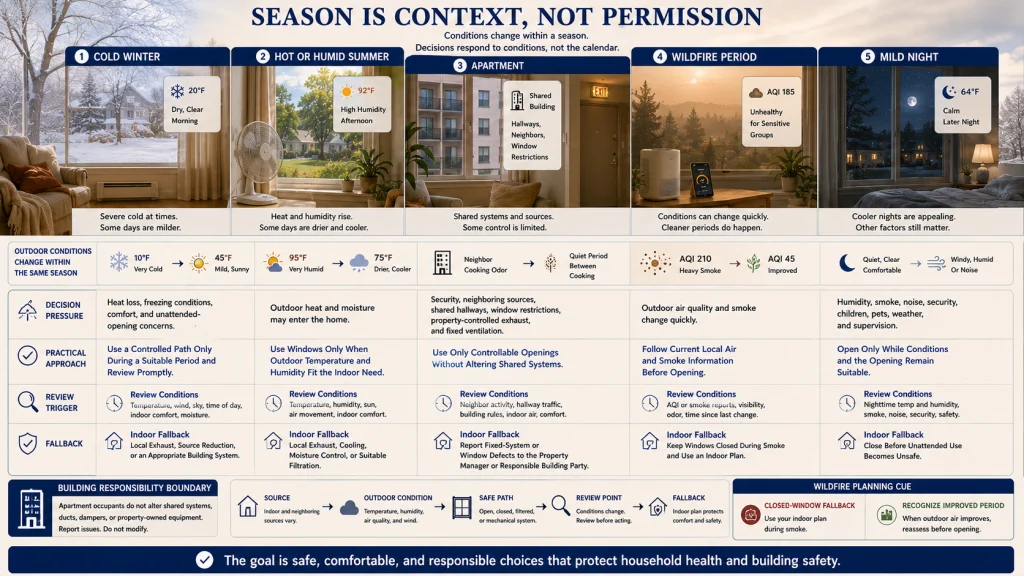
Plan for Winter, Summer, Apartments, and Wildfire-Prone Locations
Seasonal advice works best as a scenario, not a rule. The same season can contain mild, extreme, humid, smoky, windy, and stormy periods.
| Scenario | Decision pressure | Practical approach | Fallback |
|---|---|---|---|
| Cold winter period | Heat loss, freezing conditions, comfort, and unattended openings | Use a controlled path only during a suitable period and review promptly | Local exhaust, source reduction, or a building system |
| Hot or humid summer period | Outdoor heat and moisture may enter the home | Use windows only when outdoor temperature and humidity fit the indoor need | Local exhaust, cooling, moisture control, or filtration as appropriate |
| Apartment or shared building | Security, shared hallways, neighboring sources, window restrictions, and building-controlled systems | Use controllable openings without altering shared systems | Report fixed-system or window defects to the property manager |
| Wildfire-prone location | Conditions may shift quickly between unsuitable and improved periods | Follow current local air and smoke information before opening | Keep windows closed during smoke and use an indoor plan |
| Mild nighttime period | Cooler air may be appealing, but security, humidity, noise, and supervision remain relevant | Use only when the opening can remain safe and conditions are suitable | Close before unattended use becomes unsafe |
Apartment occupants may control ordinary window use while the property owner or manager controls fixed exhaust, shared ventilation, damaged windows, and building repairs. The guide to indoor air quality in apartments explains how to separate occupant actions from building responsibilities.
In wildfire-prone locations, the plan should include both a closed-window fallback and a method for recognizing improved outdoor periods. The answer cannot be reduced to a daily airing time.
Use the Source, Outdoor Condition, Safe Path, Review Point, and Fallback
The useful question is not “Are open windows good?” It is “Do these outdoor conditions help with this indoor event, through this safe path, right now?”
Begin with the source. Check current outdoor air, smoke or hazard alerts, temperature, humidity, weather, pollen conditions, and the safety of the opening. When those pieces agree, create a clear inlet and outlet around the room that needs attention.
Set a review point before walking away. Close or change the plan when weather shifts, indoor moisture rises, the source spreads, or security and supervision become uncertain. When outdoor air is unsuitable, use the fallback that matches the source or route the problem to the responsible person.
That approach removes the pressure to follow a universal routine. The household does not need the same answer every day. It needs a decision that can change when the air, weather, room, and people change.
FAQs
🪟 How often should I open windows to air out the house?
There is no universal frequency. Open windows when a specific indoor source or occupancy event creates a need and current outdoor air, weather, humidity, security, and opening safety make ventilation appropriate.
⏳ How long should windows stay open?
Use a review point instead of one fixed number. Reassess the source, room condition, outdoor air, weather, indoor humidity, comfort, and safety, then close or adjust the path when conditions change.
🔥 Should I open windows during wildfire smoke?
Keep outdoor smoke out and follow current local public guidance during a smoke event. Use an indoor fallback and recheck conditions for a more suitable period rather than following a normal airing routine.
💧 Can opening windows make indoor humidity worse?
Yes. Outdoor air can add moisture when outdoor humidity is high. If indoor dampness or condensation rises after opening, close the path and use source control, local exhaust, or another appropriate moisture strategy.
🌼 Should windows stay closed when pollen is high?
Use current local pollen information and any individual medical guidance that applies. Do not use window ventilation as allergy treatment, and change the plan if symptoms worsen.
🌙 Is nighttime the best time to open windows?
Nighttime may offer cooler air, but humidity, smoke, noise, security, children, pets, weather, and unattended openings still matter. Use the same condition and safety check rather than treating nighttime as automatically better.
🚩 When should windows remain closed?
Keep them closed during outdoor smoke, pollution, severe weather, unsuitable temperature or humidity, unsafe security conditions, or any situation involving an unsafe opening. Use local exhaust, filtration, source reduction, or building support as appropriate.