A warm-up prepares you for the activity that follows rather than collecting unrelated stretches. Start by checking the space and equipment, then raise effort gradually, move the joints the session will use through comfortable ranges, and rehearse the main movement in an easier form. The sequence may be brief for easy work and longer for harder or less familiar work. Stop when symptoms or movement limits suggest that preparation alone cannot make the session appropriate.
One Generic Routine Does Not Prepare Three Different Workouts
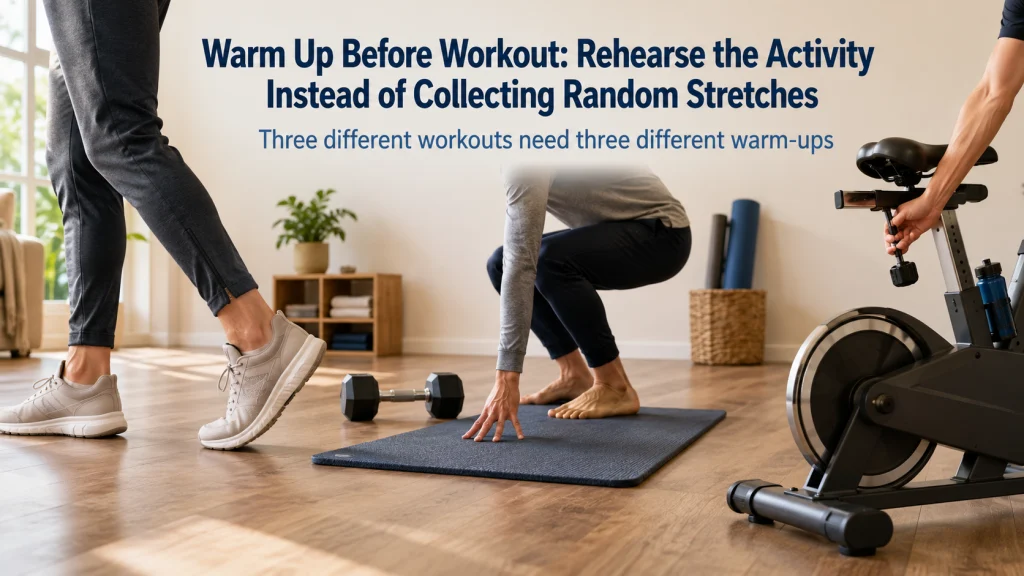
Picture three people getting ready at home. One plans to walk, one plans to do bodyweight strength work, and one plans to ride a stationary bike. All three follow the same toe-touch routine because a video labels it a complete beginner warm-up.
The routine may move part of the body, but it does not prepare each person for the same demands. The walker needs a gradual transition into repeated steps. The strength session needs easier versions of the positions and movement patterns that will carry resistance. The cyclist needs comfortable hip, knee, and ankle motion plus a low-resistance start on the machine.
A useful warm-up resembles the work that follows while remaining easier than the main session. That simple match matters more than collecting a fixed number of stretches.
For the broader setup process, use the beginner home-workout guide. The complete home exercise guide can help place preparation within the rest of a safe, practical routine.
Define the Four Jobs of a Warm-Up
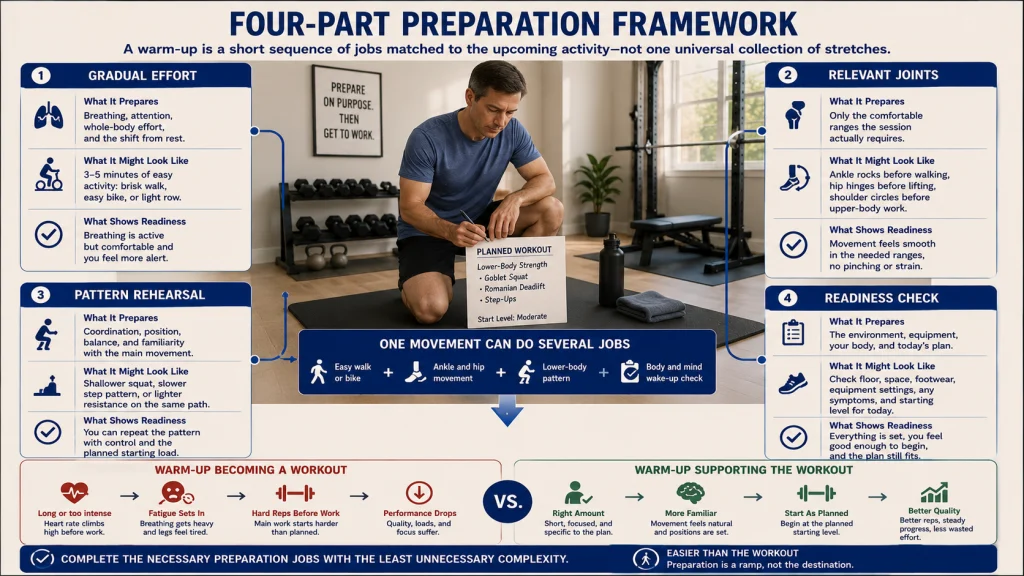
A warm-up is not one special exercise. It is a short preparation sequence with four separate jobs. Some movements can serve more than one job, but every choice needs a clear connection to the session you actually plan to do.
| Warm-Up Job | What It Prepares | What It Might Look Like |
|---|---|---|
| Gradual effort transition | Breathing, heart rate, attention, and whole-body effort | A slower walk, easy pedaling, or gentle repeated movement before increasing pace |
| Relevant joint movement | The comfortable ranges needed for the planned activity | Controlled ankle motion before walking or comfortable shoulder movement before upper-body work |
| Movement-pattern rehearsal | Coordination, position, balance, and familiarity with the main exercise | A shallower squat before deeper squats or an unloaded hinge before resistance |
| Readiness check | Space, equipment, symptoms, and whether the planned difficulty fits today | Testing the floor, machine settings, footwear, and the first easy repetitions |
Not every session needs four separate drills. A slow first phase of walking may raise effort, move the relevant joints, rehearse the gait pattern, and reveal whether the floor or body feels different today. The goal is to complete the jobs with as little unnecessary complexity as possible.
A demanding warm-up can reduce the quality of the session it was meant to support. For a beginner, it can be reassuring to know that preparation is not a test to pass. Its job is to build readiness, not prove fitness.
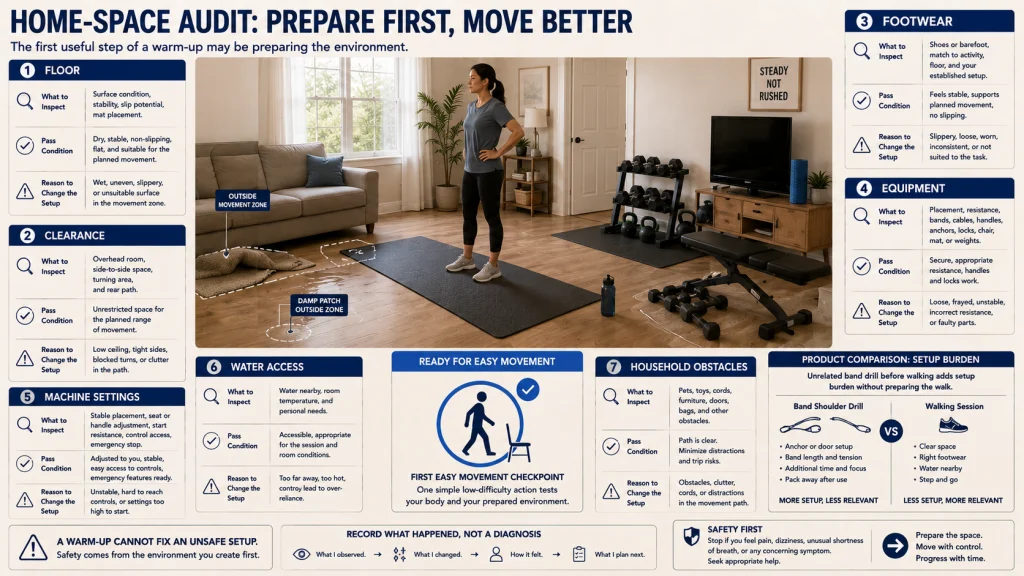
Start With the Environment, Floor, Footwear, and Equipment
At home, the first useful movement may be clearing the space. A good sequence cannot compensate for a sliding rug, a chair in the stepping path, a loose resistance attachment, or a machine placed too close to a wall.
Use this short home-space check before moving faster:
- Floor: Confirm that the surface is stable, dry, and suitable for the planned movement.
- Clearance: Check overhead space, side-to-side room, and the path behind you.
- Footwear: Match footwear or barefoot practice to the activity, floor, and your usual safe setup.
- Equipment: Inspect placement, adjustment, resistance, cables, bands, handles, and locking parts before loading them.
- Machine settings: Set seat position, resistance, and emergency features before beginning.
- Hydration access: Decide whether keeping water nearby fits the session length, room temperature, and your personal needs.
- Household interruptions: Move pets, toys, cords, and other avoidable obstacles out of the movement area.
Editorial observation: Products and videos often present one universal preparation sequence despite major differences in floor space, footwear, equipment, exercise type, and planned intensity. Resistance-band shoulder movements add no useful preparation to a walking session when the shoulders are not part of the planned work and the band only adds setup burden.
Once the environment is ready, the first easy movement becomes both preparation and a practical test of the setup.
Raise Effort Gradually
Moving directly from rest into the hardest planned pace can feel abrupt. A gradual transition gives you time to notice breathing, balance, coordination, equipment feel, and whether today’s starting level matches your current condition.
Begin with a lower-intensity version of the activity or another simple movement that uses much of the same body. Increase one demand at a time, such as pace, range, resistance, or complexity. You do not need to increase all of them together.
For example, a walking session might begin with shorter, easier steps before pace rises. A cycling session might begin with low resistance before cadence or resistance increases. A strength session might begin with the planned pattern using less range, support, or resistance.
The first easy minutes are not wasted time. They create room to settle into the movement before the main work asks for more. Keep this phase clearly easier than the workout itself. The guide to choosing beginner exercise intensity can help when you are unsure whether either phase is already too demanding.
Key decision: Increase effort only after the easier version feels coordinated and manageable. A warm-up is not complete merely because a timer ends.
Move Relevant Joints Through Comfortable Ranges
The useful range is the range the upcoming activity needs today, not the largest range you can force. You do not need to earn the workout by reaching farther than feels comfortable. Keep the movement controlled and repeatable, without guarding, bouncing, or pushing through pain.
Choose joint movements that match the planned session. Walking may benefit from gentle ankle motion, easy knee bends, and comfortable hip movement. An upper-body strength session may need controlled shoulder, elbow, and wrist movement. Cycling preparation may focus on the hip, knee, and ankle positions used on the machine.
Relevance keeps the sequence short. Moving every joint in every direction before every workout can become a ritual that delays the session without improving readiness for the actual task.
Note: A warm-up can help you explore today’s comfortable movement, but it is not a test of maximum range. Persistent restriction, repeated pain, or a new loss of movement belongs outside a generic routine.
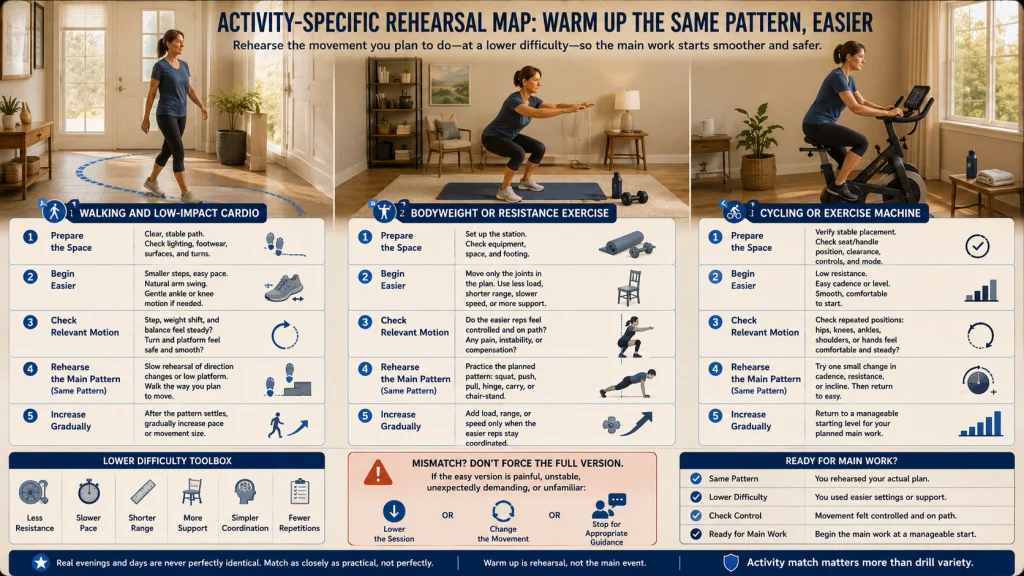
Rehearse the Exact Movement Pattern at Lower Difficulty
Rehearsal is the part that makes a warm-up specific. Instead of wondering whether you chose the “right” generic drill, use an easier version of the movement you are actually about to perform. Familiarity often feels more useful than variety at this stage.
You can lower difficulty by reducing resistance, slowing the pace, shortening the range, using support, simplifying coordination, or performing fewer repetitions. The best adjustment depends on the activity.
- Before repeated chair stands, rehearse a few comfortable stands with a stable setup and deliberate pace.
- Before wall or floor pushing movements, use an easier angle or lower resistance that preserves the same basic pattern.
- Before faster stepping, rehearse the foot pattern slowly and confirm that the floor space remains clear.
- Before machine work, practice the exact path with low resistance and verify the settings.
Rehearsal also reveals mismatches. If the easy version feels unstable, painful, unfamiliar, or more demanding than expected, the answer may be to lower the planned session, change the movement, or stop and seek appropriate guidance rather than forcing the full version.
Walking and Low-Impact Cardio Example
For walking or simple low-impact cardio, the easiest starting point is often the activity itself. Beginning gently keeps the preparation familiar, which can make the transition feel less like another routine to remember.
- Check the path: Confirm stable flooring, enough turning room, and no cords, rugs, or furniture in the stepping area.
- Begin smaller: Use easy steps with a comfortable pace and natural arm movement.
- Explore relevant motion: Add gentle ankle motion, easy knee bends, or a controlled side step only if those patterns appear in the session.
- Rehearse the plan: Practice any planned direction change, step pattern, or low platform at reduced speed.
- Increase gradually: Raise pace or movement size after the pattern feels settled.
A person preparing for an easy indoor walk may need only a brief gradual start. A session with faster intervals, direction changes, or a higher step may need more rehearsal because the main work asks for more pace, coordination, or range.
Bodyweight or Resistance Exercise Example
For bodyweight or resistance work, let the first repetitions introduce the positions and equipment you will use. A generic cardio burst may raise breathing, but it cannot tell you whether today’s squat, push, pull, or hinge setup feels coordinated and manageable.
- Prepare the station: Place the chair, mat, weights, or resistance equipment where the exercise will occur.
- Move the relevant joints: Use comfortable motion at the hips, knees, ankles, shoulders, elbows, or wrists according to the planned exercises.
- Rehearse without full load: Perform the same movement with less resistance, shorter range, slower speed, or more support.
- Check position and path: Notice whether you can maintain the intended setup without rushing or compensating.
- Add demand gradually: Move toward the planned version only when the easier repetitions remain controlled.
This article does not teach exercise technique or corrective movement. Use the home strength training guide for broader exercise selection and progression rather than trying to solve technique problems inside the warm-up.
Cycling or Exercise-Machine Example
A machine warm-up begins before the first hard effort. Taking a moment with the setup can remove the uncertainty that makes a new machine feel awkward. An incorrect seat, foot position, resistance level, or clearance problem remains present even when the first pace is slow.
- Set the machine: Confirm stable placement, appropriate seat or handle position, safe clearance, and the correct starting mode.
- Begin with low resistance: Use an easy pace that lets you notice the movement path without strain.
- Check repeated motion: Confirm that the hips, knees, ankles, shoulders, or hands feel comfortable in the positions the machine requires.
- Rehearse planned changes: Practice a small increase in cadence, resistance, incline, or another relevant setting before the main work.
- Return to the planned start: Begin the workout at a level that still leaves room for gradual progression.
The machine display does not decide whether preparation is complete. Readiness depends on the movement, your response, and whether the settings fit the session you planned.
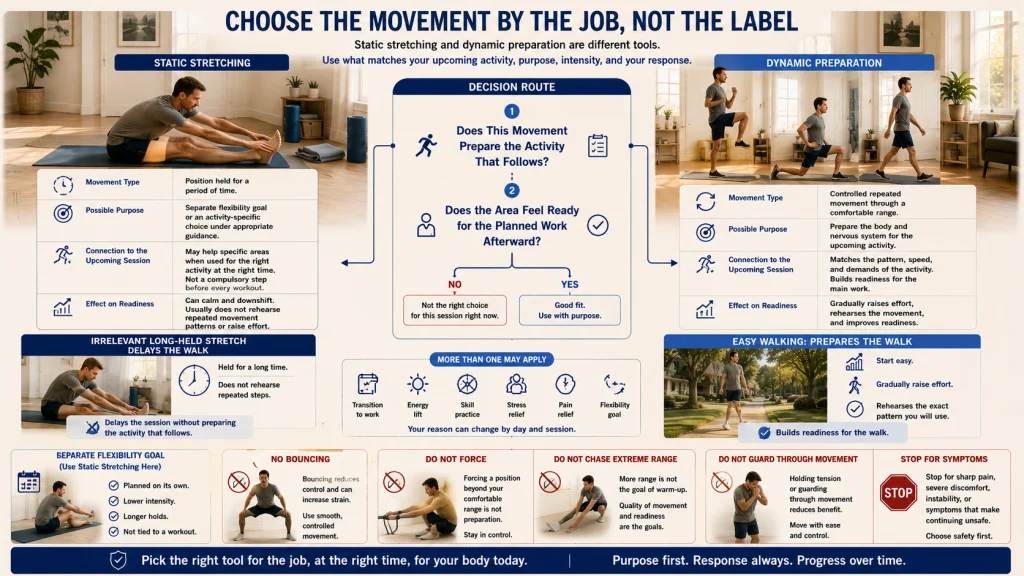
Separate Static Stretching From Dynamic Preparation
Static stretching holds a position for a period of time. Dynamic preparation uses controlled movement through a comfortable range. Neither label makes a movement automatically useful or unsuitable. The decision depends on the activity, purpose, intensity, and how the movement affects readiness.
Before many ordinary workouts, dynamic movement and lower-difficulty rehearsal fit naturally because they resemble the actions that follow. A long held stretch may be less relevant when it does not connect to the session or leaves the area feeling less ready for forceful work.
Static stretching may have a place when it serves a separate flexibility goal, follows appropriate guidance, or fits the person’s activity and response. It does not need to appear in every pre-workout sequence simply because it is called stretching.
Safety warning: Do not bounce, force a painful position, or treat extreme range as a requirement. Stop the movement if it produces sharp pain, severe discomfort, instability, or symptoms that make continuing unsafe.
Adjust for a Cold Room, Early Morning, Harder Work, or Long Inactivity
The same person may need a different preparation on different days. A warm room, familiar easy session, and active afternoon may allow a short transition. A cold space, early start, harder session, or long period of sitting may make a slower build feel more appropriate.
- Cold room: Begin with more clothing if appropriate, simple whole-body movement, and a slower increase in pace. Check that the floor and equipment are not affected by moisture or temperature.
- Early morning: Allow more time to become alert, organize the space, and explore comfortable ranges before complex or demanding movement.
- Higher planned intensity: Use more stages between rest and the main work, including lower-intensity rehearsal of the exact pattern.
- Long inactivity during the day: Start with easy repeated movement before asking for larger range, faster pace, or resistance.
- Unfamiliar activity: Spend more preparation time learning the path, controls, and setup rather than trying to create fatigue.
Longer does not automatically mean better. Add preparation because the activity or conditions require another step, not because every workout must reach a fixed number of minutes.
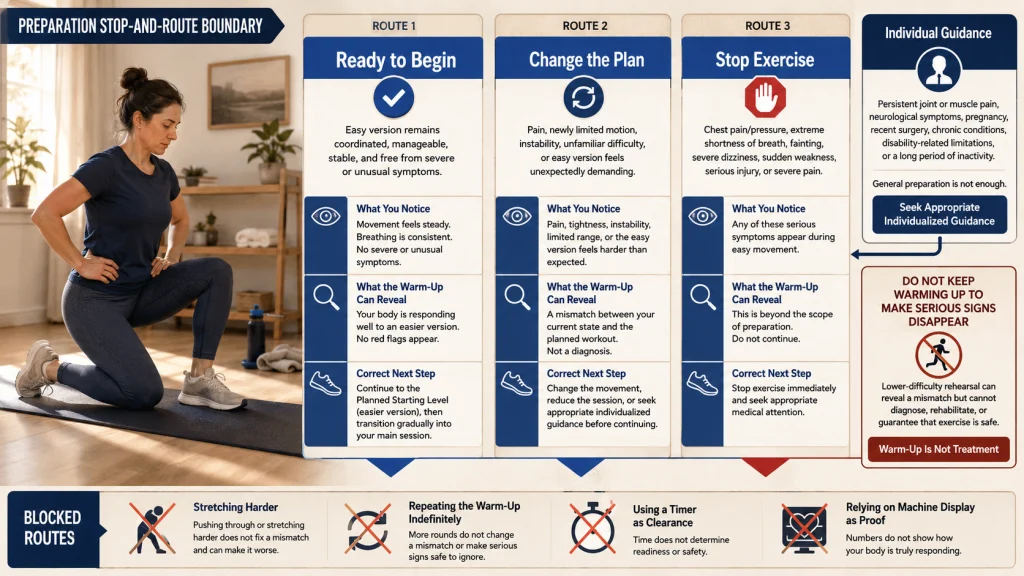
Know When a Warm-Up Is Not Enough
A warm-up can reveal how the body and environment respond today, but it cannot make every symptom, injury, or limitation safe to exercise through.
Safety warning: Stop exercise and seek appropriate help for chest pain or pressure, extreme shortness of breath, fainting, severe dizziness, sudden weakness, serious injury, or severe pain. Do not keep warming up in an attempt to make these signs disappear.
Persistent joint or muscle pain, neurological symptoms, pregnancy, recent surgery, chronic conditions, disability-related limitations, or a long period of inactivity may require individualized guidance from a physician, physical therapist, or qualified exercise professional.
If movement is painful, newly limited, unstable, or difficult even in the easier version, do not force the full version. Generic preparation does not replace evaluation, rehabilitation, or activity-specific instruction.
Choose the Activity, Then Rehearse It at Lower Difficulty
Begin by naming the main activity. Check the floor, clearance, footwear, and equipment, then choose a lower-intensity version that raises effort gradually without creating fatigue.
Move only the joints and ranges the session needs, rehearse the exact movement pattern at an easier level, and use the first repetitions as a readiness check. Add time when the room is cold, the session is harder, the activity is unfamiliar, or you have been inactive for a long period.
After the workout, preparation has a different job from the transition out of exercise. Use the guide to cooling down after a workout when you need to plan that separate phase.
FAQs
🚶 Can walking itself be the warm-up?
Yes. For a walking session, beginning with easier, shorter steps can raise effort gradually and rehearse the activity at the same time. Add specific movement only when the session includes demands such as faster intervals, direction changes, or a step platform.
⏱️ How long should a beginner warm-up be?
There is no single duration for every workout. Easy, familiar activity may need only a brief gradual start, while harder work, a cold room, unfamiliar movement, or long inactivity may require more stages. Stop adding preparation when the four jobs are complete and you remain ready for the main session.
🧘 Do I need to stretch before every workout?
No fixed stretching list is required for every activity. Choose controlled movement and lower-difficulty rehearsal that match the session. Do not force painful or extreme range simply to complete a stretching routine.
🏋️ Should a warm-up make me tired?
A useful warm-up raises effort gradually without using up the capacity needed for the workout. If preparation creates heavy fatigue or difficult repetitions, reduce the pace, resistance, range, complexity, or number of movements.
🔁 Can I use the same warm-up every day?
You can reuse a sequence when the upcoming activity and conditions are similar. Change it when the exercise type, equipment, intensity, room conditions, or movement demands change. Let the preparation follow the session rather than becoming a separate fixed ritual.
🚲 What should I do before using an exercise machine?
Check placement, clearance, adjustments, controls, and the starting resistance before moving faster. Begin with the exact machine pattern at low difficulty, then rehearse any planned changes in pace, resistance, or incline.
🌡️ Do I need a longer warm-up in a cold room?
You may prefer a slower, more gradual transition when the space is cold. Use simple whole-body movement, appropriate clothing, and activity-specific rehearsal, but do not force a fixed longer duration when readiness is already clear.
🚩 When should I stop during the warm-up?
Stop for chest pain or pressure, extreme shortness of breath, fainting, severe dizziness, sudden weakness, serious injury, or severe pain, and seek appropriate help. Painful, unstable, or newly limited movement also requires a change of plan rather than progression into the main workout.