A useful caffeine cutoff time is the last planned caffeine exposure before your intended sleep period, not one universal hour on the clock. Build a complete inventory, compare caffeine per serving with the number of servings actually consumed, and work backward from bedtime using a conservative test window. Keep morning intake and other major sleep variables stable while you test the change for seven to fourteen days. The result can guide your routine, but it cannot calculate your metabolism or replace professional advice for medication, pregnancy, heart symptoms, or severe sleep problems.
The Cutoff Is Not Only About the Final Cup
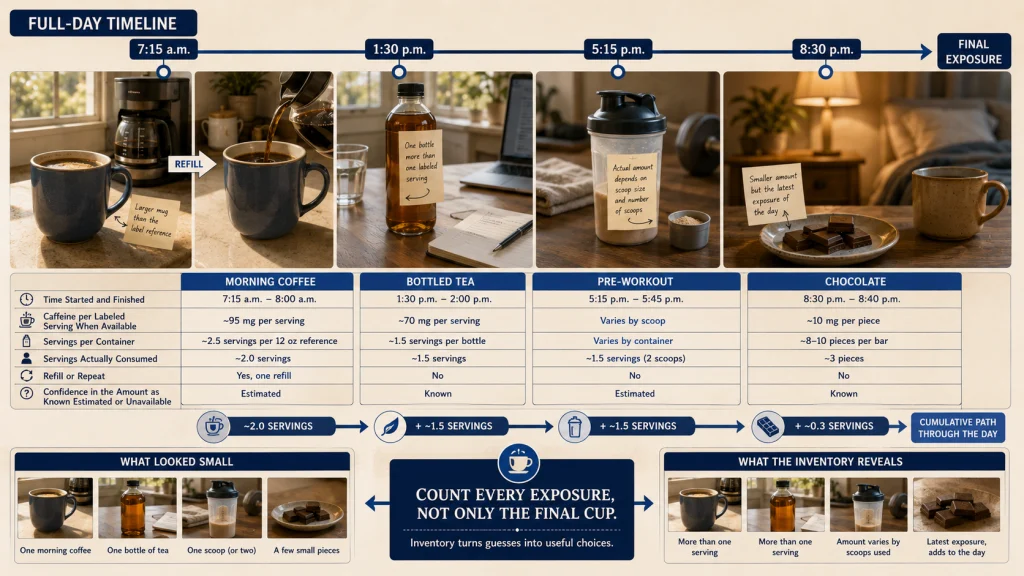
A single day’s receipt can look ordinary: coffee with breakfast, tea in the afternoon, a pre-workout drink before exercise, and chocolate after dinner. Circle the final source and you may focus on the chocolate. Circle the total number of sources and a different pattern appears.
Small amounts can arrive from several categories, and the label may describe one serving while the bottle, scoop, mug, or packet contains more than one. The last coffee matters, but so do the earlier sources and the amount that accumulated before it.
Key decision: The cutoff is not only about the final cup. It is the last planned caffeine exposure within a full-day inventory.
This changes the question from “Is 2 p.m. too late?” to “What did I consume, how much did I actually use, when do I intend to sleep, and which source is most likely to cross the test boundary?”
Use the complete sleep improvement guide for the wider sleep picture. The healthy sleep habits framework places caffeine alongside schedule, light, activity, food timing, and the sleep environment.
Define the Cutoff as the Last Planned Exposure Before Sleep
A cutoff is a planning boundary. It tells you when the last intentionally caffeinated item will end before the bedtime you are testing. It is not a claim that caffeine disappears at that moment or affects every person for the same number of hours.
Write the boundary in a form that can be checked:
- Intended bedtime: the time you plan to attempt sleep, not the time you usually notice you are still awake.
- Test window: the number of hours you will leave between the last caffeine source and bedtime.
- Cutoff clock time: bedtime minus the test window.
- Final allowed source: the exact drink, food, powder, or labeled medicine that must end before the cutoff.
- Exceptions: situations that will be recorded rather than hidden, such as an early workout or social coffee.
If bedtime changes, the clock cutoff changes with it. A person who intends to sleep at 9:30 p.m. cannot automatically use the same clock rule as someone who intends to sleep after midnight.
Planning note: Use one intended bedtime for the main test whenever practical. If bedtime varies widely, calculate the boundary from each night’s intended sleep time rather than relying on one fixed afternoon hour.
Use Research Ranges Without Turning Averages Into Guarantees
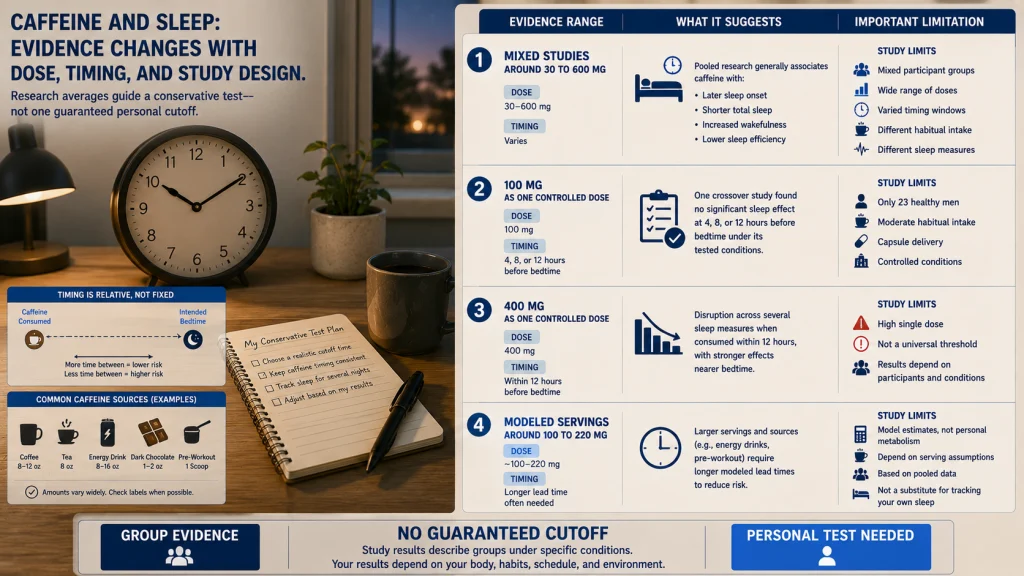
Controlled studies and pooled analyses support the basic concern: caffeine can delay sleep onset, reduce total sleep time or sleep efficiency, increase wakefulness after sleep begins, and alter sleep architecture. The size of the effect varies by dose, timing, individual sensitivity, habitual use, and study conditions.
A 2023 systematic review and meta-analysis pooled 24 studies. Across those studies, caffeine was associated with an average reduction of about 45 minutes in total sleep time, an increase of about 9 minutes in sleep-onset latency, about 12 more minutes awake after sleep began, and lower sleep efficiency. Those are group averages across mixed protocols, not predictions for one person.
A randomized crossover timing study tested single 100 mg and 400 mg doses at 4, 8, and 12 hours before bedtime in 23 healthy men with moderate habitual intake. The 100 mg conditions did not show significant sleep effects in that study, while 400 mg affected several sleep measures when taken within 12 hours, with stronger disruption closer to bedtime. The sample, capsule dosing, participant group, and controlled conditions limit how directly those findings apply to everyday drinks and other adults.
| Evidence range | What the research suggests | Important limitation |
|---|---|---|
| Mixed studies using roughly 30 to 600 mg | Pooled results generally show later sleep onset, shorter sleep, more wakefulness, or lower efficiency after caffeine. | Studies differ in participants, dose, timing, habitual intake, and sleep measurement. |
| Around 100 mg as one controlled dose | One recent crossover trial found no significant effect at 4, 8, or 12 hours before bedtime. | Only 23 healthy men were studied, and caffeine was delivered as a capsule rather than a consumer drink. |
| Around 400 mg as one controlled dose | The same trial found sleep disruption within a 12-hour window, with stronger effects closer to bedtime. | This is a high single dose and should not be treated as a universal threshold. |
| Modeled servings around 100 to 220 mg | The 2023 analysis estimated longer lead times for larger servings and sources such as pre-workout. | The estimates depend on serving assumptions and pooled data, so they are starting points for a test, not personal cutoff calculations. |
Evidence limit: Research supports working backward from bedtime and accounting for dose, but it does not provide one clock time that guarantees unaffected sleep for every adult.
Build a Complete Caffeine-Source Inventory
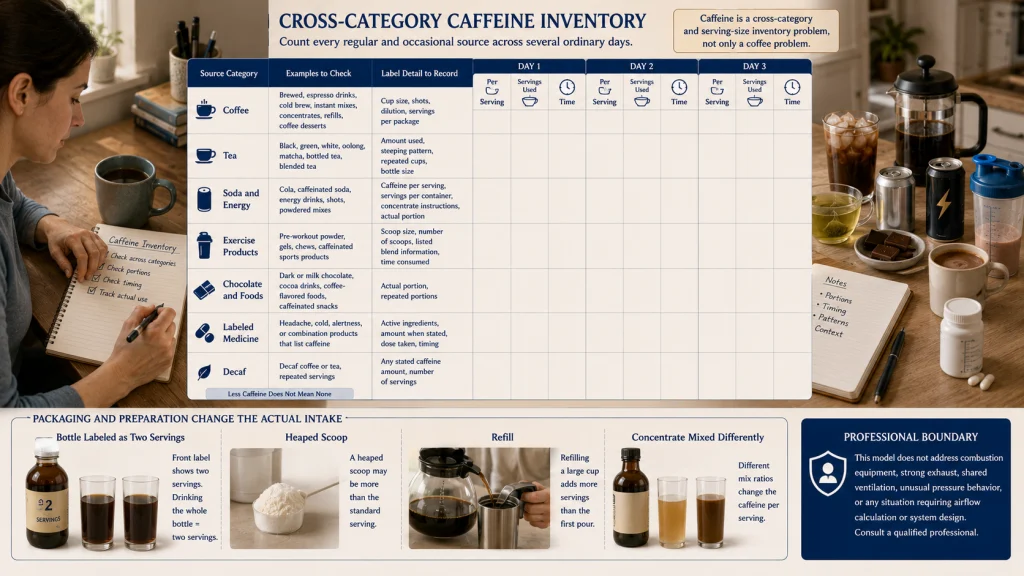
Do not begin by removing coffee alone. List every regular and occasional source for at least three ordinary days, including days with exercise, errands, or social routines.
| Category | Examples to check | Label detail to record |
|---|---|---|
| Coffee | Brewed coffee, espresso drinks, cold brew, instant mixes, concentrates, and coffee desserts | Container size, concentrate dilution, shots, refills, and servings per package |
| Tea | Black, green, white, oolong, matcha, bottled tea, and tea blends | Tea type, amount used, steeping pattern, bottle size, and repeated cups |
| Soda and energy products | Cola, caffeinated soda, energy drinks, energy shots, and powdered mixes | Caffeine per serving, servings per container, concentrate instructions, and actual portion |
| Exercise products | Pre-workout powders, gels, chews, and caffeinated sports products | Scoop size, scoops used, proprietary blend details when listed, and time consumed |
| Chocolate and foods | Dark chocolate, milk chocolate, cocoa drinks, coffee-flavored foods, and caffeinated snacks | Portion size and whether more than one portion was eaten |
| Labeled medicines | Selected headache, cold, alertness, or combination products that list caffeine | Active ingredients, caffeine amount when stated, dose taken, and timing |
| Decaffeinated drinks | Decaf coffee or tea used repeatedly through the day | Any stated caffeine amount and number of servings |
Decaf should not be recorded as caffeine-free. It generally contains less caffeine than the standard version, but repeated servings may still belong in the inventory.
Editorial observation: Caffeine is a cross-category labeling problem. Compare caffeine per serving with the number of servings actually consumed. A bottle labeled for two servings, a heaped scoop, a coffee refill, or a concentrate mixed stronger than directed can make the real amount different from the number first noticed on the package.
Record the Actual Serving and Every Repeat
The label number is useful only when it matches what went into the cup, bottle, shaker, or plate. Record actual portions rather than writing only the product category.
For each source, capture:
- Time the source was started and finished.
- Caffeine per labeled serving when available.
- Number of servings in the container.
- Number of servings actually consumed.
- Refills, second scoops, extra shots, or repeated pieces.
- Whether the amount is known, estimated from the label, or unavailable.
| Example day | Source | What looked small | What the inventory reveals |
|---|---|---|---|
| 7:15 a.m. | Morning coffee | One mug | The mug is larger than the labeled reference serving and receives a refill. |
| 1:30 p.m. | Bottled tea | One bottle | The bottle contains more than one labeled serving. |
| 5:15 p.m. | Pre-workout mix | One shaker | The scoop size and number of scoops determine the actual amount. |
| 8:30 p.m. | Chocolate | A few pieces | The portion is small, but it is the final exposure closest to bedtime. |
Multiple-source example: No single item must be unusually large for the day to contain several caffeine exposures. The morning amount, afternoon bottle, exercise product, and evening food all belong in the same timeline.
Work Backward From Intended Bedtime
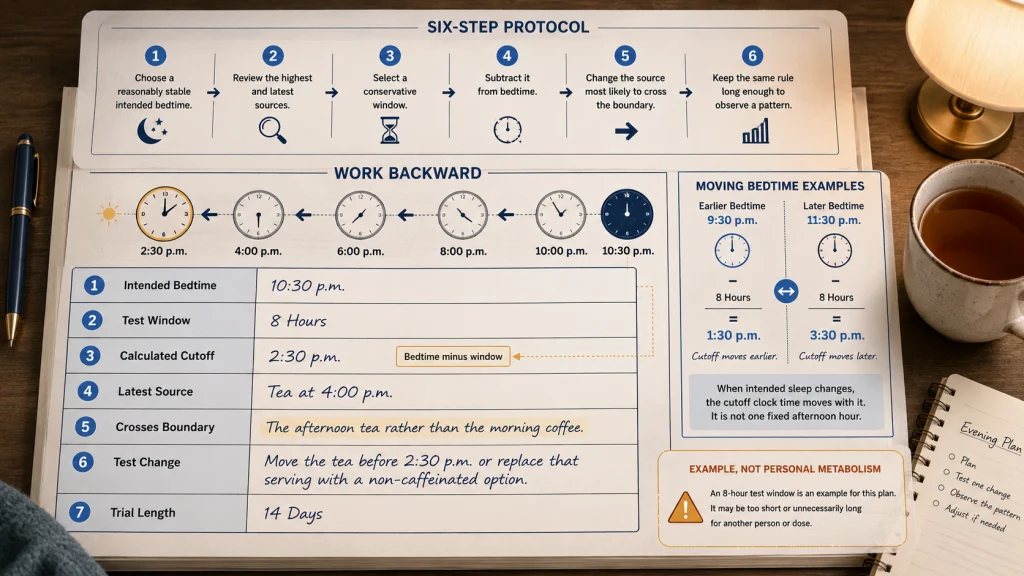
Choose a conservative test window instead of declaring a permanent rule. The research supports giving larger doses more distance from bedtime, but it does not calculate your personal metabolism.
A practical starting protocol is:
- Choose the intended bedtime you can keep reasonably stable.
- Review the highest and latest sources in the inventory.
- Select a conservative window that gives the final source substantial distance from bedtime.
- Subtract that window from bedtime to create the test cutoff.
- Move or remove the source most likely to break the boundary.
- Keep the same cutoff for seven to fourteen days before interpreting the result.
| Worksheet field | Example entry |
|---|---|
| Intended bedtime | 10:30 p.m. |
| Conservative test window | 8 hours |
| Calculated test cutoff | 2:30 p.m. |
| Latest usual source | Tea at 4:00 p.m. |
| Source most likely to cross the cutoff | The afternoon tea, not the morning coffee |
| Test change | Move that tea before 2:30 p.m. or replace that serving with a non-caffeinated option. |
| Trial length | 14 days |
Why this is a test: An 8-hour example is not a promise and may be too short or unnecessarily long for a particular person and dose. The log determines whether the chosen boundary produces a useful change under your normal conditions.
Choose Whether to Change Timing, Dose, or Both
A cutoff experiment becomes difficult to interpret when several large changes happen on the first day. Choose the variable that best matches the inventory.
| Pattern | First test | What stays unchanged |
|---|---|---|
| Moderate total amount, but one source is late | Move that source earlier. | Keep the morning routine and serving size stable. |
| Several large or repeated servings | Reduce one repeated serving or portion while keeping timing visible. | Do not also rebuild the entire bedtime routine. |
| Late source is also the largest dose | Move it earlier and consider a smaller amount as a second-stage test. | Record which change happened on which date. |
| Amount is unknown | Use the label or official product information to clarify the serving before interpreting the test. | Do not guess a precise dose from taste, cup color, or how alert you feel. |
Timing changes answer, “Does more distance help?” Dose changes answer, “Does a smaller amount help?” Changing both can be practical, but it makes it harder to know which part mattered.
Keep Morning Intake and Other Sleep Variables Stable
A useful test does not require a perfect life. It requires enough consistency that one caffeine change can be compared across several nights.
During the test, try to keep these factors reasonably steady:
- Morning caffeine source, amount, and timing.
- Intended bedtime and wake time.
- Late alcohol use and unusually heavy meals.
- Evening exercise timing.
- Naps and unusually long daytime sleep.
- Major changes in phone use, bedroom light, or bedtime routine.
Record exceptions rather than discarding the night. A late meal, difficult workday, illness, noisy room, or social event may explain why one night does not match the rest of the trial.
Practical tip: Keep the morning source stable first because removing it at the same time as the afternoon source can change daytime function and make the cutoff test harder to interpret.
Change Gradually When Abrupt Reduction Creates Problems
A sudden large reduction can create headache, fatigue, irritability, or difficulty functioning for some people. This article does not provide withdrawal treatment or a personalized reduction schedule.
Keep the experiment manageable by changing one source or serving at a time. You might move the latest drink earlier before reducing the morning amount, or shorten one repeated serving while keeping the rest of the routine stable. Record every step so the sleep log has a clear timeline.
If symptoms are severe, persistent, medically concerning, or make normal function unsafe, stop relying on a self-directed experiment and seek appropriate professional advice. Do not use extra caffeine late in the day to compensate for a difficult reduction and then interpret that night as a successful cutoff test.
Adapt the Test for Workouts, Shifts, Irregular Bedtimes, and Social Coffee
Some routines do not fit a simple afternoon boundary. The same backward method still works, but the intended sleep period and the role of the source must be clear.
- Early workouts: Record pre-workout, coffee, gels, and repeated servings separately. Morning use may still create a high total dose even when it is far from bedtime.
- Evening workouts: Separate the exercise schedule from the caffeinated product. The guide to evening exercise and sleep helps evaluate exercise timing while this article handles the caffeine source.
- Night shifts: Work backward from the intended daytime sleep period, not from midnight. Shift timing, light exposure, safety, and alertness needs require a wider plan than one cutoff rule.
- Irregular bedtimes: Calculate the cutoff from each intended bedtime, then look for the earliest recurring boundary that is practical.
- Social coffee: Decide before the event whether timing, portion, or a non-caffeinated alternative will preserve the test.
A context is not a failed experiment. Record why the source was used and whether it was planned. Repeated exceptions can reveal that the chosen cutoff conflicts with work, exercise, or social routines and needs redesign.
Use a Seven-to-Fourteen-Day Log
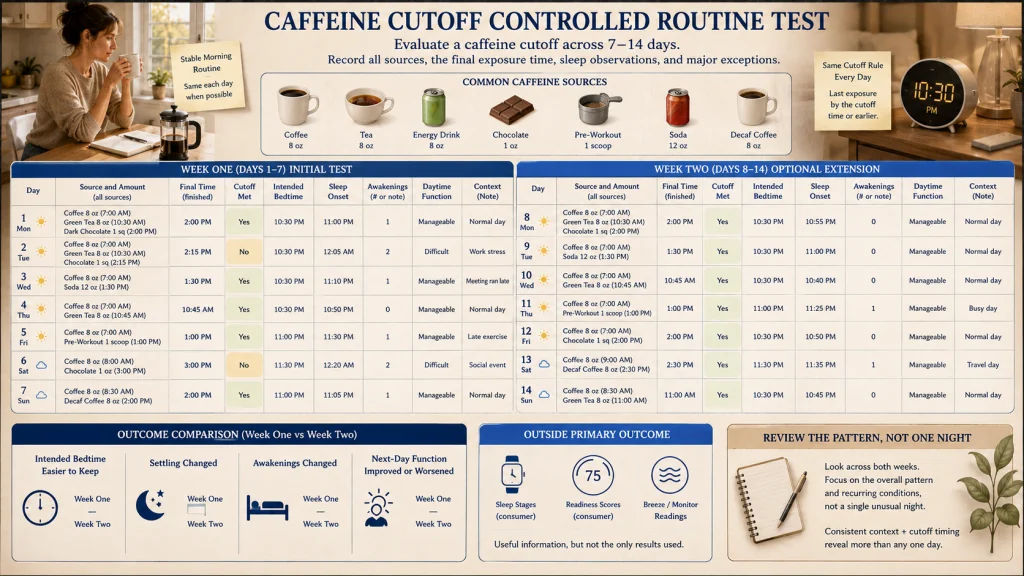
Seven days may reveal an obvious response. Fourteen days gives more room for workdays, weekends, exercise, and social variation. Use the longer test when the first week contains several unusual nights.
| Day | Caffeine source and amount | Time finished | Cutoff met? | Intended bedtime | Estimated sleep onset | Awakenings | Daytime function |
|---|---|---|---|---|---|---|---|
| 1 | Record all sources | Record final time | Yes or no | Record time | Record estimate | Number or brief note | Manageable, difficult, or unusually sleepy |
| 2 | Record all sources | Record final time | Yes or no | Record time | Record estimate | Number or brief note | Manageable, difficult, or unusually sleepy |
| 3 to 7 | Continue the same detail | Record final time | Yes or no | Keep stable when possible | Record estimate | Number or brief note | Record the practical effect |
| 8 to 14 | Repeat when the first week is mixed | Record final time | Yes or no | Keep stable when possible | Record estimate | Number or brief note | Compare workdays and weekends |
Do not use a consumer sleep stage or readiness score as the only outcome. The useful outcomes are whether the intended bedtime became easier to keep, settling changed, awakenings changed, and next-day function improved or worsened.
Mark nights with illness, unusual stress, alcohol, late exercise, travel, or a major schedule change. Those notes prevent one disrupted night from being blamed automatically on the cutoff.
Interpret a Strong, Partial, or Absent Response
Review patterns across several nights rather than judging the first evening.
| Response | What the log shows | Reasonable next step |
|---|---|---|
| Strong response | Earlier or easier sleep, fewer awakenings, and better daytime function repeatedly follow the cutoff. | Keep the boundary and identify the source most likely to break it. |
| Partial response | One outcome improves, but bedtime, awakenings, or daytime function remains inconsistent. | Test one additional change, such as a smaller late dose or a longer window. |
| No clear response | Sleep and daytime function do not change across a reasonably consistent test. | Check inventory accuracy, serving size, trial consistency, and other sleep factors before making the rule stricter. |
| Worse daytime function | The cutoff is met, but fatigue or reduced function makes the plan difficult or unsafe. | Pause major changes and seek appropriate guidance rather than forcing the experiment. |
A strong response suggests that the tested timing or dose mattered under those conditions. It does not reveal an exact metabolism rate. A partial or absent response does not prove caffeine is irrelevant, because the dose, timing, inventory, and other sleep variables may still be mixed.
Keep Medication, Pregnancy, Heart Symptoms, and Severe Sleep Problems Outside a Self-Test
This article is for general timing and inventory. It does not provide pregnancy guidance, medication interaction advice, cardiac advice, treatment for withdrawal, or a personalized caffeine calculation.
Professional boundary: Discuss caffeine with a qualified professional when you are pregnant, use a medicine that contains caffeine or may interact with it, have significant heart symptoms, or have a medical condition affected by stimulant use. Do not change a prescribed or labeled medicine solely to meet a sleep experiment.
Sleep safety: Persistent or severe sleep difficulty, breathing-related symptoms during sleep, or dangerous daytime sleepiness requires appropriate professional evaluation. Do not drive or perform hazardous work when sleepiness makes the activity unsafe.
Seek urgent help for severe chest pain, fainting, marked breathing difficulty, severe confusion, or another immediate medical emergency. A caffeine log is not the right tool during an urgent problem.
Write the Test Cutoff and the Source Most Likely to Break It
Finish with one sentence: “For the next fourteen days, my final planned caffeine exposure will end by [time], based on an intended bedtime of [time].”
Then name the source most likely to cross that boundary. It may be afternoon tea, a second coffee, pre-workout, an energy product, chocolate, or a labeled medicine. Record the actual serving rather than the category alone.
The purpose is not to discover one perfect hour for every future day. It is to create a complete inventory, test a conservative bedtime-backward boundary, and use the result to decide whether timing, dose, or another sleep factor deserves the next change.
FAQs
☕ What is a reasonable caffeine cutoff time?
There is no universal clock time. Choose an intended bedtime, work backward using a conservative test window, account for dose and every source, and evaluate the result for seven to fourteen days.
🕑 Is a 2 p.m. coffee cutoff right for everyone?
No. The same clock time creates different windows for different bedtimes, doses, and routines. Treat 2 p.m. as a possible test boundary only when it matches your intended bedtime and inventory.
📏 Does the amount matter as much as the time?
Yes. Research suggests that larger doses can affect sleep across a longer window, but individual response and study conditions vary. Record caffeine per serving and the number of servings actually consumed.
🍫 Should chocolate count in the inventory?
Yes. Record chocolate, cocoa drinks, coffee-flavored foods, and other labeled sources when they are part of the day. Small sources matter most when several occur or one is close to bedtime.
🫖 Is decaf completely caffeine-free?
No. Decaf usually contains less caffeine than the standard version, but it should not be assumed to contain none. Check available labeling and count repeated servings.
🏋️ What if pre-workout is my latest source?
Record the caffeine per serving, scoops actually used, and time consumed. Then separate the caffeine decision from the exercise-timing decision and test whether moving or reducing that source changes sleep.
📓 How long should I test a new cutoff?
Use at least seven reasonably typical days. Extend the log to fourteen days when the first week contains unusual work, exercise, social events, illness, or inconsistent bedtimes.
🚩 When should I ask a professional about caffeine and sleep?
Seek appropriate guidance for pregnancy, medication questions, significant heart symptoms, severe withdrawal concerns, persistent sleep difficulty, or dangerous daytime sleepiness. Urgent symptoms require immediate help.