Ventilating a house means creating a useful path for outdoor air to enter and indoor air to leave. One cracked window may provide only an opening, while a separated inlet and outlet can create a clearer route through the room. Start with the source event, check whether outdoor conditions and the opening are safe, then decide where air should enter and where it should exit. Verify fan direction and equipment functions from exact instructions, and stop before modifying ducts, pressure relationships, combustion equipment, electrical connections, or permanent systems.
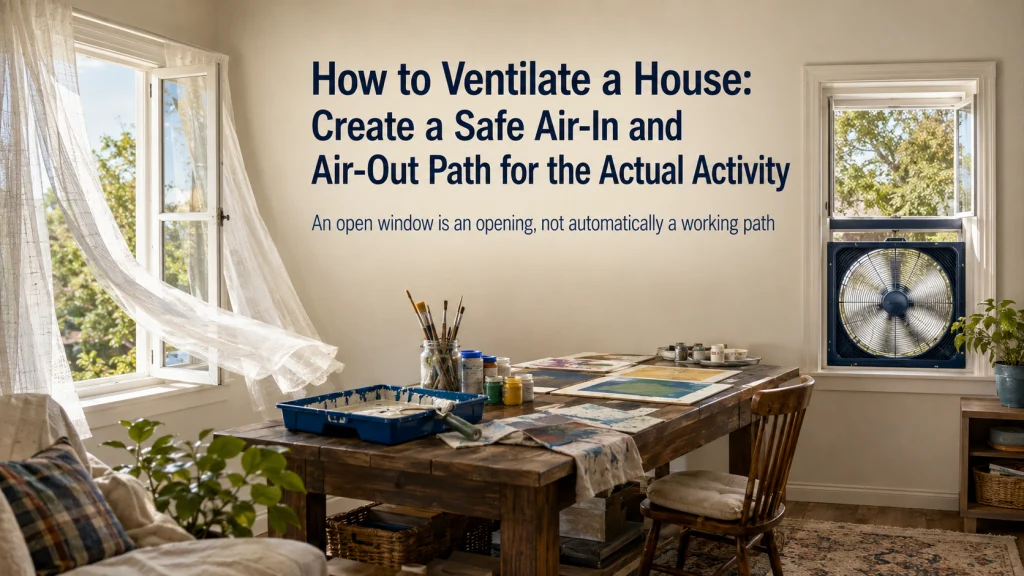
Three Open-Window Arrangements Can Create Three Different Air Paths
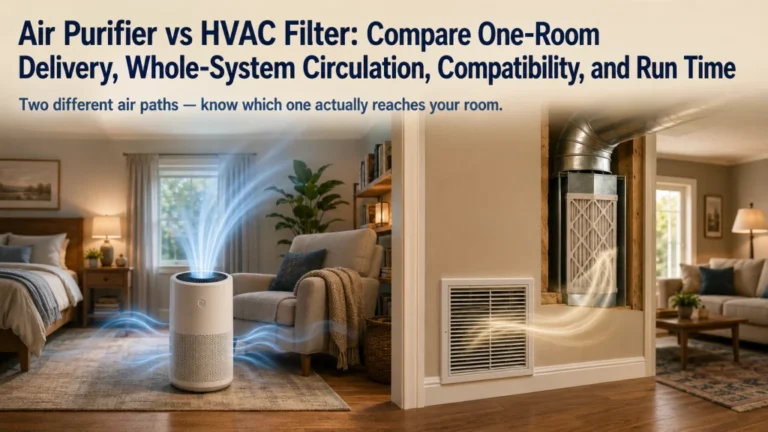
Picture the same room after a paint-free craft activity has left a noticeable odor. In the first arrangement, one window is cracked while the door remains closed. In the second, two windows on the same wall are open. In the third, one opening is used as an inlet while a separated window fan sends air outdoors through another opening.
All three rooms have an open window. They do not have the same ventilation path.
| Arrangement | Likely air-path question | What may limit the result |
|---|---|---|
| One window cracked, door closed | Can air both enter and leave through the same small opening? | Weak pressure difference, little cross-room movement, and no separate outlet |
| Two openings on the same wall | Will outdoor conditions and wind create useful movement between them? | Air may enter and leave near the same side without crossing the occupied area |
| Separated inlet and outward exhaust | Does air travel from the cleaner entry side, across the source area, and out? | Fan direction, opening placement, room boundaries, weather, and makeup air |
An open window is an opening, not automatically an effective route. Useful exchange depends on where air enters, where it travels, what source it passes, and where it leaves.
The third arrangement is not a universal instruction. It is a model showing why separation and direction matter. Outdoor smoke, humidity, temperature, security, children, pets, weather exposure, combustion equipment, and the exact fan design can make a different choice necessary.
The guide to indoor air quality at home places ventilation within the broader source, pathway, and control process.
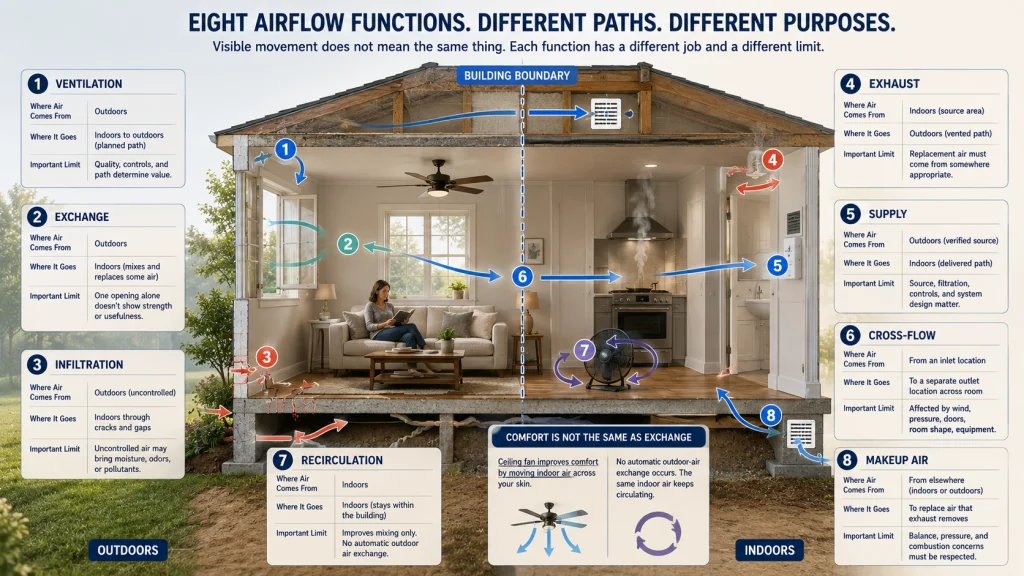
Separate Ventilation, Infiltration, Exhaust, Supply, Cross-Flow, and Recirculation
Several household air terms sound interchangeable because each can involve moving air. Their functions are different, and confusing them can make a room feel breezier without increasing outdoor-air exchange.
| Term | Practical meaning | Important limit |
|---|---|---|
| Ventilation | Outdoor air enters while indoor air leaves through natural or mechanical paths | The outdoor air still needs to be suitable for the household and activity |
| Outdoor-air exchange | Indoor air is replaced or diluted by air from outside | One opening does not reveal how much useful exchange is occurring |
| Infiltration | Outdoor air enters through uncontrolled gaps, cracks, and leaks | It is not the same as a planned ventilation route |
| Exhaust | Air is intentionally removed from a room or source area to outdoors | Exhaust needs an appropriate replacement-air path |
| Supply | Outdoor air is intentionally brought into the building or room | The source, filtration, controls, and system design determine suitability |
| Cross-flow | Air moves between separated inlet and outlet locations | Wind, pressure, doors, room shape, and equipment affect the actual route |
| Recirculation | Indoor air is moved within the room or building | Movement alone does not bring outdoor air in or send indoor air out |
| Makeup air | Air that replaces what an exhaust system removes | An inadequate or uncontrolled path can affect pressure and combustion safety |
This distinction changes the first question. A ceiling fan may improve comfort through air movement. A bathroom exhaust fan may remove moist air outdoors. A window opening may support exchange when outdoor conditions and pressure create a useful path. They are not interchangeable controls.
Identify the Source Event and Room Before Opening Anything
Ventilation works best when it is matched to the event that changed the room. You may notice shower moisture staying on the mirror, cooking effects reaching the hallway, or a hobby odor becoming obvious only after the door has been closed for a while. Those details matter more than opening the nearest window by habit.
Begin with a plain description of what happened and where it started. The source location matters because a useful path carries the condition toward an outlet. A poorly chosen path may pull it across bedrooms, shared living areas, or other rooms that were not part of the original problem.
Before changing windows, doors, or fans, note:
- Which activity or condition is active.
- Which room contains the source.
- Whether the source is still continuing.
- Which nearby openings connect to outdoors.
- Which interior doors connect the room to the rest of the home.
- Whether local outdoor exhaust already exists.
A source that can be stopped, reduced, covered, or moved may need less whole-room ventilation afterward. The broader healthy home environment guide helps place ventilation alongside moisture, cleaning, building conditions, and other household controls.
Check Outdoor Air, Weather, Humidity, Security, and Opening Safety
The most convenient opening is not always suitable at the moment it is needed. Outdoor air can bring smoke, pollen, humidity, heat, cold, traffic exhaust, nearby odors, or wind-driven rain into the home.
Check the conditions that matter before opening the path:
- Outdoor smoke and current air-quality conditions.
- Humidity and whether indoor moisture is already difficult to manage.
- Temperature and the needs of people in the home.
- Rain, strong wind, storms, and weather exposure at the opening.
- Nearby traffic, construction, equipment, or other outdoor sources.
- Window and door security.
- Child, pet, and fall safety at every opening.
- The condition of screens, guards, cords, plugs, and the surrounding surface.
Nighttime ventilation may offer cooler air in one season and create security, noise, humidity, or outdoor-source concerns in another. Seasonal habits should therefore remain conditional rather than becoming a permanent rule.
The article on when to open windows for ventilation focuses on deciding whether outdoor air is suitable now.
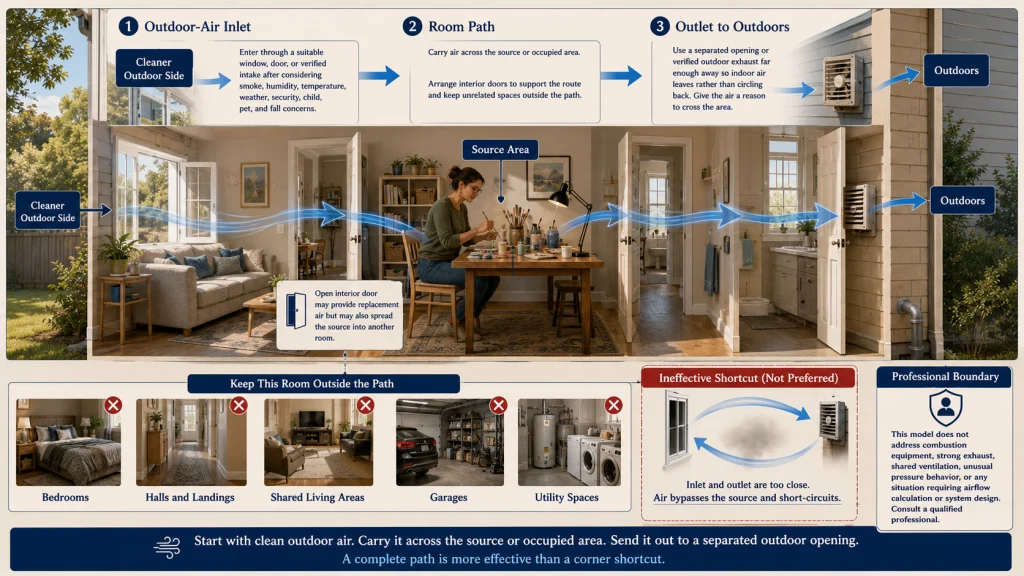
Locate a Practical Outdoor-Air Inlet and a Separate Outlet
Once the source and outdoor conditions are clear, sketch the route before switching on equipment. The useful question is not simply “Which window opens?” It is “Where should air enter, what should it pass, and where should it leave?”
| Outdoor-air inlet | Room path | Outlet to outdoors |
|---|---|---|
| Cleaner and safer outdoor side available ↓ Suitable window, door, or verified intake | Air crosses the occupied or source area → Interior doors support the route without opening unrelated rooms | Separated opening or outdoor-vented exhaust ↑ Indoor air leaves instead of circling back |
This diagram is a route model, not an airflow calculation. The inlet should draw from the cleaner and safer outdoor side available. The outlet should sit far enough away in the path that air has a reason to cross the relevant area rather than entering and leaving beside the same corner.
Interior doors can complete or interrupt the route. Opening a door may provide needed makeup air, but it may also connect the source room with bedrooms, halls, or common areas. The right boundary depends on where the air should travel and which rooms should remain outside the path.
Path limit: If the route affects combustion equipment, strong exhaust systems, shared building ventilation, or unusual pressure behavior, stop and use qualified professional guidance. This article does not calculate airflow or pressure balance.
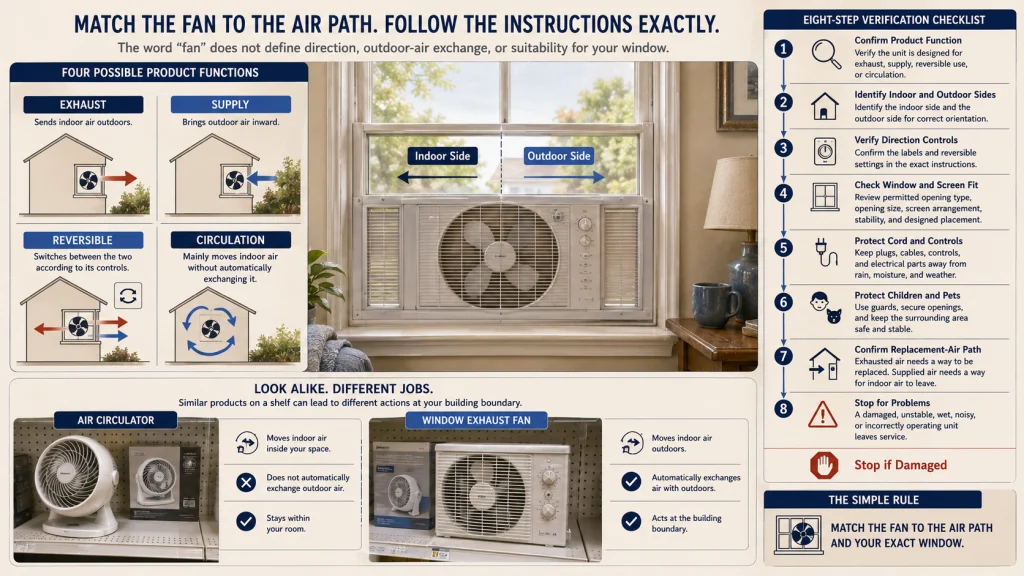
Use a Window Fan Only According to Its Exact Direction and Installation Instructions
A window fan may be designed to send indoor air out, bring outdoor air in, or reverse direction. That sounds simple until the practical details appear: the controls may be labeled from the indoor side, the screen may change the fit, the cord may not safely reach the outlet, or the opening may no longer feel secure once the fan is in place.
Nora’s retail observation is that products described as air circulators are often displayed beside exhaust and window fans even though their jobs are not identical. Direction controls, reversible settings, screen fit, noise, storage, cord length, guards, and weather limits all affect whether the product can create the path the household intends.
- Confirm whether the unit is designed for exhaust, supply, reversible use, or circulation.
- Identify which side of the housing faces indoors and which faces outdoors.
- Follow the exact instructions for direction controls and reversible settings.
- Check the permitted window type, opening size, screen arrangement, and fit.
- Keep cords, plugs, and controls away from unsafe moisture or weather exposure.
- Use guards and opening controls appropriate for children and pets.
- Confirm that another safe path can provide or receive replacement air.
- Stop if the unit is damaged, unstable, unusually noisy, wet, or not operating as described.
The label “fan” does not reveal whether the unit exchanges outdoor air, circulates indoor air, or is suitable for a particular window. Use the exact instructions rather than guessing from the housing or the direction you can feel air moving.
This article does not provide fan-installation, electrical, or window-modification instructions.
Use Kitchen or Bathroom Exhaust at the Source
Local exhaust is often more direct than trying to clear the entire home after a source has spread. A kitchen hood that vents outdoors can act near cooking. A bathroom exhaust fan can remove moist air near bathing.
Fan noise does not prove that air is reaching outdoors. A unit may recirculate, have a blocked path, be connected differently than expected, or operate poorly. Check the available documentation and observe whether the room condition still spreads or lingers.
Simple user-level checks include whether the fan is turned on during the activity, whether the grille is visibly blocked, whether the controls are understood, and whether the installed feature is described as outdoor exhaust or recirculation.
Do not open housings, modify ducts, change wiring, cut new openings, or alter building pressure relationships as ordinary household troubleshooting. The guides to kitchen ventilation and bathroom ventilation cover the room-specific decisions in greater depth.
Ceiling Fans and Air Circulators Mainly Move Indoor Air
A ceiling fan can make a warm room feel more comfortable. A portable circulator can help move air from one side of a room toward an existing outlet. Those are useful functions, but they are not the same as replacing indoor air with outdoor air.
| Equipment or opening | Main action | Outdoor-air exchange? |
|---|---|---|
| Ceiling fan in a closed room | Moves and mixes indoor air | No automatic exchange |
| Portable air circulator | Directs indoor air along a chosen path | Only when used as part of a suitable opening arrangement |
| Outdoor-vented exhaust fan | Removes room air to outdoors | Yes, with replacement air entering through another path |
| Separated open inlet and outlet | Allows natural cross-flow when conditions support it | Potentially, but direction and strength depend on outdoor and building conditions |
The practical distinction is what happens at the building boundary. Indoor air movement may support comfort or help guide air toward an outlet. Exchange requires a path that crosses that boundary in both directions.
This is also why a noticeable breeze is not enough evidence by itself. The breeze may be part of a useful route, or it may be the same indoor air circling through the room.
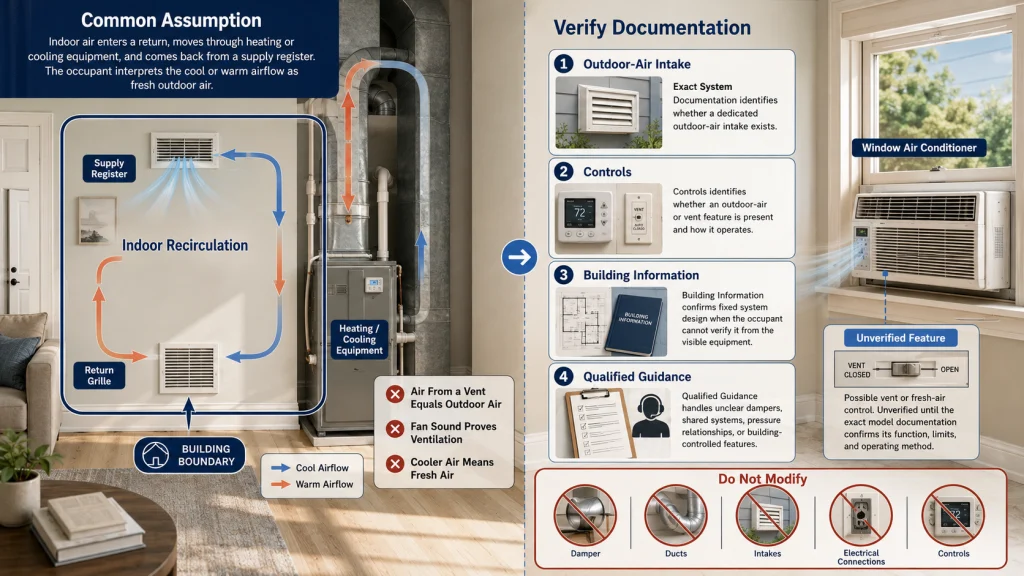
Verify Whether HVAC or a Window Air Conditioner Actually Has an Outdoor-Air Intake
Forced-air heating or cooling often moves indoor air through returns, equipment, and supply registers. That circulation should not be assumed to include outdoor air.
Some systems include a dedicated outdoor-air feature. Others primarily recirculate indoor air. A window air conditioner may have a vent or fresh-air control, but the label, function, weather limits, and operating method vary by exact unit.
Do not infer function from the grille, fan sound, or the temperature of supplied air. Use the equipment manual or qualified building information. Do not modify dampers, ducts, intakes, electrical connections, or controls without appropriate expertise.
HVAC-intake myth: Heating, cooling, or visible airflow does not prove outdoor-air exchange. Verify the exact feature before including it in the ventilation plan.
Coordinate Interior Doors Without Spreading the Source Through the Home
An interior door can serve two opposite roles. Opening it may provide makeup air for an exhaust fan. Closing it may keep an odor, dust-producing task, or moisture event from spreading into the rest of the home.
Decide which role matters for the actual activity. If bathroom exhaust requires air to enter under or around the door, sealing the room completely may weaken the path. If a dusty hobby is occurring in one room, opening every interior door may carry that material farther before it reaches an outlet.
A practical room-boundary check asks:
- Where is the source?
- Where should replacement air come from?
- Which rooms should remain outside the path?
- Does opening a door create a shortcut that bypasses the source?
- Could the path draw air from a garage, utility area, shared hallway, or another undesirable location?
Apartment layouts add shared walls, common hallways, neighboring sources, and building-controlled equipment. Occupants should not alter shared systems or assume they control the full air path.
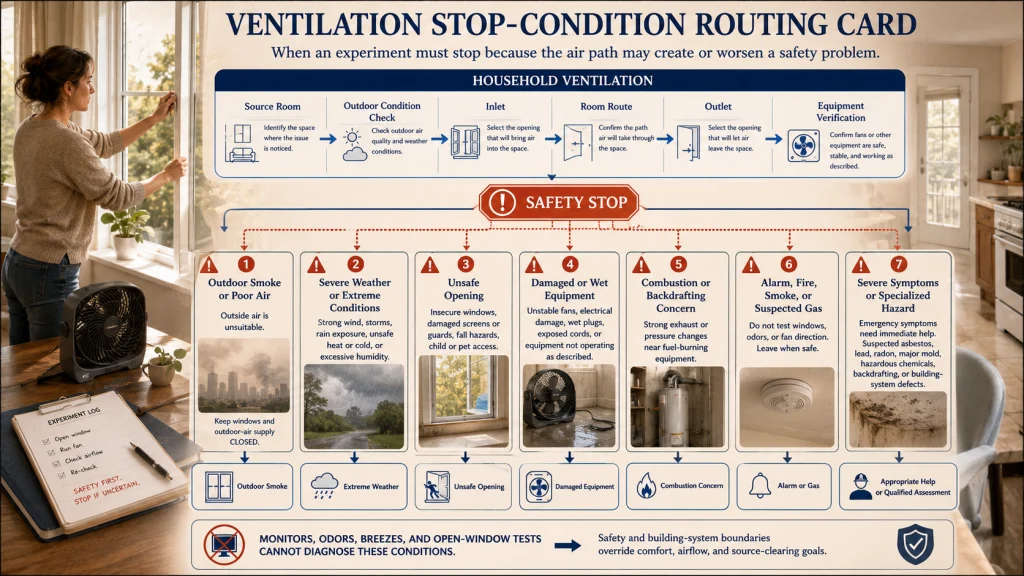
Stop for Smoke, Combustion Concerns, Damaged Equipment, Extreme Conditions, or Unsafe Openings
Household ventilation troubleshooting must stop when the air path may create or worsen a safety problem.
Safety and combustion boundary: Do not operate window or whole-house fans when outdoor smoke, severe weather, unsafe temperatures, excessive humidity, rain exposure, damaged equipment, electrical hazards, or insecure openings make the setup unsuitable. Do not create strong exhaust or pressure changes around combustion appliances without qualified guidance. A sounding smoke or carbon monoxide alarm, visible fire or smoke, or a suspected gas leak requires leaving the area when safe and contacting emergency or utility services as appropriate.
Severe breathing difficulty, chest pain, fainting, confusion, blue or gray lips, or other emergency signs require immediate appropriate help. Persistent or worsening symptoms require qualified medical guidance rather than repeated window or fan experiments.
Suspected asbestos, lead, radon, major mold, hazardous chemicals, backdrafting, or building-system defects require appropriately qualified assessment. A consumer monitor, odor, open-window test, or fan direction cannot diagnose these conditions.
Child, pet, and fall safety are part of every opening decision. Screens are not automatically fall guards, and a fan placed in a window does not make the opening secure.
Route Permanent Ventilation Needs to System-Level Guidance
Existing windows, doors, exhaust fans, and verified equipment features may support practical short-term ventilation. They do not replace a designed system when the home needs reliable, controlled outdoor-air exchange across seasons and rooms.
System-level questions include airflow requirements, pressure balance, duct design, filtration, energy use, humidity control, intake and exhaust placement, commissioning, maintenance, and interaction with combustion equipment. Those decisions exceed a household opening-and-fan workflow.
Use the guide to whole-house ventilation systems when the goal is a permanent approach rather than temporary use of existing paths.
Renters and apartment occupants may control windows, interior doors, and ordinary product use while the property owner or manager controls fixed exhaust, shared ventilation, window restrictions, and building repairs. Report defects rather than modifying building systems.
Follow the Air Path, Not Just the Feeling of a Breeze
A useful ventilation plan begins with a specific event in a specific room. Check whether outdoor air and the opening are suitable, then decide where replacement air should enter and where indoor air should leave.
After the path is open, follow it with your attention. Does it cross the source area? Does an interior door send the condition into another room? Is a fan exchanging air or only making the room feel less still? Has the outdoor weather changed since the window was opened?
Those observations determine the next step. Local exhaust may be enough. A safer inlet may be needed. The room boundary may need to change. A permanent building or HVAC question may need professional guidance instead. Ventilation succeeds when the source, inlet, route, outlet, equipment, and outdoor conditions work together, not when the largest possible number of windows are open.
FAQs
🪟 Is opening one window enough to ventilate a room?
Not necessarily. One window provides an opening, but useful exchange depends on pressure, outdoor conditions, the route through the room, and where indoor air can leave. A separated inlet and outlet often make the intended path easier to understand.
🌬️ What is the difference between ventilation and air circulation?
Ventilation exchanges indoor and outdoor air. Circulation moves air within the room or building. A ceiling or portable fan can create noticeable airflow without bringing outdoor air inside.
↔️ Should a window fan blow inward or outward?
The direction depends on the planned inlet and outlet and the unit’s exact design. Follow the product instructions for exhaust, supply, or reversible use rather than applying one direction to every fan and room.
🍳 Is a recirculating range hood the same as outdoor exhaust?
No. A recirculating hood returns air to the room after it passes through the unit. Outdoor exhaust sends air out of the building through a dedicated path.
❄️ Does running heating or air conditioning bring in fresh air?
Not automatically. Many systems mainly recirculate indoor air. Check the exact system manual, controls, or building documentation to verify whether an outdoor-air intake exists.
🚪 Should interior doors stay open during ventilation?
It depends on the intended route. An open door may provide replacement air, but it may also spread a source into other rooms. Decide where air should enter, cross, and leave before changing the door position.
🚩 When should I stop trying to ventilate the house myself?
Stop for outdoor smoke, severe weather, unsafe openings, damaged electrical equipment, combustion or backdrafting concerns, alarms, gas, fire, or building-system defects. Use the appropriate emergency, utility, property-management, contractor, or environmental-professional route.