Exercise intensity for beginners is best judged by how the activity feels in your body, not by a treadmill speed, calorie estimate, video level, or smartwatch zone alone. Use the talk test and a simple 0-to-10 effort scale to separate light, moderate, and vigorous work. Start below your hardest repeatable effort, then change intensity separately from workout length and weekly frequency. Stop immediately and seek appropriate help for serious symptoms such as chest pain or pressure, fainting, severe dizziness, sudden weakness, or extreme shortness of breath.
The Same Speed Can Feel Completely Different
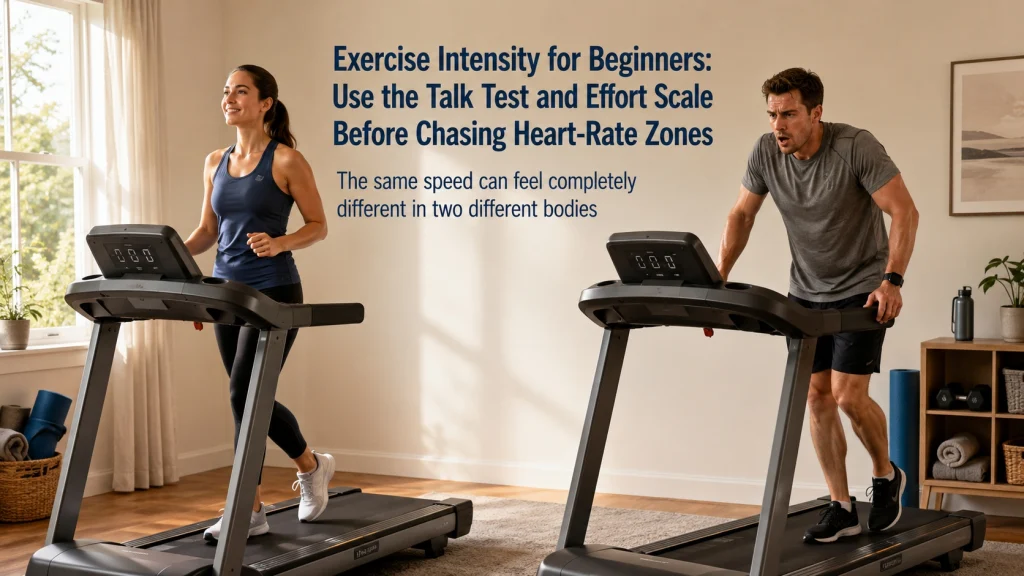
Two people can walk on treadmills set to the same speed while doing very different workouts. One may be able to sing along with a song. The other may only manage a few short phrases before pausing for breath. The display is identical, but the relative intensity is not.
That difference matters because beginner workout intensity should match your current fitness, movement experience, health, and ability. A preset beginner level on a bike, treadmill, or video can feel light to one person and vigorous to another. The label is a starting clue, not a personalized limit.
This article focuses on how hard aerobic or mixed home exercise feels. It does not prescribe an individual heart-rate zone, interpret unusual heart rhythms, or define strength-training loads in depth. For the wider setup process, review how to start working out at home and the broader home exercise guide.
Absolute and Relative Intensity in Plain Language
Absolute intensity describes the work itself without adjusting for the person doing it. A certain walking speed, cycling resistance, or exercise pace can be classified by how much energy it usually requires.
Relative intensity asks a different question: how hard is this activity for you right now? It reflects your current capacity, so the same task can land at different effort levels for different people.
The CDC intensity guidance uses breathing, the talk test, and a 0-to-10 effort scale to help people judge relative aerobic intensity. Those methods are useful at home because they do not depend on one machine, one watch, or one formula.
Key decision: Use speed, resistance, and program labels to reproduce a session, but use your breathing, speech, and perceived effort to decide how hard the session actually is.
This distinction prevents a common beginner error: assuming that a low-looking number must be easy or that a high-looking number must be productive. The number only describes the setting. Your response describes the intensity.
Light, Moderate, and Vigorous Effort
Light, moderate, and vigorous are not three fixed speeds. They are three effort ranges. Breathing, speech, control, and recovery help separate them. This is useful when a class label makes you feel behind, because the goal is not to match someone else’s pace. It is to identify the effort you can manage today.
| Effort level | What it often feels like | Useful beginner role |
|---|---|---|
| Light | Breathing is close to normal. Conversation feels easy. You could continue comfortably. | Warm-ups, cool-downs, recovery movement, skill practice, and starting points after inactivity. |
| Moderate | Breathing is clearly faster. You can talk in sentences, but singing would be difficult. | Steady aerobic work that feels purposeful without requiring an all-out effort. |
| Vigorous | Breathing is hard. You can usually say only a few words before needing another breath. | Higher-effort work for people who are ready for it and can maintain form and control. |
Beginners do not need to prove that every workout reached vigorous intensity. Light work can build consistency and movement tolerance. Moderate intensity can be challenging enough for many sessions. Vigorous work is an option, not a requirement for every day.
It is normal for the same session to feel different after poor sleep, a stressful day, a break from exercise, or a change in routine. Adjusting the effort is not backing out of the workout. It is using the information your body is giving you.
A useful range also depends on the session’s purpose. A light walk may support recovery, while a moderate dance session may be the main workout. The label only becomes useful when it is connected to what you are trying to do.
Use the Talk Test During Aerobic Exercise
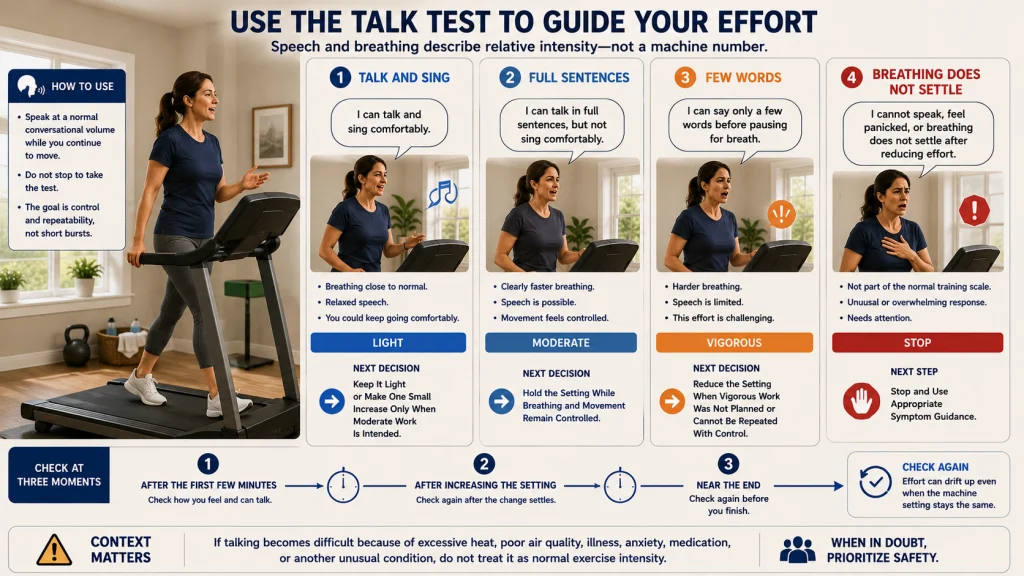
The talk test turns breathing into a practical decision. Speak a full sentence at your normal conversational volume while continuing the activity. Do not whisper, rush the words, or stop moving just to pass the test.
| What you can do | Likely relative intensity | What to do next |
|---|---|---|
| Talk and sing comfortably | Light | Keep it light, or make one small increase if the session is meant to be moderate. |
| Talk in sentences but not sing comfortably | Moderate | Hold the setting if breathing and movement remain controlled. |
| Say only a few words before pausing for breath | Vigorous | Reduce the setting if vigorous work was not planned or cannot be repeated safely. |
| Cannot speak, feels panicked, or breathing does not settle after reducing effort | Beyond a normal training check | Stop. Follow the symptom guidance later in this article. |
The talk test works especially well during walking, cycling, dancing, stepping, and other continuous activities. Check it after the first few minutes, again after increasing the setting, and once more near the end. Effort can drift upward even when the machine number stays the same.
Note: Talking difficulty caused by room heat, poor air quality, illness, anxiety, or another condition should not be dismissed as a normal workout result. Reduce or stop the activity and use the symptom guidance that fits the situation.
Use a 0-to-10 Perceived-Effort Scale
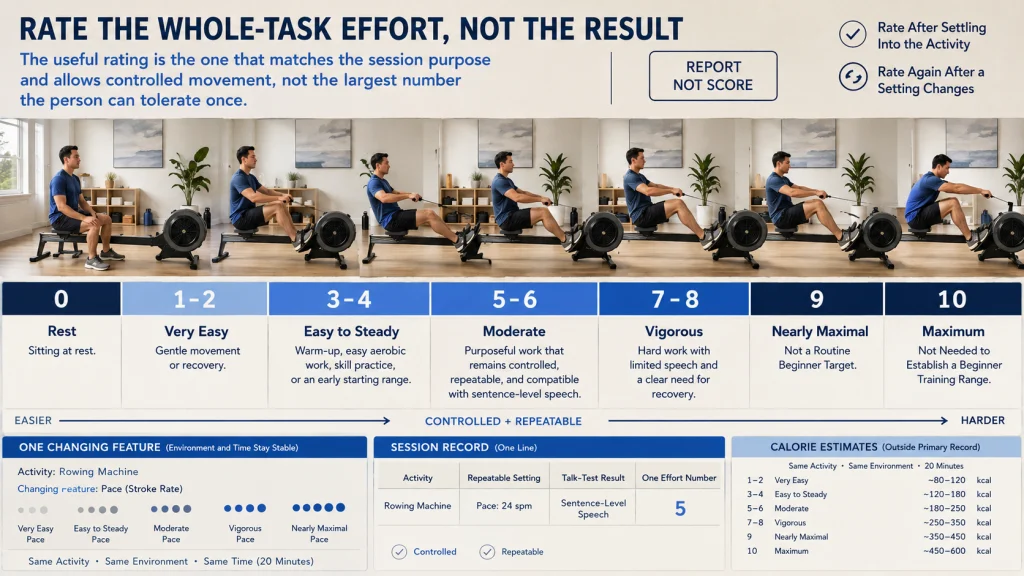
A perceived-effort scale asks you to rate the whole task, including breathing, muscle demand, coordination, and how much concentration it takes to continue. On this scale, 0 is sitting at rest and 10 is your maximum possible effort. The number does not need to be perfect. Its value comes from helping you notice whether the session feels manageable, harder than expected, or ready for a small change.
| Rating | Plain-language meaning | Typical use |
|---|---|---|
| 0 | Rest | Sitting quietly |
| 1 to 2 | Very easy | Gentle movement or recovery |
| 3 to 4 | Easy to steady | Warm-up, easy aerobic work, or an early starting range |
| 5 to 6 | Moderate | Purposeful work that remains controlled and repeatable |
| 7 to 8 | Vigorous | Hard work with limited speech and a clear need for recovery |
| 9 | Nearly maximal | Not a routine beginner target |
| 10 | Maximum effort | Not needed to establish a beginner training range |
Use the number as a report, not a score. A 4 is not a failure, and an 8 is not automatically better. This matters for beginners who feel pressure to make every session look impressive. The useful number is the one that matches the session’s purpose and still allows controlled movement.
Rate the effort after you have been moving long enough to settle into the activity. Then rate it again if you change speed, resistance, range of motion, impact, or arm involvement. A single session can move through several effort levels.
Practical tip: Write down the activity, the setting, your talk-test result, and one effort number. That short record is more useful for repeating the session than saving a calorie estimate alone.
Treat Device Numbers as Reference Points, Not Personal Limits
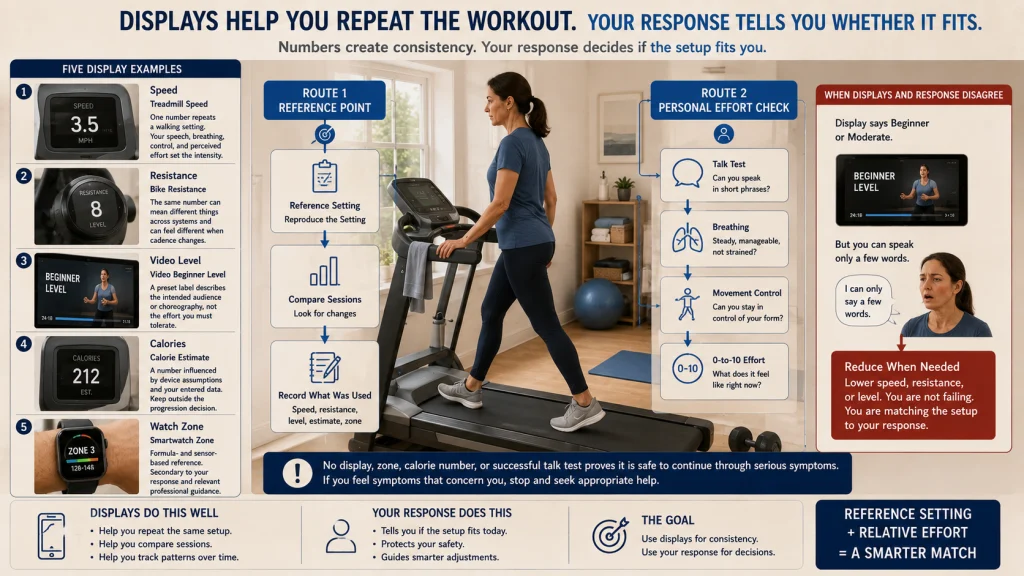
Watches, exercise bikes, treadmills, and video platforms use different assumptions. A calorie estimate may depend on entered body data. A zone label may depend on a formula. A video difficulty label may reflect choreography or production choices. A resistance level may not match another machine with the same number. When the screen and your experience disagree, that does not mean you are doing the workout incorrectly.
Editorial observation: A preset beginner level can still be too demanding for one person and barely challenging for another. The label describes the audience the program was designed for, not the effort you are required to tolerate.
Calorie displays also should not decide whether you increase intensity. They can vary by device and input assumptions, and a larger number does not prove that the session was better matched to you. Chasing the highest screen value can turn a manageable routine into a test you dread repeating. A stable session gives you clearer information and a better chance of returning to it.
Use these displays as tools for consistency:
- Speed can help you reproduce a walking session.
- Resistance can help you return to a cycling setup.
- Video levels can help you choose a familiar sequence.
- Time can show how long you maintained the planned effort.
Then let relative intensity decide whether the setting stays, drops, or increases.
Aerobic Intensity Is Not the Same as Strength Difficulty
The talk test is designed for continuous aerobic effort. It is useful during walking, cycling, dancing, marching, or low-impact cardio because breathing and speech change as the overall demand rises.
Strength work creates a different problem. A set of squats, presses, rows, or carries may feel locally difficult in the working muscles even when you can speak normally between repetitions. Breath-holding, technique, load, repetition speed, range of motion, and proximity to muscular fatigue all affect strength difficulty.
Do not use easy speech as proof that a strength exercise is easy enough. Also do not turn a hard set into an aerobic test by rushing repetitions. For beginner strength sessions, prioritize controlled technique, a load you can manage, and stopping the set before form breaks down.
Note: This article does not prescribe individual strength loads or repetition limits. Use the talk test for the aerobic portions of mixed sessions, then judge strength exercises by control, technique, and the plan designed for that movement.
Start Below Your Maximum Repeatable Effort
Your first workable intensity is not the hardest effort you can survive once. It is an effort you can repeat with similar control on the next planned session. Finishing with some capacity left can feel less dramatic, but it often makes the next workout easier to approach.
For a generally healthy beginner, a practical first target is often light to moderate effort. That gives you room to notice technique, breathing, joint comfort, and recovery without making every session a test. It also gives you permission to learn what different effort levels feel like before trying to push them higher.
The current federal activity guidance advises inactive adults to start with small amounts and build over time. Apply that principle by making one controlled change only after the current level feels repeatable.
Use One Progression Trigger
Keep the current intensity until all of these are true:
- The talk-test result matches the effort you planned.
- Your movement remains controlled through the session.
- You finish without needing to push through severe or unusual symptoms.
- You can return for the next planned session without an outsized recovery cost.
When those conditions are consistent, increase one variable slightly. For example, add a small amount of speed, resistance, incline, impact, arm involvement, or movement range. Do not raise all of them at once.
Key decision: Progress when the current effort is controlled and repeatable, not merely because the screen offers a higher level.
Change Intensity Separately From Duration and Frequency
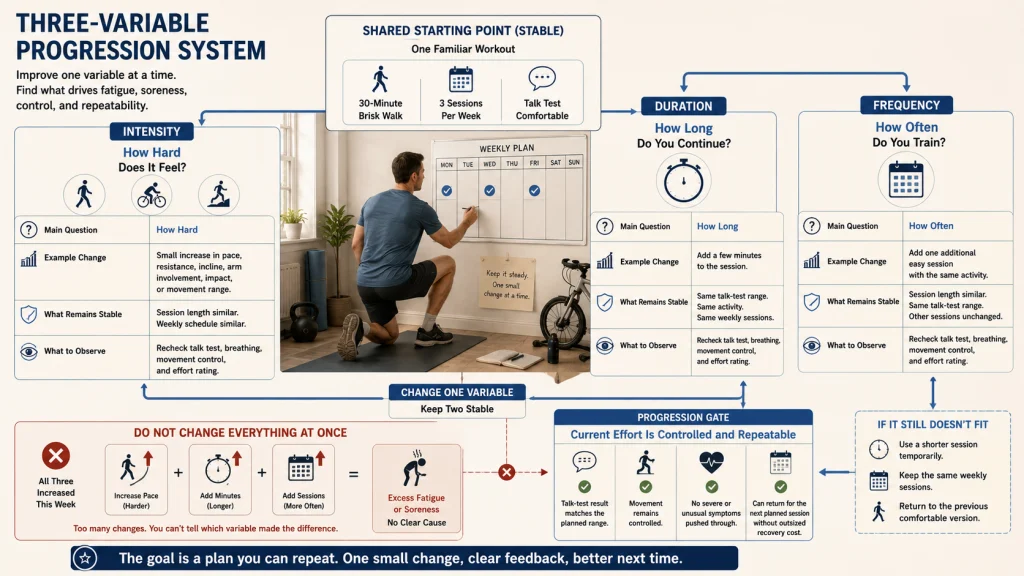
Intensity answers how hard the activity feels. Duration answers how long one session lasts. Frequency answers how often you train. These variables interact, but they are not interchangeable. Keeping them separate can make a beginner plan feel less confusing because you do not have to improve everything at once.
| Variable | Main question | Example change | What to keep stable while testing it |
|---|---|---|---|
| Intensity | How hard does it feel? | Slightly increase walking pace | Keep session length and weekly schedule similar |
| Duration | How long do you continue? | Add a few minutes | Keep the same talk-test range and number of sessions |
| Frequency | How often do you train? | Add another weekly session | Keep the new session easy and familiar at first |
Changing one variable at a time makes the result easier to interpret. If you increase pace, extend the session, and add another workout in the same week, you may not know which change created excessive fatigue or soreness. That uncertainty can make a normal adjustment feel like failure when the plan simply changed too much at once.
Use workout length guidance when the problem is how long to continue. Use beginner workout frequency guidance when the problem is how many sessions fit your week. Keep this article’s talk-test and effort-scale method focused on how hard each session feels.
Examples for Walking, Cycling, Dancing, and Low-Impact Sessions
The same framework works across different activities, but the setting you adjust will change.
Walking
Begin at a pace that lets you speak comfortably. If the goal is moderate intensity, increase speed or incline until you can still talk in sentences but would not want to sing. If speech drops to only a few words, reduce the setting unless vigorous work was planned. The useful check is the change in your breathing, not whether the pace seems fast or slow.
Stationary Cycling
Choose a cadence and resistance that allow smooth pedaling without rocking, gripping the handlebars tightly, or losing control. Raise only one setting at a time. A low resistance number can still feel hard if the cadence is fast, while a higher number can feel manageable at a slower cadence.
Dancing
Dance intensity can change through tempo, arm use, travel across the room, jump height, and movement size. Keep the choreography simple enough that coordination does not hide how hard you are working. Reduce impact or range before abandoning the session entirely.
Low-Impact Cardio
Marching, step touches, knee lifts, and supported movement can range from light to vigorous. Low impact describes how the body contacts the floor, not how easy the workout feels. Faster tempo, larger arm movements, and deeper ranges can raise intensity without adding jumps.
For more ways to choose an activity that fits your space and ability, review these home cardio options.
Practical tip: Test the easiest version first, identify its talk-test and effort-scale result, then change one feature. That creates a clearer path than starting with the most demanding version shown on screen.
Know When to Stop and Seek Help
Normal effort can include faster breathing, a stronger heartbeat, warmth, and temporary muscle fatigue. Those signs should remain connected to the work you are doing and should ease after you slow down or stop.
Safety warning: Stop exercise immediately and seek appropriate help for chest pain or pressure, extreme shortness of breath, fainting, severe dizziness, sudden weakness, a serious injury, or severe pain. Call emergency services when symptoms are severe, sudden, or potentially life-threatening.
Do not use a smartwatch zone, calorie display, or passed talk test as proof that it is safe to continue through serious symptoms. Consumer exercise metrics cannot diagnose the cause of chest symptoms, unusual breathlessness, dizziness, faintness, or weakness.
Persistent joint or muscle pain, neurological symptoms, pregnancy, recent surgery, chronic health conditions, disability-related limitations, or a long period of inactivity may require individualized guidance from a physician, physical therapist, or qualified exercise professional. New, worsening, unexplained, or function-limiting symptoms also deserve qualified evaluation rather than a harder workout.
Note: If breathing remains unusually difficult after you reduce the effort, stop the session. Do not keep testing whether the symptom will pass under load.
Choose a Repeatable Effort Before You Progress
For your next aerobic session, record three things: the talk-test result, a 0-to-10 effort rating, and the one setting you used. Aim for an effort that matches the session’s purpose and still allows controlled movement.
Keep that level until it feels repeatable, then choose one progression trigger. Increase intensity, duration, or frequency separately so you can tell what changed. Device numbers can help you reproduce a setup, but your relative effort should decide whether that setup fits.
FAQs
🗣️ What intensity should a beginner start with?
Many generally healthy beginners can start with light to moderate effort, using easy speech and controlled movement as checks. The starting level should feel repeatable rather than maximal. A long period of inactivity, chronic conditions, recent surgery, pregnancy, or disability-related limitations may require individualized guidance.
🎚️ Is moderate intensity always a 5 or 6 out of 10?
A 5 or 6 is a useful general reference for relative moderate intensity, but your rating should be checked against breathing and speech. You should usually be able to talk in sentences but not sing comfortably. Do not force the number when your actual response suggests a different effort.
⌚ Should I follow my smartwatch heart-rate zone?
You can use the zone as one piece of information, but not as a personalized medical limit or proof of safety. Formulas, settings, sensors, and individual responses vary. Confirm the session with the talk test, perceived effort, movement control, and any relevant professional guidance.
💦 Does sweating mean the workout is vigorous?
No. Sweating is affected by heat, humidity, clothing, hydration, genetics, and the activity itself. Use breathing, speech, and perceived exertion rather than sweat alone to judge intensity.
🚶 Can slow walking count as moderate exercise?
Yes. A slow pace can count as moderate when it noticeably raises your breathing while you can still speak in sentences. Someone with a different fitness level may need more speed or incline, so judge the walk by your talk-test result rather than by how the number looks.
🔁 When should I make a workout harder?
Progress after the current effort has become controlled and repeatable across planned sessions. Change one variable slightly, such as pace or resistance, while keeping duration and frequency stable. Recheck the talk test and effort rating after the change.
🏋️ Can I use the talk test for strength exercises?
The talk test is most useful for continuous aerobic activity. Strength difficulty also depends on load, technique, repetition speed, range of motion, and how close the working muscles are to fatigue. Use controlled form and an appropriate strength plan rather than speech alone.