Evening exercise and sleep should be judged by more than the clock time. Intensity, duration, finish time, body heat, stimulant use, emotional arousal, meal timing, and the work required to return the home to bedtime conditions can all change the result. Keep the session type stable while testing one variable at a time, then compare sleep onset, awakenings, morning function, and practical routine friction across a week. Stop and seek appropriate care for chest pain, fainting, severe shortness of breath, acute injury, or another concerning symptom.
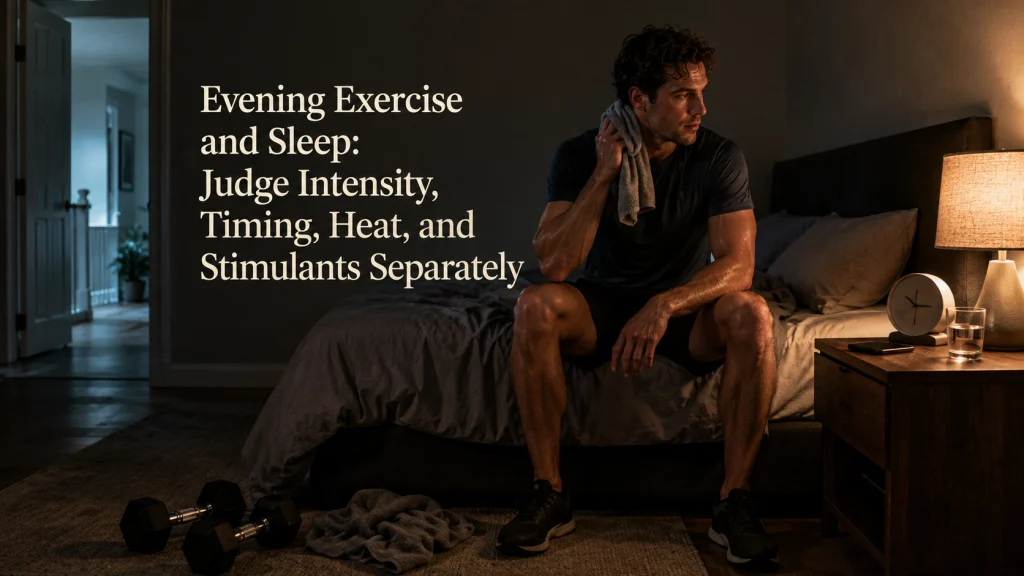
Two 8 p.m. Workouts Can Be Completely Different Exposures
Put two calendar entries at 8 p.m. The first is twenty minutes of mobility in a quiet room. It ends with light cleanup, no stimulant, and enough time to follow the usual bedtime routine.
The second is a hard interval session with a caffeinated pre-workout, loud equipment, a hot shower, a late meal, and laundry left in the bedroom. The clock time is the only thing the two sessions share.
| Timeline | 8 p.m. mobility session | 8 p.m. hard interval session |
|---|---|---|
| Before exercise | Normal dinner and no added stimulant | Pre-workout product and unfinished evening tasks |
| Session | Twenty minutes, controlled effort, low noise | Hard intervals, longer duration, higher arousal |
| Body heat | Mild increase that settles quickly | Strong heat and sweating that continue after the session |
| After exercise | Equipment stored and usual routine begins | Hot shower, laundry, equipment cleanup, and late meal |
| Bedtime effect to observe | Whether movement helps the transition into the evening | Whether alertness, heat, hunger, or delayed routine affects sleep |
Core distinction: The finish time matters, but it does not describe the whole exposure.
The complete sleep improvement guide covers the wider sleep system. The healthy sleep habits framework helps place exercise beside caffeine, meals, light, schedule, and bedroom conditions.
Understand Why Time Alone Does Not Describe the Workout
“Working out at night” can describe a slow walk after dinner, a moderate strength session, a competitive game, or a strenuous interval workout. It can also describe a session that ends three hours before sleep or one that ends immediately before the person tries to settle.
The same clock entry can carry different combinations of muscular effort, cardiovascular strain, emotional arousal, body heat, noise, food, caffeine, cleanup, and schedule pressure. A simple rule about evening exercise misses those differences.
Use time as one field in the record, not the verdict. Record when the session started, when the active work ended, when the body and home felt settled again, and when sleep was attempted.
Useful timing distinction: Workout finish time and bedtime-ready time are not always the same. The second includes showering, eating, cooling down, storing equipment, and returning the room to a sleep-friendly condition.
Use the Evidence Without Creating a Universal Bedtime Rule
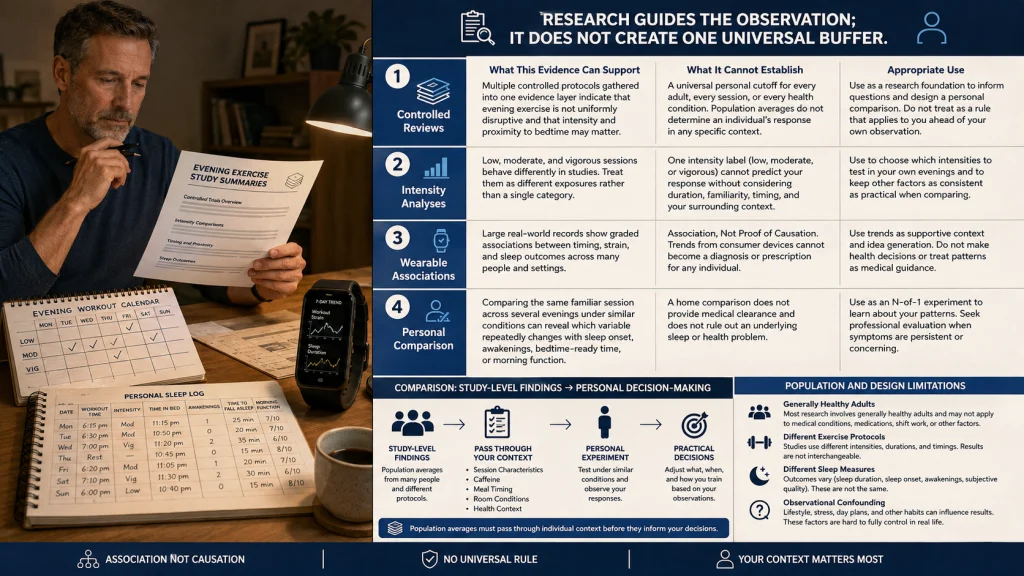
A systematic review and meta-analysis of healthy participants found that evening exercise was not generally associated with worse sleep. The review also suggested that vigorous exercise ending very close to bedtime may be more likely to affect some sleep outcomes.
A later systematic review examined evening exercise timing and intensity across controlled studies. The included protocols, participant groups, exercise definitions, and sleep measurements varied, so the pooled findings should not be converted into one guaranteed buffer for every adult.
A large 2025 wearable study reported dose-response associations between later, more strenuous evening exercise and later sleep onset, shorter sleep, and less favorable overnight measures. Because the study was observational, it can identify patterns but cannot prove that the workout alone caused every sleep difference.
| Evidence type | What it can support | What it cannot establish |
|---|---|---|
| Systematic reviews of controlled studies | Evening exercise is not uniformly disruptive, and intensity and proximity to bedtime can matter. | A personal cutoff that works for every session, person, or health condition |
| Intensity-specific analyses | Low, moderate, and vigorous sessions should not be treated as the same exposure. | That one intensity label predicts an individual’s response without considering duration and context |
| Large observational wearable data | Real-world timing and exercise strain can show graded associations with later sleep measures. | Causality, clinical diagnosis, or a prescription based on a consumer device score |
| Personal comparison | Which variable appears repeatedly linked to sleep under similar conditions | Medical clearance or proof that no underlying sleep or health problem exists |
Evidence limit: Most research describes generally healthy adults under study-specific conditions. Use it to design an observation, not to replace individualized medical guidance or exercise clearance.
Classify Six Variables Before Blaming the Entire Evening Workout
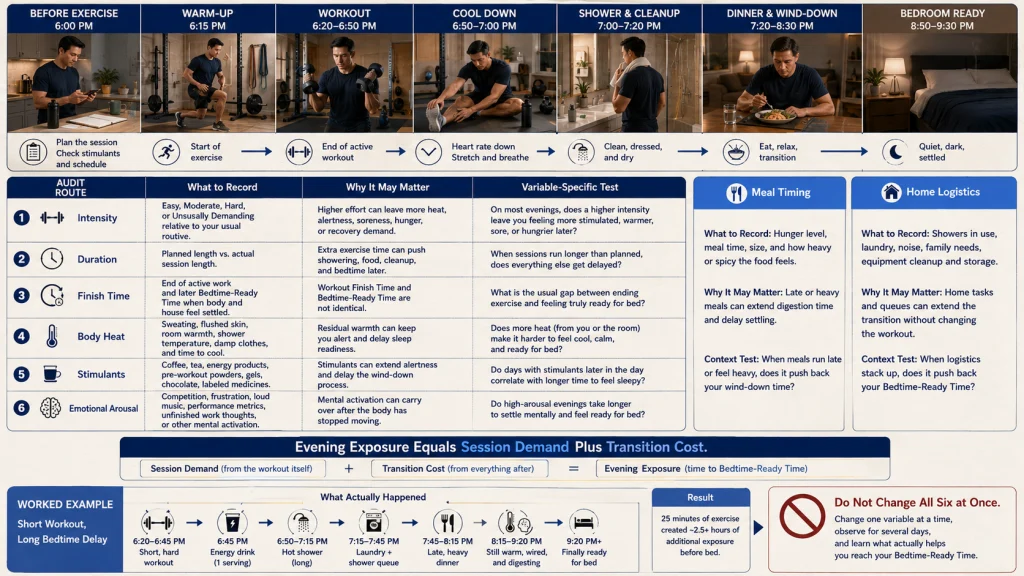
Audit the session in separate columns. A sleep problem linked to a late workout may come from one dominant variable or from several variables arriving together.
| Variable | What to record | Why it may matter |
|---|---|---|
| Intensity | Easy, moderate, hard, or unusually demanding relative to your normal session | Higher effort can leave more heat, alertness, and recovery demand. |
| Duration | Total session length and whether it ran longer than planned | A longer session can delay cleanup, food, showering, and bedtime. |
| Finish time | End of active work and time the body felt settled | The usable transition window may be shorter than the clock suggests. |
| Body heat | Sweating, flushed skin, warm bedroom, hot shower, and time needed to cool | Heat can become the practical obstacle even when the workout itself ends on schedule. |
| Stimulants | Pre-workout, coffee, tea, energy products, and labeled medicines | The session may be blamed for an exposure that began before it. |
| Emotional arousal | Competition, frustration, loud music, demanding metrics, or work-related rumination | The body may be tired while attention remains activated. |
Meal timing belongs beside the audit because hunger and late eating can alter the post-workout sequence. Home logistics also matter, but they are easiest to evaluate after the six session variables are visible.
Identify the Actual Post-Workout Obstacle
The complaint “exercise keeps me awake” may describe several different experiences. Name the first obstacle that appears after the session.
- Alertness: The body feels tired, but thoughts remain fast or competitive.
- Heat: Sweating continues, the room feels warm, or a hot shower extends the heat load.
- Hunger: The session creates an unplanned meal close to bedtime.
- Soreness or discomfort: Positioning in bed becomes difficult.
- Noise conflict: Equipment or cleanup disturbs a partner, neighbor, or household routine.
- Delayed routine: Showering, laundry, storage, and food push every later task back.
The first obstacle is more actionable than a broad ban on nighttime exercise. If the session ends comfortably but equipment cleanup delays bedtime by forty minutes, moving the entire workout may solve the wrong problem.
Editorial observation: A compact home workout is not automatically low-friction. It can still leave equipment, laundry, moisture, noise, and trapped heat in the bedroom, turning a short session into a long transition.
Separate Low-Intensity Movement From Vigorous Sessions
Low-intensity movement, mobility, and ordinary walking should not be grouped automatically with demanding intervals, heavy competitive sessions, or unusually strenuous training. Their effects on heat, arousal, soreness, hunger, and recovery can be very different.
This does not mean one category is always helpful and the other is always disruptive. The same person may sleep normally after a familiar hard session on one day and struggle after a shorter session combined with caffeine, stress, or a late meal on another.
Classify intensity relative to the person and the normal routine rather than copying another person’s pace or heart-rate zone. This article does not provide an exercise program or tell you which exercises to perform before bed.
Comparison rule: Do not use the clock to compare a gentle twenty-minute session with a strenuous sixty-minute session as though timing were the only changed variable.
Build a Stable-Session Test and Change Finish Time First
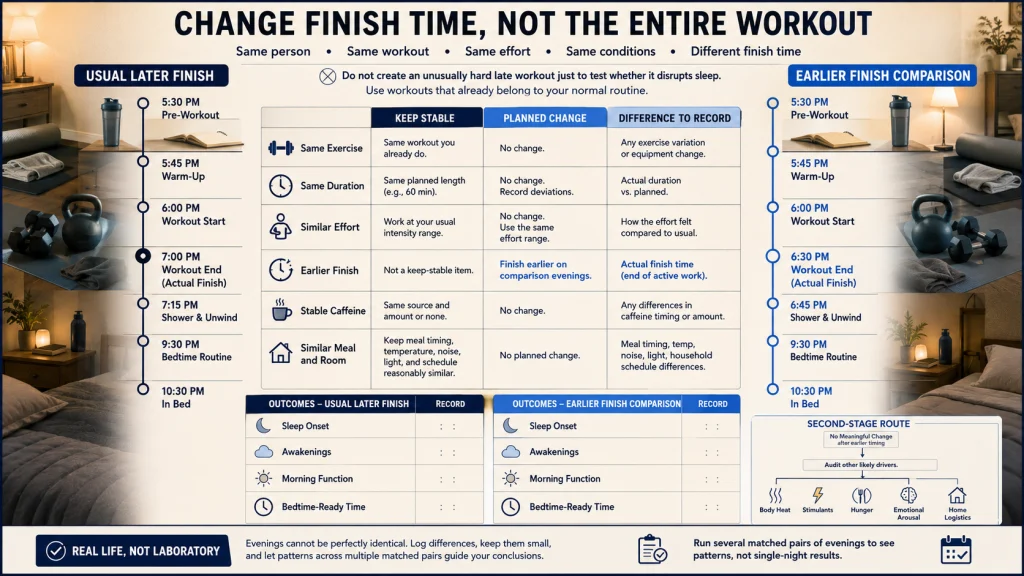
If timing is the suspected variable, keep the exercise type and duration as stable as practical. Move the same familiar session earlier on selected days rather than comparing two unrelated workouts.
| Test field | Keep stable | Change |
|---|---|---|
| Exercise type | The same familiar session | Nothing |
| Duration | The same planned length | Nothing |
| General effort | A similar perceived intensity | Nothing |
| Finish time | Record accurately | Earlier on comparison days |
| Caffeine and pre-workout | Keep the source and amount unchanged, or exclude it from both conditions | Do not alter during the timing test |
| Meal and room conditions | Keep reasonably similar | Record unavoidable differences |
Use sessions that belong in the normal routine. Do not create an unusually hard late workout to test whether it harms sleep. Compare sleep onset, awakenings, morning function, and bedtime-ready time across several sessions.
If the earlier finish changes nothing, return to the audit. Heat, stimulant use, hunger, emotional arousal, or home logistics may be the more useful variable to test next.
Create a Simple Cooldown Transition
A transition should help the household move from exercise to the normal evening routine. It does not need to become another performance system with special scores, gadgets, supplements, or a long checklist.
Use the smallest sequence that handles the real friction:
- End the active session at the planned time.
- Complete the ordinary low-effort finish already appropriate for the workout.
- Lower noise and bright stimulation.
- Move equipment and damp clothing out of the sleeping area.
- Use a shower temperature and routine that do not extend overheating.
- Return to the same bedtime steps used on non-exercise evenings.
The transition is successful when it reduces delay and leaves the room ready for sleep. It does not need to make you feel perfectly calm or produce a specific wearable score.
Check Pre-Workout and Caffeine Labels Separately
A session may appear to be the problem when the more important exposure happened before it began. Check coffee, tea, energy products, powders, gels, chocolate, and labeled medicines for caffeine.
Record caffeine per serving and the number of servings actually consumed. Powder scoop size, repeated servings, concentrate instructions, and a bottle containing more than one serving can change the total.
Do not assume that a product marketed for exercise is stimulant-free. Also do not assume that all products with the same category name contain the same amount.
Use the guide to choosing a personal caffeine cutoff test when stimulant timing may be crossing the intended sleep window. Test caffeine separately from workout timing whenever possible.
Check Meal Timing and Post-Workout Hunger
Evening exercise can change when and how much a person wants to eat. A delayed dinner, large recovery meal, spicy food, heavy portion, or repeated kitchen cleanup may become the true bedtime obstacle.
Record whether the meal was planned before the session, delayed by the workout, or added because hunger appeared afterward. Also record when eating ended and whether fullness, reflux-like discomfort, thirst, or bathroom trips affected the night.
This article does not prescribe a recovery meal. Use the guide to late-night eating and sleep to evaluate meal timing, portion, and digestive comfort separately from the exercise session.
Audit Home Friction Around the Workout
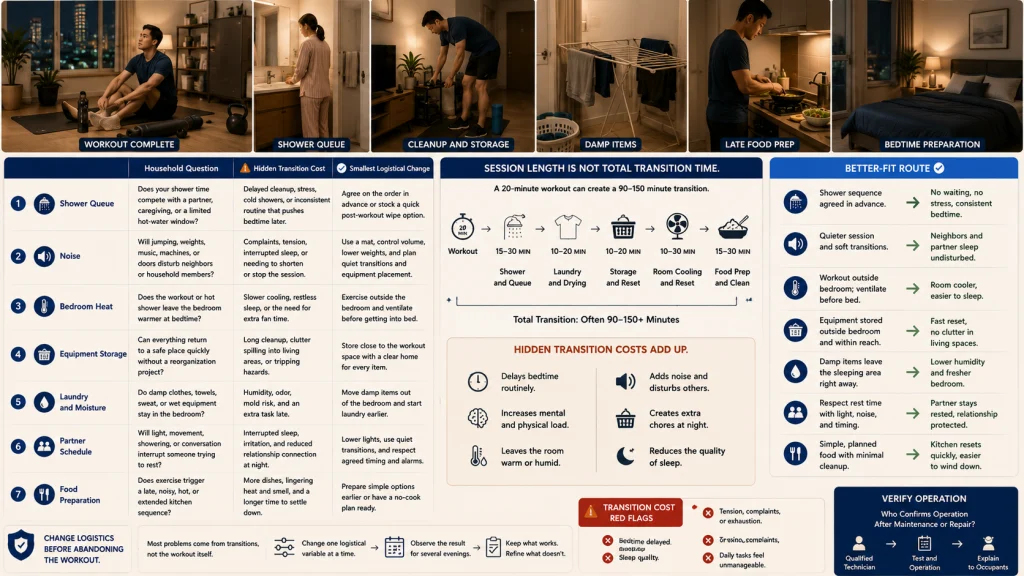
A workable evening session must fit the household, not only the exercise plan. The workout can be physiologically manageable while the setup creates conflict, delay, or a bedroom that is too warm and cluttered for sleep.
| Home-friction check | Question |
|---|---|
| Shower queue | Does the session compete with another person’s bedtime or bathroom routine? |
| Apartment noise | Do jumping, weights, music, or equipment disturb neighbors or household members? |
| Bedroom heat | Does exercise happen where the room must later cool for sleep? |
| Equipment storage | Can everything be put away without turning bedtime into a cleanup project? |
| Laundry and moisture | Are damp clothes and towels removed from the sleeping area promptly? |
| Partner schedule | Does light, noise, showering, or movement interrupt someone already resting? |
| Food preparation | Does the session create a late, noisy, or extended kitchen routine? |
A solution may be logistical rather than physiological. Moving equipment, shortening cleanup, preparing the room earlier, or choosing a quieter session can preserve the evening exercise window without pretending every late workout is the same.
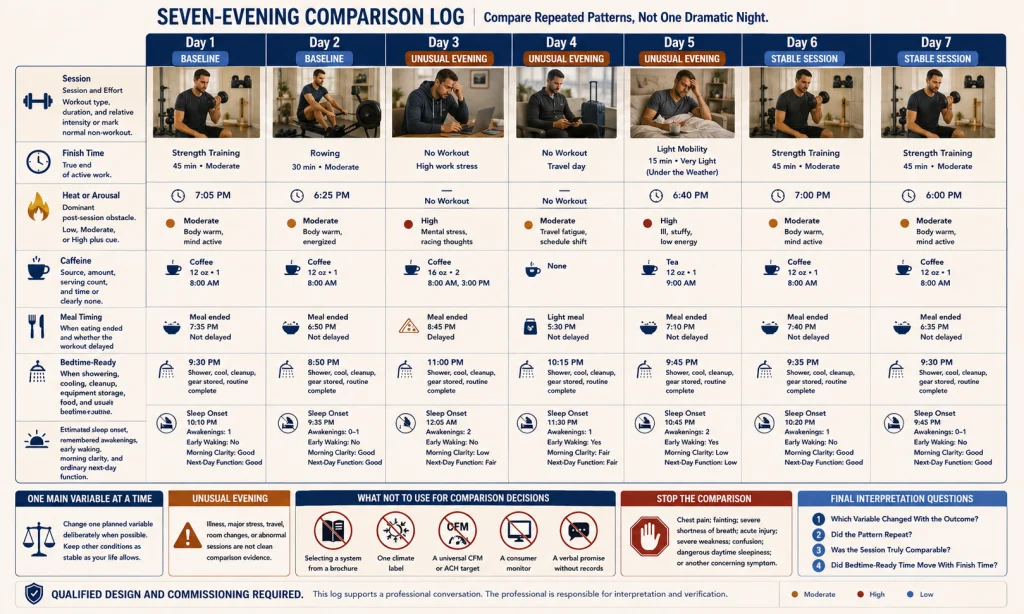
Use a One-Week Comparison Table
Use the week to compare repeated patterns, not to rebuild the experiment. Keep the main session stable on comparison days and mark evenings that were unusual.
| Day | Session and effort | Finish time | Heat or arousal | Caffeine | Meal timing | Bedtime-ready time | Sleep and morning notes |
|---|---|---|---|---|---|---|---|
| 1 | Record type, duration, and relative intensity | Record time | Low, moderate, or high | Source, amount, and time | When eating ended | Record time | Sleep onset, awakenings, morning function |
| 2 | Use the same detail | Record time | Low, moderate, or high | Source, amount, and time | When eating ended | Record time | Sleep onset, awakenings, morning function |
| 3 to 5 | Repeat on normal workout and non-workout evenings | Record time | Record the dominant obstacle | Keep stable when possible | Keep similar when possible | Record time | Note any unusual stress, illness, or room condition |
| 6 to 7 | Compare the stable session at another finish time when practical | Record time | Record the dominant obstacle | Keep stable | Keep similar | Record time | Compare the full night and next day |
Look first for the variable that changes with the outcome. If later finish time tracks with delayed sleep only on stimulant days, timing may not be the whole explanation. If bedtime-ready time stays late even when the workout ends earlier, the transition cost may be dominant.
Keep Symptoms and Medical Clearance Outside a Sleep Experiment
This article covers ordinary evening exercise timing in generally healthy adults. It does not provide an exercise program, cardiac clearance, injury treatment, disease-specific advice, or treatment for insomnia.
Stop and seek appropriate care: Chest pain, fainting, severe shortness of breath, a new irregular heartbeat sensation, acute injury, severe weakness, confusion, or another concerning symptom should not be managed by changing workout timing alone. Urgent or severe symptoms require urgent medical attention.
People with known heart, lung, metabolic, neurological, pregnancy-related, or other medical considerations should use individualized professional guidance for exercise intensity and timing. A normal wearable reading does not clear symptoms or prove that exercise is safe.
Persistent sleep difficulty, dangerous daytime sleepiness, or repeated breathing-related sleep symptoms also deserves appropriate assessment, regardless of whether the workout comparison shows a pattern.
Move the Variable, Not the Entire Workout
Write down the session type, duration, intensity, finish time, body heat, stimulant use, meal timing, emotional arousal, and bedtime-ready time. Then identify the first repeated obstacle.
If the session itself is stable, move one variable: finish earlier, remove the stimulant from both comparison conditions, simplify the meal sequence, reduce room heat, or shorten the cleanup transition. Do not change everything at once.
Evening may remain the only realistic exercise window. The goal is not to abandon it because of the clock, but to discover which part of the exposure repeatedly interferes with the full night.
FAQs
🌙 Is working out at night always bad for sleep?
No. Research does not show that all evening exercise is disruptive. Intensity, duration, finish time, stimulants, body heat, meal timing, and individual response all matter.
⏰ How long before bed should exercise end?
There is no universal buffer that works for every adult and every session. Test the same familiar workout at different finish times while keeping other major variables stable.
🚶 Is light movement different from a vigorous late workout?
Yes. They can differ in heat, arousal, soreness, hunger, duration, and cleanup. Do not classify them as the same exposure simply because both occur in the evening.
🔥 What if body heat is the main problem?
Record how long sweating and warmth continue, whether the room heats up, and whether a hot shower extends the transition. Test heat and room logistics separately from finish time.
☕ Can pre-workout affect the comparison?
Yes. Check caffeine per serving, actual servings, and consumption time. Keep stimulant use stable during a workout-timing test or test it as a separate variable.
🍽️ What if I become hungry after evening exercise?
Record whether exercise delays dinner or creates an unplanned late meal. Evaluate meal timing, portion, comfort, and cleanup separately rather than blaming the workout automatically.
📊 Can a fitness tracker prove the workout harmed sleep?
No. A wearable can add timing and trend context, but it cannot prove causation, provide medical clearance, or diagnose a sleep disorder from one night.
🚨 When should I stop exercising and seek help?
Stop for chest pain, fainting, severe shortness of breath, acute injury, severe weakness, confusion, or another concerning symptom. Urgent or severe symptoms require urgent medical care.