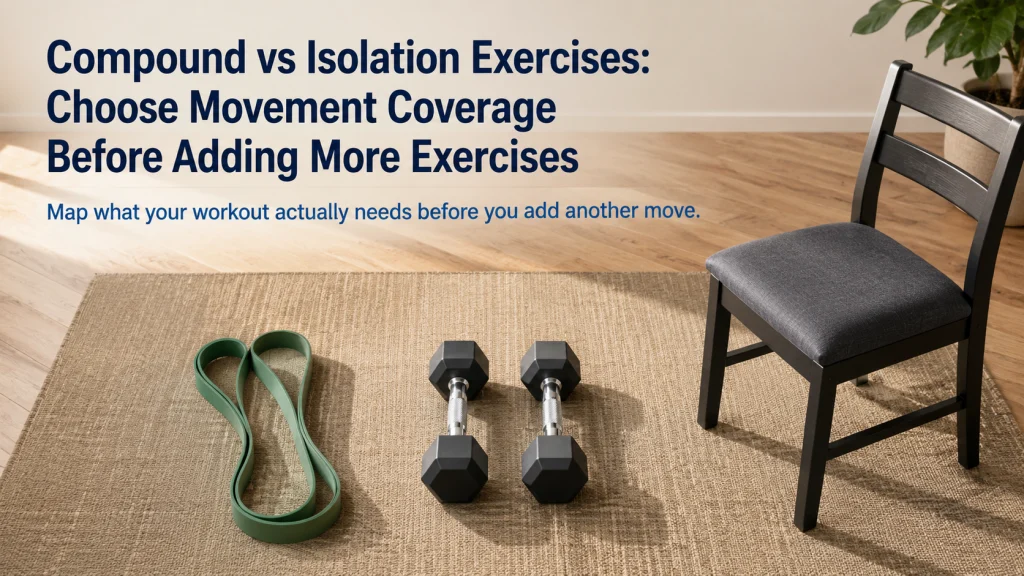
Compound and isolation exercises solve different selection problems, so neither category is automatically better. Start by mapping the movement functions your program needs, then choose exercises that cover those functions with the equipment, time, and space you actually have. Multi-joint movements often cover more work at once, while single-joint movements can add focused volume, preference, or a missing function. Put the exercise that matters most earlier in the session, then add accessory work only when it has a clear job.
Five Movement Functions Can Beat a List of Twelve Exercises
A longer workout list can feel reassuring because every visible muscle seems to have its own exercise. Consider two home strength sessions. The first uses five movement patterns: a push, a pull, a squat, a hinge, and a trunk exercise. The second contains twelve exercises, including several curl variations, two triceps movements, two shoulder raises, and repeated leg extensions, but no stable pulling movement.
The twelve-exercise plan looks more detailed on the screen. The five-pattern plan may be easier to remember, easier to set up, and more complete for the session’s actual purpose.
| Session design | Exercise count | Functions covered | Main gap |
|---|---|---|---|
| Five-pattern session | Five | Push, pull, squat, hinge, trunk | Optional focused work may be limited |
| Twelve-exercise session | Twelve | Several repeated arm and shoulder functions | No stable pull and little lower-body balance |
Exercise count and program usefulness are not the same thing. The first decision is whether the session covers the movements that matter, not whether the list is long enough to look impressive.
Define Multi-Joint and Single-Joint Movement Without Marketing Language
A multi-joint exercise uses meaningful movement at more than one joint. A squat variation involves the hips, knees, and ankles. A row usually involves the shoulder and elbow. A push-up uses the shoulder and elbow while the trunk helps maintain position.
A single-joint exercise emphasizes movement mainly at one joint. A curl focuses on elbow flexion, a lateral raise focuses on shoulder movement, and a leg extension focuses on the knee.
These labels describe how a movement is organized, not how valuable it is. A multi-joint exercise is not automatically safer or more useful, and a single-joint exercise is not automatically cosmetic or unnecessary. The category tells you what the movement does, while the program decides why it is there.
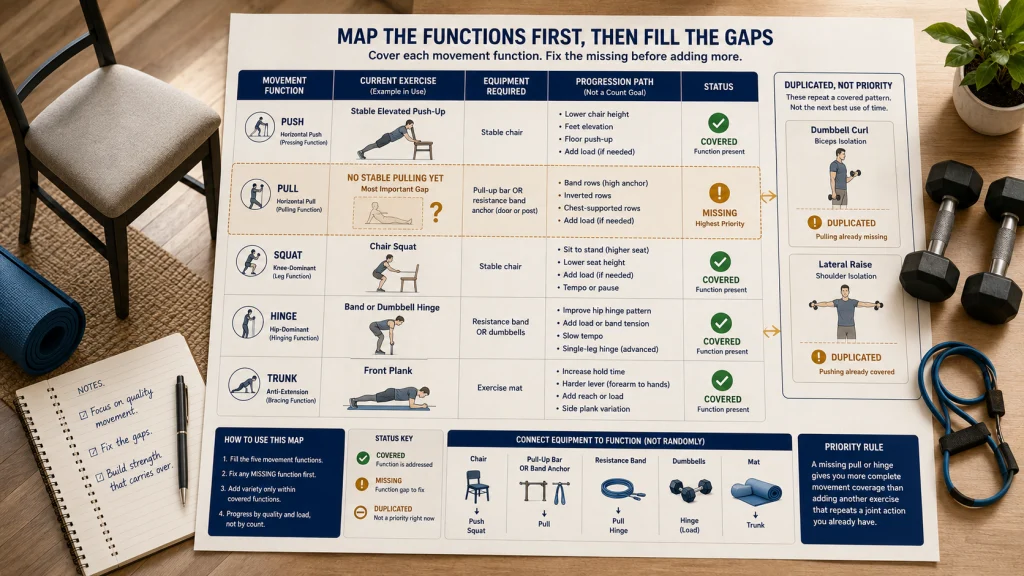
Map Movement Coverage Before Counting Exercises
Begin by listing the movement functions the program is meant to train. A simple home framework may include push, pull, squat, hinge, and trunk work. Additional functions belong only when they support the person’s goal, equipment, preference, or weekly plan.
| Movement function | Current exercise | Equipment needed | Progression path | Status |
|---|---|---|---|---|
| Push | __________ | __________ | __________ | Covered / Missing / Duplicated |
| Pull | __________ | __________ | __________ | Covered / Missing / Duplicated |
| Squat | __________ | __________ | __________ | Covered / Missing / Duplicated |
| Hinge | __________ | __________ | __________ | Covered / Missing / Duplicated |
| Trunk | __________ | __________ | __________ | Covered / Missing / Duplicated |
Use the worksheet to expose blank rows before adding new variations. A missing pull matters more than a second curl, and a missing hinge matters more than another exercise that repeats the same knee-dominant pattern.
Understand the Advantages and Limits of Multi-Joint Patterns
Multi-joint exercises can train several muscles and coordination demands within one set. That makes them useful when time is limited or when the session needs a small number of dependable anchors.
They also offer several ways to progress, including load, repetitions, range, tempo, leverage, and harder variations. This can make performance easier to compare from one session to the next.
The movement may still be limited by one weak link. Grip can end a row before the back reaches the intended effort, and balance or load placement can end a squat before the legs do.
Their broader demand can also require more setup and coordination. That tradeoff matters when the room is small, the equipment is awkward, or the person is still learning the movement.
Understand the Advantages and Limits of Single-Joint Work
Single-joint exercises can add focused work without repeating the full coordination and fatigue of a larger movement. They may be useful when one muscle receives too little work because another part of a multi-joint exercise reaches its limit first.
They can also make room for preference. A person who enjoys curls, calf raises, or lateral raises may be more willing to return to the program when one or two of those exercises are included.
Their limits are practical rather than moral. Resistance may be difficult to progress in small steps, the setup may be unstable, or local fatigue may interfere with a later priority exercise if the movement is placed too early.
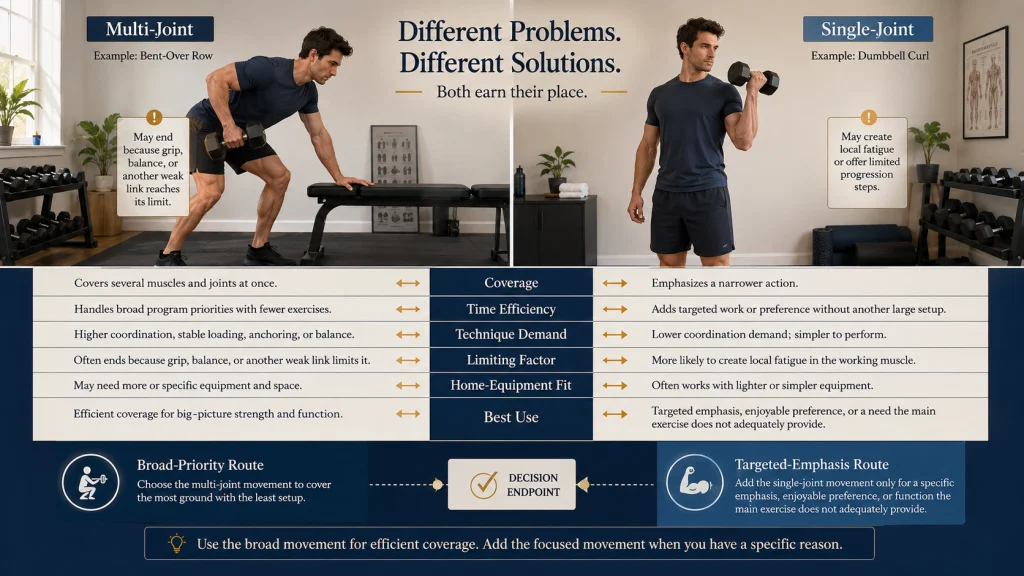
Compare the Categories by the Decision They Simplify
The useful comparison is not which category wins. It is which category solves the current problem with the least unnecessary complexity.
| Decision factor | Multi-joint movement | Single-joint movement |
|---|---|---|
| Movement coverage | Often covers several muscles and joints at once | Usually emphasizes a narrower function |
| Time efficiency | Can cover more program needs in fewer exercises | Can add targeted work without another large setup |
| Technique demand | May require more coordination and setup | May be simpler, but still requires controlled motion |
| Limiting factor | One muscle, grip, balance, or setup may end the set | Local fatigue may be easier to identify |
| Home equipment fit | May need stable loading or anchoring | Often works with lighter or simpler equipment |
| Best use | Covering broad program priorities | Adding a specific emphasis, preference, or missing function |
Read Comparative Research With Its Limits in View
Direct comparisons are shaped by the muscle measured, training experience, supervision, volume, exercise choice, and study duration. A result for one body part or one supervised program should not be treated as a complete exercise-selection rule.
Some studies report similar broad outcomes when effort and training volume are comparable, while others find muscle-specific differences. Those findings are most useful when they clarify a particular gap, not when they are turned into a rule that every program needs both categories for every muscle.
- Small samples may not represent all adults or home trainees.
- One measured muscle does not prove whole-program superiority.
- Gym machines and supervised equipment may not translate to a small home setup.
- Exercise labels do not capture technique, effort, progression, or adherence.
- A short comparison cannot determine the best long-term program for every goal.
Use the evidence to narrow the decision, then confirm that the movement fits the room, can be progressed, and supports the intended outcome.
Use Isolation Work for a Specific Gap, Preference, or Goal
Focused work belongs when it answers a specific question. Does the program need extra elbow flexion, calf work, shoulder elevation, or another emphasis? Does another factor limit the larger exercise before the target muscle receives enough work? Is the movement enjoyable enough to improve consistency?
Do not use a single-joint exercise to promise fat loss from one body area. The muscle being trained does not determine where body fat is reduced.
Editorial observation: Retail displays and workout libraries often give every visible muscle its own tile, attachment, or mini-routine. That presentation can make a short program feel unfinished even when the main work is already covered. Several curl variations may expand the list while the person still has no stable pulling movement that fits the room.
Account for Home Equipment and Setup Efficiency
At home, an exercise also has a setup cost. A movement may require a bench, door anchor, heavy load, clear floor area, chair, mat, or repeated furniture changes.
- Can the exercise be set up safely in the available room?
- Does it require moving furniture between every set?
- Can the resistance be adjusted in useful steps?
- Does the exercise duplicate a function already covered with less friction?
- Can the equipment be stored without making the routine harder to start?
One multi-joint exercise may save time when it covers several needs. One single-joint exercise may also save time when it adds focused work without another complex setup. Efficiency depends on the actual room and equipment, not the exercise label.
Efficiency can come from either category. A multi-joint movement may cover several needs in one setup, while a single-joint movement may add useful work with a light band and almost no room change. Judge the real setup, not the label.
Use bodyweight strength training when limited equipment changes the resistance method and exercise choices available at home.
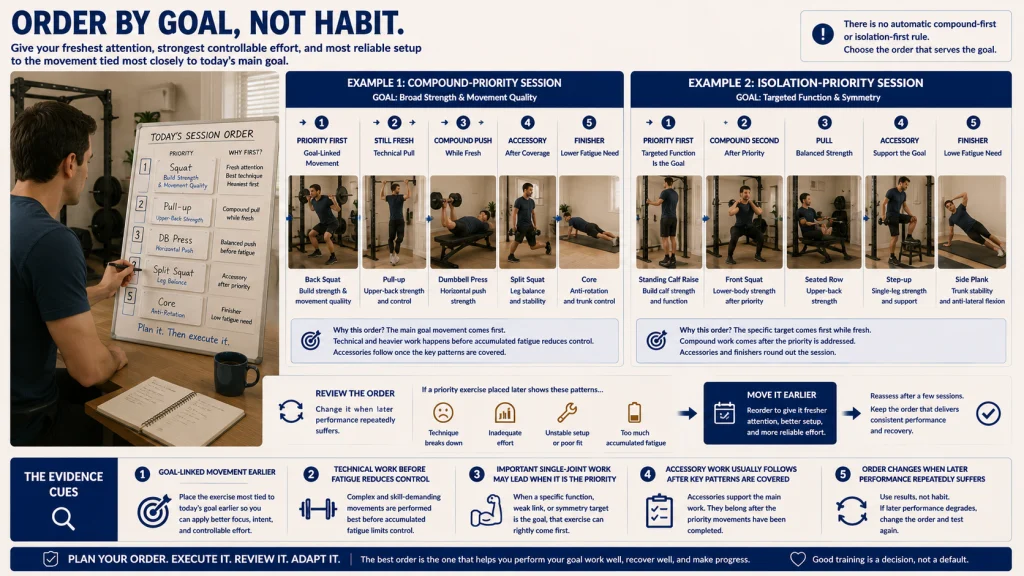
Place the Priority Exercise Earlier
Once the exercises are chosen, order determines which one receives the freshest attention. The priority movement usually belongs earlier because later exercises are performed with more accumulated fatigue.
- Place the movement tied most closely to the main goal earlier in the session.
- Put technically demanding exercises before fatigue makes setup or control less reliable.
- An important single-joint exercise can come first when it is the main priority.
- Accessory work usually follows once the main movement functions are covered.
- Change the order when later exercises repeatedly receive poor technique or too little effort.
The better question is not simply compound first or isolation first. It is which movement should receive the clearest technique, strongest effort, and most reliable setup today.
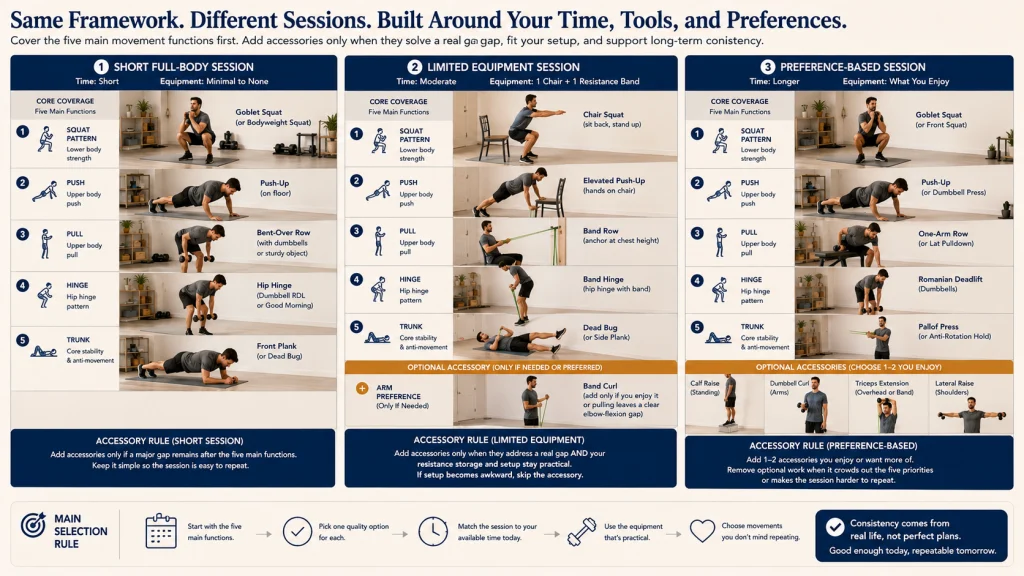
Build Sessions Around Coverage, Equipment, and Preference
The same framework can produce very different sessions because time, equipment, and preference change what is practical.
Short Full-Body Session
A brief session may use one squat pattern, one push, one pull, one hinge, and one trunk exercise. No accessory work is added unless a major function is missing or one exercise cannot be progressed.
Limited-Equipment Session
A person with one band and a chair might use a chair squat, elevated push-up, anchored band row, band hinge, and a simple trunk exercise. A curl can be added only if arm work is a real preference or the pulling setup does not provide enough elbow-flexion work.
Longer Preference-Based Session
A longer session may keep the five main functions, then add a calf raise, curl, triceps extension, or lateral raise because the person enjoys them or wants extra focused volume. The accessory exercises remain optional rather than proof that the session is complete.
| Session type | Main selection rule | Accessory rule |
|---|---|---|
| Short full-body | Cover the main functions with minimal exercise count | Add only for a clear gap |
| Limited equipment | Choose movements that fit one stable setup | Add only when resistance and storage remain practical |
| Preference-based | Keep broad coverage, then add enjoyable focused work | Remove accessories when they crowd out priorities |
These examples select movements inside one session. Use full-body and split workouts when the question is how those movements should be distributed across the week.
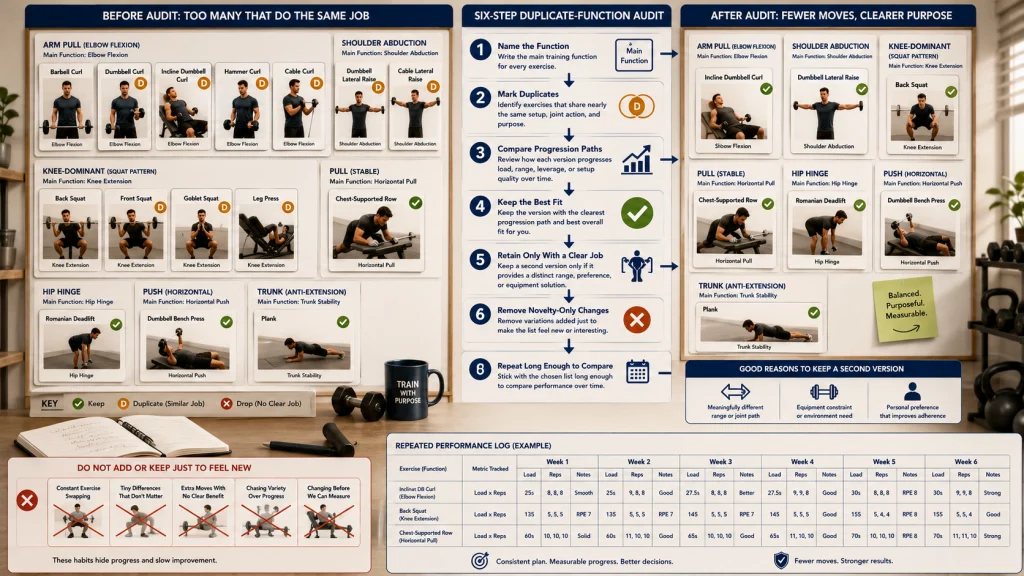
Audit Duplicate Function and Endless Variation
Frequent variation can make a program harder to evaluate. When exercises change every week, it becomes difficult to tell whether strength improved, whether setup became easier, or whether the list simply became different.
- Write the main training function beside every exercise.
- Mark exercises that use nearly the same setup, joint action, and purpose.
- Keep the version with the clearest progression path or best fit.
- Retain a second variation only when it serves a different preference, range, or equipment need.
- Remove changes made only to keep the list feeling new.
- Repeat the remaining exercises long enough to compare performance over time.
Use progressive overload at home when the urge to add another variation is really a need for a clearer way to make the current movement harder.
Keep Pain, Joint Limitations, and Rehabilitation Outside General Selection Rules
Do not use a single-joint exercise as a self-prescribed correction for pain, instability, numbness, weakness, or a movement problem. A focused exercise is not automatically a rehabilitation exercise.
Stop exercise and seek appropriate help for chest pain or pressure, fainting, severe dizziness, extreme shortness of breath, sudden weakness, serious injury, or severe pain. Persistent joint or muscle pain, neurological symptoms, pregnancy, recent surgery, chronic conditions, disability-related limitations, or a long period of inactivity may require individualized guidance.
This guide does not diagnose injuries, prescribe corrective exercise, create disease-specific programs, or replace a physician, physical therapist, or qualified exercise professional.
Identify the Movement Gaps, Priority, and Optional Accessory Work
List the movements the program needs, choose the exercise that best fits each job, and decide which one deserves the freshest effort.
Use multi-joint movements when one exercise can handle several priorities efficiently. Add single-joint work when it offers a specific emphasis, useful preference, or practical solution that the main movements do not provide.
For the wider training framework, return to strength training at home, how to exercise at home, or home workout plans.
FAQs
🧩 What is the main difference between compound and isolation exercises?
Compound exercises involve meaningful movement at more than one joint, while isolation exercises emphasize movement mainly at one joint. The distinction describes structure, not universal quality.
⏱️ Are compound exercises always more time-efficient?
Often, but not always. They can cover several movement demands at once, yet setup, coordination, and equipment may make a focused single-joint exercise more practical in some home sessions.
🎯 When should I add an isolation exercise?
Add one when it fills a missing function, provides desired muscle emphasis, fits a preference, or adds useful work that the main exercise does not provide.
📋 How many exercises should a home workout include?
Use enough exercises to cover the priority movement functions without unnecessary duplication. The correct number depends on time, equipment, weekly structure, and goals.
🏠 Which category works better with limited equipment?
Either can fit. Multi-joint movements may cover more needs with fewer exercises, while single-joint movements may work well with light bands or dumbbells and simple setups.
🔢 Should compound exercises always come first?
No. Place the exercise tied most closely to the main goal earlier. That may be a multi-joint or single-joint movement depending on the session priority.
🔁 How do I know whether exercises are duplicating each other?
Label the movement function beside each exercise. Repeated functions are useful only when they add a clear progression path, preference, or specific emphasis.
🚩 Can isolation exercises fix joint pain?
Do not prescribe them as a correction for pain or injury. Persistent symptoms and joint limitations require appropriate evaluation and individualized guidance.