Full-body and split routines can both work when weekly training volume and effort are comparable. The better structure is the one that fits your available days, session limit, home setup, recovery, and tolerance for missed workouts. A full-body plan spreads several muscle groups across fewer sessions, while a split divides the same weekly work across more focused days. Choose the calendar first, define what happens when a day is missed, and use progression data instead of beginner-versus-advanced labels.
Compare Equal Work Before Comparing Labels
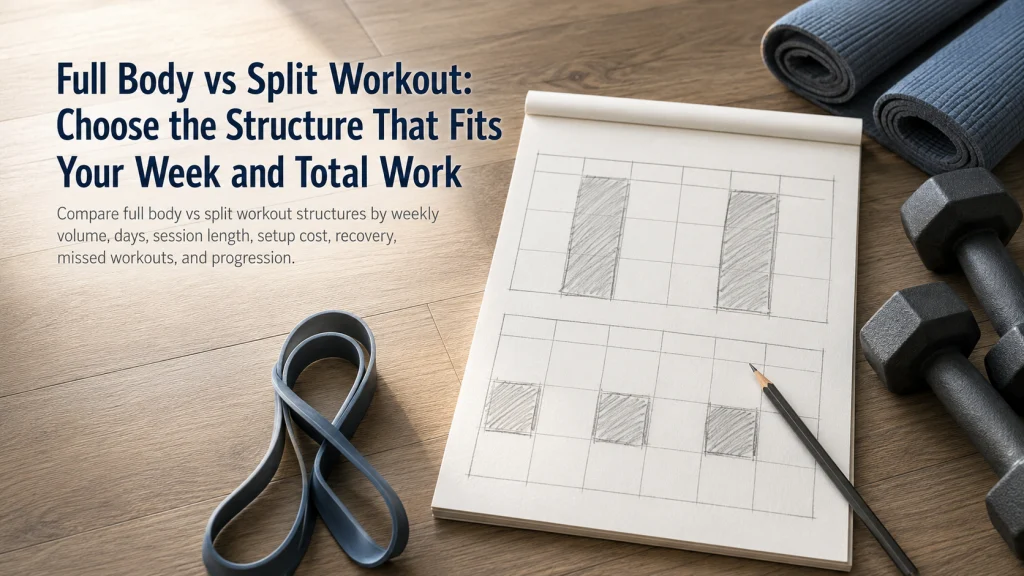
A weekly plan can look sensible on paper and still feel wrong once it meets a real household calendar. Consider two plans with the same eight exercises and sixteen total work sets. Plan A uses two longer full-body sessions, while Plan B distributes the same work across four shorter split sessions. The weekly amount is equal, but the lived experience of the week is different.
| Day | Two-day full-body structure | Four-day split structure |
|---|---|---|
| Monday | Eight work sets across several muscle groups | Four upper-body work sets |
| Tuesday | Rest or other activity | Four lower-body work sets |
| Thursday | Eight work sets across several muscle groups | Four upper-body work sets |
| Friday | Rest or other activity | Four lower-body work sets |
| Weekly total | Sixteen work sets | Sixteen work sets |
Remove one day from each calendar and the tradeoff becomes easier to see. The two-day plan loses half of its scheduled work. The four-day plan loses one quarter of the total, yet the missing session may also erase every direct set for one muscle group. The better calendar depends on the kind of disruption your week is most likely to create.
Define Full-Body and Split Structures
A full-body routine trains several major muscle groups in the same session. It does not require every exercise or every muscle group to receive equal attention each day. The defining feature is broad coverage within a session.
A split routine divides resistance work across different days. The split might separate upper and lower body, divide movement patterns, or rotate broad training groups. This article compares calendar structure only and does not prescribe a complete bodybuilding routine.
Neither structure belongs to one experience level. A beginner can use a simple split when the schedule supports it, and an experienced trainee can use full-body training when it matches available days and recovery.
For the larger decision map, review strength training at home.
Understand the Equal-Volume Evidence and Its Limits
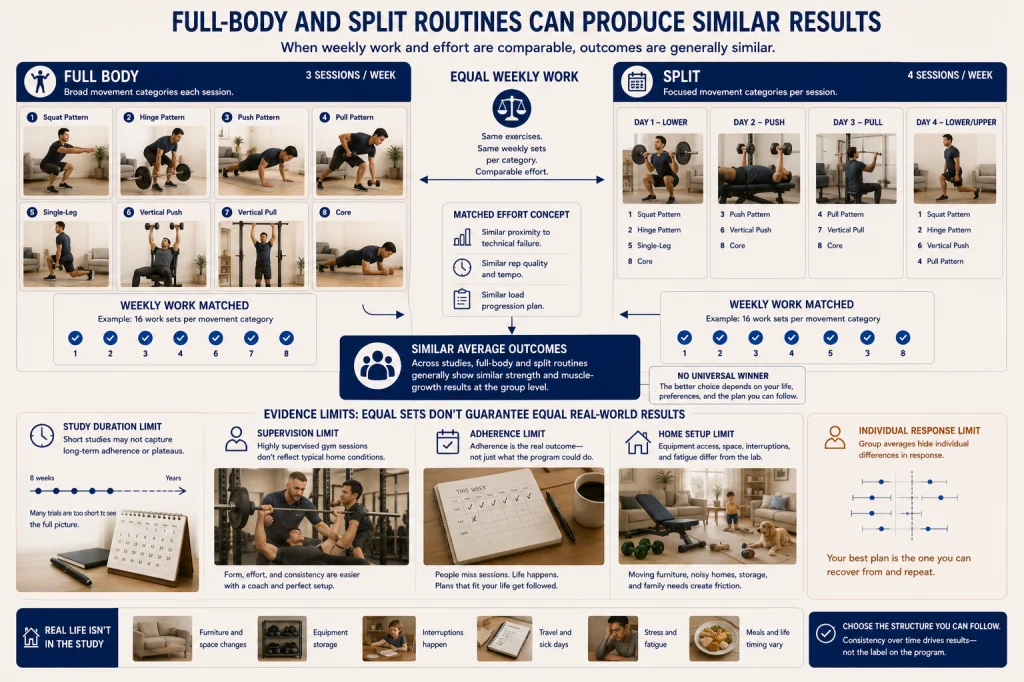
Research comparing full-body and split routines generally finds similar strength and muscle-growth outcomes when weekly training volume is equated. This supports a practical conclusion: distribution alone is unlikely to create a universal winner when the total work, effort, and progression are comparable.
That conclusion has limits. Studies differ in duration, training experience, exercise selection, supervision, adherence, and the way volume is matched. A result from one group cannot prove that every home trainee will respond identically.
- Equal weekly sets do not guarantee equal effort or technique quality.
- A short study may not capture long-term adherence or changing schedules.
- Supervised gym sessions may not reflect home setup friction.
- Average group results do not identify the best calendar for one household.
Use the evidence to remove exaggerated claims, not to ignore your schedule. The structure that allows consistent, progressive work is usually more useful than the one that looks more advanced.
Compare Your Available Training Days
Begin with the days you can protect in an ordinary week, not the schedule that works only when nothing goes wrong. Two dependable windows naturally favor broader sessions because each visit needs to cover more. With four dependable windows, the same weekly work can be spread into shorter, more focused blocks.
Three days leave room for either design. Broad sessions can repeat several movement patterns across the week. A rotating split can also work, although an uneven calendar may give one area two exposures this week and only one the next.
Use the beginner workout schedule guide when resistance training must fit beside cardio, mobility, or other weekly activities.
Compare Session Duration and Setup Cost
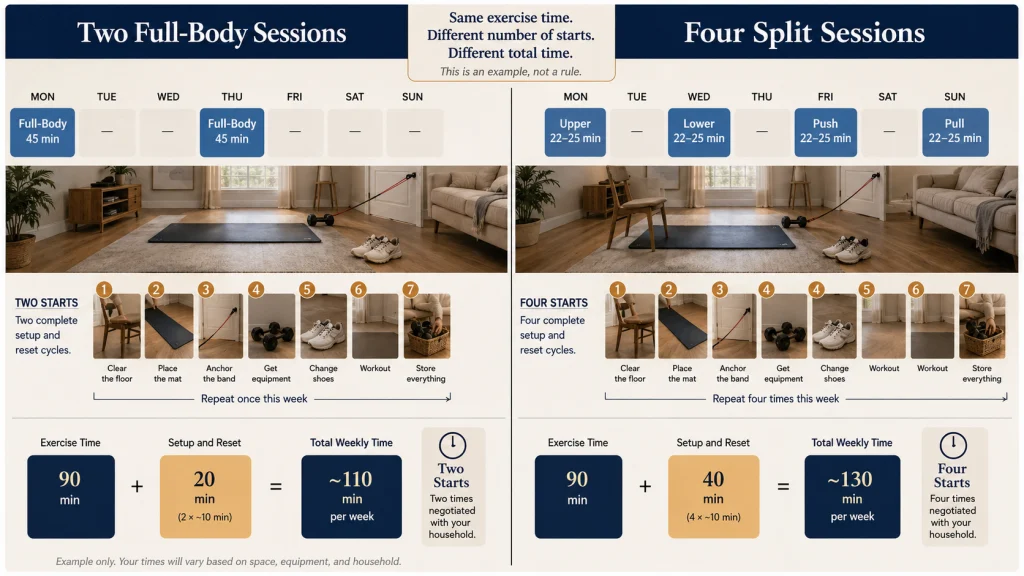
Split sessions are often shorter because they cover fewer muscle groups. Full-body sessions may take longer because they include more movement categories. Exercise time is only part of the comparison at home.
Setup cost includes moving furniture, laying out a mat, adjusting a bench or chair, anchoring a band, retrieving weights, changing shoes, and putting everything away. That cost repeats every time a session begins.
| Weekly structure | Exercise time | Setup and reset time | Total weekly time |
|---|---|---|---|
| Two full-body sessions | 45 minutes each, 90 minutes total | 10 minutes each, 20 minutes total | 110 minutes |
| Four split sessions | 22.5 minutes each, 90 minutes total | 10 minutes each, 40 minutes total | 130 minutes |
Editorial observation: Four short split sessions can require more total furniture moving, equipment setup, and household negotiation than two longer full-body sessions, even when the exercise time is identical.
Compare Frequency per Muscle Group
Frequency is the number of meaningful weekly exposures for a muscle group or movement pattern. Two broad sessions may provide two exposures, and an upper-lower calendar can reach the same number across four days.
Session names do not reveal the actual pattern. A four-day calendar might train one region once and another three times, while a three-day broad plan can shift emphasis without dropping repeated exposure.
Compare actual exposure rather than counting session names. The guide to beginner workout frequency covers the larger question of how many training days fit recovery and the rest of the week.
Compare Fatigue and Exercise Quality Within a Session
Within a broad session, attention and energy must be shared across several movement categories. Exercises placed near the end may receive less control when the earlier work is demanding or the session runs long.
Focused days solve that problem only partly. Concentrating several exercises on related muscles can create deep local fatigue, so a short upper-body session may still be more demanding for the shoulders and elbows than a longer mixed session.
Exercise order, set count, rest, and effort affect quality more than the structure name. The guide to rest between sets can help when rushed sessions are causing technique to decline.
Compare Resilience to a Missed Session
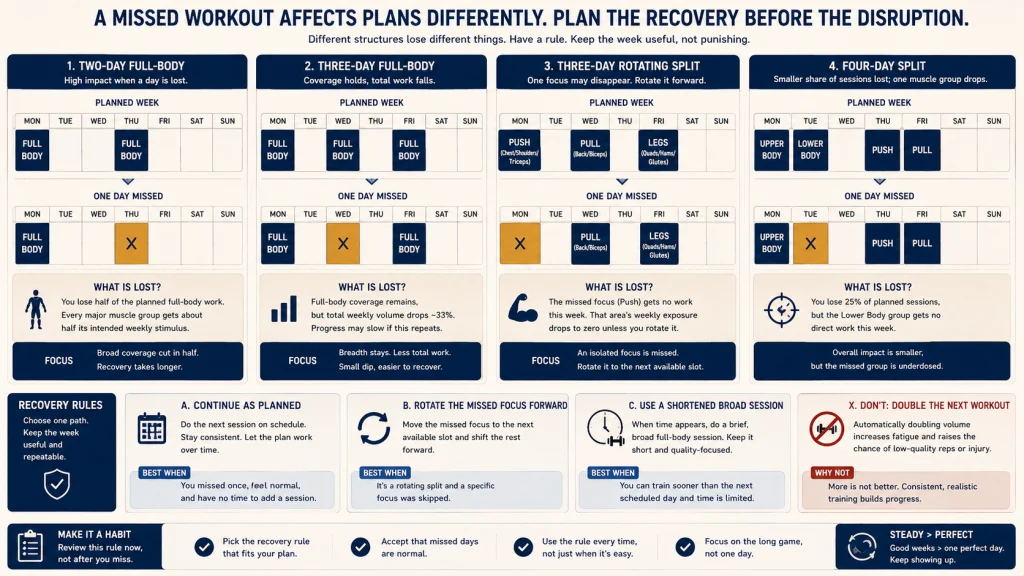
A resilient schedule includes a rule for disruption before disruption happens. Broad sessions distribute coverage across each visit, so losing one day removes a large share of the week but does not isolate the loss to one region. A focused calendar loses a smaller fraction of total sessions, yet the missed block may contain the only planned work for a specific area.
| Structure | Planned week | One missed day | Practical consequence |
|---|---|---|---|
| Two-day full-body | Two broad sessions | One broad session remains | Half the planned weekly work is lost across several groups. |
| Three-day full-body | Three broad sessions | Two broad sessions remain | Coverage remains broad, but total work drops. |
| Three-day split | Three focused sessions | One focus may disappear | The missed area may need to rotate into the next week. |
| Four-day split | Four focused sessions | Three sessions remain | Total loss is smaller, but one group’s frequency may fall sharply. |
Choose the recovery rule in advance. You might continue with the next scheduled day, rotate the missed focus forward, or use a shortened broad session when time allows. Automatically doubling the next workout usually creates a new problem instead of repairing the old calendar.
Compare Household Schedule, Space, Noise, and Equipment Constraints
Home training shares space with work calls, meals, children, roommates, neighbors, and storage limits. A four-day calendar may appear efficient until the same table must be moved, the same floor cleared, and the same equipment returned to storage four separate times.
Noise changes the decision too. A brief evening session can be easier to schedule but harder to perform quietly, while two longer daytime sessions may create less friction for the people sharing the space.
Shared equipment adds another layer. One household may benefit from focused days that use a single setup, while another may prefer fewer sessions built around the same compact tools. The calendar has to work in the room, not only in a spreadsheet.
Use Two-Day or Three-Day Full-Body Structures
These examples show weekly distribution only. They are not complete exercise prescriptions.
| Example | Monday | Wednesday | Friday | Best fit |
|---|---|---|---|---|
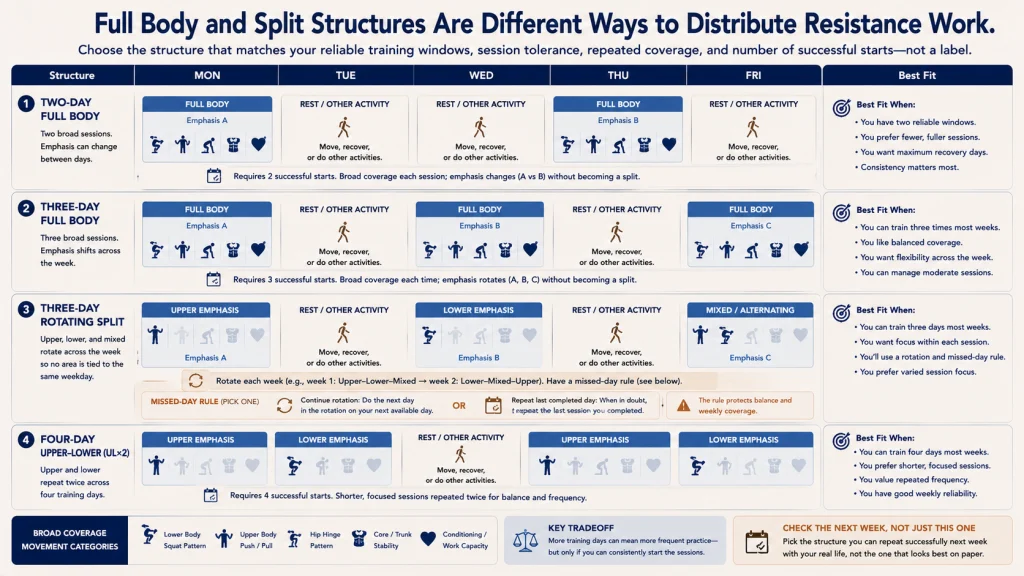
| Two-day full-body | Broad resistance session | Other activity or rest | Broad resistance session | Two reliable training windows and tolerance for longer sessions |
| Three-day full-body | Broad session, emphasis A | Broad session, emphasis B | Broad session, emphasis A or balanced work | Three moderate windows and preference for repeated broad coverage |
A full-body structure can vary emphasis without becoming a split. One day may place a lower-body movement earlier, while another begins with an upper-body movement, as long as each session still includes broad coverage.
Use Three-Day or Four-Day Split Structures
These schedules illustrate distribution without prescribing a complete routine.
| Example | Monday | Tuesday | Thursday | Friday |
|---|---|---|---|---|
| Three-day rotating split | Upper emphasis | Rest or other activity | Lower emphasis | Mixed or alternating emphasis |
| Four-day upper-lower split | Upper | Lower | Upper | Lower |
A three-day split often needs a rotation rule so one area is not always assigned the same weekday or skipped whenever the week becomes busy. A four-day split usually creates shorter sessions but requires four successful starts.
Consider a Hybrid Structure
A hybrid week blends broad coverage with focused work. One broad session can anchor the schedule while two shorter days add upper- or lower-body emphasis. Another version uses two broad days and keeps a brief practice session optional.
The advantage is flexibility: the anchor session preserves some coverage when a focused day disappears. The risk is that an optional session slowly becomes a required fourth day and recreates the scheduling problem.
Use a hybrid only when it solves a named issue, such as limited weekday time or one movement that needs more practice. Complexity is not evidence of a better plan.
Compare the Main Tradeoffs
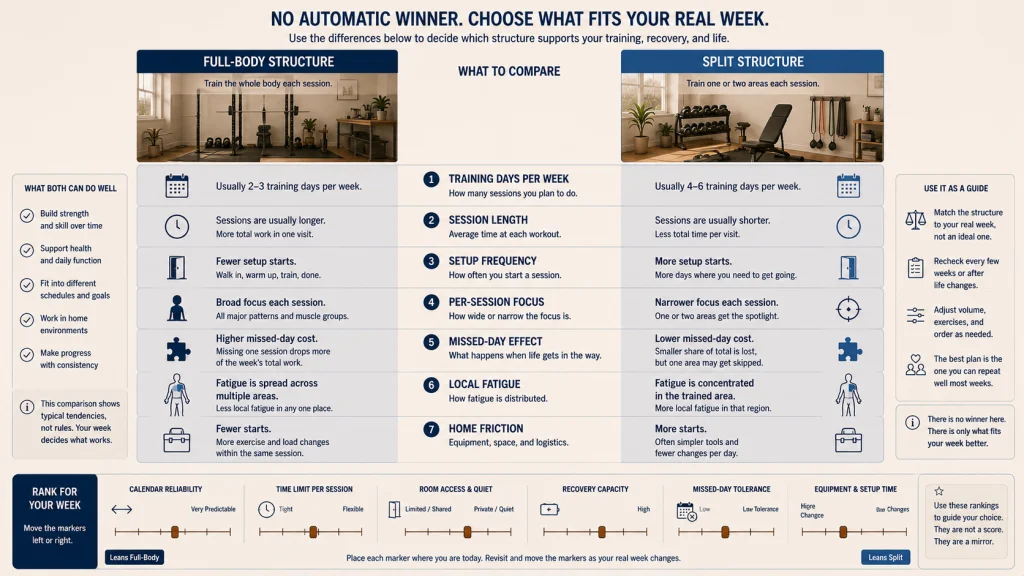
| Factor | Full-body structure | Split structure |
|---|---|---|
| Training days | Often fits fewer weekly days | Often spreads work across more days |
| Session length | Usually longer | Usually shorter |
| Setup frequency | Fewer weekly setups | More weekly setups |
| Per-session focus | Broad | Narrower |
| Missed-day effect | Larger share of total work lost | Smaller total share lost, but one area may disappear |
| Local fatigue | Spread across several groups | Can accumulate within the focused area |
| Home friction | Fewer starts, potentially more equipment changes per session | More starts, potentially simpler equipment needs each day |
No row creates an automatic winner. Rank the factors according to your actual week.
Choose Based on Adherence and Progression Data
Give the structure enough time to produce comparable information. Track completed sessions, setup time, session length, missed days, exercise quality, recovery, and whether the main movements are progressing.
The warning signs often show up outside the exercise log: a room that is never free at the planned hour, equipment that stays packed away, or a final movement that is always rushed. Those patterns may call for a different distribution rather than a harder session.
- Weekly days: How many sessions were actually completed?
- Session limit: Did the work fit the available time without rushing?
- Missed-day rule: Was the next step clear when life interrupted?
- Progression: Did repetitions, load, range, or control improve?
- Recovery: Was the next planned session manageable?
- Household fit: Did setup, noise, space, or shared equipment create repeated friction?
Use compound and isolation exercise choices only after the calendar structure is clear. Exercise selection and weekly distribution are related decisions, but they are not the same decision.
Keep the Weekly Structure Within Your Current Capacity
Changing from full-body to a split does not automatically increase recovery. Total weekly work, effort, exercise choice, sleep, and other activity still matter. Avoid adding training days while keeping every session unchanged unless the added weekly load is intentional and manageable.
Safety warning: Stop exercise and seek appropriate help for chest pain or pressure, fainting, severe dizziness, extreme shortness of breath, sudden weakness, serious injury, or severe pain. Persistent joint or muscle pain, neurological symptoms, pregnancy, recent surgery, chronic conditions, disability-related limitations, or a long period of inactivity may require individualized guidance.
This comparison is for generally healthy adults and does not prescribe rehabilitation, disease-specific training, sport peaking, or specialized bodybuilding programming.
Choose the Week Before Choosing the Label
Choose the days you can realistically protect, set a session limit that respects the rest of the household, and decide what happens when life removes one workout. Then select full-body, split, or hybrid distribution using setup cost, recovery, exercise quality, and progression data.
Comparable weekly work can succeed in either structure. The most useful choice is the one that still makes sense on a busy week, not only on the perfect one.
For broader planning beyond resistance training, use how to exercise at home and the collection of home workout plans.
FAQs
⚖️ Is full-body training better than a split?
Neither structure is universally better. When weekly volume and effort are comparable, the practical choice depends on available days, session length, recovery, setup, preference, and missed-day consequences.
🌱 Are full-body routines only for beginners?
No. Full-body training can suit different experience levels. It is a calendar structure, not a beginner label.
🏋️ Do split routines build more muscle?
A split does not automatically produce more muscle growth. Research generally finds similar outcomes when weekly volume is equated, though individual studies and populations have limits.
📅 Can I use full-body training three days per week?
Yes, when the per-session work and recovery are manageable. The three sessions can use broad coverage with different emphasis rather than identical workloads.
⏳ Which structure gives shorter workouts?
Split sessions are often shorter because they cover fewer areas, but more weekly setups can increase total time. Include furniture moving, equipment changes, and cleanup in the comparison.
🚫 What happens if I miss a workout?
Missing a full-body session removes broad weekly work. Missing a split day may remove all planned work for one group. Set a missed-day rule before the week begins.
🔀 Can I combine full-body and split training?
Yes. A hybrid can use one broad session plus focused days, or two broad days plus an optional practice session. Keep the purpose simple so the schedule does not become harder to follow.
📝 How long should I test a structure?
Use it long enough to gather several comparable weeks of attendance, session time, recovery, and progression data. Avoid switching after one unusually good or difficult session.