Training to failure is not the same as finishing a hard set, losing technique, or stopping at a planned repetition target. The useful decision is where the set should end before it begins, based on the exercise, equipment, training experience, home setup, and the consequences of getting stuck or losing control. Current evidence does not support making every set maximal as a universal requirement for strength or muscle gain. For most home training, a conservative stop with stable technique and a small amount of controlled capacity remaining is easier to repeat, progress, and recover from.

The Same Set Can End in Three Different Ways
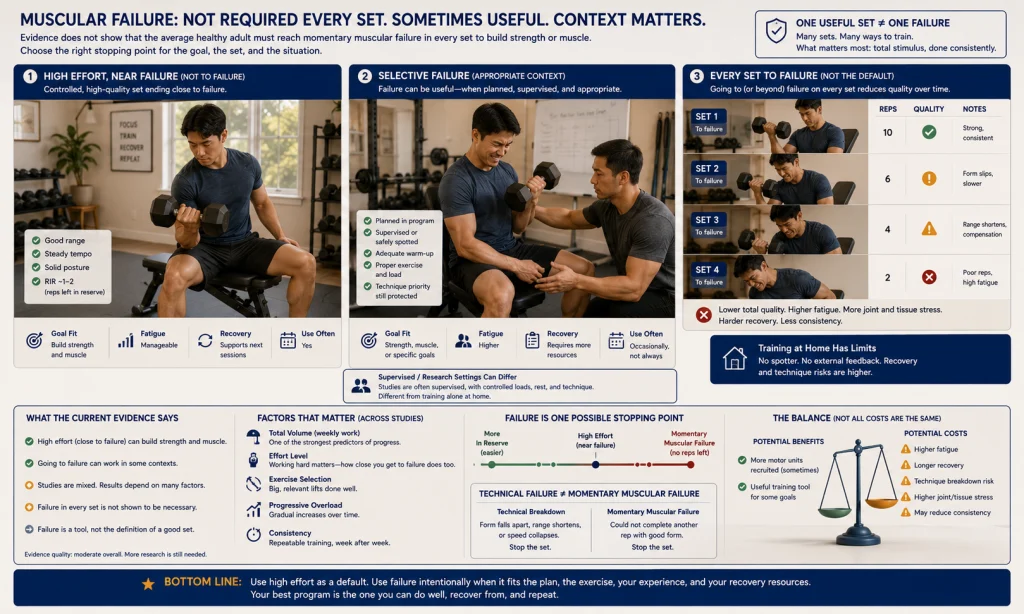
The difficult moment in a home set is often not the first repetition. It is the point near the end when the target number is close, the set already feels hard, and stopping can feel like quitting too early. Now imagine the same exercise, load, and target repeated three times. In the first version, the set ends after the planned repetition while posture, range, and tempo remain stable. In the second, the next repetition is completed only by shortening the range, shifting the body, or using momentum. In the third, another repetition is attempted with the intended technique but cannot be completed.
| Set ending | What happens | What it means |
|---|---|---|
| Planned stop | The target is reached with stable technique and some controlled capacity remaining | The set ends by design |
| Technical failure | The repetition depends on shortened range, momentum, shifting, or loss of control | The intended exercise standard has already ended |
| Momentary muscular failure | Another repetition cannot be completed with the intended technique despite a genuine attempt | The working muscles cannot complete the next repetition at that moment |
These endings are not interchangeable. A difficult repetition can still be controlled, while a completed repetition can already be technically unacceptable. Stopping before the number on the plan is reached may be the more disciplined choice when the movement itself has changed.
Define Planned Stop, Technical Failure, and Momentary Muscular Failure
A planned stop ends the set at a preselected repetition target or effort limit. It may leave a small amount of controlled capacity available, which can support repeatable technique and later sets.
Technical failure occurs when the intended movement standard can no longer be maintained. The range may shorten, the trunk may shift, the speed may become uncontrolled, or another body part may take over. Treating this breakdown as productive effort can turn a clear exercise into a different and less predictable movement.
Momentary muscular failure is reached when another repetition cannot be completed with the intended technique at that moment. It is not simply discomfort, a strong burn, slow movement, or uncertainty about whether another repetition would be difficult.
Proximity to failure describes how close the set ends to that final unsuccessful repetition. It can be estimated, but it cannot be measured perfectly during every home workout.
Use Current Evidence Without Treating Failure as Useless
Research comparing failure and non-failure resistance training generally does not show that momentary muscular failure is consistently required for the average healthy adult to gain strength or muscle. High-effort sets can be effective without ending in an unsuccessful repetition.
That does not mean failure has no place in any program. Studies differ in training experience, exercise choice, load, supervision, volume matching, and how failure is defined. Some advanced or specialized programs may use it selectively, but that does not make it a default requirement for home training.
- Failure is one possible stopping point, not the definition of a useful set.
- Volume, effort, exercise selection, progression, and consistency still matter.
- Study results from supervised settings may not reflect training alone at home.
- A set ending near failure is not identical to a set ending with unsafe technique.
- One research result cannot establish the best stopping rule for every person or exercise.
The practical question is not whether failure is always good or always bad. It is whether the selected stopping point supports the goal without creating unnecessary technique, recovery, or safety costs.
High Effort Does Not Require Making Every Set Maximal
A set can feel demanding while still ending before an unsuccessful repetition. Slower movement, local fatigue, and concentration can signal high effort without requiring the person to test the absolute limit.
Leaving a small amount of controlled capacity may preserve technique, reduce uncertainty, and make the remaining sets more useful. This is especially relevant when the workout includes several exercises or repeated sets for the same area.
The guide to choosing resistance for strength training helps separate the load decision from the stopping decision. The guide to sets and repetitions for beginners defines the planned work before effort limits are added.
Match the Stopping Rule to the Exercise Consequence
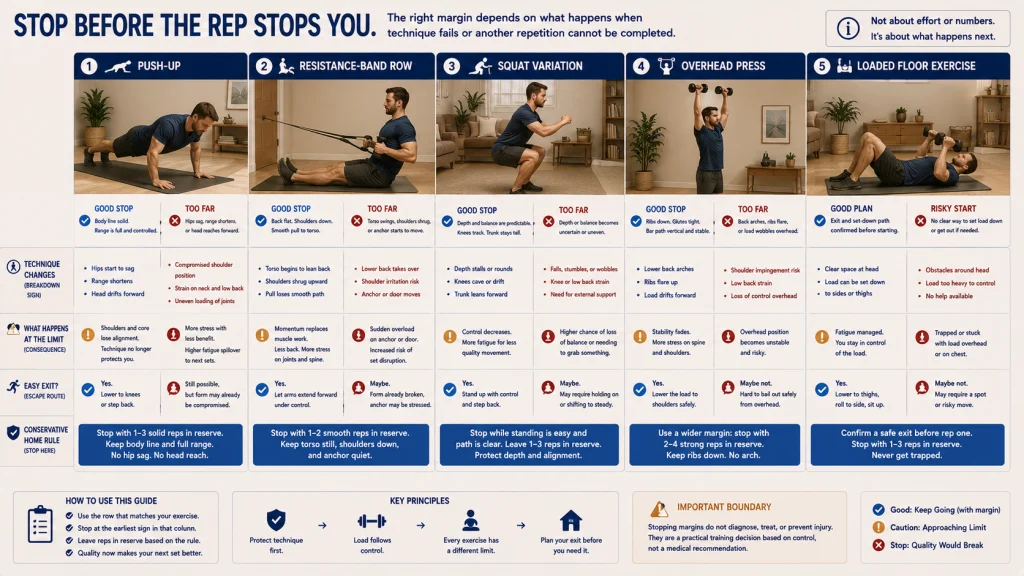
The consequence of reaching the limit depends on the movement itself. Body position, load path, available escape, and the way resistance is applied change what happens when another controlled repetition is no longer available.
| Exercise example | What technical breakdown may look like | Consequence of reaching the limit | Conservative home rule |
|---|---|---|---|
| Push-up | Hips sag, range shortens, or the head reaches forward | The person can usually lower to the floor, but shoulders or wrists may lose position | Stop when the next repetition would require a changed body line |
| Band row | Torso swings, shoulders shrug, or the band anchor shifts | A released band or unstable anchor can create a sudden movement | Stop before momentum or anchor movement replaces the row |
| Squat variation | Depth changes, knees or trunk shift, or balance becomes uncertain | A chair, wall, or loaded object may move when the person tries to recover | End the set while the standing path remains predictable |
| Overhead press | Back arches, rib position changes, or the load drifts | A failed repetition may leave the weight in an unstable overhead position | Use a wider margin and stop before the load path becomes uncertain |
| Loaded floor exercise | Range shortens or the load becomes difficult to reposition | The person may become trapped by the setup or unable to place the load safely | Define the exit and set-down plan before the first repetition |
A wider stopping margin is sensible when the movement has no easy exit or when a failed repetition changes the load path suddenly.
Account for Training Alone at Home
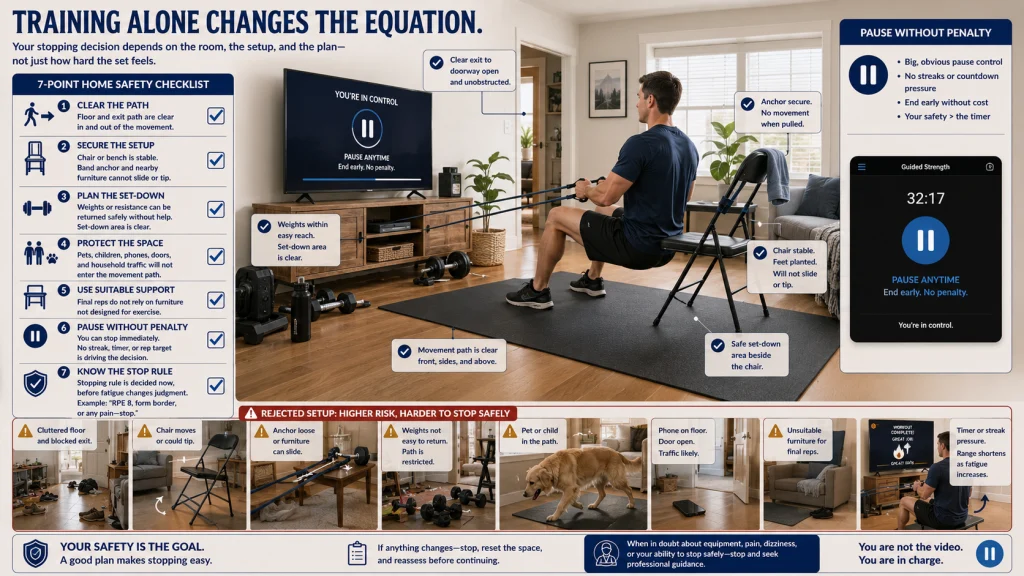
Training alone changes the environment around the set. There may be no one to move a chair, check an anchor, clear a pet from the floor, or help when the planned set takes longer than expected. The decision to continue therefore includes the room, equipment, and exit space, not only the working muscles.
- The floor area and exit path remain clear for the entire set.
- The chair, anchor, bench, and nearby furniture cannot slide or tip under load.
- The weight or band can be returned to a safe position without assistance.
- The phone, pet, child, door, or household traffic is unlikely to enter the movement path.
- The final repetitions do not depend on furniture that was not designed to support exercise.
- The set can be stopped immediately without preserving a video streak, timer, or repetition target.
- The stopping rule is known before fatigue makes the room feel less predictable.
Editorial observation: At home, the pressure to finish often comes from the screen rather than another person. A video may celebrate completion while remaining blind to a shortened range, a moving chair, or a band anchor that has started to shift. The safer interface is the one that makes stopping feel like a normal decision.
A home setup should make the conservative choice easy. If stopping requires dropping equipment, stepping around clutter, or arguing with a countdown, the setup needs to change before the effort limit does.
For the larger home setup and exercise decision map, use strength training at home.
Consider the Fatigue Cost for Later Sets and Sessions
A maximal set can reduce repetition performance, movement quality, and concentration in the sets that follow. The cost may also extend to another exercise in the same session or to the next planned workout.
That cost is not automatically unacceptable. It becomes a problem when the set produces more disruption than useful work. If the final repetition forces a long recovery, removes later planned sets, or changes technique for the rest of the session, the stopping rule may be too aggressive.
Use rest between sets when the next set is repeatedly limited by incomplete recovery. Use workout recovery when fatigue is carrying into later days.
Let Beginners Learn Stable Technique Before Testing Limits
Beginners are still learning what a controlled repetition feels like. They may confuse discomfort with failure, mistake a new coordination problem for muscle limitation, or continue after the movement has already changed.
A conservative stop gives more opportunities to repeat the intended technique. It also makes it easier to compare sessions because the exercise is less likely to change shape as fatigue rises.
Beginners do not need to prove effort by reaching an unsuccessful repetition. A repeatable set with clear technique and a known stopping rule is more useful than a dramatic final attempt.
Estimate Remaining Controlled Repetitions Without Pretending It Is Exact
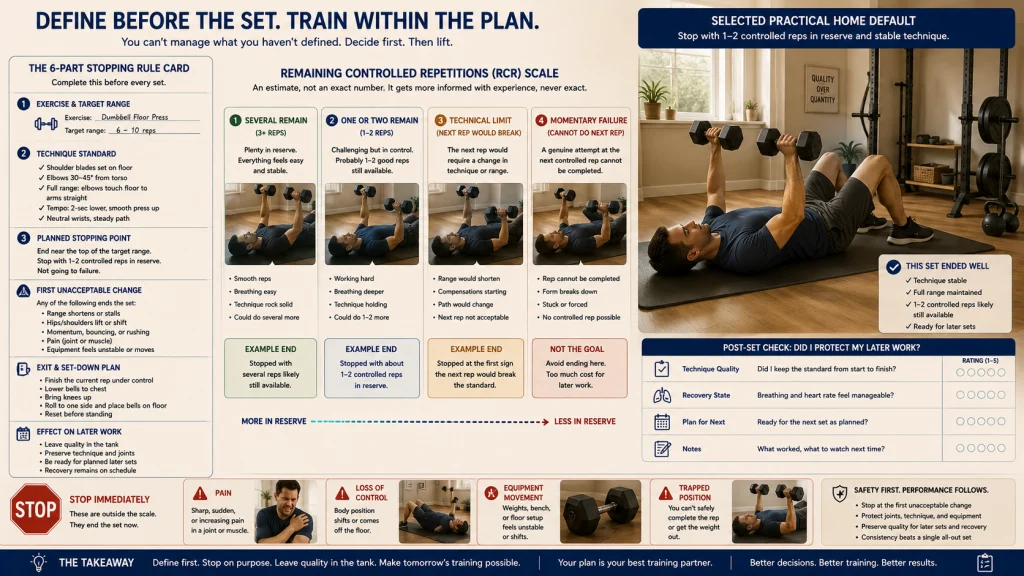
One practical method is to estimate how many additional repetitions could have been completed with the same range, posture, and movement path. The estimate is called remaining controlled repetitions here because the word controlled keeps technique inside the judgment.
| Example ending | Estimated capacity | Interpretation |
|---|---|---|
| The set ends while several smooth repetitions still seem available | Far from failure | Useful for practice, warm-up, or lower-demand work |
| The set ends when perhaps one or two controlled repetitions remain | Close to failure | High effort without requiring an unsuccessful repetition |
| The next repetition would require altered technique | Technical limit reached | Stop even if the load might still move another way |
| The next controlled repetition is attempted but cannot be completed | Momentary muscular failure | The set reached the unsuccessful-repetition endpoint |
The estimate improves with experience but remains imperfect. Do not use it as proof that every set landed at an exact distance from failure.
Use a Qualified Professional When the Stopping Point Is Hard to Judge
Individual guidance can help when technique changes are difficult to recognize, the exercise has a trapping risk, an old injury affects movement, or the person repeatedly reaches severe fatigue without knowing where the set should end.
Pregnancy, recent surgery, chronic conditions, disability-related limitations, neurological symptoms, persistent joint or muscle pain, or a long period of inactivity may require a physician, physical therapist, or qualified exercise professional to individualize the routine.
This article does not prescribe rehabilitation, disease-specific programs, maximal-load testing, forced repetitions, drop sets, or bodybuilding specialization.
Stop for Pain, Loss of Control, Trapped Positions, or Severe Symptoms
End the set immediately when pain, instability, equipment movement, a trapped position, or loss of control appears. Do not reinterpret those signals as productive effort.
Stop exercise and seek appropriate help for chest pain or pressure, fainting, severe dizziness, extreme shortness of breath, sudden weakness, serious injury, or severe pain. Do not continue because a repetition target or video countdown is unfinished.
Persistent joint or muscle pain, numbness, tingling, weakness, or other neurological symptoms require evaluation. A safer exercise or lower stopping limit may be needed, but that decision should not be improvised through repeated maximal attempts.
Define the Stopping Point Before Fatigue Makes the Decision
- Name the exercise and target repetition range.
- Define the technique standard that must remain stable.
- Choose whether the set ends at the target, near failure, or at another qualified limit.
- Identify the first unacceptable change, such as shortened range, momentum, shifting, pain, or unstable equipment.
- Confirm the exit and set-down plan.
- Record whether the rule preserved later sets and recovery.
Define the stopping point before the set begins, while the target, technique standard, and exit plan are still easy to judge. Separate a planned stop, technical failure, and momentary muscular failure, then match the limit to the exercise consequence, home setup, experience level, and effect on later work.
For many home sessions, stopping with stable technique and a small amount of controlled capacity remaining is a practical default. Failure can be used selectively, but it is not a universal requirement and should never be confused with pain, loss of control, or an unsafe position.
Use progressive overload at home to increase one measurable variable over time without making maximal effort the only progression method.
For the broader training system, return to how to exercise at home.
FAQs
🎯 What does training to failure mean?
It means reaching the point where another repetition cannot be completed with the intended technique at that moment. It is different from discomfort, a planned stop, or technique breakdown.
🧱 Is technical failure the same as muscular failure?
No. Technical failure occurs when the movement standard is lost. The load may still move through momentum, shortened range, or shifting, but the intended repetition has ended.
🌱 Should beginners train to failure?
Beginners usually benefit from learning repeatable technique and a conservative stopping rule before testing an unsuccessful repetition. High effort does not require a maximal ending.
💪 Is failure required for muscle growth?
Current evidence does not show a consistent requirement for momentary muscular failure in the average healthy adult. Sets performed near failure can still provide high effort.
🏠 Is training to failure riskier at home?
It can carry greater consequences when there is no spotter, no fixed rack, unstable furniture, limited space, or no clear way to set down the load.
🔢 How many repetitions should remain?
There is no exact number that fits every exercise and person. A common practical target is to stop while perhaps one or two controlled repetitions still seem available, then adjust using technique, recovery, and progression data.
📉 What if the last repetition uses momentum?
Treat that as a technique change, not proof of a productive final repetition. End the set when momentum replaces the intended movement standard.
🚩 When should I stop immediately?
Stop for pain, loss of control, unstable equipment, a trapped position, chest pain or pressure, fainting, severe dizziness, extreme shortness of breath, sudden weakness, serious injury, or severe pain.