Make-ahead meals work only when the recipe has a clear stopping point and the later cooking or serving step remains intact. A meal may be fully cooked, assembled but uncooked, partly prepared as separate components, or left at the measured-ingredient stage. Choose the stage before starting, keep raw animal foods separate from ready-to-eat ingredients, and do not invent partial-cooking shortcuts. Label the final step, storage destination, container instructions, and any required cooking or reheating directions so the meal can be completed safely.
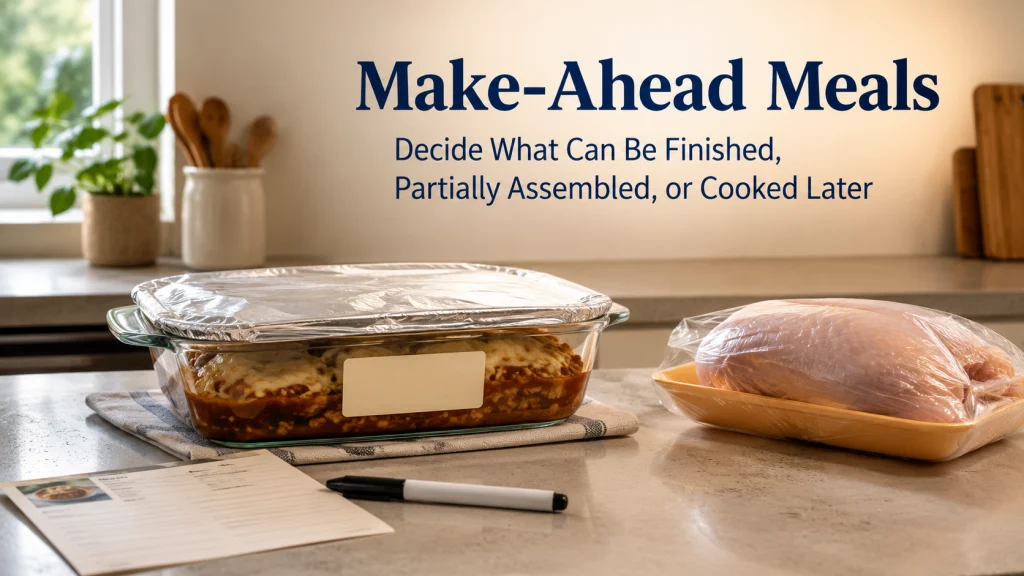
One Meal Can Have Four Very Different Stopping Points
Imagine one dinner planned for Thursday. On Sunday, the household could stop after measuring the dry ingredients, preparing several components, assembling the dish without cooking it, or fully cooking the meal and cooling it for later use. All four versions may be described casually as make-ahead, but they do not carry the same instructions.
| Stopping point | What is completed | What must remain clear |
|---|---|---|
| Measured ingredients | Selected ingredients are portioned but remain uncooked and mostly separate | The recipe, ingredient identity, storage needs, and later assembly order |
| Prepared components | Some ingredients are cooked or otherwise prepared as separate building blocks | Which component belongs to the meal and what final assembly remains |
| Assembled but uncooked | The meal is placed together in its intended cooking container without completing the main cook | Whether the recipe explicitly supports this stage, how it is stored, and the complete final cooking directions |
| Fully cooked | The meal reaches its completed cooking stage | Prompt cooling, storage destination, and the exact later reheating or serving method |
The tempting mistake is to stop wherever Sunday energy runs out and assume Thursday cooking will make the plan work. A useful make-ahead stage is chosen in advance and supported by the recipe. It is not a universal place where every meal can pause.
Separate Prepared Ingredients, Components, Assembled Meals, and Leftovers
The labels matter because two covered dishes can look equally finished while requiring very different next steps. A prepared ingredient is washed, cut, measured, or portioned before the main cooking step. A component is a cooked building block stored separately for later use. An assembled meal has been put together in its intended form but still needs the main cooking step. A fully cooked meal has completed that step before storage.
Par-cooked food has been partly cooked and is expected to finish later. That stage carries significant safety risk when it is improvised, especially with meat or poultry. A leftover begins as food cooked for an earlier meal or purpose and then stored for later use.
Use advance ingredient preparation when the work remains uncooked. Use component meal prep when separate cooked building blocks are the goal. This article follows one meal toward a defined stopping point instead of preparing unrelated parts.
Key decision: Name the stage in plain language before starting. “Make it ahead” is too vague to guide cooking, cooling, storage, or the final step.
Use a Tested or Clearly Written Recipe With Safety Directions
A reliable plan should still make sense when the person finishing the meal is tired, distracted, or was not present during preparation. The recipe needs to explain where work may stop and how the meal continues later, including raw handling, assembly, cooking, cooling, storage, thawing when applicable, and reheating.
Read the entire recipe before preparing anything. Look for:
- The exact stage that may be completed early.
- The container or cooking vessel required at that stage.
- Whether refrigeration or freezing is allowed.
- The final appliance, cooking method, temperature, or doneness instruction.
- Any change in cooking time after chilled or frozen storage.
- Instructions for cooling and reheating when the meal is fully cooked first.
A vague “prepare ahead” note may sound helpful while leaving the most important decision unresolved. When the stopping point, storage method, or later cooking change is missing, keep the meal at an earlier clearly supported stage rather than filling in the gap yourself.
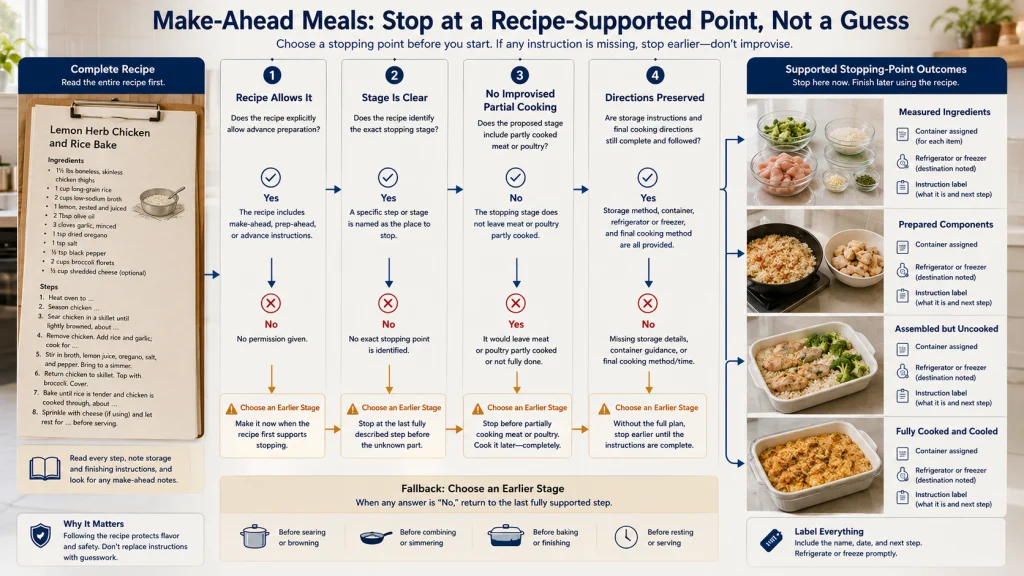
Identify the Exact Stopping Point Before Starting
The best stopping point removes enough work to make the later meal easier without leaving a confusing half-finished dish behind. Decide it before ingredients are mixed, containers are filled, or raw and cooked foods begin sharing the work area.
Safe-stopping-point decision tree:
Does the recipe explicitly allow advance preparation?
No → Do not create a make-ahead version.
Yes → Continue.
Does it identify the stage to stop?
No → Prepare only clearly supported ingredients or components.
Yes → Continue.
Does the stage involve partly cooked meat or poultry?
Yes → Stop unless validated guidance explicitly permits the exact method.
No → Continue.
Are storage and final cooking directions preserved?
No → Do not proceed until they are available.
Yes → Assign the container, destination, label, and later step.
A convenient stage is not automatically a suitable one. The meal may need to remain as separate ingredients, be assembled without cooking, or be fully cooked and cooled. Let the recipe decide which option is supported.
Keep Raw Animal Foods Separate From Ready-to-Eat Components
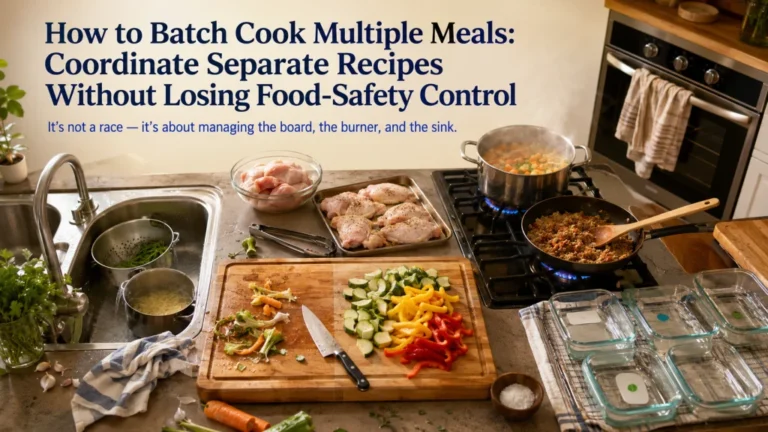
A busy prep counter can hold raw meat or poultry, cooked ingredients, vegetables, sauces, garnishes, labels, and clean containers within arm’s reach. The meal may feel organized while the work surface quietly becomes harder to control. Task order and separation are therefore part of the method, not an optional cleanup detail.
Prepare ready-to-eat ingredients in a clean zone, move them into clean covered containers, and clear the work area before handling raw animal foods. Wash hands and clean tools, boards, surfaces, and handles whenever contamination could transfer. Do not reuse a raw-food bowl, utensil, marinade, or cutting surface for cooked or ready-to-eat food without the correct cleaning step.
Place the recipe, labels, and clean storage containers away from the raw-food zone before work begins. That small choice keeps the written plan and finished components from being handled during the messiest part of preparation.
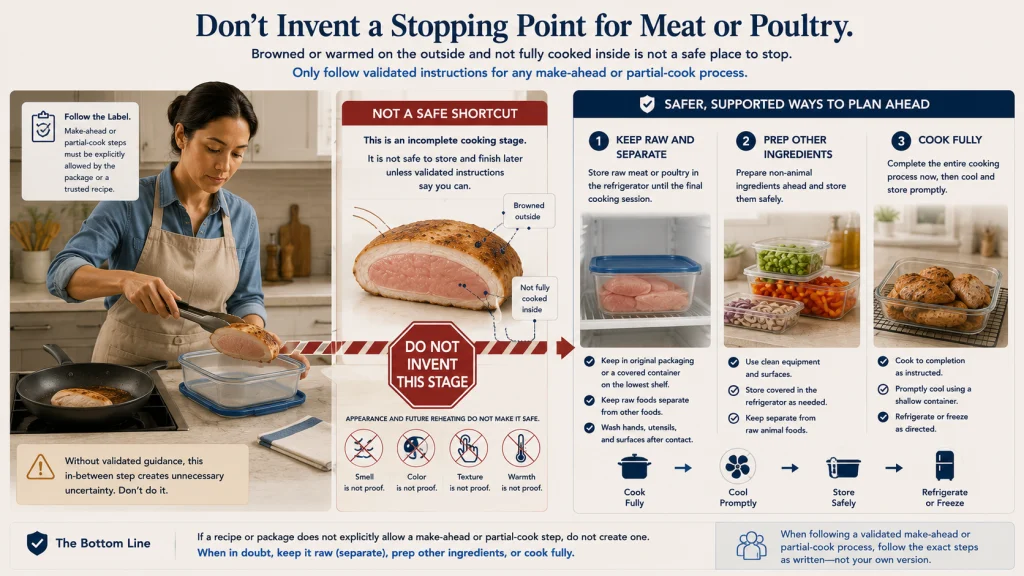
Do Not Invent a Partial-Cooking Stage for Meat or Poultry
Partly cooking meat or poultry can feel like a practical compromise when prep time is running short. The problem is that the food is left at a poorly controlled stage: the outside may look cooked, the center has not completed the required process, and the later cook may not know exactly what remains.
Safety warning: Do not partially cook meat or poultry for later completion unless validated guidance explicitly permits the exact method. Do not brown, warm, or begin cooking it simply because the meal will return to heat later. If the recipe does not support that stopping point, choose a different stage.
A safer alternative may be to keep the raw food refrigerated and separate until the final cooking session, prepare only the non-animal ingredients early, or cook the meal fully and follow the supported cooling and reheating path.
Do not use smell, appearance, texture, or the fact that food feels warm as proof that the partial stage was safe.
Preserve the Final Cooking Method, Temperature, Time, and Container Directions
Instructions that feel obvious on Sunday are easy to lose by Thursday. Once the dish is covered and stored, the next person should not have to remember which appliance, temperature, cover, or final check was intended.
Preserve the appliance or cooking method, any preheating step, the final cooking temperature or other doneness instruction, the expected time range, and any adjustment for chilled or frozen food. Keep details such as when to remove a cover, transfer the food, stir, rotate, rest, or check doneness with the meal rather than relying on memory.
Container labels such as oven-safe, microwave-safe, or freezer-safe describe the container under stated conditions. They do not prove that the recipe itself can be frozen, cooked from frozen, reheated evenly, or stored in that vessel without quality or safety problems.
Editorial observation: A dish with a freezer-safe label can still hold a recipe that does not freeze or reheat well. Container capability and recipe suitability are two separate checks.
Cool Fully Cooked Meals Promptly Before Storage
When the meal is fully cooked, the satisfying part may feel finished, but one important job remains. Cooling and storage need their own space in the plan. A deep, hot dish should not sit on the counter while the kitchen is reset and every other task is completed.
Divide larger amounts into suitable shallow containers or smaller portions when needed so cooling can proceed promptly. Assign refrigerator and freezer destinations before cooking begins, and leave enough space for the containers to be stored safely without being crowded beside raw food.
Safety warning: Refrigerate or freeze perishable cooked food promptly using the applicable guidance. Do not place a large batch into storage in a form that prevents safe cooling, and do not rely on smell, appearance, or taste as the sole safety test.
This article does not set universal refrigerator periods for finished meals. Food-specific storage, thawing, and reheating decisions belong in the dedicated storage guidance.
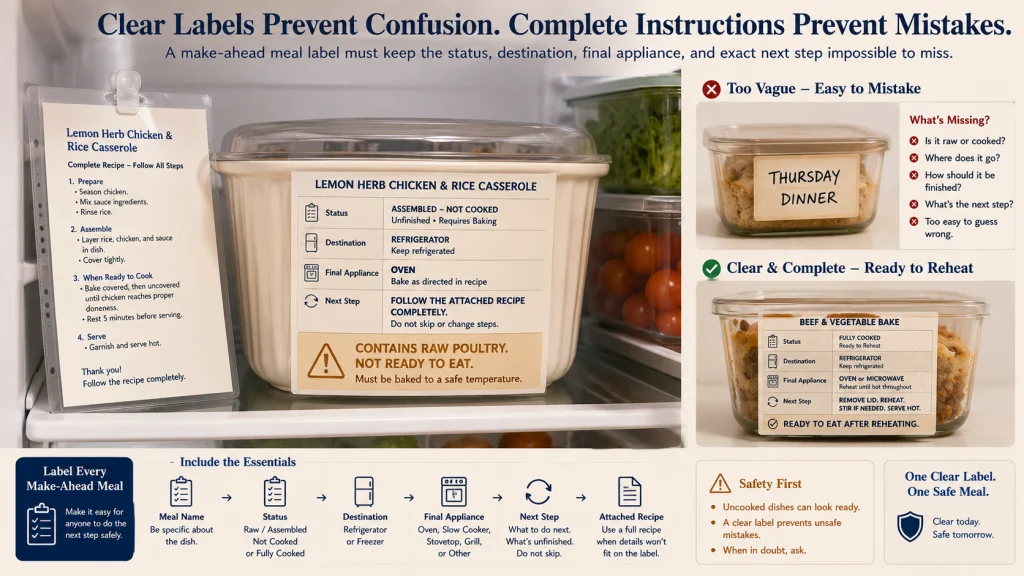
Label the Unfinished Step and Storage Destination
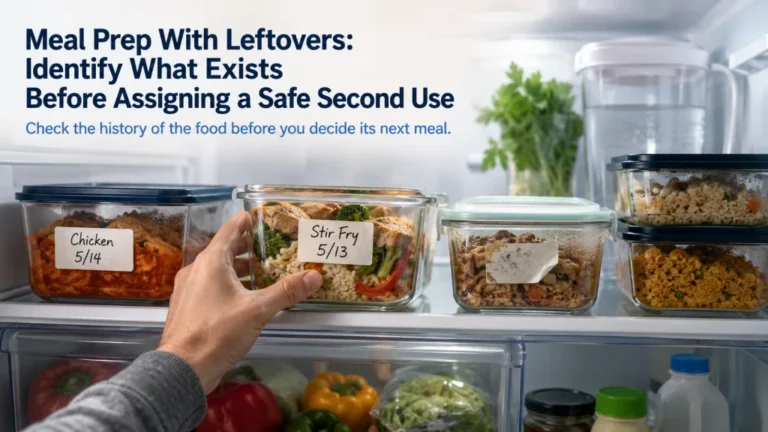
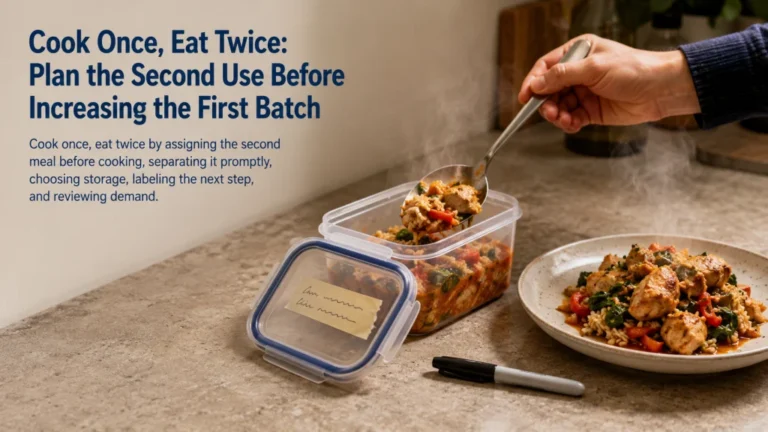
A useful label should answer the question someone will ask when opening the refrigerator: “Is this ready to eat, ready to heat, or still waiting to be cooked?” “Thursday dinner” does not distinguish an assembled raw meal from a fully cooked one.
Instruction-preservation label:
Meal: Thursday vegetable and poultry bake
Status: assembled, not cooked
Prepared: Monday evening
Destination: refrigerator
Final appliance: oven
Final step: follow the attached recipe directions completely
Important: contains raw poultry and is not ready to eat
For a fully cooked meal, replace the raw-food warning with the exact reheating and serving instructions. Preserve the recipe with the label when the directions are too detailed to fit clearly on the container.
A preparation date helps identify the batch. It does not create a universal safe storage period or replace the recipe’s storage guidance.
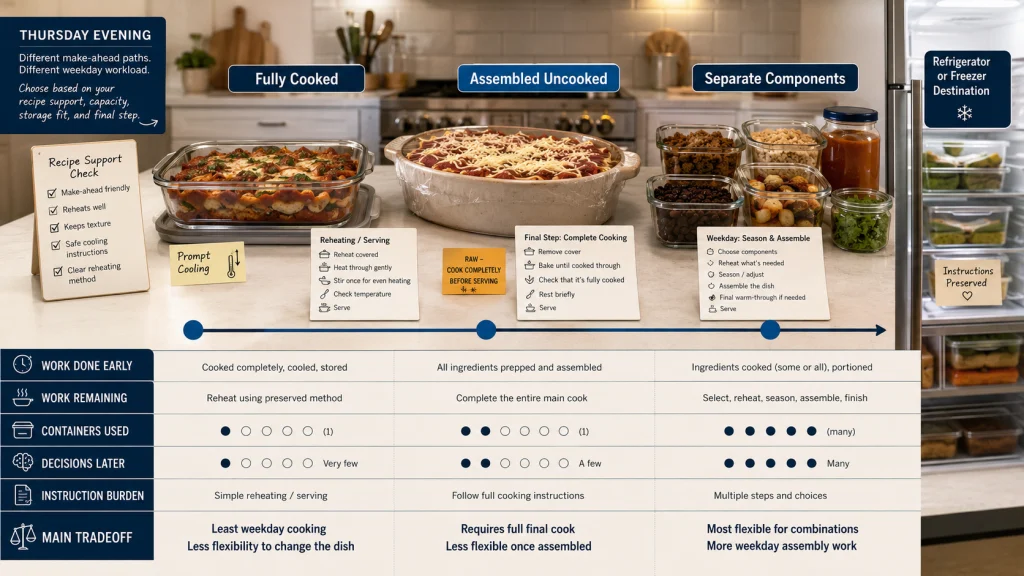
Compare Fully Cooked, Assembled Uncooked, and Component Methods
The best stage depends on what Thursday realistically looks like. Some households need a meal that can be reheated with almost no thought. Others prefer a freshly cooked finish and can handle one clear final step. No method is automatically more advanced or more convenient.
| Method | What is done early | What remains later | Main tradeoff |
|---|---|---|---|
| Fully cooked meal | The complete cooking step is finished before cooling and storage | Reheating or serving according to the preserved instructions | Least weekday cooking, but quality and reheating fit must be verified |
| Assembled but uncooked meal | The supported ingredients are combined in the intended cooking vessel | The complete main cooking step | Freshly cooked result, but raw-food separation and exact final directions are critical |
| Component method | Separate cooked building blocks are prepared | Selection, reheating, seasoning, and final assembly | More flexibility, but more containers and weekday decisions |
Choose the fully cooked route when the recipe supports cooling and reheating well and the household needs a nearly finished meal. Choose assembled uncooked only when the recipe clearly supports that stage. Choose components when flexible later use is worth the assembly burden.
Use freezer meal prep when frozen storage is part of the plan, and use the recipe-scaling guide before increasing yield.
Route Storage Duration, Freezing, Thawing, and Reheating to the Correct Process
Storage handoff: Once the stopping point is chosen, the remaining questions depend on the exact food, destination, and later method.
- How long a specific meal may remain refrigerated.
- Whether the recipe can be frozen at the selected stage.
- Which container and headspace are appropriate.
- Whether thawing is required before cooking or reheating.
- How the meal should be reheated evenly.
- Whether texture changes make the selected route a poor fit.
Use the meal-prep storage guide for these food-specific decisions. Container and appliance labels still need to be read alongside the actual recipe and storage method.
Do not use a slow cooker as a general shortcut for reheating refrigerated leftovers. Follow the supported reheating method for the exact meal instead of substituting an appliance because it can hold the food.
For container and appliance fit without product-specific recommendations, review meal-prep tools and appliances.
Choose the Stopping Point Before the Meal Enters Storage
Begin with a clearly written recipe, then decide where the meal should pause: measured ingredients, prepared components, assembled uncooked, or fully cooked. The goal is not to push every possible task into prep day. It is to leave a later meal that is easier to finish without becoming ambiguous.
Before storage, confirm five details: the recipe, stopping point, final step, refrigerator or freezer destination, and label. When any one of those is unclear, leave the meal at an earlier supported stage instead of inventing a shortcut.
Use the batch-cooking method guide when deciding among preparation approaches, and connect the meal to the complete meal-prep process when planning the wider week.
FAQs
🍲 Does make-ahead always mean fully cooked?
No. A make-ahead meal may stop at measured ingredients, prepared components, an assembled uncooked stage, or a fully cooked stage. The recipe must identify which stopping point is supported and what happens next.
🥩 Can I partially cook meat and finish it later?
Do not invent a partial-cooking method for meat or poultry. Use that stage only when validated guidance explicitly permits the exact process; otherwise keep it raw until the final cook or cook it fully before cooling and storage.
🧊 Does freezer-safe cookware mean the meal can be frozen?
No. A container may tolerate freezing while the meal still requires different preparation, storage, thawing, or reheating directions. Treat the vessel and the recipe as separate decisions.
🏷️ What should I write on an uncooked make-ahead meal?
Record the meal name, preparation date, storage destination, status as uncooked, final appliance, and complete cooking instruction. Make the raw-food status clear so the dish cannot be mistaken for ready-to-eat food.
🔥 Can I cook a chilled assembled meal for the original recipe time?
Do not assume the original time remains correct after chilled storage. Follow the recipe’s make-ahead directions, including any change in cooking method, time, temperature, or container.
🥘 Can I reheat leftovers in a slow cooker?
Do not use a slow cooker as a general reheating shortcut for refrigerated leftovers. Follow the supported reheating method for the specific food, then use the slow cooker only if the recipe provides a safe role for it.
⏳ How long can a make-ahead meal stay refrigerated?
There is no universal refrigerator period for every meal or stopping point. Record the preparation date and use food-specific storage guidance for the exact dish and stage.