Progressive overload at home means changing a stable routine in a way you can measure, not replacing the workout every time it starts to feel familiar. Begin with one repeatable exercise setup, choose a readiness trigger, and change only one variable such as repetitions, load, range, leverage, assistance, sets, or weekly exposure. Record the result before making another adjustment. Equipment can expand the available resistance range, but it is not the only path to progress.

A Comparable Log Shows Progress That Random Workouts Hide
Imagine two four-week training logs. The first repeats the same supported split squat with the same chair height, range, and set target. Week by week, the repetitions become smoother, the balance improves, and the final set ends with more control. In week five, the trainee lowers the support slightly and keeps everything else the same.
The second log lists a new workout every day. One session uses a band circuit, the next uses slow bodyweight repetitions, and the next adds a heavier household object. The sessions may feel difficult, but nothing is directly comparable. There is no clear way to tell whether the person became stronger, simply learned a new movement, or was tired from the previous day.
| Log pattern | What stays comparable | What the reader can learn |
|---|---|---|
| Same exercise and setup for four weeks | Variation, support, range, rep target, and rest | Whether control, repetitions, or remaining capacity improved |
| Different workout every session | Very little | That the session felt new or tiring, not necessarily that capacity increased |
Progress needs a baseline. Novelty can be enjoyable, but it cannot replace comparable information.
Separate Progression From Novelty, Fatigue, and Soreness
Progression means increasing the challenge of a repeatable movement or training dose after the current version has become stable enough to justify a change. The change might involve more resistance, more controlled repetitions, a larger range, less support, an additional set, or another measurable variable.
Novelty means doing something different. Fatigue means the body is temporarily less capable after work. Soreness is a sensation that can follow unfamiliar or demanding activity. None of these proves that the routine has progressed.
Key decision: Before changing an exercise, identify what improved in the current version and which single variable will test the next step.
For the larger programming map, review strength training at home. This article focuses only on changing a stable routine over time.
Establish a Stable Baseline and Technique Standard
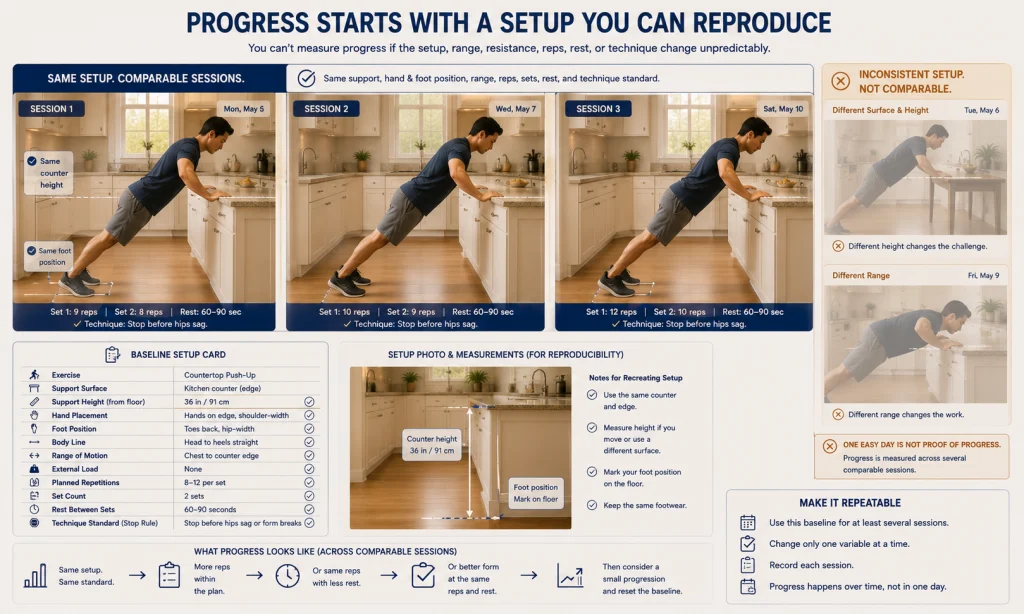
A baseline is the version of an exercise you can reproduce. Record the movement, support surface, range, band position or external load, planned repetitions, set count, rest, and the technique standard that ends the set.
For example, “push-up” is too vague for a useful comparison. “Countertop push-up with hands at the same edge, chest reaching the same height, two sets of eight, stopping before the hips sag” creates a repeatable reference.
Use a baseline long enough to observe more than one good day. One unusually easy session can reflect sleep, stress, timing, or a change in setup. A pattern across several comparable sessions gives a better reason to progress.
Practical tip: Take a quick setup note or photo of the support height, band anchor, or floor position when those details are hard to recreate.
Increase Controlled Repetitions Within the Planned Range
Adding repetitions is often the simplest progression because it does not require new equipment. Keep the exercise variation, range, load, support, and technique standard unchanged. Add repetitions only while the movement remains controlled and recovery stays acceptable.
If the plan is eight to twelve repetitions, a set might move from eight controlled repetitions to nine, then ten, across separate sessions. Once the upper end becomes repeatable, another variable can change. The number should not rise by shortening the range, rushing the movement, or ignoring technique loss.
The guide to sets and repetitions for beginners explains how to choose the current dose before using repetition increases as progression.
Increase External Resistance or Band Tension
When the current load and rep target are repeatable, a small resistance increase may be appropriate. Keep the exercise and technique standard stable so the new trial answers one clear question: can the reader perform the same movement with slightly more resistance?
With dumbbells, the next available increment may be larger than ideal. With bands, moving farther from the anchor, shortening the band, or choosing a different band can all increase tension. Record the exact change because a band label alone does not capture the starting stretch or movement path.
Use a conservative trial rather than jumping directly to the heaviest option available. The guide to choosing a strength-training load covers exercise-specific resistance selection without maximal testing.
Increase Range or Change Leverage
A larger controlled range can increase demand without changing the object in your hands. A squat may progress from touching a higher chair to reaching a slightly lower stable surface. A push-up may move from a wall to a countertop. A hip hinge may travel farther only if the spine and balance remain controlled.
Leverage changes how much of the body or external load must be controlled. Lowering the support in a push-up, extending the arms farther from the torso, or moving a weight farther from the body can make the same labeled load harder.
Do not add range and harder leverage in the same step. Choose one, record it, and compare the result against the previous setup.
Reduce Assistance or Increase One-Sided Contribution
Support can make a movement stable and scalable. Progress may come from using less hand pressure on a chair, relying less on the stronger leg, or shifting more work toward one side while keeping balance and control.
One-sided contribution does not require an advanced single-leg or single-arm skill. A split stance, staggered stance, supported step, or one-arm-supported row can increase the role of one side without removing every point of support.
For a full explanation of leverage, support, and bodyweight progressions, use bodyweight strength training.
Add a Set Only When the Current Work Is Repeatable
An additional set increases total work. It also increases session time and recovery demand, so it should not be the automatic first response to every plateau.
Consider adding a set when the current sets remain technically stable, the final repetitions are controlled, the exercise still fits the available time, and the reader is recovering normally between sessions. If the second set already deteriorates sharply, adding a third set may only repeat low-quality work.
Note: More sets are not automatically better. The added set should have a clear reason and should remain comparable to the existing work.
Change Weekly Exposure Only After Reviewing Recovery
Weekly exposure can increase by training a movement or muscle group more often. That change affects the entire week, not just one set, so it deserves a wider recovery review.
Look at sleep, ordinary energy, motivation, joint and muscle comfort, and whether performance is stable at the next session. If the current schedule already produces declining technique, persistent soreness, or unfinished sessions, adding another day is unlikely to solve the problem.
The broader workout recovery guide can help separate normal recovery needs from a progression plan that has become too demanding.
Use Tempo and Pauses as Tools, Not Automatic Upgrades
Slowing part of a repetition or adding a pause can increase control demands and make a familiar load feel harder. These tools can be useful when equipment increments are limited or when the reader wants to reinforce a stable position.
Tempo should not become exaggerated time under tension for its own sake. An extremely slow repetition may change breathing, balance, and fatigue so much that it no longer tests the same task. A pause should have a clear location and purpose, such as holding the bottom of a controlled split squat briefly before standing.
Record the tempo or pause. “Same exercise, but slower” is not enough detail for a future comparison.
Use a Home Progression Hierarchy Instead of Changing Everything
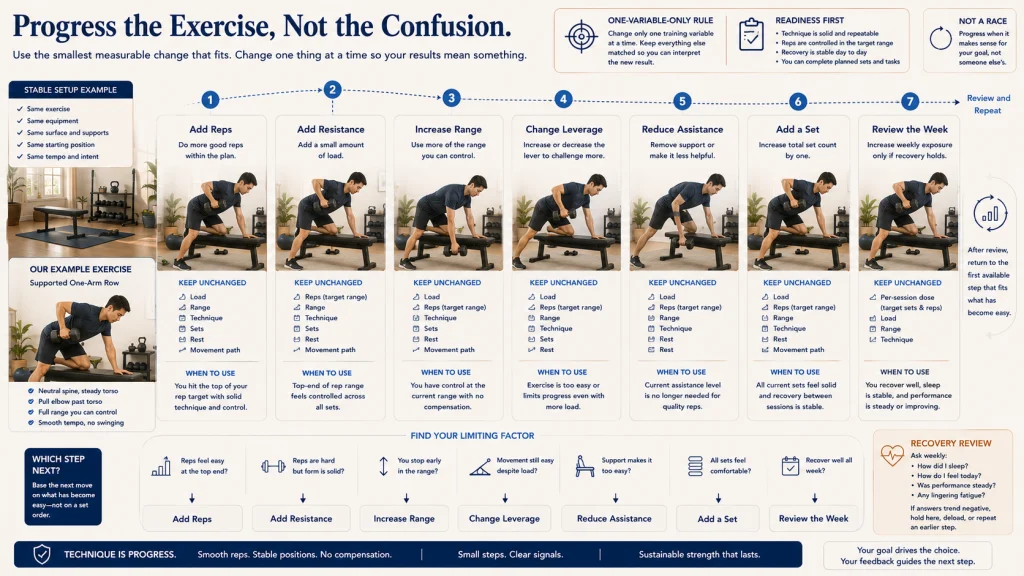
The best next variable depends on the exercise, available tools, and what has become easy. This hierarchy keeps the decision practical.
| Progression option | Use it when | Keep unchanged |
|---|---|---|
| Add controlled repetitions | The current variation is stable and below the planned upper range | Load, support, range, and technique standard |
| Add resistance | The upper rep target is repeatable with capacity remaining | Exercise, range, and set structure |
| Increase range | The current range is controlled and the next depth or reach is safe | Load, tempo, and support |
| Change leverage | The same movement pattern can be made slightly more demanding | Rep target, range standard, and set count |
| Reduce assistance | Support is no longer needed at the current level | Movement path and speed |
| Add a set | Existing sets remain repeatable and recovery supports more work | Load, variation, and rep target |
| Increase weekly exposure | The current week is stable and recovery remains adequate | Per-session dose at first |
Start near the top of the hierarchy when a small change can create a clear comparison. Move lower only when the simpler options no longer fit.
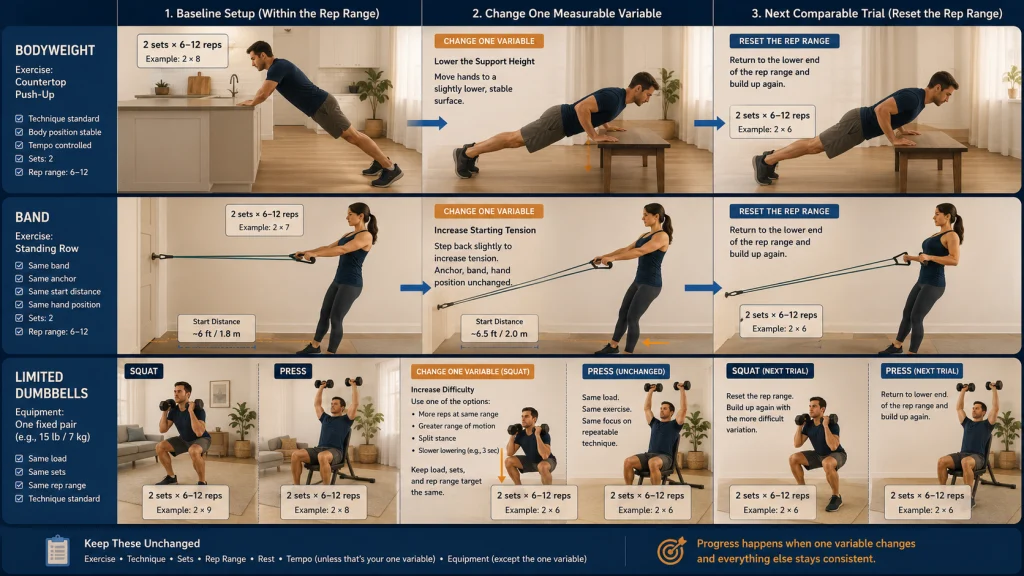
See How Progression Works With Three Home Methods
Bodyweight Example
A reader performs countertop push-ups for two sets of eight with stable hips and a consistent chest-to-counter range. Over several sessions, the reader reaches two sets of twelve without losing control.
The next change is lowering the hands to a slightly lower, stable surface while returning to the lower end of the rep range. Repetitions, range standard, and set count remain fixed during the first trial. The progression comes from leverage, not from adding every possible challenge at once.
Band Example
A standing band row uses the same band, anchor, starting distance, and hand position. The reader moves from ten to fifteen controlled repetitions while keeping the shoulder position stable.
The next step is a small increase in starting tension, created by stepping slightly farther from the anchor. The rep target returns to the lower end. Changing the band, stance, tempo, and target together would hide which variable produced the new difficulty.
Limited-Dumbbell Example
A reader has one pair of dumbbells that is too light for a squat but appropriate for a press. For the squat, the reader first increases controlled repetitions within the plan. When the pair still feels limited, the next step may be a larger range, a split stance, or slower lowering while keeping the load unchanged.
For the press, the same pair may already be challenging enough. The reader keeps the load and focuses on repeatable technique rather than copying the squat progression.
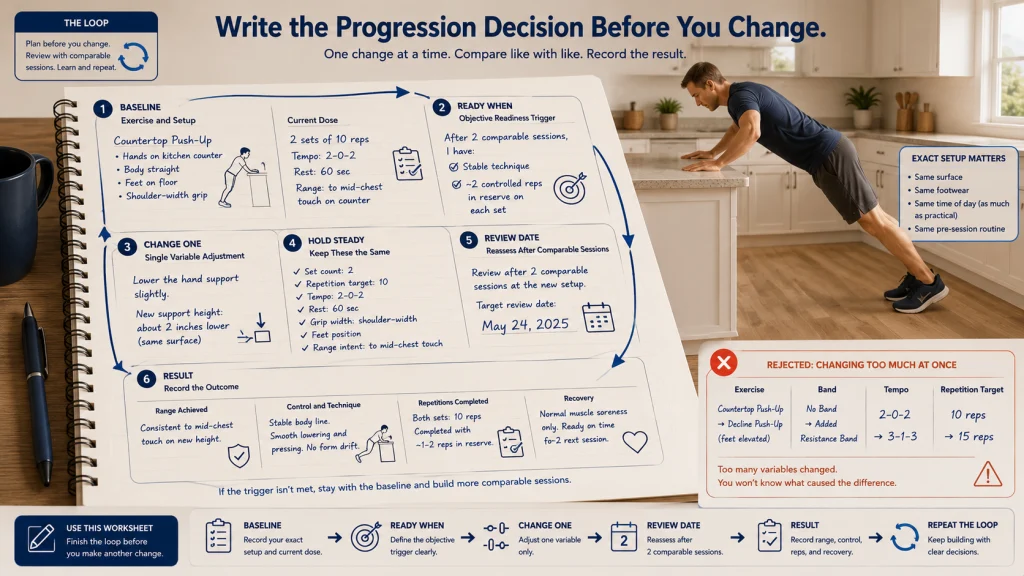
Use One Variable and a Dated Review
A progression decision should be specific enough to test. Write the baseline, readiness trigger, chosen variable, and review date before changing the routine.
| Worksheet field | Example entry |
|---|---|
| Exercise and setup | Countertop push-up, same surface and range |
| Current dose | Two sets of ten |
| Readiness trigger | Two sessions with stable technique and two controlled reps remaining |
| One variable to change | Lower hand support slightly |
| Variables held steady | Set count, rep target, tempo, and rest |
| Review date | After two comparable sessions |
| Result | Record range, control, reps completed, and recovery |
Editorial observation: Subscription platforms often present constant new content as progression, while equipment marketing often frames the next purchase as the only next step. Changing the exercise, band, tempo, and rep target together creates activity, but it removes the comparison that would show what actually improved.
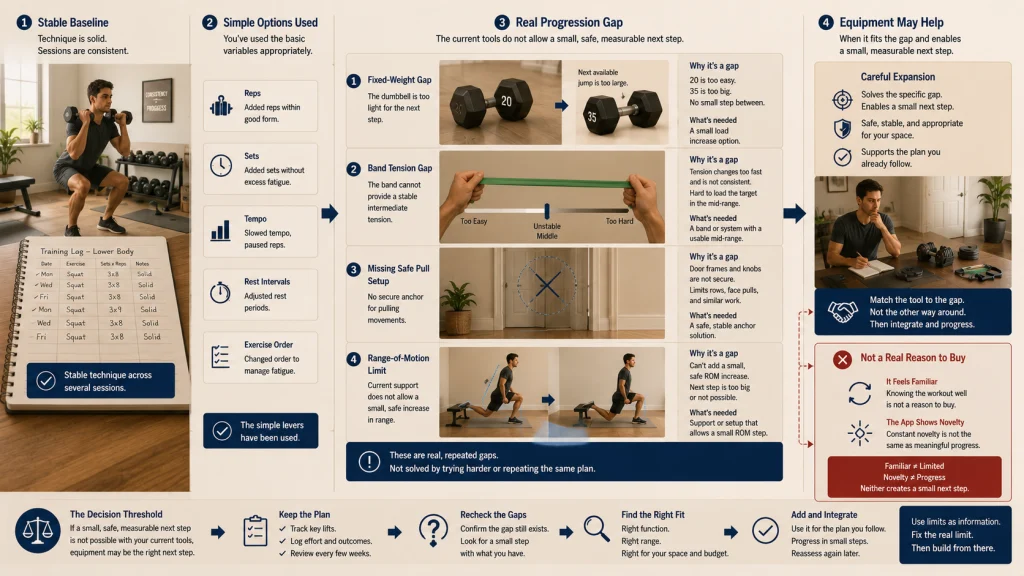
Decide When Equipment Expands the Progression Range
Equipment becomes useful when the current tools create a real progression gap. A fixed dumbbell may be too light for one movement, the next available load may be too large, a band may not provide a stable tension range, or a safe pulling setup may be unavailable.
Equipment threshold: Consider expanding the setup when several sessions show that technique is stable, simple variables have been used appropriately, and the available resistance no longer allows a small, measurable next step.
That decision is different from buying equipment because a workout feels familiar. Familiarity can mean the baseline is finally becoming useful. For product-fit questions, use the home exercise equipment guide.
Handle Plateaus, Deloads, Pain, and Persistent Decline Without Advanced Programming
A short plateau does not automatically require a complex schedule. First check whether the setup is truly comparable, recovery has changed, the rep target is appropriate, or several variables were increased at once.
A temporary reduction in load, range, sets, or weekly exposure may be reasonable when fatigue has accumulated, but this article does not prescribe a fixed deload calendar. The reduction should respond to the actual pattern and should not hide persistent symptoms.
Training to failure is also not a progression requirement. Use the guide to effort and failure in strength training when every set is becoming a maximal test.
Safety warning: Stop exercise and seek appropriate help for chest pain or pressure, fainting, severe dizziness, extreme shortness of breath, sudden weakness, serious injury, or severe pain. Persistent joint or muscle pain, neurological symptoms, pregnancy, recent surgery, chronic conditions, disability-related limitations, or a long period of inactivity may require individualized guidance.
Persistent decline across several sessions, worsening symptoms, or repeated loss of control deserves a pause and a closer review rather than another progression variable.
Progress From a Baseline You Can Compare
Choose one stable exercise setup and define what readiness looks like. When that trigger appears, change one variable, record the result, and set a review date before making another adjustment.
Progress may come from repetitions, load, range, leverage, less assistance, another set, or weekly exposure. The useful change is the one you can measure without sacrificing technique, recovery, or safety.
For the broader movement path, return to how to exercise at home.
FAQs
📈 What counts as progressive overload at home?
It is a measurable increase in challenge applied to a stable exercise or training dose. That change can involve repetitions, resistance, range, leverage, assistance, sets, or weekly exposure.
🏋️ Do I need heavier weights every week?
No. Load is only one progression variable, and adding weight every workout is not required. Use the smallest change that fits the exercise and readiness trigger.
🔁 Is changing exercises a form of progression?
Sometimes, but a new exercise can also be simple novelty. Progress is easier to judge when the new variation changes one known variable and remains comparable to the previous setup.
🧍 How can I progress bodyweight exercises?
You can add controlled repetitions, increase range, change leverage, reduce support, or increase one-sided contribution. Change one variable while keeping the rest of the setup stable.
🟠 How do I progress with resistance bands?
Increase repetitions first or make a small, recorded change in starting tension, anchor distance, grip, or band choice. Band color or label alone is not enough because setup affects resistance.
➕ When should I add another set?
Add a set when the current sets remain controlled, the added work fits the session, and recovery supports it. Do not add volume simply because a session did not feel exhausting.
📝 What should I record in a progression log?
Record the exercise, setup, current dose, technique standard, readiness trigger, one changed variable, review date, and result. The log should let you recreate the comparison.
⏸️ What should I do when progress stalls?
Check setup consistency, recovery, technique, and whether too many variables changed at once. A short plateau does not automatically require advanced periodization or more equipment.
🚩 When should I stop progressing the routine?
Stop increasing difficulty when technique becomes unsafe, recovery declines persistently, or concerning symptoms appear. Severe pain, chest pressure, fainting, severe dizziness, extreme shortness of breath, or sudden weakness require appropriate help.