A useful portable air purifier starts with a defined job: a named pollutant in a real room, handled at a fan speed the household can live with. Large coverage numbers and long feature lists can distract from the questions that determine everyday use, including filter supply, noise, placement, controls, recurring cost, and safety. Compare particle and gas media separately, verify the performance claim that matches the concern, and look beyond the checkout price. Ozone generation and unsupported health, germ, detox, whole-home, or no-upkeep promises are reasons to walk away.
The Same Price Can Buy Very Different Clean-Air Value
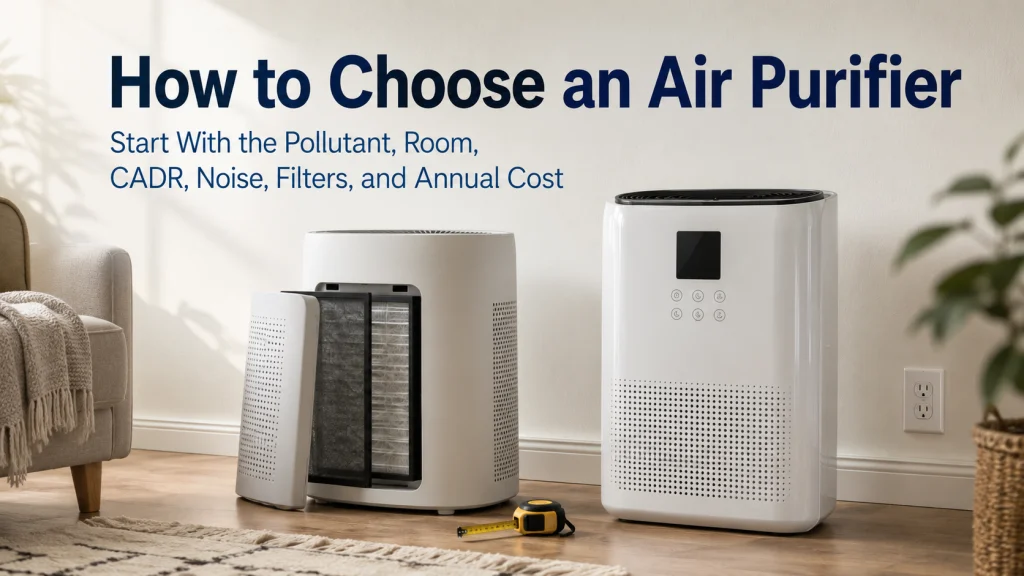
Two portable air purifiers sit beside each other at the same price. The first has a verified smoke CADR, straightforward controls, replacement filters that are easy to identify, and noise information across more than one fan setting. The second advertises a much larger room, twelve electronic features, several wellness claims, and an app, but offers no independent clean-air metric or clear replacement-filter price.
The second product may win the first glance. Months later, the difference may be less glamorous: one unit is still running with a fresh filter, while the other sits unplugged because quiet mode feels ineffective, replacement media is hard to find, or the controls make a simple task feel complicated.
| Same-price comparison | Purifier A | Purifier B |
|---|---|---|
| Target pollutant | Particle role is clear | Broad wellness language |
| Verified delivery | Independent particle-delivery metric is available | Large room claim without a clear testing basis |
| Usable setting | Noise and performance can be compared across settings | Quiet mode is listed without showing useful clean-air delivery |
| Maintenance | Replacement filter is identifiable and available | Filter price and supply are unclear |
| Controls | Core functions work directly on the unit | Several functions depend on an app or account |
The better purchase is the one whose performance, sound, maintenance, and cost still make sense after the excitement of opening the box has passed.
Use Buying Terms as Separate Decision Tools
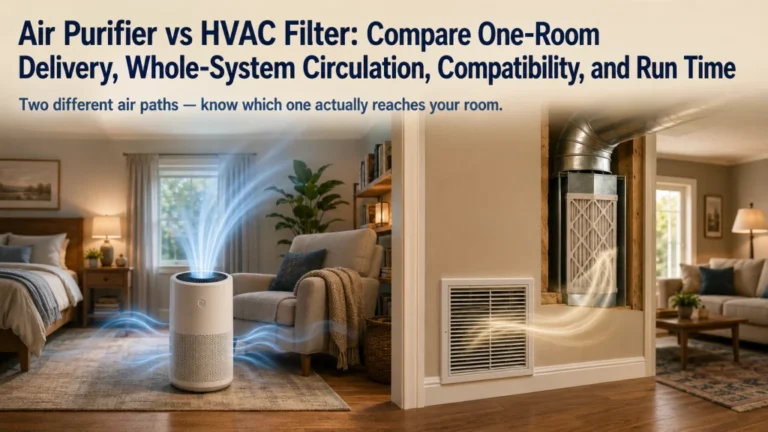
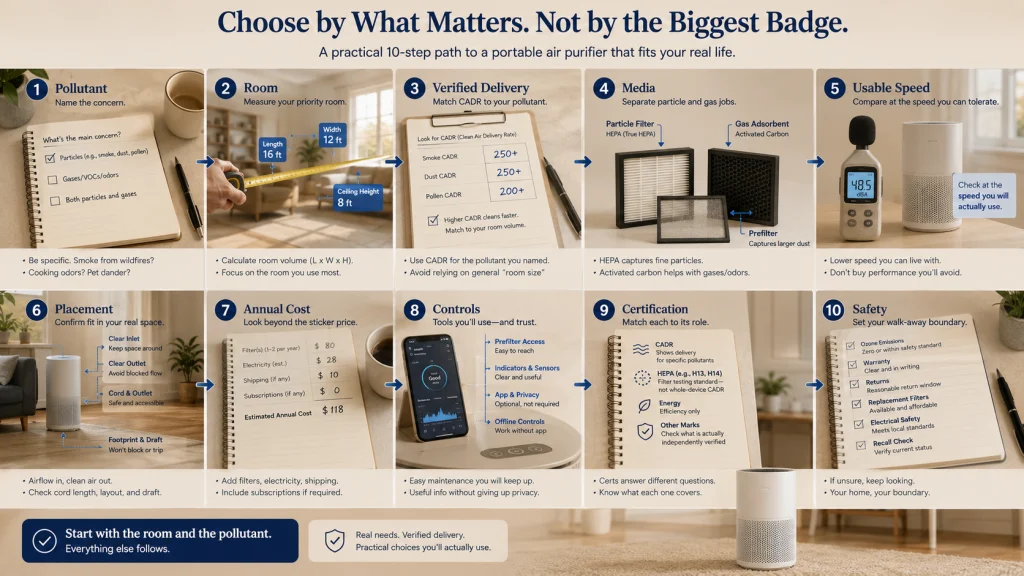
Product pages often place several technical terms beside one large room number, even though each term answers a different question. A portable air cleaner is a room-based device with its own fan and air-cleaning media. CADR describes the cleaned-air delivery of a complete unit for stated particle categories. Room coverage is an advertised or calculated space based on assumptions that may include ceiling height, fan speed, air-change rate, and room boundaries.
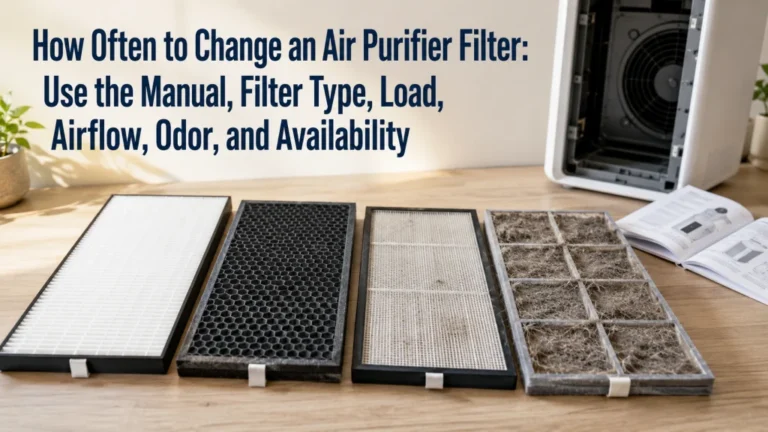
HEPA describes a particle-filter efficiency category or claim, not the clean-air delivery of the complete machine. An adsorbent, often activated carbon or another material, is intended to hold certain gases or vapors on its surface. A prefilter catches larger material before it reaches the main filter and may be washable, vacuumable, or replaceable according to the product instructions.
Noise affects which fan setting the household can sustain. Operating cost includes replacement filters, electricity, shipping, subscriptions, and other recurring requirements. Certification has a defined scope. One label may address independent performance testing, another energy efficiency, and another ozone-emission compliance. No single label answers every buying question.
Buying sequence:
1. Name the pollutant.
2. Name and measure the room.
3. Identify the verified performance metric.
4. Match particle and gas media separately.
5. Compare delivery at a tolerable speed.
6. Confirm placement and household fit.
7. Calculate annual ownership cost.
8. Audit controls, maintenance, and privacy.
9. Verify certification roles and exact claims.
10. Check safety, warranty, returns, filter supply, and recalls.
Name the Room and Pollutant Before Viewing Products
Browsing is easier when the household has already decided which room matters first and what it wants reduced there. A closed bedroom used overnight is a different job from an open living area connected to a kitchen and hallway. Airborne smoke particles, pollen, pet dander, household dust, and a specific odor also require different evidence and media.
A short note made before shopping can keep the comparison grounded:
- The priority room and when people use it.
- Whether doors usually remain open or closed.
- The target pollutant, separated into particles, gases, or both.
- Whether the source is ongoing, occasional, or already controlled.
- The quiet periods that may limit fan speed.
- The available placement area and electrical access.
Source control and suitable outdoor-air ventilation remain the first steps when applicable. A portable unit should not be used to avoid repairing a source, improving local exhaust, controlling moisture, or leaving an unsafe condition.
Use the guide to whether air purifiers work when the main uncertainty is capability rather than product selection. The broader air cleaners and air filters guide separates portable, central, particle, gas, maintenance, and safety routes.
Measure Floor Area and Ceiling Height Before Using a Coverage Claim
A tape measure often reveals why two rooms with the same name are not the same job. One bedroom may have a standard ceiling and a closed door, while another opens into a dressing area or hallway. Floor area is only the beginning. Ceiling height changes the air volume, while doorways, arches, stairwells, and connected spaces change what the purifier is being asked to serve.
Do not assume one unit placed in a hallway will treat several closed rooms equally. Air must reach the intake and return to each occupied area. An open plan may require a different strategy from a closed room, including more than one cleaning location.
Note: This article does not calculate the required unit size. Record the room dimensions, ceiling height, openings, priority occupancy, and likely operating speed, then use the guide to choosing an air-purifier size.
Use Smoke CADR for Fine-Particle Comparison and Treat Room Claims as Assumption-Dependent
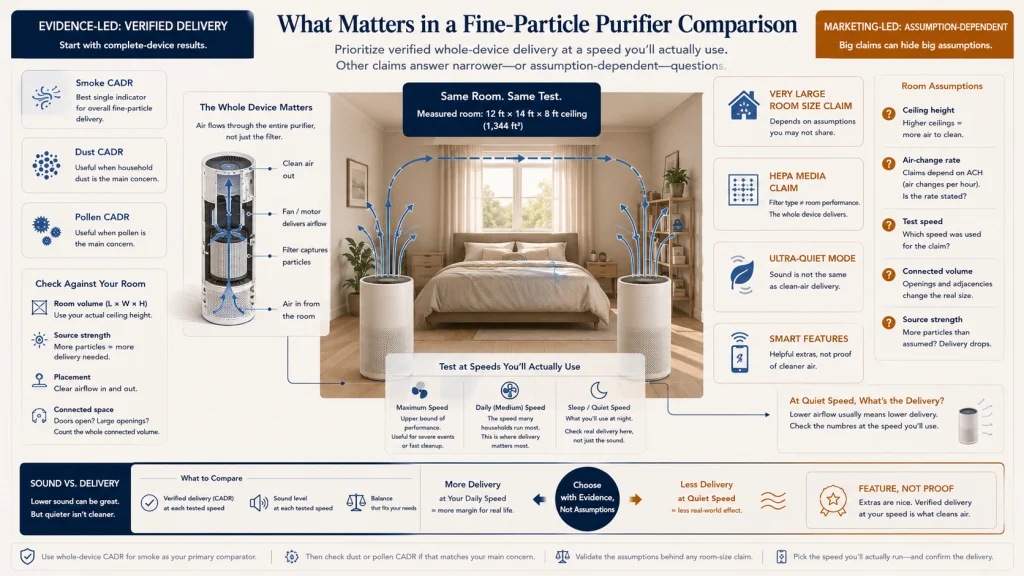
For fine particles, smoke CADR brings the comparison closer to the actual machine than a broad large-room badge. It reflects how airflow and particle capture work together in the complete device under stated test conditions. The number still leaves other household questions open, including gas removal, sound at lower settings, placement, and recurring cost.
| Verified metric or marketing claim | What it can support | What still needs checking |
|---|---|---|
| Smoke CADR | Comparison of complete-device delivery for fine particles | Room volume, operating speed, noise, source strength, and placement |
| Dust or pollen CADR | Comparison for the stated particle category | Whether that category matches the household concern |
| Suggested room size | A space estimate under stated assumptions | Ceiling height, air-change assumption, fan setting, and open-plan geometry |
| HEPA filter claim | Information about the particle media | Whole-device airflow, bypass, clean-air delivery, and real-room operation |
| Quiet mode | A lower-sound operating option | How much cleaned air is delivered at that setting |
| Smart or wellness feature | A control, display, automation, or marketing function | Whether it improves verified clean-air delivery or practical use |
A large coverage number may be based on a gentle air-change assumption that falls short of what the household imagines. The useful comparison is the stated metric and its assumptions, not the biggest number printed on the package.
Choose Particle and Gas Media Separately
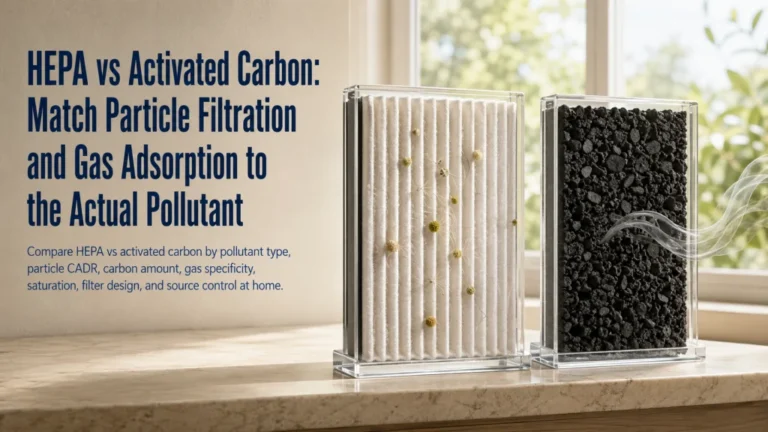
A smoky afternoon and a lingering paint odor may both make a room unpleasant, but they do not ask the filter to perform the same job. Particle filters and gas adsorbents work through different mechanisms. Strong particle delivery does not establish odor or gas performance, and a carbon-colored sheet does not prove useful capacity for a specific vapor.
For particle concerns, compare verified complete-device delivery and filter construction. For gas or odor concerns, look for a defined target, meaningful adsorbent construction, replacement information, and clear limits. When both particles and gases matter, evaluate both stages instead of assuming one strong metric covers the entire problem.
Use HEPA versus activated carbon for the detailed mechanism decision. Do not interpret particle capture or odor reduction as proof of medical benefit.
Compare Performance at the Fan Speed the Household Can Tolerate
The loudest setting often belongs to the demonstration, not the household routine. Bedrooms, work calls, television, conversation, and sleep all shape the speed people will actually keep running. A quiet setting that moves too little air may not fit the room, while a powerful unit that is regularly switched off cannot do the job it was bought to do.
| Noise-versus-CADR decision | Question to answer | Buying implication |
|---|---|---|
| Maximum speed | Can the household tolerate this sound during the period of highest need? | Do not base the purchase only on a setting that will rarely be used |
| Medium or daily setting | Is useful clean-air delivery available at the likely routine speed? | Prioritize performance that survives ordinary use |
| Sleep or quiet setting | Does the reduced sound also reduce delivery below the room’s need? | Compare both sound and airflow, not the quiet label alone |
| Automatic mode | What does the onboard sensor detect, and how does the unit respond? | Do not assume automation always selects the speed required for the target pollutant |
Editorial observation: Recurring filter cost and noise often determine long-term use more than launch features. A device that looks exceptional during comparison can become a poor fit when the household lowers the speed, delays filter purchases, or stops running it.
Confirm Airflow Clearance, Footprint, Draft, Lights, and Household Fit
The purifier needs a real place to live, not an idealized empty corner from a product photo. Measure the footprint and include the space required for air inlets, outlets, filter access, cord routing, and removal of panels or filters.
Check whether the outlet creates a noticeable draft near a bed, chair, desk, or pet area. Bright displays, indicator lights, button sounds, and automatic brightness changes may matter in a bedroom. A tall narrow device may be easy to place but easier to tip. A wide low device may be stable but occupy the walking path.
Children and pets can change the placement decision. Controls may be touched, grilles may attract paws or toys, cords may be pulled, and loose hair can increase prefilter work. These details do not make one format universally better. They determine whether the household can operate and maintain the unit safely in the intended location.
For the day-to-day placement, door, window, speed, and run-time routine, use the guide on how to use an air purifier.
Calculate Purchase Price, Filters, Electricity, Shipping, and Availability
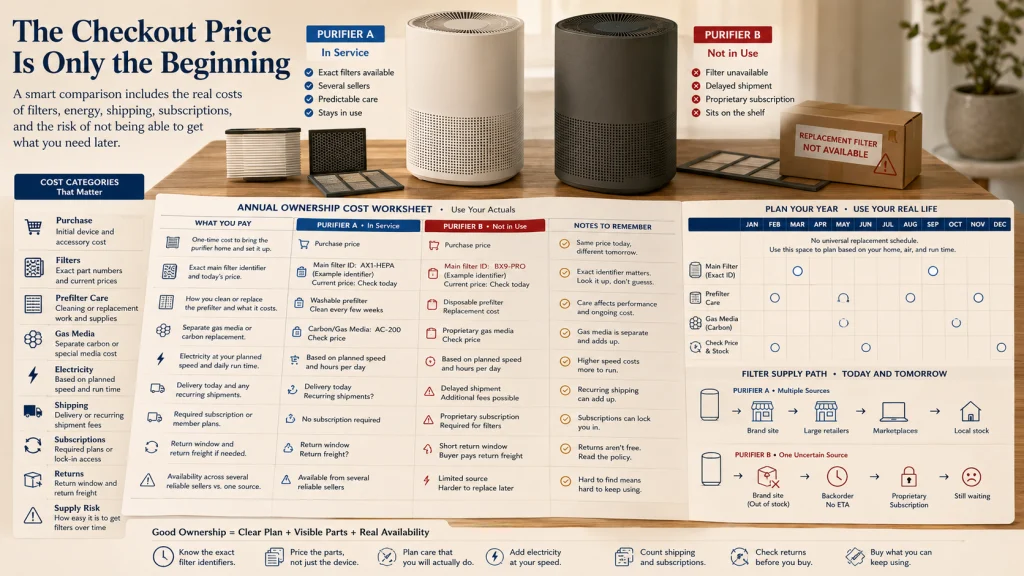
The checkout price is the easiest number to see and often the least complete. A lower-priced machine may rely on expensive proprietary filters, frequent shipping, or a subscription. A higher-priced machine may still be poor value when replacement media disappears or the household pays for features it stops using.
| Annual-cost worksheet | What to verify | What to record |
|---|---|---|
| Initial purchase | Device price, required accessories, tax, and delivery | Total cost to begin using the unit |
| Main filter | Exact part number, current price, expected inspection or replacement guidance, and availability | Likely annual filter spending under the planned use |
| Prefilter | Whether it is cleaned or replaced and what care it requires | Time, replacement cost, and cleaning supplies |
| Gas media | Whether it is separate, combined, and available as a replacement | Additional recurring cost for gas or odor use |
| Electricity | Power use at the likely fan setting and planned daily run time | Estimated annual operating cost using the household rate |
| Shipping | Delivery fees, minimum orders, recurring shipments, and return freight | Costs not shown in the filter price |
| Supply risk | Whether filters are sold by several reliable sources or one uncertain channel | Likelihood that maintenance becomes difficult later |
Do not invent a universal replacement schedule to complete the worksheet. Use the exact product instructions, inspect the filters as directed, and account for household conditions. The detailed maintenance process belongs in the air-purifier filter replacement guide.
Audit Prefilter Care, Indicators, Sensors, Apps, Privacy, and Offline Controls
Routine care should not feel like solving the machine every month. The prefilter should be reachable, the main filter orientation should be clear, panels should close securely, and ordinary cleaning should not require unusual tools or extensive disassembly.
A filter indicator may be a timer, a usage estimate, a pressure-based signal, or another manufacturer-defined system. It does not automatically measure remaining filter effectiveness. An onboard sensor may react to a limited pollutant range and may be influenced by placement, airflow, household products, or calibration choices. Auto mode is useful only when its sensor and response match the target concern.
For connected features, confirm:
- Whether an account is required.
- Which functions remain available without the app.
- What data the device collects and stores.
- Whether several household members can control it.
- What happens if internet service or company support ends.
- Whether firmware updates can change controls or behavior.
For many households, reliable buttons for speed, timer, lights, and filter reset will matter longer than an impressive app screen. Connected features earn their place only when they make operation clearer without taking basic control away from the unit.
Verify Certification Roles Without Treating Labels as Equivalent
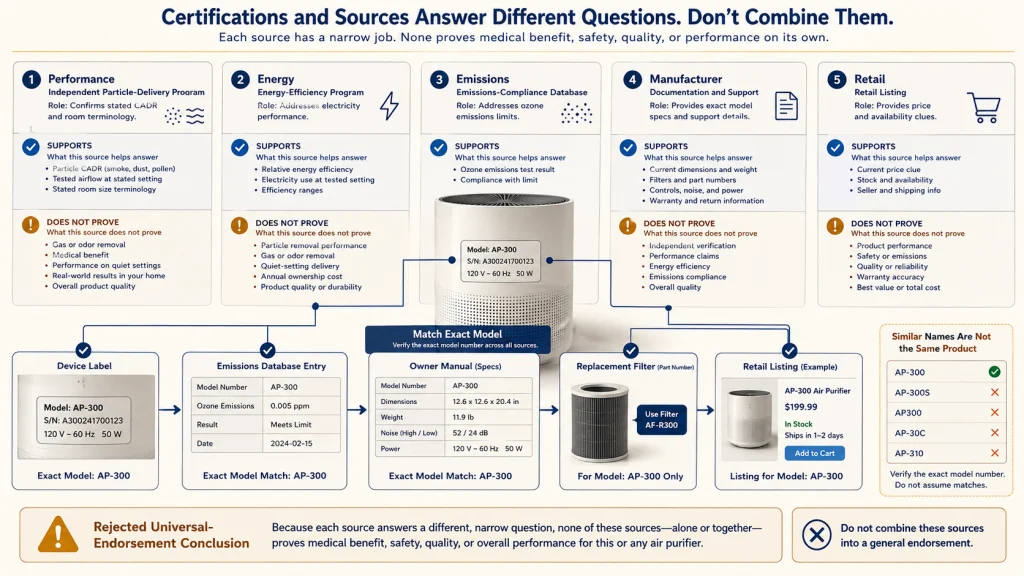
Certification logos can create a reassuring row of badges, but they do not all mean the same thing. Each program answers a narrow question. The useful task is to match the exact model to the exact program and keep a limited performance, efficiency, or emissions result from becoming a general health endorsement.
| Program or source | Useful role | What it does not establish by itself |
|---|---|---|
| AHAM Verifide | Independent verification of stated particle CADR and suggested-room-size terminology for listed models | Gas removal, medical benefit, quiet-setting delivery, annual cost, or household fit |
| ENERGY STAR | Energy-efficiency information under the program’s applicable criteria | Medical protection, gas performance, safe placement, or overall product quality |
| CARB certification database | Verification of ozone-emission compliance for exact listed air-cleaning devices | Pollutant-removal effectiveness, medical benefit, or suitability for the room |
| Manufacturer documentation | Current dimensions, filters, controls, noise, energy use, app requirements, warranty, and return terms | Independent verification unless the claim is tied to a recognized external program |
| Retail listing | Current price and availability clues | Complete specifications, certification, warranty interpretation, or performance proof |
Match the exact model number across the label, database, manual, replacement filter, and sales page. Similar names and shared product families do not guarantee identical certification or specifications.
Reject Ozone Generators and Unsupported Health or Whole-Home Claims
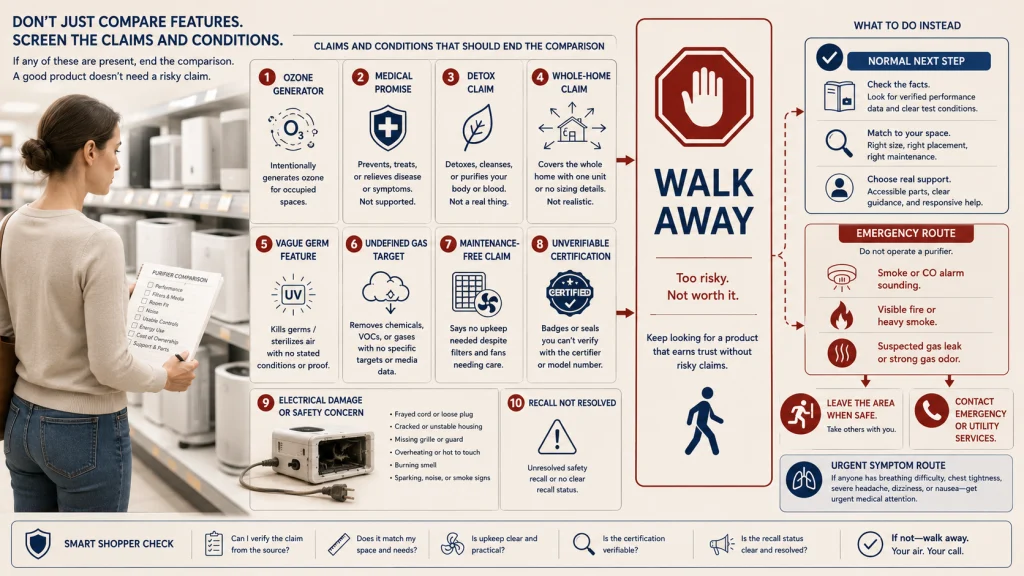
Reject-product checklist:
- Reject a device intended to generate ozone for routine use in an occupied home.
- Reject claims that promise disease prevention, treatment, detoxification, or guaranteed symptom relief.
- Reject claims that a portable room unit cleans an entire home without a credible airflow and room plan.
- Reject vague germ or UV claims that do not define the mechanism, conditions, maintenance, and verified outcome.
- Reject gas or chemical-removal claims that do not identify the target and provide support for the exact media and product.
- Reject claims of no required upkeep when the device contains filters, collectors, lamps, fans, sensors, or surfaces that require care.
- Reject certification logos that cannot be matched to the exact model in the relevant program or documentation.
- Reject products with damaged cords, unstable housings, overheating, burning odors, missing guards, or unresolved recall concerns.
Do not use a purifier to remain around a sounding smoke or carbon monoxide alarm, visible fire or smoke, or a suspected gas leak. Leave the area when safe and contact emergency or utility services as appropriate. Severe breathing difficulty, chest pain, fainting, confusion, blue or gray lips, or other emergency signs require immediate appropriate help.
Use the focused guide on ozone and ionizer safety when electronic or reactive technologies are part of the comparison.
Check Warranty, Returns, Filter Supply, and Recall Status
Some problems appear only after the purifier is humming beside the bed or desk. The draft may land on a chair, the display may brighten a dark room, or the controls may feel less intuitive than they looked online. Return terms matter because fit is difficult to judge from a sales page. Review the window, condition requirements, restocking terms, original-packaging rules, and return freight before discarding the box.
Review the warranty for duration, covered parts, registration requirements, exclusions, proof-of-purchase rules, shipping responsibility, and whether replacement filters must be purchased through a particular channel. A long warranty headline can provide little practical value when freight or service access makes a claim difficult.
Confirm that replacement filters are currently available under a clear part number. Check whether older units still receive filters and app support. Verify the exact model’s recall status and follow current manufacturer or regulator instructions if a recall, electrical warning, or safety notice applies.
Practical tip: Save a copy of the product page, manual, filter part number, order record, warranty terms, and return policy at purchase. Current pages can change after the sale.
Choose Verified Delivery You Can Afford and Sustain
The final choice should still make sense in the room where the purifier will run. The target pollutant, room geometry, performance evidence, sound, media, and placement need to form one workable system rather than a collection of impressive specifications.
Look beyond the first-year price to the routine that follows: filters, electricity, shipping, subscriptions, cleaning, and the time required to keep the machine usable. Certification roles, exact model claims, offline controls, filter supply, warranty, returns, and recall status complete the picture. Unsupported health promises, vague whole-home language, ozone generation, and complexity without a clear purpose do not.
The useful purchase is the machine the household can place, hear, maintain, afford, and continue running for the defined job. That standard is quieter than a feature list, but it is far more likely to survive everyday life.
For the full sequence connecting air cleaning with source control, ventilation, moisture, cleaning, and other healthy-home decisions, use the healthy home environment guide.
FAQs
🌫️ Which CADR should I compare for smoke particles?
Use smoke CADR for fine-particle comparison, then check whether the delivery fits the actual room and likely fan setting. It does not describe gas removal, quiet-mode performance, placement, or annual filter cost.
🏠 Can I trust the largest room-size number on the box?
Not without reading the assumptions. Room claims may use different fan settings, ceiling heights, air-change rates, and room boundaries, so compare the underlying verified metric and the real space.
🔇 Should I choose the quietest air purifier?
Choose a sound level the household can tolerate while the device still delivers enough cleaned air for the job. A very quiet setting may be useful for sleep but insufficient for the target room or source.
🧪 Does a carbon filter remove every odor or gas?
No. Performance depends on the target gas, adsorbent type, media amount, airflow, source strength, and remaining capacity. A vague carbon or odor claim is not enough to establish useful performance.
📱 Is auto mode more effective than a fixed fan speed?
It depends on what the onboard sensor detects and how the control system responds. Auto mode may be convenient, but it should not replace checking whether the selected speed provides suitable delivery for the target pollutant.
💵 How should I compare long-term purifier cost?
Add the purchase price, replacement filters, electricity, shipping, subscriptions, and maintenance supplies. Also consider filter availability and the cost of returning or servicing a large unit.
✅ Does certification mean an air purifier is medically effective?
No. Certification programs have defined roles such as performance verification, energy efficiency, or ozone-emission compliance. None should be treated as a universal medical endorsement.
⚠️ When should I reject a purifier immediately?
Reject ozone generators intended for occupied use, unsupported disease or detox claims, unverifiable certification, unclear replacement filters, and products with damaged electrical parts or unresolved safety concerns. Do not use a purifier as a response to an alarm, fire, heavy smoke, or suspected gas leak.