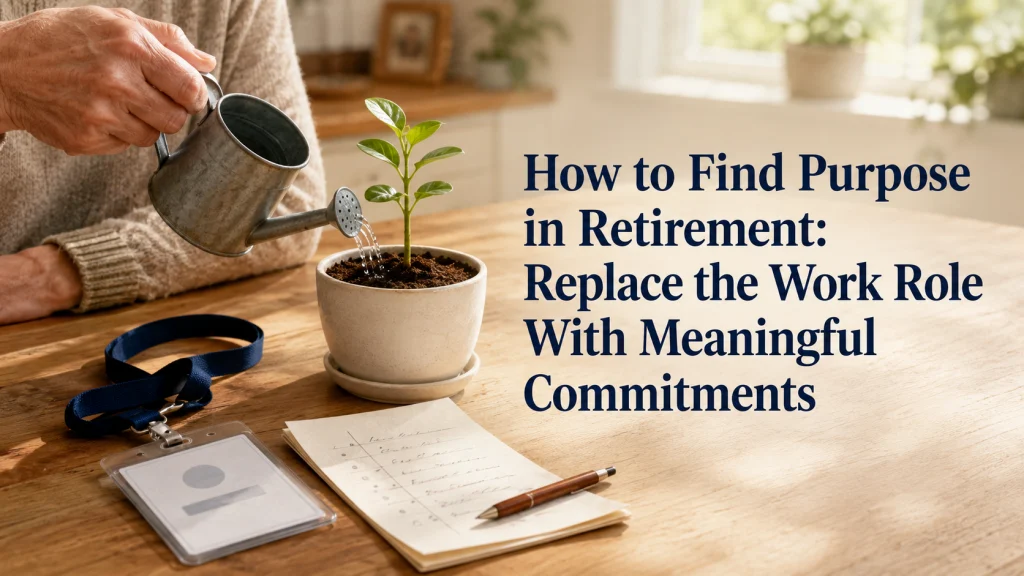
Learning how to find purpose in retirement starts by noticing which functions disappeared with the work role, not by searching for one perfect calling. Choose a small portfolio that includes contribution, connection, learning, care, creativity, stewardship, faith, play, or rest in proportions that fit your current life. Test one or two commitments for four weeks, scale them for different energy levels, and review engagement rather than productivity totals. Persistent low mood, hopelessness, severe withdrawal, loss of function, or thoughts of self-harm require qualified support rather than another activity experiment.
An Empty Calendar Can Feel Different by Thursday
On Monday morning, the blank weekly calendar feels pleasant. There is no commute, no standing meeting, no urgent message waiting before breakfast. The open space looks like freedom.
By Thursday, the same calendar can feel different. No one is expecting an update. The familiar colleagues are elsewhere. A hobby fills an hour, but not the whole shape of the week. The question is no longer only what to do with free time. It is what the day is organized around and where contribution, feedback, and connection now come from.
Retirement removes more than work hours. It can remove cues, people, identity, movement, mastery, income, feedback, and the quiet reassurance that someone depends on what you know how to do.
Starting point: Rebuild the functions you miss rather than copying the job you left.
The healthy aging guide places meaningful activity beside physical, social, and practical well-being. The guide to staying independent as you age explains why autonomy can include chosen commitments, support, and adaptation.
Define Purpose as Direction Expressed Through Repeated Commitments
Purpose does not have to arrive as one dramatic mission. It can be a direction that becomes visible through repeated commitments: helping one person learn, caring for a place, practicing a craft, maintaining a relationship, contributing to a group, studying a subject, or protecting time for enjoyment.
A systematic review of research involving older adults found that purpose in life has been conceptualized in several ways, including meaningful goals, social relationships, mattering to others, inner strength, well-being, and spirituality. That variety supports a broader approach than asking every retiree to identify one defining cause.
Purpose can also change. A commitment that feels meaningful immediately after retirement may later make room for caregiving, learning, creative work, faith, friendship, stewardship, or rest. Change does not mean the earlier commitment was false.
Useful definition: Purpose is a direction you can express in ordinary weeks. It is not a test of how impressive, productive, public, or permanent the activity appears.
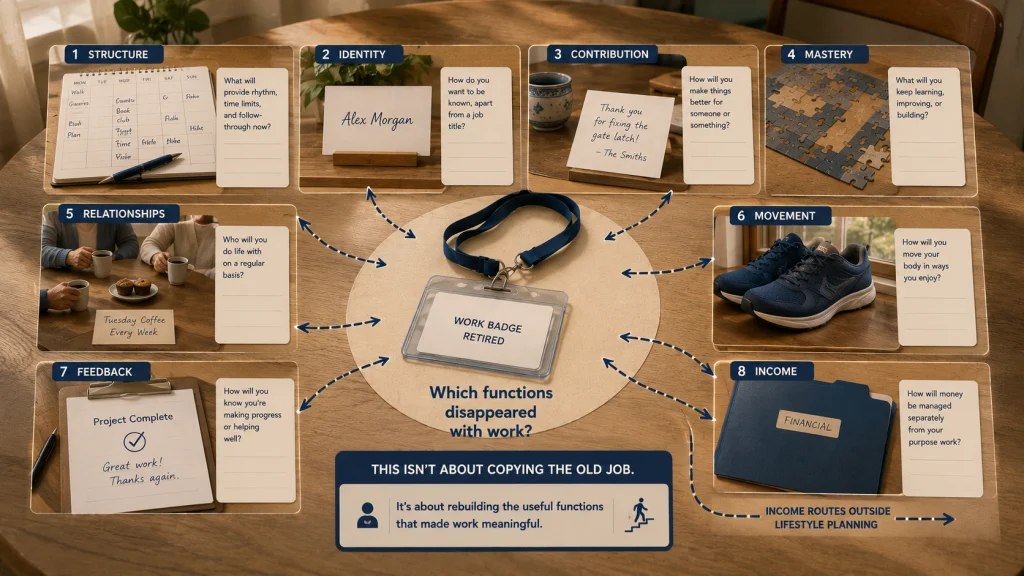
List the Functions Work Previously Supplied
Job titles hide multiple functions inside one role. When work ends, the loss may come from only two or three of them. Naming those functions makes the next step more precise.
| Work Function | What It May Have Provided | Question for Retirement |
|---|---|---|
| Structure | A reason to begin, stop, prepare, and move through the week | Which recurring commitments could give selected days a shape? |
| Identity | A familiar answer to what you do and where you belong | Which qualities or roles still feel true outside the job title? |
| Contribution | Evidence that knowledge, effort, or care helped someone | Where would a small, reliable contribution matter? |
| Mastery | Problems to solve, skills to use, and progress to notice | What would you enjoy practicing without needing professional status? |
| Relationships | Colleagues, customers, teams, and casual daily contact | Which relationships need an intentional replacement for workplace contact? |
| Income | Pay, benefits, and financial choices | Does any work decision require separate financial or career advice? |
| Movement | Walking, commuting, standing, carrying, or leaving home | Which ordinary action can replace movement that used to happen automatically? |
| Feedback | Deadlines, appreciation, correction, completion, and visible results | How will you know that a commitment remains useful and chosen? |
The inventory may reveal that work itself is not what you miss. You may miss one person asking for your judgment, the walk to the train, the satisfaction of finishing a repair, or the rhythm of Tuesday meetings.
Separate What You Miss From What You Are Relieved to Leave
Retirement can contain grief and relief at the same time. Someone may miss mentoring junior colleagues while feeling grateful to leave deadlines, commuting, office politics, physical strain, or constant availability behind.
Being useful to a small team
Solving practical problems
Seeing familiar people
Having a reason to prepare for Tuesday
Urgent messages after dinner
A long commute
Performance pressure
Tasks that no longer felt meaningful
Use the first column to identify functions worth rebuilding. Use the second to set boundaries. A new commitment does not need to reproduce the schedule, status, strain, or emotional cost of the old role.

Choose the Ingredients That Matter in This Season
Purpose can contain several ingredients, and not all of them need to be public or service-oriented. Rest, enjoyment, relationships, and quiet stewardship can carry meaning without producing a résumé line.
Contribution may involve helping, teaching, repairing, organizing, advising, or creating something useful. Ask who or what benefits from the effort.
Connection may come through friendship, family, neighbors, groups, or intergenerational contact. Ask where you feel known rather than merely present.
Learning may involve a class, language, skill, subject, instrument, or independent study. Ask what keeps curiosity active.
Care may be directed toward people, animals, plants, a household, or a shared place. Ask what you choose to tend without carrying an unsustainable burden.
Creativity may include writing, music, making, cooking, design, storytelling, or problem-solving. Ask what you want to express or bring into existence.
Stewardship may involve a garden, archive, tradition, community resource, or natural place. Ask what is worth preserving or improving.
Faith may include worship, reflection, ritual, study, service, or spiritual community. Ask which practices connect daily life with your beliefs.
Play may involve games, humor, travel, movement, collecting, performance, or shared enjoyment. Ask what feels absorbing without needing to produce a result.
NIA’s activity guidance includes social connection, learning, community participation, movement, hobbies, and activities that can be adapted for distance or other restrictions. It also advises finding a balance that does not turn enjoyable participation into stress.
Build a Portfolio Instead of Giving One Activity the Whole Burden
It can be unsettling when one meaningful activity starts carrying the emotional weight of the entire week. If that class is canceled, the project pauses, or the group changes, the loss can feel much larger than the schedule suggests. A small portfolio makes purpose less fragile.
A balanced starting portfolio might contain:
- One contribution that benefits another person, group, place, or project.
- One recurring connection where someone notices your presence.
- One learning or creative practice that develops over time.
- One form of enjoyment that does not need to prove usefulness.
- Enough uncommitted time for rest, appointments, care needs, and ordinary life.
The ingredients can overlap. A community garden may provide stewardship, learning, movement, contribution, and connection. A weekly phone call may provide care and relationship. A solitary craft may provide creativity, mastery, and play.
The portfolio should make the week feel inhabited, not crowded. Retirement does not need to become another schedule that earns approval through output.
Match Commitments to Energy, Access, Budget, and Care Responsibilities
An activity can sound meaningful and still leave someone exhausted before it even begins. Transport, stairs, parking, storage, fees, equipment, timing, caregiving, pain, fatigue, hearing, vision, weather, or digital access can consume more energy than the activity returns.
Before committing, ask:
- How much preparation, travel, carrying, standing, screen time, or recovery is required?
- Does the schedule fit the person’s ordinary energy rather than an unusually good week?
- What fees, materials, clothing, memberships, transport, or storage are involved?
- Can the format change when mobility, health, caregiving, or weather changes?
- Is the commitment still chosen, or does it already feel like another obligation?
- Can the person leave, pause, or reduce participation without shame or financial loss?
Editorial observation: An activity or product can look inspiring in a demonstration while hiding the daily setup burden. Impressive features are irrelevant when transport, storage, charging, access, cost, or preparation makes consistent use unrealistic. Feasibility matters more than the promise printed on the box.
The guide to transportation options for older adults can help when the meaningful activity is reachable only through a fragile travel plan.
Compare Activities by Function Rather Than Status
Part-time work is not inherently more purposeful than a hobby, and volunteering is not required. Compare what each option supplies and what it costs to maintain.
| Activity Type | Functions It May Supply | Questions Before Committing |
|---|---|---|
| Volunteering | Contribution, connection, structure, and feedback | Are the role, training, schedule, transport, boundaries, and support clear? |
| Mentoring | Contribution, identity continuity, relationship, and mastery | Is the responsibility defined, wanted, and appropriate to current expertise? |
| Part-time work | Income, structure, colleagues, feedback, and contribution | Does it require separate career, tax, benefit, or financial guidance? |
| Hobby or creative practice | Play, mastery, creativity, rest, and identity | Does it remain enjoyable without public output or rapid progress? |
| Class or study group | Learning, connection, structure, and feedback | Are pace, cost, access, technology, and preparation manageable? |
| Family or caregiving role | Care, contribution, relationship, and stewardship | Is the role chosen, shared, bounded, and compatible with the person’s health and life? |
| Community project | Contribution, stewardship, connection, and practical mastery | Can the role survive leadership changes, conflict, seasonal demands, or reduced availability? |
A prestigious role that drains the week may fit worse than a modest commitment that leaves someone engaged, connected, and willing to return.
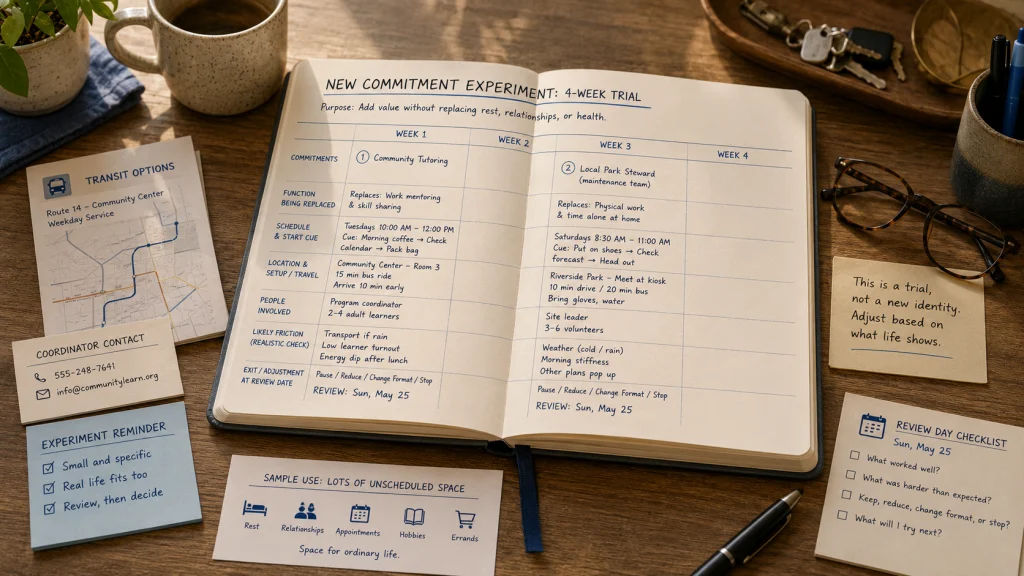
Start With a Four-Week Experiment and a Defined Schedule
After a long career, it can feel strange to try something without knowing whether it will become part of your identity. A low-pressure experiment makes room for uncertainty. Four weeks is long enough to encounter ordinary variation while remaining short enough to revise without treating the choice as permanent.
| Planner Field | What to Write |
|---|---|
| Function being replaced | Structure, contribution, connection, mastery, movement, identity, or feedback |
| Commitment | The specific activity or role being tested |
| Schedule | Day, start cue, expected length, place, and travel or setup time |
| Other people | Who expects attendance, shares the activity, or needs an update? |
| Friction | Transport, cost, access, energy, preparation, caregiving, technology, or recovery |
| Exit or adjustment | How to pause, reduce, change format, or stop after the experiment |
| Review date | The date the four-week experience will be reviewed |
Do not fill every open day during the first week. One or two commitments make it easier to notice what the activity contributes and what it costs. The guide to planning for aging can help coordinate purpose with housing, transportation, support, and other practical priorities without turning this experiment into a complete life plan.
Add Minimum, Normal, and High-Energy Versions
Energy and access vary. A scalable commitment can preserve the underlying value without demanding the same format every week.
Minimum version: Review one scanned photograph at home and add a short note. Stewardship and learning remain present even when travel or energy is limited.
Normal version: Attend the regular community-history meeting and complete the planned task. Contribution, connection, and structure come together.
High-energy version: Join the meeting, interview a participant, and help organize the next public event. The larger role is available when capacity is genuinely there.
The minimum version should still feel connected to the value, not like a punishment for having less energy. The high-energy version is optional. It should not become the hidden standard against which every ordinary week is judged.
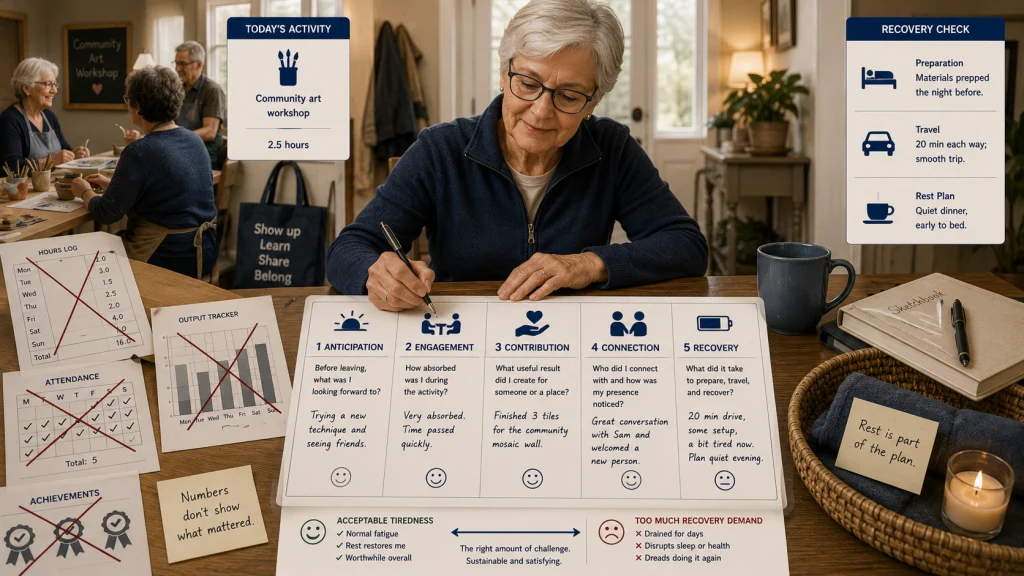
Track Anticipation, Engagement, Contribution, Connection, and Recovery
Hours, attendance, tasks, and outputs are easy to count, especially for someone accustomed to deadlines and reviews. Those numbers can quietly recreate the performance culture the person hoped to leave. Review the lived experience instead.
- Anticipation: Did I look forward to the commitment, feel neutral, or repeatedly dread it?
- Engagement: Was I absorbed, interested, present, or mainly waiting for it to end?
- Contribution: Did my effort help a person, group, place, practice, or value I care about?
- Connection: Did anyone notice my presence, listen, collaborate, or share the experience?
- Recovery: What preparation and recovery did the activity require, and was that cost acceptable?
A commitment can be meaningful and tiring. The useful question is whether the tiredness fits the value and current capacity, not whether the activity produces constant happiness.
A 2023 retirement study found that surveyed adults generally viewed purpose and direction during retirement as important, with older adults placing greater importance on it. The study examined perceptions, not a guarantee that any particular activity will improve health or retirement satisfaction.
Adjust When an Activity Becomes Obligation, Inaccessible, Isolating, or Too Expensive
Meaning can change without disappearing. A class may become too fast, a volunteer role may expand beyond the agreement, transport may become unreliable, or a hobby may begin to feel like another job.
Adjust one part before abandoning the entire value:
- Reduce frequency or responsibility.
- Change from leading to participating.
- Move from in-person to phone, online, home-based, or hybrid participation.
- Replace a fee-heavy activity with a lower-cost expression of the same ingredient.
- Change groups when the environment feels isolating, disrespectful, or poorly organized.
- Protect rest by removing an activity rather than filling every open period.
Leaving a commitment can be the correct decision. Purpose is not proven by endurance, and retirement does not create a duty to volunteer, work, care for others, or remain publicly active.
Maintain Purpose During Temporary Health or Mobility Limits
A procedure, injury, illness, pain flare, caregiving period, or transport disruption can remove the usual format of an activity. That loss may feel larger when the commitment had become the main source of structure or connection.
Preserve the value while changing the format:
- Contribution can become a phone call, review, introduction, or small home-based task.
- Connection can move to shorter visits, scheduled calls, letters, or online participation.
- Learning can continue through audio, reading, observation, or one-to-one instruction.
- Stewardship can become planning, recordkeeping, or advising while physical tasks pause.
- Creativity can scale to materials and positions that fit current access and energy.
- Play can become quieter without needing to become productive.
The changed format is not a lesser version of the person’s value. It is a bridge through a period when the body, schedule, or environment has different limits.
The article on solo aging support roles can help when a temporary setback reveals that transport, home help, communication, or local backup has no named owner.
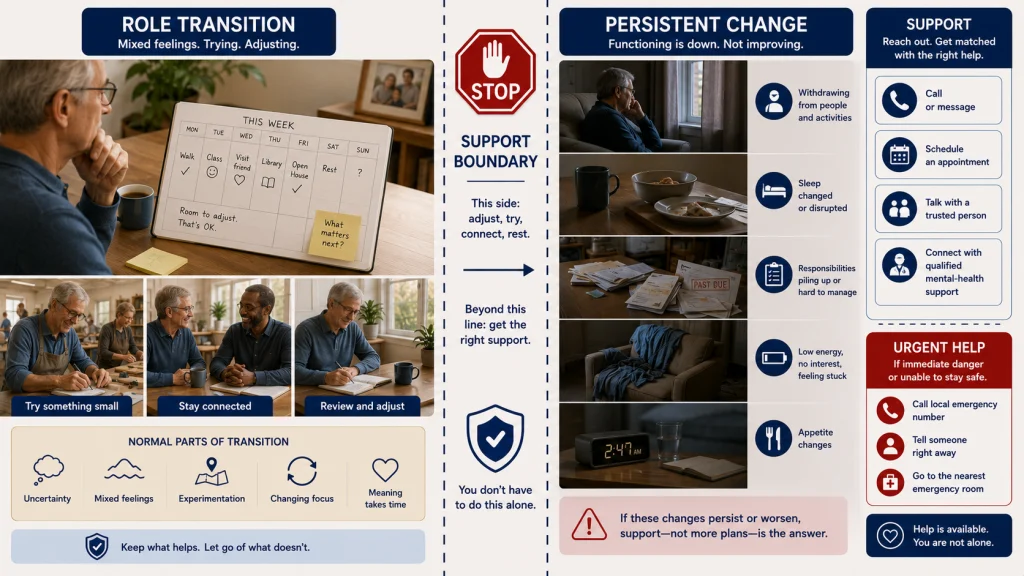
Distinguish Role Transition From Symptoms That Need Professional Support
It can take time to adjust when a long-held role ends. Some uncertainty, grief, boredom, mixed feelings, or experimentation can occur during that transition. This article cannot determine when those experiences reflect depression, anxiety, complicated grief, cognitive change, or another condition.
Mental-health boundary: Seek qualified support for persistent low mood, hopelessness, severe withdrawal, major changes in sleep or appetite, inability to manage ordinary responsibilities, or loss of function. Do not assume that another hobby, class, volunteer role, or schedule will treat a mental-health condition.
If you are in immediate danger or may harm yourself or someone else, contact emergency services. In the United States, call or text 988 for the Suicide & Crisis Lifeline. Outside the United States, use the crisis or emergency service for your location.
Support is not a failure to create enough purpose. A mental-health professional can address symptoms while meaningful commitments remain one part of ordinary life.
Choose One Contribution, One Connection, and One Enjoyable Commitment
Begin with the function you miss most from work. Choose one contribution, one recurring connection, and one activity that is enjoyable on its own terms.
Place them into a four-week experiment with a defined schedule, a realistic exit, and minimum, normal, and high-energy versions. Review anticipation, engagement, contribution, connection, and recovery rather than comparing retirement with a former performance system.
The goal is not to fill the calendar until it looks important. It is to create a week with enough direction, relationship, usefulness, curiosity, care, play, and rest to feel like your own.
FAQs
🧭 How do I find purpose in retirement?
Identify which functions work provided, choose a small portfolio of meaningful ingredients, and test one or two repeated commitments for four weeks. Review how they affect engagement, contribution, connection, and recovery.
📅 Why does retirement feel empty even when I have hobbies?
A hobby may provide enjoyment without replacing structure, colleagues, contribution, feedback, movement, or identity. Identify the missing function rather than assuming the hobby is inadequate.
🌱 Does purpose need to be one major mission?
No. Purpose can be expressed through several small commitments involving relationships, contribution, care, creativity, learning, stewardship, faith, play, and rest.
🤝 Do I have to volunteer after retirement?
No. Volunteering is one option, not a requirement. Part-time work, mentoring, hobbies, learning, family roles, community projects, relationships, and private creative or spiritual practices may serve different functions.
⚖️ How many commitments should I begin with?
Start with one or two experiments rather than filling the week. Leave room for rest, appointments, relationships, care needs, and ordinary schedule variation.
🔋 What if my energy changes from day to day?
Create minimum, normal, and high-energy versions that preserve the same underlying value. The high-energy version remains optional, and skipping may be appropriate when health, pain, rest, or safety requires it.
🚗 What if transport or mobility limits participation?
Change the format before assuming the value is lost. Consider home-based, phone, online, nearby, shorter, seated, or shared-transport versions while reviewing access, cost, safety, and recovery.
🧠 When should I seek mental-health support?
Seek qualified help for persistent low mood, hopelessness, severe withdrawal, major sleep or appetite changes, inability to manage ordinary responsibilities, loss of function, or thoughts of self-harm. Immediate danger requires crisis or emergency support.