Solo aging does not mean being lonely, living without meaningful relationships, or doing everything alone. It means planning without assuming that a spouse, adult child, or nearby relative will automatically coordinate help when a specific need appears. Map the roles that require another person, ask for explicit agreement, add backups, and keep professional authority with qualified legal, financial, health, and care-planning experts. Start by filling one uncovered role and scheduling one real conversation.
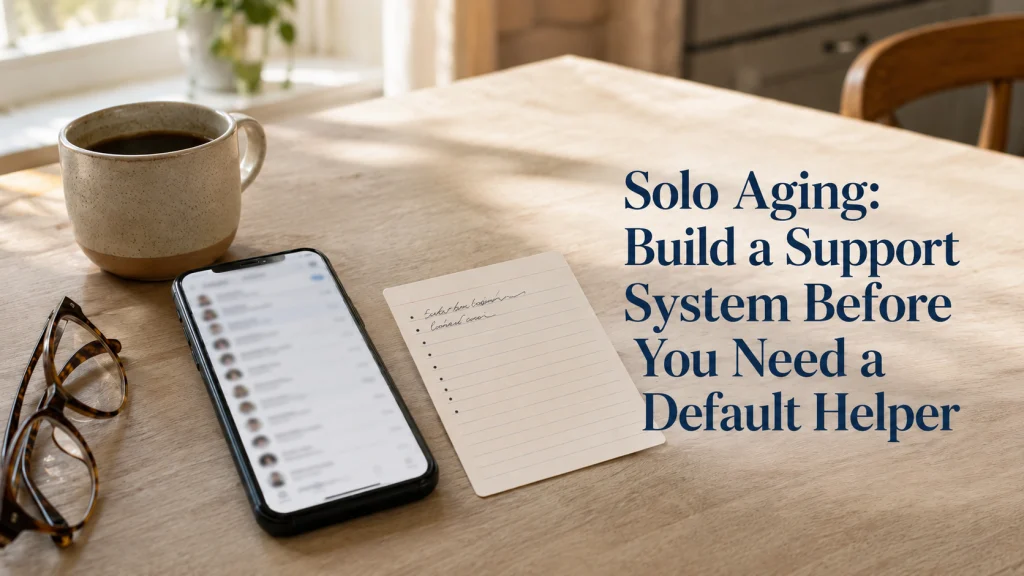
A Blank Take-Home Contact Line Reveals a Planning Gap
A routine medical form asks, “Who can take you home and stay with you tonight?” The line remains blank.
The person filling it out is not socially isolated. There are friends from work, neighbors who exchange keys, people from a weekly class, and relatives who live in other states. Yet no one has agreed to provide transportation, stay overnight, receive discharge instructions, or call for help if recovery does not go as expected.
A broad social circle can be rich, loyal, and meaningful while still leaving a specific support role uncovered. The gap becomes visible only when the situation asks for a name, a task, a place, and a time.
Starting point: A social circle becomes a support plan only after specific roles are discussed and accepted.
The healthy aging guide provides the broader context for later-life planning. The guide to staying independent as you age explains why autonomy can include chosen support, backups, and professional help.
Define Solo Aging Without Equating It With Living Alone
Solo aging describes planning for later life without a reliable default family helper who is expected to coordinate everyday support or major decisions. It may apply to someone who is single, partnered without children, widowed, divorced, estranged from relatives, geographically separated from family, or simply unsure who could take on a sustained support role.
Living alone is a household arrangement. Social isolation is a lack of sufficient connection. Solo aging is a planning condition. The three can overlap, but they are not interchangeable.
Recent AARP research describes many adults living alone as content, connected, and strongly attached to autonomy, while also identifying concerns about future independence, health, and paid help. The point is not to frame solo aging as failure. It is to make future support less dependent on an unspoken assumption.
UNH Extension’s solo-aging guidance likewise emphasizes starting early and building plans around social networks, health care, home, finances, and legal questions. This article focuses on practical role coverage and leaves detailed professional execution outside its scope.
List the Situations That Require Another Person
It is easy to ask, “Who would help me?” and receive a reassuring but vague answer. A more useful question is, “Which situation requires another person, and what would that person actually need to do?”
- Short-term recovery: Provide a ride, stay nearby, bring food, check the home, help with errands, or notice worsening symptoms.
- Emergency contact: Answer a call, provide basic information, reach other contacts, or travel to the location when appropriate.
- Document access: Know where important instructions and contact lists are stored without receiving unnecessary access.
- Home check: Respond to a leak, storm, power loss, missed check-in, pet need, or temporary absence.
- Transportation: Cover a medical visit, repair appointment, grocery trip, or period when driving is not possible.
- Pet care: Feed, walk, transport, or temporarily house an animal during an unexpected absence.
- Communication: Update agreed contacts, coordinate a service, or help the person understand what happens next.
- Decision advocacy: Support the person’s stated wishes in settings where qualified authority and proper documents may be required.
Some situations need companionship. Others need practical labor, local availability, professional skill, or formal authority. Treating them as one generic helper role hides the most important gaps.
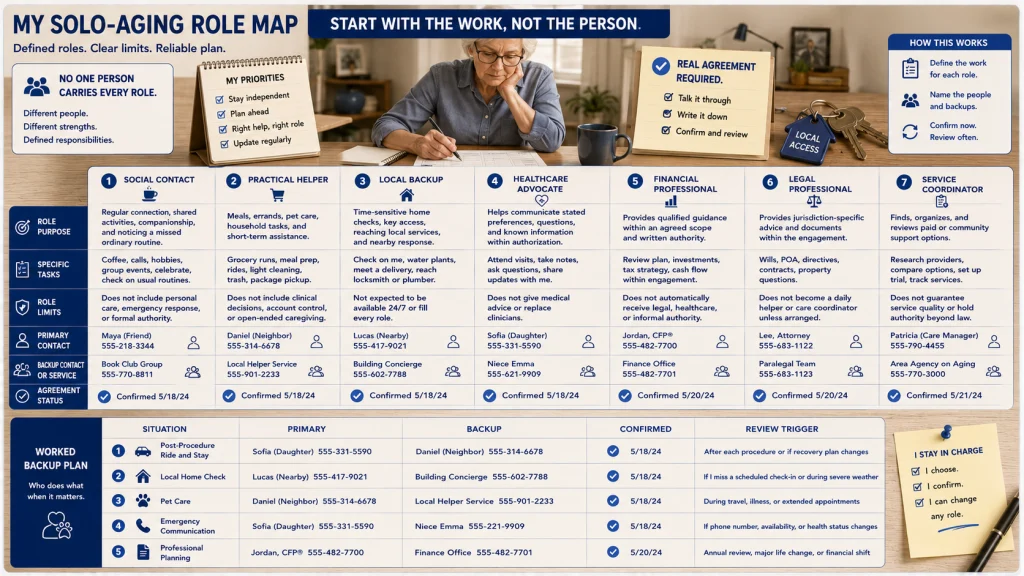
Build a Role Map Before Choosing Names
Start with the work, not the person. A close friend may be excellent at listening but unable to provide transportation. A nearby neighbor may handle a home check but should not be expected to interpret health information or manage financial matters.
| Role | What the Role Covers | Limits of the Role |
|---|---|---|
| Social contact | Regular connection, shared activities, noticing a missed routine, and companionship | Emergency response, personal care, or formal decision authority |
| Practical helper | Errands, meals, pet care, household tasks, or short-term support | Clinical decisions, account control, or open-ended caregiving |
| Local backup | Time-sensitive check-ins, key access, home concerns, or reaching local services | Being available at all hours or carrying every support role |
| Healthcare advocate | Helping communicate preferences, questions, and known information within proper authority | Providing medical advice or replacing the clinical team |
| Financial professional | Qualified guidance within an agreed professional scope | Legal authority, health decisions, or informal personal control |
| Legal professional | Advice and documents appropriate to the person’s jurisdiction and wishes | Daily task help or ongoing care coordination unless separately arranged |
| Service coordinator | Finding, organizing, and reviewing paid or community support | Guaranteeing service quality or holding authority beyond the contract and law |
The role map protects relationships by making the request specific. It also shows where friendship is enough, where paid help may be practical, and where qualified authority is necessary.
Ask for Explicit Agreement Instead of Assuming Someone Will Step In
A friend who says, “Call me anytime,” may mean emotional support, an occasional ride, or genuine emergency availability. None of those meanings should be assumed.
Make the request concrete:
Name the situation: “I am planning for a same-day medical procedure.”
Name the task: “Would you be willing to drive me home and stay for the first few hours?”
Name the likely burden: “It may take most of the afternoon, and the date could change.”
Allow a real no: “Please decline if the timing, responsibility, or uncertainty does not work for you.”
Confirm the next step: “If you agree, may I list you for this role and review the plan with you before the appointment?”
A clear request may feel more vulnerable than a general conversation about the future. It is also kinder. The other person can understand the responsibility, set limits, and agree to something they can actually sustain.
The guide to accepting help while preserving choice can help when asking feels like a loss of independence rather than a planning decision.
Create Backups and Avoid Assigning Every Role to One Person
One reliable person can still become unavailable because of illness, travel, work, caregiving, distance, or a change in the relationship. A resilient plan uses primary and backup contacts and distributes roles according to capacity.
| Role | Primary Contact | Backup Contact or Service | Agreement Confirmed? | Review Trigger |
|---|---|---|---|---|
| Post-procedure ride and stay | Name and preferred contact method | Second person or qualified transport and support option | Yes, no, or conversation scheduled | Procedure scheduled or availability changes |
| Local home check | Name and access limits | Second neighbor, property contact, or paid service | Yes, no, or pending | Move, key change, or extended trip |
| Pet care | Name and care instructions | Second person or established service | Yes, no, or pending | Pet, schedule, or health changes |
| Emergency communication | Name and information shared | Second contact | Yes, no, or pending | Phone, address, health, or relationship change |
| Professional planning | Qualified professional and scope | Second office, referral route, or replacement process | Engagement current or review needed | Law, finances, health, or wishes change |
Backups are not evidence that the primary person is unreliable. They reduce pressure on everyone and prevent one relationship from becoming the entire support structure.
Map Home and Neighborhood Constraints
Home planning can feel unusually personal because every repair, key, stair, and access decision touches the place where daily life happens. A support network can be willing and still be unable to overcome a difficult building, inaccessible entrance, unreliable utilities, distant services, or a home that requires constant maintenance.
Review the practical setting:
- Who can enter the home when the person cannot reach the door?
- How are keys, building access, alarms, pets, and privacy handled?
- Can a helper reach the home during bad weather or a local emergency?
- Which repairs or daily tasks already depend on one provider or neighbor?
- Are essential rooms, exits, lighting, stairs, and communication tools usable?
- What happens during a power, water, heat, cooling, or phone outage?
The guide to home safety for older adults helps identify environmental friction without assuming that living alone is unsafe. The emergency preparedness guide can turn outage, evacuation, medication, pet, and communication concerns into a separate practical plan.
Map Transportation and Community Access
Losing a familiar transportation option can shrink a week faster than expected. Appointments, groceries, friendships, volunteering, and ordinary errands may all depend on different kinds of rides. Transportation is not one role. A neighbor who offers a grocery ride may not be available for an early appointment, a long procedure, a weekly commitment, or a last-minute discharge.
List the trips that matter:
- Routine health, dental, vision, and therapy appointments
- Procedures that require an escort or another adult afterward
- Groceries, pharmacy access, banking, and household errands
- Social, faith, volunteer, educational, and interest-based activities
- Pet care and veterinary visits
- Unexpected travel during a vehicle repair, illness, or severe weather period
For each trip, identify a usual method, a backup, booking requirements, operating area, cost questions, accessibility needs, and what happens after hours. The guide to transportation options for older adults can help compare routes without recommending one universal service.
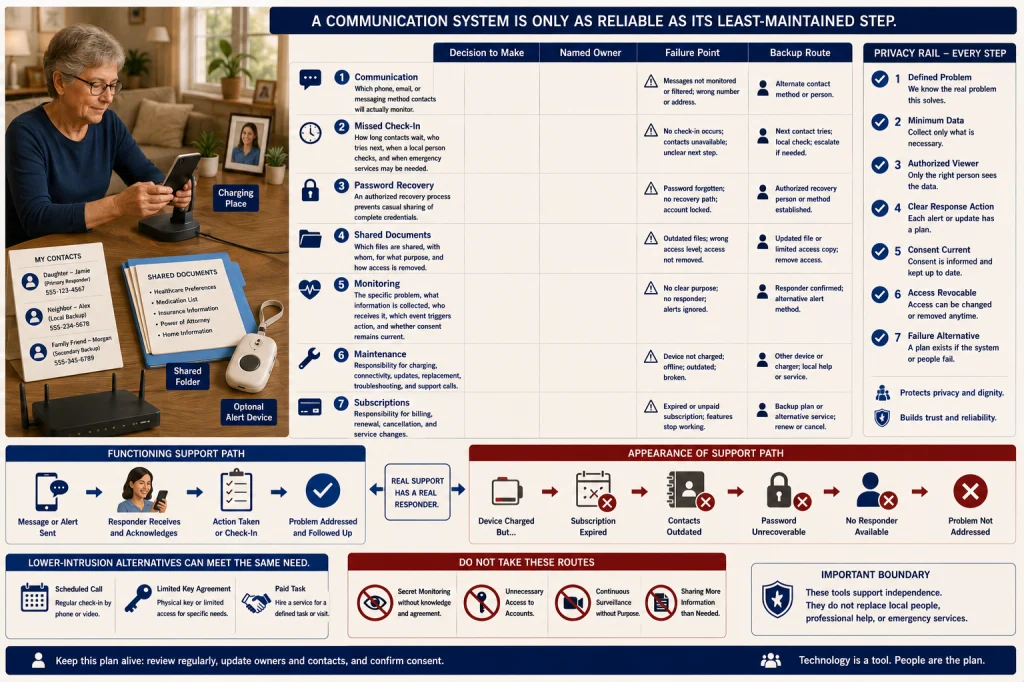
Plan Communication, Password Support, and Technology Maintenance
Technology can feel reassuring because it turns an uncertain future into buttons, alerts, and shared information. It can also become one more system the person is expected to maintain alone. Communication tools create setup, charging, subscription, password, update, and privacy work that someone must own.
| Technology and Privacy Check | Decision to Make |
|---|---|
| Primary communication | Which phone, email, or messaging method will contacts actually monitor? |
| Missed check-in | How long should contacts wait, who tries next, and when should local help be called? |
| Passwords and recovery | What recovery process exists, and who has only the access that is properly authorized? |
| Shared documents | Which files are shared, with whom, for what purpose, and how access is removed? |
| Monitoring | What information is collected, who receives it, what action follows, and whether consent remains current? |
| Device maintenance | Who handles charging, connectivity, updates, replacement, and support calls when the system fails? |
| Subscriptions | Who reviews billing, renewal, cancellation, and service changes? |
The guide to technology for older adults covers usability and setup. The guide to medical alert systems can help frame questions about response paths and maintenance without assuming that a device replaces local people or emergency services.
Editorial observation: A communication system is only as reliable as its least-maintained step. A charged device with an expired subscription, an outdated contact list, or a password no one can recover may create the appearance of support without a working response.
Plan for Temporary Setbacks Separately From Long-Term Support
A temporary setback can be emotionally difficult because needing help for two weeks may feel like evidence about the rest of life. It is not. Many support gaps first appear during a procedure, fracture, infection, home repair, bereavement, vehicle problem, or short period of exhaustion. A person may remain fully capable of directing decisions while needing practical help for days or weeks.
A temporary plan should answer:
- Who checks in and how often?
- Who covers meals, transport, pets, mail, and urgent household tasks?
- Which professional instructions need to be followed, and who can help communicate questions?
- What signs trigger a call to the clinical team or emergency services?
- When does the temporary arrangement end or require reassessment?
Long-term support planning asks different questions about ongoing personal help, housing, care coordination, cost, authority, and changing capacity. Do not use a short recovery plan as proof that friends can provide indefinite care, and do not turn a temporary setback into an assumption that the person has lost independence.
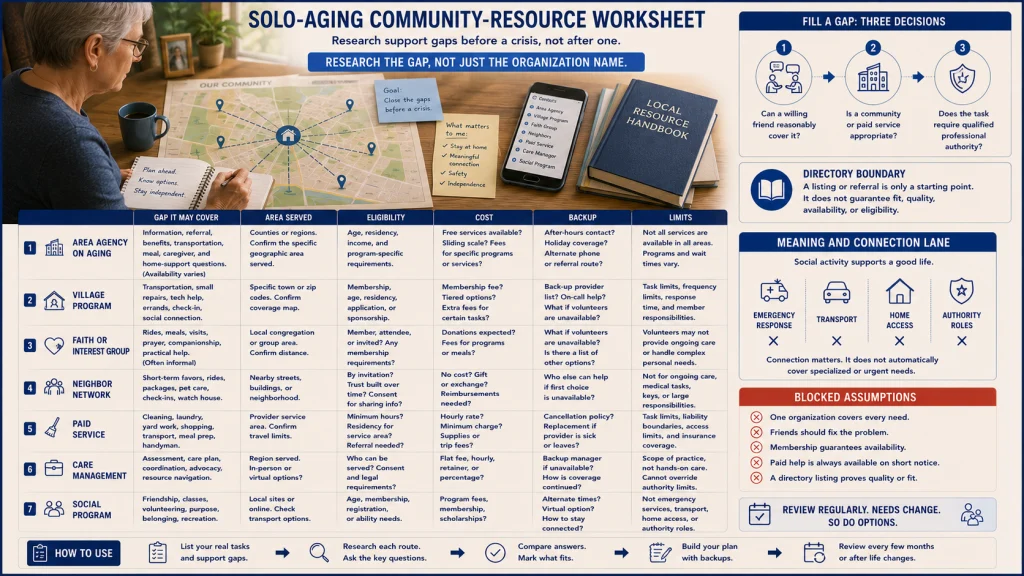
Identify Community Resources Before a Crisis
Researching community help can feel impersonal, especially when the need has not happened yet. The purpose is not to turn relationships into a service directory. It is to know which gaps friends cannot reasonably cover. Community support is easier to evaluate when there is time to ask about availability, eligibility, cost, geographic coverage, waitlists, privacy, and what happens outside normal hours.
| Resource Type | Questions to Record |
|---|---|
| Area Agency on Aging | Which information, referral, benefits, caregiver, transportation, meal, or home-support services are available locally? |
| Village or membership program | What area is served, which tasks are included, who provides them, and what does membership cover? |
| Faith or interest group | Is support formal or informal, and what happens when volunteers are unavailable? |
| Neighbor network | Which small tasks are realistic, what access is shared, and who is the backup? |
| Paid household service | What task, schedule, screening, supervision, cancellation, and payment process applies? |
| Professional care management | What credentials, scope, fees, conflicts, communication duties, and replacement process should be reviewed? |
| Social and activity program | Does it provide meaningful connection, transportation, accessibility, and a routine the person values? |
The federal Eldercare Locator connects U.S. older adults and families with local services and Area Agencies on Aging. A directory is a starting point, not a guarantee that a service fits the person’s needs.
Support planning should also protect meaning, not only emergencies. The guide to finding purpose after retirement addresses activities, contribution, structure, and connection separately from contingency roles.
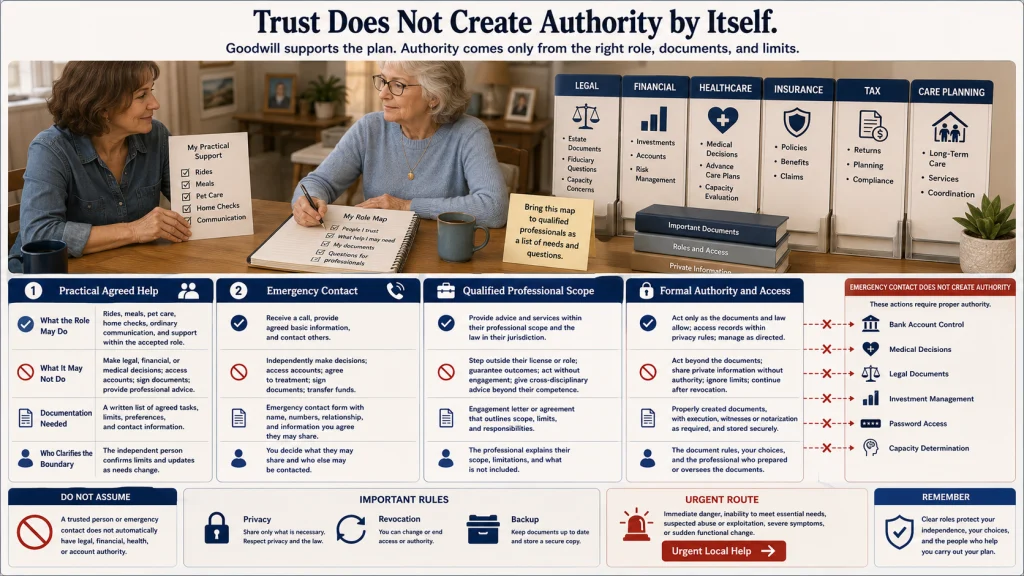
Keep Legal, Financial, and Healthcare Authority With Qualified Planning
Friendship, availability, and trust are valuable, but they do not create legal authority or professional competence. A role map can identify unanswered questions, but it cannot draft documents, appoint decision-makers, manage investments, determine capacity, or create a medical advocacy plan.
Professional boundary: Use qualified professionals for legal documents, estate and fiduciary questions, taxes, investments, insurance, healthcare authority, capacity concerns, long-term care, and individualized medical planning. Requirements differ by jurisdiction and circumstance. Do not give someone access to accounts, records, passwords, or decisions merely because they agreed to be an emergency contact.
Bring the role map to the appropriate professional as a list of practical needs and questions. Ask how formal authority, backups, privacy, revocation, record access, and professional replacement should be handled.
Immediate danger, inability to meet essential needs, suspected abuse or exploitation, severe symptoms, or sudden functional change requires qualified local or emergency help rather than routine planning.
Protect Privacy and Avoid Over-Surveillance
Concern can lead people to collect more information than the plan needs. Location sharing, door sensors, cameras, account access, shared calendars, and health dashboards can expose private routines without guaranteeing a useful response.
For every shared tool, ask:
- What specific problem is this intended to solve?
- What information does it collect?
- Who can see, store, copy, or share that information?
- What event triggers action, and who is responsible for responding?
- Can the person pause or revoke access?
- What happens if the device, connection, company, or contact fails?
- Would a scheduled call, key agreement, or paid task solve the problem with less intrusion?
Consent should be specific and revisited. Secret monitoring, unnecessary account access, or constant observation can damage trust while leaving the real support gap unchanged.
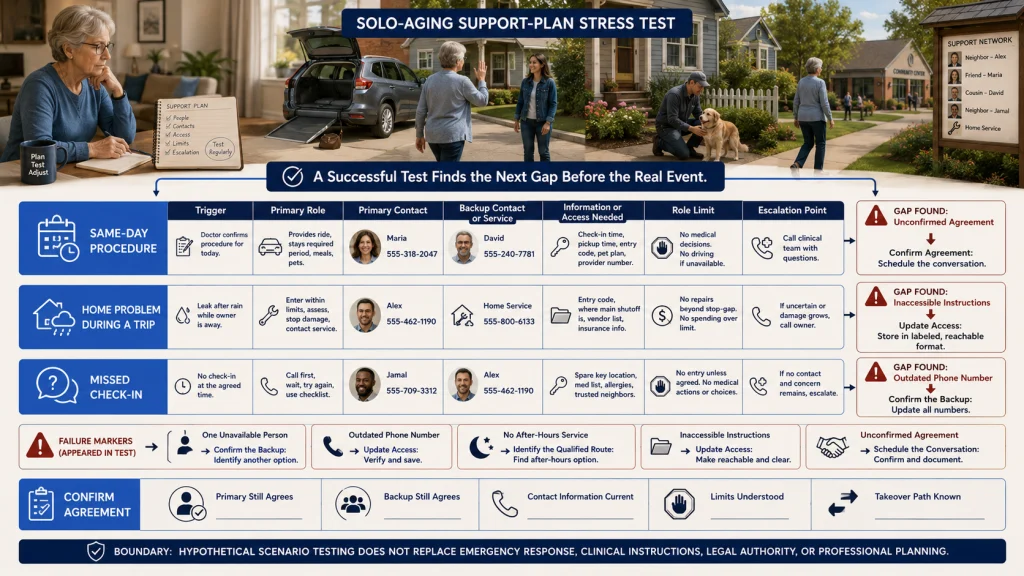
Test the Plan With Three Scenarios
A plan that looks complete on paper may still depend on one unavailable person, an outdated phone number, a service that does not operate at night, or instructions no one can access.
| Scenario | Questions to Test |
|---|---|
| Same-day procedure | Who confirms the appointment requirements, provides the ride, stays afterward, handles food or pets, and calls the clinical team if instructions are unclear? |
| Home problem during a trip | Who can enter, identify the issue, contact the correct service, protect pets or belongings, and keep the owner informed without exceeding agreed authority? |
| Missed check-in with no answer | Who calls first, how long do they wait, which backup tries next, who can make a local check, and when are emergency services contacted? |
Contact the primary person and backup for each scenario. Confirm that they still agree, have the correct information, understand their limits, and know who takes over if they cannot respond.
A test is successful when it reveals the next gap while the situation is still hypothetical.
Review the Plan After Major Life Changes
A support plan is a relationship system, so it changes when people, places, health, work, and services change.
Review after:
- A move, major home repair, or neighborhood change
- The death, illness, relocation, retirement, or reduced availability of a contact
- A new diagnosis, procedure, injury, mobility change, or repeated difficulty with an essential task
- Retirement or a major schedule change
- A new relationship, separation, estrangement, reconciliation, or boundary change
- A pet, vehicle, technology, service, subscription, or transportation change
- A legal or financial planning update completed with qualified professionals
The broader guide to planning for aging can help review housing, transport, people, activity, health routines, and next steps together.
Do not wait for every part of the plan to become perfect. Update the first role that no longer has a willing, reachable, and appropriate primary contact or backup.
Fill the First Uncovered Role and Schedule the Conversation
Solo aging is not a prediction of loneliness or a demand to replace family with a spreadsheet. It is the practical work of naming where another person, service, or qualified professional will be needed before the situation becomes urgent.
Choose one scenario, identify the role, write the task, and ask one person for explicit agreement. Add a backup and record the limits of the role.
The first completed conversation is more useful than a perfect plan that exists only in your head. Fill one uncovered role now, then schedule the next review.
FAQs
🧭 What does solo aging mean?
Solo aging means planning without assuming that a spouse, adult child, or nearby relative will coordinate support or major decisions by default. A solo ager may live alone or with others, have many close relationships, and remain socially connected.
🏠 Is living alone unsafe by itself?
No. Safety depends on the person, home, health, access, routines, support structure, and changing needs. Living alone should not be treated as proof that relocation or supervision is required.
🤝 Can friends replace every family support role?
No single relationship should be assumed to cover companionship, practical tasks, emergency response, care coordination, and formal authority. Friends may fill agreed roles, while other needs require paid services or qualified professionals.
📋 Which role should I fill first?
Start with the role most likely to be needed soon or the one with the most serious consequence if left blank, such as a post-procedure escort, local emergency contact, pet backup, or home-access plan.
🚗 What if no friend can provide transportation?
Research community, medical, accessible, volunteer, or paid transportation options before the trip is scheduled. Confirm escort rules, booking time, service area, cost, hours, and backup arrangements.
📱 Should I use monitoring technology?
Only when it addresses a defined problem with informed permission, limited access, a clear response plan, and ongoing maintenance. Technology does not replace a willing responder or emergency services.
⚖️ Can an emergency contact make legal or health decisions?
Being listed as an emergency contact usually identifies someone to call; it does not by itself establish decision-making or account authority. Legal, financial, and healthcare roles require the appropriate qualified planning.
🚨 When does routine planning become urgent?
Stop the worksheet and use the appropriate local response when safety cannot wait. Examples include immediate danger, severe symptoms, a sudden loss of function, essential needs going unmet, or possible abuse or exploitation.