A bar, body wash, shower gel, or gentle cleanser cannot be judged by format alone. Compare the actual cleansing task, intended use, ingredient list, fragrance, after-feel, package behavior, storage needs, sharing pattern, cost per real use, and observed skin response. Keep medicated, antibacterial, acne, antifungal, intimate, facial, hair, and disease-specific products outside an ordinary body-cleanser comparison. Stop using a product and seek appropriate advice for burning, swelling, hives, severe itching, rash, cracks, bleeding, or persistent irritation.
Hide the Front Labels and Compare What Actually Changes
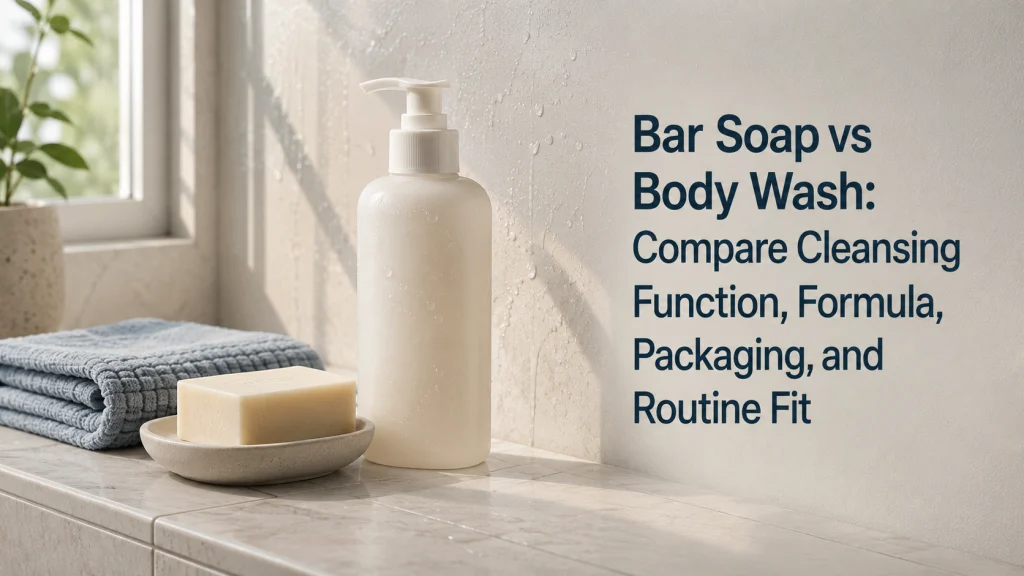
Place three products on the counter: one bar, one body-wash bottle, and one bottle labeled as a cleanser. They may have been bought for different reasons, recommended by different people, or left behind by different routines in the same household. Cover the front marketing panels. Without the brand story, color, scent name, and large claims, the comparison becomes more practical.
Turn each product around and look for the intended use, directions, ingredient list, fragrance information, warnings, package size, dispensing method, and storage instructions. Then consider how the product behaves in the bathroom and how the skin responds after comparable use. The aim is not to crown a winner. It is to find the format that creates the fewest problems in a real routine.
| Front Label Hidden | What to Compare Instead | Why It Matters |
|---|---|---|
| Bar | Formula, intended body area, fragrance, lather, drying between uses, grip, and sharing | The solid shape does not reveal the cleanser system or how the bar will fit the room. |
| Body wash | Directions, ingredients, pump or cap, bottle weight, amount dispensed, leakage, and leftover product | The liquid format does not prove gentleness, strength, or value. |
| Cleanser or shower gel | Exact claims, intended use, fragrance, texture, rinse behavior, warnings, and treatment language | Category names on the front can describe texture or marketing position rather than a predictable skin response. |
Format is only one variable. For the larger body-care context, use the personal hygiene guide. The bathing and body-odor guide can help separate cleanser choice from shower frequency, odor troubleshooting, and item care.
Define Soap, Cosmetic Cleanser, Body Wash, Shower Gel, and Medicated Wash
Everyday product names overlap, so the first useful question is not, “Which name sounds cleaner?” It is, “What is this product intended to do, and what does its label direct the user to do?”
- Soap: In ordinary conversation, this word can describe many rinse-off cleansers. Under the narrower US regulatory definition, only certain products made primarily from alkali salts of fatty acids and represented solely as soap fit that category.
- Cosmetic cleanser: A rinse-off product intended to cleanse, beautify, add fragrance, moisturize, or otherwise provide a cosmetic use without making a treatment claim.
- Body wash: A liquid or gel cleanser marketed for external-body washing. The name does not identify one standard formula.
- Shower gel: Commonly a liquid or gel-format body cleanser, often differentiated by texture, fragrance, or lather rather than a universal technical definition.
- Medicated wash: A cleanser that also claims to treat, prevent, or affect a condition or body function. Its directions, active ingredients, warnings, and intended use require separate attention.
- Intended use: The purpose established by claims, labeling, directions, promotional material, and how the product is presented for use.
In the United States, intended use helps determine whether a product is treated as a cosmetic, a drug, both, or a narrowly defined soap. The US Food and Drug Administration product-category framework explains why two rinse-off products with similar packaging can fall under different requirements when their claims differ.
Understand Why Bar Versus Liquid Does Not Reveal the Formula
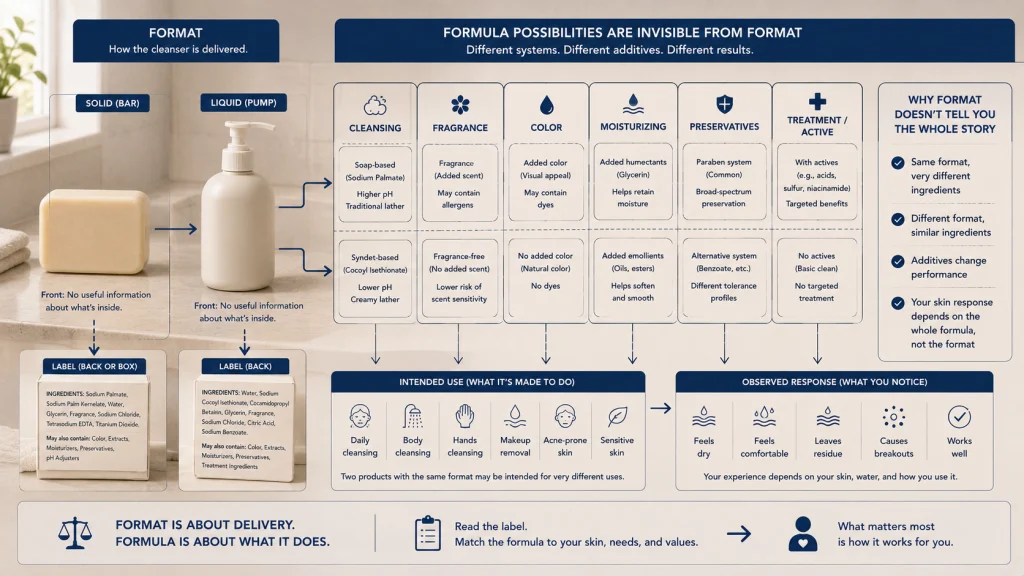
A solid bar and a liquid wash can use different cleansing systems, fragrances, moisturization ingredients, colors, preservatives, and treatment ingredients. Two bars may be less alike than one bar and one liquid cleanser. The container tells you how the product is delivered, not the full formula inside it.
| Format Question | Formula Question | What the Format Cannot Prove |
|---|---|---|
| Is it a solid bar? | What cleansing ingredients, fragrance, color, and other components are listed? | That it will feel stronger, milder, simpler, or more hygienic. |
| Is it a liquid body wash? | What is the intended use, and how much product does the package dispense? | That it will rinse more easily or leave less tightness. |
| Is it called a shower gel? | Is the texture, scent, lather, or treatment claim the meaningful difference? | That it removes more soil because it produces more foam. |
| Is it marketed as gentle? | What do the exact label, directions, fragrance information, and observed response show? | That every user or body area will tolerate it. |
| Is it marketed as natural? | Which ingredients and instructions are actually present? | That the formula has a predictable safety or irritation profile. |
Start with format for practical handling. Move to the label and observed response for the more important comparison.
Compare the Cleansing Task Before Comparing the Container
The same person may need different amounts of cleansing on different days. A low-activity day, a sweaty workout, outdoor dirt, sunscreen, oily residue, and occupational exposure are not interchangeable tasks.
For ordinary external-body washing, ask:
- Which body areas actually need cleanser?
- Is the goal removing sweat, visible dirt, surface oil, product residue, or a combination?
- Does the label support use on the intended external area?
- Can the product spread and rinse without excessive rubbing?
- Does the task require a specialty instruction that falls outside normal bathing?
A cleanser that works for ordinary underarm and body washing is not automatically suitable for the face, scalp, intimate area, wound, or a medical condition. The technique guide on how to wash the body explains where cleanser fits within preparation, rinsing, drying, and aftercare.
Compare Fragrance, Lather, After-Feel, and Observed Irritation
Fragrance, foam, slip, and the feeling left after rinsing can strongly influence preference. They should be described as observed product behavior, not treated as proof of cleansing power or health superiority.
| Feature | Useful Observation | What Not to Assume |
|---|---|---|
| Fragrance | How strong it is during use, whether it remains after rinsing, and whether it is acceptable in a shared home | That a stronger scent means the body is cleaner |
| Lather | How easily the product spreads and whether foam helps the user see where it has been applied | That a larger amount of foam removes more material |
| After-feel | Whether skin feels comfortable, coated, tight, slippery, dry, or difficult to rinse | That one after-feel is universally healthier |
| Observed irritation | New burning, itching, redness, rash, cracking, swelling, or persistent discomfort associated with use | That the user can diagnose the cause from one symptom |
For dry-skin contexts, the American Academy of Dermatology dry-skin guidance emphasizes gentle cleansing, limiting cleanser to needed areas, and avoiding excessive rubbing. That advice should not be converted into a diagnosis or a universal product prescription.
Audit Grip, Pump, Cap, Weight, Refill, Travel, and One-Handed Use
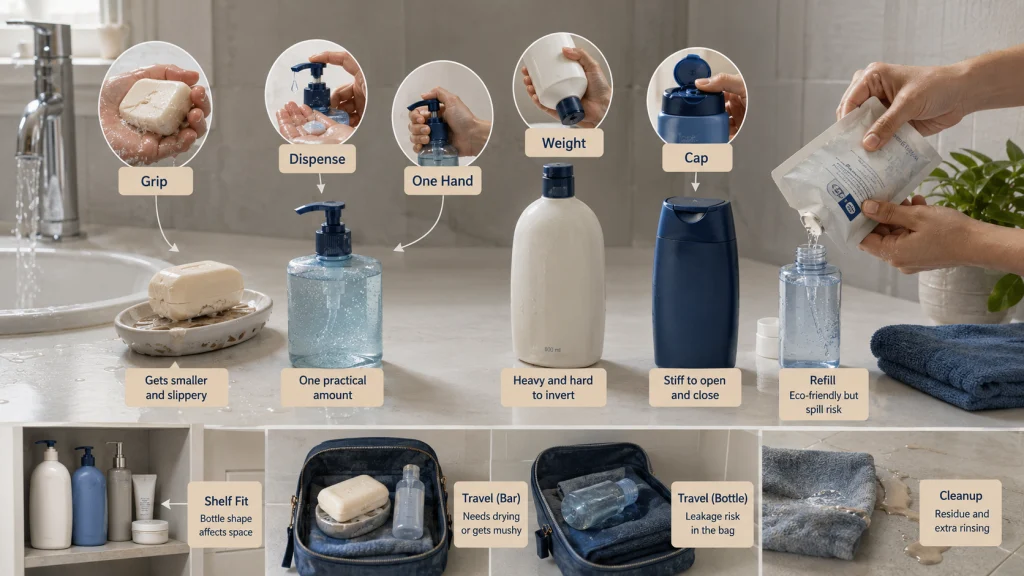
Package behavior can decide whether a cleanser is convenient long before the formula comparison is settled. Wet hands, limited shelf space, a shared bathroom, travel, and one-handed use can turn a small design difference into a repeated burden.
| Package-Use Audit | Bar Format | Bottle or Refill Format | Decision Question |
|---|---|---|---|
| Grip | May become smaller or slippery as it wears. | Bottle shape and surface may be easier or harder to hold when wet. | Can the product be handled securely without awkward reaching? |
| Dispensing | Amount depends on wetting, rubbing, and contact time. | Pump, flip cap, squeeze opening, or refill spout controls output. | Does the package release a practical amount without repeated effort? |
| Weight | Usually lighter and becomes smaller over time. | A large bottle may be heavy or difficult to invert. | Can it be lifted and replaced safely? |
| One-handed use | May require holding and rubbing the bar at the same time. | A stable pump may work with one hand, while a tight cap may not. | Does the actual package support the user’s routine? |
| Refill | Replacement usually means opening another bar. | Refilling can reduce containers but adds pouring, cleaning, labeling, and spill considerations. | Is the refill process realistic and hygienically manageable in this home? |
| Travel | Requires a dry, ventilated, leak-resistant carrying method. | Requires a secure cap and compliance with travel-volume rules when relevant. | Which format creates fewer packing and drying problems? |
Editorial observation: Package usability is part of routine fit. A stiff cap, heavy bottle, weak pump, slippery bar, or refill that drips down the container can change how much product is used and whether cleanup is delayed. Compare the exact package in the actual bathroom rather than awarding the format a general convenience score.
Compare Storage, Drying, Leakage, and Shared-Bathroom Behavior
The bar or bottle continues to affect the bathroom after the shower ends. Storage determines whether a bar dries, a cap stays clean, a refill remains labeled, or a bottle leaks onto the shelf.
For a bar, review:
- whether water drains away rather than collecting around it;
- whether the storage surface can be cleaned and dried;
- whether the bar becomes soft, sticks to the surface, or breaks into unusable pieces;
- how sharing is handled in the household;
- whether travel storage allows the bar to dry before closing.
For a bottle or refill, review:
- whether the pump, cap, neck, and shelf collect residue;
- whether the bottle leaks when tipped or transported;
- whether the label remains readable after repeated wet handling;
- whether users dispense very different amounts;
- whether a refill container is clearly identified and cleaned as directed.
Sharing does not automatically make one format unacceptable. It changes the storage, handling, and communication questions that need to be answered.
Compare Price With Actual Use and Leftover Waste
The shelf price does not show how long the cleanser will last in a particular home. Usage depends on the amount dispensed, how broadly it is applied, how the product is stored, how many people use it, and how much becomes difficult to access near the end.
| Cost or Waste Factor | What to Record | Why a Promise Is Not Possible |
|---|---|---|
| Purchase price | Price paid and usable amount | Regional prices, package sizes, and promotions vary. |
| Amount per use | Whether the bar or dispenser encourages more product than needed | Application area and user habits differ. |
| End-of-package loss | Bar fragments, product below a pump tube, residue in a refill, or leakage | Package design and storage conditions change the leftover amount. |
| Shared use | Number of users and how consistently they dispense or store the product | Household behavior can outweigh format. |
| Packaging | Container, wrapper, pump, cap, refill pouch, and local disposal options | Waste systems and refill availability differ by location. |
Use observed household consumption rather than assuming a bar always lasts longer or a refill always reduces total waste. A cheaper product that is over-dispensed, discarded early, or poorly tolerated may not be the lower-cost routine.
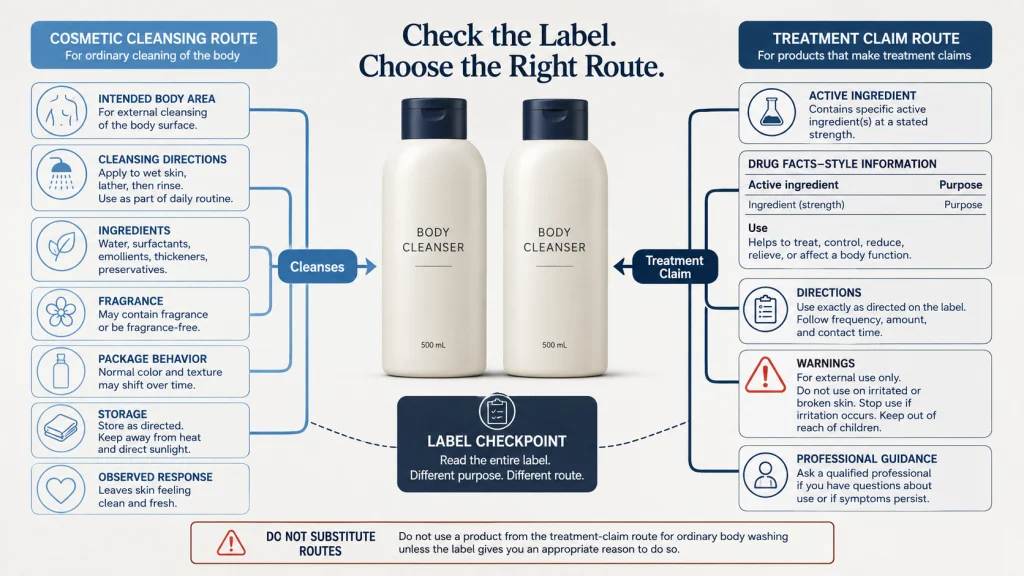
Check Whether the Product Only Cleanses or Makes Treatment Claims
A product that only cleanses belongs in a different decision path from one that claims to treat acne, control fungus, reduce disease-causing organisms, or affect a body function. The format may look ordinary even when the intended use changes the category.
- Read the intended body area and cleansing directions.
- Compare fragrance, formula, package, storage, and observed response.
- Do not interpret cosmetic wording as proof of treatment.
- Look for active ingredients, Drug Facts, treatment language, warnings, and specific directions.
- Use the product only for its labeled purpose.
- Do not substitute it for an ordinary body wash without a reason that fits the label and appropriate guidance.
Words such as antibacterial, antiseptic, acne, antifungal, treatment, prevention, or relief should trigger a label review rather than an assumption that the cleanser is a stronger everyday option. A medicated claim does not make the product appropriate for broader or more frequent use.
Keep Intimate, Facial, Hair, and Medical Cleansers Outside This Comparison
This article compares rinse-off formats for ordinary external-body washing. It does not select products for internal genital cleansing, vaginal douching, intimate symptoms, facial treatment, scalp conditions, hair washing, wounds, infection concerns, body acne, eczema, dermatitis, or another skin disease.
| Area or Need | Why It Needs a Separate Route |
|---|---|
| Face | Facial products and treatment routines may use different formulas, directions, and tolerability criteria. |
| Hair and scalp | Hair type, scalp response, styling, and treatment needs are not answered by a body-format comparison. |
| Intimate area | Internal cleansing, douching, symptoms, and specialty products require distinct safety boundaries. |
| Wound or recent procedure | Clinician, surgical, or wound-care instructions take priority over ordinary bathing advice. |
| Diagnosed or suspected condition | Product choice may require professional evaluation rather than trial-and-error comparison. |
Do not extend a product’s body-washing success to another area without checking its exact label and the instructions that apply there.
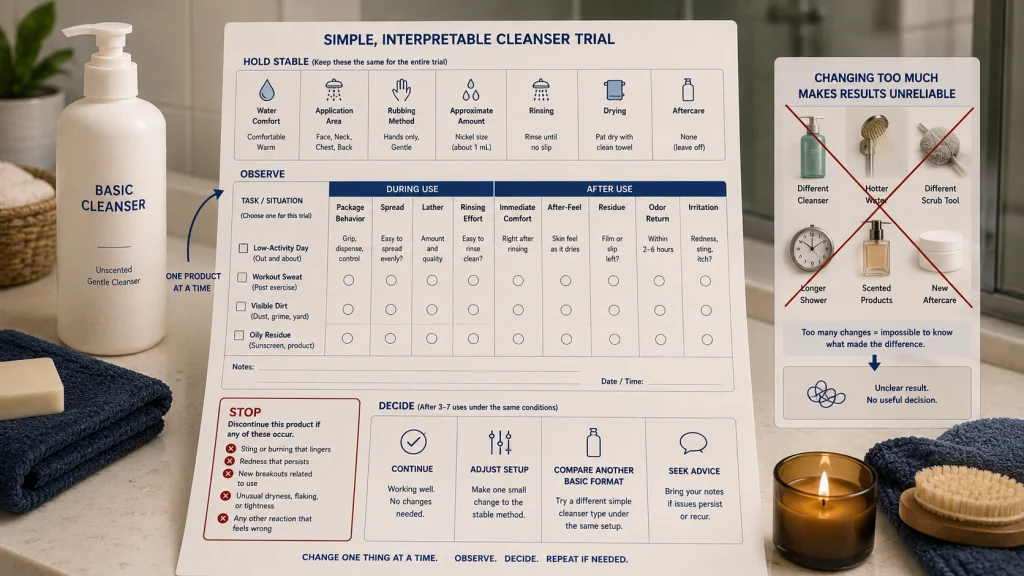
Run a Controlled One-Product Trial With the Same Shower Method
Changing the cleanser, water temperature, scrubbing tool, shower length, fragrance products, and aftercare at the same time makes the result difficult to interpret. A controlled trial keeps the ordinary shower method reasonably stable while one cleanser is observed.
| Product-Trial Sheet | Record |
|---|---|
| Cleansing task | Low-activity day, workout sweat, visible dirt, oily residue, or another ordinary external-body task |
| Product and intended use | Format, exact label category, intended body area, fragrance, and relevant warnings |
| Shower method held stable | Water comfort, application area, hands or soft cloth, approximate product amount, rinsing, drying, and aftercare |
| Package behavior | Grip, dispensing, leakage, one-handed use, shelf fit, and cleanup |
| During use | Spread, lather, scent, rinsing effort, and any immediate discomfort |
| After use | Comfort, tightness, coating, dryness, odor return, residue, or irritation |
| Stop condition | Burning, swelling, hives, severe itching, rash, cracking, bleeding, or persistent irritation |
| Decision | Continue ordinary use, change the package setup, compare another basic format, or seek advice |
Use comparable showers rather than forcing identical conditions that do not exist. Stop the trial early when a warning sign appears. The purpose is to understand routine fit, not to prove that a product is safe for every person.
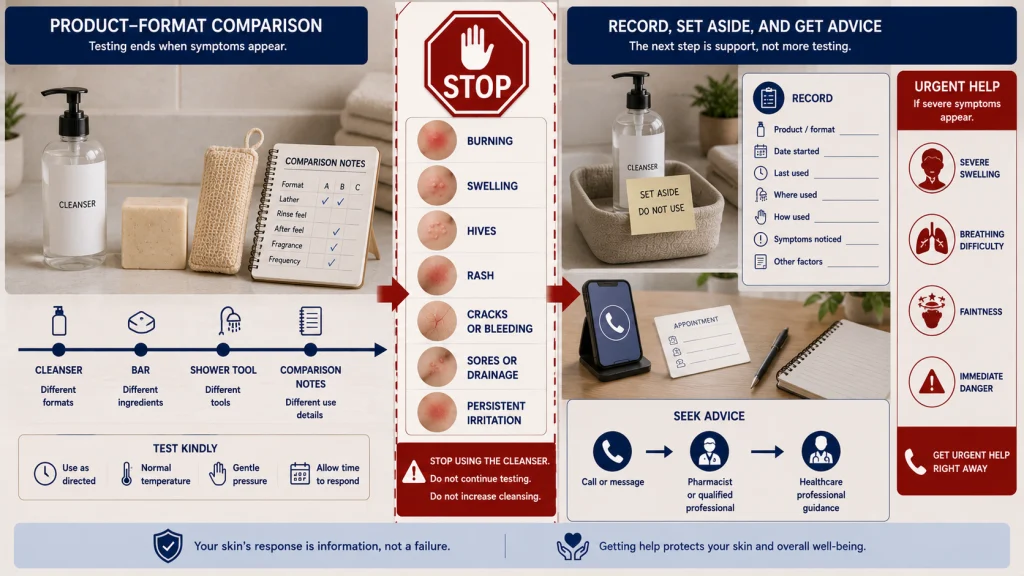
Stop for Rash, Burning, Swelling, Cracking, or Persistent Irritation
Product comparison ends when symptoms move beyond an ordinary preference such as scent, texture, or lather. Do not keep testing a cleanser to finish a comparison when the skin is reacting.
Stop using the product and seek appropriate advice for burning, swelling, hives, severe itching, rash, cracks, bleeding, sores, drainage, or persistent irritation. Use urgent help for severe swelling, breathing difficulty, faintness, or another immediate danger.
This article cannot diagnose sensitive skin, dermatitis, allergy, infection, acne, or an odor disorder. Record the product, body area, timing, directions used, and observed response so a qualified professional can evaluate the situation when needed.
If odor remains or returns despite an ordinary shower and clean clothing, use the guide to body odor after showering instead of automatically increasing cleanser strength or frequency.
Choose the Task, Formula, Package, Storage, Response, and Evidence Need
Begin with the cleansing task and intended external body area. Read the exact label, ingredients, fragrance information, directions, warnings, and any treatment claims before comparing the solid or liquid format. A familiar product does not need to be defended simply because it has always been in the shower, and a new format does not need to replace it simply because the packaging looks more modern.
Then test routine fit: grip, dispensing, bottle weight, one-handed use, travel, refill, drying, leakage, storage, sharing, cost, and leftover waste. Keep the shower method stable enough to observe how the product spreads, rinses, and feels afterward. A good choice is often the one that quietly works in the room, in the hand, and in the household without demanding extra effort every day.
Use an ordinary cleanser for an ordinary cleansing task. Route medicated, antibacterial, acne, antifungal, intimate, facial, hair, wound, and disease-specific needs to their proper instructions. When irritation persists or becomes severe, stop comparing formats and seek appropriate advice. The point is not to build a perfect shelf. It is to choose a cleanser that fits the task and then let the routine stay simple.
FAQs
🧼 Does a bar clean better than body wash?
Format alone cannot answer that question. Compare the actual formula, intended use, amount applied, cleansing task, shower method, rinsing, storage, and observed response.
🧴 Is liquid body wash automatically milder?
No. Liquid products vary widely in cleansing ingredients, fragrance, treatment claims, and directions. Read the exact label and observe how the skin responds under a consistent shower method.
🫧 Does more lather mean the product works better?
Lather may help spread the product or show where it has been applied, but foam volume alone does not establish how well the cleanser fits the task or the user’s skin.
🌿 Should I choose a product because it says natural?
Use the ingredient list, intended use, directions, warnings, package behavior, and observed response. A broad marketing term does not replace those checks.
✋ Which format is easier to use with one hand?
It depends on the exact package and bathroom setup. A stable pump may be easy to operate, while a stiff cap or heavy bottle may not be. A bar may be light but slippery or difficult to hold as it becomes smaller.
🧳 Is a bar or liquid better for travel?
A bar needs a way to dry and travel without soaking its container. A liquid needs a secure closure and may be subject to travel-volume limits. Choose the format that creates fewer leakage, drying, and packing problems for the trip.
💊 How do I know whether a wash is medicated?
Check for treatment or prevention claims, active ingredients, Drug Facts labeling, warnings, and specific directions. Use medicated products only for their labeled purpose and appropriate need.
🚩 When should I stop trying a cleanser?
Stop for burning, swelling, hives, severe itching, rash, cracks, bleeding, or persistent irritation. Seek appropriate advice rather than changing several products and shower variables at once.