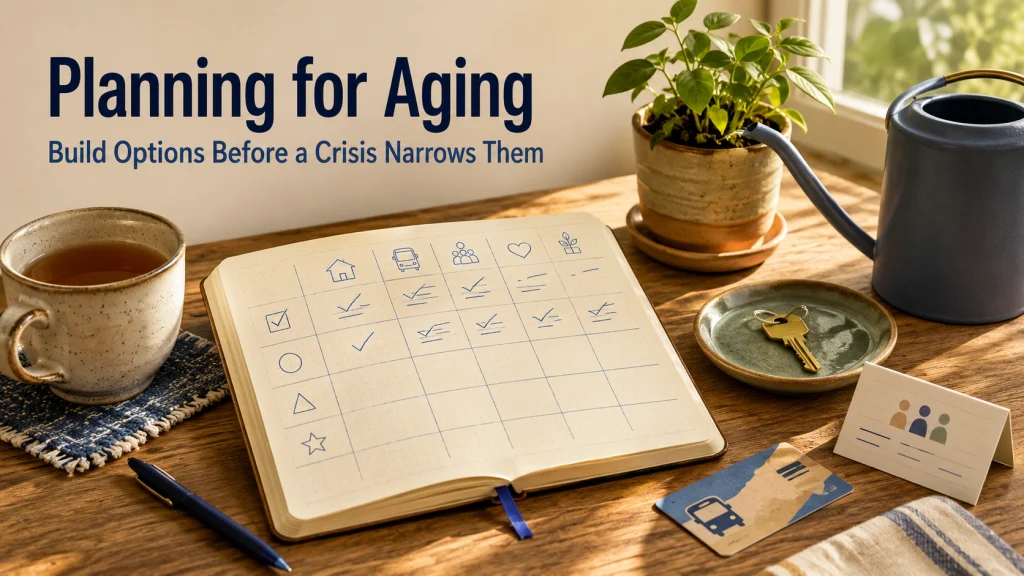
Planning for aging is not about predicting every future problem. It is about preserving options before a move, health change, transportation loss, or support gap makes decisions more urgent. A useful first plan records what matters to you, how daily life works now, who can help, which professional questions remain open, and one next action in each priority area. Review it when circumstances change so the plan stays connected to real life rather than becoming a forgotten folder.
A Retirement File Is Not a Complete Later-Life Plan
Imagine opening a well-organized folder. The retirement statement is current. Account information is easy to find. Important dates are written down. Yet there is no emergency contact list, no transportation backup, no record of preferred help, and no plan for what happens if stairs, shopping, device setup, or home maintenance become harder for a while.
The folder can look reassuring and still leave one question: what happens when part of ordinary life stops working? Financial preparation cannot answer who will bring groceries, notice a meaningful change, manage a difficult home task, or help after a short-term setback.
Key decision: A useful aging plan covers the life around the money.
This article creates a first-pass planning workbook. It does not draft legal documents, recommend investments or insurance, create a medical care plan, or choose long-term support arrangements. Its job is to make practical gaps visible early enough for you to ask better questions and keep more choices open.
Define Planning as Preserving Options
Aging preparation often feels impossible because it is framed as a demand to predict every decline. That is not a workable task. You do not need to know exactly what will happen. You need enough information and backup capacity to respond when something changes.
Option-preserving plans usually do four things:
- Record what the person wants to protect.
- Describe how daily life works now.
- Identify where one change could create a bottleneck.
- Create a next step before the decision becomes urgent.
For example, a person may not know whether they will stop driving in the next few years. They can still learn which destinations matter most, test one alternative route, and write down who could help after a temporary driving pause. That preparation does not force a decision. It expands the number of workable choices.
The broader healthy aging guide can help place each concern in the right part of daily life, while the practical independence guide focuses on maintaining choice, function, and support in ordinary routines.
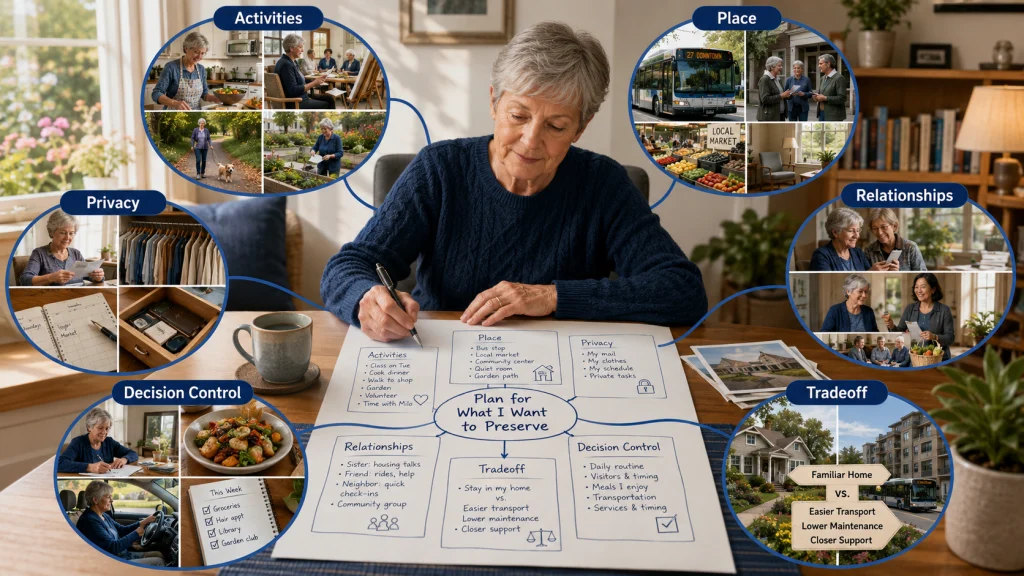
Start With Values and Non-Negotiables
A plan is easier to use when it begins with what matters, not with a list of possible losses. Write down the activities, relationships, places, routines, and forms of control that make daily life feel like your own.
| Value area | Question to answer | Example of a concrete preference |
|---|---|---|
| Activities | Which weekly activities would you work hardest to preserve? | Attend a community class, cook one evening meal, or walk to a nearby shop. |
| Place | Which parts of your home or community matter most? | Remain near familiar transit, friends, a faith community, or a local market. |
| Privacy | Which tasks or spaces do you prefer to manage privately? | Keep control of personal correspondence, clothing choices, or household scheduling. |
| Relationships | Who do you want involved in decisions, and who should not be assumed? | Consult a sibling for housing choices but use a local friend for immediate help. |
| Decision control | Which decisions do you want to keep directing even if help is needed? | Choose routines, visitors, food preferences, transportation, and service timing. |
Preferences do not need to be dramatic to matter. A person may care deeply about keeping a pet, having a quiet morning, maintaining access to a garden, or continuing one volunteer role. These details guide later choices about housing, transport, technology, support, and scheduling.
Note: Values can conflict. Staying in a familiar home may compete with easier transportation or lower maintenance. Write down the tradeoff instead of pretending every preference can be protected equally.
Create a Current-Function Baseline Without Diagnosing Yourself
A baseline is a practical description of how life works now. It is not a medical score and should not be used to label a symptom or predict decline. Its purpose is to make future changes easier to notice and discuss.
Record how you currently manage:
- Moving around the home and community.
- Shopping, cooking, cleaning, laundry, and basic home upkeep.
- Appointments, communication, paperwork, and recurring bills.
- Transportation to essential and meaningful destinations.
- Technology used for safety, contact, information, or services.
- Social connection, leisure, learning, and contribution.
Use neutral observations. Write, “I now sit down partway through meal preparation,” rather than, “I am becoming frail.” Write, “I need help resetting the router,” rather than, “I cannot handle technology.” The first version describes a task. The second assigns a broad identity that may hide the actual solution.
Safety warning: A sudden, unexplained, worsening, or safety-relevant change in function should be discussed promptly with an appropriate professional. An immediate safety risk requires urgent help. Do not use a planning worksheet to explain or diagnose a new change.
Domain 1: Record Health Questions for Professional Follow-Up
Health questions can feel heavy because uncertainty is personal. Keep this task small: write down issues that affect daily function, then bring them to the appropriate professional instead of trying to solve them through a worksheet.
- Which changes are new, persistent, worsening, or interfering with daily tasks?
- Which appointments, screenings, medication reviews, or follow-ups are already due?
- Are instructions from different professionals difficult to coordinate?
- Which symptoms or side effects affect driving, balance, sleep, cooking, or self-care?
- Who should be contacted when a health question becomes urgent?
- Where are current health records, medication lists, and contact details stored?
Professional boundary: Use qualified professionals for individualized medical, legal, financial, insurance, tax, eligibility, advance-care, and long-term support decisions. This article can help organize questions, but it cannot determine the correct professional answer or recommend one credential as universally sufficient.
The practical goal is to leave this domain with a short follow-up list. A vague concern such as “health planning” is hard to act on. A specific task such as “bring the recent balance change and current medication list to the next appointment” is usable.
Domain 2: Review Housing and Home Management
Housing decisions involve more than whether someone wants to move. The home may be comfortable today while depending on stairs, outdoor maintenance, driving, complex repairs, or another person’s unpaid help.
Walk through the home and ask:
- Which entrance is easiest to use in bad weather or after a temporary injury?
- Which daily tasks depend on stairs, carrying, reaching, grip, or balance?
- What maintenance must be completed monthly, seasonally, and unexpectedly?
- Where would a temporary helper sleep, park, or store equipment if needed?
- Which rooms, services, or community features are difficult to replace?
- What recurring costs or service arrangements could become hard to manage?
Editorial observation: A household solution may look simple until maintenance, storage, charging, replacement parts, recurring costs, stairs, or setup are included. Ask whether another person must regularly operate or maintain the solution before treating it as independent.
Use the home safety planning guide to review hazards and routines, then use the aging-in-place checklist for a more detailed room-by-room assessment. This article only identifies the questions that belong in the plan.
Domain 3: Map Mobility and Daily Tasks
Do not reduce mobility to walking distance. Daily function may also depend on standing from a chair, carrying groceries, reaching storage, using stairs, opening containers, moving through crowded spaces, or recovering after a demanding task.
Choose three routines that matter and break each into steps. For example, grocery shopping may involve making a list, reaching the store, walking through it, reading labels, lifting items, paying, carrying bags, and storing food at home. The difficult step may be transportation rather than walking, or carrying rather than shopping.
| Routine | Hardest step | Current workaround | Next question |
|---|---|---|---|
| Taking out trash | Moving a full bin across the front threshold | Using smaller bags | Could the container size, pickup location, or help schedule change? |
| Meal preparation | Standing through preparation and cleanup | Splitting the task into shorter periods | Which tools, surfaces, or prepared components reduce effort? |
| Community activity | Walking from parking or transit to the entrance | Arriving early to rest | Is there a closer route, drop-off point, companion, or schedule option? |
This task-level view prevents broad conclusions such as “I can no longer manage the house.” It shows which step needs a different method, environment, schedule, or form of help.
Domain 4: Plan Transportation and Community Access
Transportation is connected to food, health care, relationships, recreation, work, volunteering, and control over time. Waiting until driving stops or a route becomes unsafe can leave too few tested alternatives.
List your regular destinations and answer:
- How often must this destination be reached?
- Is the timing flexible or fixed?
- Can the trip be combined with another errand?
- What happens if the usual driver, vehicle, or route is unavailable?
- Which option works for evenings, bad weather, or mobility equipment?
- Who can help arrange a ride if technology or scheduling becomes difficult?
Test one backup before it is needed. A service that appears available may require advance booking, a smartphone, a long walk to a stop, a payment method, or a waiting area that does not fit the person.
The transportation options guide provides a deeper comparison of driving alternatives, community access, backup routes, and trip planning.
Domain 5: Build People, Service, and Communication Backup
A contact list can look reassuring until help is needed at a specific hour. Someone may care deeply but live far away, be unavailable during work, or lack the skill needed for one task. Another person may be nearby and dependable for practical help but not right for private decisions.
For each support need, write down the role:
- Who notices when the usual routine changes?
- Who can provide immediate local help?
- Who can coordinate information from a distance?
- Who can help with technology, transportation, meals, pets, or home access?
- Which paid or community service could replace unavailable informal help?
- How will people communicate if the normal phone or internet service fails?
People planning without default family support may need a more deliberate network. The solo aging guide focuses on building backup when no automatic family helper can be assumed.
Technology can support contact, reminders, access, and coordination, but only when setup, charging, connectivity, recovery, and user confidence are included. Use the technology planning guide to evaluate those practical requirements.
Domain 6: List Documents and Decisions for Qualified Professionals
This domain keeps legal, financial, tax, insurance, eligibility, care-preference, and long-term support questions visible without pretending that a general article can answer them.
Create a discussion list such as:
- Which legal documents exist, where are they stored, and when were they last reviewed?
- Who is authorized to receive information or act in defined situations?
- Do named contacts know that they have been listed?
- Which accounts, recurring payments, insurance records, and household obligations need an organized inventory?
- Which care preferences should be discussed with appropriate professionals and trusted people?
- Which questions involve state law, taxes, eligibility, contracts, or individualized financial risk?
Professional boundary: Do not use this checklist to draft or interpret legal documents, select investments, compare insurance strategies, determine benefit eligibility, create a medical plan, or choose a long-term support contract. Take the organized questions and records to qualified professionals who can assess the person’s situation and jurisdiction.
The output for this domain is an appointment list and a record-location list, not a set of do-it-yourself answers.
Domain 7: Protect Purpose, Learning, and Enjoyable Activity
Planning can become dominated by risks and paperwork. A plan that protects only survival but not joy is incomplete. It should also preserve reasons to get up, go out, learn, contribute, create, rest, and spend time with other people.
Write down:
- One activity that provides enjoyment.
- One role that provides contribution or responsibility.
- One relationship or group you want to maintain.
- One skill, subject, or creative practice you want to continue learning.
- One low-effort version for weeks when energy, transport, or health changes.
A meaningful activity needs practical support. A class may depend on transport. Gardening may depend on storage, reach, water access, and seasonal help. Volunteering may depend on a predictable schedule or digital communication. Include those dependencies in the same plan rather than treating purpose as an abstract wish.
Use the guide to finding purpose after retirement when this domain needs a deeper process for roles, learning, contribution, and enjoyable structure.
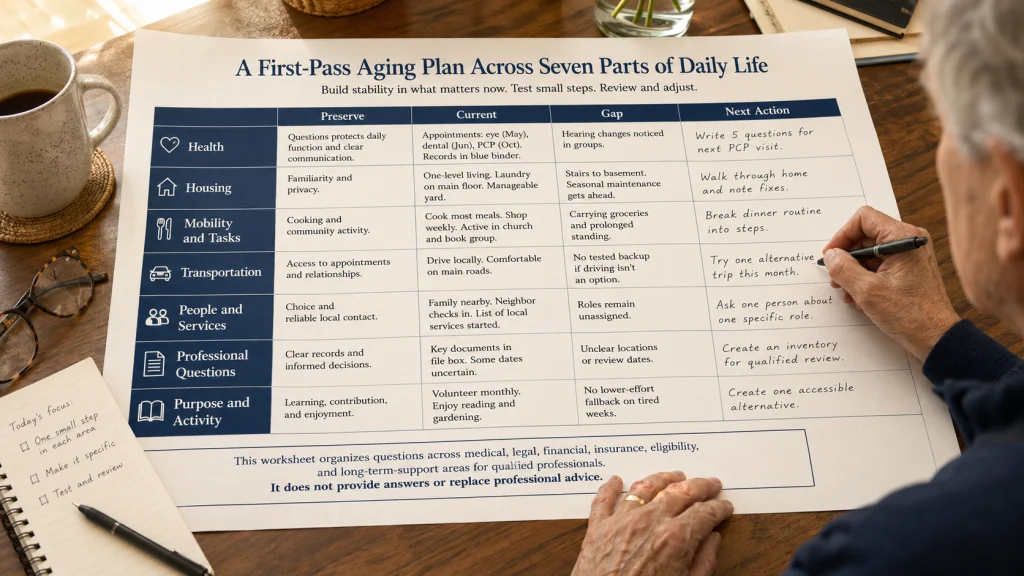
Complete the Seven-Domain Aging-Plan Worksheet
Use one row per domain. Keep the first version brief enough to finish. The goal is not a perfect answer. It is a visible record of what matters, what is working, what could narrow options, and what should happen next.
| Domain | What I want to preserve | Current capacity or resource | Gap or unanswered question | One next action |
|---|---|---|---|---|
| Health questions | Daily function and clear communication | Current records and regular appointments | Recent change not yet discussed | Prepare a short question list |
| Housing | Familiar neighborhood and privacy | Manageable daily layout | Stairs and seasonal maintenance | Complete a home walkthrough |
| Mobility and tasks | Cooking and community activity | Most tasks remain manageable | Carrying and prolonged standing | Break one routine into steps |
| Transportation | Access to appointments and friends | Current driving or transit routine | No tested backup | Try one alternative trip |
| People and services | Choice and reliable local contact | Several willing contacts | Roles are not assigned | Ask one person about one role |
| Professional documents | Clear records and informed decisions | Some documents already exist | Review dates and locations unclear | Create an inventory for professional review |
| Purpose and activity | Learning, contribution, and enjoyment | Current weekly activities | No low-effort fallback | Create one accessible alternative |
Replace the examples with your own language. A useful row names a real task and a realistic next action. “Solve transportation” is too broad. “Test the bus route to the clinic on a non-appointment day” can be completed and reviewed.
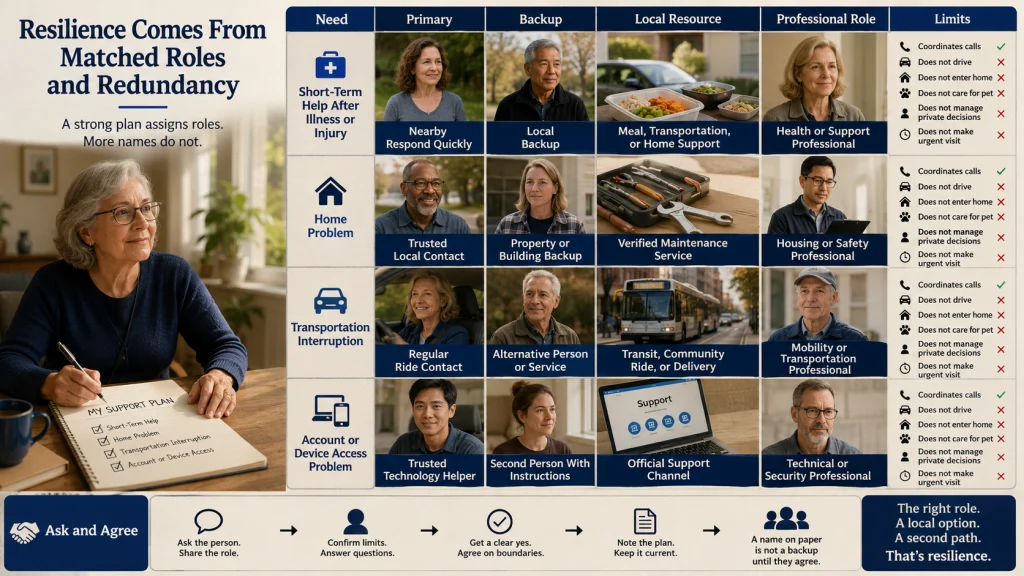
Build a Support Map With Roles and Backups
A support map shows who or what fills each role. It should include informal contacts, local resources, services, and professional categories without assuming one person can handle everything.
| Need or situation | Primary contact | Backup | Local resource or service | Professional role to contact |
|---|---|---|---|---|
| Short-term help after illness or injury | Person who can respond quickly | Second local contact | Meal, transport, or home-support resource | Appropriate health or support professional |
| Home problem | Trusted local contact | Property or building contact | Verified repair or maintenance service | Relevant housing or safety professional |
| Transportation interruption | Regular ride contact | Alternative person or service | Transit, community ride, or delivery option | Mobility or transportation professional when needed |
| Account or device access problem | Trusted technology helper | Second person with documented instructions | Official support channel | Appropriate technical or security professional |
Ask before assigning someone. A name on paper is not a backup until the person understands the role and agrees to it. Record limits as well. Someone may be able to coordinate calls but not provide transport, enter the home, manage a pet, or make a time-sensitive visit.
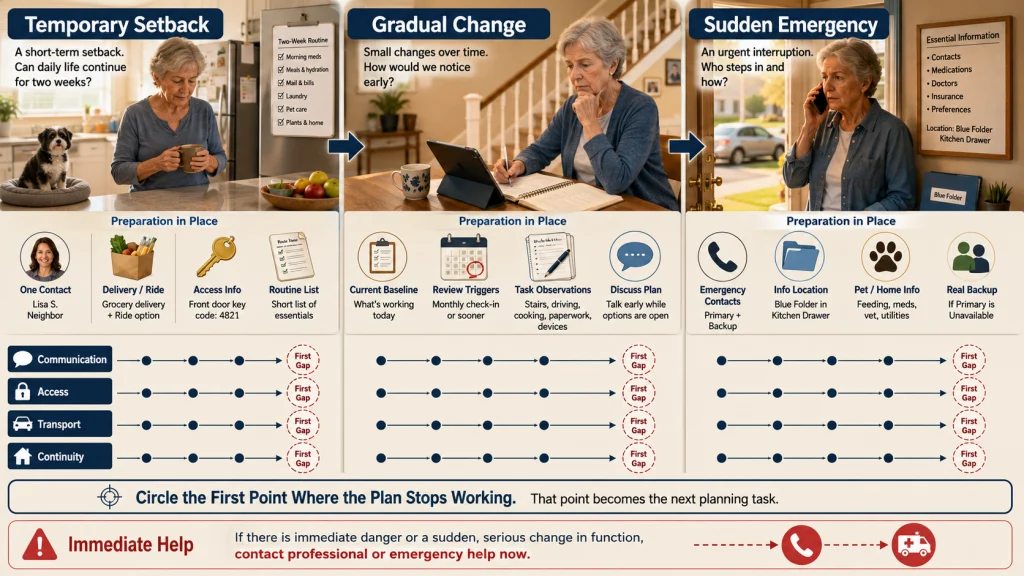
Run Three Scenarios Before They Become Urgent
Scenarios expose dependencies that a general checklist may miss. Keep them practical and limited. The goal is to test communication, access, transport, and short-term continuity, not to predict a specific diagnosis or crisis.
| Scenario | Questions to test | Useful preparation |
|---|---|---|
| Temporary setback | Who handles groceries, transport, pets, laundry, and home access for two weeks? | One local contact, one delivery option, current keys or access instructions, and a short household routine list. |
| Gradual change | How would you notice that stairs, driving, cooking, paperwork, or device use is becoming harder? | A baseline, review triggers, task-level observations, and a plan for discussing changes early. |
| Sudden emergency | Who is contacted, how is the home accessed, where is essential information, and who manages immediate responsibilities? | Emergency contacts, accessible records, pet or household instructions, and a clear backup when the primary person is unavailable. |
Safety warning: A sudden functional change, immediate danger, or urgent medical concern requires prompt professional or emergency help. Do not spend time completing a worksheet when immediate action is needed.
After each scenario, circle the first point where the plan stops working. That point becomes a real planning task.
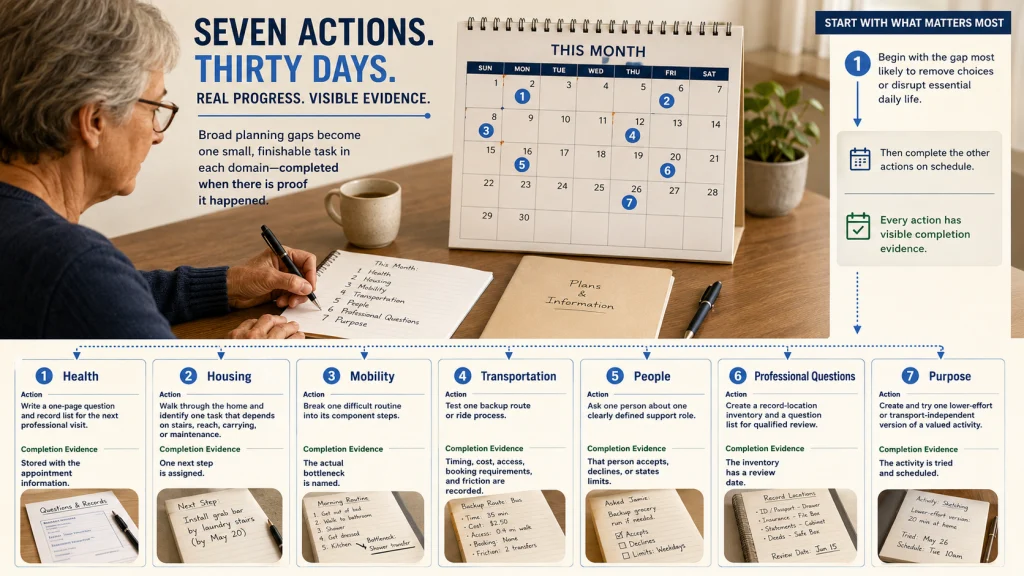
Convert Gaps Into a 30-Day Action List
Choose one small task per domain. Seven contained tasks are easier to complete than one vague instruction to prepare for later life.
| Domain | Action within 30 days | Completion evidence |
|---|---|---|
| Health questions | Write a one-page question and record list for the next professional visit. | The list is stored with appointment information. |
| Housing | Walk through the home and identify one task that depends on stairs, reach, or maintenance. | One next step is assigned. |
| Mobility and tasks | Break one difficult routine into steps. | The actual bottleneck is named. |
| Transportation | Test one backup route or ride process. | Timing, cost, access, and booking friction are recorded. |
| People and services | Ask one person about one clearly defined support role. | The person accepts, declines, or sets limits. |
| Professional documents | Create a location inventory and list questions for qualified review. | The inventory has a review date. |
| Purpose and activity | Create one lower-effort or transport-independent version of a valued activity. | The fallback has been tried once. |
Do not wait for every domain to feel equally important. Start with the gap most likely to remove choices or disrupt essential daily life, then complete the remaining tasks over the month.
Set Annual Reviews and Event-Based Triggers
Review the one-page plan at least once a year, even when nothing obvious has changed. Also review it after an event that affects housing, transportation, health, support, technology, or daily responsibilities.
Use this annual review checklist:
- Are the values and non-negotiables still accurate?
- Has current function changed in any important task?
- Are contact names, phone numbers, access instructions, and backup roles current?
- Have services, transport routes, device requirements, or recurring costs changed?
- Do professional questions or document reviews need new appointments?
- Are meaningful activities still accessible and enjoyable?
- Has every action item gained an owner, date, or next review point?
Review sooner after a move, retirement, death or unavailability of a support person, new diagnosis, fall, driving change, major home change, or technology change. The event does not automatically require a major life decision. It requires checking whether the existing plan still works.
Practical tip: Put the review date on the first page and link it to a recurring event you already remember, such as an annual household paperwork review or a birthday month.
Complete One Page and Schedule the First Review
Your first aging plan does not need to settle every question. It needs to show what matters, how life works now, where one change could narrow options, who can help, which questions belong with professionals, and what you will do next.
Complete the seven-domain worksheet, add the support map, test the three scenarios, and choose one 30-day action in each domain. Then write the first review date at the top of the page.
The plan matters because it reveals a gap while there is still time to compare options, involve the right people, and preserve control over the next decision.
FAQs
🧭 When should I start planning for aging?
Start while daily life is stable enough to compare options without pressure. The first plan can be brief and should focus on values, current function, support, practical gaps, and one next action in each priority area.
📄 Does this plan replace legal or financial planning?
No. It keeps legal, financial, insurance, tax, eligibility, and care-preference questions visible so you can bring them to qualified professionals. It does not draft documents, select products, or provide individualized recommendations.
🏠 Do I need to decide now whether I will move?
No. Record what the current home requires, which features matter, and what changes could make it harder to manage. Testing alternatives and identifying triggers can preserve choices without forcing an immediate move.
🚗 What if I still drive and do not need transportation help?
Keep the current routine, but test one backup for an appointment, essential errand, or meaningful activity. A tested alternative is more useful than a service name discovered during an urgent interruption.
🤝 Does accepting support reduce independence?
Not necessarily. Support can preserve choice and energy when it is matched to a specific task and the person remains involved in decisions. Independence does not require completing every task alone.
📱 Should technology be part of the plan?
Include technology when communication, transport, services, home access, reminders, or safety depend on it. Also record setup, charging, password recovery, connectivity, replacement, and who can help when the system stops working.
🔄 How often should I review the plan?
Review it annually and after a move, retirement, support-person loss, new diagnosis, fall, driving change, major home change, or technology change. Update only the parts affected by the event rather than rebuilding everything.
🚨 What should I do during an immediate safety problem?
Seek prompt professional or emergency help. Do not delay action to complete a worksheet, contact list, or long-term planning task when there is immediate danger or a sudden serious change.