Walking endurance should be judged by duration, pace, terrain, and recovery together rather than by distance or step count alone. Start with a repeatable route, record when effort first changes the walk, and use planned walk-rest intervals before fatigue forces a stop. Progress only one variable at a time while keeping weather, terrain, seating, hydration, and the return route visible. A sudden or disproportionate decline belongs outside self-directed progression and should be evaluated appropriately.

Compare two walks of the same distance
Two people complete the same route. The first walks continuously, slows sharply near the end, reaches home exhausted, and needs a long recovery before ordinary activity feels manageable again. The second uses planned walking and resting periods, keeps a steadier rhythm, and recovers more predictably.
Continuous walk
- Same total distance
- No planned rest
- Pace drops late in the route
- Return becomes the hardest part
- Recovery lasts much longer than expected
Planned intervals
- Same total distance
- Rest begins before failure
- Pace remains more even
- Return route stays manageable
- Recovery is steadier and easier to compare
The second walk is not automatically easier in every sense. It is easier to interpret because the pacing plan prevents the final minutes from hiding what the route and recovery are doing.
More distance is not progress when recovery keeps getting worse.
Define endurance using duration, pace, terrain, and recovery
Walking endurance is the ability to continue under comparable conditions without the walk or recovery becoming progressively less manageable. Four variables belong in the definition:
- Duration: How long the person walks, including or excluding planned rests as clearly labeled.
- Pace: Whether the rhythm stays similar or slows sharply as the walk continues.
- Terrain: The surface, slope, turns, weather exposure, and route complexity.
- Recovery: How the person feels after stopping and how long it takes to return to ordinary activity.
A longer walk on a flat indoor route cannot be compared directly with a shorter walk in heat, on a slope, or across uneven pavement. The conditions have changed along with the time.
Use the mobility planning guide when walking endurance is only one part of a broader change in daily movement.
Choose a repeatable baseline route or indoor course
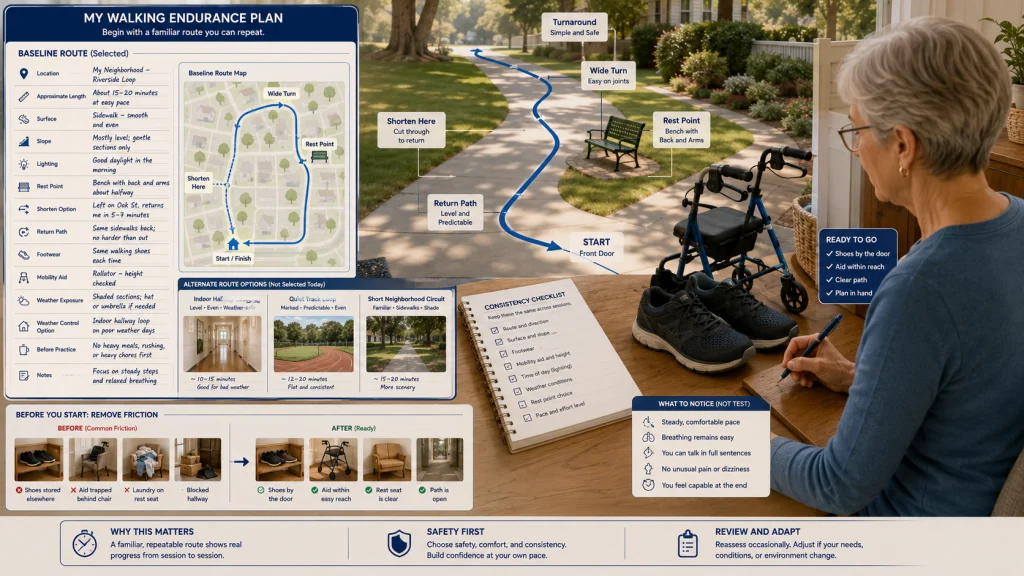
The baseline route should be familiar enough that navigation does not become the main challenge. It should also have an easy turnaround, known rest access, and a return path that does not become unexpectedly harder.
Baseline worksheet:
- ☐ Route location and approximate length are known.
- ☐ Surface and slope remain reasonably consistent.
- ☐ Lighting and visibility are adequate.
- ☐ A chair, bench, railing, wall, or other planned rest point is available.
- ☐ The route can be shortened without creating a difficult return.
- ☐ Footwear and mobility aid match the route.
- ☐ Weather exposure can be avoided or controlled.
- ☐ The person is not starting immediately after an unusually demanding task.
An indoor hallway, room loop, quiet track, or short neighborhood circuit can all serve as a baseline when the route is predictable. The purpose is not to find the easiest possible path. It is to create a condition that can be repeated and compared.
Once the route is stable, the next useful question is not “How far can I force this today?” It is “When does the quality of the walk first begin to change?”
Editorial observation: Household friction can undermine a good baseline before walking begins. Shoes may be in another room, the aid may be behind a chair, the hallway may be blocked, or the only resting seat may be covered with laundry. Removing those repeated obstacles makes the plan easier to follow without changing the exercise itself.
Record the time before effort or symptoms force a stop
Begin at a pace that feels sustainable rather than using the first minutes to prove speed. Record the time when one of the following first appears:
- Pace drops noticeably.
- Foot placement becomes less consistent.
- The person begins leaning heavily on a mobility aid.
- Conversation or attention becomes difficult.
- Effort rises enough that a rest feels necessary.
- A new symptom appears.
The first change point is more useful than the final point of exhaustion. It shows where the walk begins to lose its original quality.
Do not use a concerning or disproportionate symptom as a training marker. Those responses belong in the escalation plan, not the progression log.
Use planned walk-rest intervals instead of failure-based rests
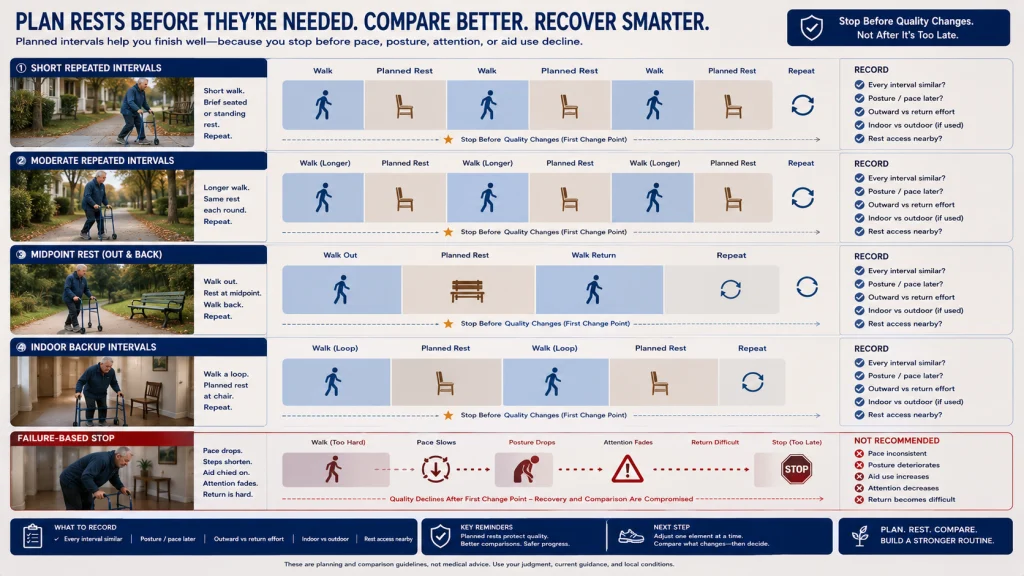
A planned rest begins before the person reaches the point where walking form, attention, or confidence starts falling apart. This makes each interval easier to compare and prevents the final return from becoming a separate endurance test.
| Walk-rest interval table | Illustrative structure | Use it when | What to record |
|---|---|---|---|
| Short repeated intervals | Brief walk, planned seated or standing rest, repeat | The baseline becomes difficult quickly or recovery is inconsistent | Whether every interval remains similar |
| Moderate repeated intervals | Longer walk period with the same planned rest each round | Short intervals remain steady across the session | Whether pace or posture changes in later rounds |
| One planned midpoint rest | Walk to a known rest point, recover, then return | The route is familiar and the return is no harder than the outward section | Outward and return effort separately |
| Indoor backup intervals | Repeat a clear hallway or room loop with a nearby chair | Heat, rain, low energy, or outdoor conditions change the route | How the indoor version compares with the outdoor baseline |
Exact interval lengths are not universal. Choose a starting pattern that ends each walking period before quality deteriorates, then repeat it under similar conditions.
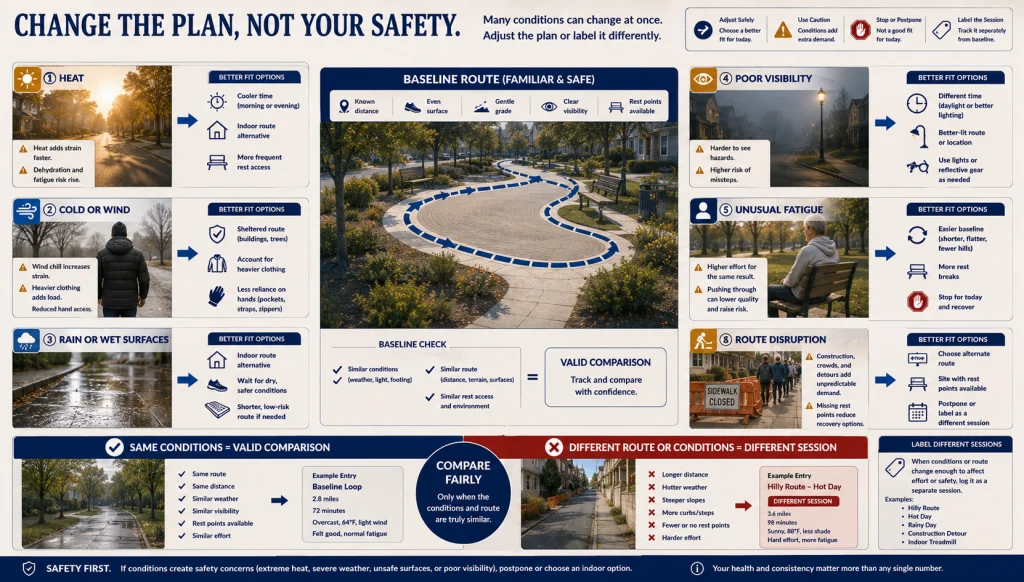
That comparison only stays meaningful when the environment remains reasonably steady. A longer interval in cool indoor air and the same interval on a hot slope are not the same test.
Hold terrain and weather stable while testing duration
Increasing time while also changing the route makes the result difficult to interpret. A longer walk may seem unsuccessful when the real difference was heat, wind, a steeper return, more curbs, or fewer places to rest.
Weather and route adjustment card:
- Heat: Shorten the route, choose a cooler time or indoor option, and increase rest access.
- Cold or wind: Use a sheltered route and account for heavier clothing or reduced hand access.
- Rain or wet surfaces: Move indoors rather than testing endurance on a less predictable surface.
- Poor visibility: Change the time or location instead of relying on the same route in dim conditions.
- Unusual fatigue: Use the easier baseline or stop rather than forcing the planned progression.
- Route disruption: Avoid construction, crowds, blocked sidewalks, or a missing rest point when comparing progress.
When the conditions differ, label the session as a different route rather than treating the result as direct evidence of improvement or decline. Stabilizing the environment answers one question: whether duration is changing. The next section answers a different question: which part of the plan should advance.
Progress total time or interval length, not both
Choose one progression variable after the baseline becomes repeatable. Increasing total session time and extending every walking interval in the same week can quietly double the demand.
| Progression choice | What changes | What stays the same | Stop progressing when |
|---|---|---|---|
| Total time | Add a small amount to the overall session | Walk-rest pattern, route, pace, and terrain | Later intervals become less steady or recovery worsens |
| Walking interval length | Extend one or more walking periods | Total session time, rest length, route, and pace | The new interval reaches the failure point instead of ending before it |
| Number of intervals | Add one repeat of the same pattern | Interval length, rest, and conditions | The final repeat differs clearly from the first |
Progress is not proven by completing a harder plan once. Repeatability, recovery, and the ability to continue ordinary activity afterward matter more than one unusually strong day.
This is where the plan becomes less about chasing a bigger number and more about protecting a walk that still leaves room for the rest of the day.
Plan hydration, temperature, seating, and the return route
Endurance plans often focus on the outward walk and treat the return as automatic. The route is incomplete until the person can get back without the second half becoming much harder.
Carry water when appropriate and practical, but do not turn hydration into a rigid prescription. Temperature, health conditions, medication questions, and individual needs may require qualified guidance.
Know where the person can sit, whether the seat has arms, and whether the rest area remains available at the planned time. A bench in direct sun or a chair behind a locked door does not function as dependable rest access.
Use a loop, out-and-back route, or indoor course only when the return difficulty is understood. Avoid routes where the easiest section comes first and the steepest, hottest, or least supported section appears after fatigue has accumulated.
Interpret normal effort versus concerning symptoms cautiously
Ordinary effort can include feeling warm, breathing more deeply, or wanting a planned rest. The response should settle with rest and remain similar across comparable sessions.
Do not normalize a new or disproportionate change simply because it occurs during exercise. A response that is severe, abrupt, worsening, persistent, or clearly out of proportion to the route requires qualified evaluation rather than another self-test.
Fatigue also deserves context. Poor sleep, heat, illness recovery, a new route, and a demanding day can affect one session, but repeated decline under comparable conditions should not be dismissed as lack of motivation.
This article does not diagnose heart or lung disease, anemia, frailty, deconditioning, balance disorders, or another medical cause of reduced endurance.
When the response remains within an ordinary, repeatable range, a short log can show whether the plan is actually becoming more dependable.
Use a two-week progression log
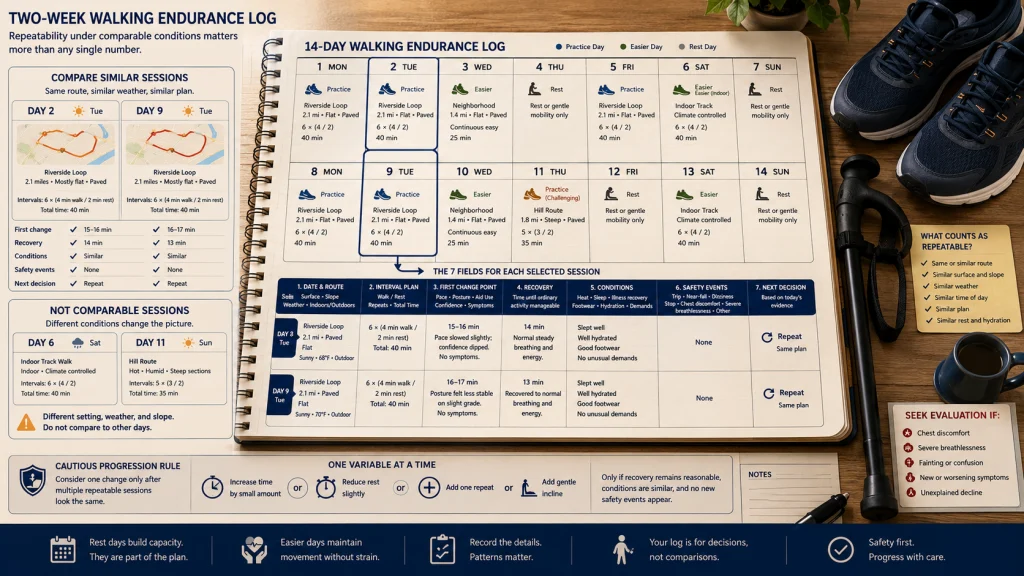
A two-week log is long enough to show whether the baseline repeats under ordinary conditions without turning every day into a test. It should include rest and easier days rather than assuming daily progression.
| Two-week recovery log | What to record |
|---|---|
| Date and route | Location, surface, slope, weather, and indoor or outdoor setting |
| Interval plan | Walking period, rest period, number of repeats, and total session time |
| First change point | When pace, posture, aid use, confidence, or symptoms first changed |
| Recovery | How long it took to feel ready for ordinary activity |
| Conditions | Heat, sleep, illness recovery, footwear, hydration access, and unusual demands |
| Safety events | Trip, near-fall, dizziness, unexpected stop, chest discomfort, or severe breathlessness |
| Next decision | Repeat, simplify, progress one variable, or seek evaluation |
Compare sessions only when route and conditions are reasonably similar. One faster walk in cool weather and one slower walk in heat do not form a clean progression test.
Use the functional exercise guide when the log also needs to include chair rise, carrying, reaching, or other daily tasks.
Escalate after chest pain, fainting, severe breathlessness, or sudden decline
Red-flag boundary: Stop self-directed troubleshooting and seek qualified evaluation for chest pain or pressure, fainting, severe or disproportionate breathlessness, sudden weakness, confusion, a fall, a sudden reduction in walking capacity, or another new, severe, persistent, worsening, or unexplained symptom. Emergency symptoms require immediate help.
Do not keep shrinking the route simply to see whether a serious response disappears. When walking capacity changes abruptly or begins disrupting essential daily movement, the problem may sit outside ordinary pacing and progression.
Assessment is also appropriate when recovery keeps lengthening despite comparable conditions, when the person repeatedly needs unexpected support, or when walking has become limited by symptoms rather than ordinary effort.
Use the balance exercise guide when steadiness is the primary issue. Use the chair exercise guide when seated movement is needed while walking difficulty is being evaluated.
State the baseline, interval plan, single progression variable, and red-flag boundary
Finish the plan in four lines:
- Baseline: Name the repeatable route, conditions, pace, rest access, and return path.
- Interval plan: Record when walking begins and ends, where rest occurs, and how many repeats are planned.
- Single progression variable: Choose total time, interval length, or number of repeats.
- Red-flag boundary: Write the symptom or sudden decline that ends self-directed practice and triggers evaluation.
A complete example might read: “I will use the same indoor loop with a chair near the midpoint. I will walk for a manageable period, rest before my pace drops, and repeat the same pattern. For two weeks, I will change only total time while keeping the route and intervals steady. Any sudden, severe, or clearly disproportionate response ends the plan and triggers evaluation.”
Use the broader healthy aging guide when endurance is part of a larger plan for movement, daily function, and independence.
Building stamina should make ordinary walking more dependable, not turn every outing into a test of how much fatigue can be tolerated. The clearest progress is a repeatable walk with steadier recovery and fewer surprises afterward.
FAQs
🚶 Is walking farther always a sign of better endurance?
No. Distance must be considered with pace, terrain, recovery, and symptoms. A longer walk followed by much worse recovery may not represent useful progress.
⏱️ Should I walk until I feel exhausted?
No. Planned rests should begin before pace, posture, attention, or confidence deteriorates. Failure-based rests make sessions harder to compare.
🪑 Is sitting during a walking workout allowed?
Yes. A planned seated rest can help keep later intervals comparable. The seat should be available, stable, and positioned before the walk begins.
📈 What should I increase first?
Choose one variable, such as total time, interval length, or number of repeats. Keep route, terrain, pace, and rest pattern as consistent as possible.
☀️ Does hot weather change the plan?
Yes. Heat can change effort and recovery, so use a cooler time, shorter route, more rest access, or an indoor alternative rather than treating the session as a direct comparison.
💧 How much water should I drink?
This article does not prescribe a universal amount. Keep water accessible when appropriate and seek qualified guidance for health, medication, temperature, or fluid questions.
📝 What belongs in a recovery log?
Record the route, interval plan, first change point, recovery time, weather, unusual fatigue, and any trip, dizziness, severe breathlessness, or other concerning response.
🚩 When should reduced walking endurance be assessed?
Seek qualified evaluation when walking capacity drops suddenly or a response is severe, persistent, worsening, unexplained, or clearly out of proportion to the route. Emergency symptoms require immediate help.