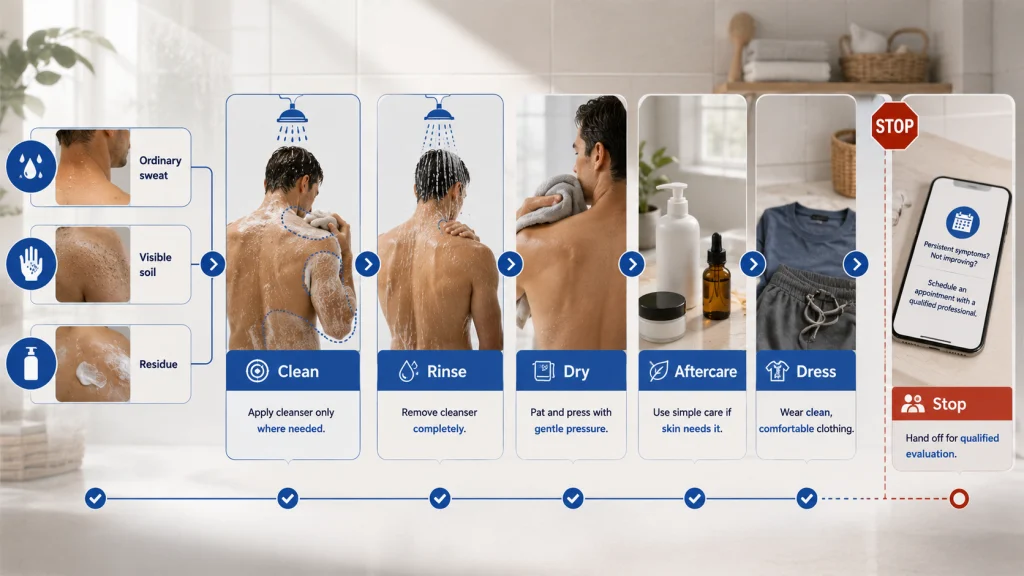
A practical shower removes ordinary sweat, visible soil, and residue without turning heat, cleanser, friction, or time to maximum. Prepare clean clothes and a towel first, use comfortable water, wash the external body with only the cleanser and pressure the task requires, rinse fully, and dry carefully. Hair, facial, intimate, wound, medical, and assisted-bathing needs may require separate instructions. Persistent tightness, itching, rash, pain, cracks, bleeding, drainage, sores, swelling, fever, or severe irritation requires qualified evaluation rather than a harsher routine.

Turn Four Shower Variables Down From Maximum
Imagine four shower controls labeled heat, cleanser, friction, and time. All four are turned as high as they can go. The water is very hot, cleanser is applied broadly, the skin is rubbed hard, and the shower continues long after ordinary sweat and soil are gone.
That routine may feel thorough because it is intense. Intensity, however, is not the same as completing the task well. A shower is complete when the day’s actual buildup has been removed safely, not when the skin feels stripped or heavily perfumed.
| Variable | Maximum Setting | Enough for the Task |
|---|---|---|
| Heat | Water feels harsh or leaves skin uncomfortable. | Water feels comfortable and supports washing without creating avoidable irritation. |
| Cleanser | Product is applied broadly because more seems cleaner. | A suitable amount is used where sweat, soil, oil, or residue actually needs removal. |
| Friction | Skin is rubbed repeatedly or aggressively. | Hands or a soft clean cloth move gently enough to lift ordinary residue. |
| Time | The shower continues without a clear remaining task. | The sequence ends after cleansing, rinsing, drying, and needed aftercare are complete. |
For the larger category, use the personal hygiene guide. When the uncertainty involves frequency, body odor, product function, or post-shower return rather than technique alone, begin with the bathing and body-odor guide.
Define the Tasks Before Building the Sequence
The four controls make more sense once each part of the routine has a clear job. A shower becomes easier to plan when the words describe specific tasks rather than a vague feeling of being clean enough.
- Clean: Remove the sweat, surface oil, dirt, or product buildup relevant to the current task.
- Rinse: Use water to carry away loosened soil, cleanser, and removable residue.
- Cleanser: A product used according to its label on appropriate external skin to help remove material that water alone may not remove easily.
- Friction: The rubbing force created by hands, cloth, tools, or repeated movement over the skin.
- External skin: Skin surfaces that can be washed without inserting products or tools into an internal body area.
- External fold: A skin-to-skin area where moisture may remain and where careful washing and drying may be useful.
- Aftercare: The ordinary steps taken after drying, such as applying a suitable moisturizer or another product according to need and instructions.
- Symptom boundary: The point where persistent or concerning skin changes require evaluation instead of another technique experiment.
Key principle: The sequence follows the task. It does not require every body area to receive the same product, pressure, or amount of attention.
Prepare the Towel, Clothes, Products, Footing, and Storage
Once the task is clear, the room should make that task easier. A rushed shower often begins before the water turns on: the towel is across the room, clean clothes are missing, bottles are difficult to reach, or the floor becomes cluttered with items that must be moved while wet.
Prepare the setup in this order:
- Place a clean, dry towel within easy reach without creating a trip or splash hazard.
- Set out clean clothing or sleepwear so washed skin does not return to previously worn fabric.
- Choose only the products needed for the current task.
- Keep bottles stable and reachable without stretching, twisting, or stepping around clutter.
- Check that the floor, mat, and shower entrance provide stable footing.
- Move cords, loose tools, and unnecessary containers away from the wet area.
Editorial observation: Packaging affects technique. A slippery bottle, stiff pump, loose cap, or product stored behind several other items can encourage awkward reaching and rushed use. A simpler setup with reachable products, a nearby towel, and a clear exit may improve the routine without adding another product.
Choose Comfortable Water and Reduce Excessive Heat
With the setup ready, water becomes the next variable to control. It should support washing without becoming a test of how much heat the skin can tolerate. If the shower repeatedly leaves skin tight, itchy, red, or uncomfortable, temperature is one of the first variables to review.
Comfortable water is not one exact number for every home or person. Plumbing, room temperature, weather, skin response, and individual preference vary. Use direct feedback from the skin and follow any clinician instructions that apply.
Lower the temperature when:
- the skin becomes uncomfortable during the shower;
- redness or tightness repeatedly follows bathing;
- the person stays under hotter water only because intensity feels more effective;
- a clinician has given instructions that require a different approach.
Frequency is a separate decision. The guide on how often to shower can help when the main uncertainty is when a full shower is useful rather than how to perform it.
Keep Hair and Facial Routines Separate When Instructions Differ
Before cleanser reaches the body, separate any routines that follow different instructions. Hair and facial care do not need to share the same schedule, product, order, or technique as the body shower. Combining all three decisions can make the routine longer and make irritation harder to trace.
Hair and scalp care may depend on hair type, scalp response, styling, sweat, protective styles, and product use. Facial care may involve products and instructions designed specifically for facial skin. This article does not prescribe either routine.
Choose before entering the shower:
- Will the hair be washed, rinsed, protected, or left alone?
- Will facial cleansing happen at the sink, in the shower, or under separate instructions?
- Could hair or facial product run onto the body and require a final body rinse?
Separating the decisions keeps the external-body sequence clear: prepare, wet, cleanse where needed, rinse, dry, dress, and review the skin response.
Use Only Enough Suitable Cleanser for the Actual Task
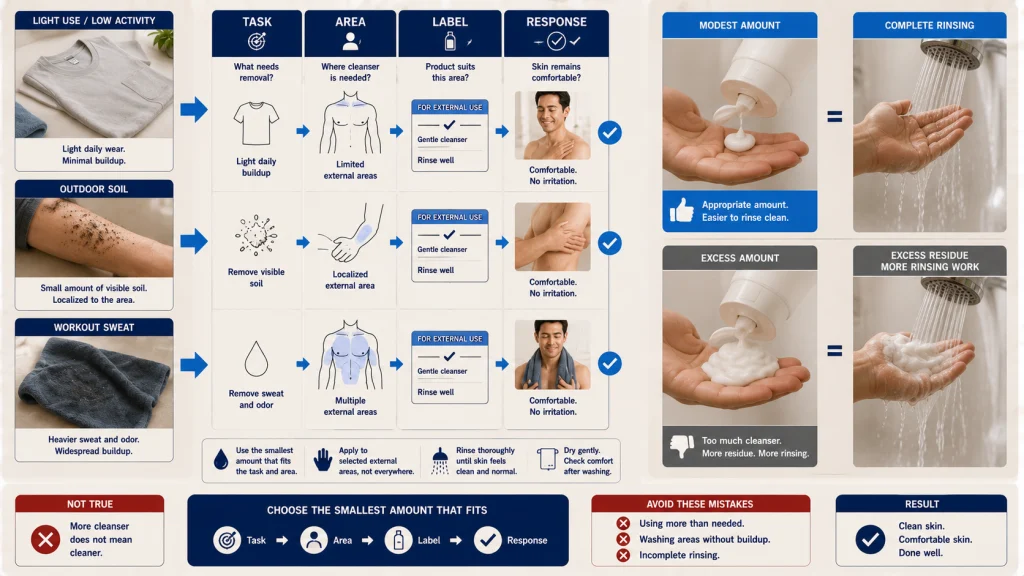
Once hair and facial steps are separated, cleanser can be matched to the body task itself. A low-activity day, a sweaty workout, outdoor dirt, and oily product buildup do not necessarily require the same coverage.
- Task: What buildup actually needs removal today?
- Area: Which external skin areas actually need cleanser?
- Label: Is the product suitable for that area and use?
- Amount: What is the smallest practical amount that spreads and rinses as directed?
- Response: Does the skin remain comfortable during and after use?
- Fallback: If irritation appears, what product or step will be paused while guidance is sought?
A larger amount can create more residue to rinse without improving the result. Fragrance can change how the shower smells, but fragrance is not evidence that ordinary sweat or soil has been removed.
When choosing between common cleansing formats, use the comparison of bar soap and body wash. The format matters less than suitability, label use, rinsing, storage, and skin response.
Prioritize Dirty, Sweaty, Odor-Prone, and External Fold Areas
After choosing the product and amount, direct attention where it is actually needed. Areas with sweat, dirt, oil, product buildup, or trapped moisture may need more care than skin that remained comfortable and clean.
| Body Area or Need | Default External-Body Route | Separate Handoff |
|---|---|---|
| Underarms and ordinary sweat-prone external skin | Wash gently as needed, rinse completely, and dry carefully. | Persistent odor after washing belongs in post-shower troubleshooting. |
| Visible soil or surface residue | Use suitable cleanser and gentle movement until removable material is gone. | Chemical, occupational, or contamination exposure follows its own instructions. |
| External skin folds | Wash the external surfaces carefully and dry moisture-prone areas. | Pain, rash, sores, drainage, swelling, or severe irritation requires evaluation. |
| Feet | External washing and careful drying may be part of the body shower. | Persistent foot-specific odor, skin changes, or footwear problems need separate guidance. |
| External genital or intimate area | Use only appropriate external care and follow exact product or clinician directions. | Internal cleansing, douching, urinary symptoms, discharge, sores, pain, or unusual odor remain outside this article. |
| Wounds, recent procedures, or medical skin needs | Do not apply the ordinary sequence automatically. | Follow clinician, wound-care, or surgical instructions. |
This handoff map protects the ordinary shower from expanding into facial treatment, hair care, intimate treatment, wound care, or medical bathing.
Use Hands or a Soft Clean Cloth With Low Friction
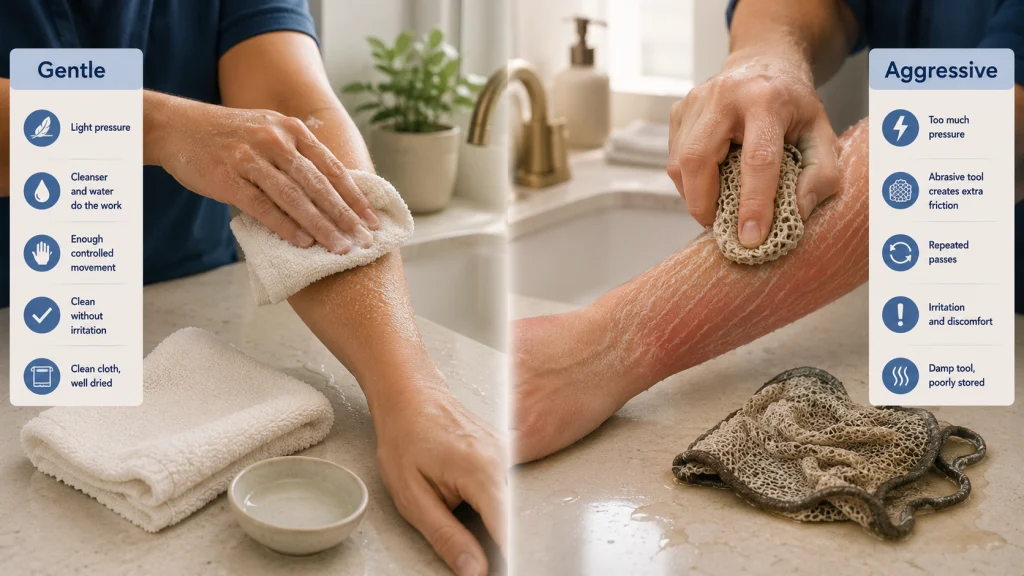
Area choice answers where to wash; friction answers how. External-body washing does not need to feel abrasive. The useful motion spreads cleanser, loosens removable material, and reaches the intended area without creating unnecessary pressure.
| Gentle Approach | Aggressive Approach | Better Review Question |
|---|---|---|
| Use clean hands or a soft clean cloth. | Use a rough tool because discomfort feels more thorough. | Did the area become clean without leaving the skin irritated? |
| Move over the area with controlled pressure. | Repeat the same area until the skin feels tight or tender. | Did additional rubbing complete a task or only increase friction? |
| Allow cleanser and water to do part of the work. | Use force to compensate for unsuitable product or rushed rinsing. | Would a better product fit, soaking time, or rinse solve the issue more gently? |
| Clean and dry any reusable cloth appropriately. | Reuse a damp or unclean tool without reviewing storage. | Does this tool improve the task enough to justify its cleaning and storage? |
Low friction is especially important when the skin is already uncomfortable. Persistent symptoms belong outside technique experimentation.
Keep Harsh Tools, Exfoliation, and Treatment Washes Outside the Default
Gentle washing is the default. Brushes, abrasive tools, exfoliating products, powered devices, treatment washes, and layered product sequences add separate decisions that most ordinary showers do not need.
Do not add them by default because a social-media routine appears more complete. Each item may have its own application area, frequency, warning, cleaning method, and stop-use instruction.
Before using any nonbasic tool or treatment product, check:
- whether the label supports the intended body area;
- whether the product is cosmetic, cleansing, medicated, or treatment-oriented;
- whether another product in the routine creates overlapping irritation;
- how the tool must be cleaned, dried, charged, or stored;
- which symptoms require stopping use and seeking guidance.
This article does not prescribe exfoliation or treatment washing. Follow exact labels and qualified instructions.
Rinse Until Cleanser and Loosened Residue Are Gone
Once washing is finished, the routine should move forward rather than add another product. Rinsing is a complete step, not an afterthought between cleansing and reaching for the towel. Product left on the skin or trapped in an external fold can make it difficult to judge where discomfort began.
Move water over each cleansed area and check places where product can remain:
- underarms and external folds;
- the back, shoulders, and areas reached indirectly;
- feet and between external skin surfaces;
- areas where hair or facial products may have run onto the body;
- the shower floor, where product can create slippery footing.
If a product is difficult to rinse, review the amount, format, water access, and label rather than adding more friction.
Dry Gently and Pay Attention to Moisture-Prone External Folds
Rinsing removes what has been loosened; drying prepares the skin for what comes next. Rushing this step can leave moisture in external folds, underarms, or other skin-to-skin areas.
Use a clean, dry towel and gentle pressure. Pat or press where rubbing feels irritating. Take enough time to dry the feet, underarms, and external folds that tend to remain damp.
Keep the floor and exit in mind. Do not step onto a cluttered surface or stretch across the room for a towel while wet. If safe standing, reaching, or exiting is difficult, ordinary shower instructions are not enough and an adapted setup may be needed.
Drying check: Is the skin dry enough for clothing and aftercare without repeated rubbing, and is the exit path stable and clear?
Apply Ordinary Aftercare According to Need and Instructions
When the skin is dry, aftercare can stay simple. It should respond to the skin and the products already used rather than becoming another long sequence.
Possible ordinary steps include:
- applying a suitable moisturizer when needed and according to its instructions;
- allowing the skin or underarm product to dry before dressing;
- following a clinician-directed step exactly when one applies;
- leaving irritated or symptomatic skin free from additional optional products until guidance is obtained.
Adding several fragranced or treatment-oriented products at once makes the skin response harder to interpret. Use the minimum that completes the aftercare task.
Put On Clean Clothing and Separate Fabric Odor From Skin Odor
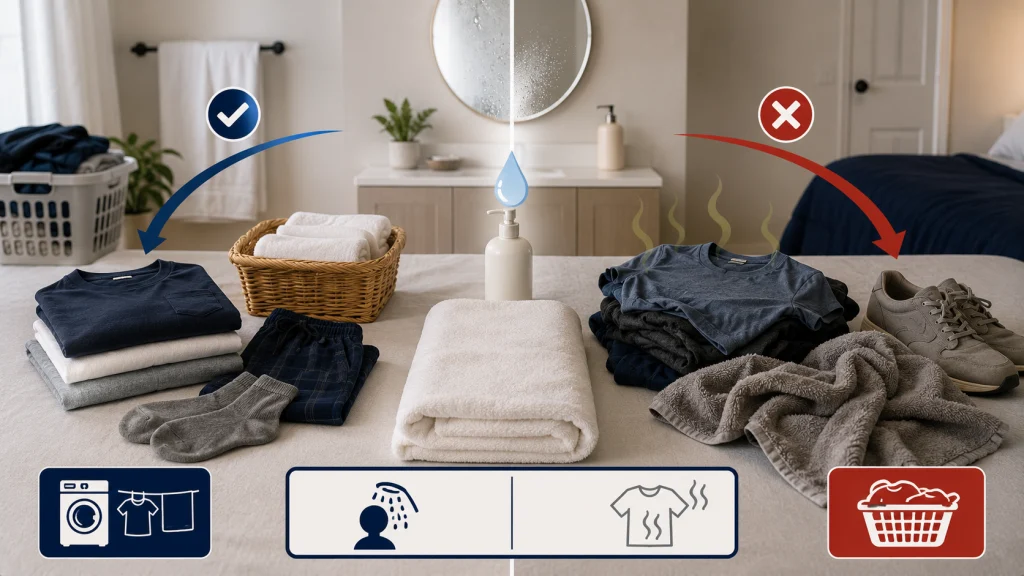
The body routine ends with what touches the skin next. Previously worn clothing, damp towels, or fabric that retained odor can make a successful shower seem ineffective after dressing.
Choose clean clothing that fits the activity and climate. Allow skin and any labeled aftercare product to dry before dressing when appropriate. Send worn clothing and used towels to the correct laundry or drying process instead of leaving damp fabric in the bathroom.
If odor remains or returns quickly despite reasonable washing, rinsing, drying, and clean fabric, use the guide to post-shower odor troubleshooting. That workflow separates skin, product, towel, clothing, footwear, and symptom questions.
Move Tool Cleaning and Storage Into the Item-Care Routine
Once the person is dressed, the remaining work belongs to the items left behind. A cloth, reusable applicator, brush, razor, powered tool, bottle, shower mat, or storage container creates its own cleaning and safety task, separate from washing the body.
After the shower:
- follow the item’s exact cleaning instructions;
- rinse reusable items when directed;
- allow items to dry in an appropriate location;
- keep electrical or powered components away from water as instructed;
- remove product buildup from storage surfaces;
- discard or replace items according to their condition and directions rather than a universal schedule.
Separating item care from body care keeps the shower sequence shorter and makes it easier to notice whether a reusable tool is helping or adding friction.
Stop Technique Experiments When Symptoms Persist
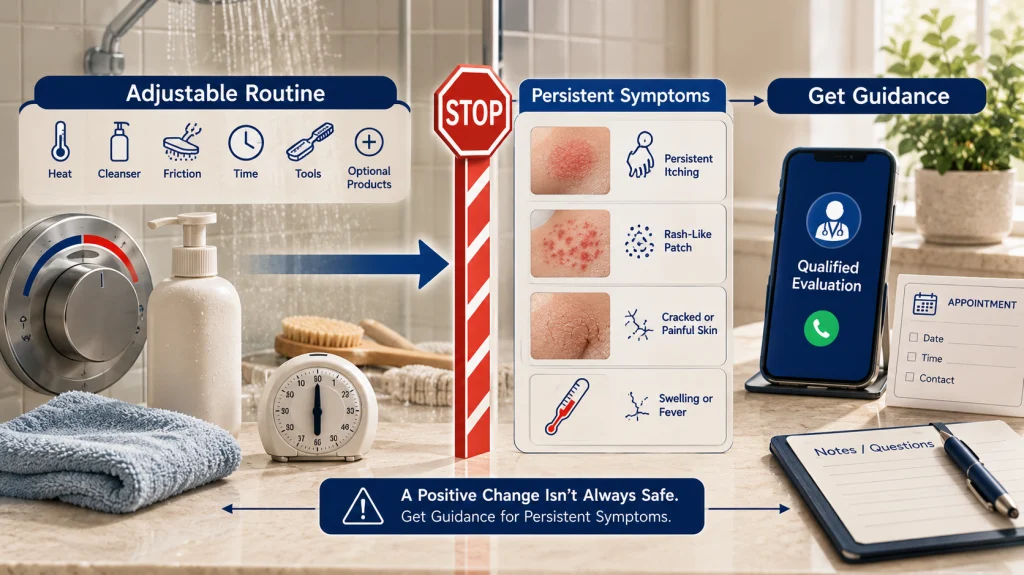
Technique changes should stop when the problem is no longer an ordinary routine issue. A shower can be adjusted for comfort, but it cannot diagnose or treat a skin condition, wound, infection, or medical cause of odor or irritation.
Stop adding heat, cleanser, friction, tools, exfoliation, or optional products when there is persistent tightness, itching, rash, pain, cracks, bleeding, drainage, sores, swelling, fever, or severe irritation. Seek qualified evaluation and follow clinician directions.
Wounds, recent surgery, infection concerns, clinician-directed bathing, chemical exposure, and occupational decontamination require their own instructions. Do not apply the ordinary sequence when a specific medical or safety protocol exists.
Prepare, Set the Water, Cleanse, Rinse, Dry, Dress, and Review
Prepare a stable bathroom setup, clean towel, clean clothing, and only the products needed for the current task. Use comfortable water and keep heat, cleanser, friction, and time at the level needed to handle that day’s buildup.
Prioritize visibly dirty, sweaty, odor-prone, and moisture-prone external areas. Keep hair, facial, intimate, wound, medical, and assisted-bathing instructions separate. Rinse fully, dry carefully, complete simple aftercare, and put on clean clothing.
Review the result rather than the intensity of the routine. If skin remains comfortable and the task is complete, more product or scrubbing is unnecessary. If odor returns or symptoms persist, move to the appropriate troubleshooting or professional route instead of making the shower harsher.
FAQs
🚿 Is there one required order for washing the body?
No universal sequence fits every task. Prepare the setup, wash the external areas that need attention, rinse fully, dry carefully, complete needed aftercare, and dress in clean clothing. Hair and facial routines may follow separate instructions.
🌡️ How hot should shower water feel?
Use water that feels comfortable and does not repeatedly leave the skin tight, itchy, red, or irritated. There is no universal temperature for every home or person. Follow clinician instructions when they apply.
🧼 Does every body area need cleanser every time?
Not automatically. Match cleanser to the actual sweat, visible soil, oil, or residue on appropriate external skin. Use a suitable amount, follow the label, rinse completely, and review the skin response.
👐 Are hands enough for ordinary washing?
Clean hands may be enough for ordinary external-body washing. A soft clean cloth may also fit. Aggressive tools are not required for the default routine and can add friction, cleaning, drying, and storage tasks.
🧴 Should exfoliation be part of every shower?
No. Exfoliation and treatment products remain separate from the default body-washing sequence. Follow their labels and qualified guidance, and stop when irritation or concerning symptoms appear.
🫧 How do I know when rinsing is complete?
Move water over every cleansed area until cleanser and loosened residue are gone. Check underarms, external folds, the back, feet, and areas where hair or facial products may have run onto the body.
👕 Why can odor return after putting on clothes?
Previously worn clothing, damp towels, footwear, or retained fabric odor can transfer odor back to clean skin. Check the item and use post-shower troubleshooting before increasing heat, cleanser, or friction.
🚩 When should I stop changing my shower routine?
Stop self-directed experiments for persistent tightness, itching, rash, pain, cracks, bleeding, drainage, sores, swelling, fever, or severe irritation. Wounds, recent surgery, infection concerns, and exposure protocols require qualified instructions.