Indoor air quality in apartments depends on separating what happens inside the unit from what travels through shared systems or building pathways. Start by handling alarms, gas, smoke, and severe symptoms as emergencies. For nonemergency concerns, record the time, room, activity, weather, window and door status, fan use, and nearby building events without naming a pollutant or blaming a neighbor. Reduce sources you control, use windows and existing exhaust only when conditions and building rules allow, and avoid blocking or modifying shared equipment. Submit a specific maintenance request, treat portable products and low-cost sensors as limited tools, and escalate according to the actual issue rather than guessing at its source.
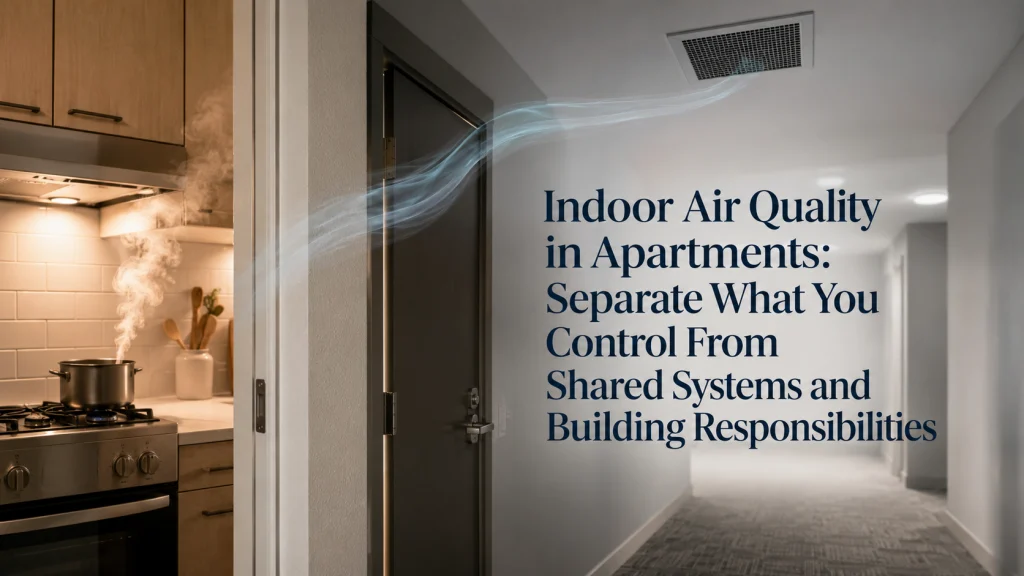
Three Similar Odors Can Require Three Different Responsibility Paths
An odor appears only in the bedroom late at night. Another enters from the hallway during a maintenance project. A third begins while dinner is cooking inside the unit.
- Bedroom at night: document timing, room, window position, vent behavior, corridor conditions, and repeated pattern.
- Hallway during maintenance: note the building activity, location, duration, notices, and whether the odor changes when the unit door opens or closes.
- During the reader’s own cooking: reduce the indoor source, use the existing kitchen exhaust correctly, and observe whether the event stays local or spreads.
The word “smell” describes the experience, not the source. The same sensation can begin inside the unit, enter through a corridor or shaft, follow outdoor air, or coincide with building work.
That uncertainty can be frustrating, especially when a renter is told that nothing is wrong because the event is not happening during a maintenance visit. A useful response begins with a pattern that can be described clearly, not a diagnosis that cannot be proven from odor alone.
The broader healthy home environment framework helps place apartment concerns beside source control, ventilation, cleaning, moisture, and building maintenance.
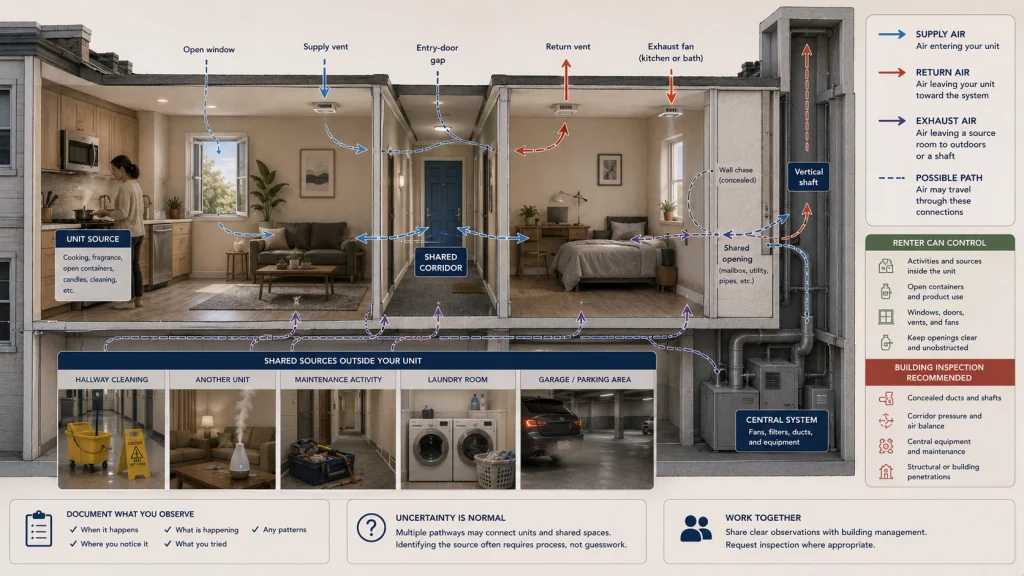
Define Unit Source, Shared Source, Pathway, Corridor, Shaft, Supply, Return, Exhaust, Responsibility, and Documentation
A unit source begins inside the apartment, such as cooking, cleaning, smoking, fragrance use, moisture, stored materials, or a damaged item.
A shared source begins elsewhere in the building or property, such as another unit, a corridor, maintenance activity, pest treatment, construction area, laundry room, garage, or shared mechanical system.
A pathway is the route air may follow. It can include an open door, window, crack, chase, shaft, shared wall opening, corridor pressure, or mechanical duct. A corridor is a common hallway. A shaft is a vertical or enclosed building passage that may carry utilities, ducts, or air movement.
A supply vent delivers conditioned or outdoor air into a space. A return vent draws air back toward a system. An exhaust removes air from a source area such as a kitchen or bathroom.
Management responsibility refers to equipment, pathways, repairs, and building conditions the renter does not control. This article does not determine legal duty. Documentation is the factual record of what happened, where, when, and under what conditions.
The indoor air quality guide explains how source control, ventilation, filtration, and moisture management fit together without assuming that one action handles every concern.
Handle Alarms, Gas, Smoke, Severe Symptoms, and Immediate Hazards First
Documentation is not the first task when an immediate hazard is present.
Emergency boundary: A sounding smoke or carbon monoxide alarm, visible fire or smoke, suspected gas leak, severe breathing difficulty, chest pain, fainting, confusion, blue or gray lips, or another emergency sign requires leaving the area when safe and contacting emergency or utility services as appropriate. Do not remain inside to collect more monitor readings, trace an odor, or wait for building management to respond.
Persistent or worsening symptoms require qualified medical guidance. A home condition, odor, visible stain, or consumer sensor cannot diagnose asthma, allergy, poisoning, infection, mold-related illness, carbon monoxide exposure, chemical sensitivity, or another medical condition.
Suspected asbestos, lead, radon, major mold, combustion backdrafting, hazardous chemicals, or a serious building-system defect requires appropriately qualified assessment.
Separate Renter-Controlled Actions From Building-Controlled Conditions
| Concern | Renter-controlled action | Building-controlled action |
|---|---|---|
| Cooking smoke or moisture inside the unit | Reduce the source, use existing exhaust, adjust cooking method, and document spread | Verify exhaust operation, duct route, termination, and shared-system behavior |
| Bathroom moisture | Run the installed fan, preserve the replacement-air path, and record drying response | Inspect fan, duct, electrical condition, termination, and building moisture |
| Odor entering from a corridor | Record timing, door status, location, and related activity | Review corridor pressure, door seals, maintenance activity, and shared ventilation |
| Blocked or inactive vent | Keep the visible opening unobstructed and document the behavior | Inspect concealed equipment, balancing, dampers, controls, and duct condition |
| Construction or pest-treatment odor | Follow notices, reduce unit sources, and record the event | Provide applicable instructions, scheduling, ventilation, and qualified follow-up |
| Consumer monitor change | Record device, placement, time, activity, and pattern | Determine whether professional investigation or system review is appropriate |
The table is a responsibility-routing tool, not a legal determination. A renter can control behavior and documentation inside the unit, but concealed ducts, central systems, corridor pressure, shafts, roof terminations, and shared equipment remain building questions.
That split can feel unfair because the renter experiences the odor, noise, or dampness every day while the equipment behind the wall remains out of reach. Naming the boundary does not solve the problem by itself, but it helps turn frustration into a request the right person can act on.
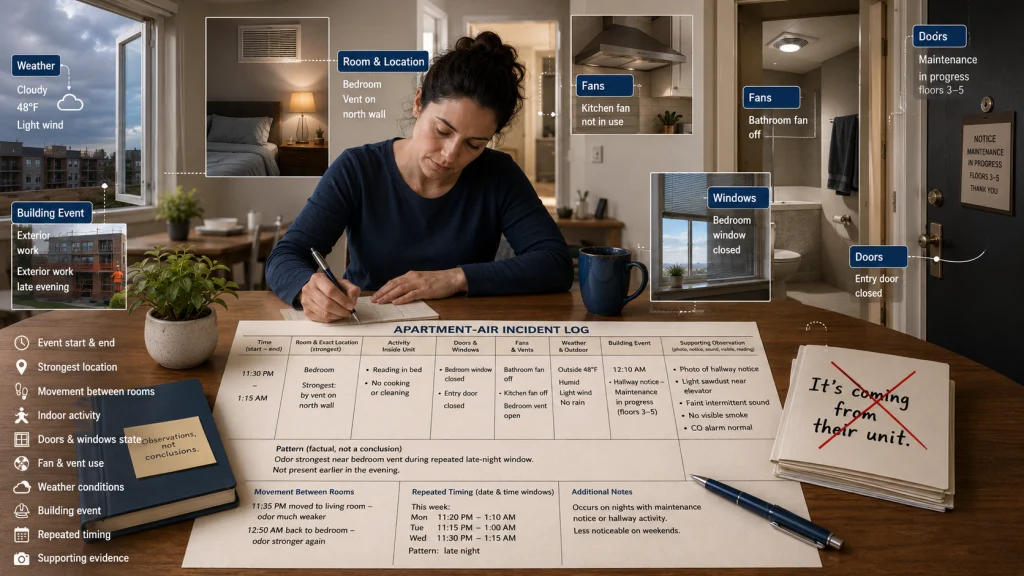
Record the Event Without Diagnosing the Source
A useful incident log makes patterns visible without claiming more than the observations support.
| Incident log field | What to record |
|---|---|
| Date and time | When the event began, changed, and ended |
| Room and location | Where it was strongest and whether it moved |
| Activity inside the unit | Cooking, showering, cleaning, laundry, candles, smoking, or no obvious source |
| Doors and windows | Open, closed, sealed, or restricted |
| Fan and vent status | Kitchen fan, bathroom fan, supply, return, or portable device behavior |
| Weather and outdoor conditions | Wind, rain, smoke, nearby work, or other visible conditions |
| Building event | Maintenance, cleaning, pest treatment, painting, construction, or hallway activity |
| Supporting observation | Photo, notice, device reading, noise, visible smoke, staining, or repeated timing |
Use neutral wording such as “sweet odor strongest near the bedroom vent from 10:30 p.m. to midnight” rather than “toxic fumes from the neighboring unit.” The first statement can be checked. The second identifies a source and hazard without proof.
A dated log also helps when the event disappears before maintenance arrives. It gives the renter something more useful than the discouraging sentence, “It happens, but never when someone is here.”
Reduce Sources Controlled Inside the Unit
Begin with sources that can be changed safely without altering the building.
- Pause or remove optional fragrance products when they coincide with the concern.
- Use cleaning and pest products only according to their instructions.
- Store materials in suitable closed containers.
- Reduce cooking smoke and moisture at the source.
- Keep ordinary supply, return, and exhaust openings unobstructed.
- Address visible spills, damp materials, or damaged household items through appropriate guidance.
Source control is useful because it removes one variable. It does not prove that the remaining concern comes from a neighbor or shared system.
The guide to improving indoor air quality at home provides a wider source-control sequence for conditions the household can actually change.
Use Windows and Existing Exhaust Only When Conditions and Rules Allow
Opening a window may help or may bring in outdoor smoke, traffic pollution, pollen, humidity, heat, cold, or construction dust. Sealed windows, safety restrictions, weather, and building rules can also limit this option.
Before opening windows, review outdoor conditions, the direction of the concern, security, children, pets, fire-safety features, and any building restrictions.
Existing kitchen and bathroom exhaust should be used according to their intended function and product guidance. A running sound does not prove outdoor termination or effective removal.
The guide on when window ventilation makes sense separates useful outdoor-air opportunities from conditions that may make opening windows a poor choice.
For a broader review of airflow through the home, use the home ventilation framework.
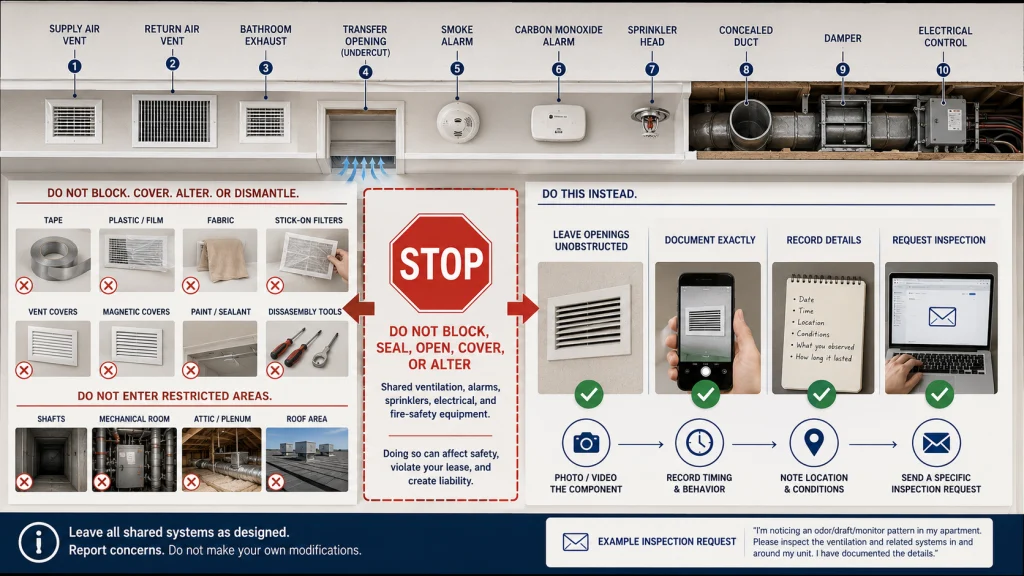
Verify Kitchen and Bathroom Fan Behavior and Request a Specific Inspection
Record whether the fan starts, changes speed, vibrates, produces unusual noise, moves some air at the grille, or affects moisture and odor spread. These observations help describe the problem but do not verify installed airflow or duct destination.
Use the kitchen ventilation workflow for source capture during cooking and the bathroom ventilation workflow for shower moisture, grille maintenance, replacement air, and drying response.
“The [kitchen/bathroom] fan operates, but [odor/moisture/smoke] remains in [room] under the following repeated conditions: [dates, times, activity, door/window status]. Please confirm whether the fan is intended to exhaust outdoors and arrange inspection of the fan, duct connection, termination, controls, and any shared-system issue that may affect operation. I have not modified or blocked the equipment.”
A specific request is easier to route than “the air is bad.” It names the equipment, pattern, conditions, and remedy being requested without diagnosing the cause.
Treat Portable Products as Limited Tools, Not Building Repairs
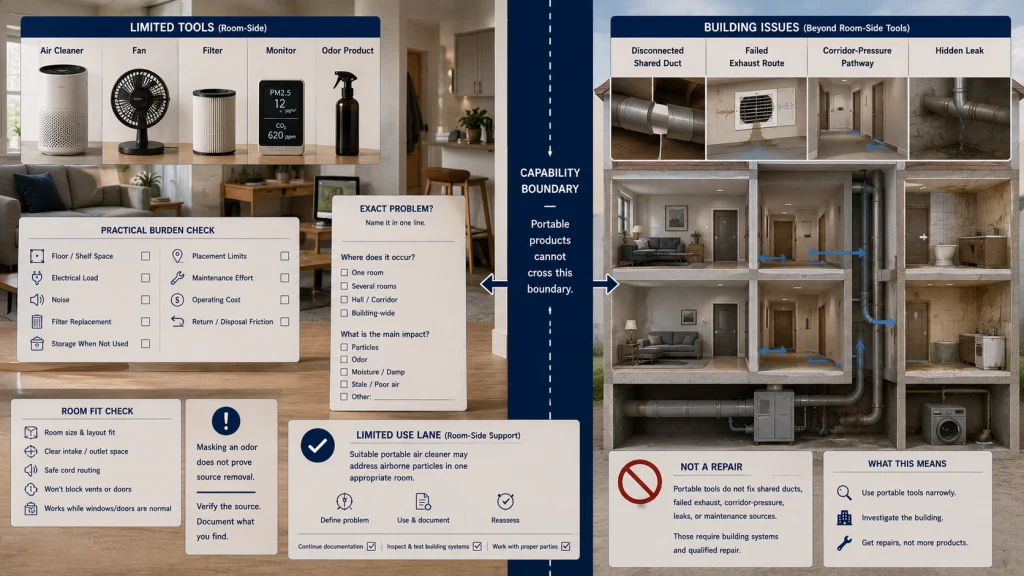
Nora’s bounded merchandising observation is that renters are often sold portable fans, air cleaners, odor products, filters, and monitoring devices for problems that may originate in shared ventilation or building maintenance. The purchase can feel like the only action available, but it also brings noise, floor or shelf space, electrical load, filter replacement, storage, and return friction back into the unit.
- Define the pollutant or problem the product is intended to address.
- Check whether the room, electrical load, noise, storage, filter replacement, and operating burden fit the household.
- Review exact product documentation for compatibility, placement, maintenance, and limitations.
- Do not expect a portable device to repair a shared duct, corridor-pressure problem, failed exhaust, leak, or building source.
- Do not use fragrance or odor-masking products as proof that the source has been removed.
- Stop use for overheating, damaged cords, instability, unusual odor, or other electrical concerns.
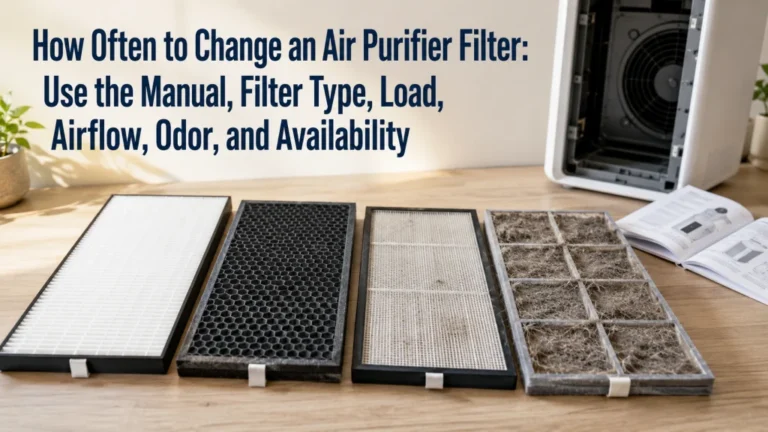
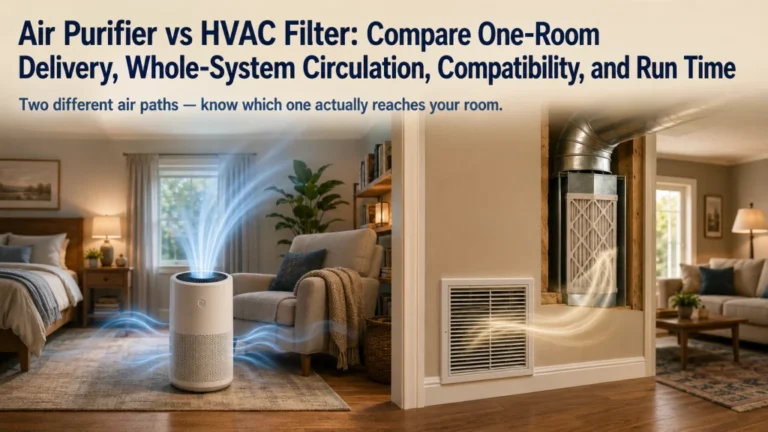
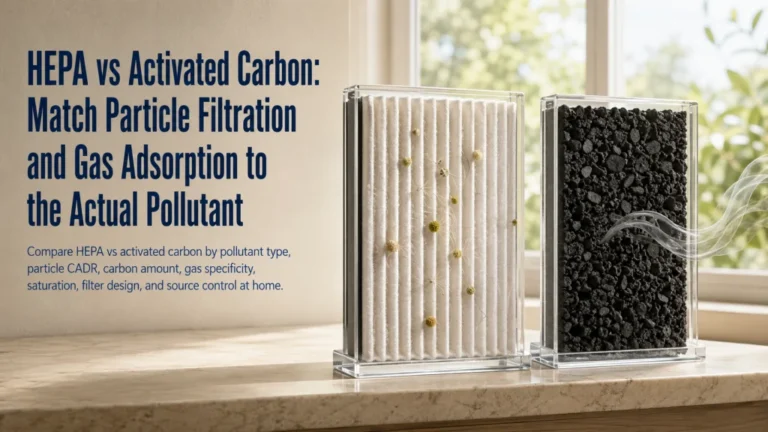
Portable filtration may be useful for a defined airborne particle problem in a suitable room, but it does not identify the source or settle responsibility. Product selection belongs in the site’s portable-air-cleaning guidance rather than this renter-routing article.
A portable device may make one room feel more manageable while the renter waits for inspection. It should not become the reason a recurring building problem is left undocumented or unrepaired.
Treat Low-Cost Sensor Readings as Supporting Observations
A consumer monitor may help show timing, repetition, room differences, or a response to an activity. It does not automatically identify a pollutant, prove a health risk, establish a building violation, or locate the source.
Record the device model, sensor type, placement, height, room, date, time, ventilation status, nearby activity, and whether the pattern repeats. Avoid moving the device repeatedly during the same comparison.
Readings are most useful when paired with factual context. “The value rose during cooking and declined after the kitchen fan ran” is stronger documentation than “the apartment is contaminated.”
It is understandable to keep checking a number when the source feels invisible. A useful log gives the reading a beginning, an activity, and an end so the device supports the story instead of becoming the whole story.
Questions about monitor limitations, placement, and interpretation belong in the site’s monitoring and detector guidance.
Escalate According to the Actual Issue Without Giving Legal Advice
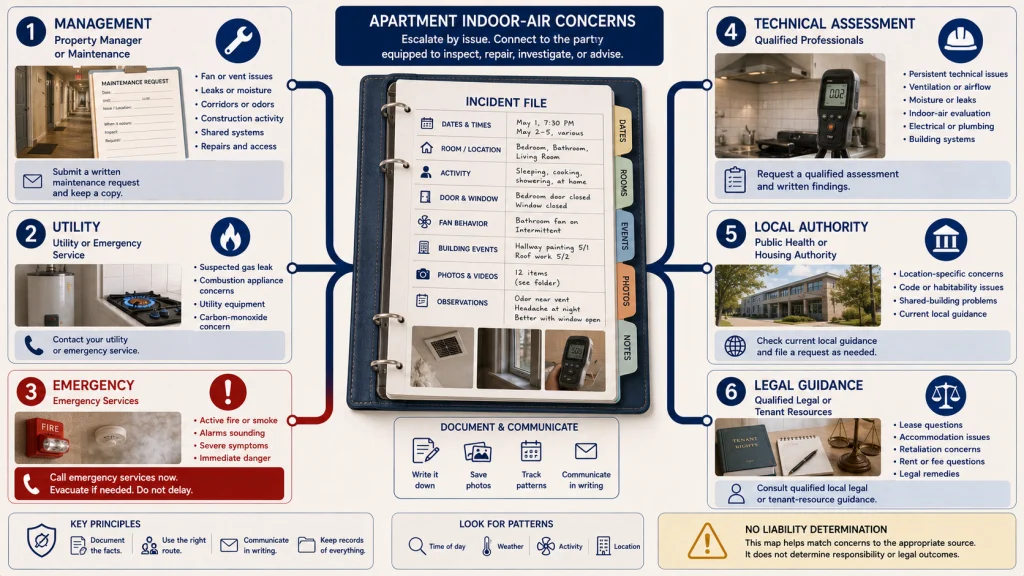
| Observed issue | Appropriate next path |
|---|---|
| Fan, vent, leak, corridor, construction, or shared-system concern | Property manager, owner, or maintenance team with a specific written request |
| Suspected gas, combustion, or utility equipment issue | Utility or emergency service as appropriate |
| Immediate fire, smoke, alarm, or severe medical emergency | Leave when safe and contact emergency services |
| Persistent building condition requiring technical assessment | Appropriately qualified environmental, ventilation, electrical, plumbing, or building professional |
| Location-specific public-health or housing concern | Applicable local public-health or housing authority after checking current local guidance |
| Lease, accommodation, retaliation, withholding-rent, or legal-remedy question | Qualified local legal or tenant-resource guidance outside this article |
This map does not determine liability or legal rights. It helps route a factual concern to the party equipped to inspect, repair, investigate, or advise.
When repeated requests feel like they disappear into a general maintenance queue, a precise incident log and one clearly stated remedy can make the problem easier to assign and harder to misunderstand.
Document the Pattern, Control the Unit Source, Protect Systems, Request the Remedy, and Escalate
A renter does not need to identify the pollutant before making a useful record. The first question is where and when the event occurs, what is happening inside the unit, and which shared conditions coincide with it.
Reduce the sources you control. Use existing windows and exhaust only when conditions and rules allow. Leave shared vents, alarms, sprinklers, ducts, and central equipment unchanged.
Then request the specific action the building can perform: inspect the fan, trace the duct, review a corridor pathway, provide treatment instructions, repair a leak, or evaluate shared-system behavior.
The goal is not to win an argument about what the odor “must be.” It is to build a reliable path from a recurring experience to the correct inspection, repair, professional assessment, or emergency response.
That path also gives the renter something practical to hold onto when the source remains uncertain: a dated pattern, a protected system, a specific request, and a clear next level of help.
FAQs
🏢 What can a renter control about apartment air quality?
Renters can reduce sources inside the unit, use existing windows and exhaust when appropriate, keep vents unobstructed, document patterns, and submit specific maintenance requests. Concealed ducts, central equipment, corridors, shafts, and shared systems require building involvement.
👃 Can an odor identify where a problem comes from?
No. Odor can help document timing and location, but it cannot reliably identify a pollutant, health risk, neighbor, or building violation.
🪟 Should I open windows when the apartment smells bad?
Only when outdoor conditions, safety, security, and building rules make it appropriate. Opening a window can also bring in smoke, humidity, traffic pollution, or construction dust.
🚫 Can I cover a vent that brings in odor?
Do not block or seal shared supply, return, exhaust, transfer, alarm, sprinkler, or fire-safety equipment. Document the pattern and request inspection of the exact vent or pathway.
🌀 Does a portable air cleaner solve a shared-building problem?
Not by itself. It may reduce a defined airborne particle problem in a suitable room, but it cannot repair shared ducts, failed exhaust, corridor pressure, leaks, or maintenance sources.
📟 Can a low-cost monitor prove the apartment is unsafe?
No. It can support documentation of timing and patterns, but it does not automatically identify the pollutant, establish risk, locate the source, or prove a violation.
📝 What should a maintenance request include?
Include the room, dates, times, activity, door and window status, fan behavior, building events, and the exact inspection or repair being requested. Describe observations rather than diagnosing the cause.
🚨 When should apartment air concerns be treated as an emergency?
Treat sounding smoke or carbon monoxide alarms, visible fire or smoke, suspected gas leaks, severe breathing difficulty, chest pain, fainting, confusion, or blue or gray lips as emergencies. Leave when safe and contact the appropriate emergency or utility service.