A bedtime routine for adults works best when it creates a clear transition from evening activity to lights out without demanding a long list of tasks. Start with a dependable cue, use three functional steps, set a definite endpoint, and keep a 10-minute fallback for late or disrupted nights. Optional activities can help, but only when their setup, cleanup, charging, and timing do not make the routine harder to repeat. The goal is not to force sleep. It is to make the final part of the evening quieter, simpler, and more predictable.

Two Routine Cards, One Busy Night
Imagine two handwritten cards on the same bedside table. The first lists seven steps and takes about 45 minutes. The second has three steps and takes 10 minutes.
- Finish the remaining chores.
- Prepare a drink.
- Take a long bath.
- Complete a full skin-care sequence.
- Write a journal entry.
- Read and stretch.
- Adjust several room settings before bed.
- Close the day.
- Lower stimulation.
- Prepare the sleep space and turn out the light.
The longer card may look thoughtful on a quiet evening. On the first late worknight, it is abandoned because there is not enough time or energy to complete it. The shorter card leaves less room for negotiation and still creates a recognizable transition.
A routine is useful only if it survives the nights when motivation is lowest.
The rest of this guide shows how to design that shorter structure, expand it only when useful, and test whether it fits your actual household rather than an idealized evening.
Define the Routine’s Job as Creating a Transition
A wind-down sequence should mark the change from doing, deciding, watching, cleaning, working, or scrolling to preparing for sleep. It does not need to make you unconscious on command, and it should not become a nightly test that you can pass or fail.
Key decision: Judge the routine by whether it reduces evening decisions and leads reliably to lights out, not by whether sleep begins immediately every night.
This distinction keeps ordinary variation from turning into performance pressure. Some nights you may feel sleepy before the sequence ends. Other nights you may reach bed while still feeling alert. The routine can still be doing its job if it closes the evening consistently and removes avoidable stimulation.
For broader decisions about daytime habits, bedroom conditions, and scheduling, use the complete sleep improvement guide. This article stays focused on the short sequence immediately before bed.
Choose Lights Out First, Then Work Backward
Begin with the endpoint instead of collecting activities. Choose a realistic lights-out time that fits the sleep schedule you are trying to maintain, then subtract the amount of time you can protect on ordinary evenings.
For example, if lights out is 10:45 p.m. and the routine ceiling is 20 minutes, the sequence starts at 10:25 p.m. That ceiling matters because a routine without a limit tends to expand. A bath becomes a long soak, reading becomes another chapter, and preparation for tomorrow turns into reorganizing the kitchen.
- Endpoint: the light goes out and the active routine is finished.
- Routine ceiling: the maximum time the standard version is allowed to take.
- Start time: the endpoint minus the routine ceiling.
Work backward only far enough to identify the few steps that help you close the day. Do not add an activity simply because it appears in someone else’s night routine.
Use a Start Cue That Already Exists
The easiest cue to repeat is usually an event already present in the evening. Finishing the dishes, closing a laptop, ending the final television episode, plugging in the phone, or completing a pet’s last trip outside can all serve as a clear handoff.
A clock alarm can help, but an event cue often requires less interpretation. When the event ends, the first routine step begins. The cue should be specific enough that two people could identify whether it happened.
| Weak cue | More usable cue |
|---|---|
| When I feel tired | When I close the laptop after the last work task |
| Later in the evening | After the kitchen is reset |
| After one more video | When the current episode ends |
| When everything is done | When the 10:15 p.m. reminder appears |
If the recurring problem is knowing what to do but repeatedly delaying the start, the next decision may be better addressed through bedtime procrastination strategies. That problem concerns the delay itself, while this routine design begins after you have chosen to start.
Build Three Functional Stages
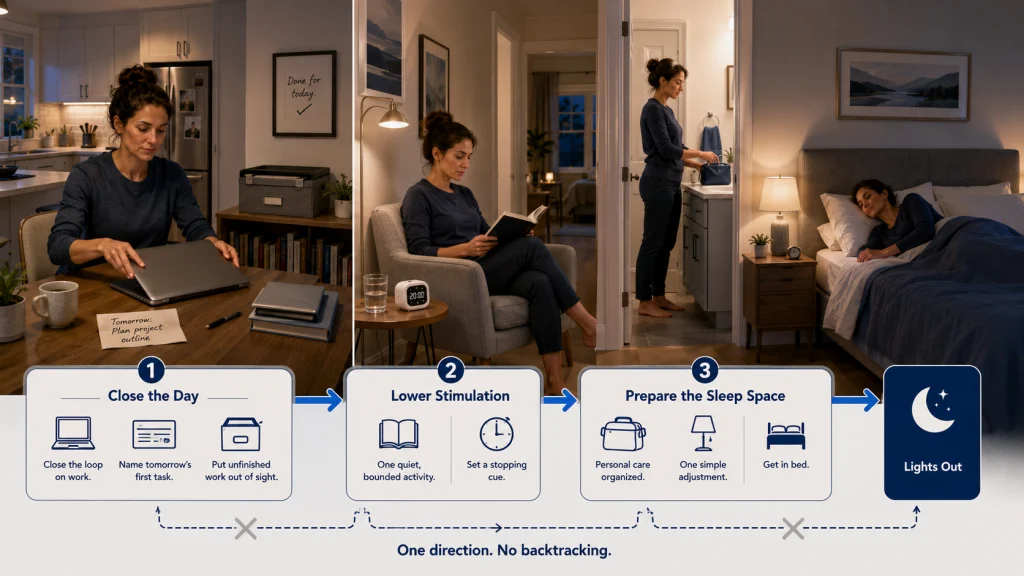
A reliable adult bedtime routine does not need a fixed set of universal activities. It needs three jobs completed in a sensible order.
- Close the day: end unfinished loops that would otherwise pull you back into work or chores.
- Lower stimulation: shift from active input toward one quieter, bounded activity.
- Prepare the sleep space: complete the final practical actions needed before lights out.
The order reduces backtracking. If you prepare the room first and then return to a bright kitchen to pack lunch, the sequence loses its direction. If you start reading before setting an alarm or putting away work materials, unfinished tasks may remain mentally active.
Practical tip: Give each stage one primary action. A second action belongs only when it is quick, necessary, and easy to repeat.
A basic sequence might be: write tomorrow’s first task, read for a defined period, then complete bathroom care and turn out the light. Another person might lock the door, listen to one calm audio track, then adjust the room and get into bed. The function stays stable even when the activity changes.
Choose One Quiet Activity and Give It a Stopping Rule
Reading, gentle stretching, listening to calm audio, journaling, breathing practice, or a warm shower may fit the lowering-stimulation stage. None is required for everyone. Choose one that feels manageable in your home and does not create a new project.
The stopping rule is as important as the activity. Without one, a quiet activity can become extended entertainment or delay.
- Read for 10 minutes or until the current short section ends.
- Write three lines, not a complete life review.
- Listen to one track or one short audio segment.
- Stretch through one familiar sequence, then stop.
- Shower with the usual supplies, without adding a full maintenance routine.
Note: A stopping rule should be visible and easy to follow. Avoid rules such as continue until fully relaxed, because the endpoint is unclear and can create more monitoring.
- Close an unfinished loop: write tomorrow’s first task or place needed items by the door, then stop once the next action is clear.
- Reduce incoming stimulation: lower the room light, silence nonessential alerts, or place the phone in its charging location using settings prepared in advance.
- Shift attention: read, listen to calm audio, journal briefly, or use another quiet activity with a timer, page, track, or line limit.
- Prepare the room: adjust bedding, close curtains, or reduce avoidable noise using only changes available in the current space.
- Finish necessary personal care: keep the required supplies together and avoid expanding the step with optional treatments.
Select only the activity that serves a needed function. The box is not a checklist, and no routine needs one option from every line.
Create a 10-Minute Minimum for Late Nights
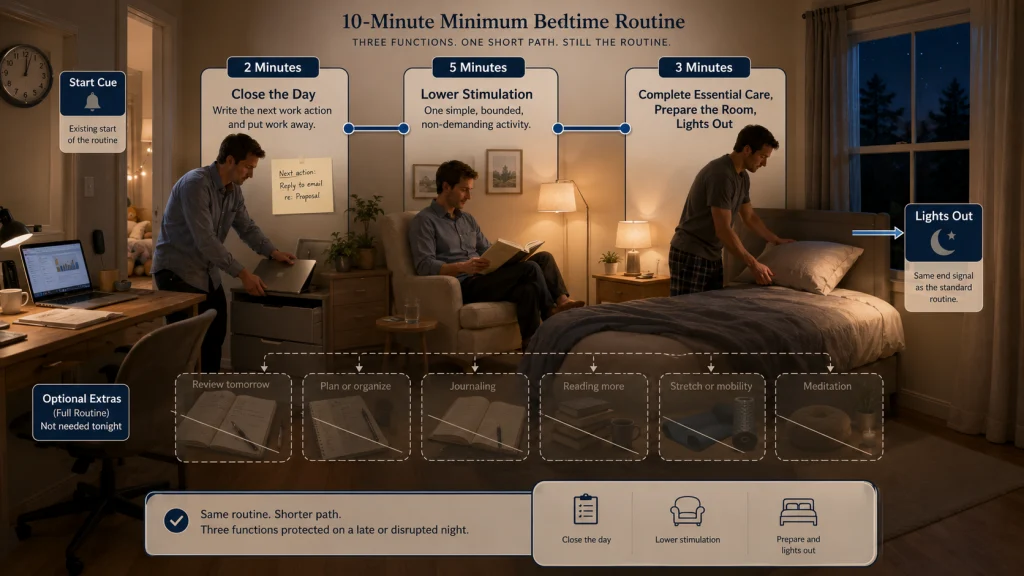
The fallback version is not a failed version of the routine. It is the routine designed for nights when work runs late, travel interrupts the environment, a child needs attention, a partner’s schedule changes, or energy is unusually low.
Keep the same cue when possible, preserve the same three functions, and remove anything optional.
- Close the day in two minutes by writing the next task and putting work out of sight.
- Lower stimulation for five minutes with one quiet activity.
- Use the final three minutes for necessary personal care, room preparation, and lights out.
If even 10 minutes is unrealistic on some nights, reduce the quiet activity before removing the completion signal. The final steps should still make it obvious that the active evening has ended.
Add Optional Steps Only When They Survive Busy Nights
An extra step earns a place only when it solves a repeated problem, stays inside the routine ceiling, and can disappear without breaking the three core stages. Avoid making the sequence dependent on special supplies, a particular room, a charged device, or uninterrupted privacy unless those conditions are reliably available.
- Keep it when the purpose is clear and the setup is minor.
- Move it earlier when preparation or cleanup threatens lights out.
- Remove it when the minimum version repeatedly works better without it.
This keeps optional preferences available on spacious evenings without turning them into requirements on difficult ones.
Audit Setup, Cleanup, Charging, and Household Constraints
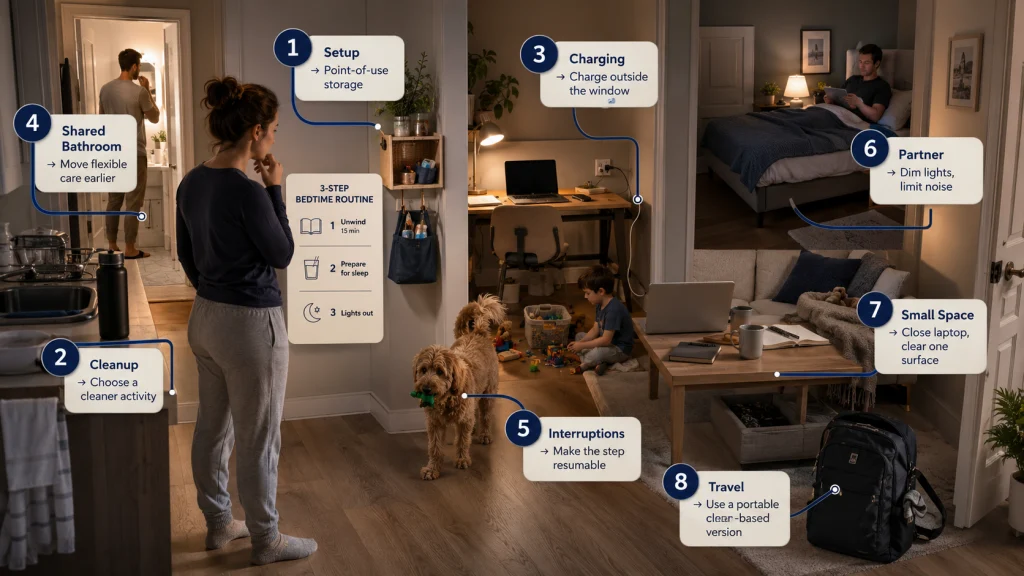
A routine can appear simple while hiding several small barriers. Filling a device, washing an accessory, finding a charging cable, resetting an app, waiting for a shared bathroom, or moving supplies between rooms can turn one step into five.
Editorial observation: When evaluating home-wellness bundles, I found that items could look coherent together while creating excessive setup, cleanup, charging, or storage. The same friction applies to routines. A useful sequence should be judged by the work required to begin it again tomorrow.
| Friction point | Question to ask | Lower-friction adjustment |
|---|---|---|
| Setup | Do supplies need to be found, filled, assembled, or moved? | Store the necessary items together where the step happens. |
| Cleanup | Does the activity leave dishes, wet items, cables, or materials to reset? | Choose a cleaner version or move the activity earlier. |
| Charging | Will the routine fail when a device is empty? | Use a non-device fallback or charge outside the routine window. |
| Shared bathroom | Can another person’s timing block the sequence? | Move flexible care steps earlier and keep only essentials near lights out. |
| Children or pets | Which step is most likely to be interrupted? | Make that step resumable or replace it with a shorter action. |
| Partner schedule | Will light, sound, or movement disturb someone? | Prepare items in advance and use a quieter completion signal. |
| Small space | Does the same room serve work, entertainment, and sleep? | Use a visible reset, such as closing the laptop and clearing one surface. |
| Travel | Does the sequence depend on home-only equipment? | Keep a portable three-step version based on actions, not objects. |
Remove or relocate the highest-friction step first. Do not redesign the entire routine because one accessory, room, or timing conflict is inconvenient.
Use Light and Phone Settings Without Making Configuration the Routine
Reducing bright light and stimulating input can support a quieter pre-bed period, but repeated device configuration can become another task. Set recurring controls once when possible, then let the cue trigger the already-prepared environment.
- Schedule quiet hours instead of silencing every app manually.
- Reduce unnecessary alerts before the routine begins.
- Choose one charging location that does not require searching for a cable.
- Use a saved lighting scene or a single familiar lamp rather than adjusting several controls.
- Keep essential calls available when household responsibilities require them.
Note: The purpose is to reduce incoming stimulation, not to create a complicated technology rule. If phone behavior remains the main barrier, use the separate guidance on phone use before bed rather than expanding this sequence into a complete device-management plan.
For the broader relationship between evening routines, timing, and bedroom conditions, review the healthy sleep habits framework.
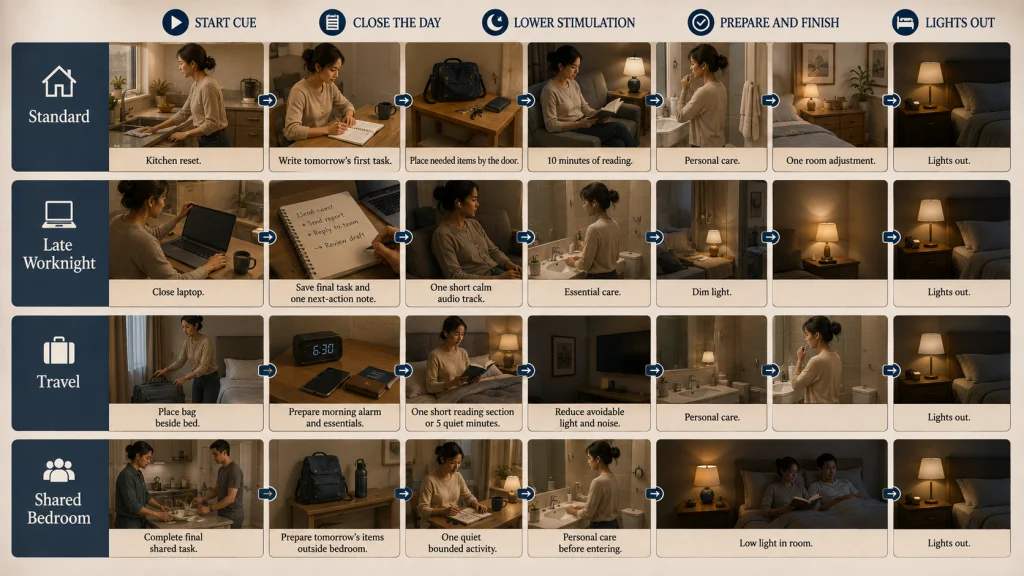
Four Sample Routines for Different Evenings
These templates preserve the same architecture while changing the details to match the setting. Use them as models, not as fixed prescriptions.
| Situation | Start cue | Close the day | Lower stimulation | Prepare space and finish |
|---|---|---|---|---|
| Standard evening | Kitchen is reset | Write tomorrow’s first task and place needed items by the door | Read for 10 minutes | Complete personal care, adjust the room, lights out |
| Late worknight | Laptop closes | Save the final task and write the next action | Listen to one short calm track | Complete essential care, dim the room, lights out |
| Travel night | Bag is placed beside the bed | Set the morning alarm and place essentials together | Read one short section or sit quietly for five minutes | Reduce avoidable light and noise, complete care, lights out |
| Shared-bedroom night | Final shared task ends | Prepare tomorrow’s items outside the bedroom | Use quiet reading or audio with a defined stop | Finish personal care before entering, use low light, lights out |
The standard and fallback versions should feel related. Keeping the same cue or same final step helps the shortened version remain recognizable rather than feeling like no routine at all.
Run a Two-Week Test Before Expanding the Routine
Keep the start cue, three stages, endpoint, and fallback version stable for two weeks. The purpose is to see whether the sequence can be followed under ordinary conditions, not to produce a perfect score or prove a health outcome.
Record four brief observations each morning:
- Adherence: Did the standard version, minimum version, or neither happen?
- Sleep onset estimate: Did sleep seem to begin quickly, moderately, or after a long period? Use a rough estimate rather than repeatedly checking the clock.
- Awakenings: Note whether you remember no awakening, one, or several, without trying to create a precise sleep record.
- Next-day function: Note whether you felt generally able to handle normal responsibilities, noticeably slowed, or dangerously sleepy.
At the end of the first week, do not add a new activity simply because the routine feels plain. Look for one repeated failure point. During the second week, change only that point while keeping the rest stable.
Examples include moving the cue 15 minutes earlier, shortening the quiet activity, placing supplies together, or switching from a device-based activity to a non-device fallback. A single change makes it easier to tell whether the adjustment improved repeatability.
Troubleshoot the Pattern, Not the Whole Evening
When the sequence is not working, identify where it breaks before adding more steps.
| Problem | What may be happening | First adjustment |
|---|---|---|
| Starting too late | The cue occurs after the intended routine window or depends on finishing everything. | Use an earlier fixed event and move unfinished low-priority tasks to tomorrow. |
| The routine becomes entertainment | Reading, video, audio, or browsing has no stopping rule. | Set a page, track, episode, or timer boundary before starting. |
| Performance anxiety | The sequence has become a test of whether sleep happens immediately. | Return attention to completing the transition, not measuring success in bed. |
| Boredom | The quiet activity feels unpleasant enough that you avoid beginning. | Keep the same function and duration, but choose a different bounded activity. |
| Partner conflict | Light, sound, room access, or timing affects another person. | Separate personal steps from shared-room steps and agree on the final low-light period. |
| Frequent interruptions | The routine assumes uninterrupted time that the household cannot provide. | Use steps that can pause safely and keep the minimum version available. |
Change the smallest part that directly addresses the failure. A routine that begins too late usually needs a better cue or shorter duration, not additional relaxation activities.
Know When Routine Design Is Not Enough
A practical sequence can organize the end of the evening, but it is not treatment for insomnia, a mental-health condition, a breathing-related sleep problem, or another medical issue.
Safety warning: Seek qualified guidance when difficulty falling or staying asleep is persistent, worsening, unexplained, or limiting normal function. Breathing pauses, gasping, severe snoring with concerning symptoms, or repeated morning headaches also deserve professional evaluation. Do not rely on a bedtime routine to assess or manage those signs.
Safety warning: Dangerous sleepiness requires prompt action. Do not drive, operate equipment, work at height, or continue another safety-sensitive task when you are struggling to stay awake. Arrange safer transportation or immediate support and seek appropriate medical guidance.
If you are unable to sleep and are becoming more alert or frustrated, avoid turning the routine into repeated clock checking or a longer series of tasks. A brief quiet activity in low light outside the bed may provide a clearer reset, followed by returning to bed when you feel sleepy. When this pattern repeats or causes meaningful daytime difficulty, seek professional assessment rather than continuing to add self-directed steps.
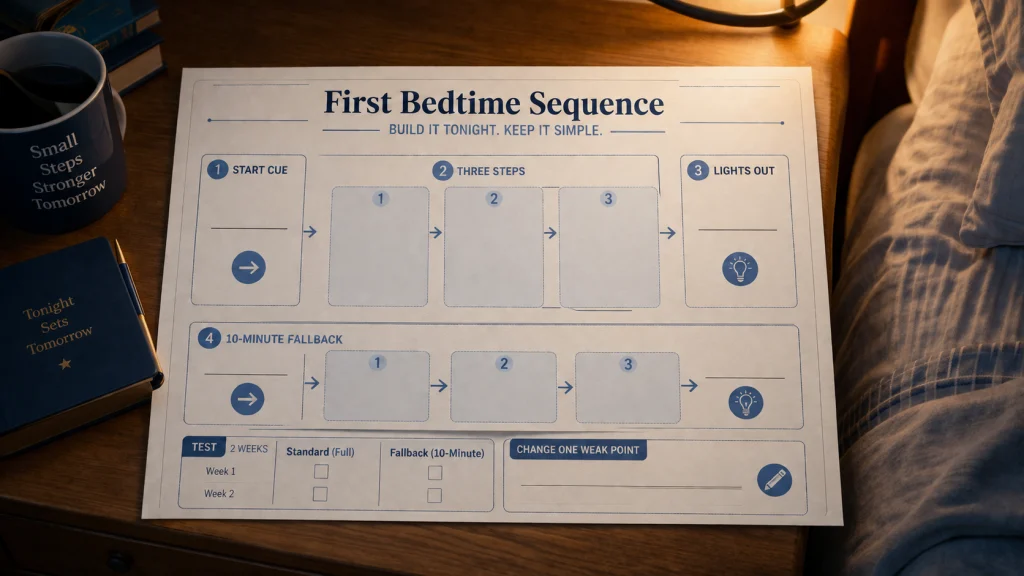
Fill Four Blanks and Test the Sequence
Build the first version with four decisions. Keep it small enough to begin tonight and stable enough to test for two weeks.
- My start cue is: ______________________________
- My three steps are: __________________, __________________, and __________________
- My lights-out endpoint is: ______________________________
- My 10-minute fallback is: ______________________________
Use the standard version on ordinary nights and the fallback when time or energy is limited. After two weeks, keep what survived, remove what created friction, and change only one weak point at a time.
FAQs
⏱️ How long should an adult bedtime routine be?
It should be long enough to create a clear transition and short enough to survive busy nights. Set a duration ceiling based on your actual schedule, then keep a 10-minute minimum version for late or disrupted evenings.
🧭 What are the three most useful stages?
Close the day, lower stimulation, and prepare the sleep space. The activities can vary, but keeping these functions in the same order reduces backtracking and extra decisions.
📱 Does the phone have to stay outside the bedroom?
Not in every household. Choose a location and settings that reduce avoidable alerts and browsing while preserving any essential calls or responsibilities. The arrangement should be simple enough that you do not reconfigure it every night.
📚 Is reading required before bed?
No. Reading is one possible quiet activity, not a universal requirement. Choose a bounded activity that fits your preferences, space, and responsibilities, then give it a clear stopping rule.
🌙 What should I do on a very late night?
Use the minimum version instead of abandoning the sequence. Close the day briefly, choose a short low-stimulation activity, complete essential care and room preparation, then reach lights out without adding optional steps.
🔁 When should I change the routine?
Test a stable version for two weeks unless a step is clearly unsafe or unworkable. Then change the single friction point that most often blocks completion, such as a late cue, excessive duration, device dependence, or shared-space conflict.
🚩 When should sleep difficulty be evaluated?
Seek qualified guidance when sleep difficulty is persistent, worsening, unexplained, or interfering with normal function. Breathing symptoms, repeated severe daytime impairment, or dangerous sleepiness should not be managed as a routine-design problem alone.