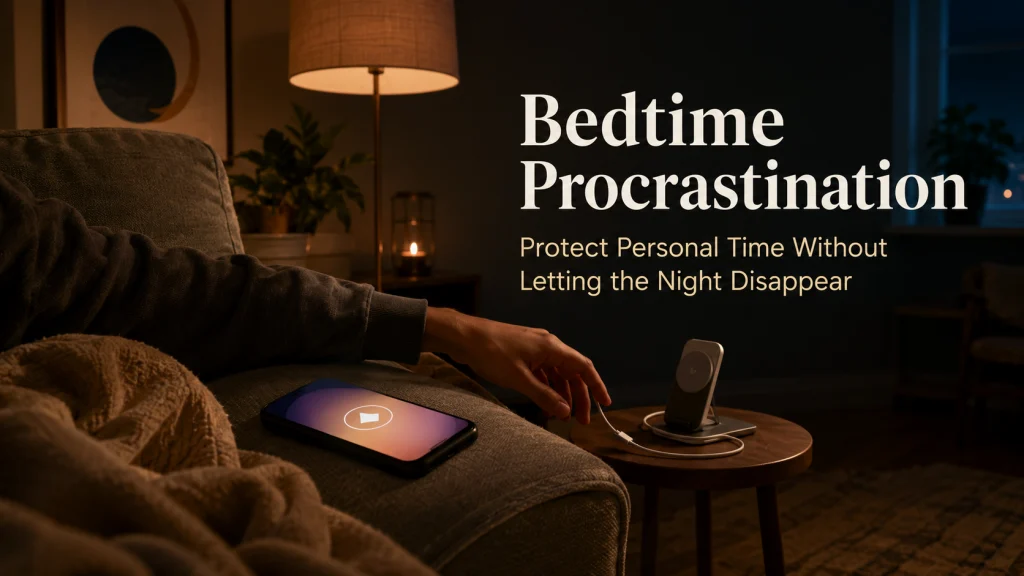
Bedtime procrastination is the voluntary delay of sleep even when you intend to go to bed and have a reasonable opportunity to do so. The delay often protects something the day failed to provide, such as quiet, autonomy, entertainment, task completion, or a transition out of responsibility. The practical goal is not to remove all personal time at night, but to define what that time is for and give it a closing boundary that does not depend on willpower alone. Persistent distress, major impairment, or severe sleep problems require appropriate professional support.
The 11:47 p.m. Note Is Not a Character Flaw
A phone note written at 11:47 p.m. says, “If I stop now, this day had nothing in it for me.” The person is tired. Tomorrow has an early start. Yet closing the video, game, book, chat, or unfinished project feels less like a healthy choice and more like surrendering the only unclaimed part of the day.
That sentence points to a time-allocation conflict, not laziness. Sleep has value, but so do autonomy, pleasure, quiet, and the feeling that the day contained something chosen rather than assigned. When those needs receive no space earlier, late evening may become their only protected territory.
Key decision: Before trying to force an earlier bedtime, identify what the delay is protecting and decide how that need will receive a defined place.
The delay often protects something the day failed to provide. Once that function is visible, you can preserve the useful part of the evening without letting unlimited options consume the entire night.
What Bedtime Procrastination Is and Is Not
Bedtime procrastination means delaying sleep despite intending to sleep, having an opportunity to sleep, and expecting the delay to make the next day harder. The term describes a pattern of behavior. It does not identify a diagnosis or explain the cause by itself.
Three situations need to be separated:
- Voluntary delay: You could begin the transition to bed, but continue another activity.
- Externally forced late bedtime: Work, caregiving, noise, housing conditions, transportation, or another demand prevents an earlier bedtime.
- Inability to sleep: You go to bed with the intention to sleep but remain awake or experience severe sleep disruption.
The first is the main focus here. The second requires changes to constraints, not a lecture about discipline. The third may need sleep-specific evaluation rather than another productivity system.
The phrase revenge bedtime procrastination is sometimes used when late-night wakefulness feels like reclaiming control after a demanding day. The more useful question is not whether the label fits. It is what reward, relief, or unfinished need keeps the night open.
What Current Evidence Can and Cannot Prove
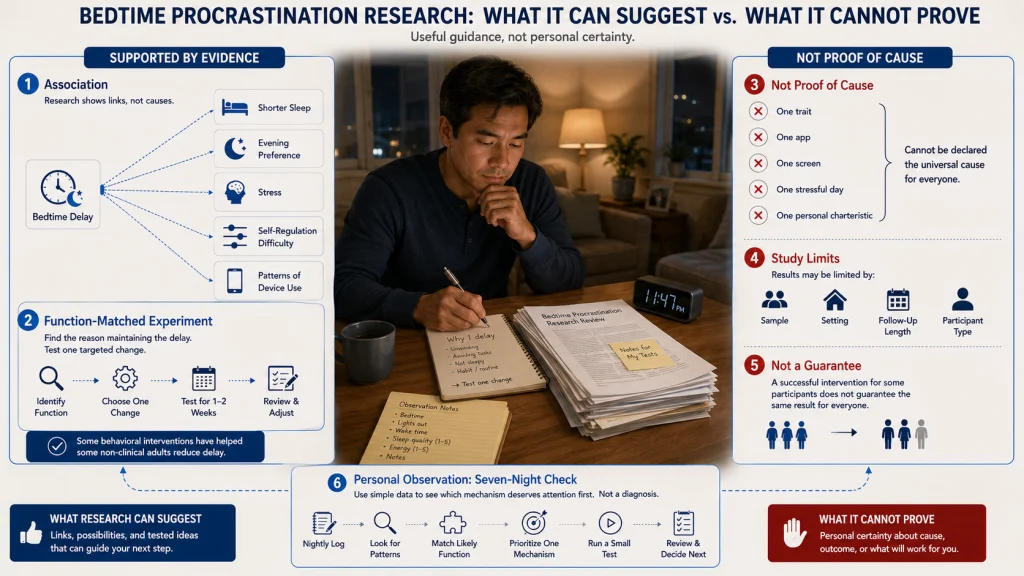
Research on bedtime procrastination has found associations with shorter sleep, evening preference, self-regulation difficulties, stress, and patterns of device use. These findings help explain why the behavior is not simply a matter of choosing the correct bedtime once.
Behavioral research also suggests that interventions matched to the reason for the delay can help some adults reduce bedtime procrastination. That supports a function-based approach: identify the reward or obstacle, then change the condition maintaining it.
Note: Associations do not prove that one trait, app, stressor, or screen causes the delay for every person. Intervention studies also have limits, including sample size, setting, follow-up length, and the fact that non-clinical participants may not represent people with severe sleep or mental-health problems.
Use evidence to guide observation, not to assign yourself a diagnosis. A seven-night pattern in your own routine can show which mechanism deserves attention first.
Identify What the Delay Is Doing for You
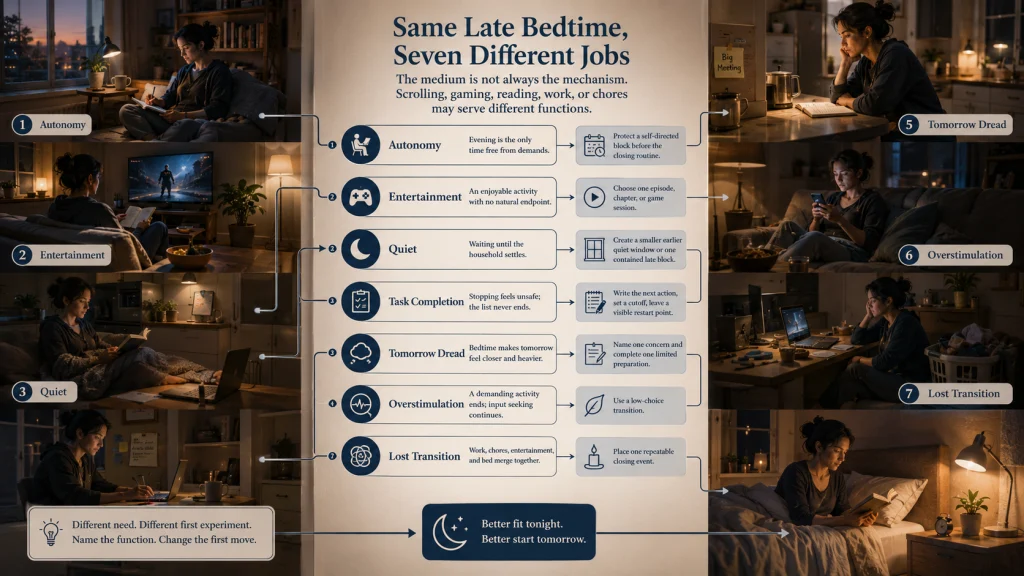
The same late bedtime can serve different functions. A phone limit may help when endless content removes stopping cues, but it may fail when the real problem is that the person has had no protected choice all day.
| Function of the delay | What it may look like | First change to test |
|---|---|---|
| Autonomy | You resist stopping because the evening is the only time no one is asking anything from you. | Protect a defined block of self-directed time before the closing routine begins. |
| Entertainment | You intend to watch, read, play, or browse briefly, but the activity has no natural endpoint. | Choose one bounded unit, such as one episode, one chapter, or one game session. |
| Quiet | You wait until the household settles before thinking, reading, or sitting alone. | Create a smaller quiet window earlier or protect a contained late block with a clear end. |
| Task completion | You keep working or doing chores because stopping with an unfinished task feels unsafe or irresponsible. | Write the next action, set a task cutoff, and leave visible proof that the work has a restart point. |
| Dread of tomorrow | Going to bed feels like making the next demanding day arrive faster. | Name one concern, make one limited preparation, and avoid turning the whole night into anticipatory work. |
| Overstimulation | You finish a demanding activity but continue seeking input because the nervous system has not shifted gears. | Insert a low-choice transition before bed rather than expecting an instant stop. |
| Loss of transition | Work, chores, entertainment, and bed run together with no event marking the change. | Create one repeatable closing event that starts the move toward sleep. |
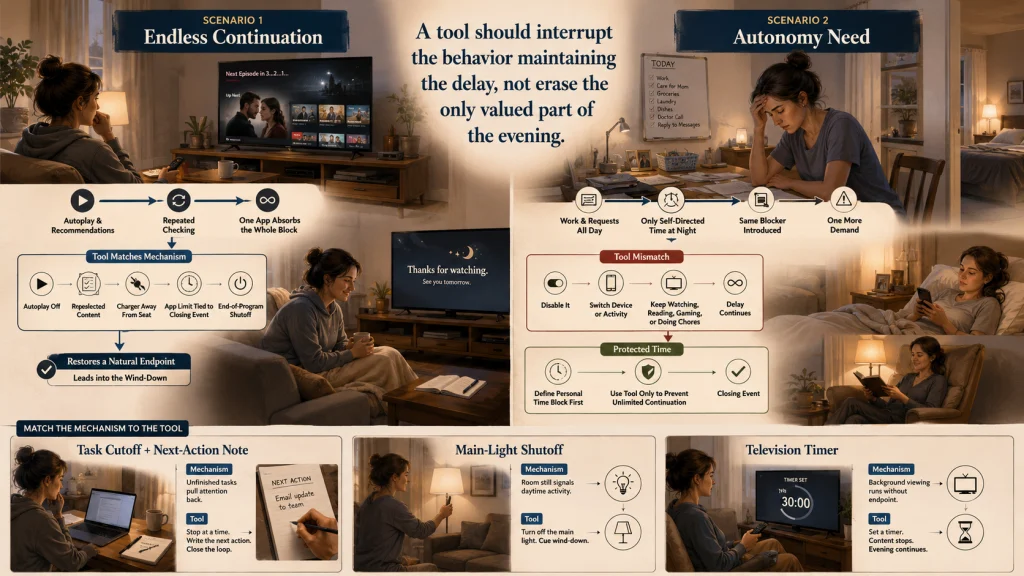
A phone blocker illustrates why mechanism matters. If endless scrolling is the main problem, blocking access may restore a stopping cue. If autonomy is the main problem, the blocker can feel like one more demand taking away the last personal hour. The person may disable it, move to another device, or replace scrolling with another open-ended activity.
Editorial observation: Apps, timers, charging stations, and calming products cannot repair a schedule that contains no protected personal time. A product designed to add a soothing step can feel like another obligation when the reader is already defending the last free hour.
Separate Intentional Leisure From Accidental Time Loss
Staying up for an activity you consciously chose is different from discovering that an hour disappeared into recommendations, autoplay, short videos, extra chores, or repeated checking. Both can delay sleep, but they need different boundaries.
Before the activity begins, define three things:
- The choice: What do I actually want from this time?
- The unit: What is one complete amount of it?
- The ending: What event will close the activity?
“Watch one selected episode, then plug in the phone” is a contained plan. “Watch something until I feel ready for bed” leaves the ending dependent on a feeling that may never arrive while more content remains available.
Measure the Real Delay for Seven Nights
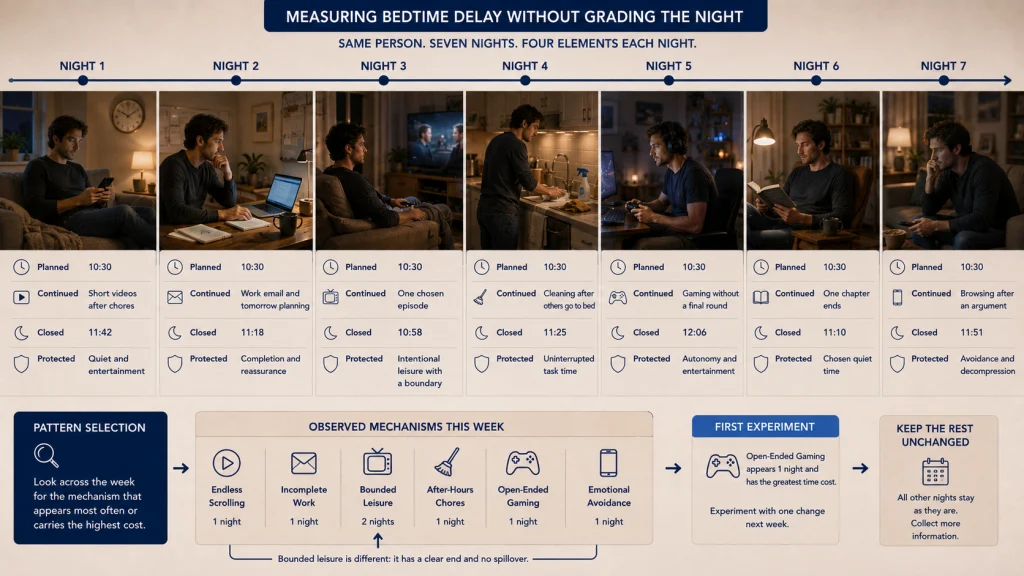
Do not begin by judging the night as good or bad. For one week, record the planned transition time, the activity that continued, the actual closing time, and what the activity was providing. The purpose is to find a pattern that can be changed.
| Night | Planned transition | What continued | Actual closing time | What the delay protected |
|---|---|---|---|---|
| 1 | 10:30 p.m. | Short videos after chores | 11:42 p.m. | Quiet and entertainment |
| 2 | 10:30 p.m. | Work email and tomorrow planning | 11:18 p.m. | Task completion and reassurance |
| 3 | 10:30 p.m. | One chosen episode | 10:58 p.m. | Intentional leisure |
| 4 | 10:30 p.m. | Cleaning after everyone went to bed | 11:25 p.m. | Uninterrupted task time |
| 5 | 10:30 p.m. | Gaming without a final round | 12:06 a.m. | Autonomy and entertainment |
| 6 | 10:45 p.m. | Reading one chapter | 11:10 p.m. | Chosen quiet time |
| 7 | 10:30 p.m. | Browsing after an argument | 11:51 p.m. | Avoidance and decompression |
This example shows that there is no single delay. Some nights contain deliberate leisure with a clear end. Others contain unfinished work, emotional avoidance, or an activity designed to continue. Choose the most frequent or costly pattern for the first experiment rather than changing every night at once.
Protect Personal Time Before It Becomes a Midnight Emergency
If late evening is the only part of the day that feels personally owned, removing it can make the plan impossible to maintain. Preserve the need, but give it a shape.
Two options work differently:
- Earlier protected time: Move a small block of quiet, entertainment, or personal choice to a point before the household’s final demands.
- Contained late-evening time: Keep the activity at night, but define its start, one chosen unit, and its closing event.
An earlier block does not need to be large. Twenty minutes of uninterrupted choice after dinner may reduce the pressure to reclaim ninety minutes at midnight. When earlier time is impossible, a contained block is more realistic than pretending personal time should disappear.
Practical tip: Name the protected need in plain language. “I need thirty minutes when no one is asking me to solve anything” is easier to design around than “I need to be better at bedtime.”
Create a Closing Event With One Final Choice
An open-ended night keeps presenting new decisions: another clip, another task, another message, another chapter, another round. A useful closing event reduces those options to one final choice.
Examples include:
- Choose one final episode before playback begins.
- Set the television to turn off at the end of the selected program.
- Write tomorrow’s first work step, then close the laptop.
- Place the phone on its charger after one final message check.
- Turn off the main room light and leave only the light used for the transition.
The event should be visible and specific. “Use less phone” is not an event. “When the selected episode ends, plug the phone into the charger outside reach and begin the three-step wind-down” tells you exactly what happens next.
For the sequence after the closing event, use a short adult bedtime routine that still works on late nights.
Match Friction Tools to the Actual Mechanism
Friction tools are most useful when they interrupt the behavior that removes the stopping cue. They are less useful when they block the only valued part of the evening without replacing it.
| Mechanism | Tool to test | What the tool should change |
|---|---|---|
| Autoplay or endless recommendations | Turn autoplay off or choose content before starting | Restore a natural endpoint. |
| Automatic phone checking | Move the charger away from the bed or leisure seat | Add a physical end to repeated checking. |
| One app absorbs the whole block | Use an app limit tied to the closing event | Interrupt accidental continuation without removing all leisure. |
| Television continues in the background | Use a sleep timer or end-of-program shutoff | Prevent the next program from becoming the default choice. |
| Work has no stopping rule | Set a task cutoff and write the next action | Reduce the fear that stopping means losing control of the task. |
| The room still signals daytime activity | Dim or switch off the main lights at the closing time | Create an environmental transition with fewer decisions. |
When phone use is the main medium of delay, the guide to changing phone use before bed provides a narrower decision path. Do not make the phone carry blame for a workload, relationship conflict, or lack of personal time that would continue on another screen.
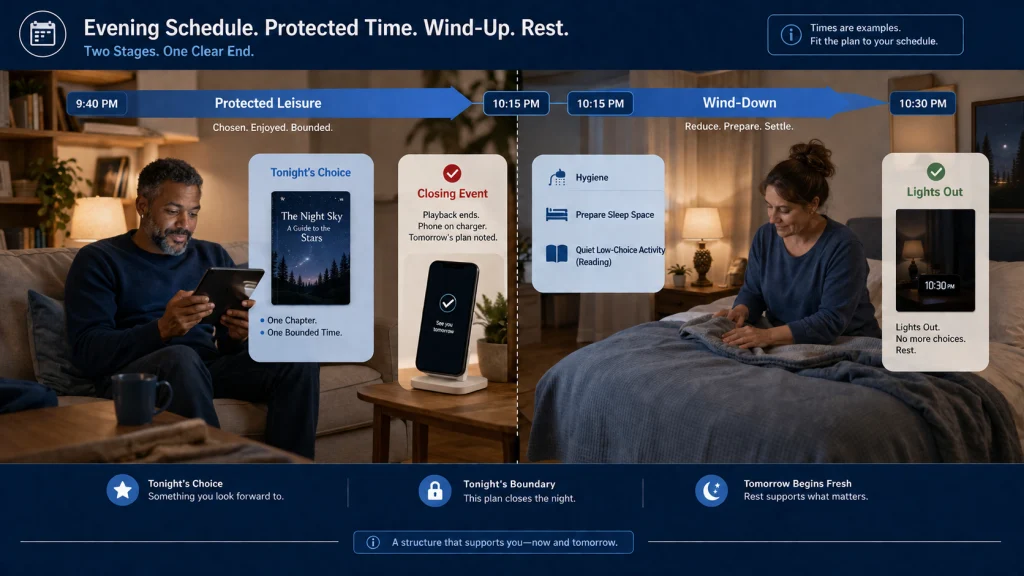
Use a Two-Stage Evening: Protected Leisure, Then Wind-Down
A bedtime plan can protect enjoyment and still close the night. The two stages have different jobs: the first gives the evening something worth having, and the second lowers choice and stimulation before sleep.
| Time | Stage | Example | Boundary |
|---|---|---|---|
| 9:40 to 10:15 p.m. | Protected leisure | One selected episode, a chapter, a game session, or quiet music | The activity is chosen before it begins and has one complete unit. |
| 10:15 p.m. | Closing event | Playback ends, phone goes on the charger, or laptop closes after the next-step note | No new entertainment or work option is opened. |
| 10:15 to 10:30 p.m. | Wind-down | Basic hygiene, prepare the sleep space, and one quiet low-choice activity | The sequence has a fixed endpoint rather than continuing until sleepiness appears. |
| 10:30 p.m. | Lights out | End the routine | The night does not reopen for optional tasks. |
The exact times are examples, not universal targets. Choose a lights-out point that fits your schedule, then reserve a realistic leisure block and a short transition before it.
The broader healthy sleep habits guide can help you place this evening change within the rest of your routine. For a wider view of sleep decisions, use the practical sleep guide.
Build an If-Late Fallback Before You Need It
An all-or-nothing plan often collapses after overtime, caregiving, travel, conflict, or an unexpectedly long task. Once the preferred bedtime has passed, the person may decide the night is already lost and keep going.
Create the fallback in advance:
If-late rule: If the closing time has passed, choose ten minutes of protected personal time, complete the minimum wind-down, and do not reopen work, chores, or unlimited content.
The fallback should preserve a small amount of choice while reducing the size of the delay. It is not punishment for missing the preferred plan. It is the version designed for the nights when motivation and time are lowest.
A useful fallback may be one song playlist, a few pages of reading, a brief shower, or ten quiet minutes without solving anything. The activity should have a clear stop and require little setup or cleanup.
Address Workload, Caregiving, Relationships, and Housing Constraints
Some nights run late because the schedule is overloaded, not because the person failed to manage impulses. A closing rule cannot create time that does not exist.
Look for constraints such as:
- Work that continues into the evening without a defined cutoff.
- Caregiving tasks that cannot begin until another person is settled.
- A partner’s schedule that keeps the shared bedroom active.
- Limited housing space with no quiet area before others go to bed.
- Household chores concentrated into the final hour.
- Conflict or emotional tension that makes the transition feel unsafe or unfinished.
Then change the smallest part of the system that can create a real boundary. That might mean moving one chore, alternating the final household task, using headphones in a shared room, setting a work handoff note, or agreeing on a quiet period that does not require everyone to sleep at the same time.
Note: When another person’s needs, unsafe housing, financial pressure, or inflexible work conditions control the night, self-control tools may have limited effect. The plan must acknowledge the constraint rather than treating it as a personal failure.
Know When the Pattern Needs Professional Support
This article addresses non-clinical bedtime delay. It cannot determine whether persistent sleep loss or avoidance is connected to a mental-health condition, attention problem, sleep disorder, trauma, medication effect, or another health concern.
Seek appropriate professional support when the pattern includes:
- Persistent psychological distress or a strong sense that bedtime is emotionally unsafe.
- Major impairment in work, driving, caregiving, concentration, relationships, or daily function.
- Severe or persistent difficulty sleeping even after you begin the bedtime transition.
- Repeated inability to control behavior across several parts of life, not only at bedtime.
- Marked mood changes, hopelessness, panic, or other symptoms that need assessment.
- Dangerous sleepiness, near misses, or inability to stay awake during safety-critical tasks.
Safety warning: Do not use a bedtime label to diagnose ADHD, depression, anxiety, trauma, burnout, or insomnia. Severe symptoms, immediate danger, or inability to stay safe require prompt appropriate help.
Bring a short record of sleep timing, the seven-night delay log, recent changes, and the effect on daily function. Concrete information is more useful than trying to prove that one label explains everything.
Name the Protected Need and the Closing Rule
Finish with two sentences you can use tonight:
Protected need: “The part of the evening I am trying to protect is ______.”
Closing rule: “After ______, I will close the activity by ______ and begin the minimum wind-down.”
The answer may be quiet, choice, entertainment, completion, connection, or relief from responsibility. Protecting that need does not require leaving the whole night open. Give it a defined place, choose one complete unit, and use a closing event that removes the next unlimited option.
The aim is not a flawless bedtime. It is an evening that contains something personally meaningful and still reaches a clear end.
FAQs
🕚 Why do I delay going to bed even when I am tired?
The delay may protect quiet, autonomy, entertainment, unfinished work, or distance from tomorrow’s demands. Track what continues after your intended transition time and what that activity is providing before choosing a solution.
📱 Is bedtime procrastination always caused by phone use?
No. A phone can remove stopping cues, but the same delay can move to television, gaming, reading, chores, or work. Device limits help most when endless access is the mechanism rather than the only source of personal time.
🎮 Can I keep late-night leisure and still sleep on time?
Yes. Choose one contained unit of leisure, define the end before beginning, and follow it with a short wind-down. The goal is to remove unlimited continuation, not every enjoyable activity.
⏱️ How long should I track the delay?
Seven nights is a practical starting window because it includes different workdays and weekend conditions. Record the planned transition, what continued, the closing time, and what the delay protected.
🔒 Why does an app blocker fail after a few nights?
It may be targeting the medium rather than the function. When the delay protects autonomy or quiet, blocking one app can feel like another restriction unless a defined personal-time block replaces what was removed.
🌙 What should I do when the planned bedtime has already passed?
Use an if-late fallback instead of abandoning the night. Keep a small bounded amount of personal time, complete the minimum wind-down, and avoid reopening unlimited content or non-urgent tasks.
🧠 Does bedtime procrastination mean I have a mental-health condition?
No. The behavior alone does not diagnose any condition. Persistent distress, severe sleep problems, dangerous sleepiness, or significant impairment deserves appropriate professional assessment.