Bodyweight strength training becomes easier or harder through leverage, support height, range of motion, stability, tempo, and total work. The goal is not to jump from a wall push-up to an advanced skill, but to choose a repeatable variation and change one variable at a time. A complete home plan still needs push, pull, squat, hinge, single-leg, trunk, and carry or bracing functions, even when equipment is minimal. Equipment becomes useful when a movement function, especially pulling, cannot be loaded safely or progressively in the space you have.
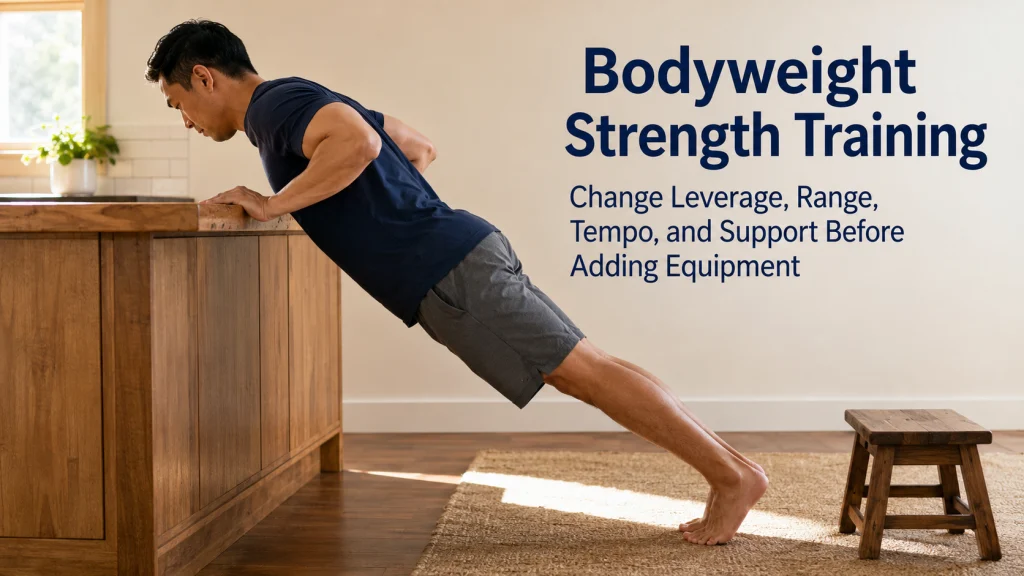
The Same Push Pattern Can Create Five Different Challenges
Picture one push-up pattern performed against a wall, then a countertop, a lower stable surface, the floor, and finally with the feet raised. The person has not become heavier between steps. What changes is how much of the body must be supported, the angle against gravity, and the amount of control required.
That is the central idea behind strength training without weights. Bodyweight is already a form of resistance. For someone beginning at home, this can make progress feel less mysterious: you do not need to prove yourself with the floor version before you are ready. Progress comes from arranging resistance so the current variation requires effort, while still feeling stable enough to repeat with control.
| Level 1 | Level 2 | Level 3 | Level 4 | Level 5 |
|---|---|---|---|---|
| Wall push | Countertop push | Low stable-surface push | Floor push | Feet-elevated push |
| More support | Moderate-high support | Moderate support | Body parallel to floor | More load toward the upper body |
| More support and easier leverage → less support and harder leverage | ||||
This five-step picture is not a rule that everyone must follow in order. It is a way to see the variables. A lower surface may be too large a jump, while a smaller change in range or tempo may be the better next step.
Bodyweight Resistance Is Not the Same as a Cardio Circuit
Bodyweight resistance training uses the body, gravity, support surfaces, and deliberate muscular effort to challenge a movement pattern. A session may raise your heart rate, but speed is not what makes it strength work. The important question is whether the chosen variation creates controlled resistance for the muscles doing the job.
A fast sequence of squats, mountain climbers, and push-ups may function mainly as conditioning when the goal is continuous movement. A slower set with a stable starting position, a repeatable range, and enough rest to preserve control is organized more clearly around strength.
Bodyweight work also does not need to imitate advanced calisthenics. Handstands, pistol squats, explosive jumps, and skill-heavy holds are not required starting points. For a broader view of how resistance work fits alongside cardio, mobility, and other home options, use the home exercise decision guide. For programming decisions such as weekly structure and major muscle coverage, review the home strength planning guide.
Key decision: Choose a variation because it gives you a useful level of resistance and control, not because it looks more advanced.
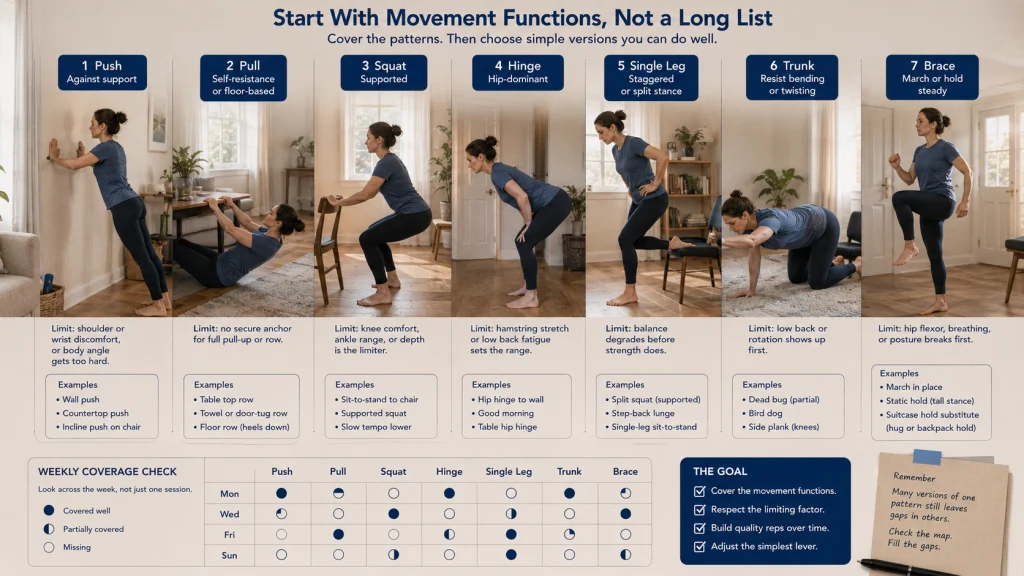
Map the Movement Jobs Before Choosing Variations
A long exercise list can hide an incomplete plan. Someone may collect several push-up variations while doing little for pulling, hip movement, single-leg control, or the trunk. Start with movement functions, then decide how each function can be represented in your room.
| Movement function | What the body is doing | Bodyweight-friendly direction | Practical limitation |
|---|---|---|---|
| Push | Pressing the body or support away | Change wall, counter, low-surface, or floor leverage | Shoulder and wrist tolerance may change the setup |
| Pull | Drawing the arms or body toward resistance | Use self-resistance or floor-based upper-back work | True progressive pulling is difficult without a secure anchor |
| Squat | Bending at the hips and knees while staying balanced | Adjust support, depth, stance, or assistance | Depth should not be forced past comfortable control |
| Hinge | Moving mainly through the hips while the trunk stays organized | Practice hip travel, wall reach, or supported single-leg versions | Bodyweight may stop being challenging before technique is limiting |
| Single-leg | Shifting more work to one side | Use split stance, staggered stance, step, or supported balance | Balance can fail before the working muscles are challenged |
| Trunk | Resisting unwanted bending, twisting, or arching | Use bracing, crawling positions, or controlled limb movement | Long holds can become a discomfort contest instead of useful practice |
| Carry or bracing substitute | Maintaining posture while moving or resisting load | Use marching, crawling, or static bracing when no secure load is available | A bodyweight substitute does not fully reproduce an external carry |
The map is a coverage check, not a demand to fit every function into every session. Across the week, it helps reveal whether the plan repeatedly favors the easiest patterns to set up while leaving harder-to-arrange functions untouched.
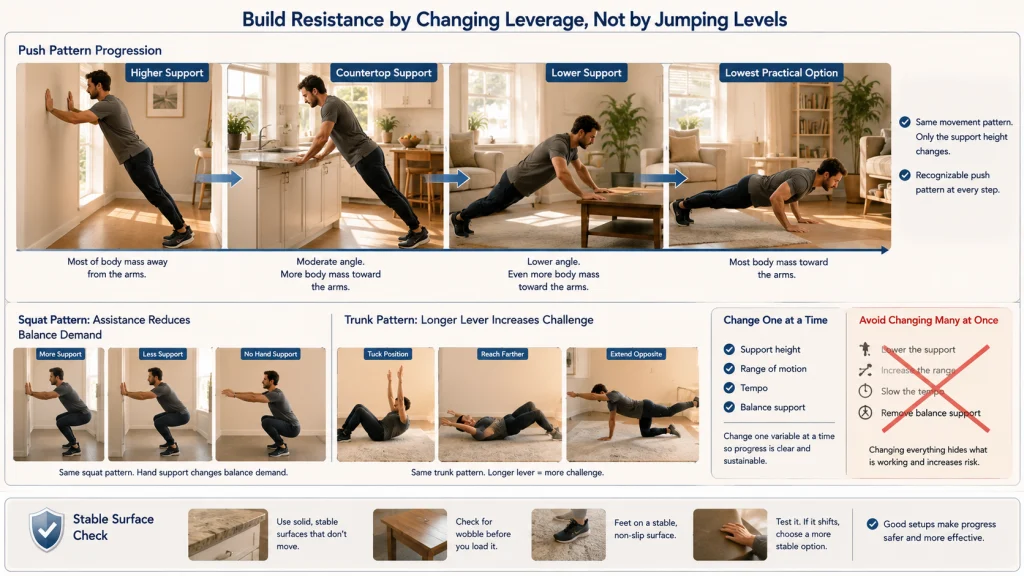
Change Leverage and Support Height First
Leverage changes how body mass is distributed around the working joints. Support height changes the angle at which gravity acts on the body. Together, they often provide the cleanest way to scale a movement because the pattern can remain recognizable while the difficulty shifts.
For a push, moving from a wall to a countertop usually places more of the body’s weight into the arms. For a squat, using light hand support can reduce balance demand without removing the leg movement. For trunk work, extending an arm or leg farther from the body increases the lever length even though no weight has been added.
Editorial observation: Products sold as beginner aids sometimes change stability or leverage without explaining that function. A lower anchor point, longer handle position, or less supportive surface can make a movement harder even when no added weight appears on a label.
Change one setup detail at a time. If you lower the support, widen the range, slow the tempo, and remove balance assistance all at once, you will not know which change made the variation stop being repeatable.
Change Range of Motion Within Comfortable Control
Range of motion is the distance traveled during a repetition. A longer range can increase the amount of work a pattern demands, but only when the positions remain controlled and suitable for the person performing them.
A supported squat may begin with a shallow, consistent depth. Progress might mean sitting the hips slightly lower while the feet remain planted and the return stays steady. A push variation may begin with a limited bend at the elbows, then gradually use more depth without the shoulders collapsing forward or the trunk losing position.
The goal is not to chase the deepest possible position. A smaller range that can be repeated cleanly is more useful than a larger range reached through bouncing, twisting, dropping, or pain. Range should also be reduced when fatigue changes the movement enough that the intended pattern is no longer recognizable.
Note: A harder variation is not evidence of better form. Difficulty and movement quality are separate questions.
Use One-Sided Work and Stability Changes Carefully
Shifting more work to one limb can make a bodyweight movement harder without adding equipment. A staggered squat, split stance, step variation, or one-arm-supported position changes how much each side contributes. It can also reveal differences in balance and control that were hidden in a symmetrical stance.
That does not mean the least stable option is automatically the best progression. When balance becomes the main challenge, the target muscles may receive less useful work because the set ends when the person wobbles, grabs for support, or changes the movement to stay upright.
Support is not cheating. It is a programming variable. A stable handhold can let the legs work through a better range, while a deliberately reduced handhold can become the next progression when balance is ready to take on more responsibility.
Adjust Tempo and Pauses Without Turning Them Into a Test of Suffering
Tempo changes how quickly a repetition is lowered, reversed, and completed. A pause removes momentum at a chosen point. Both can make a familiar variation more demanding because they require longer control and reduce the ability to rush through weak positions.
A practical change might be a slower lowering phase, a brief pause near the bottom of a squat, or a controlled stop before pressing away from a countertop. The count itself is less important than whether the same pace can be repeated without breath-holding, shaking that changes the movement, or a loss of position.
A slower repetition is not automatically superior, and exaggerated time-under-tension claims are not needed. Very slow work can create fatigue that limits the number of useful repetitions without solving the actual progression problem. Use tempo when it improves control or creates a manageable increase in difficulty, not as a punishment layered onto every set.
Add Repetitions or Sets Only When the Variation Stays Stable
More repetitions and more sets increase total work, but they should not be the only progression tools. If a wall push has become very easy, adding more and more repetitions may turn the set into a long endurance task. Changing to a slightly lower support may create a clearer strength challenge with less repetition.
Before adding work, check three things: the movement looks similar from the first repetition to the last, recovery is adequate before the next session, and no new pain or unusual symptom has appeared. When those conditions are present, a small increase in repetitions or an additional set can be a reasonable next step.
For help choosing a workable starting amount, use the guide to beginner sets and repetitions. Keep effort separate from the idea that every set must end at complete failure. The guide to training to failure explains why stopping with control can be a better fit for many home sessions.
Practical tip: Record the variation, support height, range, repetitions, and sets. Writing only “push-ups” or “squats” hides the variables that actually changed.
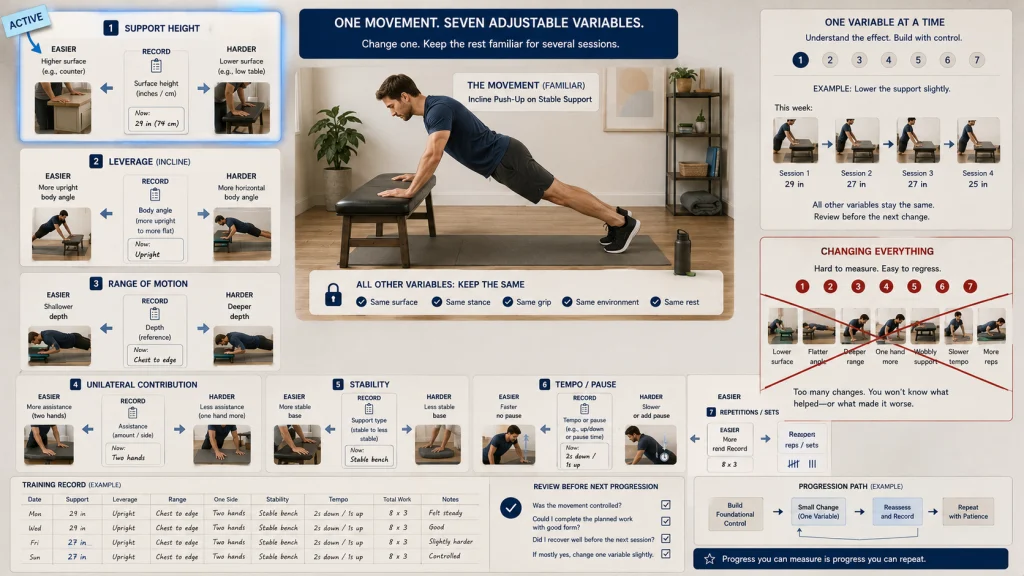
Use One Progression Variable at a Time
A bodyweight plan becomes easier to manage when each change has a purpose. The table below separates the main variables so a harder day does not turn into a random collection of changes.
| Variable | How to make the movement easier | How to make it harder | What to record |
|---|---|---|---|
| Support height | Use a higher stable support | Use a lower stable support | Surface and approximate height |
| Leverage | Keep limbs closer to the body | Move limbs farther from the body or shift more mass toward the working area | Body and limb position |
| Range | Use a smaller controlled distance | Increase the distance while control remains comfortable | Depth or clear endpoint |
| Unilateral contribution | Share work evenly between sides | Shift more work to one side | Stance and assistance |
| Stability | Add reliable hand or floor support | Reduce support gradually | Type of support used |
| Tempo or pause | Use a natural controlled rhythm | Slow one phase or add a brief pause | Where the pace changed |
| Repetitions or sets | Reduce total work | Add a small amount of work | Completed repetitions and sets |
When one variable changes, keep the others familiar for a few sessions. That makes the result easier to interpret. The broader guide to progressive overload at home explains how to use this same principle across bodyweight, bands, and external weights.
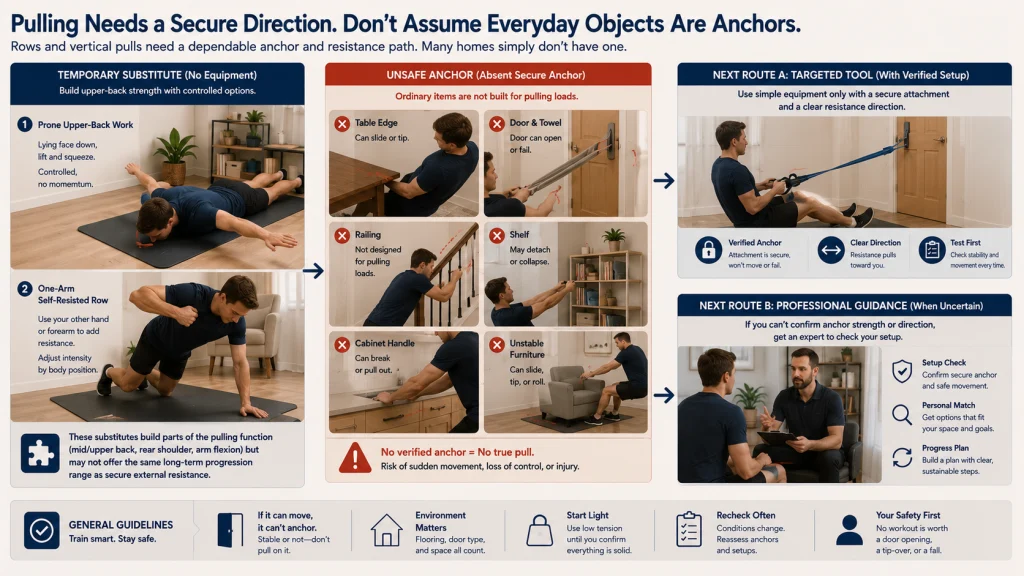
Solve the Home Pulling Limitation Honestly
Pushes, squats, hinges, and many trunk patterns are easy to arrange with the floor and a stable support. Pulling is different. A true row or vertical pull needs something secure to pull against, and many ordinary rooms do not provide an anchor that is both strong and positioned well.
Note: Floor-based upper-back movements and self-resisted rows can train parts of the pulling function, but they may not provide the same progression range as a secure row or pull-down setup.
Avoid pretending that any table edge, door, railing, towel, or cabinet is automatically suitable. Furniture can slide, tip, separate at a joint, or fail in a direction it was not designed to handle. A substitution is not useful when the setup creates a fall or impact risk.
In a room with no trustworthy anchor, use self-resistance or controlled prone upper-back work as a temporary solution, and treat the limitation as information. This is one of the clearest cases where a simple resistance tool or professional setup check may add real function rather than unnecessary complexity.
Check Household Surfaces Before You Put Bodyweight on Them
A countertop, wall, chair, step, or low surface changes leverage only if it stays still under the expected force. Visual sturdiness is not enough. The movement may push down, forward, sideways, or upward, and an object that supports one direction may fail in another.
- Check that the surface does not slide, rock, fold, roll, or rotate.
- Confirm that the floor beneath it is dry, level, and free of loose rugs or clutter.
- Inspect visible joints, hinges, fasteners, cracks, and damaged edges.
- Test light pressure in the same direction the exercise will apply before adding more bodyweight.
- Keep enough clear space to step away or lower yourself safely if balance changes.
- Do not hang from doors, shelves, tables, rails, or fixtures unless they are specifically designed and installed for that load.
- Stop using any setup that shifts, creaks, flexes unexpectedly, or changes position during a repetition.
Safety warning: Do not use unstable furniture as exercise equipment. If a setup depends on guessing whether an object will hold, choose a different variation.
This check should be repeated after moving the object, changing the floor surface, or increasing how much bodyweight the support receives.
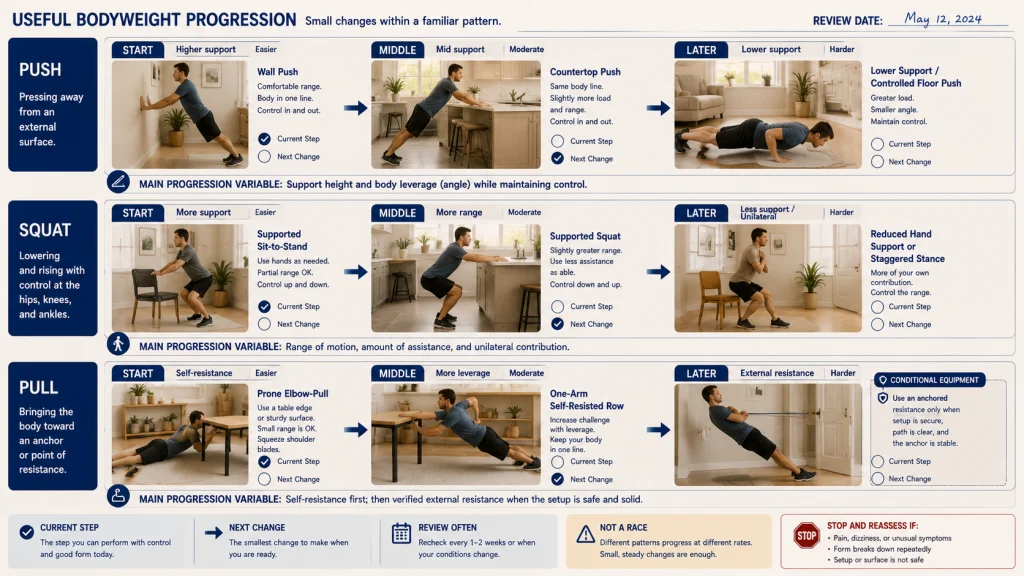
Three Progression Ladders Show How the Variables Work
These examples are not complete workouts. They show how one pattern can progress through small changes rather than an abrupt jump to an advanced exercise.
| Pattern | Starting variation | Middle variation | Later variation | Main variable |
|---|---|---|---|---|
| Push | Wall push with comfortable range | Countertop push with the same body line | Lower stable-surface push or controlled floor push | Support height and leverage |
| Squat | Supported sit-to-stand from a stable chair | Supported squat with slightly greater range | Reduced hand support or staggered stance | Range, assistance, and unilateral contribution |
| Row substitute | Prone elbow pull with a small controlled lift | One-arm self-resisted row with steady opposing pressure | Securely anchored resistance row when a safe setup is available | Self-resistance, control, then external resistance |
The row example ends differently because the room changes what is possible. That is not a failure of bodyweight training. It is an honest boundary: some functions are easier to scale with a secure external resistance than with household improvisation.
Choose a current step that feels controlled, then identify only one next change. Set a review date rather than advancing because a variation has been used once or because another person performs a harder version.
Know When Equipment or Individual Guidance Becomes Useful
Equipment is useful when it solves a specific limitation. A band can provide a clearer pulling direction. A dumbbell can make a hinge or carry easier to progress after bodyweight changes stop creating enough challenge. A stable platform may provide a predictable support height. None of these items makes the program complete by itself.
Use a product-last sequence:
- Name the movement function that is difficult to train.
- Identify why the current bodyweight setup is limited.
- Decide whether leverage, range, tempo, or support can solve it safely.
- Choose equipment only when it adds a missing resistance direction, a safer setup, or clearer progression.
- Check storage, setup time, floor space, maintenance, and whether the item will actually be used.
The home exercise equipment guide can help separate useful function from extra attachments. It is not necessary to buy a collection simply because bodyweight training is the starting method.
Individual instruction becomes more useful when you cannot find a comfortable variation, repeatedly lose balance, are unsure whether a support is safe, or need modifications for a condition, recent surgery, pregnancy, disability-related limitation, or a long period of inactivity. That guidance should match the actual limitation rather than force everyone toward the same progression ladder.
Respect Pain, Fall Risk, and Other Safety Boundaries
Bodyweight does not mean risk-free. The body can still be placed in a difficult leverage position, moved through an unsuitable range, or supported by an unstable object. A progression should be stopped when control breaks down or a symptom suggests that routine exercise advice is no longer enough.
Safety warning: Stop exercise and seek appropriate help for chest pain or pressure, fainting, severe dizziness, extreme shortness of breath, sudden weakness, serious injury, or severe pain.
Persistent joint or muscle pain, numbness, tingling, unusual weakness, repeated falls, or symptoms that are new, worsening, unexplained, or limiting normal activity require qualified evaluation. Do not use a harder variation to test whether a painful area can tolerate more.
Pregnancy, recent surgery, chronic conditions, disability-related limitations, neurological symptoms, or a long period of inactivity may change which positions, ranges, and progression rates are appropriate. This article cannot provide rehabilitation or individualized exercise clearance.
Practical tip: When a variation feels wrong, step back to the last controlled version and record what changed. The useful question is not “Can I force one repetition?” but “Can I repeat this setup safely and consistently?”
Choose the Pattern, Current Variation, Next Variable, and Test Date
Start by naming the movement function you want to train. Choose a variation that provides effort without strain, record the support, range, tempo, repetitions, and sets, then select one variable for the next progression.
Give the new version enough practice to judge whether it is repeatable. Progress may look modest from the outside, such as using a slightly lower surface or needing less hand support, but those changes still count when they are controlled and measurable. If the room cannot provide a safe pulling setup or another resistance direction, treat equipment as a targeted solution rather than proof that bodyweight work has failed. The best next step is the smallest change that keeps the movement controlled and gives you a clear reason to continue.
FAQs
🧱 Can wall exercises really build strength?
A wall can provide a useful starting level of resistance when floor versions are not yet controlled. Progress comes from increasing effort over time through a lower support, greater range, longer lever, slower phase, or more total work.
📈 How do I know when to use a harder variation?
Consider a small progression when the current version stays consistent across the set, recovery remains manageable, and no new pain or unusual symptom appears. Change one variable so you can tell whether the new setup is actually a better fit.
🪑 Is using a chair for support cheating?
No. A stable chair or fixed support can reduce balance demand and make the intended movement easier to control. The surface must be checked for sliding, tipping, folding, and structural damage before it receives bodyweight.
🧲 Can I train my back without equipment?
Self-resisted rows and floor-based upper-back movements can cover part of the pulling function. A secure external anchor often provides a clearer path for long-term pulling progression, so this is one area where minimal equipment may be genuinely useful.
⏱️ Should every repetition be very slow?
No. A slower phase or brief pause can improve control and increase difficulty, but extremely slow repetitions are not required. Use a pace you can repeat without breath-holding, strain, or a major change in position.
⚖️ Is a one-leg variation always better?
No. One-sided work can increase the contribution of one limb, but it can also make balance the main limit. Light support or a staggered stance may provide a more useful progression than jumping directly to an unsupported single-leg exercise.