Beginners do not need one perfect repetition range or the largest number of sets they can tolerate. A useful starting dose matches the exercise variation, keeps technique stable, and leaves enough recovery for the next session. Start conservatively, record what happened, and change only one variable after the result becomes clear. Ten repetitions can be manageable, demanding, or excessive depending on the resistance and how many controlled repetitions remain.
The Same Ten Repetitions Can Create a Different Dose
Picture two people completing two sets of ten push-ups. One uses a wall and finishes each set feeling that several smooth repetitions were still available. The other uses the floor, slows sharply near the end, and loses body position on the final repetitions. Both logs say “2 sets of 10,” but the sessions did not create the same demand.
| What the log shows | First set of ten | Second set of ten |
|---|---|---|
| Exercise variation | Wall push-up | Floor push-up |
| Technique at the end | Stable and repeatable | Position begins to collapse |
| Remaining capacity | Several controlled repetitions likely remain | Little or no controlled capacity remains |
| Practical meaning | The variation may be ready for a small progression | The variation or target may be too demanding today |
The number is only one part of the dose. Exercise difficulty, resistance, range of motion, technique quality, effort, rest, and weekly frequency all change what those repetitions mean. The broader home strength training framework helps organize those decisions, while the home exercise guide places resistance work inside a balanced movement routine.
Define Repetitions, Sets, Exercise Volume, and Weekly Volume
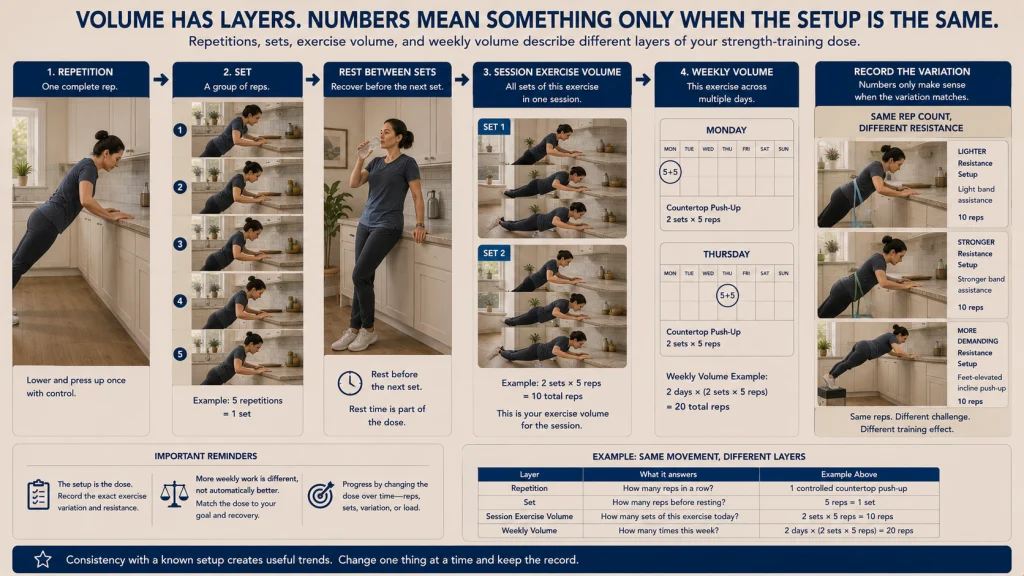
A repetition is one complete performance of a movement. A set is a group of repetitions performed before a rest period. Exercise volume describes how much work you perform for one movement in a session, while weekly volume combines the work repeated across the week.
Repetition → Set → Exercise volume → Weekly volume
- One repetition: one controlled squat, press, row, hinge, or other movement.
- One set: a planned group of repetitions followed by rest.
- Exercise volume: all planned sets for that movement during one session.
- Weekly volume: the combined work for that movement pattern across all sessions that week.
For example, two sets of eight repetitions performed twice during the week create more weekly exposure than the same two sets performed once. That does not automatically make the larger amount better. It only means the total dose is different and should be judged against technique, effort, time, and recovery.
Resistance also matters. Ten repetitions with a light band, ten with a stronger band, and ten with a demanding bodyweight variation are not interchangeable. A useful record includes the number of repetitions and sets, but it also names the exact resistance or variation used.
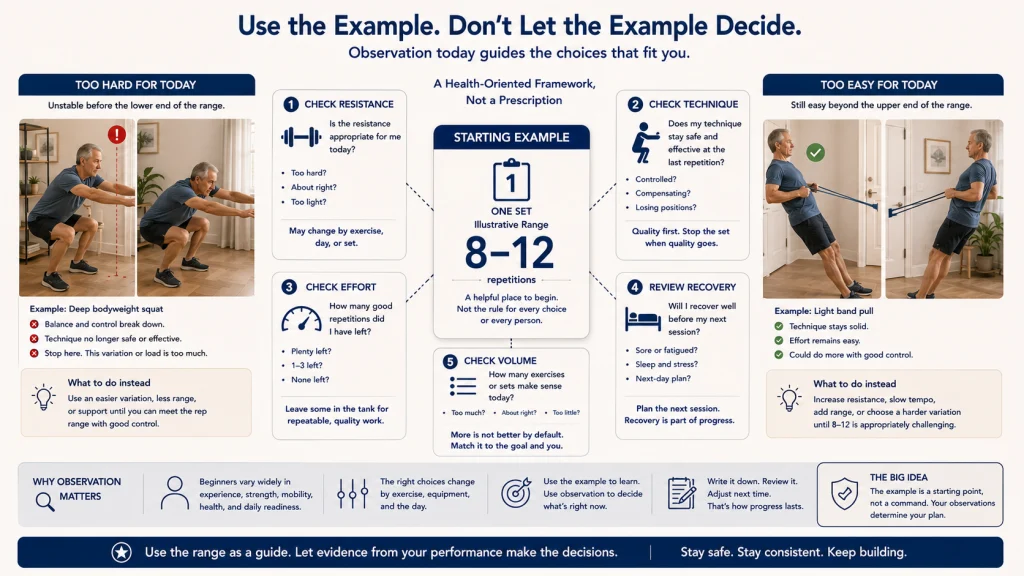
Use the CDC Starting Example as a Framework, Not a Universal Rule
CDC public guidance gives an accessible example of performing one set of 8 to 12 repetitions for muscle-strengthening activity. That can help a beginner understand what a basic set looks like, but it is a health-oriented starting framework rather than a fixed prescription for every exercise, body, goal, or schedule.
Note: The example does not tell you which resistance to use, how difficult the final repetition should feel, how many exercises belong in the session, or whether one set remains appropriate after your capacity changes.
A range of 8 to 12 repetitions could be sensible for one movement and poorly matched to another. A challenging squat variation may become unstable before eight controlled repetitions, while a light band pull may remain easy well beyond twelve. The written range cannot replace observation.
Use a public starting example to begin conservatively, then adjust from the result. The questions that matter are whether technique remained consistent, whether the chosen effort matched the plan, and whether you recovered well enough to repeat the work.
Choose a Rep Target After Selecting a Controllable Variation
Repetition targets become useful only after the exercise difficulty is appropriate. If the movement is too easy, a low target may end before meaningful effort appears. If the movement is too hard, a moderate target may encourage shortened range, rushing, or loss of control.
Start by choosing a variation you can repeat with a stable setup and a comfortable range of motion. For external resistance, the guide to choosing a starting weight explains how resistance and remaining capacity work together. For bodyweight movements, adjust support height, leverage, or range before treating the rep number as the main problem.
Practical tip: Choose a small rep range rather than one rigid number. A range gives you room to stop when technique changes instead of forcing every set to end on the same count.
Suppose you plan for six to ten controlled repetitions. Reaching eight with consistent technique can be a successful set. Stopping at six because the position becomes unstable can also be the correct decision. The range guides the session, but the movement quality decides where the set ends.
Stop the Set When Technique Changes or Planned Effort Is Reached
A beginner set should not continue simply because the target number has not appeared yet. End the set when the movement no longer matches the version you intended to perform, the range shortens unexpectedly, balance becomes unreliable, or the effort reaches the stopping point you planned.
Technique change is not limited to one dramatic failure. It may look like a squat shifting toward one side, a row turning into a shoulder shrug, a press losing trunk position, or repetitions becoming much faster to escape a difficult portion of the movement.
Stopping before complete failure can make technique easier to repeat and recovery easier to interpret. The separate guide to training to failure explains why reaching an absolute limit is not required for every beginner set.
Choose One or Multiple Sets From Current Capacity and Time
One well-controlled set can be a practical starting point when the movement is unfamiliar, the session includes several movement patterns, or time is limited. Multiple sets create more work, but they also require more time, more rest, and more repeatable technique.
The decision is not “one set is for beginners and several sets are for advanced trainees.” A beginner may use one set for a new movement and two sets for a familiar one in the same session. The appropriate amount can differ by exercise because coordination, resistance, and local fatigue differ.
| Current situation | Reasonable starting approach | What to observe |
|---|---|---|
| New movement or uncertain technique | Begin with one controlled working set | Whether the movement remains stable and understandable |
| Familiar movement with good recovery | Consider a second set | Whether the second set resembles the first |
| Limited session time | Prioritize one set across the main movement patterns | Whether rushing reduces control or rest |
| Large drop from set one to set two | Keep the current set count or reduce difficulty | Whether load, variation, or rest is mismatched |
Rest is part of this decision. A second set performed too quickly may look like proof that two sets are excessive when the real issue is insufficient recovery. The guide to rest between sets covers how the next set can be separated from the first without turning the pause into guesswork.
Add Sets Only After the First Set Remains Repeatable
Before adding another set, check whether the current work is stable enough to repeat. A first set that ends with rushed repetitions, shortened range, or an uncertain setup does not become more useful merely because it is repeated.
A second set is easier to justify when the first set uses consistent technique, the planned effort is reached without strain, and the movement can be repeated after a reasonable rest. The second set does not need to match the first perfectly, but a sharp drop can reveal that the resistance, variation, target, or rest period needs adjustment.
Weekly recovery matters too. A session may feel manageable in the moment but leave the next planned session noticeably worse. Keep the dose steady long enough to see a pattern rather than adding sets after one unusually easy day.
Key decision: Add work because the current dose is repeatable and recoverable, not because a larger number looks more serious.
More Than One Repetition Range Can Be Useful
Beginners often encounter charts that assign one narrow repetition range to strength, another to muscle development, and another to endurance. Those categories can describe broad programming tendencies, but they should not be treated as locked compartments.
Current resistance-training evidence supports flexibility in loading and repetition choices when the exercise provides sufficient challenge, the effort is appropriate, and progression continues over time. A moderate range is often convenient because it balances technique practice, resistance, and session length, but it is not the only workable option.
Lower repetition sets usually require a harder resistance and may demand more setup consistency. Higher repetition sets can create more local fatigue and may make technique harder to monitor near the end. Neither direction is automatically superior for every beginner.
Choose a range that fits the movement and lets you judge the result. A band exercise may be easier to control for more repetitions, while a balance-demanding single-leg movement may need a lower target. The practical question is whether the range supports consistent technique and a clear progression decision.
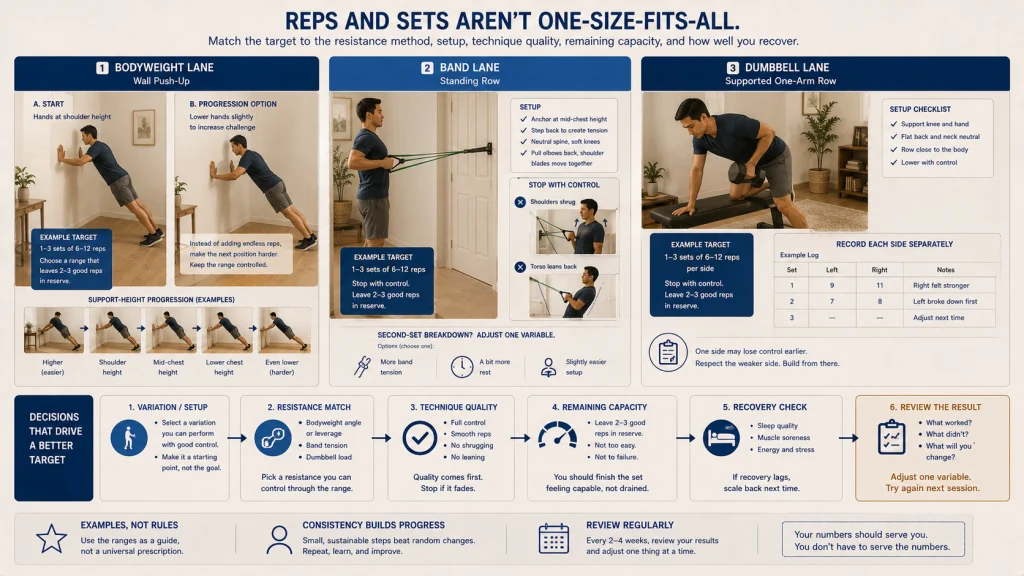
Three Examples Across Bodyweight, Bands, and Dumbbells
The examples below show why the starting dose should follow the resistance method rather than one universal rule. They are decision examples, not finished programs.
Bodyweight Example: Wall Push-Up
A beginner chooses a wall height that allows six to ten controlled repetitions without the hips sagging or the shoulders rising. The first session uses one set. If ten repetitions remain smooth and several more appear possible, the next step may be a slightly lower hand position rather than a large increase in repetitions.
Band Example: Standing Row
The band is anchored safely, and the starting position can be repeated without stepping farther back during the set. The reader chooses eight to twelve controlled repetitions and stops when the shoulders begin to shrug or the torso starts leaning backward. If a second set falls apart immediately, the band tension or rest period may need adjustment before more volume is added.
Dumbbell Example: Supported Row
The reader selects a resistance that allows a stable supported position and a consistent pulling path for six to ten repetitions per side. If one side reaches the target while the other loses control earlier, the useful log records each side separately rather than hiding the difference inside one total number.
Across all three examples, the rep range is only the visible part of the decision. The exercise variation, resistance, setup, technique, remaining capacity, and recovery determine whether the dose should stay the same or change.
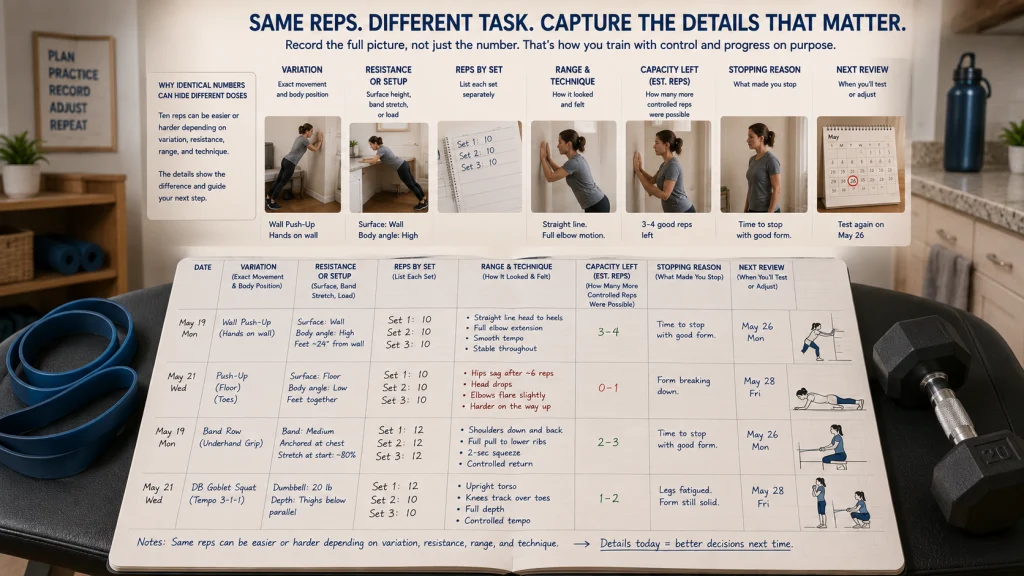
Record More Than Sets and Repetitions
Apps and printed workout cards often make sets and repetitions easy to record while leaving out the details that explain why the result changed. Ten wall push-ups and ten floor push-ups cannot be compared by rep count alone. The same problem appears when a band is stretched farther, a dumbbell changes, or range of motion becomes deeper.
Editorial observation: A tracking tool is only as useful as the fields it preserves. A simple note that names the variation, resistance, range, and remaining capacity can be more informative than a polished history showing only completed numbers.
| Date | Movement and variation | Resistance or setup | Reps by set | Technique and remaining capacity | Next review |
|---|---|---|---|---|---|
| [Date] | [Example: countertop push-up] | [Surface height or load] | [Example: 8, 8] | [Stable; about 2 controlled reps remained] | [Keep or change one variable] |
| [Date] | [Movement and exact variation] | [Band, dumbbell, or body position] | [Set results] | [Range, speed, balance, stopping reason] | [Planned test date] |
The log should make the next decision easier. It does not need to become a detailed diary. Record enough information to tell whether the movement became easier because you adapted, because the setup changed, or because the previous entry did not describe the same task.
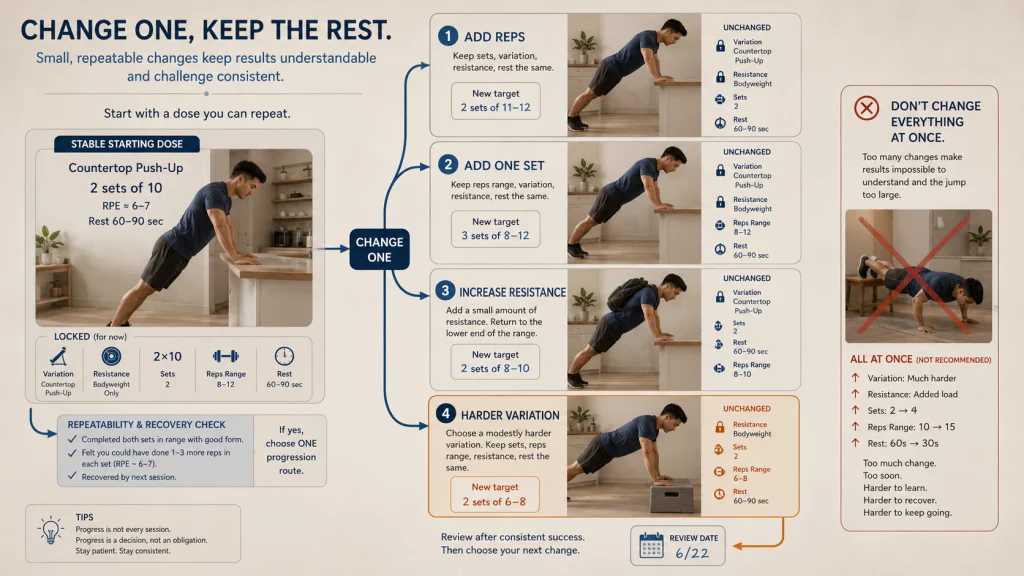
Increase One Variable at a Time
When a set becomes repeatable, resist the urge to add repetitions, add a set, increase resistance, shorten rest, and choose a harder variation all at once. Several simultaneous changes make the result difficult to interpret and can turn a manageable progression into an abrupt jump.
Practical tip: Keep the exercise and setup stable, then change one item:
- Add a small number of repetitions within the planned range.
- Or add one set while keeping the resistance and range stable.
- Or increase resistance slightly while returning to the lower end of the rep range.
- Or choose a modestly harder variation without increasing the other variables.
For example, a reader who completes two stable sets of ten countertop push-ups might lower the support slightly and return to two sets of six to eight. That produces a clearer test than lowering the support, adding a third set, and forcing twelve repetitions at the same time.
This is the basic logic of progressive overload at home: apply a measured challenge, observe the result, and adjust from evidence rather than urgency.
Respect Pain, Loss of Control, and Symptom Boundaries
Ordinary muscular effort, warmth, and temporary fatigue are not the same as sharp pain, sudden weakness, loss of balance, or symptoms that make continued exercise unsafe. Stop the set when control is lost or a movement causes severe pain.
Safety warning: Stop exercise and seek appropriate help for chest pain or pressure, fainting, severe dizziness, extreme shortness of breath, sudden weakness, a serious injury, or severe pain. Do not continue the session to complete a planned number.
Persistent joint or muscle pain, neurological symptoms, pregnancy, recent surgery, chronic conditions, disability-related limitations, or a long period of inactivity may require individualized guidance before the dose is changed. This article does not provide rehabilitation dosage or disease-specific programming.
A rep target should never override the condition of the person performing it. When symptoms change the situation, the next decision is evaluation or individualized support, not another adjustment to sets and repetitions.
Choose a Dose You Can Review, Not a Number You Must Defend
Begin with a controllable exercise variation, a modest repetition range, and a set count that fits your current capacity and time. Decide in advance what technique change or effort level will end the set, then record the exact variation, resistance, repetitions, sets, and remaining capacity.
Keep the dose steady long enough to see whether it is repeatable and recoverable. When the result is consistently strong, change one variable and choose a review date. The best beginner number is not the one that looks impressive on a card. It is the one that gives you enough information to make the next adjustment safely.
FAQs
🔢 Is one set enough for a beginner?
One controlled set can be a reasonable starting point, especially for a new movement or a session with several movement patterns. Add another set when the first remains repeatable, recovery is acceptable, and the extra work fits the session.
🏋️ Should every exercise use 8 to 12 repetitions?
No. That range can be a useful public starting example, but exercise difficulty, resistance, balance demands, technique, and effort can make a different range more practical. Use the range as a guide rather than a requirement.
🧭 How do I know when to stop a set?
Stop when technique changes meaningfully, range shortens unexpectedly, balance becomes unreliable, or you reach the planned effort limit. Do not force the target count after the movement no longer matches the version you intended.
📈 Should I add repetitions or another set first?
Either can work, but change one variable at a time. Adding a few repetitions within the range is often easy to interpret, while adding a set increases session volume and recovery demand more noticeably.
⏱️ Does a short rest mean I need fewer sets?
Not necessarily. A large drop between sets may reflect insufficient rest rather than an excessive set count. Keep the resistance and target stable, allow a more suitable rest period, and compare the result before changing the program.
📝 What should I record besides reps?
Record the exercise variation, resistance or setup, repetitions by set, technique quality, and how many controlled repetitions seemed to remain. These details make future comparisons more meaningful.