To fix a sleep schedule that has temporarily drifted, first measure the difference between your current timing and the wake time daily life now requires. Build the repair around that wake time, protect a realistic opportunity for sleep, pair the morning with light, and keep evening cues, naps, meals, caffeine, and weekends steady enough to interpret what happens. A large gap may be easier to manage as smaller dated steps rather than one forced bedtime jump. Persistent difficulty, major mood change, dangerous sleepiness, or an unexplained pattern needs qualified evaluation rather than a more aggressive self-directed reset.
Measure the current time, required time, and size of the shift
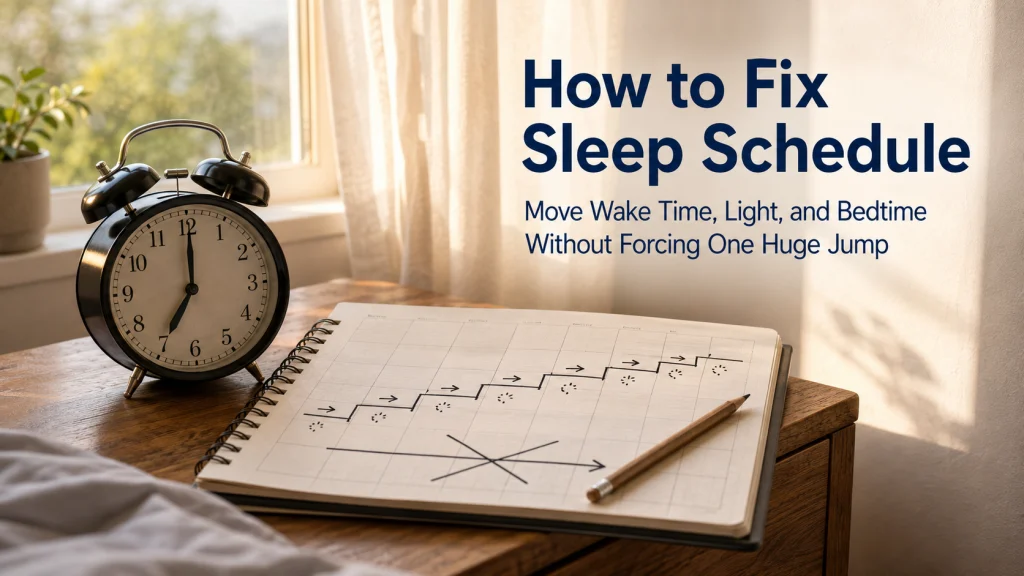
A paper calendar can make the problem visible before any advice begins. Write three rows for the same week: when sleep currently starts and ends, when work or daily responsibilities require it to occur, and the difference between those two patterns.
| Calendar row | Example entry | What it reveals |
|---|---|---|
| Current timing | Sleep near 1:30 a.m., wake near 9:30 a.m. | The pattern the body and routine are following now. |
| Required timing | Wake at 6:30 a.m. for work and morning preparation. | The fixed point the repaired schedule must serve. |
| Measured gap | Wake time is about three hours later than required. | The size and direction of the repair. |
A schedule cannot be repaired until the gap is measured. “Go to bed earlier” is too vague to plan around. A measured gap shows whether the problem is a modest drift after a few late nights or a larger mismatch that may need several dated steps.
Key decision: Anchor the plan to the required wake time, not to an aspirational bedtime chosen without reference to the morning.
Confirm that the problem is temporary schedule drift
This plan is for timing that moved after a recognizable change such as vacation, a school break, illness recovery, repeated late nights, unemployment, or a period without fixed morning obligations. The previous schedule should have been reasonably workable, and the current goal should be a return toward a clearly defined daily requirement.
Pause before treating the problem as ordinary drift when the pattern is persistent, unexplained, worsening, or accompanied by major changes in mood, energy, behavior, alertness, or functioning. Difficulty shifting sleep can have causes that cannot be sorted through a general schedule plan.
Use the broader sleep schedule decision guide when you are not yet sure whether the problem is temporary drift, long-term inconsistency, naps, work timing, travel, weekends, or another timing conflict.
Define the required wake time from real obligations
The useful wake time is the one that leaves enough room for what must happen before the day begins. Work start time alone is not enough. Include commuting, caregiving, breakfast, prescribed morning routines, pet care, school preparation, and the time needed to become fully ready.
Write the earliest non-negotiable wake time for each day. If the week contains different start times, identify the wake time that must remain stable enough to prevent the schedule from swinging back and forth.
A practical planning mistake is choosing bedtime because an app or alarm asks for one while leaving the morning undefined. A 10 p.m. bedtime target is meaningless when work finishes at 9:30 p.m. and the person still needs time to eat, prepare for morning, and wind down. The schedule must fit the evening that actually exists.
Calculate a realistic sleep opportunity before choosing bedtime
Once the required wake time is clear, work backward and protect enough time in bed for the amount of sleep you generally need. This is a planning window, not a guarantee that sleep will begin the moment you lie down.
Check whether the proposed window conflicts with work, caregiving, meals, commuting, household tasks, or a wind-down period. If the evening cannot support the target, the answer is not simply to lie down earlier and hope. The plan may need changes to evening obligations, a different first step, or a more realistic transition period.
Editorial observation: Bedtime tools can make a target look precise while hiding the practical sequence before it. A useful schedule accounts for the last required task of the evening, not only the time printed on the alarm screen.
Decide whether to move directly or use smaller dated steps
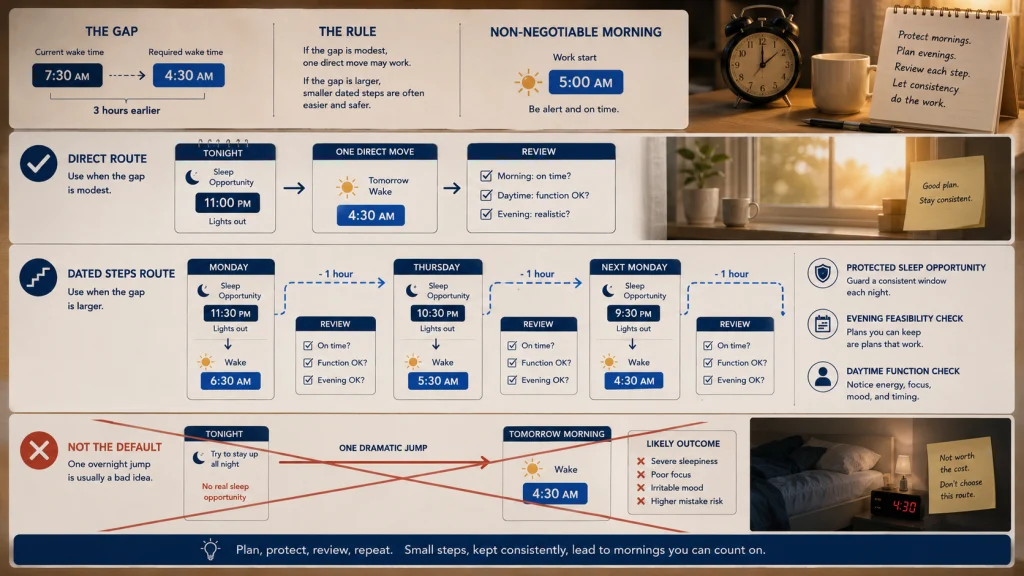
A modest gap may be manageable with one direct change when the required wake time is unavoidable and the evening can support it. A larger gap may be easier to follow when divided into smaller steps with dates attached.
| Planning question | Direct move may fit when | Smaller steps may fit when |
|---|---|---|
| Size of the gap | The difference is limited and close to the required schedule. | The current and required times are far apart. |
| Morning obligation | The new wake time begins immediately and cannot move. | There is time to prepare before the obligation begins. |
| Evening feasibility | The evening already allows a suitable sleep opportunity. | Work, meals, or household routines must be moved gradually. |
| Response to change | The first adjustment does not create severe sleep loss or unsafe daytime sleepiness. | A large first move causes repeated failure, long wakefulness, or major daytime difficulty. |
The table is a planning aid, not a prescription for how quickly an individual should shift. Choose a pace that can be followed safely and reviewed. If every attempt creates persistent impairment, stop treating the problem as a simple scheduling issue.
Why an all-nighter is not the default: Staying awake through an entire night can create severe sleepiness, poor attention, and safety risk without helping the body settle into and maintain the repaired schedule. A dated wake-time plan with protected sleep opportunity is easier to evaluate and recover from.
Move wake time and morning light together
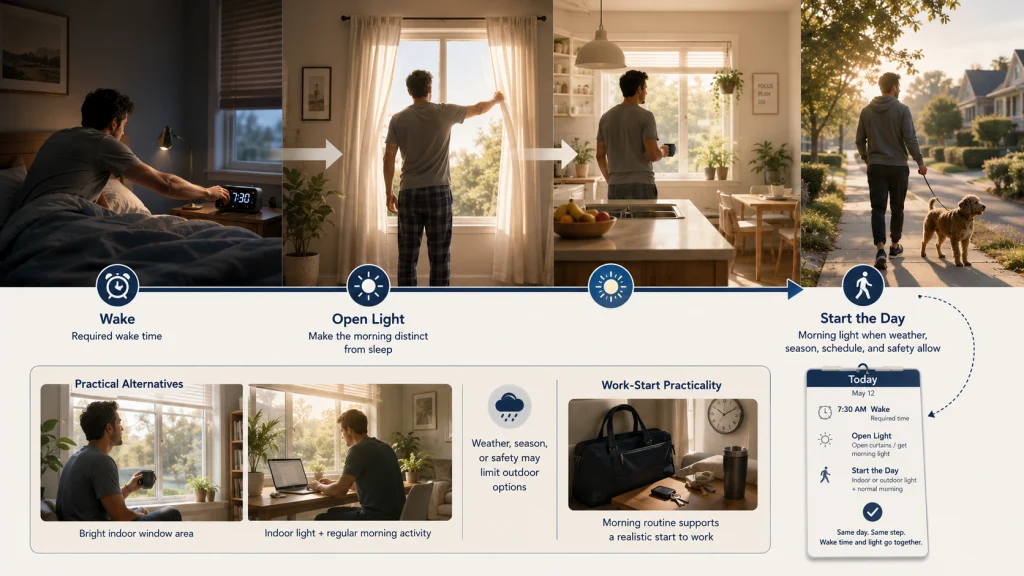
Wake at the dated time in the plan and bring the morning into view soon afterward. Open curtains, move into a brighter part of the home, or spend ordinary morning time outside when conditions and personal safety allow. The purpose is to make the start of the day distinct from the previous sleep period.
Keep the light plan practical. It should fit the season, weather, household, work start, and the person’s ability to access outdoor or brighter indoor space. This article does not prescribe clinical light therapy or individualized treatment.
Use the morning light timing guide when light exposure is the part of the repair plan that needs closer attention.
Lower late-evening light and stimulation without building a perfect routine
The evening should gradually look and feel different from the active part of the day. Reduce unnecessary bright light, highly activating work, and tasks that repeatedly push the planned sleep window later. The goal is not to create a rigid ritual or remove every screen.
Choose the one evening source of delay that matters most. It may be unfinished work, gaming, household cleanup, social messaging, a late meal, or bright room lighting. Move or shorten that element before adding a long list of sleep habits.
A simple transition could be closing work at a fixed time, preparing the morning earlier, lowering room light, and choosing a quieter final activity. Keep the change narrow enough to repeat.
Protect the main sleep period from late naps
A nap can reduce the sleepiness that would otherwise build toward the intended bedtime. That does not make every nap a problem. The important questions are when the nap occurs, how long it lasts, and whether it repeatedly delays the main sleep period.
Record naps during the repair instead of relying on memory. If a late nap is followed by long wakefulness at the intended bedtime, move the nap decision into its own plan rather than tightening bedtime further.
Use the nap timing guide when the placement of daytime sleep is interfering with the repair.
Keep caffeine, meals, and exercise stable enough to read the result
A repair test becomes hard to interpret when caffeine, meal timing, exercise, naps, and bedtime all change at once. Keep these cues reasonably stable while moving the main schedule.
- Record the time of the last caffeinated drink instead of changing the amount and timing every day.
- Keep major meals from swinging several hours between workdays and free days when possible.
- Place exercise where it fits consistently rather than testing a different time each day.
- Note unusual events such as illness, travel, celebrations, or overtime that alter the schedule.
This does not require a perfect routine. It creates enough consistency to tell whether the dated wake-time plan is moving in the intended direction.
Let bedtime follow growing sleepiness
Moving bedtime hours earlier on paper does not guarantee that sleep will appear on command. Going to bed far before sleepiness may turn the bed into a place for waiting, checking the time, and becoming frustrated.
Keep the required wake time and morning start clear, then prepare for bed as sleepiness grows within the protected opportunity. If the intended bedtime repeatedly arrives while the person remains fully alert, review the size of the shift, evening obligations, late naps, and whether the pattern may need professional assessment.
The target bedtime is a planning boundary, not a performance score. One difficult night does not prove the whole repair has failed.
Set a weekend ceiling before the first free day arrives
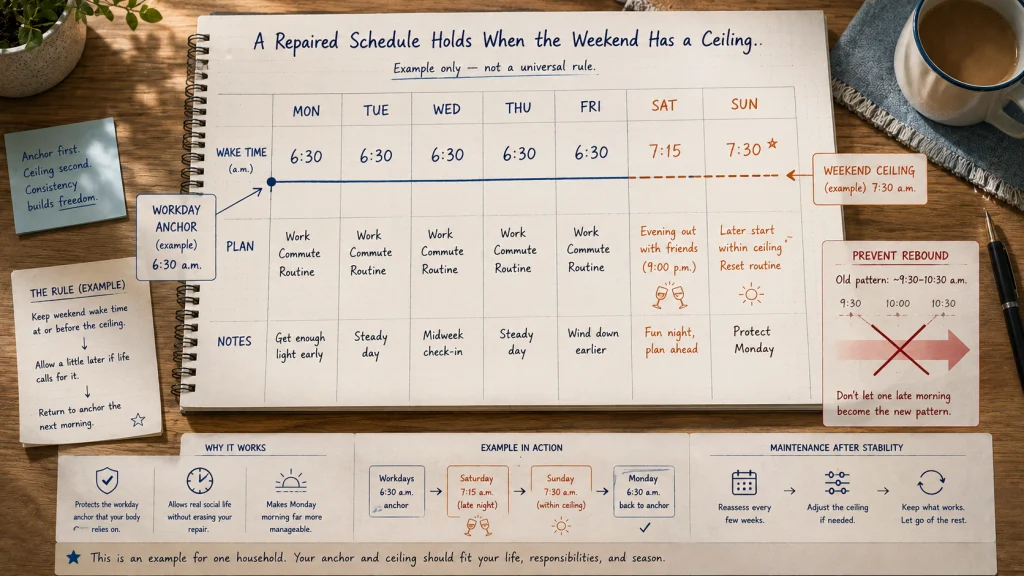
A repaired schedule can rebound when the first weekend removes the morning obligation. Decide in advance how late wake time is allowed to move before it begins pulling the schedule back toward the old pattern.
Weekend ceiling example: A person who needs to wake at 6:30 a.m. on workdays may decide that 7:30 a.m. is the latest planned weekend wake time during the repair. This is an example, not a universal limit. The useful ceiling is the smallest variation that remains realistic for that person’s life.
Also plan for social events and late nights. A ceiling that ignores the person’s actual weekend will be abandoned quickly. The goal is to prevent a full reversal, not to make every day identical.
Once the target has been reached, use the consistent sleep schedule guide to build a maintenance plan that can survive ordinary weekends.
Write a recovery rule for one disrupted night
A late event, missed alarm, sick child, work emergency, or poor night can interrupt the plan. The repair should include a response before that happens.
A useful recovery rule keeps the disruption from becoming permission to abandon the week. It may state that the person will return to the planned wake time the next day when safe, avoid an unplanned late nap, keep the morning light routine, and resume the next dated step rather than restarting the entire plan.
Safety comes first. If the disrupted night creates dangerous sleepiness, do not drive or perform another attention-sensitive task. Arrange a safer alternative and review whether the plan is moving too aggressively.
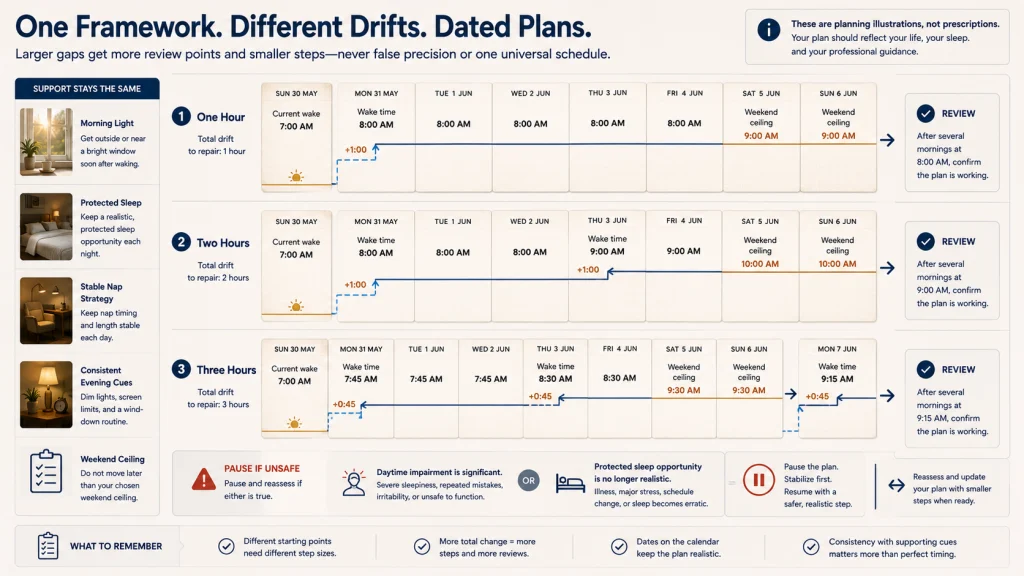
Review three dated repair examples
These examples show how to turn a measured gap into a calendar. They are not prescriptions, and the timing should be adjusted to the person’s obligations, response, and safety.
| Measured drift | Example dated plan | Review point |
|---|---|---|
| One hour later than required | Monday: move wake time to the required time, begin the morning light routine, keep naps and evening cues stable, and protect the earlier sleep opportunity. | Review after three to four mornings for wake-time adherence, estimated sleep, and daytime function. |
| Two hours later than required | Monday: move wake time one hour earlier. Thursday: move the remaining hour if the first step is manageable. Keep the same weekend ceiling. | Review at each dated step rather than waiting until the end. |
| Three hours later than required | Monday, Thursday, and the following Monday: use three smaller wake-time steps. Move morning light and the evening preparation window with each step. | Pause the next step if daytime impairment becomes significant or the sleep opportunity is no longer realistic. |
The examples use simple intervals so the planning method is visible. They do not establish a medically correct shift speed for every person. A required work start may force a different approach, while persistent inability to move the schedule may require qualified evaluation.
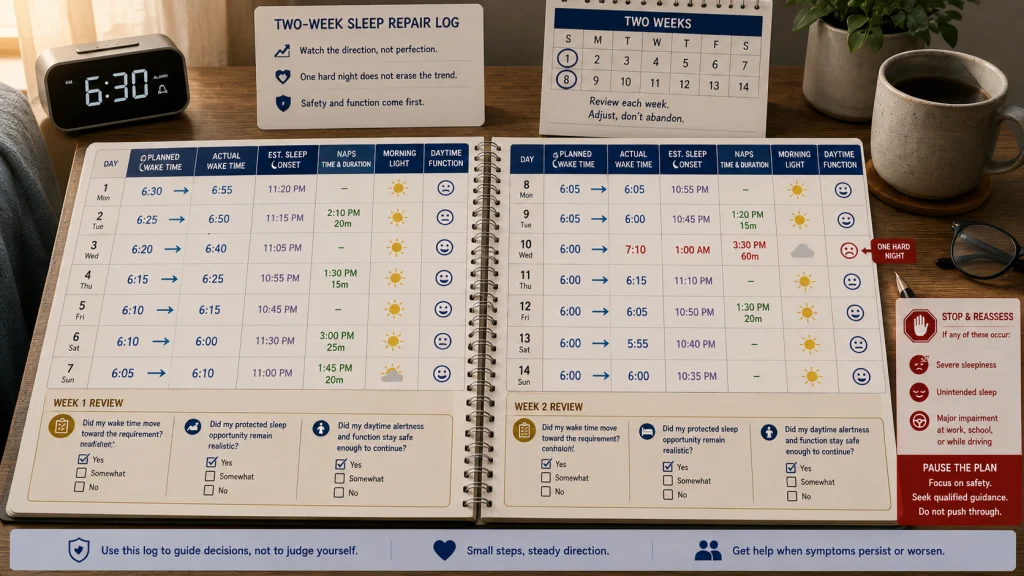
Use a two-week log to separate progress from one bad night
Record estimates rather than trying to measure sleep perfectly. The log should show whether the dated plan is being followed, whether sleep timing is moving, and whether daytime function remains acceptable.
| Day | Planned wake | Actual wake | Estimated sleep onset | Naps | Morning light | Daytime function |
|---|---|---|---|---|---|---|
| Day 1 | Time | Time | Estimate | Time and duration | What occurred | Alertness, sleepiness, and function |
| Day 2 | Time | Time | Estimate | Time and duration | What occurred | Alertness, sleepiness, and function |
| Day 3 | Time | Time | Estimate | Time and duration | What occurred | Alertness, sleepiness, and function |
| Day 4 | Time | Time | Estimate | Time and duration | What occurred | Alertness, sleepiness, and function |
| Day 5 | Time | Time | Estimate | Time and duration | What occurred | Alertness, sleepiness, and function |
| Day 6 | Time | Time | Estimate | Time and duration | What occurred | Alertness, sleepiness, and function |
| Day 7 | Time | Time | Estimate | Time and duration | What occurred | Alertness, sleepiness, and function |
| Day 8 | Time | Time | Estimate | Time and duration | What occurred | Alertness, sleepiness, and function |
| Day 9 | Time | Time | Estimate | Time and duration | What occurred | Alertness, sleepiness, and function |
| Day 10 | Time | Time | Estimate | Time and duration | What occurred | Alertness, sleepiness, and function |
| Day 11 | Time | Time | Estimate | Time and duration | What occurred | Alertness, sleepiness, and function |
| Day 12 | Time | Time | Estimate | Time and duration | What occurred | Alertness, sleepiness, and function |
| Day 13 | Time | Time | Estimate | Time and duration | What occurred | Alertness, sleepiness, and function |
| Day 14 | Time | Time | Estimate | Time and duration | What occurred | Alertness, sleepiness, and function |
At the end of each week, ask three questions: Did wake time move toward the requirement? Did the sleep opportunity remain realistic? Did daytime function stay safe enough to continue? Do not hide a worsening pattern behind a high adherence score.
Stop self-directed repair when the pattern is persistent or unsafe
A temporary schedule plan should not be used to diagnose or treat insomnia, a circadian disorder, a mood episode, medication effects, or another medical cause. It also does not prescribe melatonin, sedatives, stimulants, medication timing, or clinical light therapy.
Safety warning: Do not drive or perform another attention-sensitive task when you are struggling to stay awake, having unintended sleep episodes, or unable to maintain attention. Stop the activity and arrange a safer alternative.
Seek qualified evaluation when the pattern remains difficult to shift despite a realistic opportunity for sleep, or when it is accompanied by severe daytime sleepiness, major mood or behavior change, breathing concerns, unexplained impairment, or a worsening loss of function. New, severe, persistent, or unexplained symptoms should not be treated as a failure of discipline.
Fill in the five parts of your repair plan
Complete the plan in one short block:
- Current timing: When sleep and wake time occur now.
- Required timing: The wake time daily life requires.
- Shift size: The difference between the two patterns.
- First dated step: The first wake-time and morning-light change you will test.
- Recovery rule: What you will do after one late night, missed alarm, or unavoidable event.
Use the broader sleep improvement guide when timing may not be the only sleep issue. Use the daylight-saving adjustment guide when the problem is a predictable one-hour clock transition rather than temporary personal drift.
The plan is complete when it fits the morning, protects sleep opportunity, defines the first date, and includes a safe recovery rule. It does not need to promise a perfect night or an instant reset.
FAQs
🕒 How do I know how far my sleep schedule has shifted?
Compare your current wake time with the wake time required by work, school, caregiving, commuting, and morning preparation. Record bedtime and estimated sleep onset too, but use the wake-time difference to define the direction and approximate size of the repair.
🌅 Should I fix bedtime or wake time first?
Build the plan around the required wake time, then protect a realistic sleep opportunity before it. Let bedtime move with growing sleepiness rather than forcing yourself to lie awake hours earlier.
📅 Can I change a three-hour drift in one night?
A large direct change may create severe sleep loss or be impossible to follow. Smaller dated steps may be more manageable, but the pace must fit the person’s obligations, response, and safety rather than a universal formula.
🌙 Should I stay awake all night to reset my schedule?
An all-nighter is not the default repair method because it can create dangerous sleepiness and does not establish a maintainable routine. A dated wake-time plan with protected sleep opportunity is easier to monitor and recover from.
😴 Do I have to stop napping completely?
Not necessarily. Record the nap’s timing and duration, then notice whether it repeatedly delays the main sleep period. A late nap that disrupts bedtime needs a separate timing decision.
☕ Should I change caffeine, meals, and exercise at the same time?
Keep them stable enough to interpret the main schedule test. Changing every cue at once makes it difficult to know what helped or what created a new problem.
🛌 What should I do after one late night?
Use the recovery rule written into the plan rather than abandoning the week. Return to the planned pattern when safe, keep morning cues steady, and avoid turning one disruption into a full weekend reversal.
🚗 When should I stop trying to fix the schedule myself?
Stop and seek qualified guidance when the pattern is persistent, unexplained, worsening, or accompanied by severe sleepiness, unintended sleep, major mood change, breathing concerns, or significant impairment. Do not drive when you are struggling to stay awake.