Air purifiers can reduce selected airborne pollutants when the filter mechanism, clean-air delivery, room, placement, run time, and maintenance all fit the job. The useful question is not whether one machine can make a home broadly “clean,” but whether it can reduce a named pollutant in the space where people actually spend time. Less airborne smoke, a weaker odor, less dust on a shelf, and a change in symptoms are different outcomes that require different evidence. Treat a portable air cleaner as a supplement to source control and appropriate ventilation, not as proof that a source is safe or a medical condition has been addressed.
One Air Purifier Can Face Four Incompatible Definitions of Success
Imagine placing the same portable unit in a living room for four different reasons. One household wants a calmer indoor space while wildfire smoke hangs outside. Another wants a fresh paint odor to disappear before the room is used again. A third is tired of wiping the same dark shelf and seeing dust return. A fourth hopes the machine will explain why morning headaches keep happening.
Those goals may sound like one question, but they require different mechanisms, evidence, and next steps.
| Goal | What kind of question it is | What would count as a useful answer |
|---|---|---|
| Reduce wildfire particles in room air | Particle-removal and clean-air-delivery question | A suitable particle filter moving enough air through the priority room under real operating conditions |
| Remove a paint odor | Gas-media and source-control question | Identifying the source, using appropriate ventilation, and evaluating adsorbent media for the specific gas or vapor |
| Stop dust from appearing on furniture | Airborne-particle plus settling and cleaning question | Reducing some airborne material while also addressing surfaces, fabrics, entry pathways, and cleaning |
| Cure morning headaches | Medical-causation claim | A purifier cannot establish the cause or prove treatment; persistent or worsening symptoms need qualified guidance |
The first step is not asking whether air purifiers work in general. It is naming the pollutant, mechanism, room, operating conditions, and outcome you expect to change.
Define What “Works” Means Before Comparing Results
A purifier can do a real job and still disappoint when the household expected a different one. A dusty prefilter may show that material reached the unit, yet the shelf across the room may still need cleaning. An odor may fade while the source remains. Someone may feel better, worse, or unchanged for reasons the machine cannot identify. These are not contradictions. They are different definitions of success.
Use one of these outcome categories:
- Pollutant capture: material is retained by the filter or adsorbent.
- Room concentration reduction: less of the target remains airborne in the occupied space.
- Visible-dust change: less material appears on surfaces over time.
- Odor change: the smell becomes weaker or different.
- Symptom change: a person reports feeling different.
- Disease outcome: a diagnosed condition or measurable clinical result changes.
These outcomes sit at different evidence levels. Physical capture is the closest to the device itself. Individual health is several steps farther away, with room conditions, other exposures, behavior, season, and personal health all entering the picture. That is why a filter label or laboratory efficiency number cannot carry the whole conclusion.
Connect the Pollutant, Mechanism, Air Delivery, Room, and Source
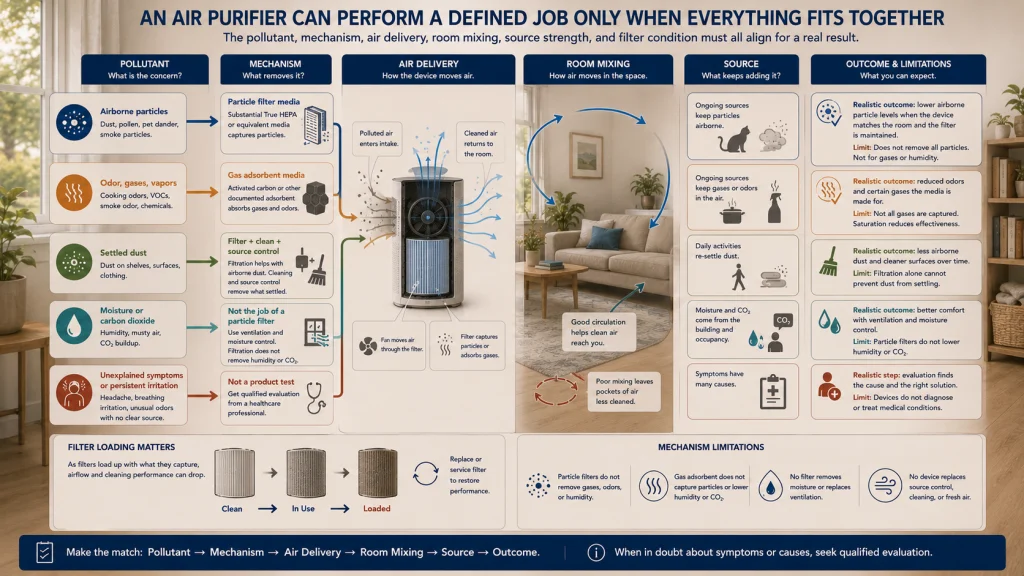
The machine cannot respond to a vague wish for “better air.” It can act only on material that reaches its intake and meets the relevant media. Before looking at features, connect six parts of the job:
- Pollutant: particle, gas, vapor, biological material carried in air, or an unspecified concern.
- Mechanism: particle filter, gas adsorbent, or another documented process.
- Air delivery: how much treated air the complete device sends back into the room.
- Room mixing: whether polluted air reaches the intake and cleaned air circulates through the occupied area.
- Source strength: how quickly new pollution enters or is generated.
- Filter loading: how use and accumulated material affect airflow and continued performance.
| Pollutant or concern | Mechanism to evaluate | Realistic outcome | Main limitation |
|---|---|---|---|
| Airborne dust, pollen, pet dander, or smoke particles | Particle filtration with sufficient clean-air delivery | Lower airborne particle concentration in the treated space | Continuing sources, poor room mixing, low speed, or insufficient capacity |
| Specific odors, gases, or vapors | Adsorbent media selected for the target | Possible reduction while the media retains useful capacity | Unknown target gas, too little media, rapid saturation, or an uncontrolled source |
| Settled dust on shelves and textiles | Particle filtration plus cleaning and source control | Possible reduction in some airborne material before it settles | Material already on surfaces does not travel automatically to the filter |
| Moisture or high carbon dioxide | Not handled like ordinary particle filtration | Requires the correct ventilation, moisture, or source process | A particle filter does not remove humidity or provide fresh outdoor air |
| Symptoms or a medical condition | Qualified evaluation plus appropriate environmental controls | No guaranteed individual response from a consumer air cleaner | Symptoms have many possible causes and cannot be diagnosed by filter performance |
This framework also shows when the question has moved beyond evidence and capability. The guide to air cleaners and air filters connects portable units, central filtration, gas media, maintenance, and source control without treating them as interchangeable options.
Particle Filters Can Reduce Airborne Material That Reaches Them
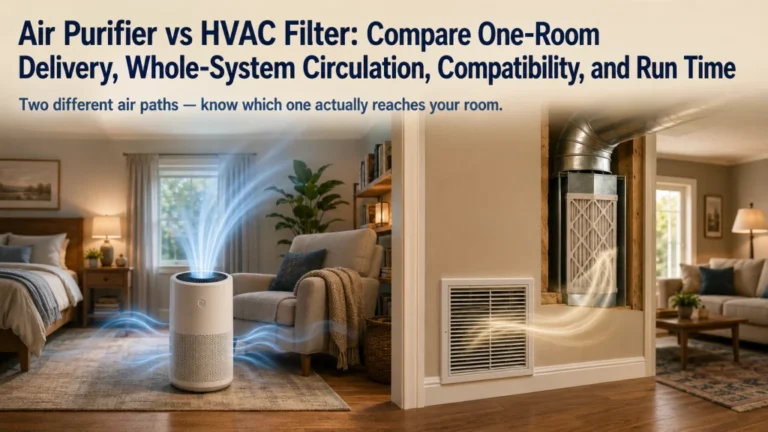
For particle concerns, the basic mechanism is straightforward: room air reaches the intake, particles meet the filter, and cleaned air returns to the space. A suitable portable unit can reduce airborne pollen, portions of household dust, pet dander, smoke particles, and some biological material carried in air. The difficult part is making that cycle happen often enough in the room that matters.
A closed bedroom with a unit running through the night is a different task from a living area that opens into a kitchen, hallway, and stairwell. The first has a clearer boundary. The second keeps sharing air with the rest of the home. Ongoing smoke entry, active cooking, disturbed dust, shedding fabrics, or a frequently opened door can also add particles faster than the unit removes them.
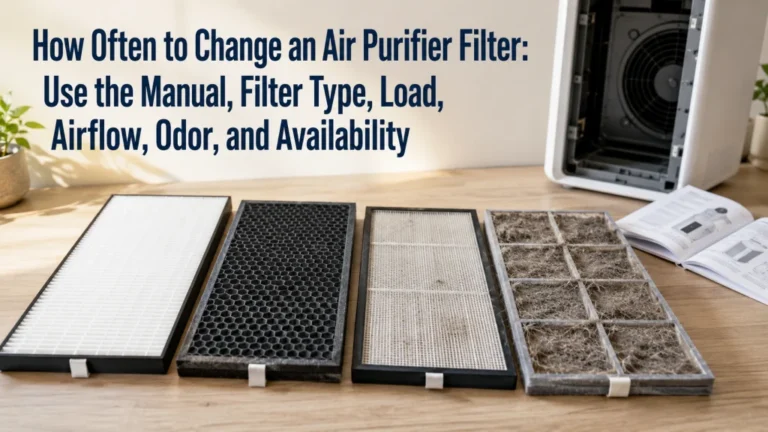
Editorial observation: Visible dust on a prefilter proves that the device captured some material. It does not establish how much airborne exposure changed, how the rest of the room performed, or whether any symptom changed.
A filter that looks dirty can be evidence of capture and a maintenance signal. It is not a complete before-and-after test of the room.
Separate Filter Efficiency From Whole-Device Clean-Air Delivery
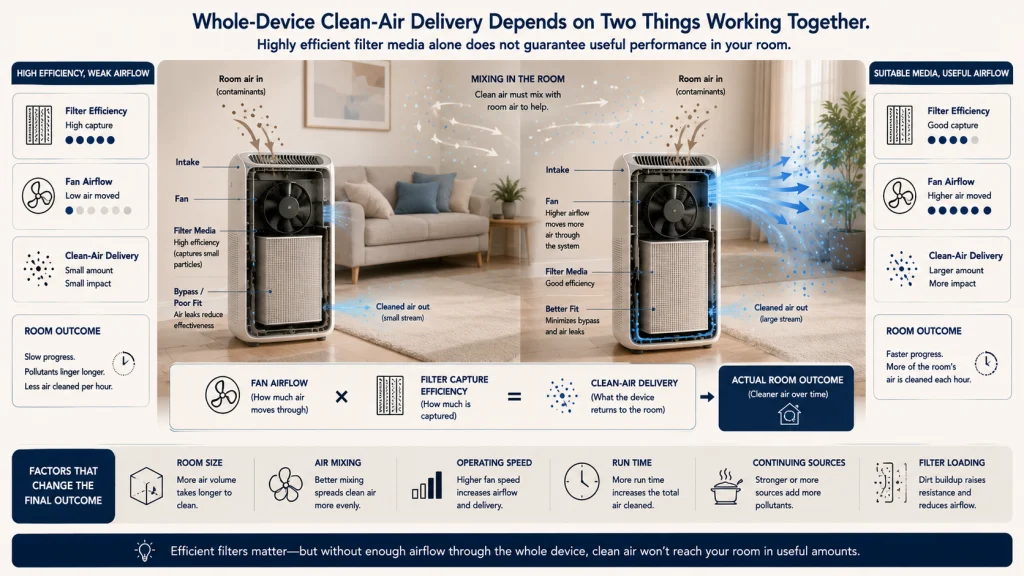
The filter is one part of the system, not the room result. Filter efficiency describes what the media captures from air that passes through it under stated conditions. Clean-air delivery describes what the complete device returns after airflow and filtration work together. A highly efficient medium paired with weak airflow can therefore produce less useful room delivery than the front label seems to imply.
Filter-efficiency-versus-CADR diagram:
Room air
↓ reaches the intake
Fan airflow
+
Filter capture efficiency
↓ work together inside the complete unit
Cleaned-air delivery back to the room
↓ interacts with room size, mixing, source strength, and run time
Actual room outcome
This distinction matters because shoppers often compare the strongest-looking filter words while overlooking the fan, room, speed, and maintenance routine. The device still has to move enough air, limit bypass, remain maintained, and run under the conditions used to judge it.
When the question becomes how much clean-air delivery the room needs, move to the guide on choosing an air-purifier size.
Gas and Odor Reduction Depends on the Target and the Adsorbent
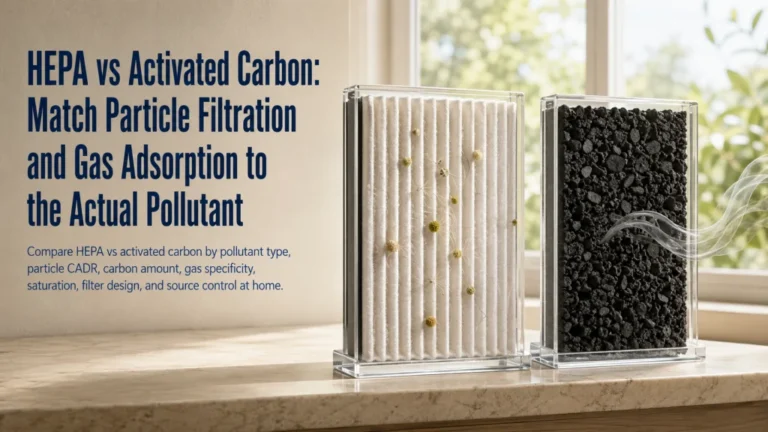
A room can smell noticeably better and still leave the household unsure what changed. Particle media and gas adsorbents do different jobs, and a thin dark sheet does not automatically make a particle purifier a strong gas-removal system. Gas performance depends on the target compound, adsorbent type, amount of media, airflow, contact time, source strength, and remaining capacity.
An odor can weaken for several reasons, including ventilation, source removal, changing humidity, nose adaptation, or adsorption. That makes smell an incomplete performance test. A reduced smell does not prove that every gas is gone, and a persistent smell does not reveal which media would solve it.
When painting, cleaning products, furnishings, combustion, or another source is involved, control the source and use appropriate ventilation first when it is safe and suitable. Generic air-cleaning advice should not be used to remain around a suspected hazardous release.
The comparison of particle and gas media is covered in HEPA versus activated carbon.
Airborne Material and Settled Material Need Different Controls
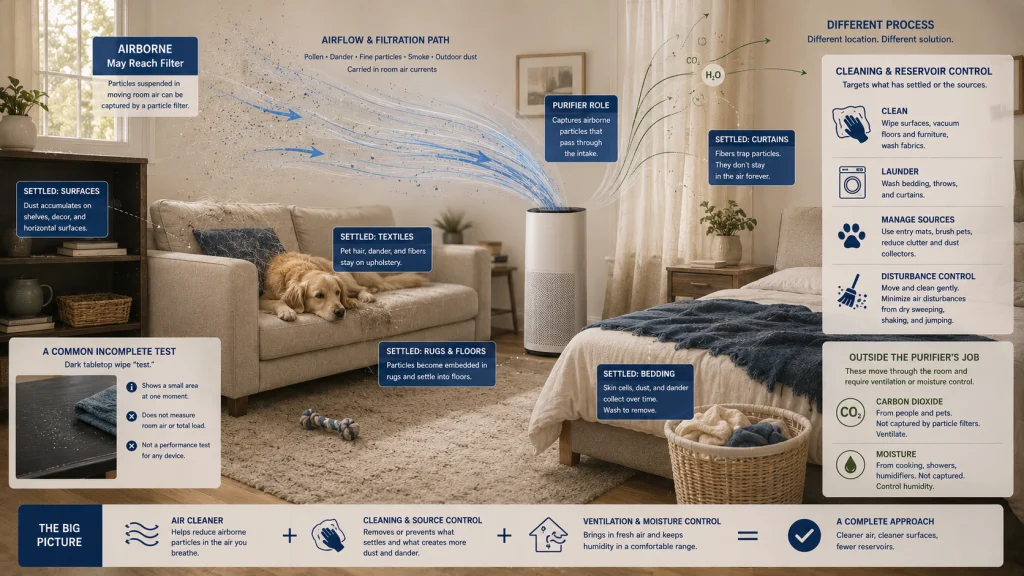
This is where a useful purifier can still feel disappointing. The fan has been running, yet dust returns to the shelf, pet hair remains on the sofa, and bedding still needs washing. Filtration may reduce some material before it settles, but it does not vacuum furniture, seal entry gaps, or empty reservoirs in rugs and fabrics. A dark tabletop is therefore an incomplete test of airborne performance.
A portable particle filter also does not remove carbon dioxide or moisture in the way ventilation and humidity control do. Those concerns require the correct environmental process rather than a stronger particle label.
Use the broader healthy home environment guide when the concern crosses into ventilation, moisture, cleaning, or another control outside portable filtration.
Capturing Airborne Mold Spores Does Not Fix a Moisture Source
A musty room can make a purifier feel like the quickest visible action. A particle filter may capture some airborne spores that reach it, but the damp material behind the concern remains where it was. The device cannot dry a wall, repair a leak, remove damaged material, or determine how far the problem extends.
If moisture continues, new material can keep entering the air. Visible growth, recurring dampness, water damage, persistent musty conditions, or a suspected concealed source needs a moisture-focused response rather than a purifier-only plan. Do not use cleaner operation or a change in odor to declare the source resolved.
Airborne-Virus Reduction Is Not Complete Infection Prevention
During an illness, switching on a purifier can feel like a clear and immediate step. Suitable filtration may reduce some infectious material carried in airborne particles, but it is one layer in the room rather than a barrier around each person.
How much it contributes depends on the amount released, distance from the source, ventilation, room mixing, filtration rate, run time, occupancy, and other protective measures. Close-range exposure can occur before shared air ever reaches the intake.
A germ-related feature or laboratory result should therefore be read as evidence about a mechanism under stated conditions, not as a promise of individual protection. The practical question is what filtration adds to the full plan in that room.
Read Health Evidence as a Ladder, Not a Single Yes-or-No Claim
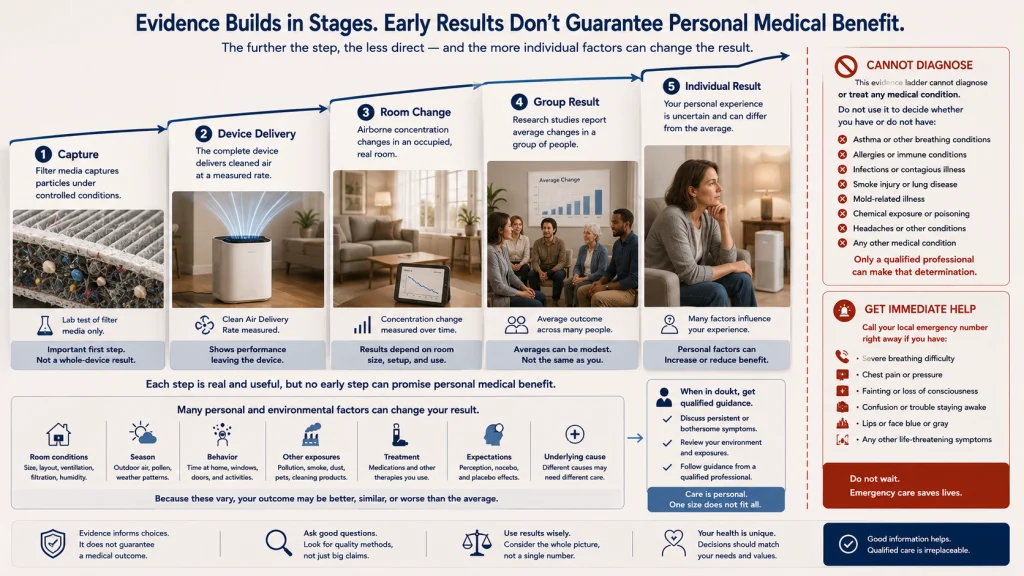
It is understandable to want the final answer to be personal: Will someone sleep better, breathe more comfortably, or wake without the same symptom? Evidence usually reaches that question in stages. A study can show particle capture without proving that every user will feel different, and an average group change cannot predict one household or one symptom with certainty.
Evidence-strength ladder:
Step 1: The media captures a target under controlled conditions.
↓
Step 2: The complete device delivers cleaned air at a measured rate.
↓
Step 3: Airborne concentration changes in a real room under stated conditions.
↓
Step 4: A study observes an average symptom or health-related change in a defined group.
↓
Step 5: An individual experiences a reliable personal benefit.
Each step adds distance between the filter and the conclusion. Room conditions, behavior, other exposures, treatment, season, expectations, and the underlying cause can all influence what one person notices. A modest group effect can still be real without becoming a guaranteed individual benefit.
Cannot-diagnose warning: An air purifier cannot diagnose asthma, allergies, infection, smoke injury, mold-related illness, chemical exposure, headaches, or another medical condition. It also cannot prove why a symptom changed.
Severe breathing difficulty, chest pain, fainting, confusion, blue or gray lips, or other emergency signs require immediate appropriate help. New, persistent, unexplained, or worsening symptoms require qualified medical guidance.
Common Real-World Conditions Can Reduce Performance
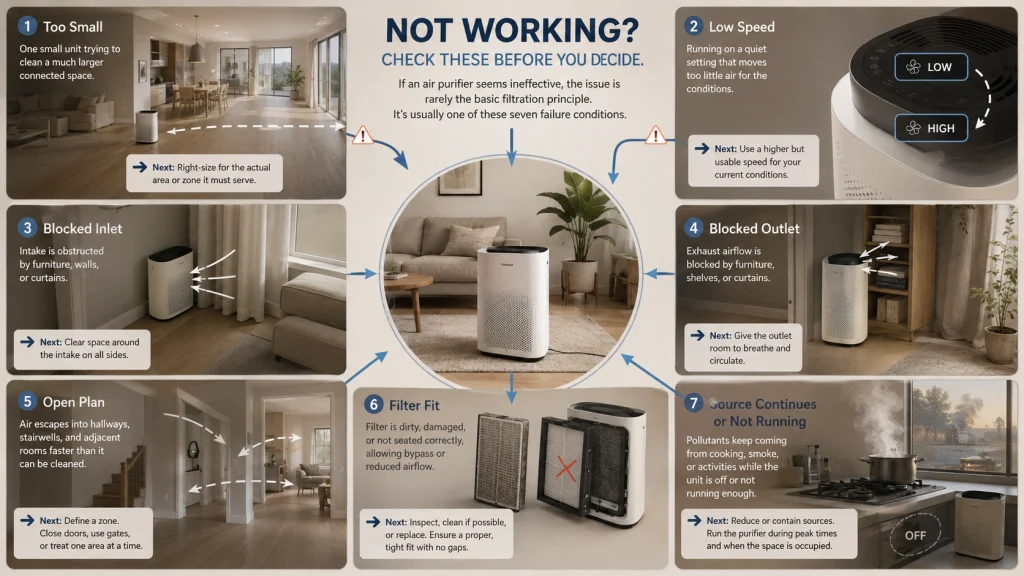
When a purifier seems ineffective, the failure may be in the match rather than the mechanism. Before replacing the unit or abandoning filtration, look at what was happening around it:
- Undersizing: the unit delivers too little cleaned air for the room volume and source strength.
- Low operating speed: the quiet setting used every day moves substantially less air than the setting behind the headline claim.
- Blocked airflow: furniture, curtains, walls, or stored objects restrict the intake or outlet.
- Open-plan dilution: air moves through connected rooms, hallways, or stairs beyond the intended zone.
- Dirty or poorly fitted filters: loading, damage, incorrect installation, or bypass changes airflow and capture.
- Continuing sources: smoke, cooking particles, dust disturbance, shedding materials, or outdoor entry continue adding pollution.
- Inconsistent run time: the unit is off during the period when the source is strongest or the room is occupied.
The useful response is not automatically a larger machine or permanent maximum speed. Each condition points to a more specific next step: sizing, placement, routine, source control, or maintenance.
Send Buying, Sizing, Operation, and Filter Questions to the Right Decision
Once the evidence question is clear, the remaining work becomes practical. This article does not choose a model or complete every setup decision, so route the next uncertainty rather than forcing it into another yes-or-no claim.
| Your next question | Use this guide |
|---|---|
| How do I compare mechanisms, ownership cost, noise, controls, and maintenance before buying? | How to choose an air purifier |
| How much clean-air delivery does my room need? | What size air purifier do I need? |
| Where should the unit go, how long should it run, and which speed should I use? | How to use an air purifier |
| Do I need particle media, gas media, or both? | HEPA versus activated carbon |
Medical questions, severe symptoms, emergency signs, suspected gas leaks, alarms, visible fire or smoke, and hazardous-source concerns must not be routed into a product comparison.
Decide Whether the Purifier Fits a Defined Job
A useful answer should leave you with a defined job, not a vague promise. Name the pollutant, match the mechanism, and check whether enough cleaned air can reach the occupied space under the speed, run time, source conditions, and maintenance routine the household can sustain.
Then choose the outcome you will judge. Capture on a filter, a room concentration change, less settled dust, a weaker odor, and a personal health change are not interchangeable. A portable unit may be a reasonable supplement when the job and conditions fit, while source control, ventilation, cleaning, moisture correction, emergency response, and medical evaluation remain separate responsibilities.
FAQs
🌫️ Do air purifiers really remove smoke?
A suitable particle filter can reduce smoke particles that reach it when clean-air delivery, room size, placement, speed, and run time fit the situation. It does not remove every gas in smoke or make an active fire, heavy smoke condition, or unsafe source acceptable.
🐾 Can an air purifier remove pet dander?
It may reduce airborne dander particles that reach the filter. Dander already settled on bedding, rugs, furniture, and floors still requires cleaning and source management.
🧹 Will a purifier stop dust from collecting on furniture?
It may capture some airborne particles before they settle, but it will not remove dust already on surfaces or control every source. Judge airborne filtration and household cleaning as related but separate tasks.
👃 Does a carbon filter remove every odor?
No. Gas and odor performance depends on the target, adsorbent type, media amount, airflow, source strength, and remaining capacity. A vague carbon or odor claim does not establish performance for every gas.
🦠 Can an air purifier prevent infection?
Filtration may reduce some infectious material carried in airborne particles, but it cannot guarantee prevention. Close-range exposure, ventilation, source strength, occupancy, and other protective measures still matter.
🩺 Can I tell whether a purifier is helping my health?
A personal symptom change cannot show by itself what caused the change, and feeling no difference does not prove that room particles stayed the same. When symptoms are severe, persistent, worsening, or unexplained, stop treating the purifier as the diagnostic tool and seek appropriate qualified guidance.