Component meal prep works when a small set of cooked building blocks has clear later uses and does not create more weekday assembly than the household can manage. Start from two or three planned meals, choose only the components those meals share, and count reheating, seasoning, dishes, and final decisions as part of the workload. Cook safely, divide larger amounts for prompt cooling, label each component, and assign a refrigerator or freezer destination before the session ends. Flexibility is useful only when the pieces still lead to realistic meals.
Twelve Possible Meals Can Still Become Six Containers With No Plan
Six labeled containers can look like an impressive week of options. Cooked grains, roasted vegetables, a cooked protein, beans, a sauce, and a garnish may combine on paper into a dozen different meals. The refrigerator appears organized, and nothing has been assembled too early.
Then Wednesday arrives. One component needs gentle reheating, another is best served cold, the sauce needs thinning, the garnish needs chopping, and the only clean pan is already in use. The household still has to choose a combination, check the labels, season the food, assemble the meal, and wash the dishes created by the final step.
| Theoretical combination | Real weekday work | What decides whether it is useful |
|---|---|---|
| Grain + protein + vegetables + sauce | Reheat three items, adjust moisture, add sauce, and wash the pan or bowls | Whether the meal has a named use and the steps fit the available time |
| Beans + vegetables + grain | Choose seasoning, decide the serving format, and check whether textures still work together | Whether the finishing decision was planned before storage |
| Protein + vegetables + garnish | Warm some items without overheating others, then add a fresh finish | Whether the components can share a practical reheating path |
| Any remaining combination | Search for a missing sauce, wrap, broth, or side that was never assigned | Whether the component set is complete enough to become a meal |
The promise of variety can feel reassuring on prep day, especially when the refrigerator looks full and organized. The real test comes later, when someone is tired, hungry, and deciding whether those containers form a meal without starting another cooking session. Modularity is useful only when the answer is yes.
Keep Cooked Components Separate From Ingredient Prep and Finished Meals
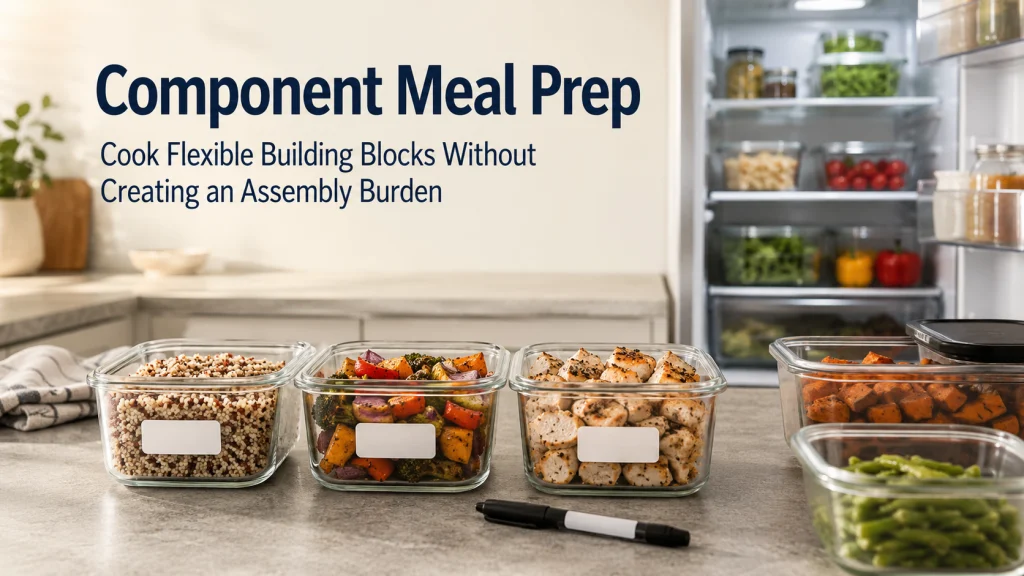
Component meal prep creates cooked building blocks that remain separate until a later meal. Examples include cooked grains, roasted vegetables, cooked beans, a prepared sauce, or a cooked protein that has more than one named use.
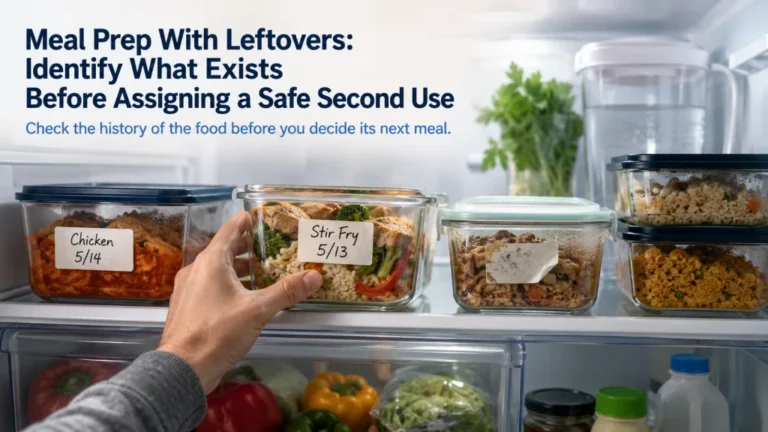
Uncooked washing, cutting, measuring, and portioning belong to preparing ingredients ahead of time. A casserole, assembled lunch, or finished dinner stored in its final form belongs to make-ahead meals. Food that was originally cooked for another purpose and is now being redirected belongs to meal prep with leftovers.
Use the component method only when keeping foods separate preserves useful flexibility. When the household already knows the exact final meal and would benefit from opening one container instead of four, a finished-meal method may remove more weekday work.
The broader batch-cooking guide helps choose the right preparation method before increasing the cooking quantity.
Start From Two or Three Named Later Assemblies
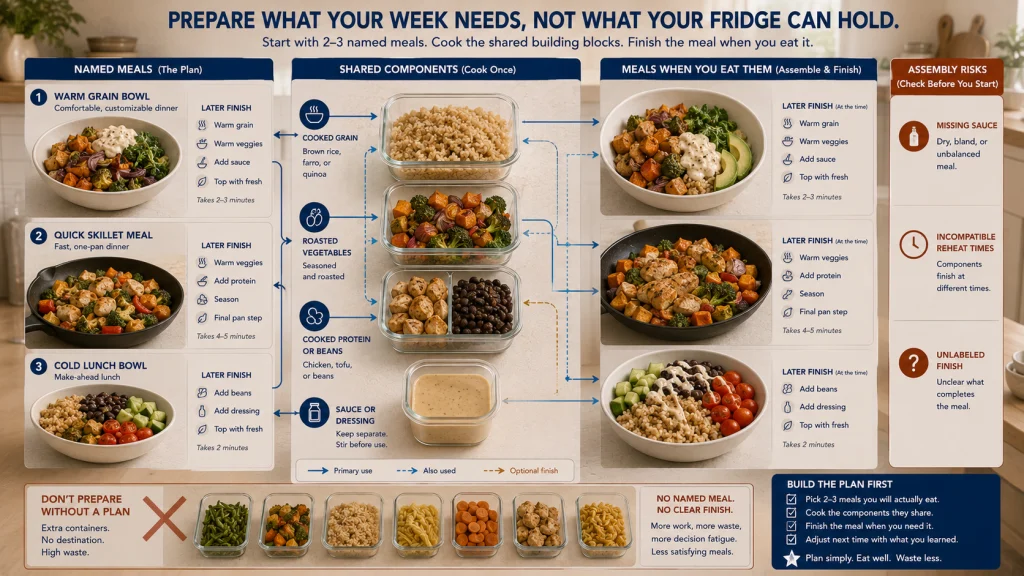
A refrigerator can hold many containers and still offer no obvious dinner. Begin with the meals that must come out of it, not with the amount of shelf space available. Two or three named assemblies are usually enough to reveal which cooked parts are worth preparing together.
For example, a household may plan:
- A warm grain bowl with roasted vegetables and a sauce.
- A quick skillet meal using the same vegetables and a cooked protein.
- A cold lunch using the grain, beans, and a separate finish.
Those meals do not require seven neutral containers. They may require one grain, one vegetable component, one protein or bean component, and one finish that is stored separately. The names of the meals give each component a role and reveal what still has to happen on the day of use.
| Planned assembly | Cooked component needed | Later finish | Assembly risk |
|---|---|---|---|
| Warm grain bowl | Cooked grain and roasted vegetables | Add sauce and optional fresh topping | Two items may need different reheating times |
| Quick skillet meal | Cooked vegetables and cooked protein | Combine, season, and heat through | A final pan and cleanup step remain |
| Cold lunch | Cooked grain and beans | Add dressing and a fresh item | The meal fails when the finish is missing or unlabeled |
A component-use matrix is not a nutrition plan. It is a workload map showing which cooked foods have a destination and which ones are being prepared without a realistic later use.
Limit Neutral Components to Those With Realistic Finishes
A neutral component can adapt to several meals, but every unfinished choice becomes a weekday decision. The cook still has to choose a seasoning, sauce, texture, serving format, and reheating method. When several components are intentionally bland and unassigned, the flexibility can feel less like freedom and more like another planning session.
Cooking many plain components because each one might combine with the others later can leave the weekday cook with too many unfinished choices. A better fit is to keep only the components that serve named meals, then assign a specific finish such as a sauce, broth, seasoning blend, fresh topping, or assembly instruction.
Editorial observation: Three neutral components can create useful flexibility, but seven components can recreate the same decision load meal prep was meant to reduce. Modular container systems make the combinations look effortless while also increasing labels, lids, refrigerator space, and unfinished choices.
A component does not need to taste complete on its own, but the household should know how it becomes complete. “Cooked beans for Thursday soup and Friday lunch” gives the next person a path. “Beans for something” leaves them standing at the refrigerator making the plan again.
Cook Each Component Using Applicable Safe-Temperature Guidance
Several pots and trays can finish within minutes of one another, which is when a calm prep session can become rushed. Keep raw animal foods away from ready-to-eat ingredients and cooked components. Clean hands, boards, utensils, surfaces, and containers between tasks when contamination could transfer.
Use the safe cooking guidance that applies to the specific food rather than relying on color, texture, smell, or a general batch rule. A component that will be reheated later still needs to be cooked safely during the original session.
Safety warning: Do not partially cook a component and assume the later reheating step will correct an uncertain process unless the method is specifically supported by safe handling instructions. Keep the required final cooking step visible on the label when a food is not ready to eat.
When several components finish at different times, move each one into its cooling and storage path instead of leaving the first items on the counter until the entire session is complete.
Divide Larger Amounts for Prompt Cooling and Assign a Destination
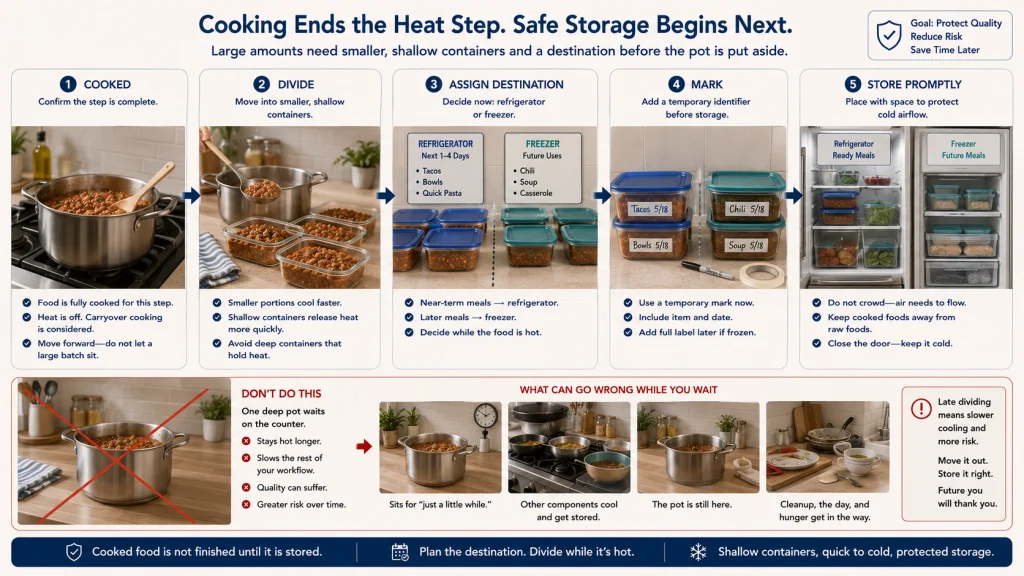
A large pot or deep container can hold the full batch while making cooling and refrigerator placement harder. Before cooking begins, decide which portions are intended for near-term refrigerated use and which are intended for the freezer. The container plan should match that destination.
Cooling and labeling checkpoint:
1. Finish cooking safely
Confirm the applicable cooking step is complete.
2. Divide larger amounts
Use suitable shallow containers or smaller portions so the food can cool promptly.
3. Assign the destination
Refrigerator for planned near-term use or freezer for the assigned later use.
4. Mark each container for follow-up
Add a brief identifier so the food can be labeled fully in the next step without becoming anonymous.
5. Protect the storage path
Keep raw foods separate and avoid overcrowding that interferes with safe cooling and organization.
Safety warning: Do not leave a large cooked batch waiting for every other component to finish. Divide and refrigerate or freeze perishable food promptly. Do not use one universal refrigerator life for all cooked components.
Food-specific storage, thawing, and reheating decisions belong in the meal-prep storage guide.
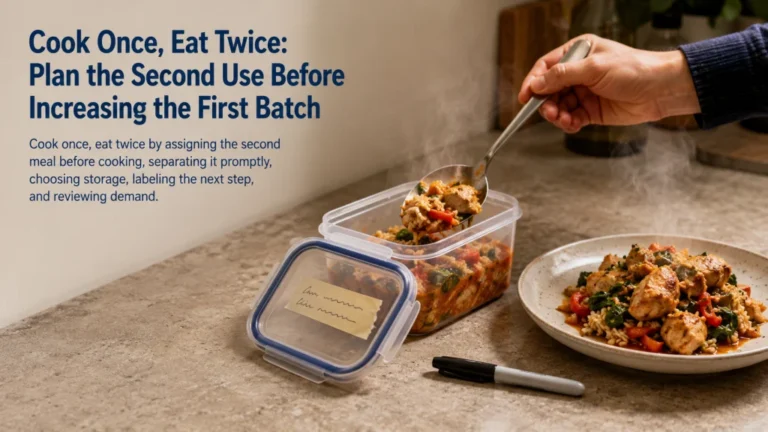
Label the Component, Date, Planned Uses, and Final Step
Once several containers are stacked together, memory becomes a weak system. One may be ready to eat, another may need reheating, and another may still require a complete cooking step. A useful label preserves those distinctions for anyone opening the refrigerator later.
Include:
- The name of the cooked component.
- The date it was prepared.
- The two or three planned meals that use it.
- Whether it is ready to eat, needs reheating, or requires further cooking.
- Any separate sauce, garnish, or ingredient needed to finish the meal.
Label example: “Roasted peppers and onions, prepared Monday evening, for Tuesday grain bowl and Thursday skillet meal, reheat before serving, sauce stored separately.” The wording can be brief, but it should preserve the destination and the final step.
A date records when preparation occurred. It does not replace food-specific storage guidance or prove that the food remains safe.
Calculate Weekday Assembly, Reheating, Dishes, and Decision Work
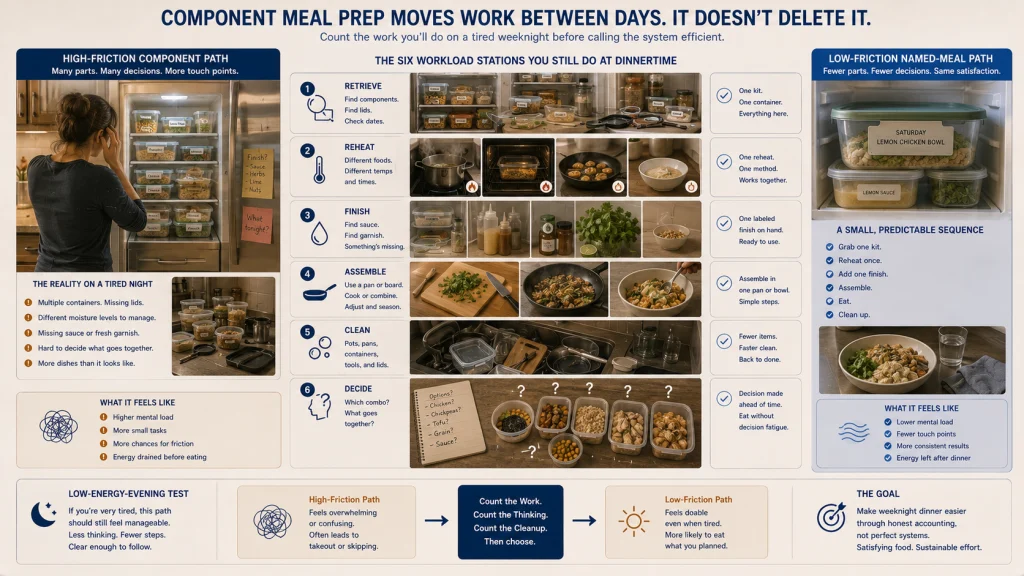
Component prep moves labor rather than making it disappear. Prep day may feel productive, yet the real burden can reappear at 6:30 p.m. as several lids, separate reheating steps, and one more decision about sauce. Count both sides before deciding that the method saves effort.
| Assembly-labor calculation | Questions to count | What increases the burden |
|---|---|---|
| Retrieval | How many containers, lids, and refrigerator locations are involved? | Components stored in several places or without clear labels |
| Reheating | Can the foods reheat together, or do they need different methods and times? | One item dries while another remains cold, requiring separate steps |
| Finishing | What sauce, seasoning, liquid, garnish, or fresh item is still needed? | Missing finishes or open-ended flavor decisions |
| Assembly | Does the meal need a pan, bowl, cutting board, blender, or other tool? | A supposed quick meal that becomes another cooking session |
| Cleanup | How many dishes and utensils remain after the meal is built? | Separate reheating containers and single-use tools |
| Decision work | Is the combination already named, or must someone design dinner from scratch? | Too many interchangeable parts with no assigned path |
A component system succeeds when the later meal can be completed with a small, predictable sequence, even on a low-energy evening. If every assembly still requires several choices and tools, reduce the component count or prepare a more complete meal.
For arranging the cooking session itself, including work zones, equipment flow, and counter use, review kitchen organization for meal prep.
Compare Three Components, Two Paths, and Complete Meals
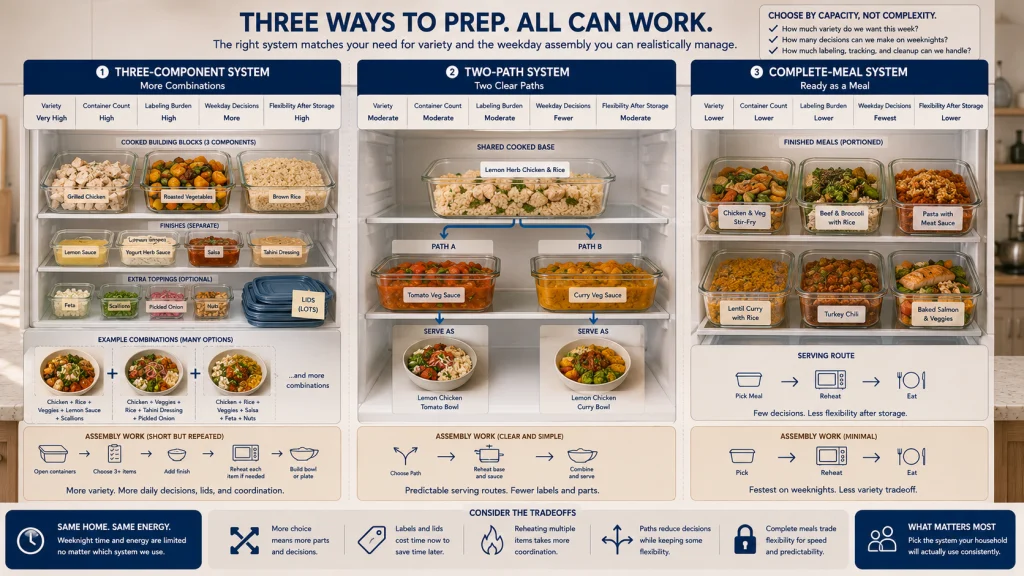
Some households enjoy choosing among several paths at dinnertime. Others want one obvious meal that can be heated and served. The right level of modularity depends on how much choice feels useful after preparation and how much assembly the household can realistically complete.
| Method example | How it works | Best fit | Main tradeoff |
|---|---|---|---|
| Three-component system | Prepare three cooked building blocks with several named combinations and separate finishes | A household that wants variety and can handle short assembly steps | More containers, labels, decisions, and reheating coordination |
| Two-path system | Prepare a small shared base, then assign it to two clearly different meals | A household that wants some variety with limited weekday choices | Less flexibility, but easier labeling and fewer unused parts |
| Complete-meal system | Store meals assembled or finished before the weekday begins | A household that values speed and predictable reheating over modular choice | Less ability to change the meal after storage |
The three-component method is not automatically more advanced. A two-path system may preserve enough variety while keeping the final work manageable. A complete-meal method may be the better choice when weekday capacity is low.
For variety planning that does not depend entirely on neutral containers, use meal prep without eating the same thing every day. For broader routine design, review meal-prep systems.
Review Unused Components and Reduce the Next Batch
An unused container is not proof that the whole method failed. It shows where the prep-day plan and the actual week separated. The food may have lacked a named use, required too much finishing, competed with another meal, or occupied more refrigerator space than expected.
| Unused-component review | What the answer may reveal | Adjustment for the next session |
|---|---|---|
| Which component remained? | The component had the weakest connection to a named meal | Remove it or reduce the quantity |
| Was the planned finish available? | The system depended on a sauce, garnish, wrap, broth, or side that was missing | Prepare or label the finish with the component |
| Was assembly too demanding? | The meal required more reheating, chopping, or cleanup than expected | Choose a two-path or complete-meal method |
| Did the component lose useful quality? | The cut, cooking method, container, or later use was a poor match | Change the preparation method or move the task closer to the meal |
| Was too much prepared? | The theoretical number of meals exceeded actual household demand | Scale the next batch to confirmed uses |
| Did the household choose another meal? | The plan lacked flexibility where it was actually needed | Keep fewer components and leave room for an unplanned meal |
Do not turn the end of the week into a rescue exercise that invents more combinations after the fact. Reduce the next batch until the components consistently reach their assigned meals.
Build Fewer Components With Clearer Destinations
Begin with two or three named later meals, then choose the smallest set of cooked components that serves them. The aim is not a refrigerator that looks impressively full. It is a weeknight meal that still feels easy to finish when energy and attention are limited.
Before the session ends, confirm that the foods can share a practical cooking, cooling, storage, and reheating path. Assign each component a refrigerator or freezer destination, label the planned uses and final step, and calculate what the weekday cook still has to do. After the week, review what remained unused and reduce the next batch.
A useful component system can be summarized in five parts: named uses, limited components, realistic assembly, clear storage destinations, and a review of what the household actually used. Connect those decisions to the complete meal-prep process when planning the full week.
FAQs
🧩 What counts as a meal-prep component?
A component is a cooked building block stored separately for one or more named later meals. It is not merely a prepared raw ingredient, and it is not a fully assembled or finished meal.
🍚 How many components should I prepare?
Use the smallest number that supports the meals already planned. Add another component only when it has a clear use and does not create more labeling, storage, reheating, and decision work than the household can manage.
🌶️ Do components need to be neutral?
No. A component can be seasoned or finished for a defined set of meals. Neutral preparation is useful only when the later flavor paths are already realistic and the unfinished decisions will not become a weekday burden.
🔥 Can I reheat every component together?
Not always. Components may differ in moisture, density, serving temperature, and reheating needs. Plan the assembly around foods that can share a practical reheating method, and follow food-specific safe reheating guidance.
🏷️ What should a component label include?
Include the component name, preparation date, planned meals, storage destination, and whether it is ready to eat, needs reheating, or requires a final cooking step. Add the name of any separate finish needed to complete the meal.
🧊 How long can cooked components stay refrigerated?
There is no universal refrigerator life for every cooked component. Use food-specific storage guidance, label the preparation date, and do not rely on smell, appearance, or taste as the sole safety test.
📉 What should I do when components go unused?
Identify whether the problem was excess quantity, no named use, missing finishes, quality loss, or too much assembly. Reduce or remove the weakest component in the next session rather than creating more theoretical combinations.