Meal planning can reduce avoidable food waste when every perishable item has a next action. Begin with food already in the refrigerator, freezer, and pantry, then plan the shortest-window items into early meals. Count the meals likely to happen at home before choosing purchase quantities. Treat sale and bulk offers as conditional, assign each planned leftover to a named meal, freezer action, or safe discard decision, and preserve dates and instructions when repackaging. Record preparation scraps, spoiled ingredients, uneaten portions, and forgotten leftovers separately. Change one planning behavior from the log, while allowing food-safety guidance to override the desire to save food.
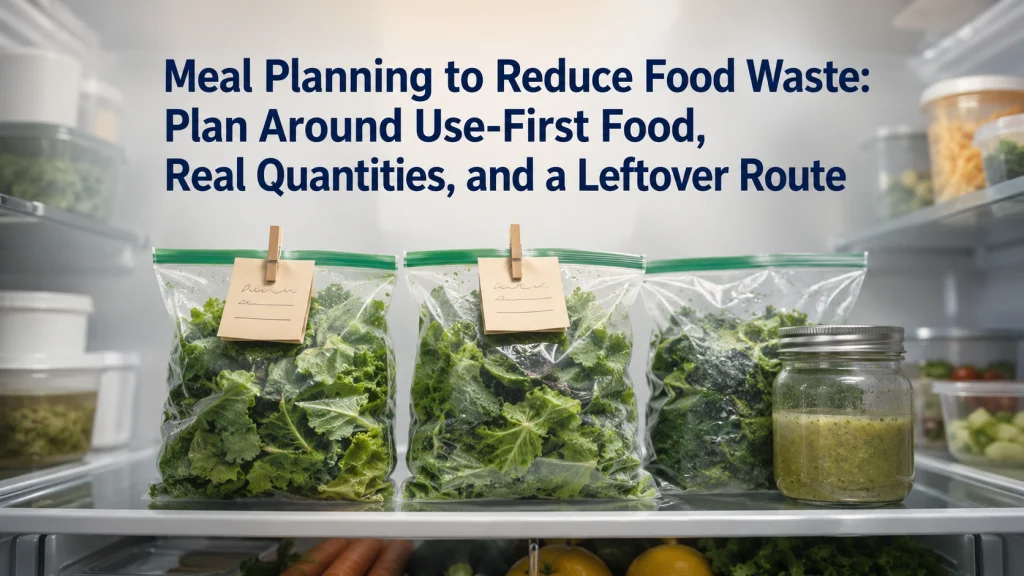
Assigned Food Has a Next Action
Three identical bags of spinach enter the refrigerator on the same day. One is marked for Monday dinner. One is marked for Wednesday lunch. The third has no assigned use.
Bag 1 → Monday meal → visible place → used first
Bag 2 → Wednesday meal → quantity reserved → used next
Bag 3 → no meal, no date, no fallback → pushed behind other food → rediscovered too late
The third bag did not become less useful because its leaves were different. It became easier to forget because no decision was attached to it.
That is the practical center of meal planning to reduce food waste. Food is more likely to be used when the household knows what it is for, when it should be used, and what happens if the original plan changes.
The broader meal prep process connects this planning step with preparation, cooling, storage, and later use.
For a simpler starting routine, beginner meal prep guidance can help turn the use-first list into a manageable first week.
Define Prevention, Leftover Management, Donation, Diversion, and Disposal
Prevention means avoiding unnecessary purchases, preparation, or spoilage before food becomes unwanted. It includes checking what is already available, planning realistic quantities, assigning uses, and changing the plan when the week changes.
Leftover management means giving prepared food a dated next step. That step may be a named meal, a suitable freezer action, incorporation into another planned dish, or a safe discard decision.
Donation moves suitable food to another user through an appropriate organization or local process. This article does not address donation law, eligibility, transport, or local acceptance rules.
Diversion sends food or scraps toward another managed route, such as composting where available. Disposal is the final discard route. Municipal programs and disposal methods sit outside this article.
The focus here is prevention. Composting or another diversion path may manage food after it is unwanted, but it does not correct overbuying, forgotten leftovers, or a package with no assigned use.
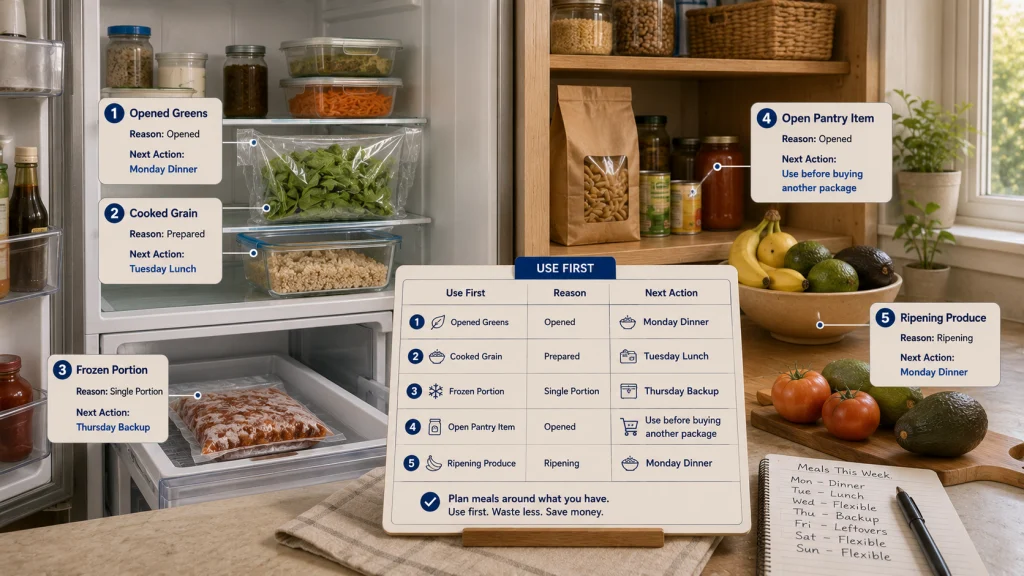
Make a Use-First Refrigerator, Freezer, and Pantry List
Plan from existing food before opening a recipe site or writing a new shopping list. A short use-first inventory does not need to become a complete household stock system.
| Area | Use-first item | Reason it needs attention | Assigned action |
|---|---|---|---|
| Refrigerator | Opened greens | Short useful window and already opened | Monday dinner and Tuesday lunch component |
| Refrigerator | Cooked grain | Prepared food without a named next meal | Wednesday bowl or freezer decision |
| Freezer | Single prepared portion | Easy to overlook behind larger packages | Thursday backup meal |
| Pantry | Open package | Partly used and likely to be replaced by a new purchase | Use before buying another package |
| Counter | Ripening produce | Condition is changing visibly | Early-week breakfast or snack |
Keep the list short enough to guide the week. The full pantry, stock thresholds, and ongoing purchasing system belong in a dedicated pantry inventory workflow.
Nora’s practical observation is that refrigerator bins, produce keepers, labels, and inventory apps improve visibility only when the household also assigns a use. A perfectly organized bin can still hold food that nobody has decided to eat.
When the problem is not visibility but the way food moves through shelves, counters, and prep zones, organizing the kitchen around meal prep can reduce the quiet friction that pushes use-first food out of sight.
Plan Meals Around Items With the Shortest Useful Window
Once the use-first list is visible, place the most time-sensitive items earlier in the week. Foods with a longer stable window, freezer options, and shelf-stable ingredients can support later meals.
This is not a demand to predict the exact day every ingredient changes. It is a planning order:
- Use opened, prepared, ripening, or delicate items first.
- Give current leftovers a named meal before adding new cooking.
- Place flexible freezer or pantry options later.
- Keep one meal open when the schedule often changes.
A plan that begins with new recipes can make the existing food feel like an interruption. A plan that begins with use-first items turns those foods into the starting point.
The weekly meal-planning workflow can help place those uses on the calendar without turning every day into a rigid commitment.
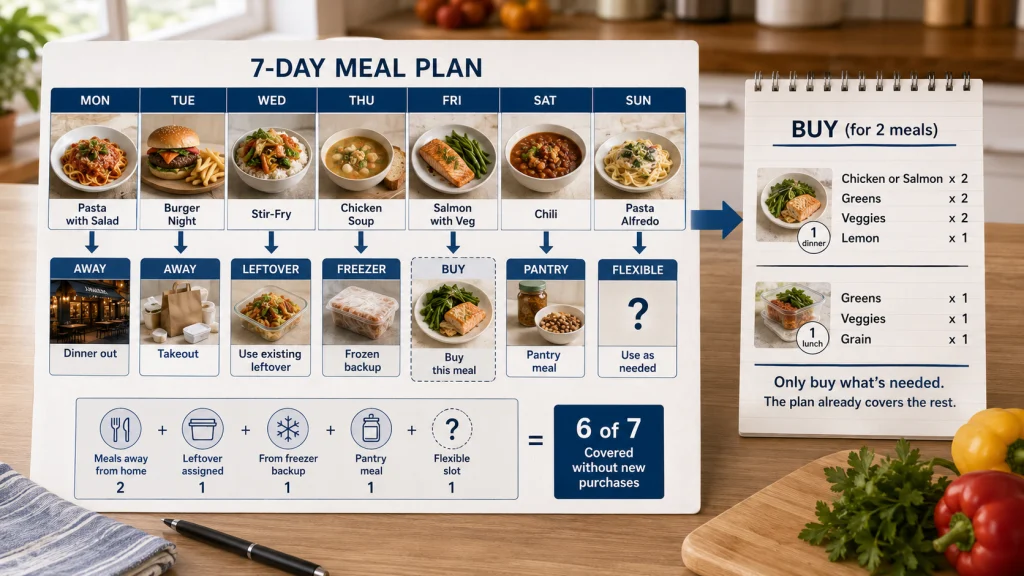
Count Meals at Home and Put Real Quantities on the Grocery List
A seven-day calendar rarely requires seven newly purchased servings of every ingredient. Some meals happen away from home, some use leftovers, and some remain flexible.
Count the eating occasions that still need food after subtracting:
- Meals planned away from home.
- Takeout or restaurant plans that are likely to happen.
- Leftovers already assigned to a meal.
- Frozen backups already available.
- Meals that will use pantry or freezer food.
- Flexible slots kept open for schedule changes.
Then write quantities beside the grocery item. “Greens for two meals” is more useful than “buy greens.” “One dinner plus one leftover lunch” gives the package a purpose before it enters the cart.
The article on calculating meal prep quantities turns calendar occasions into complete-meal, component, and freezer amounts without using calorie or macro prescriptions.
Once those amounts are clear, building the grocery list from planned uses keeps the cart tied to the week instead of to package size or impulse.
For households balancing cost as well as waste, budget-focused meal prep planning can help separate a genuinely useful lower-cost choice from food that is cheap only because too much was purchased.
Treat Sale and Bulk Purchases as Conditional
A lower unit price does not create more meals at home, more refrigerator space, or more willingness to use the item. A bargain becomes useful only when the household has a realistic route for the quantity.
- Assigned uses: Are enough meals or components already planned?
- Storage capacity: Is there suitable refrigerator, freezer, or pantry space after current food is counted?
- Preparation burden: Will dividing, cooking, labeling, or freezing the quantity fit the week?
- Actual history: Has this household reliably used the larger amount before?
- Fallback route: Is there a named freezer, sharing, or later-use plan that follows applicable guidance?
- Decision: Buy the larger quantity only when the route exists before purchase.
A sale can create urgency that feels like planning. The calmer question is whether the food already has somewhere to go.
Detailed capacity and purchasing decisions belong in the bulk grocery planning workflow.
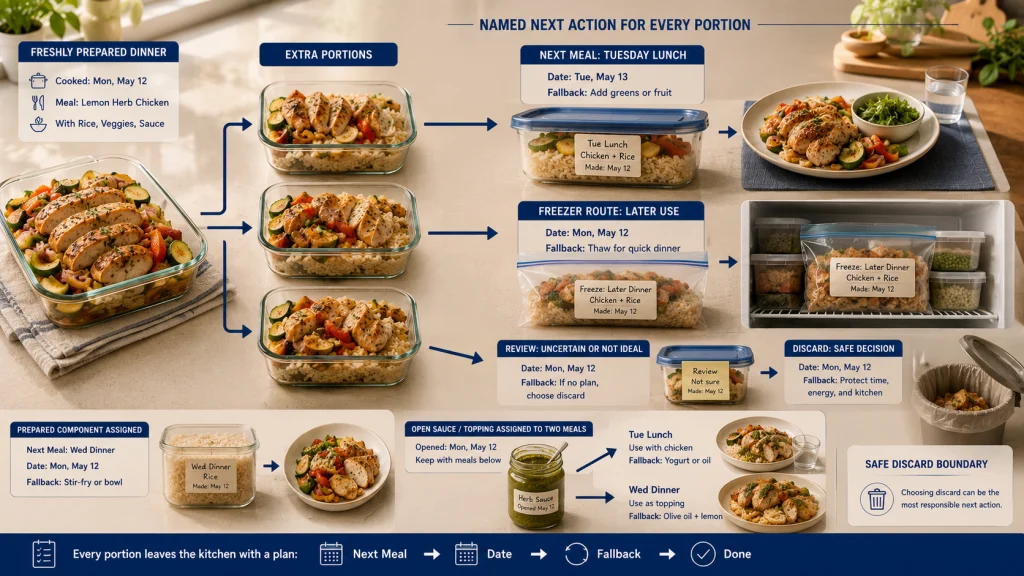
Assign Every Planned Leftover to a Meal, Freezer Action, or Safe Discard Decision
“Save the leftovers” is not a complete instruction. It describes storage without deciding the next use.
| Leftover | Next action | When | Fallback route |
|---|---|---|---|
| Extra dinner portion | Tuesday lunch | Label before refrigeration | Freeze when suitable if the lunch changes |
| Prepared component | Wednesday dinner assembly | Store separately from fragile additions | Use in Thursday lunch when appropriate |
| Open sauce or topping | Two named meals | Keep visible with the meal components | Review before the next shopping trip |
| Uncertain later portion | Suitable freezer action | Decide while labeling, not after it is forgotten | Safe discard when guidance or condition requires it |
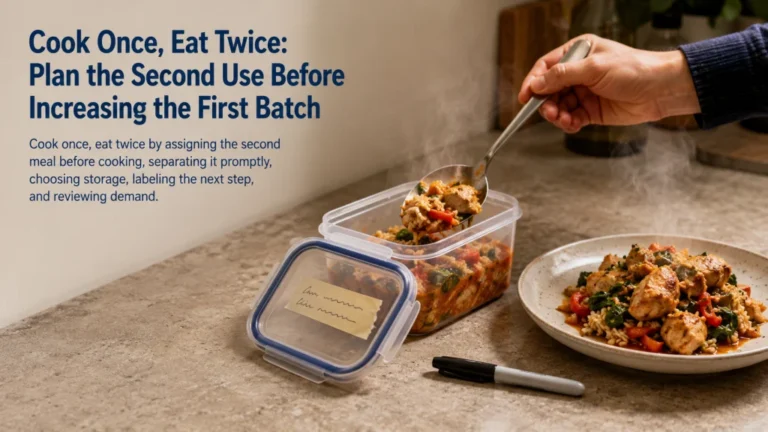
An assigned leftover feels different from an anonymous container. One is part of the plan. The other waits for someone to remember it while new food keeps arriving.
When cooking larger amounts is intentional, a batch-cooking workflow can separate planned future portions from accidental excess.
For cooling, freezing, thawing, reheating, and food-specific storage decisions, use the meal prep storage workflow.
Preserve Labels and Dates When Repackaging
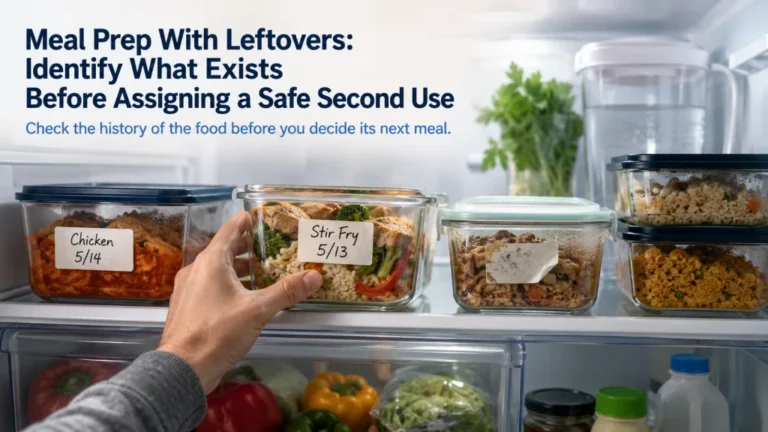
Nora’s practical caution is that moving food into a clear container can improve visibility while quietly removing the original date, storage instructions, preparation directions, ingredient information, or other details printed on the package.
Before discarding the original packaging, transfer the information the household will need:
- The food name.
- The relevant date or preparation date.
- The intended meal or use.
- Storage or preparation instructions that still apply.
- Any household-specific information needed to avoid confusion.
She treats the label as part of the container, not an optional finishing touch. Visibility without identity can replace one problem with another: the food is easy to see, but nobody remembers when it was opened or what the original instructions said.
The aim is not a decorative refrigerator. It is a clear next action that survives the transfer from package to container.
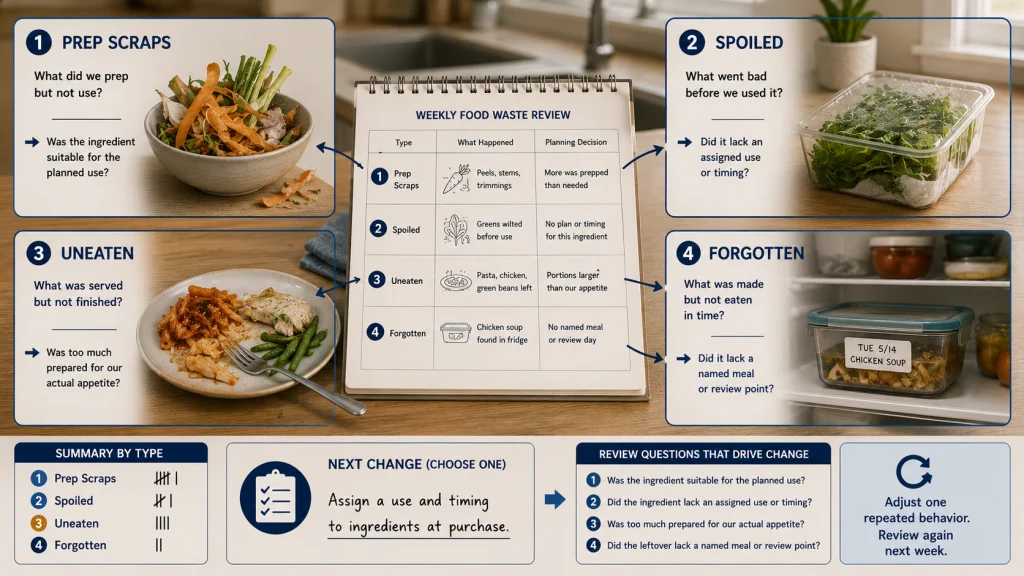
Record Four Types of Waste Separately
A single total does not explain what to change. Separate the waste by the decision point that produced it.
| Waste type | What to record | Likely planning question |
|---|---|---|
| Preparation scraps | Trim, peels, stems, bones, or other material created during preparation | Was the ingredient or preparation method suitable for the intended use? |
| Spoiled ingredients | Food that deteriorated before being prepared | Was it bought without an assigned use, hidden, or scheduled too late? |
| Uneaten portions | Prepared amounts that were served or packed but not used | Was the quantity larger than the actual number of eating occasions? |
| Forgotten leftovers | Prepared food stored without a named meal, freezer route, or review point | Was the next action unclear, the label missing, or the container out of sight? |
Record the reason without turning the log into a judgment of the household. A dinner invitation, illness, travel delay, or changing appetite can create unavoidable waste. The purpose is to find repeated planning patterns, not to demand a week with nothing discarded.
It can be discouraging to open the refrigerator and realize that good intentions became three containers nobody touched. Separating the reasons keeps that moment from becoming a vague sense of failure. It turns it into a specific change the next plan can actually use.
Change One Planning Behavior Based on the Waste Log
Match the change to the waste type.
- If ingredients spoiled before use, move one use-first item earlier or buy less.
- If portions remained uneaten, reduce one preparation quantity.
- If leftovers were forgotten, assign the next meal while storing them.
- If repackaged food became unidentified, preserve the date and instructions.
- If a bulk item remained, require named uses before the next large purchase.
Change one behavior for the next planning cycle. Several simultaneous changes make it difficult to see which adjustment helped.
A smaller purchase or one fewer prepared portion can feel inefficient while the kitchen is busy. At the end of the week, it may feel like relief: less food to monitor, fewer containers waiting for attention, and a clearer refrigerator.
When these decisions need to become a repeatable household rhythm, a meal prep system can connect planning, shopping, preparation, storage, and review without turning every week into a new project.
Broader choices about shopping cadence, stock levels, and where groceries are purchased belong in grocery and pantry planning.
Let Food-Safety Rules Override the Desire to Avoid Waste
Safety-over-waste boundary: Waste prevention never gives permission to keep food when safety is uncertain. Follow current food-specific guidance for cleaning, separation, cooking, prompt refrigeration, cooling, storage, freezing, thawing, reheating, and discard. Smell and taste are not reliable safety tests. When guidance, time, temperature history, package integrity, contamination, or food condition makes the item unsafe or uncertain, use the appropriate safe-discard route rather than trying to rescue it.
People at higher risk of foodborne illness may need stricter guidance from a qualified professional. Severe or persistent symptoms after eating require appropriate care.
Discarding food for safety is not a planning failure. The useful review happens afterward: identify whether the avoidable part occurred during purchasing, storage, preparation, labeling, or leftover routing.
Identify Use-First Food, Assign the Next Use, Route Leftovers, and Measure One Change
A useful food-waste plan is not a promise that nothing will ever be discarded. Weeks change, appetites change, meals move, and some food must be discarded for safety.
The stronger measure is whether fewer items become anonymous. A bag of greens has a meal. A leftover has a date and destination. A bulk purchase has enough named uses before it enters the cart. A discarded item leaves behind one clear lesson instead of general guilt.
That shift matters because food waste often grows in small moments of uncertainty: “I will use this somehow,” “someone will eat that,” or “I should keep it a little longer.” Replacing one uncertain promise with one visible next action makes the refrigerator easier to trust and the next week easier to plan.
The goal is not a flawless kitchen. It is a household in which food is noticed early enough to make a real decision, and where an unavoidable discard does not erase the progress made elsewhere.
FAQs
🥬 What is a use-first food list?
It is a short list of opened, prepared, ripening, delicate, or easily forgotten food that should shape the next meals. Each item should have a named use or review point.
🛒 How does a meal plan prevent overbuying?
Count the meals likely to happen at home, subtract current leftovers and freezer food, then write quantities beside grocery items. This connects purchases to expected uses instead of a full seven-day assumption.
🏷️ Should sale food always be added to the plan?
No. A sale or bulk item needs assigned uses, storage capacity, preparation time, and a fallback route. A lower unit price does not make excess quantity useful.
🍱 What should I write on a leftover label?
Include the food name, relevant date, intended meal or use, and any storage or preparation instructions the household still needs. Label the next action while storing the food.
🧊 Should every extra portion go into the freezer?
No. Freezing depends on whether the food is suitable, how it was handled, available space, and a realistic later use. Follow current food-specific freezing and thawing guidance.
📋 What types of food waste should I track?
Track preparation scraps, spoiled ingredients, uneaten portions, and forgotten leftovers separately. Each category points to a different planning decision.
🔁 How many planning changes should I make at once?
Change one repeated behavior during the next planning cycle. This makes it easier to see whether buying less, scheduling food earlier, labeling, or routing leftovers changed the result.
🚩 Should I keep uncertain food to avoid waste?
No. Waste prevention never overrides safe handling and discard guidance. Smell or taste should not be used as the only safety test.