4-7-8 breathing uses an inhale, a longer hold, and an even longer exhale, but the counts do not have to equal slow clock seconds. Start at a pace that avoids air hunger, dizziness, throat tension, and forced emptying. A hold that still feels strained after the count is shortened is a reason to move to continuous breathing rather than push through. The useful goal is a repeatable, low-effort rhythm, not perfect performance of memorable numbers.

The Same Ratio Can Feel Impossible or Manageable
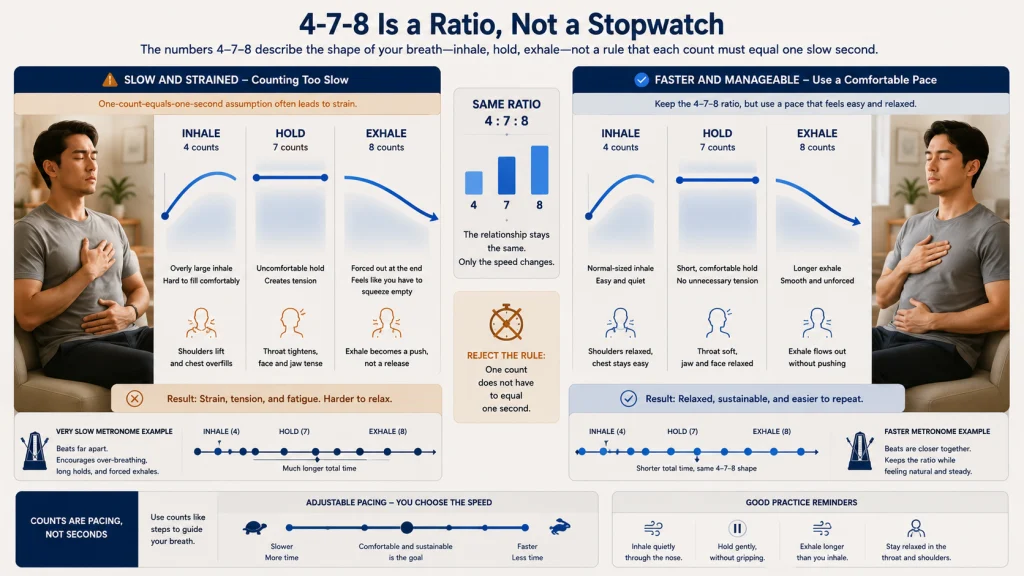
Imagine a metronome clicking very slowly. Four clicks for the inhale may feel manageable, but seven clicks of holding can become tense, and eight clicks of exhaling may leave you squeezing for air that is no longer there. Speed the metronome up, and the same 4-7-8 relationship may become easier to follow.
The count is relative pacing, not a contest for seconds. The numbers describe how the phases relate to one another. They do not require you to stretch each number into the slowest possible duration.
| Phase | Very slow count | Faster manageable count |
|---|---|---|
| Inhale for 4 | May encourage an oversized breath | Can stay quiet and normal-sized |
| Hold for 7 | May create throat tension or air hunger | May feel brief enough to remain calm |
| Exhale for 8 | May turn into forced emptying | Can remain longer than the inhale without strain |
Start by finding out whether the structure fits your breathing today. A memorable pattern is only useful when your body can follow it comfortably.
What the 4-7-8 Pattern Is
The pattern has three phases: inhale for a count of four, hold for a count of seven, and exhale for a count of eight. The inhale is the shortest phase, the hold is longer, and the exhale is longest.
The method is different from equal-count techniques because the phases are intentionally unequal. It is also different from smooth no-hold pacing because breath retention is built into the sequence.
Key decision: Before practicing, decide whether a longer hold feels appropriate. The name of the technique does not make breath retention necessary for every reader or every day.
For a broader comparison of body-first options, review breathing exercises for stress.
Why the Numbers Do Not Require Slow Clock Seconds
Counting gives the phases a relative shape. It does not force one universal speed. A quick, even count can preserve the 4-7-8 relationship while reducing the total time spent inhaling, holding, and exhaling.
This matters because people differ in lung comfort, current stress level, posture, recent activity, and familiarity with breath holds. A pace that feels easy in a supported chair may feel demanding after climbing stairs or while sitting in a compressed position.
Shortening the pace is a modification, not a failure. If shortening still does not make the hold tolerable, the next step is to switch methods rather than extend the practice.
Run a Safety and Fit Check Before You Start
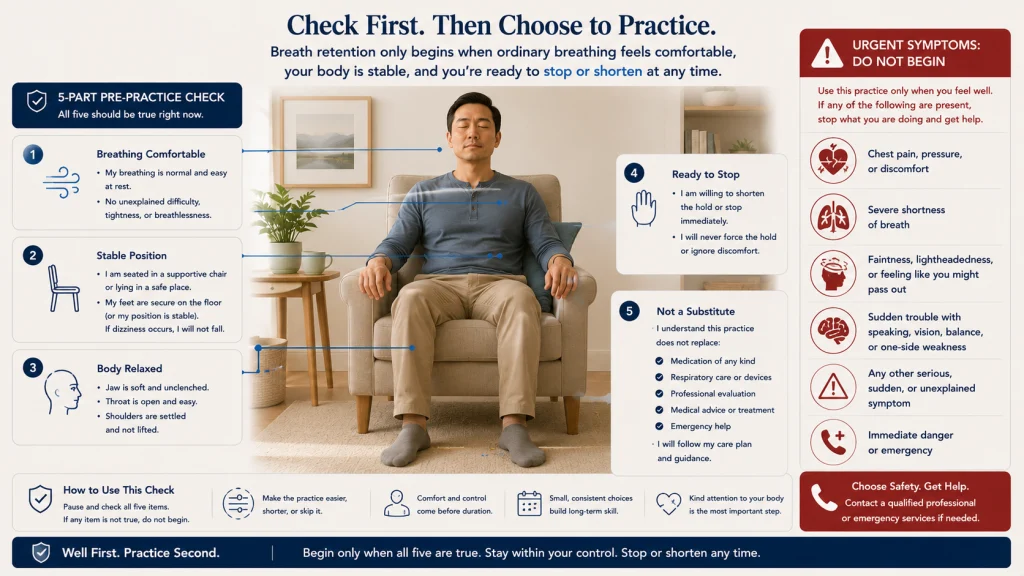
Breath retention can feel wrong for some readers or on some days. Unexplained breathing difficulty, chest symptoms, or another concern that needs evaluation should take priority over this practice.
Use this fit checklist before the first cycle:
- You can breathe normally at rest without unexplained shortness of breath.
- You are seated or lying in a stable position where dizziness would not create a fall risk.
- Your jaw, throat, and shoulders can stay relaxed during an ordinary breath.
- You are willing to shorten the pace or stop instead of forcing the hold.
- You are not using the exercise to replace medication, respiratory care, or emergency help.
Safety warning: Do not begin self-guided breath retention during chest pain, severe shortness of breath, faintness, stroke signs, immediate danger, or another urgent symptom. Seek appropriate help instead.
Set Your Posture and Empty the Breath Gently
Sit in a supported chair or lie in a stable position. Let the shoulders rest, keep the jaw loose, and give the ribs room to move. Avoid a tightly compressed posture that makes the inhale feel restricted before the pattern even begins.
Before the first counted inhale, breathe out gently. Do not squeeze the abdomen, collapse the chest, or try to empty every last bit of air. A forced starting exhale can make the next inhale oversized and turn the whole cycle into a recovery effort.
Practical tip: Begin from an ordinary exhale. The first inhale should feel like a normal breath guided by a count, not a large preparation breath.
Practice One Low-Strain Cycle
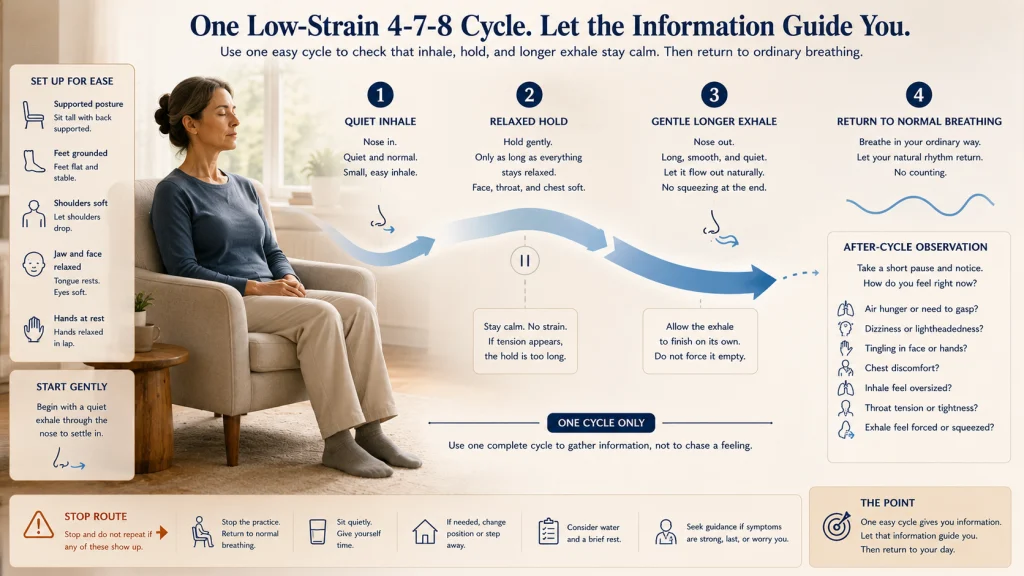
Inhale quietly through the nose for four counts. Hold for seven counts only if the throat, chest, and face remain relaxed. Exhale gently for eight counts without squeezing at the end.
One cycle gives you enough information to judge fit. Notice whether the inhale became too large, whether the hold felt like waiting calmly or fighting for air, and whether the exhale remained smooth through its final count.
After the exhale, return to ordinary breathing. There is no need to rush into another cycle. A brief pause lets you notice whether dizziness, tingling, chest discomfort, or air hunger appears after the pattern ends.
Speed the Count Instead of Forcing Capacity
A hold that starts to feel tense calls for a faster count on the next attempt. Keep the count even so the relative phases remain clear. Repeated retention is not meant to stretch your capacity.
An audio cue can make pacing easier, but it should allow adjustment. A recording that moves too slowly can pressure the reader to chase the track instead of following an unforced breath. A visual timer creates similar friction when attention stays fixed on completing every segment.
Editorial observation: A pacing tool is most useful when it can be muted, sped up, paused, or stopped immediately. Fixed audio, bright screens, subscription prompts, or sleep claims can add friction to a practice that should remain simple and easy to exit.
You do not need an app or device. Quiet self-counting is enough when it helps you maintain a steady pace without turning the exercise into a performance task.
Limit Early Repetitions and Stop With Symptoms
Early practice should end while the pattern still feels steady and ordinary breathing returns easily between cycles. Extra cycles add little when the reader is still learning how the hold and long exhale feel.
Dizziness, light-headedness, faintness, shortness of breath, unusual tingling, or chest discomfort are stop signals. These sensations are not evidence that the technique is working.
Safety warning: Chest discomfort, faintness, severe shortness of breath, or persistent symptoms require appropriate action. New, severe, worsening, unexplained, or function-limiting breathing symptoms need qualified evaluation.
If mild dizziness repeatedly occurs across different techniques, use the dedicated guide on why breathing exercises can cause dizziness rather than continuing to experiment with longer holds.
Correct the Common Errors That Make the Pattern Harder
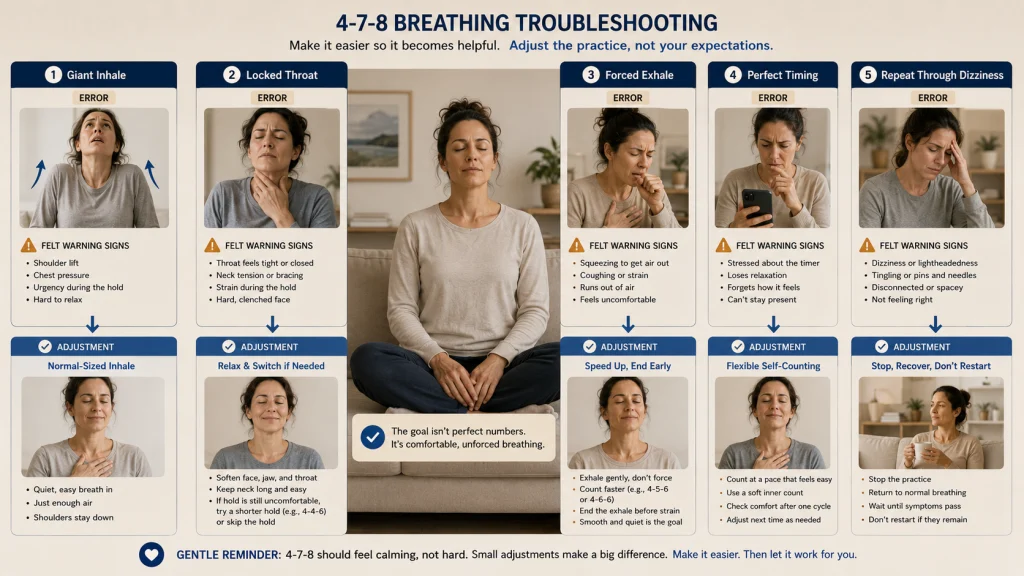
| Common error | What it can feel like | Better adjustment |
|---|---|---|
| Taking a giant inhale | Chest pressure, shoulder lifting, or urgency during the hold | Use a quieter, normal-sized inhale. |
| Locking the throat during the hold | Neck tension or a sense of bracing | Keep the face and throat relaxed, or remove the hold by switching methods. |
| Forcing the final exhale counts | Squeezing, coughing, or running out of air before the count ends | Speed the count and stop the exhale before strain develops. |
| Chasing perfect timing | Watching the timer more than noticing the breath | Use a flexible pace and judge comfort after one cycle. |
| Repeating through dizziness | Increasing light-headedness or tingling | Stop, return to normal breathing, and do not restart while symptoms remain. |
The pattern should become easier because the setup and pace fit better, not because you learned to ignore discomfort.
Compare 4-7-8 With Equal-Count and No-Hold Breathing
| Method | Timing structure | Main fit question |
|---|---|---|
| 4-7-8 breathing | Unequal phases with a relatively long hold and exhale | Can you tolerate the hold without strain or air hunger? |
| Box breathing | Equal phases that usually include two brief holds | Do equal counts feel easier than one longer hold? |
| Coherent breathing | Smooth inhale and exhale without retention | Would continuous breathing feel easier to sustain? |
Use box breathing when equal timing feels easier to track and brief holds remain manageable. Choose coherent breathing when retention adds strain or distraction.
Understand What Research Can and Cannot Support
Relaxation breathing is studied across different methods, populations, practice lengths, and comparison conditions. Results from one protocol do not prove that this specific 4-7-8 pattern produces the same effect for every reader.
Small studies or studies in narrow groups cannot support universal promises about sleep onset, heart rate, blood pressure, anxiety, or other medical outcomes. The routine may feel settling, neutral, or simply like a poor fit. That individual response still matters when broader breathing research appears encouraging.
Note: Treat the method as an optional relaxation practice, not as treatment and not as a guaranteed way to fall asleep. When sleep is the main problem, the answer may involve a broader routine rather than a longer breath hold.
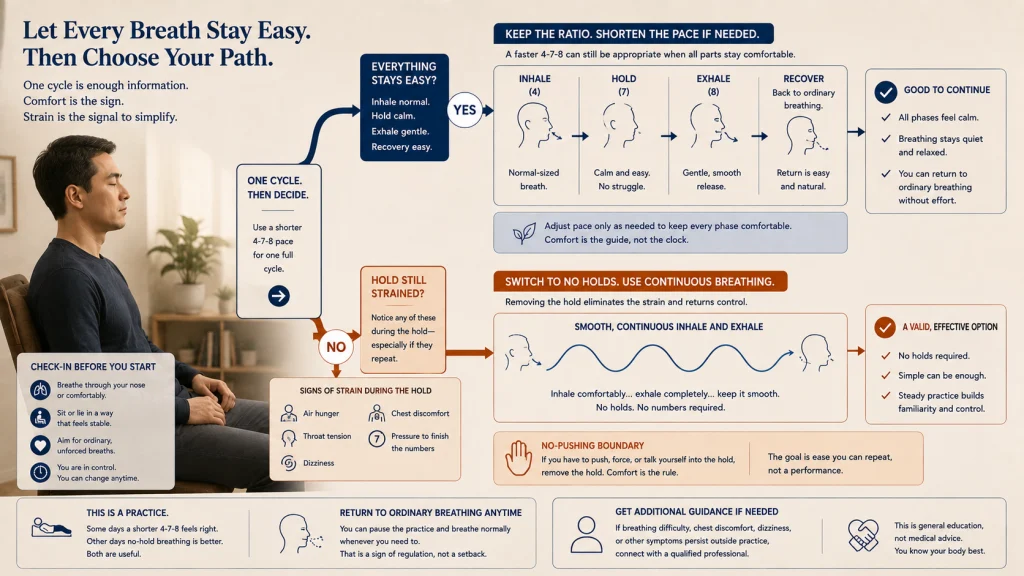
Choose a No-Hold Method When Retention Does Not Fit
For some readers, a quicker count removes the strain. Others still notice air hunger, throat tension, or pressure to finish the numbers. When that response repeats, the pattern is probably a poor fit.
Removing the hold takes away the phase causing the difficulty. A continuous rhythm can still provide a clear pacing cue without making retention part of the task.
Keep the Ratio, Shorten the Pace, or Switch
Begin with a supported posture, a gentle exhale, and one low-strain cycle. When the hold or exhale runs too long, quicken the count and judge the method by ease rather than clock seconds.
A repeatable pattern can keep the relative phases without chasing precision. Ongoing symptoms or strain during retention point toward continuous breathing as the better answer.
For the broader decision about body-first stress tools, return to how to manage stress.
FAQs
⏱️ Do the 4-7-8 counts have to be seconds?
No. The counts can act as relative pacing rather than slow clock seconds. Use an even speed that keeps all three phases smooth and manageable.
🫁 What if I cannot hold my breath for seven counts?
Speed the count rather than extending your capacity. Continued air hunger, throat tension, dizziness, or chest discomfort means the cycle should stop and the hold should be removed.
🌬️ Should the inhale be as deep as possible?
No. Use a quiet, normal-sized inhale. An oversized breath can make the hold and long exhale feel more difficult.
🔁 How many cycles should a beginner do?
Begin with one easy cycle and notice how you feel after ordinary breathing returns. Continue only while the rhythm stays steady and symptoms do not appear.
😵 Why do I feel dizzy during 4-7-8 breathing?
Dizziness can occur when breathing becomes too large, forceful, fast, or strained. Stop the exercise, return to normal breathing, and seek guidance when symptoms are persistent, severe, unexplained, or accompanied by other concerning signs.
🟦 Is box breathing the same as 4-7-8 breathing?
No. Box breathing uses equal phases, while 4-7-8 uses unequal phases with a longer hold and exhale. Both include retention, so continuous breathing may fit better when holds create strain.
🌙 Does 4-7-8 breathing guarantee faster sleep?
No. It may feel settling for some readers, but it does not guarantee sleep onset or another exact outcome. Keep sleep claims separate from whether the technique feels manageable and remains safe to practice.
🚩 When should I stop self-guided practice?
Stop for dizziness, faintness, chest discomfort, air hunger, or severe shortness of breath. New, severe, persistent, worsening, unexplained, or function-limiting symptoms need qualified evaluation, while urgent signs require immediate appropriate help.