Box breathing uses four equal phases: inhale, hold, exhale, and pause after the exhale. The equal shape is the method, but the count does not have to be four and a hold should not become a test of endurance. Start with a short, comfortable rhythm, keep each breath normal-sized, and shorten or remove a hold if strain appears. Choose another breathing pattern when equal phases or pauses make you feel air hungry, dizzy, or pressured.
The Square Should Fit Your Breath
Picture a square with four sides. Two sides feel easy, while the other two feel strained. The shape is still symmetrical on paper, but your body is telling you that the current timing is not workable.
That distinction matters because box breathing is often shown as four identical numbers. The visual can make the count look like a rule rather than a starting point. In practice, symmetry is the structure, not a demand to endure discomfort.
| Inhale Easy or strained? | ||
| Pause after exhale Easy or strained? | One adjustable cycle Use the same comfortable count for each phase, or remove a hold when needed. | Hold after inhale Easy or strained? |
| Exhale Easy or strained? |
Start with the version your body can repeat without strain, not the version that looks most precise. Readers who first need a quieter, lower-effort breathing pattern may find diaphragmatic breathing basics easier to learn before adding equal counts and pauses.
What the Four Phases Mean
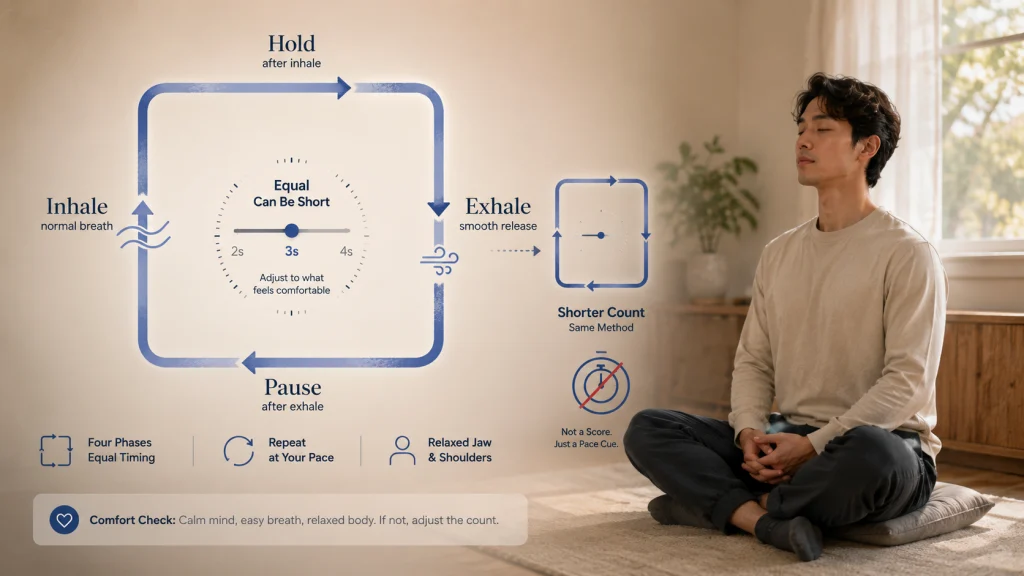
One box breathing cycle has four parts:
- Inhale: breathe in gently through the nose or in another comfortable way.
- Hold after the inhale: pause without tightening the throat, shoulders, or face.
- Exhale: let the breath out smoothly rather than forcing the lungs empty.
- Pause after the exhale: wait briefly before beginning the next inhale.
The four phases are equal in timing when using the standard structure. Equal does not mean long. A short count can preserve the square while reducing the effort required by each pause.
A count is a pacing cue, not a performance score. Some people count at roughly one beat per second, while others use a slower or faster internal rhythm. A stopwatch is optional, and exact timing is less important than a repeatable cycle that stays comfortable.
Decide Whether Holds Fit Today
Breath holds are the main feature that separates box breathing from a smooth no-hold pattern. They are also the part most likely to create discomfort. Before beginning, notice whether you already feel short of breath, light-headed, congested, unwell, or unusually aware of your heartbeat.
A brief pause may feel neutral when you are calm and rested but unpleasant when you are overheated, rushing, ill, or recovering from exertion. That does not mean you failed. It means the method is asking for something your body may not want at that moment.
Key decision: Use holds only when they feel ordinary and controllable. If a pause creates air hunger, tension, dizziness, or urgency, shorten it or switch to a no-hold method.
Unexplained breathing or cardiovascular symptoms are not a reason to experiment with longer holds. They require appropriate professional guidance rather than self-directed breath practice.
Start With a Short Comfortable Count
The familiar 4 4 4 4 breathing pattern is one example, not a mandatory prescription. A shorter equal count can teach the sequence with less pressure. The useful starting point is the shortest count that lets you complete every phase without bracing, gulping, or waiting desperately for the next inhale.
Try the rhythm while seated or standing in a stable position. Let one cycle answer a simple question: can all four parts stay quiet and manageable? When the answer is yes, repeat it. When the answer is no, change the pattern immediately.
Note: A shorter count is not a lesser version. It is a way to preserve the equal-phase structure while matching the method to your current tolerance.
Keep Each Breath Normal-Sized
Counting can quietly turn an ordinary inhale into an oversized one. You may pull in extra air because the count is still running, lift the shoulders to make room, or expand the chest more than feels natural. The same problem can happen on the exhale when you keep pushing air out to fill the entire side of the square.
Use the count to slow the transition between phases, not to maximize lung volume. The inhale can remain gentle. The exhale can end before you feel emptied out. The pauses should feel like calm stops between movements, not locked doors that prevent the next breath.
Complete One Cycle Without Chasing the Timer
One careful cycle provides more useful information than several strained ones. Begin the inhale, pause briefly, exhale smoothly, and pause again. Then stop for a moment and notice what changed.
- Did the breath stay quiet rather than becoming larger with each phase?
- Did your shoulders, jaw, throat, and hands remain relatively relaxed?
- Did either hold create urgency or a need to catch up?
- Can you begin another cycle without taking a recovery breath?
If you need a large catch-up inhale after the square, the current count is probably too demanding. Adjust before repeating. The aim is not to finish a preset number of cycles. It is to find a pattern that remains steady from one cycle to the next.
Modify the Pattern in Small Steps
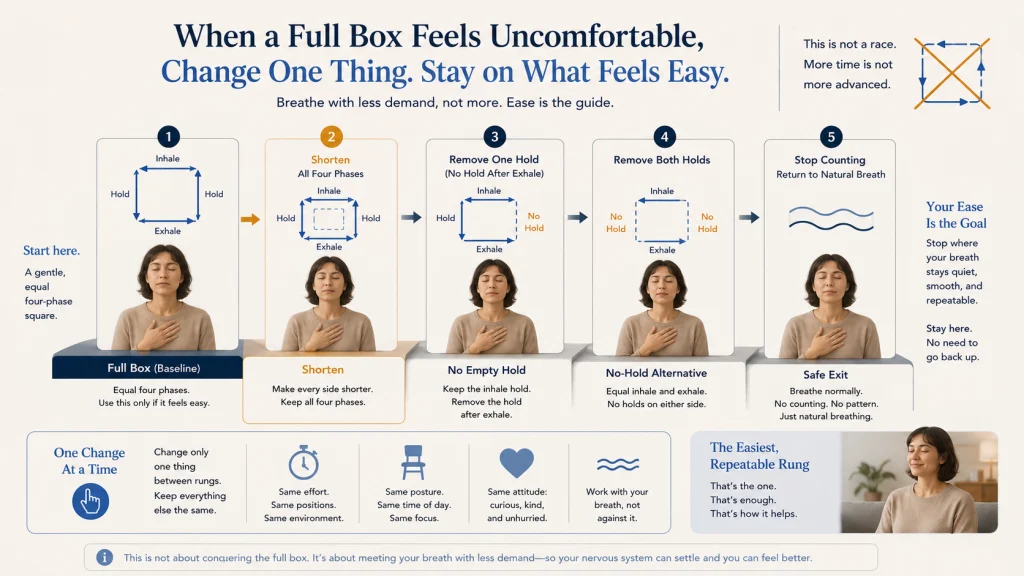
When the full square feels uncomfortable, change one demand at a time. This makes it easier to identify whether the problem is the total count, the inhale hold, the pause after exhaling, or the effort of counting itself.
- Shorten all four phases: keep the square equal but reduce the count.
- Remove the pause after the exhale: use inhale, hold, exhale, then begin the next gentle inhale.
- Remove both holds: move to an equal inhale and exhale with no pauses.
- Stop counting: return to comfortable natural breathing and try another method later.
Practical tip: Stay on the easiest rung that feels repeatable. Do not climb the ladder simply because a longer or more complete pattern appears more advanced.
If removing the holds solves the problem, steady no-hold breathing may be a better match. It keeps a paced rhythm without requiring the two pauses that define a box.
Choose a Pacing Cue That Does Not Add Pressure
The same pattern can be paced silently, visually, by touch, or with a simple self-count. The useful cue is the one that reduces mental load without making you obey a device after comfort has changed.
| Pacing option | What may help | What may get in the way |
|---|---|---|
| Self-counting | No setup, screen, sound, or equipment | Counting can become the main task or speed up under stress |
| Printed square | Simple visual path with no notifications or subscription | A fixed diagram may make one count look mandatory |
| Visual pacer | Shows phase changes without requiring mental counting | A bright screen or fixed timing can encourage following the display past comfort |
| Watch vibration | Quiet and discreet in a shared setting | Preset timing may be awkward if it cannot be shortened immediately |
Editorial observation: A useful pacing tool should make shortening, pausing, or stopping the pattern easier. A polished animation or silent vibration is less helpful when it pressures the reader to complete a count that no longer feels comfortable.
Use It in a Stable, Low-Demand Setting
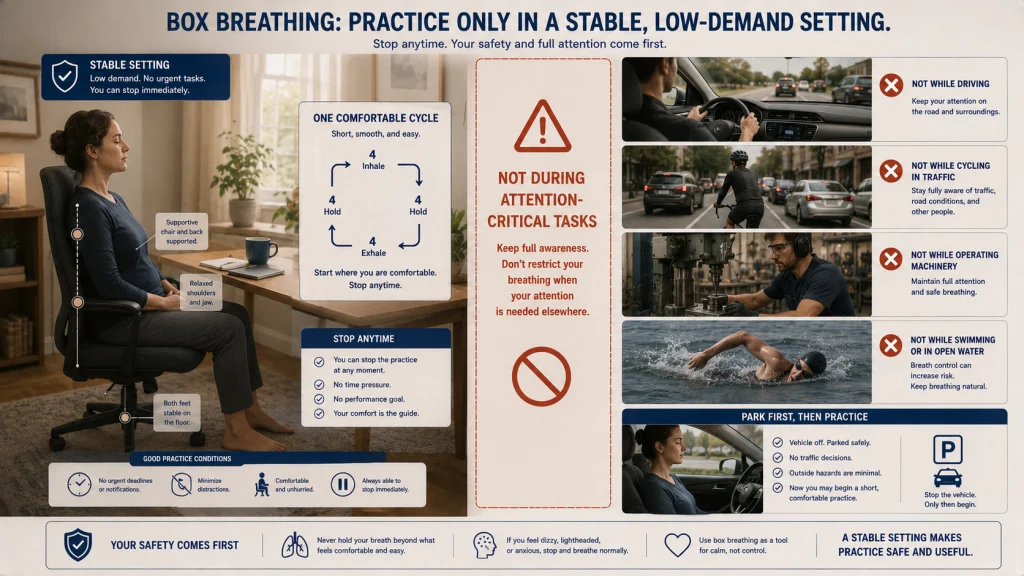
Practice first when your surroundings do not require immediate attention. A supportive chair at a desk, a quiet moment before a difficult conversation, or the transition after finishing a task can provide enough space to notice whether the pattern is actually comfortable.
Learning it while calm also lets you test the count without asking the method to fix a stressful situation on the first attempt. Once the sequence feels familiar, you can use one or two cycles as a brief pause before deciding what action the situation still needs.
Box breathing does not remove a deadline, resolve conflict, replace rest, or make an unsafe setting safe. It is one body-first option within a broader approach to managing everyday stress.
Safety warning: Do not practice box breathing while driving, cycling in traffic, operating machinery, swimming, or doing anything that requires continuous attention and an unrestricted breathing pattern.
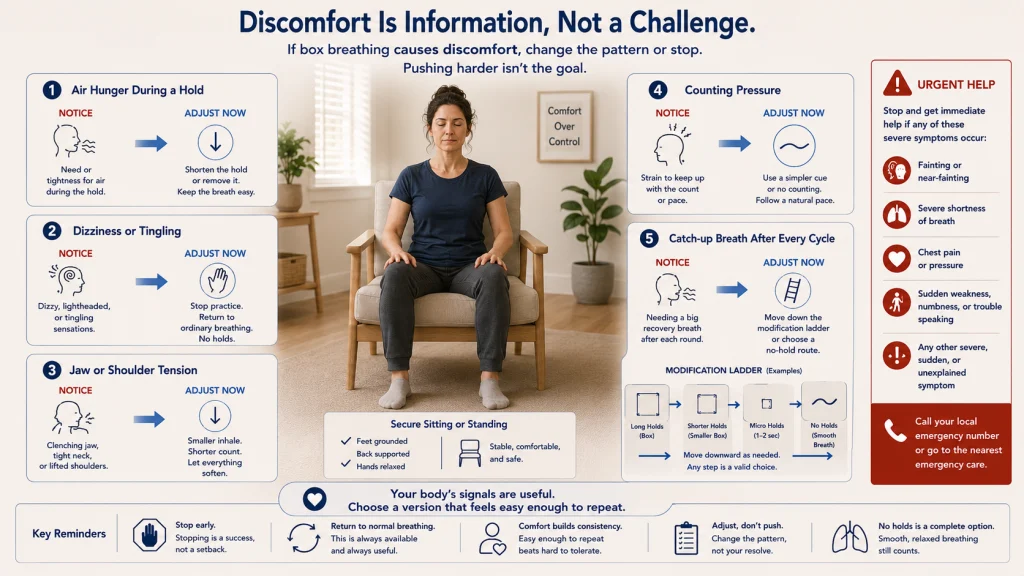
Troubleshoot Discomfort Without Pushing Through
Discomfort is information, not proof that the technique is working. Use the first sign of strain to change the pattern rather than treating the count as an obligation.
| What you notice | Likely practice issue | Immediate adjustment |
|---|---|---|
| Air hunger during a hold | The pause is too long or poorly timed for today | Shorten or remove the hold and return to normal breathing |
| Dizziness or tingling | The breath may be too large, too fast, or too effortful | Stop the exercise, breathe normally, and sit or stand securely |
| Shoulders or jaw tightening | The inhale is becoming a performance task | Reduce breath size and use a shorter count |
| Counting pressure | The cue is adding mental work | Use a simpler cue or stop counting |
| Large recovery breath after each cycle | The full square is not repeatable | Move down the modification ladder or choose a no-hold method |
Safety warning: Stop immediately if you feel faint, severely short of breath, have chest pain or pressure, develop sudden weakness, or notice other severe or unexplained symptoms. Seek appropriate urgent help rather than continuing the exercise.
For a fuller review of discomfort across breathing methods, use the guide to dizziness during breathing exercises.
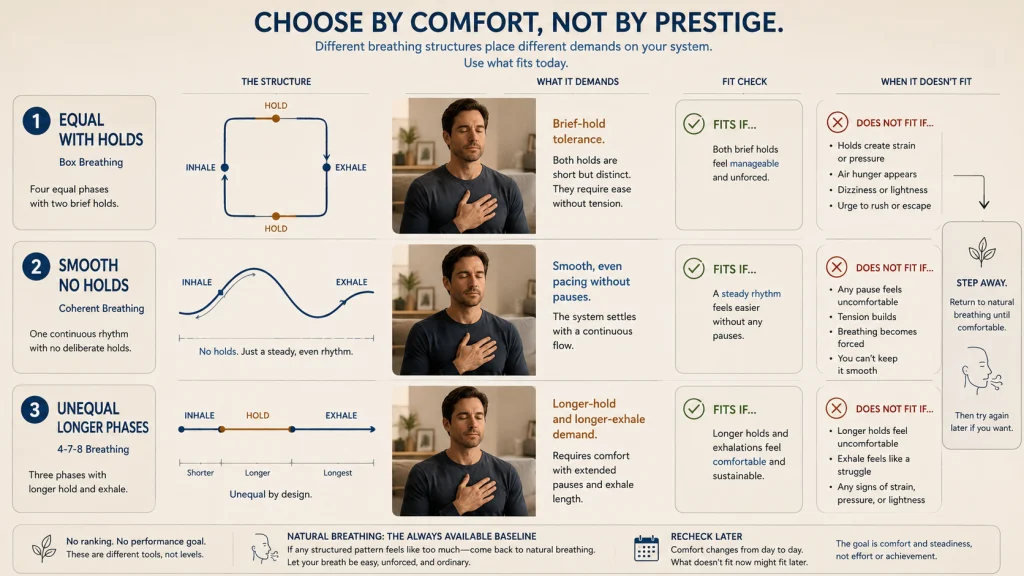
Compare Box Breathing With Other Patterns
The method name matters less than the demand it places on your breath. Equal phases, no-hold pacing, and unequal counts can feel very different even when each is described as a relaxation exercise.
| Method | Basic structure | May fit when | May not fit when |
|---|---|---|---|
| Box breathing | Equal inhale, hold, exhale, and empty hold | Brief pauses and equal counting feel manageable | Either hold creates urgency, dizziness, or pressure |
| Coherent breathing | Smooth paced inhale and exhale without holds | You want a steady rhythm with fewer phase changes | Any deliberate pacing makes the breath feel forced |
| 4-7-8 breathing | Unequal phases with a relatively longer hold and exhale | You already tolerate longer pauses and uneven counts comfortably | Longer holds or exhalations create air hunger |
Readers considering the unequal pattern can review how 4-7-8 breathing changes the timing. For a broader comparison by tolerance, setting, and complexity, see the guide to breathing exercises for ordinary stress.
Know When Self-Guided Practice Should Stop
End the practice when breathing no longer feels voluntary and manageable. Air hunger, repeated dizziness, worsening discomfort, chest symptoms, or a sense that you must force the next phase are reasons to stop, not cues to develop more tolerance.
New, severe, persistent, worsening, unexplained, or function-limiting symptoms require qualified evaluation. Unexplained breathing difficulty or cardiovascular symptoms should not be treated as a technique problem. Chest pain, severe shortness of breath, fainting, stroke signs, immediate danger, or self-harm thoughts require urgent help.
People with medical conditions, recent illness or surgery, pregnancy-related concerns, or prior instructions about breath holding may need individualized guidance before using a hold-based pattern. Box breathing is a lifestyle relaxation practice, not respiratory therapy or a replacement for medical care.
Choose a Square You Can Repeat Comfortably
Begin with one short cycle in a stable setting. Keep the breath normal-sized, use a count that does not create urgency, and treat either hold as optional when it feels strained.
The method fits when all four phases remain quiet, controllable, and repeatable. When symmetry turns calm into a test, shorten the pattern, remove the holds, or choose another method that asks less of your breath.
FAQs
🟦 Does every phase have to last four seconds?
No. Four is a familiar example, but equal timing is the defining structure. Use a shorter count when that makes the cycle easier to complete without strain.
⏱️ Is a count the same as one second?
Not necessarily. A count can be an internal pacing cue rather than exact stopwatch timing. A steady and comfortable rhythm matters more than matching a precise duration.
🫁 What should I do if the hold feels uncomfortable?
Shorten or remove the hold and return to normal breathing. Do not push through air hunger, dizziness, or chest discomfort to complete the square.
🔄 Can I use box breathing without either hold?
You can use equal inhale and exhale timing without holds, but that is no longer the full box structure. A no-hold pattern may still be a better fit when pauses are uncomfortable.
🪑 Where should I practice it first?
Choose a stable, low-demand setting where you can stop immediately. A supportive chair at a desk or a quiet moment after completing a task can work better than trying it during movement or urgent activity.
🚗 Can I practice while driving?
No. Driving requires continuous attention, and deliberate breath holds can be distracting or uncomfortable. Practice only after the vehicle is safely parked and you are no longer responsible for traffic decisions.
🧭 How do I know another method fits better?
Choose another method when equal counting or either hold repeatedly creates pressure, air hunger, or dizziness. A smooth no-hold rhythm or basic diaphragmatic pattern may place fewer demands on the breath.