A smart ring and a slim fitness tracker can both feel simpler than a smartwatch, but they create different feedback loops. A ring often keeps the hardware quiet and moves more review to the phone, while a tracker can provide visible goals, vibrations, timers, or workout feedback on the wrist. The better choice depends on body location, fit system, phone dependence, activity interference, charging, membership, and replacement risk. Test the workflow and fit before the return deadline, then choose the form that supports the actions you will actually repeat.
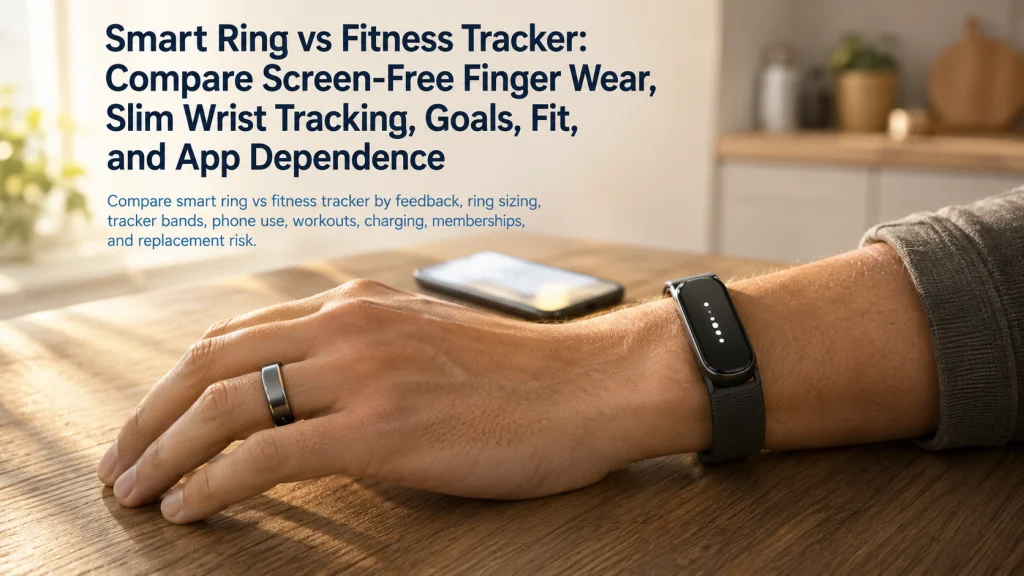
See how two minimal devices create different feedback loops
Imagine the same movement goal appearing in two systems. A slim tracker vibrates on the wrist and shows a small reminder. A ring collects information quietly, then the related prompt appears when the phone app is opened.
Both devices can look equally quiet in a product photo. The contrast appears later, when one person glances at a wrist prompt without breaking stride and another remembers at dinner that the ring data has been waiting in the phone all day.
The device with less visible hardware can demand more deliberate phone checking.
Define screen-free collection and slim wrist feedback
Screen-free collection means the device can remain in the background while detailed information lives elsewhere. A smart ring usually fits this pattern because the finger-worn hardware offers little room for text, charts, or multi-step controls. The phone app becomes the main place for trend review, settings, tags, and explanations.
Slim wrist feedback means the wearable can show or signal a limited amount of information without becoming a full wrist computer. A fitness tracker may provide a small display, vibrations, buttons, touch controls, simple goals, activity screens, or timers. Exact behavior varies widely across current products.
Category names are only a starting point. Before the shortlist becomes a purchase, check the current device page for phone support, operating-system requirements, region limits, app access, membership terms, charger, return policy, and software support.
Key decision: Choose whether feedback should appear on the body during the day or wait in the phone until you decide to review it.
Decide whether live goals, timers, or workout feedback matter
A feature deserves weight only when it changes a repeated decision. Someone who wants a quiet overnight record may be perfectly comfortable reviewing trends over breakfast. Someone else may need a timer during a walk or a vibration before a long desk session ends. The useful form is the one that matches those real moments.
List the actions that must happen before the phone is opened:
- Start, pause, or stop an activity.
- Check a timer or elapsed time.
- View a simple goal or progress cue.
- Feel a reminder or selected alert.
- See a live metric during movement.
- Confirm that an activity is recording.
Then mark each action as daily, weekly, occasional, or unnecessary. A rarely used wrist feature should not outweigh daily band discomfort or charging friction. Quiet hardware should not outweigh the annoyance of opening the phone again and again when immediate feedback genuinely matters.
Use the fitness tracker goal-setting guide when the main question is how to configure reminders and goals rather than which form to wear.
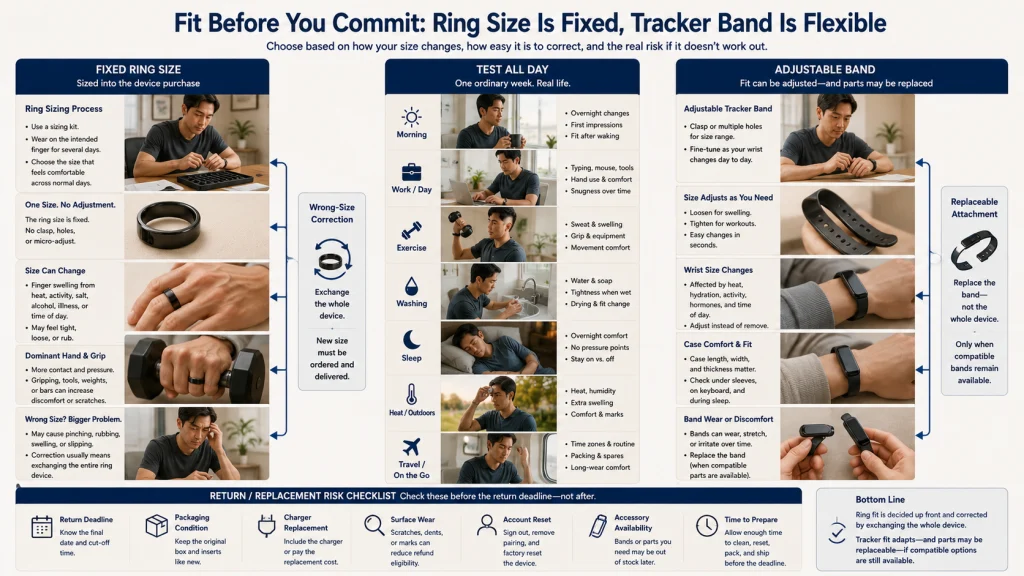
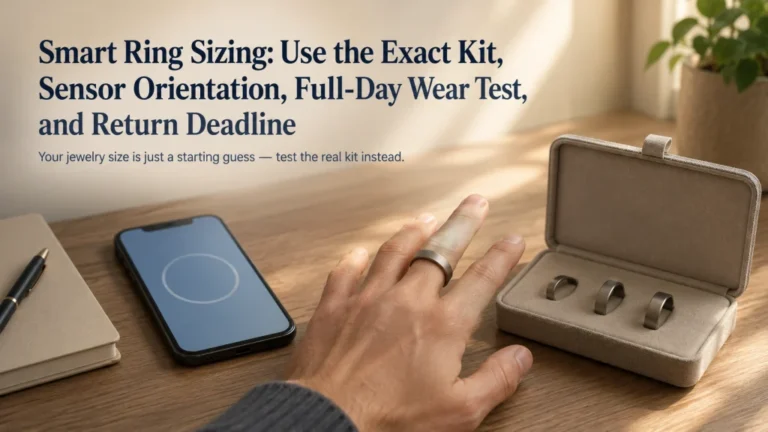
Compare fixed ring sizing with adjustable or replaceable bands
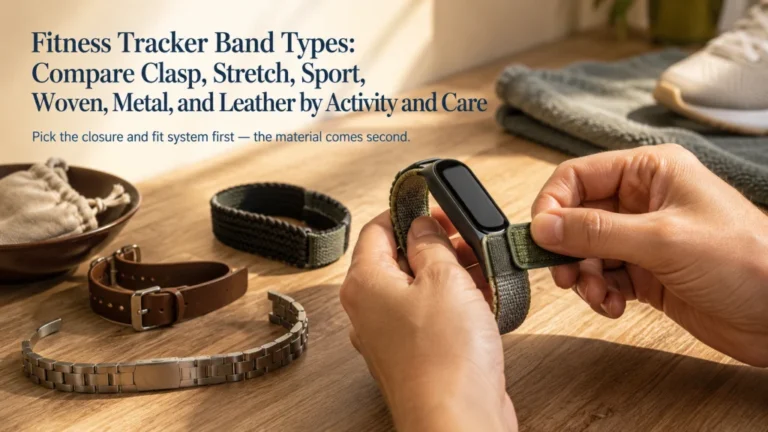
The fit system changes how easily a bad choice can be corrected. A fixed ring size follows the finger through heat, travel, washing, sleep, and swelling. An adjustable wrist band gives more room to respond, and the attachment may be replaceable even when the tracker body remains useful.
| Fit question | Smart ring | Slim fitness tracker |
|---|---|---|
| Initial sizing | May require a dedicated sizing process before final purchase. | Usually adjusts through holes, a clasp, or another band mechanism. |
| Daily size variation | Finger swelling, temperature, travel, hydration, and activity can change tightness. | Band tension can often be adjusted when wrist size or comfort changes. |
| Wrong-size correction | May require an exchange or return of the device. | May be solved by adjustment or a different compatible band. |
| Fit location | Finger choice affects grip, dominant-hand use, tools, and surface contact. | Wrist choice affects controls, sleeves, sleep position, and movement. |
| Replacement system | The ring body and fit are usually one purchase decision. | The band may be replaced separately if compatible parts remain available. |
| Return urgency | Daily size changes should be tested early in the return period. | Case comfort and band fit should be tested across work, sleep, and exercise. |
A brief fitting does not reveal the whole day. Morning comfort can change after carrying bags, washing dishes, working at a keyboard, exercising, or sleeping. Test each form in the ordinary situations that will decide whether it stays on the body.
Use the smart ring sizing guide for the finger-fit purchasing process, or the fitness tracker band guide when the wrist attachment is the remaining decision.
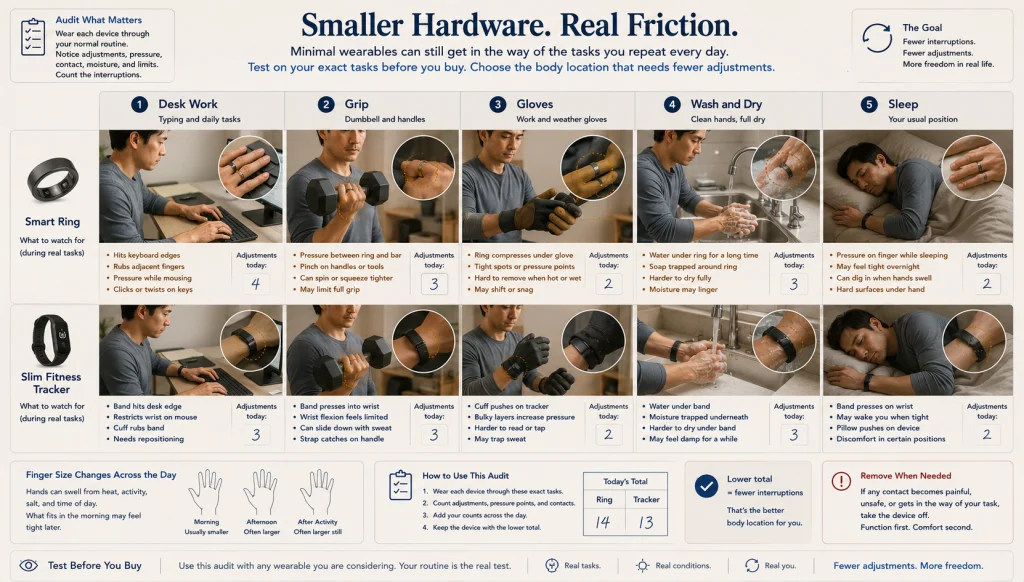
Audit interference during work, lifting, gloves, and sleep
Minimal hardware can still announce itself during ordinary movement. A ring meets every firm grip, from a grocery handle to a dumbbell. A tracker meets cuffs, gloves, desk edges, bent wrists, and the side of a pillow. These small contacts matter because they repeat long after setup day.
| Activity | Finger-worn concerns | Wrist-worn concerns | Test before deciding |
|---|---|---|---|
| Typing and desk work | The ring may contact a keyboard, desk, mouse, or adjacent fingers. | The tracker may press against the desk edge or sit under a cuff. | Complete a normal work session without repeatedly adjusting the device. |
| Lifting and gripping | Bars, dumbbells, handles, and tools may press the ring against the finger. | Wrist movement, gloves, wraps, or equipment may contact the case or band. | Test the exact grip and movement used in ordinary exercise or work. |
| Gloves | A tight glove may compress the ring or make removal difficult. | A cuff or glove may overlap the tracker. | Wear the actual work, weather, or exercise gloves you use. |
| Hand washing and moisture | Moisture may collect around the finger or beneath the ring. | Sweat and water may remain beneath the band. | Clean and dry the area according to current device guidance. |
| Overnight wear | Finger swelling or contact between fingers may become noticeable. | The band, case, or wrist position may press against the pillow or skin. | Sleep in the usual position for several nights within the return window. |
Smaller hardware is not automatically forgettable. The better location is the one that asks for the fewest adjustments during the tasks performed most often.
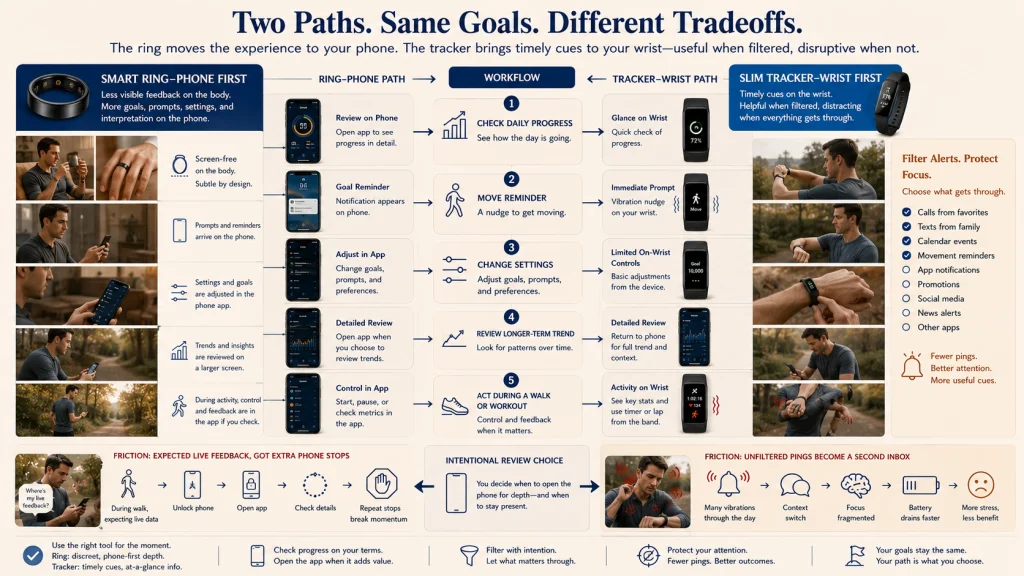
Compare notifications, goals, display, and phone dependence
Keeping alerts off the body can feel calmer, yet the information may remain unseen until the app is opened. Wrist feedback solves that delay for simple prompts, but an unfiltered stream of vibrations can become another source of interruption.
| Task | Ring-centered path | Tracker-centered path |
|---|---|---|
| Check daily progress | Open the phone app and review the current summary. | Glance at the small display or open the phone for more detail. |
| Receive a goal reminder | The phone app may deliver the prompt. | The device may vibrate or show a simple reminder. |
| Change settings | Use the phone app for most configuration. | Use the phone app, with limited settings possibly available on the device. |
| Review a trend | The phone is the primary interpretation screen. | The wrist may show a summary, while the phone handles detailed review. |
| Act during movement | The phone may be needed to start or view the activity. | The tracker may provide direct controls or live feedback when supported. |
Phone dependence is not automatically a disadvantage. A larger screen can make trends easier to understand, and choosing when to look may feel more intentional. The mismatch appears when the person expected live feedback but keeps stopping to unlock the phone.
Use the broader wearable form comparison when a smartwatch remains part of the decision.
Compare workout start, GPS configuration, and live metrics
The exercise workflow should be examined before, during, and after the activity. Before starting, note whether the phone must be opened or whether the device can begin recording on its own. During movement, decide whether a timer, route, pace, or simple metric needs to remain visible. Afterward, decide where the real review will happen.
Location behavior is product-specific. Some setups lean on the phone, some include their own location hardware, and some change behavior by activity or setting. Recording a route does not guarantee that directions or a map appear live on the device.
This comparison does not rank measurement accuracy. The only safe conclusion at category level is that sensors, algorithms, exercise modes, and display behavior must be checked in the current documentation for the device under consideration.
Use the activity tracking guide when exercise recording and location behavior need closer review. Use the smart ring and smartwatch comparison when immediate maps, apps, calls, or broader wrist control may justify a larger device.
Compare charger, battery routine, app, membership, and account
Battery claims do not reveal the moment the device has to come off. One form may use a dedicated cradle, while another relies on a clip, magnetic cable, or connector that changes across product lines. The practical question is whether that exact charger fits the user’s routine and remains easy to replace.
Ask when the device can be removed without losing the period you care about. Someone focused on overnight trends may need a daytime charging window. Someone focused on workday goals may prefer charging during a shower or before bed. Travel adds questions about spare cables, adapters, packing, and replacement access.
The app, membership, and account belong in the same ownership decision:
- Which desired features are included, paid, trial-based, or unavailable?
- What account information is required for setup and recovery?
- Does the device support the current phone and operating system?
- Can the user retrieve or export the information that matters?
- What happens to useful features if a membership ends?
- Is the device still receiving expected software and security support?
Health boundary: A consumer wearable, app, score, alert, or estimate does not provide a diagnosis, medical clearance, or treatment plan. Concerning symptoms require appropriate medical attention regardless of what the device displays.
Compare return and replacement risk
The form factor changes what is likely to end useful ownership first. A sizing mistake can affect the entire ring purchase, while a worn tracker band may be a smaller problem only when compatible replacements still exist. Chargers, clasps, adapters, accounts, and discontinued accessories can matter as much as the sensor hardware.
| Replacement-risk check | Question to answer before the deadline |
|---|---|
| Return date | What is the final date, required condition, packaging rule, and possible fee? |
| Ring sizing | Has fit been tested across the day, sleep, heat, activity, and ordinary swelling? |
| Band availability | Can the tracker band be replaced, and are compatible sizes and materials available? |
| Charger replacement | Can a compatible charger be obtained without replacing the device? |
| Surface wear | Does ordinary work or exercise expose the ring, display, case, or band to repeated contact? |
| Account transfer | Can the device be reset, transferred, or resold without an account problem? |
| Comfort test | Has the device been worn through work, exercise, washing, sleep, and travel-like conditions? |
| Decision timing | Is there enough time left to clean, reset, package, and return the device correctly? |
Current-policy warning: Return conditions, size exchanges, subscriptions, compatibility, materials, water resistance, and feature availability can change. Confirm the terms shown by the seller and device documentation for the region and purchase date.
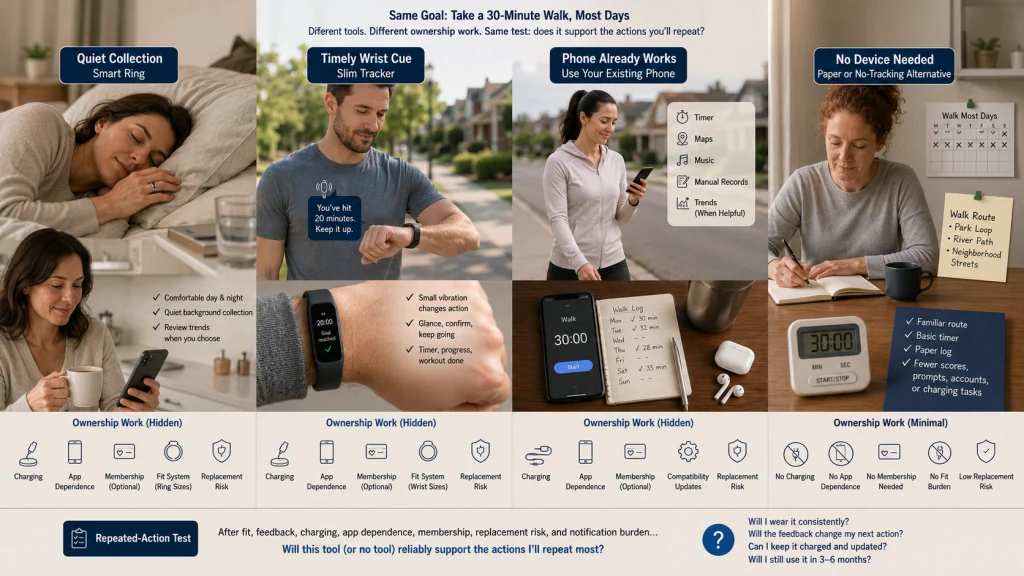
Run ring, tracker, phone-only, and no-device scenarios
Scenario 1: A ring supports quiet collection
The reader wants minimal visible feedback on the body, does not need live goals or timers, and prefers to review trends on the phone at chosen times. Finger fit remains comfortable through sleep, work, hand washing, and ordinary grip tasks. A ring may fit if the app, membership, charger, compatibility, and return conditions are acceptable.
Scenario 2: A tracker supports small but timely feedback
The reader wants a vibration, simple progress glance, timer, or workout confirmation without opening the phone. An adjustable band fits comfortably, and notifications can be limited to the few prompts that change action. A tracker may offer the useful middle ground between phone-only review and a larger smartwatch interface.
Scenario 3: The phone already provides enough information
The reader carries a phone during activities, checks trends only at home, and does not need reminders on the body. The phone already handles timers, maps, music, and manual records. A phone-only setup avoids another charger, fit system, app connection, and replacement problem.
Scenario 4: No device supports the goal better
The reader does not use recorded data to make a repeated decision and wants fewer prompts, scores, and charging tasks. A paper log, wall calendar, basic timer, familiar route, or no tracking may support the intended routine with less friction.
Use the smartwatch and fitness tracker comparison when a larger wrist interface remains under consideration.
Choose feedback, body location, fit system, phone dependence, and cost
Write the final decision in five lines:
- Feedback: State which reminders, goals, timers, or workout details must appear on the device.
- Body location: Choose finger or wrist based on work, grip, gloves, washing, exercise, and sleep.
- Fit system: Decide whether fixed ring sizing or an adjustable and replaceable band fits the household better.
- Phone dependence: Name which actions can wait for the app and which must happen without opening the phone.
- Cost: Include the device, membership, replacement band, charger, accessories, and return risk.
Use the broader wearable health technology guide when the real question is whether tracking belongs in the goal. Use the sleep and recovery tracking guide when overnight information is the main reason for considering either form.
A ring and a slim tracker can both look simple on day one. The better choice is the one that still feels simple after a week of charging, hand washing, phone review, reminders, workouts, sleep, and ordinary household movement.
FAQs
💍 Is a smart ring more screen-free than a fitness tracker?
A ring usually places more review in the phone app because there is little or no display on the device. A tracker may offer a small screen, vibrations, goals, timers, or workout information, but exact behavior varies by model.
📳 Which form is better for reminders?
A tracker may provide more direct wrist reminders when supported, while a ring may rely more on phone prompts. Choose by whether the reminder must appear during the activity or can wait for app review.
📏 Is ring sizing harder than fitting a tracker band?
Ring sizing is less adjustable and can change with finger swelling, temperature, travel, and activity. A tracker band may be adjusted or replaced, but compatibility and replacement availability still need verification.
🏋️ Can a smart ring interfere with lifting or gripping?
Bars, dumbbells, handles, tools, and gloves can press the ring against the finger or increase surface contact. Test the exact tasks you perform and follow current care guidance for the device.
📱 Which device needs the phone more often?
A ring often places more interpretation and control in the phone app, while a tracker may handle simple glances and controls on the wrist. Setup, updates, detailed review, and account management may still require the phone for either form.
🗺️ Does a fitness tracker always have GPS?
No. Location behavior can be built in, connected through the phone, limited to certain activities, or unavailable. Confirm the exact current product and the workflow you need.
🔌 Which form is easier to charge?
Neither category has a universal advantage. Compare the exact charger, charging window, replacement access, travel setup, and whether charging conflicts with the period you want to track.
🩺 Can either device tell me whether I am healthy?
No consumer wearable, sensor, app, score, alert, or estimate provides a diagnosis, medical clearance, or treatment plan. Seek appropriate medical attention for concerning symptoms regardless of the device reading.