Accepting help as you age does not have to mean handing over an entire part of life. Start by naming what you want to protect, identify the exact objection, and define the smallest useful support with clear limits. Keep consent, privacy, timing, cost, and a stop rule visible from the beginning. A short trial can show whether the arrangement protects energy, access, confidence, and valued activities without reducing decision control.
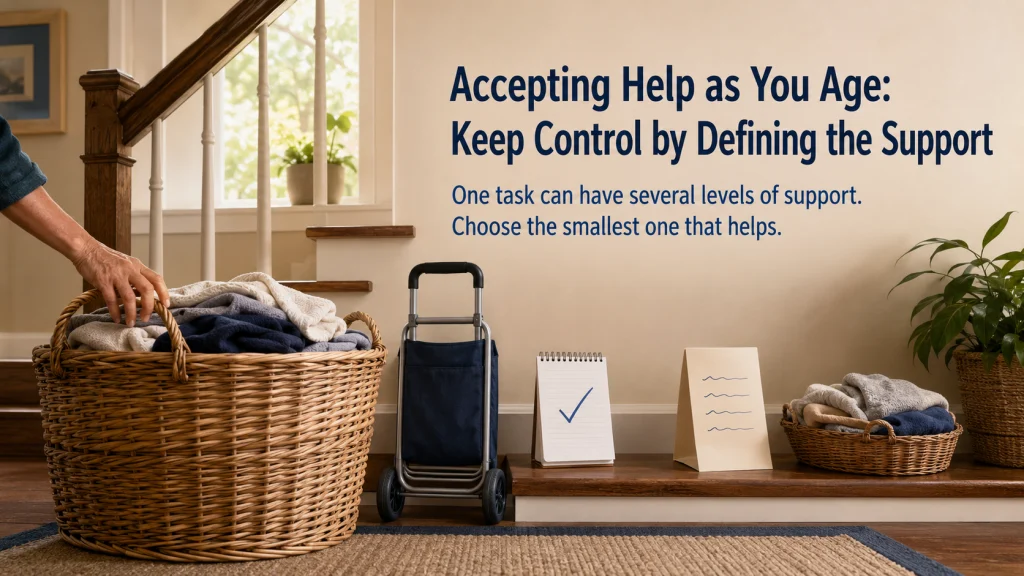
One Difficult Task Can Have Several Levels of Support
A task card on the table reads, “Carry laundry downstairs.” Beside it are four possible responses: use smaller loads, use a cart where the floor allows, ask for help only on stair days, or arrange a full laundry service.
Those choices are not equal. They change who does the task, how often support enters the home, how much privacy is involved, what it costs, and which parts remain under your direction. A small task can carry more emotional weight than its size suggests because it may feel like the first sign that other people will begin making decisions for you. Saying yes to one option does not mean saying yes to all of them.
Key decision: Define the help before deciding whether to accept it.
The same method applies to rides, deliveries, reminders, household tasks, technology setup, paperwork, and other non-emergency support. Instead of deciding whether you are a person who accepts help, decide what task is changing, what stays yours, who is involved, and how the arrangement can be reviewed or stopped.
The broader healthy aging guide places support within daily function, relationships, and meaningful activity. The guide to staying independent as you age focuses on preserving choice while routines and resources change.
Name What Independence Means to You
The word independence can hide several different priorities. One person may care most about privacy. Another may care about choosing the schedule, remaining in a familiar location, continuing a valued role, or deciding who enters the home.
Write down the two or three parts that matter most:
- Choice: I want to decide among available options.
- Privacy: I want personal spaces, information, and routines respected.
- Contribution: I want to keep doing something useful for other people.
- Routine: I want the day to follow a rhythm that feels familiar.
- Location: I want to keep access to home, community, or meaningful places.
- Self-respect: I want to be spoken with directly and included in decisions.
A support arrangement can protect one priority while interfering with another. A grocery delivery may preserve energy and home access but feel intrusive if substitutions are made without permission. A ride may preserve community activity but reduce control if the pickup window is unpredictable.
Planning note: Support is useful only when it protects the parts of independence that matter to you. Write those priorities at the top of the agreement so the practical arrangement serves them.
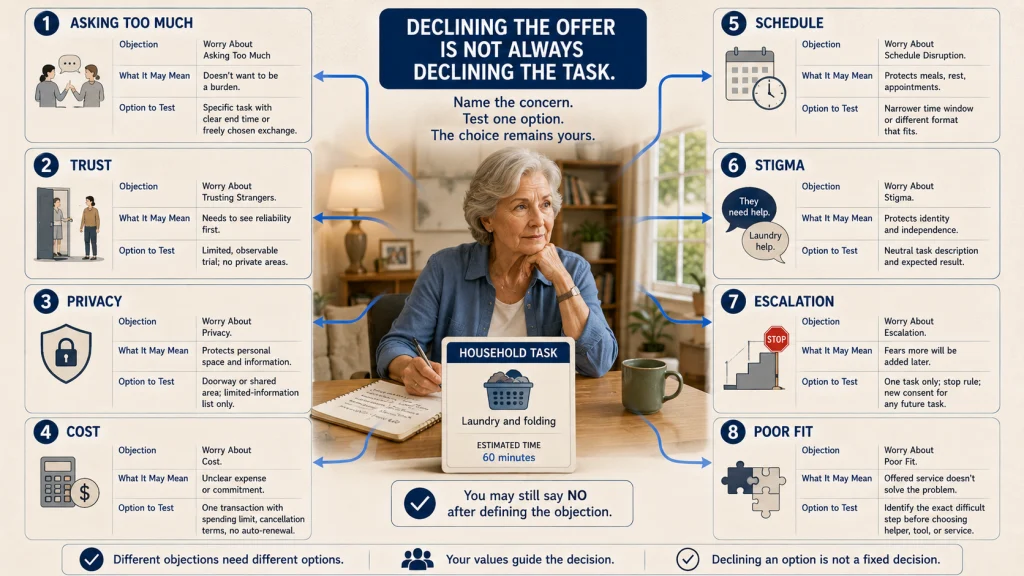
Identify the Real Objection
A refusal may sound like, “I do not want help,” while the actual objection is more specific. The person may not trust the helper, may dislike the schedule, may worry about cost, or may fear that one accepted task will lead to someone taking over several others.
| Objection | What it may mean | Option to test |
|---|---|---|
| Worry about asking too much | The request feels open-ended or unfair to the other person. | Ask for one defined task and offer a clear end time or exchange. |
| Trust | The person, service, or process has not earned access yet. | Use a limited trial with an observable task and no private areas involved. |
| Privacy | The support enters a personal space or exposes information. | Move the task to a doorway, common area, or shared list with limited details. |
| Cost | The price, cancellation rule, or ongoing commitment is unclear. | Set a spending limit and test one transaction before agreeing to regular service. |
| Schedule | The arrival window disrupts meals, rest, appointments, or valued activities. | Choose a narrower time or a different support format. |
| Stigma | The arrangement feels like a label rather than a practical tool. | Describe the task and result without attaching an identity to it. |
| Fear of escalation | One small yes feels like permission for future decisions. | Write a stop rule and state that every new task requires a separate agreement. |
| Poor fit | The offered support solves a different problem than the one you have. | Redefine the exact difficult step before choosing a person, service, or tool. |
Once the objection is named, the decision becomes more precise. You may still decline the offer, but you will know whether you are declining the task itself or the person, schedule, cost, location, or loss of control attached to it.
Separate Support From Surrendering the Whole Task
A task is usually a chain of smaller actions. Accepting support for one step does not require transferring the planning, choices, or final decision.
Consider grocery shopping. It includes choosing meals, making a list, reaching the store, selecting items, paying, carrying bags, and putting food away. If carrying is difficult, another person can move the bags while you keep control of the list, budget, substitutions, and storage.
Use the same breakdown for other routines:
- A ride can cover transportation while you choose the destination and appointment time.
- A reminder can prompt a task while you decide whether and when to complete it.
- Household support can handle one physically demanding step while you direct priorities.
- Technology help can complete setup while you keep account access and notification choices.
- Paperwork support can organize documents without making the final decision.
This task-level approach removes the false choice between doing everything and giving everything away. It creates room for a smaller arrangement that protects the parts you still want to manage.
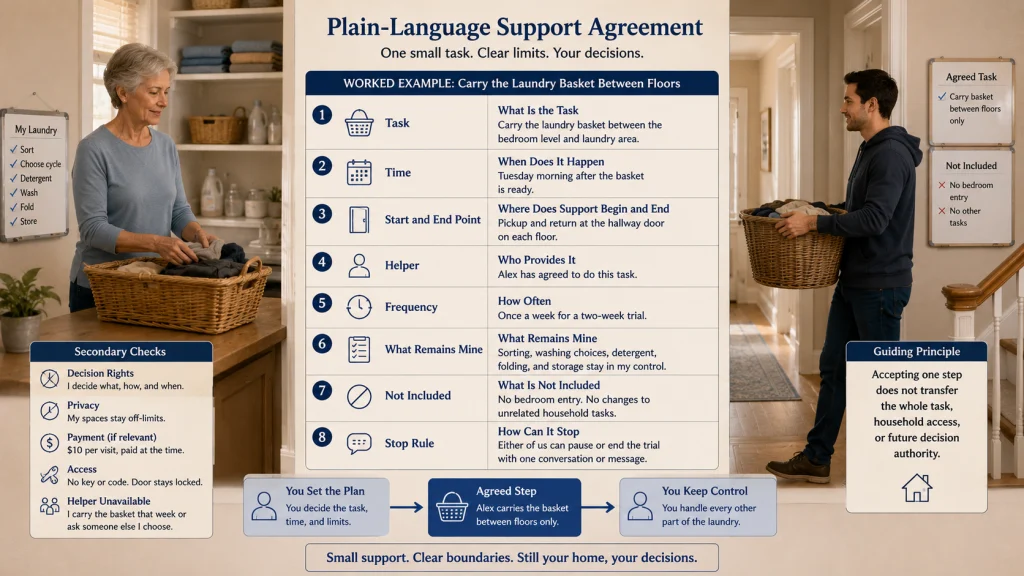
Define the Task Boundary Before Support Begins
A clear agreement reduces uncertainty for both people. It should describe the task, timing, location, frequency, decision rights, and stop rule in plain language.
| Boundary question | Example agreement |
|---|---|
| What is the task? | Carry the laundry basket between the bedroom level and the laundry area. |
| When does it happen? | Tuesday morning after the basket is ready. |
| Where does support begin and end? | Pickup at the hallway door and return to the same place. |
| Who provides it? | A named neighbor who has agreed to this task. |
| How often? | Once a week for two weeks. |
| What remains mine? | Sorting, washing choices, detergent, folding, and storage. |
| What is not included? | No entry into the bedroom and no changes to other household tasks. |
| How can it stop? | Either person can end the trial after one conversation or message. |
Write the agreement down when memory, scheduling, payment, access, or more than one person is involved. A written boundary does not need to be formal. Its purpose is to prevent assumptions from growing around a small task.
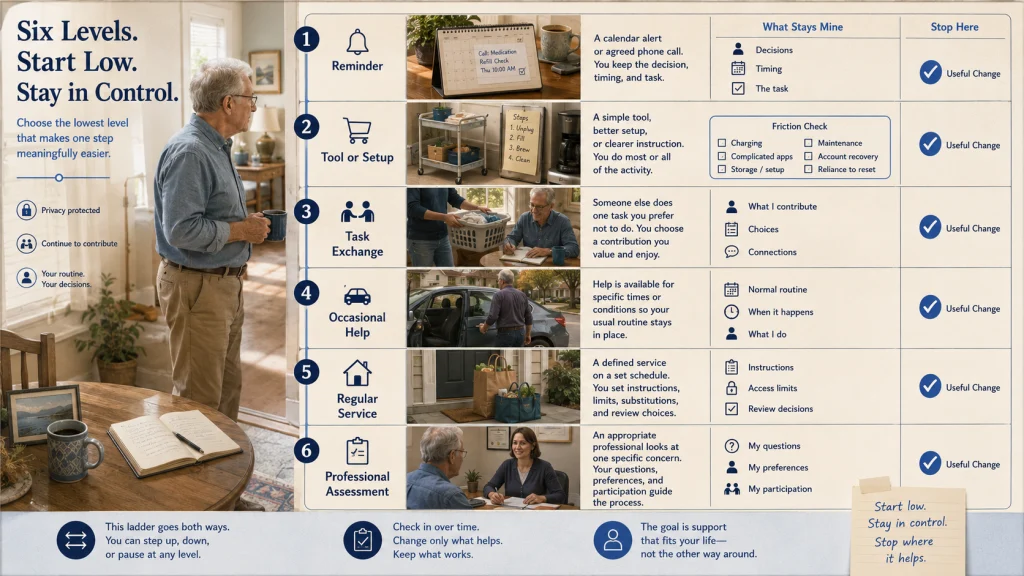
Choose the Smallest Useful Support
Start at the lowest level that meaningfully changes the difficult step. More support is not automatically better if it creates new problems with privacy, cost, maintenance, or control.
| Support level | Example | What stays under your direction |
|---|---|---|
| Reminder | A calendar alert or agreed phone call before a task. | The decision, timing, and task itself. |
| Tool or setup change | A cart, easier storage location, written instructions, or simplified device setting. | Most or all of the activity. |
| Task exchange | Someone carries laundry while you prepare a meal or complete another preferred task. | Contribution and a balanced agreement. |
| Occasional support | A ride only for evening appointments or poor-weather days. | The usual routine on other days. |
| Regular service | A defined household or delivery task on a set schedule. | Instructions, access limits, and review decisions. |
| Professional assessment | An appropriate professional evaluates a specific functional or safety concern. | Your questions, preferences, and participation in next decisions. |
Editorial observation: A support tool can remove one difficult step and still create three new ones if it needs frequent charging, a complicated app, awkward storage, or another person to reset it. Count setup and maintenance before deciding that equipment adds control.
The guide to understanding everyday task difficulty can help identify which step is changing without turning the observation into a diagnosis.
Keep Consent and Stop Rules Visible
Consent should continue after the first yes. It is not a permanent transfer of authority. The arrangement should remain understandable, voluntary, and limited to the agreed task unless immediate safety or essential needs require a different response.
Include these rules:
- Every new task requires a separate conversation.
- The helper asks before changing the method, schedule, location, or person involved.
- Private spaces and information remain off-limits unless specifically included.
- The person receiving support can pause or stop the arrangement.
- The helper can state limits instead of making an unspoken commitment.
- Disagreement triggers review, not automatic expansion of support.
A stop rule makes a trial easier to accept because it prevents a small arrangement from feeling permanent. It also protects the helper from an undefined role that quietly expands.
Simple stop rule: “We will try this task for two weeks. Either of us can pause it. Any change in task, schedule, access, or cost requires a new agreement.”
Preserve Contribution Through Task Exchange
Receiving support can feel less one-sided when contribution remains visible. The exchange does not need to have equal financial value or require physical effort. It needs to be freely chosen and realistic.
Task-exchange example: A neighbor carries a laundry basket on stair days. In return, you place a grocery order for both households, water plants during a trip, share a meal, make a check-in call, or contribute another task you genuinely want to do.
Contribution may also take the form of knowledge, companionship, planning, listening, coordinating, teaching, pet care, or maintaining a shared routine. Do not create an exchange that becomes another demanding obligation.
Some people find the idea of interdependence useful: different people contribute different strengths at different times. Use that reframe only when it feels respectful. You do not need to adopt a label to create a balanced arrangement.
Test Trust With a Limited, Observable Arrangement
Trust does not need to be decided all at once. Begin with a task that has clear boundaries, a short time frame, and a result you can observe.
A useful first trust test might involve:
- A ride to one familiar destination with an agreed pickup time.
- A delivery left at the door rather than carried through the home.
- A technology setup completed while you remain present and keep passwords private.
- A household task limited to one room or exterior area.
- A reminder call at a set time with no follow-up unless requested.
Afterward, ask whether the person arrived as agreed, followed instructions, respected privacy, communicated changes, and accepted correction without taking over. Trust grows from repeated behavior, not from a role title or family connection alone.
Family, friends, neighbors, community resources, and paid services can all be helpful or unsuitable depending on the task and relationship. Do not assume any one category is automatically available, safe, free, or preferred.
Evaluate Privacy, Reliability, Cost, Setup, and Maintenance
The support itself may be simple while the surrounding process is not. A ride requires booking. A delivery may require an app and substitutions. A reminder device may require charging, updates, account recovery, and someone who understands its settings.
| Friction area | Question to answer |
|---|---|
| Privacy | What personal space, schedule, account, or information becomes visible? |
| Reliability | What happens when the person is late, the service is canceled, or the device fails? |
| Cost | What is the full price, including fees, tips, cancellation, maintenance, and replacement? |
| Setup | Who creates the account, installs the equipment, writes instructions, or provides access? |
| Maintenance | Who charges, cleans, updates, repairs, stores, or replaces the solution? |
| Backup | What is the second option when the arrangement is unavailable? |
A support arrangement should reduce more friction than it creates. When it adds repeated calls, uncertain arrival windows, confusing accounts, or maintenance that depends on the same person every time, redesign the arrangement rather than assuming you must accept it as offered.
The technology planning guide can help evaluate setup, charging, connectivity, privacy, and recovery when a device or app is part of the support.
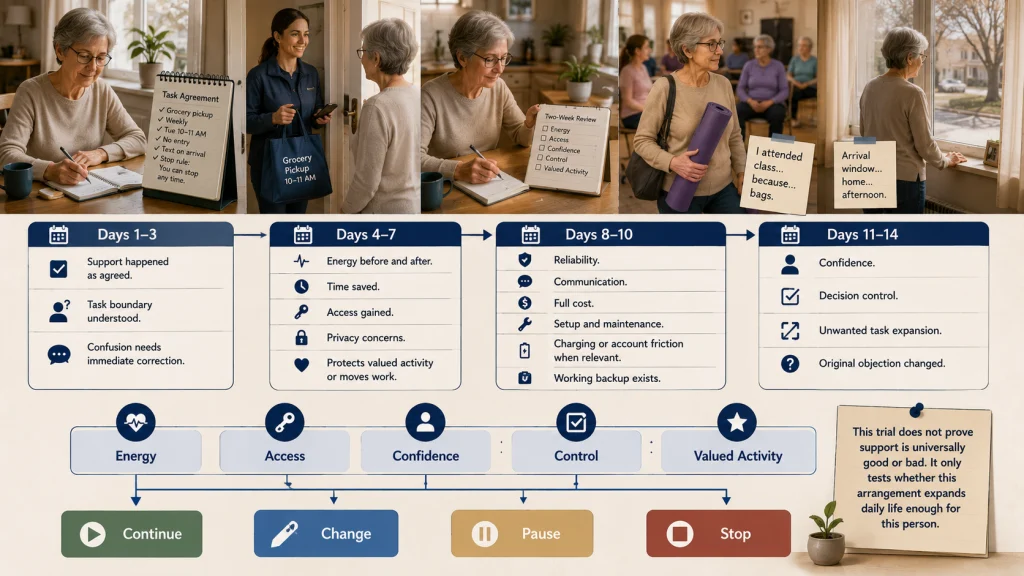
Run a Two-Week Support Trial
A short trial turns a permanent-sounding decision into a practical test. Keep the task and boundaries stable long enough to see whether the arrangement changes daily life in the intended way.
| Trial period | What to record | Question at review |
|---|---|---|
| Days 1 to 3 | Did the support happen as agreed? Was the task boundary clear? | What confusion needs immediate correction? |
| Days 4 to 7 | Energy before and after, access gained, time saved, and privacy concerns. | Does the support protect a valued activity or merely move work elsewhere? |
| Days 8 to 10 | Reliability, communication, cost, setup, maintenance, and backup problems. | Is the arrangement dependable enough to continue? |
| Days 11 to 14 | Confidence, control, unwanted expansion, and whether the original objection changed. | Should the support continue, change, pause, or stop? |
Record practical effects rather than trying to prove that the arrangement is good or bad. Examples include, “I attended the class because I did not spend energy carrying bags,” or, “The arrival window kept me home all afternoon and reduced access rather than improving it.”
At the end, review five outcomes: energy, access, confidence, decision control, and valued activities. Continue only when the balance is useful enough for you and the arrangement remains safe and workable.
Adjust Support When It Is Too Little, Too Much, Unreliable, or Controlling
A trial can fail because the amount is wrong, not because all support is unacceptable. Name the failure before replacing the arrangement.
- Too little: The difficult step remains unchanged or the helper arrives after the need has passed.
- Too much: The helper completes decisions or tasks you wanted to keep.
- Unreliable: Timing, communication, quality, or availability changes without notice.
- Controlling: Advice becomes pressure, privacy limits are ignored, or new tasks are added without consent.
- Too complicated: Setup, booking, payment, charging, or maintenance creates more work than the support removes.
Possible adjustments include narrowing the task, changing the time, choosing another person, moving support to a public or shared space, reducing frequency, adding a backup, or ending the arrangement.
When the main problem is planning across several areas rather than one task, use the later-life planning workbook to map housing, transportation, support contacts, professional questions, and review triggers together.
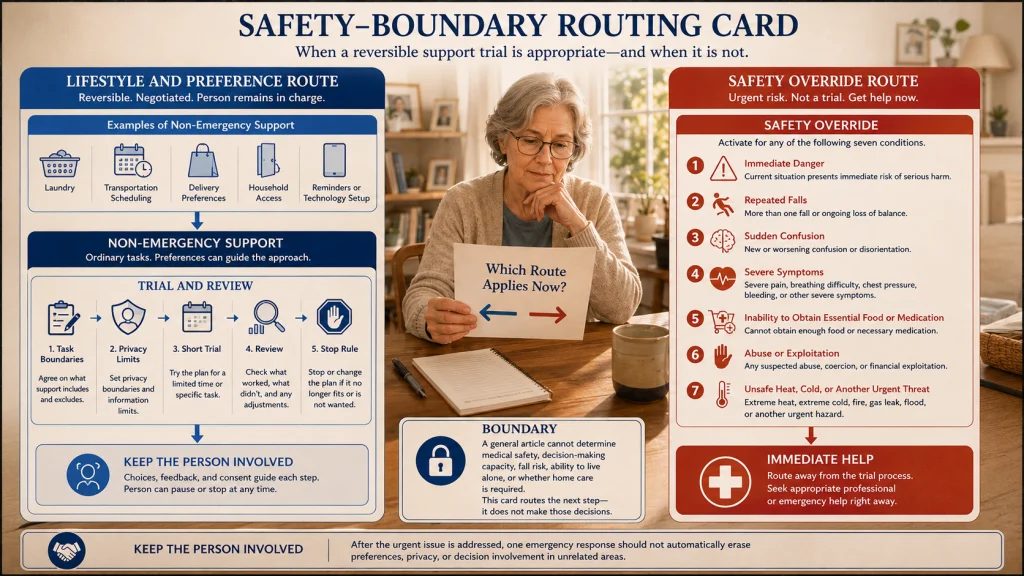
Recognize When Refusal Is No Longer Only a Lifestyle Choice
Most non-emergency support decisions can be tested, negotiated, or declined. The boundary changes when immediate danger or an inability to meet essential needs is present.
Safety boundary: Immediate danger, repeated falls, sudden confusion, severe symptoms, inability to obtain essential food or medication, abuse, exploitation, unsafe heat or cold, or another urgent threat requires appropriate professional or emergency help. Do not hide a serious change, delay urgent assistance, or rely on a support trial when immediate safety is at risk.
This article cannot determine medical safety, decision-making capacity, fall risk, ability to live alone, or whether home care is needed. Those questions require appropriate individualized assessment.
Outside an urgent situation, keep the reader involved, speak directly, and distinguish the immediate safety need from every other life decision. A response to one urgent problem should not automatically erase preferences in unrelated areas.
Write the Task, Boundary, Helper, Trial, and Stop Rule
Begin with one task that has become difficult. Write what support will cover, what remains yours, who will provide it, when and where it happens, how long the trial lasts, and how either person can stop or revise it.
The goal is not to accept every offer. It is to make the decision specific enough that you can protect privacy, contribution, routine, location, and control while gaining useful access or energy.
There may still be sadness or hesitation in changing a task that once felt effortless. That feeling does not make the decision weak or irrational. It is a reason to move carefully, keep your voice visible, and choose support that leaves more of life open to you.
A well-defined arrangement should expand daily life more than it restricts it. If it does not, adjust the task, person, timing, amount, or method until the support fits, or stop the arrangement when it remains unacceptable.
FAQs
🤝 Does accepting support mean losing independence?
Not when the task, limits, timing, and decision rights remain clear. Support can preserve energy, access, and valued routines while you continue directing the parts that matter most.
🧭 How do I decide which help to accept?
Identify the difficult step and the real objection, then choose the smallest support that changes that step. Review privacy, trust, cost, schedule, setup, maintenance, and the stop rule before agreeing.
🔒 How can I protect privacy when someone helps at home?
Define where support begins and ends, which rooms or information are excluded, and whether the task can happen at a doorway or in a shared area. Every expansion should require a separate agreement.
🪜 What is the smallest type of support?
It may be a reminder, tool, setup change, task exchange, occasional ride, or help with one physical step. Start with the lowest level that produces a useful change.
📝 Should the agreement be written down?
Writing helps when the task involves scheduling, access, payment, memory, or several people. A short note can state the task, boundaries, frequency, what remains yours, and how the trial can stop.
🔄 What if the support starts taking over other tasks?
Pause and return to the original agreement. State which additions were not accepted, narrow the task, change the helper, or end the arrangement when boundaries continue to be ignored.
👤 What if family support is unavailable or not preferred?
Consider friends, neighbors, community resources, paid services, technology, and professional roles according to the task. The solo aging guide provides a broader process for building backup without assuming family involvement.
🚨 When is a limited trial not appropriate?
Do not use a trial when there is immediate danger, repeated falls, sudden confusion, severe symptoms, abuse, exploitation, or inability to meet essential needs. Seek appropriate professional or emergency help.