Personal hygiene products are easier to choose when each item has one defined job. Start with the care tasks already selected, match one suitable product or tool to each necessary function, and keep optional grooming, body-specific items, and symptom-driven products outside the basic list. Separate reusable tools from consumables, place active items where they are used, store unopened backups in one zone, and use one refill trigger. The goal is a small working system, not a crowded shelf.
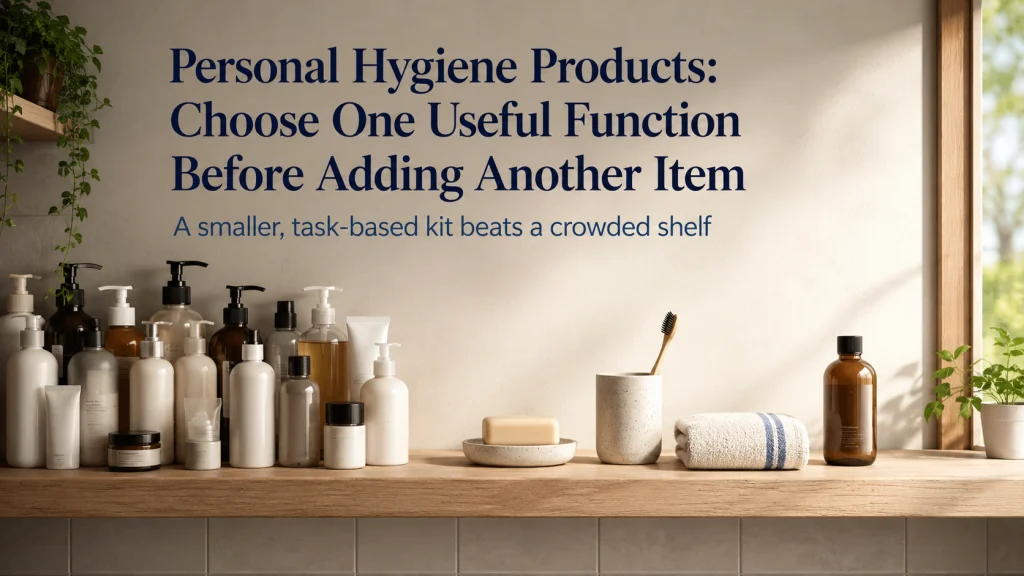
Fourteen Marketed Products Can Solve Fewer Tasks Than a Smaller Kit
Picture two bathroom kits prepared for the same adult routine. The first holds fourteen products. Several carry labels such as fresh, detox, antibacterial, clinical, or extra strength. Two items appear to solve the same cleansing task. Three are optional grooming products. One medicated item was added without a current need or professional direction.
The second kit begins with the care tasks. It contains one item for each necessary function, a small set of reusable tools, one visible active supply, one separate backup zone, and a note beside two tasks that require no specialty purchase.
| Decision area | Fourteen-product kit | Task-based kit |
|---|---|---|
| Starting point | Shelf categories and marketing claims | Tasks already chosen for the routine |
| Function | Several items have overlapping jobs | Each active item has one clear purpose |
| Optional grooming | Mixed into baseline care | Kept in a separate expanded layer |
| Backups | Duplicates sit beside active products | Unopened replacements live in one reviewable zone |
| Body-specific or clinical items | Added to the general kit without a defined reason | Routed to detailed guidance or professional advice when applicable |
| Shopping result | A longer list with unclear ownership | A smaller system that matches the actual routine |
An essential is defined by a repeated task, not by a shelf category. The product comes after the function is clear.
Use the broader personal hygiene overview when the care categories are still being mapped. For the basic task structure, review personal hygiene basics before choosing supplies.
Define Product Function, Tool, Consumable, Active Item, and Backup
Clear terms prevent the list from growing every time a new package format appears. A pump, bar, stick, wipe, refill, and travel container may look like six categories even when several serve one function.
| Term | Meaning in this article |
|---|---|
| Product function | The practical job required by a selected care task. |
| Reusable tool | An item used repeatedly that needs suitable cleaning, drying, maintenance, and storage. |
| Consumable | An item gradually used up and replaced through a refill system. |
| Active item | The product or tool currently in use at the point of care. |
| Backup | An unopened or unused replacement stored separately for a defined future need. |
| Optional grooming | A preference-based appearance or comfort step that is not part of the minimum general kit. |
| Body-specific product | An item whose suitability depends on the body area, exact instructions, and individual context. |
| Clinical product | An item intended for a medical, medicated, symptom-driven, or professionally directed purpose. |
These labels describe organization, not safety or treatment. A product belongs in the general system only when its task and function are already known.
Start From the Checklist and the Available Facilities
Do not begin with a shopping list. Begin with the care tasks that actually exist in the routine, then review where those tasks happen and what the space can support.
The personal hygiene checklist separates baseline care, event-triggered actions, periodic maintenance, optional grooming, and symptom routing. Bring only the relevant task names into the product worksheet.
Then review the facilities:
- Is there a sink, shower, laundry area, private storage space, or safe drying location?
- Can the item remain at the point of use, or must it move between rooms?
- Is the package easy to open with wet hands or limited counter space?
- Does the item need electricity, ventilation, drying, replacement parts, or an original label?
- Can another household member confuse, move, or share the item?
A product that works in a large private bathroom may add friction in a shared sink area or a small travel kit. The available space is part of the product decision.
Choose One Product Function for Each Required Task
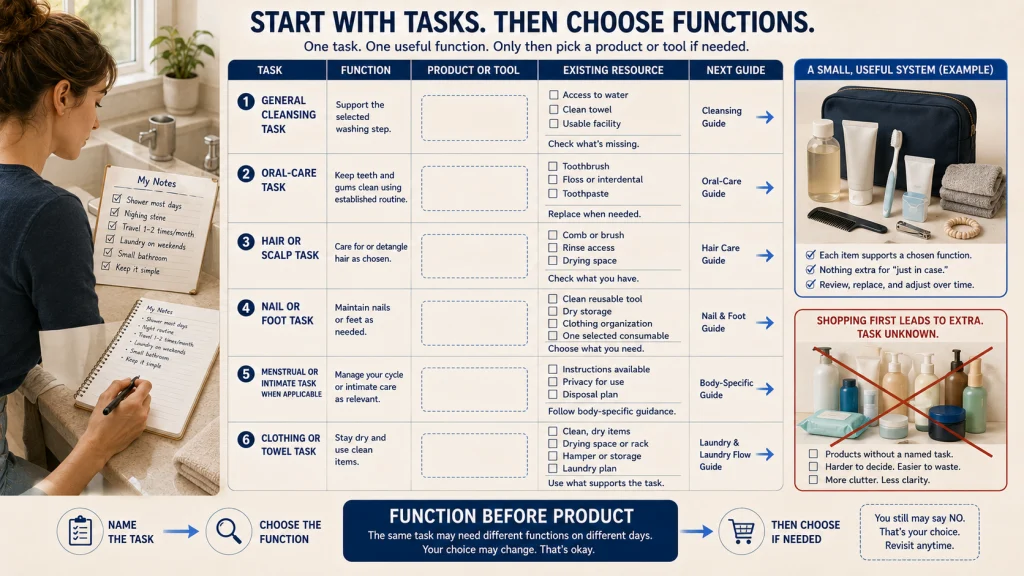
The task-to-function worksheet keeps the decision narrow. It does not prescribe a brand, ingredient, body-area technique, or medical product.
| Selected task | Necessary function | Product or tool type | Could the task be solved without another specialty purchase? | Where detailed guidance belongs |
|---|---|---|---|---|
| General cleansing task | Support the selected washing step | One suitable general-format cleanser or task-appropriate alternative | Sometimes. The missing need may be access to water, a clean towel, or a usable facility rather than another specialty item. | Body-area instructions |
| Oral-care task | Provide the tool or consumable required by the established routine | One active tool set and its needed consumable | Do not assume so. Follow dedicated oral-care guidance before removing or adding the established tool or consumable. | Oral-care guidance |
| Hair or scalp task | Support the selected care or detangling function | One suitable active item or reusable tool | Sometimes. A reusable comb or brush may already provide the needed function, while cleansing or symptom questions belong elsewhere. | Hair and scalp guidance |
| Nail or foot task | Provide one suitable maintenance function | One reusable tool or selected consumable | Sometimes. The task may require a clean reusable tool, dry storage, or clothing organization rather than another consumable. | Nail and foot guidance |
| Menstrual or intimate task when applicable | Support the exact personally relevant task | Only the item appropriate to that task and its instructions | Do not infer a purchase from the category alone. Follow the exact task, label, and body-specific guidance. | Dedicated body-specific guidance |
| Clothing or towel task | Provide a dry, usable item and a route to laundry | Towel, clothing, hamper, or storage function | Often. The needed function may be a clean item, drying space, hamper, or laundry route rather than a specialty product. | Routine and laundry planning |
The product column should stay blank until the function column is clear. This order makes duplicate items easier to see and reveals when the real need is access, storage, drying, laundry flow, or a reusable tool rather than another purchase.
Separate Reusable Tools From Consumables
Reusable tools and consumables create different kinds of work. A consumable needs refill visibility and recurring cost planning. A reusable tool needs cleaning, drying, storage, maintenance, and eventual replacement according to its instructions and condition.
| Decision | Reusable tool | Consumable |
|---|---|---|
| Primary friction | Cleaning, drying, maintenance, storage, and shared use | Running out, package waste, recurring cost, and refill timing |
| Point-of-use need | A stable, dry, safe location | An accessible active container |
| Backup decision | Usually based on failure risk, parts, or replacement delay | Usually based on the remaining supply and refill trigger |
| Review question | Is the item still usable and maintained as required? | Is enough supply visible to avoid interruption? |
A reusable item is not automatically cheaper or less wasteful if it requires replacement parts, specialized storage, repeated maintenance, or frequent transfer between locations. A consumable is not automatically simpler if several partly used packages accumulate.
Keep Body-Area Categories Connected to Their Detailed Guidance
A general product list can name broad categories, but it should not decide exact products for oral care, bathing, odor control, hands, feet, hair, intimate care, menstrual care, clothing, or personal items.
Those categories differ in technique, body area, instructions, symptoms, and individual context. A product that is appropriate for one task should not be generalized to another because the packaging uses similar language.
Use the general article to record only:
- The task that exists.
- The function required.
- Whether the item is reusable or consumable.
- Where the active item and backup will be stored.
- Which detailed guide owns the next decision.
This keeps the general kit small and prevents anatomy-specific products from being treated as universal essentials.
Compare Formats by the Actual Task
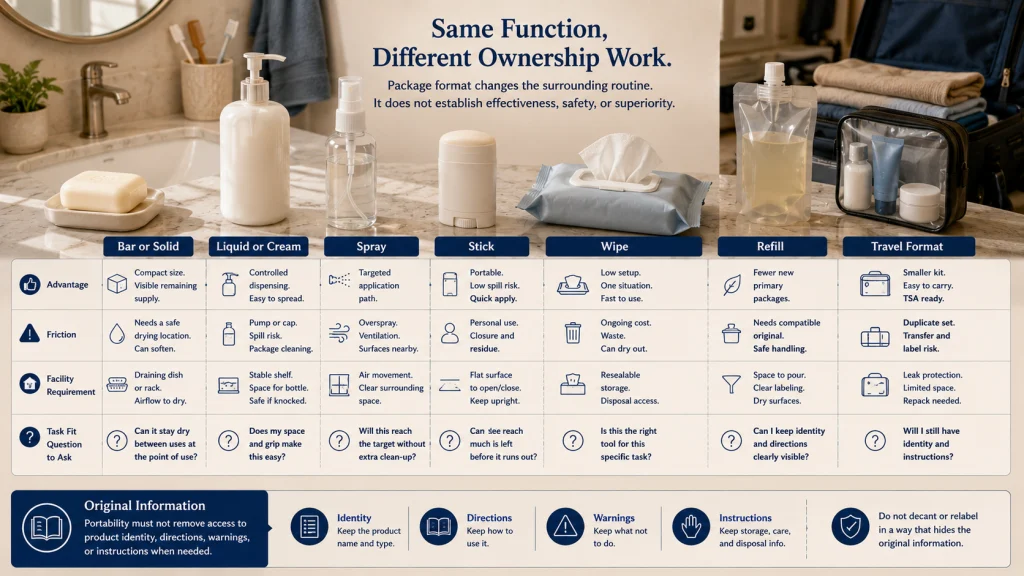
Package format affects grip, storage, portability, drying, privacy, waste, and refill visibility. It does not determine quality on its own.
| Format | Possible advantage | Possible friction | Question to ask |
|---|---|---|---|
| Bar or solid | Compact and easy to see when supply is low | Needs suitable drying and storage | Can it dry safely at the point of use? |
| Liquid or cream | Can be dispensed in a controlled location | May require a pump, cap, stable shelf, and spill management | Can the package be used comfortably with the available grip and space? |
| Spray | May support a specific application method | Can spread beyond the intended area and may need ventilation or careful storage | Does the exact task and label support this format? |
| Stick | Portable and less likely to spill | May be difficult to share safely or monitor near the end | Is it for one person’s defined task? |
| Wipe or disposable | Can reduce setup in a specific situation | Creates recurring cost, waste, storage, and disposal needs | Is the convenience serving a real task or only adding another format? |
| Refill | Can reduce the number of new primary packages | Requires compatible containers, clear labels, and safe handling | Can the original identity and instructions remain clear? |
| Travel format | Fits a smaller bag or temporary location | May create duplicate active sets and unlabeled transfers | Is the smaller format needed often enough to maintain correctly? |
Do not decant a product into an unmarked container when the original label, directions, warnings, or identity may be needed. Portability should not remove information required for safe use.
Check Usability, Storage, Privacy, Portability, and Recurring Cost
A product can match the function and still fail the routine. A cap may be difficult to open with wet hands. A pump may not fit the shelf. A tool may need a drying position the bathroom does not provide. A transparent package may be unsuitable where privacy matters.
Editorial observation: Packaging friction often appears after purchase. Pumps that lock during travel, caps that collect residue, containers that tip on narrow ledges, hidden fill levels, replacement parts, and awkward grip can add more routine work than the product description suggests.
Review the full ownership cost:
- Purchase price and refill frequency
- Replacement parts or compatible accessories
- Cleaning and drying time
- Storage space at home and during travel
- Waste and disposal requirements
- The chance that an inconvenient package will remain unused
The cheapest item is not always the lowest-cost system, and the largest package is not always economical if it crowds the room, expires under applicable instructions, or encourages duplicate active containers.
Put Active Products at the Point of Use
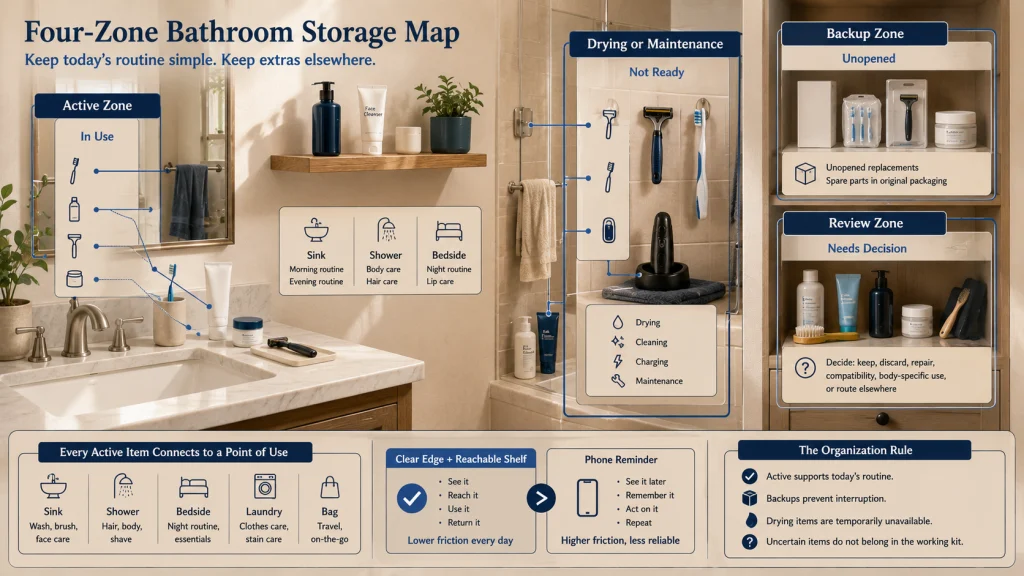
An active item should be easy to identify, reach, use, and return. The point of use may be a sink, shower, bedside area, laundry zone, bag, or another location connected to the task.
Keep only the active set in that zone. Extra packages, unopened replacements, occasional grooming items, and products awaiting a decision should live elsewhere.
| Zone | What belongs there | What stays out |
|---|---|---|
| Active zone | The current item or tool required for the routine task | Unopened duplicates, optional extras, and uncertain products |
| Drying or maintenance zone | Reusable items waiting to dry or complete required maintenance | Items already ready for use and unrelated supplies |
| Backup zone | Unopened replacements and defined spare parts | Partly used active containers |
| Review zone | Items that need a decision about duplication, disposal, repair, or routing | Products still treated as routine essentials |
A clear counter or one reachable shelf often reduces more friction than another reminder. The adult hygiene routine framework can help connect each active item to the time and location where it is actually used.
Store Unopened Backups in One Labeled Zone
Backups should prevent interruption without turning the bathroom into a warehouse. Use one labeled area that is safe for the products stored there and easy to review during the routine’s periodic check.
The label can be functional rather than decorative: unopened hygiene backups, replacement parts, or travel replacements. Keep items in their original packages when the label, warnings, directions, or identity may be needed.
Do not mix partly used products into the backup zone. A half-used container in three different rooms hides the true supply level and makes unnecessary replacement more likely.
When several household members share storage, separate personal tools and body-specific items clearly. Organization should protect privacy and reduce accidental sharing without implying that every person needs an identical kit.
Create One Refill Trigger Without Stockpiling
A refill trigger is the moment when replacement becomes necessary. Choose one rule that can be seen and followed without maintaining several competing lists.
One-trigger rule: Refill when the final unopened backup is moved into the active zone, or when the active supply reaches a clearly visible level that leaves enough time to replace it.
Use the trigger that fits the product’s availability, package visibility, and household routine. Do not create an exact replacement interval in this general article.
Stockpiling can hide duplicates, use storage needed for active care, and make it harder to notice changed needs. A backup system should answer one question clearly: is there enough supply to continue the selected task until the next realistic replacement opportunity?
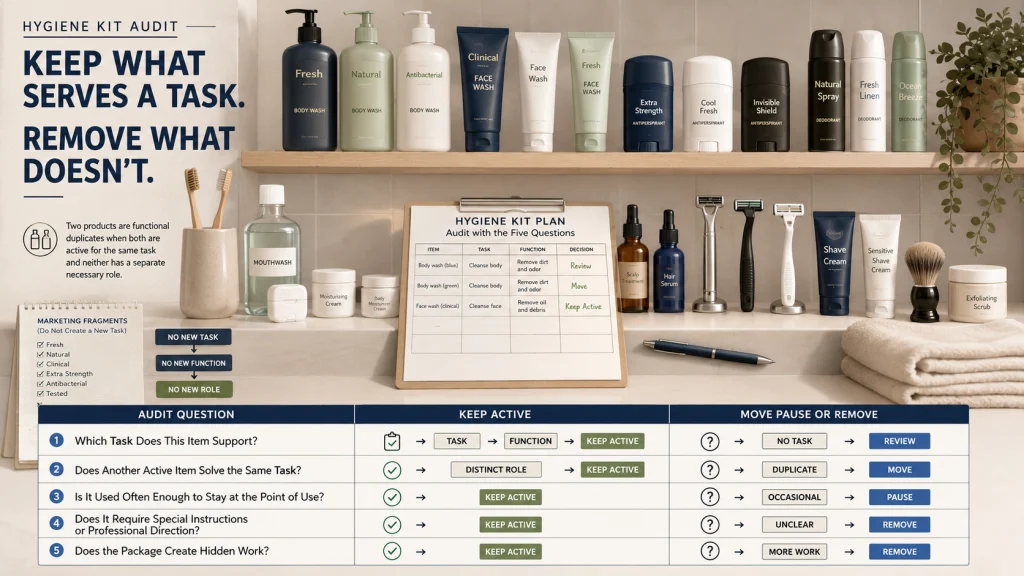
Audit Duplicate Functions and Marketing-Only Additions
Two products are functionally duplicate when they are active for the same task and neither has a separate necessary role. Different fragrance, package color, format, or marketing language does not automatically create a new function.
| Audit question | Keep active | Move, pause, or remove |
|---|---|---|
| Which task does this item support? | The task and function are clear. | No task can be named. |
| Does another active item solve the same task? | Each item has a distinct necessary role. | The difference is only format, fragrance, label language, or impulse purchase. |
| Is it used often enough to stay at the point of use? | It supports the current routine. | It belongs in an occasional, travel, or review zone. |
| Does it require special instructions or professional direction? | The routine and ownership are clear. | Route it outside the general kit until the correct guidance is available. |
| Does the package create hidden work? | Setup, maintenance, storage, and disposal fit the routine. | The item adds more friction than the function justifies. |
Do not assume fragranced, antibacterial, natural, hypoallergenic, pH-balanced, dermatologist-tested, gynecologist-tested, or clinical wording makes a product superior. Those terms do not replace a defined task, exact evidence, applicable instructions, or professional advice.
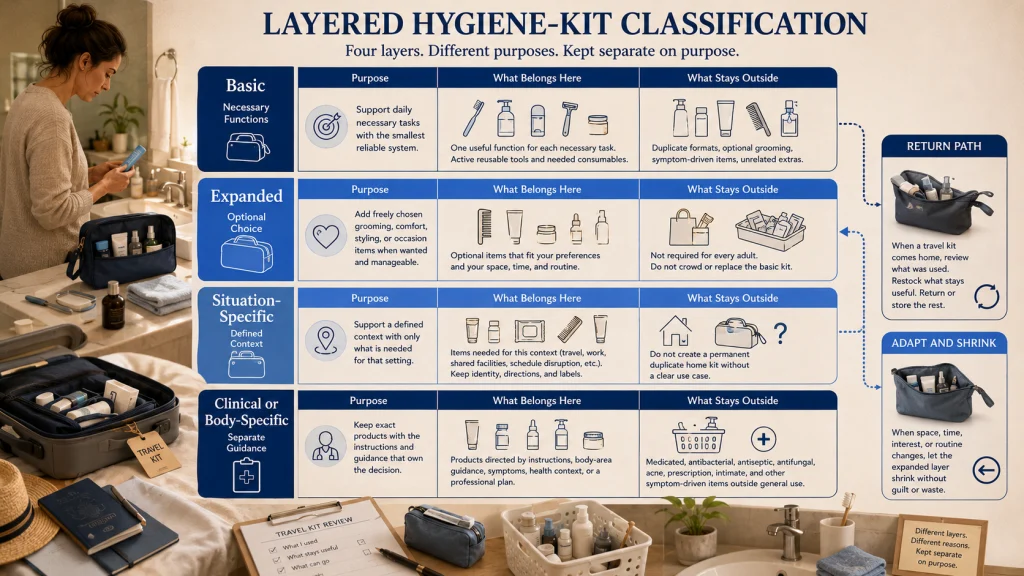
Build Basic, Expanded, and Situation-Specific Kit Layers
Layering keeps the minimum system small while allowing preference-based or temporary additions to exist without being treated as universal essentials.
| Layer | Purpose | What belongs here | What stays outside |
|---|---|---|---|
| Basic | Support the necessary tasks already selected for the routine. | One useful function per task, the active reusable tools, and the needed consumables. | Duplicate formats, optional grooming, and symptom-driven items. |
| Expanded | Add preference-based grooming, comfort, styling, or occasion-related items. | Products the person chooses and can maintain without crowding the basic system. | Items presented as required for every adult. |
| Situation-specific | Support a defined context such as travel, work, shared facilities, or a temporary schedule change. | Only the items needed for that setting, with labels and instructions preserved. | A duplicate home kit without a clear use case. |
| Clinical or body-specific | Follow the exact guidance that owns the condition, body area, or professional plan. | Only items appropriate to that separate guidance. | The general essentials list. |
A travel kit should be able to return home without creating permanent duplicate clutter. An expanded kit should be easy to reduce when time, space, or interest changes.
Keep Medicated and Symptom-Driven Products Outside the General List
Do not add medicated, antibacterial, antiseptic, antifungal, acne, prescription, intimate, or other symptom-driven products to a general essentials list. Their suitability depends on the exact product, body area, symptoms, instructions, health context, and professional advice when applicable.
This article does not diagnose or treat allergies, dermatitis, infection, dental disease, intimate conditions, odor disorders, or any other symptom. A general product worksheet cannot decide whether a symptom needs a product, a different routine, or qualified evaluation.
Use the correct guidance: Follow exact labels and professional advice where applicable. New, persistent, worsening, severe, or unexplained symptoms should not be managed by adding products from a general list.
When repeated product use, reminders, or storage are the main difficulty rather than product selection, use the guide to building hygiene habits for cue and friction planning.
List the Task, Function, Location, Backup, and Next Guide
Start with one selected care task. Write the function it requires, choose one suitable product or reusable tool category, and decide where the active item will live. Then record the backup zone, refill trigger, and any maintenance or drying requirement.
Remove products that duplicate the same function or exist only because a shelf label made them appear necessary. Keep optional grooming in an expanded layer, preserve clear labels during travel or storage, and route body-specific, clinical, and symptom-driven decisions to the guidance that owns them. A useful kit is not the longest list. It is the smallest system that reliably supports the tasks that actually exist.
FAQs
🧺 How many hygiene products does an adult need?
There is no universal number. Begin with the tasks in the person’s routine and choose one useful function for each necessary task. Optional grooming and body-specific products belong in separate layers.
🧴 Is a larger product list more complete?
Not necessarily. A long list may contain duplicate functions, unused formats, optional grooming, or symptom-driven items that do not belong in a basic kit.
♻️ Are reusable tools always better than consumables?
No. Reusable tools require cleaning, drying, maintenance, and storage. Consumables require refill visibility and recurring cost planning. Choose the format that fits the task and facilities.
🧳 Can I move products into small travel containers?
Only when the transfer is appropriate and the product can still be identified and used safely. Do not remove access to the original label, warnings, directions, or identity when that information may be needed.
📦 How many backups should I keep?
Keep enough to prevent a realistic interruption, not an undefined stockpile. One visible refill trigger and one labeled backup zone are usually easier to manage than several partly used packages.
🔍 How can I tell whether two products are duplicates?
Name the task and function for each item. When both are active for the same task and the difference is only format, fragrance, package language, or preference, they may be functional duplicates.
🚩 Should medicated products be part of a basic hygiene kit?
No. Medicated and symptom-driven products require exact instructions and may require professional guidance. Keep them outside the general list rather than presenting them as universal essentials.