Static posture describes how the body is organized while a position is being held. Dynamic posture describes how support, balance, reach, timing, and force change while the body moves. Many household tasks are mixed because they combine stillness, transitions, and repeated movement. A chair or cushion may change contact during sitting, but it cannot automatically solve a reaching or carrying problem. Start by deciding whether the concern comes from holding still, moving, or shifting between the two, then use guidance that matches the task.
A Still Photograph and a Reaching Sequence Answer Different Questions
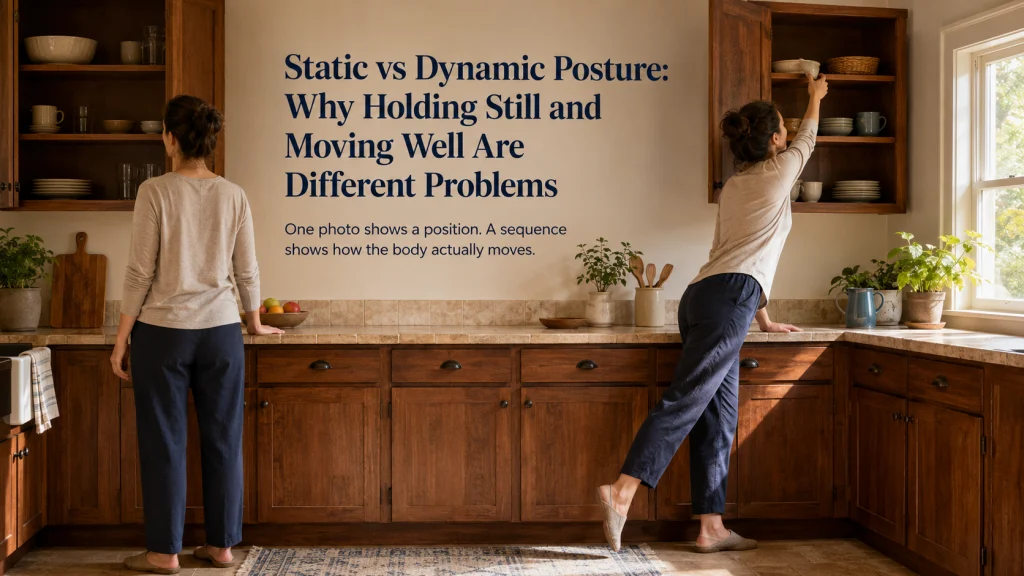
You may have looked at a photograph of yourself and thought the posture seemed fine, only to feel awkward when the task actually began. That mismatch is common because the photograph captures a position, while the task asks the body to change.
Imagine the same person in two views. The first is a single photograph taken while standing in front of a kitchen shelf. The head appears balanced over the trunk, the shoulders look relaxed, and both feet are on the floor.
The second view shows what happens next. One arm reaches toward a high shelf. Weight shifts toward one foot. The trunk turns slightly. The free hand touches the counter for support. The object is brought down, passed from one hand to the other, and carried away.
| Still photograph | Short reaching sequence |
|---|---|
| Shows one visible body position at one moment | Shows how position changes across several moments |
| May show contact with the floor, chair, or surface | Shows changing support, balance, reach, grip, and timing |
| Cannot show what happened before or after the frame | Reveals transitions that a single frame misses |
| May help describe a static setup | Is needed to understand how the task unfolds |
The photograph can describe position. It cannot tell you whether the person rushed, hesitated, lost the grip, changed support, repeated the reach many times, or carried a heavy object afterward.
This is the practical difference behind static vs dynamic posture. One concerns how the body is organized while still. The other concerns how the body manages change. The broader guide to what good posture means explains why neither appearance nor one frozen silhouette can answer every functional question.
Define Static Posture, Dynamic Posture, Transitions, Load, and Support
Static posture describes how the body is organized while a position is maintained with relatively little visible movement. Think of sitting through the quiet part of a meeting, standing at a counter while reading instructions, or holding the arms in place during detailed work.
Dynamic posture begins when the task changes the body’s support or position. Walking, bending, reaching, climbing stairs, carrying groceries, and moving between sitting and standing all require continuous adjustment.
The difference becomes easier to use when several related terms are kept separate:
- Transition: The change from one position or support pattern to another, such as standing up from a chair.
- Load: The weight, resistance, or force the body must manage during a task.
- Support: Contact from the floor, chair, backrest, handrail, counter, tool, or another surface.
- Duration: How long a position or task continues before meaningful variation occurs.
- Repetition: How often the same movement, reach, grip, or transition occurs.
These labels are useful because they point toward different first questions. A long, quiet task may need better support or more variation. A short moving task may be limited by reach, force, grip, or timing instead.
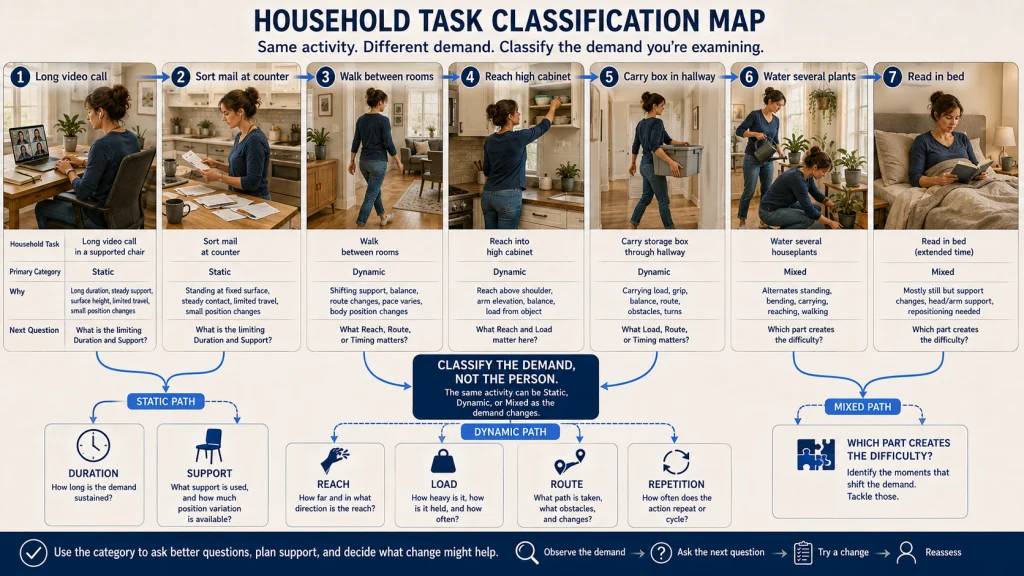
Classify Household Examples as Static, Dynamic, or Mixed
Most daily activities do not stay in one category from beginning to end. The label identifies the demand that matters most at the moment being examined.
| Household example | Primary category | Why | Question that matters next |
|---|---|---|---|
| Sitting through a long video call | Static | The body remains in a similar supported position for an extended period | How long is the position held, and what variation is available? |
| Standing at a counter while sorting mail | Static | The task uses a steady base with limited movement | Is the surface height or reach creating extra effort? |
| Walking between rooms | Dynamic | Support shifts continuously from one foot to the other | Is the concern about ordinary movement or a symptom that needs assessment? |
| Reaching into a high cabinet | Dynamic | Balance, reach, trunk position, and support change during the task | Can the item or task be placed closer or lower? |
| Watering several houseplants | Mixed | Brief standing periods alternate with bending, carrying, and reaching | Which part creates the difficulty: the hold, the reach, the load, or the repetition? |
| Reading in bed | Mixed | The body may stay still, but support and position change as comfort fades | Does the problem come from support, duration, or repeated repositioning? |
| Taking a storage box down a hallway | Dynamic | Load, grip, walking, doorways, and changing support occur together | Does the task require load-specific guidance? |
Classification prevents the first solution from being too broad. A sitting concern may call for support and position variation. A repeated reaching concern may require changing where objects are stored. A carrying concern adds load, grip, route, and task mechanics that a chair adjustment cannot address.
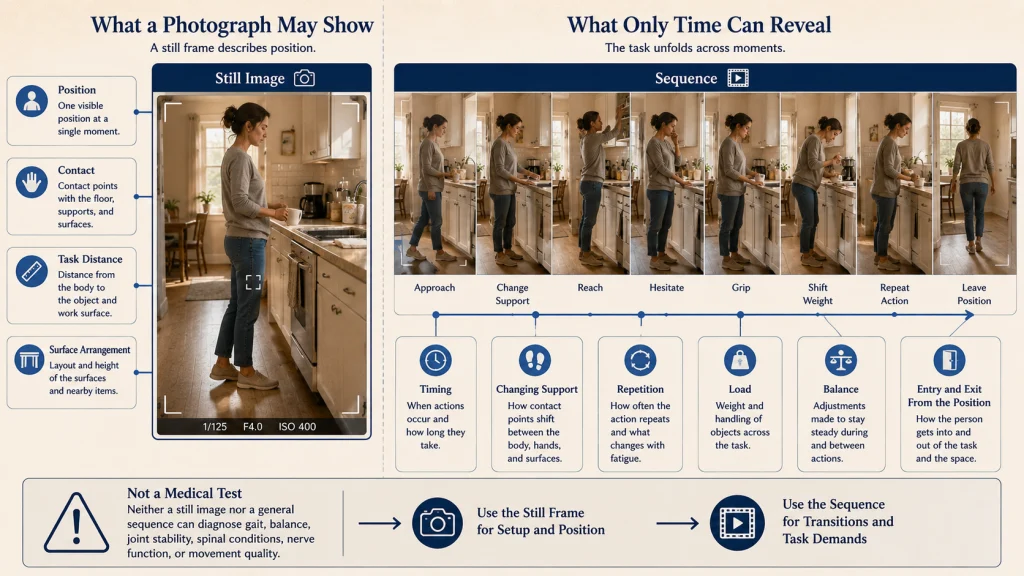
A Still Image Can Describe Position, but Not Movement Quality
A photograph can show visible relationships among the head, trunk, limbs, furniture, and work surface. It may reveal that the screen is far away, the feet do not reach the floor, or the object sits outside easy reach.
It cannot reveal the full task. A single frame does not show speed, hesitation, repeated effort, changing balance, grip pressure, fatigue, or what happened during the transition into the photographed position.
A photograph also cannot diagnose gait, balance, joint stability, spinal conditions, or movement quality. Those judgments require information outside a generic image.
Photo limit: Use a still image to describe setup and position. Use observation across time to understand transitions and task demands. Do not turn either one into a medical test.
Duration Changes the Problem in Static Positions
A supported position can feel comfortable at first and tiring later. The furniture has not changed, but the body has continued to hold contact, manage attention, and perform small stabilizing work.
This is why the same seated posture can be useful for a short email and less suitable for a long meeting. The concern is not only the visible alignment. It is the amount of time the body spends with limited variation.
| Static demand | What increases over time | Useful response category |
|---|---|---|
| Sitting with steady backrest support | Contact pressure, local fatigue, and reduced variation | Change position, task, or support before discomfort becomes the only reminder |
| Standing at one workstation | Time spent using the same foot and trunk strategy | Shift support, change the task, sit briefly, or walk when practical |
| Holding the arms in place for detailed work | Effort in the shoulders, neck, forearms, and hands | Bring the task closer, add suitable forearm support, or divide the work |
Variation does not need to be dramatic. Leaning back during part of a call, moving the feet, changing where the arms rest, standing for a different task, or walking briefly can alter the demand.
Detailed decisions about prolonged sitting, standing, and movement breaks belong to the guide on sitting and standing during work. This article only identifies duration as the main static variable.
Balance, Timing, Reach, Force, and Repetition Shape Dynamic Tasks
Movement adds questions that a static setup cannot answer. The feet may change position, the base of support may narrow, the hands may grip an object, and the body may need to coordinate several actions in sequence.
Five factors help describe the task without attempting a movement assessment:
- Balance: How the task changes the base of support or shifts body weight.
- Timing: Whether the person can move at a controlled pace or must react quickly.
- Reach: How far, high, low, or across the body the hands must travel.
- Force: How much effort is needed to lift, push, pull, hold, or grip.
- Repetition: How often the movement is repeated and whether recovery occurs between repetitions.
Consider unloading a dishwasher. One cycle may involve standing, bending, rotating, reaching into a rack, carrying dishes, and placing them at several heights. The most useful change may be moving frequently used items closer, reducing the number carried at once, or changing the sequence of the task. A static cue about shoulder position does not solve the whole activity.
This comparison does not assess balance, gait, joint stability, or technique. It only shows why dynamic questions need information about how the task changes over time.
A Neutral Reference Changes as the Body Moves
A neutral spine can provide a comfortable starting reference, but movement naturally changes the curves and relationships among the head, rib cage, pelvis, and limbs. Reaching upward, bending toward a drawer, and turning to place an object do not preserve one frozen shape.
The reference remains useful because it helps identify the ends of the available range and provides a place to return when the larger movement is no longer required. It should not become a command to keep the trunk still during every task.
During a reach, the body may shift weight, rotate, or incline. During walking, support alternates between the feet. During a transition from sitting to standing, the trunk and lower body reorganize before the final standing position is reached.
The guide to finding a neutral spine position explains the unloaded reference in more detail. Loaded lifting, exercise technique, and clinical movement questions remain outside this comparison.
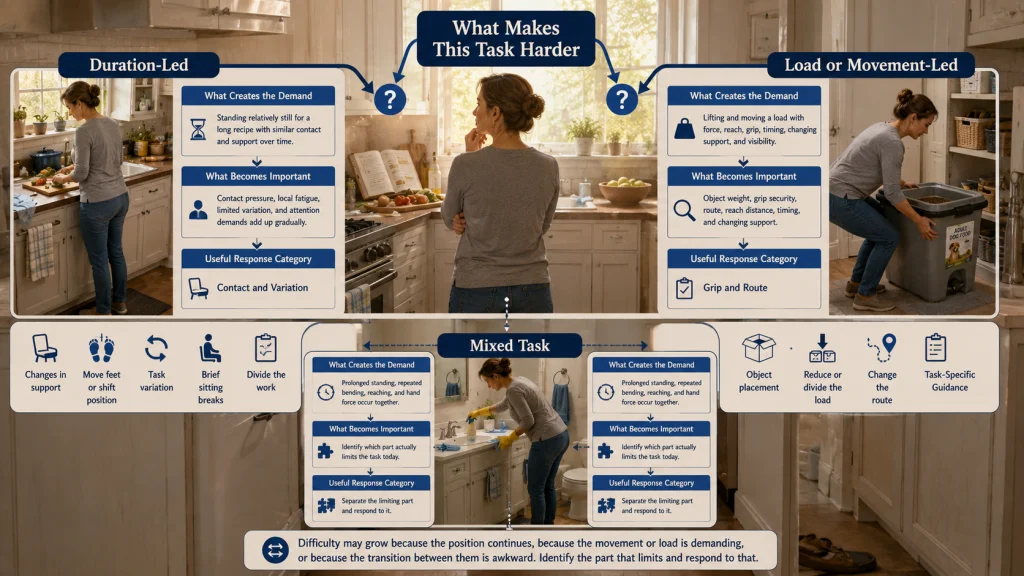
Duration and Load Create Different Decision Paths
Two tasks can feel demanding for completely different reasons. One becomes difficult because the body stays in a similar position for too long. The other is brief but asks for force, reach, or changing support.
| Duration-led concern | Load or movement-led concern |
|---|---|
| The body holds a similar position for a long period | The body manages weight, force, reach, or changing support |
| Contact pressure and limited variation become important | Grip, route, timing, repetition, and object placement become important |
| Support and position changes may reduce the demand | Task design and load-specific guidance may be needed |
| Example: standing still while preparing a long recipe | Example: lifting a large pet-food container from the floor to a shelf |
A mixed task may contain both demands. Cleaning a bathroom can involve prolonged standing, repeated bending, reaching, and force through the hands. The useful next step depends on which part is actually limiting the task.
Decision check: Ask whether the concern grows because the position continues, because the movement or load is demanding, or because the transition between them is awkward. That distinction leads to a better next step than a general posture cue.
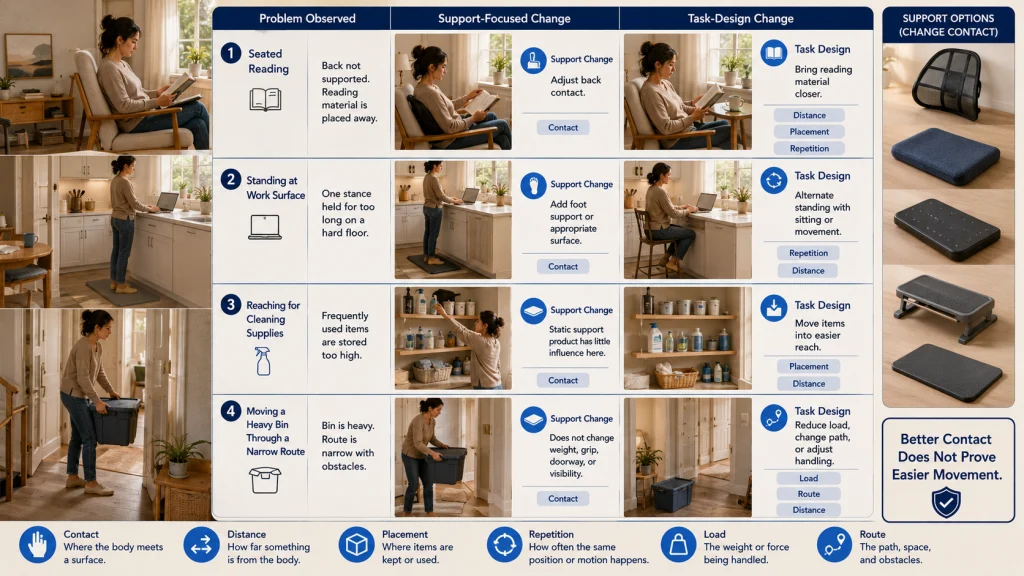
Compare a Support Change With a Task-Design Change
A support change acts where the body meets a chair, backrest, floor, or work surface. A task-design change acts on where the work is placed, how often it repeats, and what the person has to reach, hold, or move.
This difference is easy to miss because support products are visible and easy to add. Nora’s retail observation is that chairs, cushions, lumbar supports, and standing mats naturally attract attention on a display, while the harder questions sit outside the product: Is the task too far away? Is the object stored too high? Does one movement repeat all afternoon?
| Problem observed | Support-focused change | Task-design change |
|---|---|---|
| Back feels unsupported during seated reading | Adjust the backrest or contact so the trunk can rest more easily | Move the reading material closer so support is not lost during use |
| Feet feel tired while standing at a work surface | Change foot support or the standing surface when appropriate | Alternate the task with sitting or movement rather than holding one stance |
| Cleaning supplies are repeatedly reached from a high shelf | A static support change has limited influence on the reach itself | Relocate frequently used supplies within easier reach |
| A heavy bin must be moved through a narrow route | A chair or cushion does not change the handling demand | Reduce the load, change the route, or use task-specific handling guidance |
A support product may improve contact during a still task. That does not provide evidence that a moving task has become easier or safer. The broader posture improvement process helps separate body awareness from changes to the environment and the task itself.
Route Prolonged Sitting and Standing to Duration and Support Guidance
You may notice that the position seems acceptable at first, then becomes harder to ignore as the hour passes. That pattern points toward duration, support, task distance, and the lack of variation rather than a failure to hold one ideal shape.
Use sitting and standing guidance when:
- The difficulty increases as the same position continues.
- The chair, desk, counter, or screen arrangement appears to drive the posture.
- The feet, back, or arms lack suitable support.
- The task allows little opportunity to change position.
- The concern is primarily comfort and fatigue rather than lifting, carrying, or repeated force.
General posture myths can make static problems harder by turning “sit up straight” into the only available response. The guide to common posture myths explains why one visual rule cannot replace task and duration decisions.
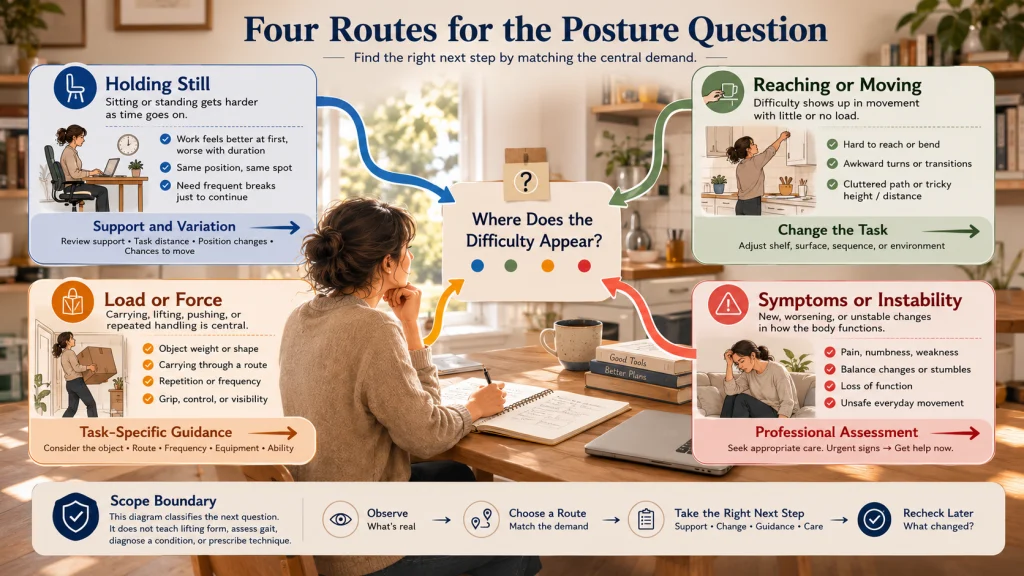
Route Lifting, Carrying, and Repetition to Task-Specific Guidance
A task changes category when the object, force, route, or repetition becomes the central problem. At that point, a general posture comparison has done its job. It has shown that the next question belongs somewhere more specific.
Use task-specific handling guidance when:
- An object must be lifted from the floor, a shelf, a vehicle, or another surface.
- The task involves carrying through doors, stairs, or changing terrain.
- The grip is difficult, the object shifts, or the load blocks the view.
- The same reach, pull, push, or transfer is repeated many times.
- The environment, route, or object placement can be redesigned.
This article does not teach lifting form or prescribe a movement technique. Those decisions depend on the object, load, frequency, route, available equipment, and individual ability.
- Main issue is holding still: Review support, duration, and opportunities to vary the position.
- Main issue is reaching or moving without meaningful load: Review placement, reach distance, repetition, and transitions.
- Main issue includes load, force, carrying, or repeated handling: Use manual material handling guidance appropriate to the task.
- Main issue includes symptoms, instability, or functional loss: Stop self-guided troubleshooting and seek appropriate assessment.
Movement Difficulty, Instability, or Symptoms May Need Professional Assessment
Ordinary task classification should stop when the concern suggests more than a setup or workload question. Do not use a photograph, household example, chair adjustment, or online checklist to assess gait, balance, joint stability, nerve function, or a musculoskeletal condition.
Seek appropriate professional evaluation: New, severe, persistent, worsening, or unexplained pain; numbness; weakness; tingling; balance changes; symptoms after a fall or injury; or difficulty completing ordinary movement safely should be assessed by a qualified professional. Loss of bowel or bladder control, chest pain, severe shortness of breath, or fainting requires immediate appropriate help.
Repeated stumbling, unexpected loss of support, a new inability to rise, or a major change in walking or household movement should not be reduced to a posture cue. Lifestyle troubleshooting ends when symptoms or functional limits suggest that self-guided changes are not enough.
The broader posture and ergonomics overview can help route ordinary setup questions while keeping clinical assessment outside household advice.
Watch the Task Long Enough to See What the Photograph Misses
A useful posture question begins before the final pose and continues after it. Notice whether the difficulty appears while the body waits, while support is changing, during the reach, or only after the same action has been repeated.
That observation usually makes the next step smaller. A duration problem can be addressed through support and variation. A placement problem can be changed at the shelf or work surface. A load or handling problem can move to task-specific guidance. Symptoms, instability, or functional loss should leave household troubleshooting altogether.
The goal is not to label every movement. It is to stop asking one still image or one alignment rule to explain an entire task.
FAQs
🪑 What is static posture?
Static posture describes how the body is organized while a position is maintained with relatively little visible movement. Sitting, standing, reading, and holding the arms in place can all create static demands when they continue over time.
🚶 What is dynamic posture?
Dynamic posture describes how the body changes during movement. It includes shifting support, reaching, timing, balance, force, grip, and transitions between positions.
🔄 Can one task be both static and dynamic?
Yes. Folding laundry, cooking, cleaning, and many work tasks mix periods of stillness with repeated reaching, walking, carrying, or position changes. Identify which part creates the difficulty before choosing a response.
📷 Can a photograph show whether someone moves well?
No. A photograph can describe one visible position and nearby support. It cannot show timing, repetition, changing balance, grip, force, or how the person entered and left the frame.
⏳ Why does a comfortable sitting position become tiring?
Contact pressure, limited variation, and ongoing muscular work can build as the position continues. The answer may be changing support or position rather than trying to hold the original posture more firmly.
🧺 Can a cushion improve lifting or carrying?
A cushion may change seated contact or support, but it does not change the weight, route, grip, repetition, or placement involved in lifting and carrying. Those tasks need guidance designed for the actual load and environment.
🚩 When should movement concerns be professionally assessed?
Seek appropriate evaluation for new, severe, persistent, worsening, or unexplained pain, neurological symptoms, balance changes, symptoms after injury, or difficulty completing ordinary movement safely. Emergency signs require immediate appropriate help.