A bathroom fan is useful only when moist air can reach the grille and the duct sends that air outdoors. First confirm the intended destination through documentation and safe observations. Then check whether replacement air can enter the room, use the fan during and after moisture-producing activities according to guidance, and keep accessible grilles clean. Compare how the room dries over repeated ordinary uses. When the problem involves concealed ducts, roof or attic access, wiring, persistent wet areas, or suspected building moisture, stop the household check and move to qualified assessment.
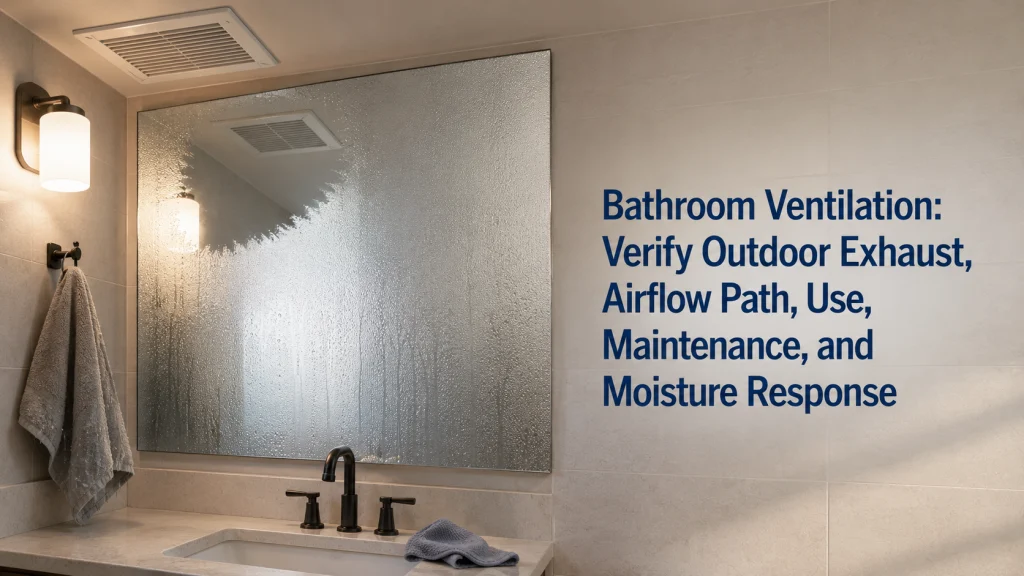
Three Identical Fan Sounds Can Lead to Three Different Exhaust Outcomes
In three bathrooms, the switch clicks, the grille hums, and the motor sounds almost the same. After the shower, however, the rooms behave differently.
In the first bathroom, the fan draws room air through a clear duct and releases it outdoors. In the second, the fan runs but the grille or duct path is restricted. In the third, the duct ends in an attic or another enclosed area instead of outside.
| Fan path | What the user hears | What may happen after the shower | What still needs verification |
|---|---|---|---|
| Outdoor termination with a usable path | A running motor | Moist air has a route out of the building | Whether the room also receives enough replacement air |
| Restricted grille or duct path | A running motor, sometimes with added strain or vibration | Mirrors, walls, and textiles may stay damp longer | Where the restriction is and whether professional service is needed |
| Termination in an enclosed space | A running motor | Moisture leaves the bathroom but enters another part of the building | The actual duct destination and condition |
Fan noise confirms that something is operating. It does not confirm the destination, the duct condition, or effective moisture removal.
The broader guide to moving air through a home covers general ventilation. This article stays with the bathroom exhaust path and the first checks that can be made without opening unsafe areas.
Define Local Exhaust, Outdoor Termination, Replacement Air, Grille, Duct, Airflow, Condensation, and Drying Response
Local exhaust removes air close to the moisture source. In a bathroom, the fan is intended to move moist room air into a duct.
Outdoor termination is the point where that duct releases air outside the building. A duct that ends in an attic, ceiling cavity, crawl space, or another enclosed area has not completed the intended outdoor path.
Replacement air is air that enters the bathroom as the fan removes air. It may arrive through a door undercut, transfer opening, or another path allowed by the room and building setup.
The grille is the accessible cover at the room side. The duct carries air away from the fan. Airflow describes moving air, but a rated number or local air movement does not by itself establish the installed result.
Condensation is moisture that forms when humid air meets a cooler surface. Drying response is the observable change after use: how quickly fog clears and whether walls, ceilings, windows, and textiles return toward their usual dry condition.
The wider indoor air quality framework places bathroom exhaust beside source control, moisture management, cleaning, and building maintenance. The broader healthy home environment approach helps connect that local exhaust task with the rest of the household system.
Confirm the Intended Outdoor Destination Without Entering Unsafe Areas
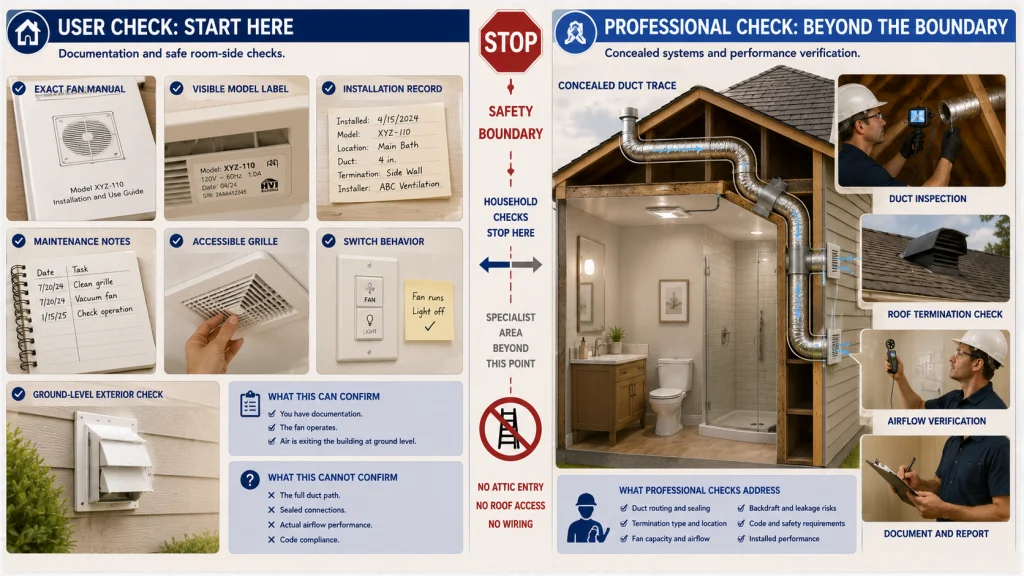
Start with documentation rather than a ladder, roof, attic hatch, or electrical panel. Find the model number, use manual, installation record, building document, inspection report, or maintenance history when available.
Look for a documented route to an exterior wall or roof termination. From safe ground level, an exterior vent may be visible, but appearance alone may not prove which fan it serves or whether the hidden duct is intact.
| User check | Professional check |
|---|---|
| Find the exact model and manual | Confirm the installed fan, duct connection, and intended configuration |
| Review visible records and safe exterior observations | Trace concealed duct routing and verify the termination |
| Note unusual noise, vibration, odor, or moisture response | Evaluate fan condition, duct restriction, leakage, disconnection, or damage |
| Inspect only the accessible room-side grille as instructed | Open housings, access concealed components, or work in attic and roof areas |
| Record switch, timer, sensor, light, or heater behavior | Diagnose wiring, controls, interlocks, and electrical faults |
| Observe drying over repeated ordinary uses | Measure installed performance and assess building moisture conditions |
The boundary is simple: keep the household check at eye level and on the room side. Concealed duct tracing, attic or roof access, wiring covers, and hidden connections belong with qualified professionals.
Operate the Fan During Showering and Continue According to Guidance
Turning the fan on only after the mirror is fully fogged means moisture has already spread through the room. When the installed fan is safe and intended for bathroom exhaust, start it with the moisture-producing activity.
Continue operation afterward according to current official guidance and the exact product instructions. This article does not give one universal number of minutes because room size, shower conditions, fan controls, duct design, climate, surfaces, and building setup differ.
Timers and humidity-sensing controls may help automate use, but their labels do not prove correct installation or effective exhaust. Review what the control actually does, how it is adjusted, and whether manual override remains available.
Nora’s bounded observation is that quieter operation and an easy-to-reach control can make consistent use more likely. Quietness improves usability, but it does not prove airflow or correct termination.
Provide a Safe Replacement-Air Path That Fits the Room and Building
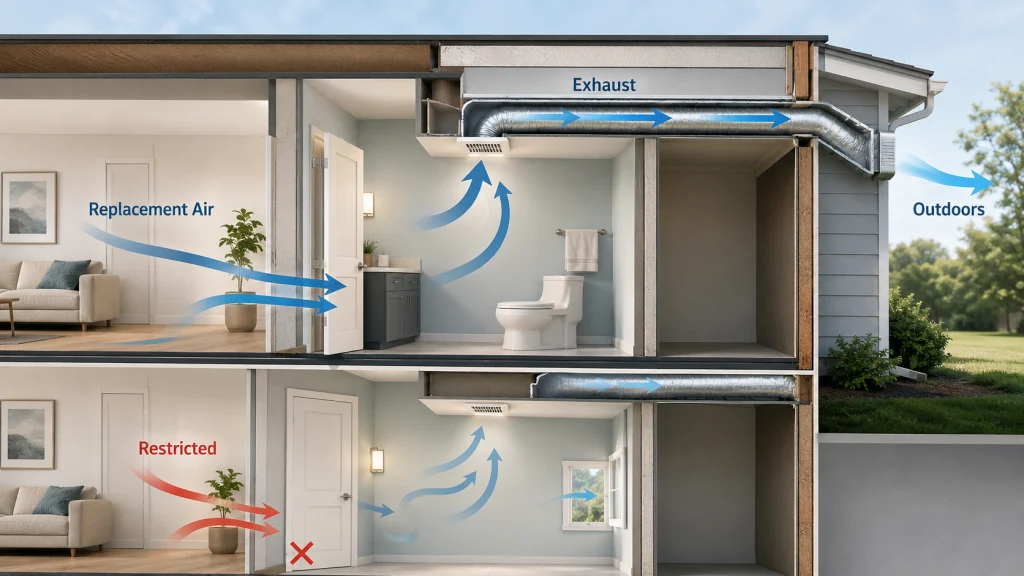
A fan cannot keep removing room air without other air entering. When the bathroom door seals tightly, the fan may have a harder time drawing air through the room.
Nearby indoor air → safe transfer path → bathroom → fan grille → duct → outdoor termination
Tightly sealed room → limited replacement air → weaker room-to-fan path
Open window without a verified fan route → some room-air movement, but not proof of outdoor fan exhaust
A safe path may be provided by the door undercut or another feature designed for air transfer. Altering doors, walls, transfer grilles, or pressure relationships requires appropriate building guidance rather than a quick household modification.
Leaving the door partly open after use may help some rooms exchange air, provided privacy, fire-safety features, children, pets, security, and building requirements allow it. During use, follow the room and building setup rather than assuming one door position fits every home.
Clean Accessible Grilles and Fan Surfaces According to the Manual
Dust and lint can collect on an accessible grille and narrow the room-side opening. Cleaning that visible surface may improve access to the fan inlet, but it does not repair a concealed duct problem.
- Find the exact model and manual.
- Confirm the fan is intended for bathroom exhaust.
- Operate it during moisture-producing use.
- Continue afterward according to official and product guidance.
- Keep the designed replacement-air path unobstructed.
- Inspect the accessible grille for dust, lint, paint, or blockage.
- Disconnect power only through the method stated in the manual before cleaning.
- Clean, dry, and reinstall accessible parts exactly as instructed.
- Stop for damaged parts, exposed wiring, sparking, burning odor, or controls that do not operate normally.
Combination units may include lighting, heaters, sensors, or replaceable parts. Follow the documentation for the exact configuration instead of treating every grille as the same product.
Nora notes that grille access and cleaning friction often matter more in daily ownership than they do on a feature card. A part that is awkward to remove or difficult to reinstall can quietly turn maintenance into a task that keeps being postponed.
Observe Mirror, Wall, Ceiling, and Textile Drying Without Diagnosing Mold
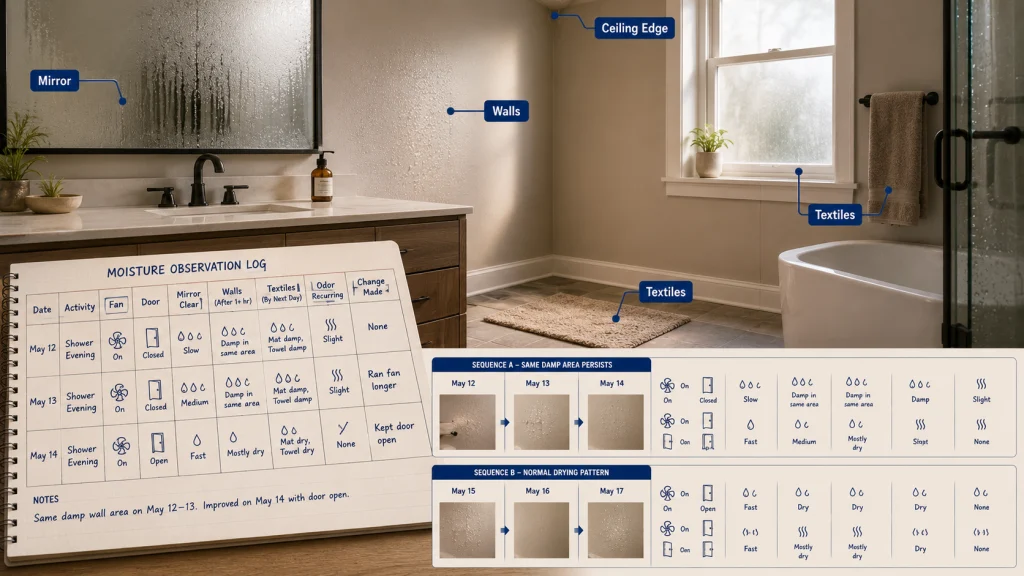
Drying response gives the household a practical way to compare ordinary uses. It does not diagnose a building condition or identify what is growing on a surface.
| Moisture-response log | Observation |
|---|---|
| Date and activity | Record the shower, bath, cleaning task, or other moisture-producing use |
| Fan timing | Note whether it ran during use and continued afterward |
| Door and air path | Record the ordinary door position and whether the transfer path was blocked |
| Mirror | Note whether fog stayed localized, covered the mirror, or remained long after use |
| Walls and ceiling | Look for visible beads, streaks, damp patches, peeling, or repeated discoloration |
| Textiles and surfaces | Note whether towels, bath mats, window areas, or ledges remain unusually damp |
| Odor and recurrence | Record persistent musty odor or the same wet areas returning |
| Change made | Document grille cleaning, fan timing, or restoration of the designed air path |
Compare similar activities rather than expecting two very different showers to produce identical results. The log is most useful when it shows a repeated pattern, not when one humid day is treated as a diagnosis.
For many households, the problem first feels personal rather than technical: a mirror that is still unusable when someone needs to leave, a towel that never seems fully dry, or a ceiling patch that keeps returning. Recording those details turns frustration into a clearer maintenance question.
Noise, Tissue Tests, and Consumer Humidity Readings Cannot Verify the Full Duct System
A running sound confirms that the motor or another component is active. It cannot show where the hidden duct ends or whether the duct is crushed, disconnected, leaking, or restricted.
A tissue held near the grille may show local suction. It does not measure installed airflow, verify outdoor termination, or show how the system performs with the door closed and replacement air limited.
A consumer humidity reading can help compare the same room over time, but the result depends on sensor placement, device quality, response delay, shower conditions, outdoor humidity, temperature, and the rest of the building.
Use these observations to form better questions. Do not use them to declare the duct safe, calculate required fan capacity, diagnose mold, or dismiss persistent moisture.
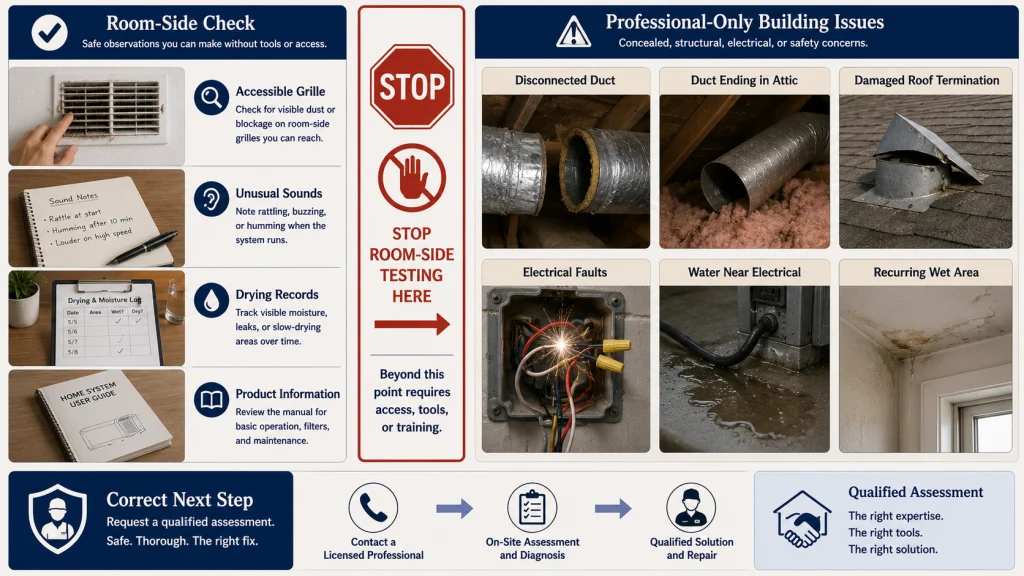
Escalate Missing Termination, Duct Damage, Roof Issues, Electrical Problems, Noise, or Persistent Moisture
Some findings move the problem beyond first-pass household troubleshooting.
Electrical, attic, roof, and mold boundary: Qualified help is needed when documentation or inspection suggests that the duct does not terminate outdoors, ends in an attic or enclosed space, is disconnected or damaged, or requires roof access. The same applies to exposed or damaged wiring, sparking, burning odor, repeated breaker trips, water near electrical components, a fan that binds or overheats, or severe new noise. Attic entry, roof work, wiring repair, duct modification, replacement sizing, and mold remediation sit outside this workflow.
A sounding smoke or carbon monoxide alarm, visible fire or smoke, suspected gas leak, severe breathing difficulty, chest pain, fainting, confusion, blue or gray lips, or other emergency signs require leaving the area when safe and contacting emergency or utility services as appropriate.
Persistent or worsening symptoms require qualified medical guidance. Suspected asbestos, lead, radon, major mold, combustion backdrafting, hazardous chemicals, or building-system defects require appropriately qualified assessment.
Route Leaks, Chronic Humidity, Condensation, and Suspected Mold Separately
A bathroom fan addresses moist room air. It does not repair a plumbing leak, roof leak, failed seal, wet wall cavity, insulation problem, thermal bridge, or another source of water.
Escalate when the same ceiling or wall stays wet despite ordinary fan use, moisture appears without showering, paint repeatedly peels, materials soften, staining expands, or a persistent musty odor remains.
At that point, the question is no longer whether the fan ran long enough. The concern has shifted to where the water is coming from and what building material may be affected. Color, odor, or a consumer monitor cannot identify the cause or establish a medical conclusion.
Whole-home pressure or ventilation may also contribute to the context. The overview of whole-house ventilation systems explains why local bathroom exhaust and continuous mechanical ventilation have separate roles.
Document the Problem Clearly When Renting
Renters may not have access to installation records, exterior terminations, electrical panels, roof areas, or concealed ducts. The safest first step is documentation rather than alteration.
Record the fan model when visible, switch or control behavior, unusual noise, grille condition, ordinary door position, shower timing, visible moisture, drying response, recurring stains, odors, and the dates of prior requests.
Send a clear management or maintenance request that describes observations without diagnosing the cause. Ask whether the unit is intended to exhaust outdoors, whether the termination and duct can be inspected, and whether electrical or moisture concerns require qualified service.
Repeatedly wiping the same wet wall while waiting for a response can feel powerless. A dated log, photographs of visible changes, and a concise written request give the problem a record that is harder to reduce to “the fan sounds fine.”
This is practical documentation, not legal advice. Building duties, notice requirements, access rights, and remedies vary. The guide to indoor air quality in apartments helps organize shared-system and management questions without assuming control over the building.
Verify the Destination, Create an Air Path, Use Consistently, Maintain, Observe, and Escalate
The most useful answer is not hidden in the sound of the motor. It comes from connecting three things: where the duct ends, whether air can enter the room, and how the bathroom dries after ordinary use.
That makes the next action clearer. A dirty grille belongs to accessible maintenance. A tightly sealed room points to the replacement-air path. A duct ending in an enclosed space, damaged wiring, recurring wet material, or a suspected leak belongs with qualified help.
The goal is not to keep testing the fan until the household feels certain. It is to gather enough reliable observations to know whether the issue is use, maintenance, airflow path, or a building problem that has moved beyond the room-side check.
A bathroom that dries normally fades back into the routine of the home. When it does not, the right response is a clearer record and the right level of help, not another round of guesswork.
FAQs
🚿 When should I run the bathroom fan?
Run the installed fan during showers and other moisture-producing activities when it is safe and intended for bathroom exhaust. Continue afterward according to current official guidance and the exact product instructions.
🏠 How can I tell whether a bathroom fan vents outdoors?
Start with the model manual, installation records, building documents, and safe exterior observations. A qualified professional may need to trace concealed ducts and verify the termination.
🚪 Should the bathroom door be open or closed?
The fan needs a safe replacement-air path, but the correct door position depends on the room and building setup. Do not assume one position applies everywhere or alter the door without appropriate guidance.
🧻 Does a tissue test prove the fan is working correctly?
No. It may show local suction at the grille, but it cannot verify installed airflow, concealed duct condition, or outdoor termination.
🧼 Can I clean the bathroom exhaust fan myself?
Clean only accessible grilles and surfaces according to the exact manual, including its power-disconnection instructions. Stop for damaged parts, exposed wiring, sparking, burning odor, or concealed work.
💧 Why are the walls still wet when the fan is on?
Possible factors include fan timing, limited replacement air, grille restriction, duct problems, shower conditions, cool surfaces, or a separate moisture source. Persistent wet areas require qualified assessment rather than a larger-fan assumption.
🏢 What should a renter document?
Record fan behavior, noise, visible moisture, drying response, stains, odors, grille condition, and request dates. Ask management to confirm outdoor termination and arrange qualified inspection when needed.
🚩 When should bathroom ventilation troubleshooting stop?
Stop for electrical damage, sparking, burning odor, water near wiring, missing outdoor termination, damaged ducts, attic or roof work, persistent moisture, suspected major mold, or emergency signs. Use appropriately qualified help.