Indoor air quality is not a permanent grade attached to a room. The same living room can feel ordinary in the morning, stuffy during a gathering, affected by dinner cooking, and refreshed later when suitable outdoor air moves through it. Those changes come from sources, pathways, building conditions, and the controls acting on them. Smell, symptoms, humidity, and monitor readings can each add a clue, but the useful question is what changed, how it traveled, and what evidence is still missing.
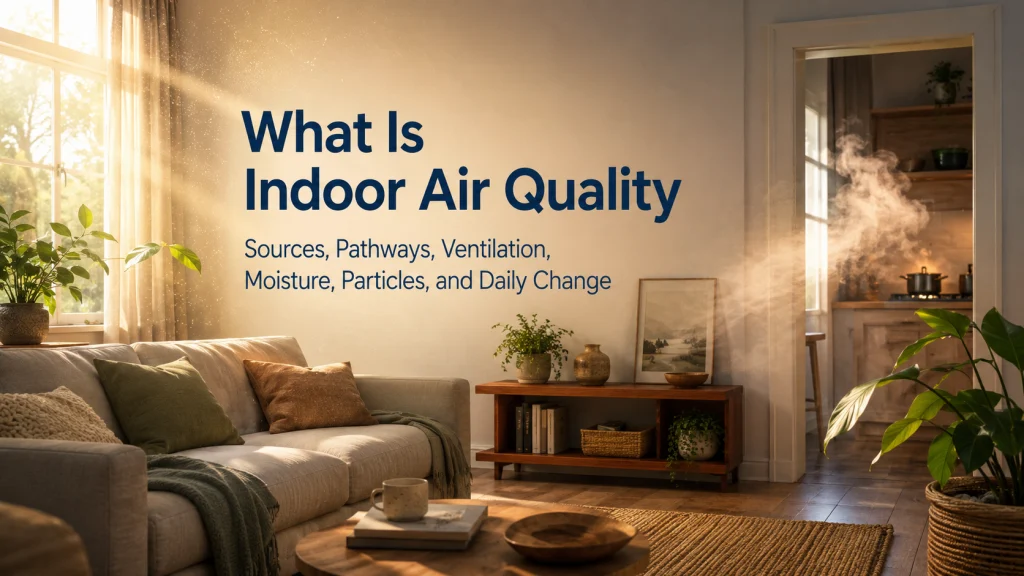
The Same Living Room Can Have Different Air Four Times in One Day
At sunrise, the living room is quiet. By afternoon, several people are talking on the sofa. During dinner, cooking odors arrive from another room. Later, a window is opened after outdoor conditions improve. The sofa, curtains, rug, and shelves have not moved, but the air around them has changed several times.
| Time and condition | What changes around the room | What the room view may hide |
|---|---|---|
| Empty overnight | Few occupant activities occur, doors remain closed, and mechanical systems may cycle | Materials, moisture, and outdoor air pathways still affect the space |
| Occupied during a gathering | More people enter, movement increases, and doors open more often | Particles, moisture, warmth, and gases can change while the room still looks familiar |
| Cooking in another room | Air and odors travel from the kitchen through doorways, pressure differences, and shared air paths | The visible source sits elsewhere, but the living-room air still responds |
| Ventilated after outdoor conditions improve | A window or exhaust path moves indoor air out and outdoor air in | The result depends on what is outdoors, how air moves, and which source remains active |
This changing room is the simplest practical model for indoor air quality. Air inside a home is never shaped by the room alone. It responds to people, activities, materials, weather, moisture, openings, and building systems.
That is why one evening smell, one patch of dust, or one monitor color can feel important without explaining the whole day. The clue may be real. It is simply one moment inside a moving system.
Indoor Air Quality Is a System of Sources, Movement, Conditions, and Controls
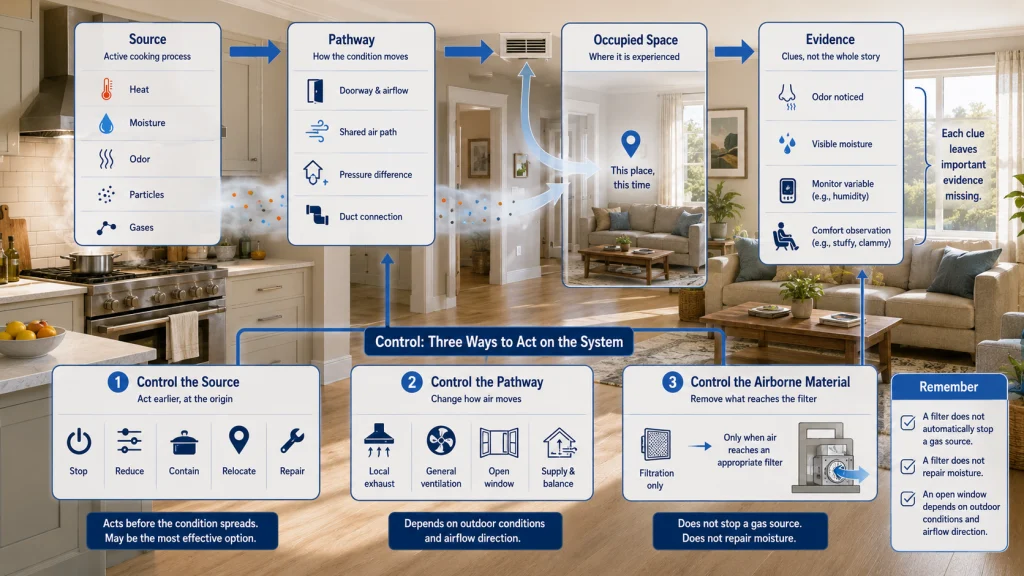
Indoor air quality, often shortened to IAQ, describes characteristics of air inside homes and other buildings that affect how the space functions and feels. It can include particles, gases, vapors, biological material, moisture, temperature, and odor. These characteristics do not all behave alike, come from the same places, or respond to the same household action.
A practical definition becomes clearer when several terms are separated:
- Pollutant: A substance or material present in the air that may be unwanted or harmful under relevant conditions.
- Source: The person, activity, object, material, outdoor condition, or building process that releases or contributes something to the air.
- Pathway: The route through which air or an airborne material moves, such as a doorway, window, crack, duct, stairwell, or exhaust path.
- Concentration: How much of a selected substance is present in a given amount of air at a particular place and time.
- Exposure: Contact with a condition over time, which depends on location, duration, activity, and the variable involved.
- Comfort: How temperature, humidity, air movement, and odor affect the experience of occupying the space.
- Control: An action or system intended to reduce a source, change a pathway, or remove a selected airborne material.
These terms prevent IAQ from collapsing into a single idea such as dust, smell, humidity, or a colored monitor display. Each describes one part of the system. A useful explanation asks what changed, where it came from, how it traveled, what evidence is available, and which type of control could match it.
| Source | Pathway | Control |
|---|---|---|
| An activity, material, person, outdoor condition, or building process adds something to the air | Air carries it through rooms, openings, leaks, ducts, or pressure-driven movement | The response acts on the source, changes air movement, or removes a selected material |
The three parts must stay connected. A filter may act on selected particles that reach it, but it does not automatically stop a gas source or repair a moisture problem. Opening a window may dilute some indoor conditions, but the result depends on outdoor air and the direction of flow. Removing a source may be more direct than trying to manage it after it spreads.
Particles, Gases, Biological Factors, Moisture, Temperature, and Odor Are Different Classes
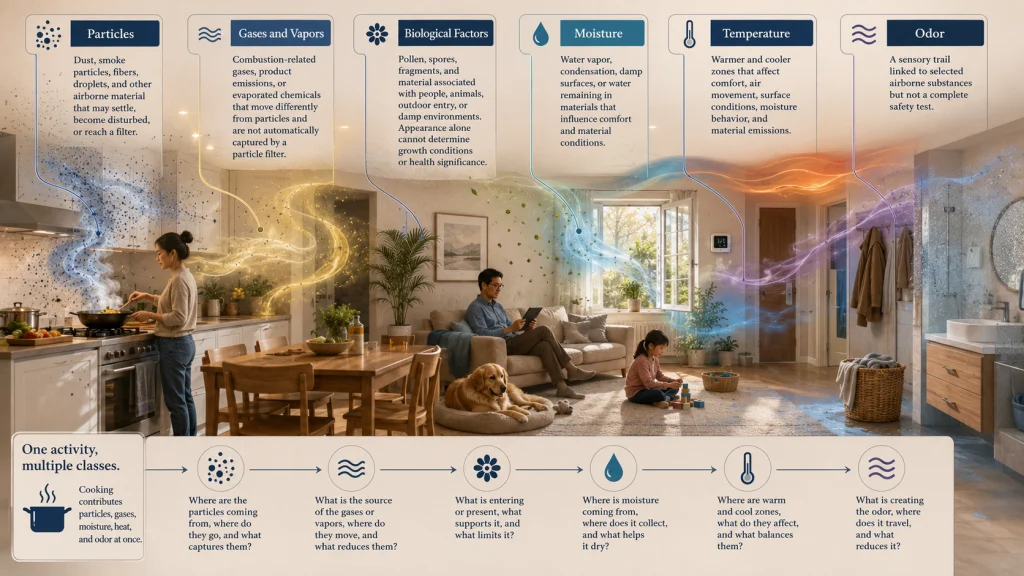
Indoor air discussions become confusing when every concern is described as the same kind of pollution. The categories overlap in a real home, but they still need to be distinguished because each has different sources, movement patterns, evidence limits, and controls.
| Class | What it may include | Why the distinction matters |
|---|---|---|
| Particles | Dust, smoke particles, fibers, droplets, and other airborne material | Particle size, settling, disturbance, and whether air reaches a filter can change behavior |
| Gases and vapors | Combustion gases, product emissions, and evaporated chemicals | A particle filter does not automatically address gases or vapors |
| Biological factors | Pollen, spores, bacteria, fragments, and material from people, animals, or damp environments | Presence, growth conditions, and health significance cannot be determined from appearance alone |
| Moisture | Water vapor, condensation, damp surfaces, and water entering or remaining in materials | Moisture can change comfort, materials, and conditions that support biological growth |
| Temperature | Warm or cool indoor conditions and differences among rooms or surfaces | Temperature affects comfort, air movement, moisture behavior, and material emissions |
| Odor | A sensory signal produced by selected airborne substances | Some substances are noticeable at low levels, while other concerns may have little or no warning smell |
A home can have more than one class present at the same time. Cooking may produce particles, gases, moisture, heat, and odor in one event. Cleaning can introduce vapors while also disturbing settled material. An open window can reduce one indoor condition while allowing outdoor particles or humidity to enter.
Editorial observation: Retail displays often separate odor products, humidifiers, purifiers, filters, fans, cleaners, and monitors into distinct shopping categories. That arrangement can make indoor air appear to be one measurable problem with several interchangeable solutions, even when the relevant source and pollutant class have not been identified.
The classification is not a shopping list. Its purpose is to keep the question specific enough that a later action can match the condition instead of treating every air concern as dust or smell.
Occupants, Activities, Products, Furnishings, and Materials Can Create Indoor Sources
Some indoor sources are obvious because an activity is happening in front of you. Cooking releases heat, moisture, odors, particles, and gases depending on the method and equipment. Cleaning may introduce vapors or disturb settled material. Hobbies can involve dust, adhesives, coatings, heat, or small particles.
People and animals also change the room. Occupancy adds warmth and moisture, movement resuspends settled material, and open doors change air pathways. A gathering therefore affects more than the number of bodies in the room.
Other sources are less tied to one visible moment. Furnishings, finishes, stored products, building materials, attached garages, damp materials, combustion equipment, and household systems may contribute under particular conditions. The rate can change with temperature, age, use, maintenance, or whether air carries the material into occupied space.
This does not mean every object should be treated as dangerous. The point is that an indoor source can be continuous, intermittent, activity-based, or dependent on building conditions. Before choosing a response, ask when the condition appears, what changes at that time, and whether the likely source is in the same room.
Source question: Look for the event, material, person, outdoor condition, or building process that changes when the air condition changes. The strongest clue is often timing, not appearance.
Outdoor Air, Openings, Ducts, and Pressure Differences Create Pathways
A source does not need to be inside the room where it is noticed. Air moves through open windows and doors, gaps around the building, stairwells, shared hallways, ducts, exhaust paths, and connections with garages or utility areas. Fans, exhaust equipment, heating and cooling systems, wind, and temperature differences can change the direction and speed of that movement.
Outdoor air is part of the system rather than an automatic cure or an automatic problem. It may help dilute some indoor-generated conditions when outdoor air is suitable and the flow reaches the affected area. It may also carry smoke, pollen, humidity, odors, or other outdoor material indoors.
Infiltration describes uncontrolled outdoor air entering through cracks, gaps, and other openings. An open window is a deliberate opening, but the direction of air movement is still influenced by wind, temperature, exhaust equipment, and pressure differences. Ducts can distribute conditioned air while also connecting rooms through the building system.
That is why “open a window” is not a complete model of ventilation. The question is where air enters, where it travels, what it carries, and where it leaves. The guide to ventilating a house addresses those air-movement decisions in greater depth.
Temperature and Humidity Change the Setting in Which Other Problems Develop
A cool window that fogs during cooking tells a different story from a warm, dry room in winter. Both scenes involve indoor air, but neither can be understood by looking at humidity or temperature in isolation.
Temperature affects comfort, air movement, surface conditions, and how quickly some materials release vapors. Humidity changes evaporation, dryness, condensation, and the conditions available for biological growth. Together, they shape the setting in which other sources behave.
Think of them as background conditions rather than a final verdict. A comfortable reading does not erase a combustion source, a particle problem, or hidden wet material. An uncomfortable reading does not reveal where water came from or whether the cause is weather, an activity, a leak, or a building defect.
The next step depends on what is visible and repeatable. Brief steam after a shower, recurring window condensation, and material that remains damp are different situations. Suspected major mold, persistent moisture intrusion, or a building-system defect requires appropriately qualified assessment rather than repeated room readings.
Treat Odor as a Trail to Follow, Not a Verdict
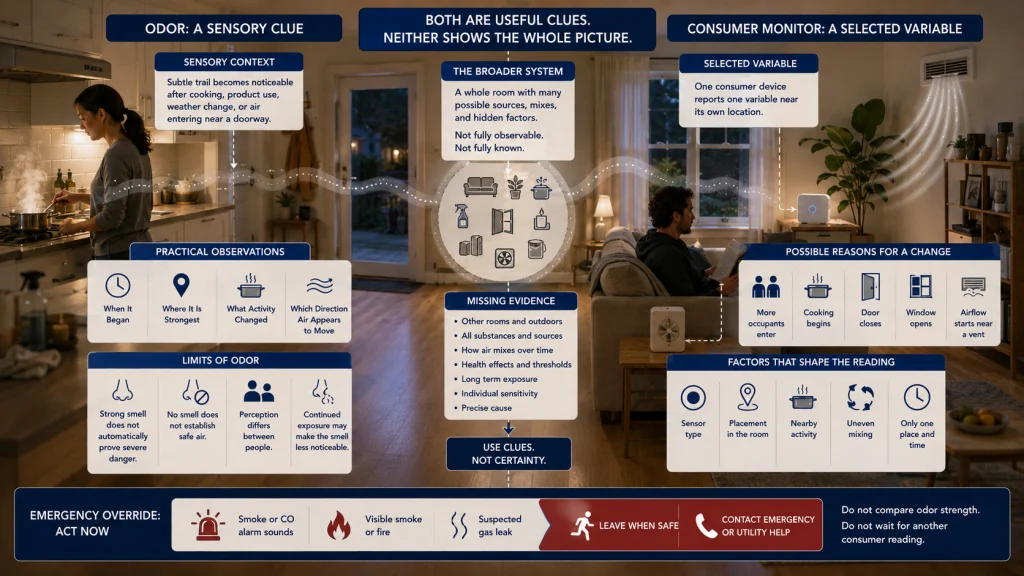
A smell can be genuinely useful because it often comes with a story. It appears when the oven starts, after a product is used, when the weather changes, or only near one doorway. Those details can point toward timing, location, activity, and air movement.
The nose cannot finish the investigation. Some substances are easy to notice at low levels, while other serious concerns give little or no useful warning. People also perceive odors differently, and a smell may fade from awareness after someone remains in the room.
The practical value of odor is the pattern around it. It may help you locate the next question, but it cannot identify every substance or establish safety by itself.
Urgent signs override household troubleshooting. If a smoke or carbon monoxide alarm sounds, fire or smoke is visible, or a gas leak is suspected, leave the area when it is safe to do so and contact emergency or utility services as appropriate. Do not wait for the smell to become stronger or for a consumer display to confirm it.
A Symptom Pattern Can Start a Conversation, but It Cannot Name the Cause
When someone repeatedly feels worse in one room, it is natural to look around for an explanation. Writing down the time, activity, location, and whether the feeling improves elsewhere can create a useful record. That record can support a conversation with a qualified professional.
What it cannot do is turn a headache, cough, irritated eyes, tiredness, or breathing discomfort into the name of a pollutant. Similar complaints can arise from many indoor and non-indoor causes, and different air conditions can overlap in the same space.
Even a repeated pattern leaves important questions open. It does not establish the substance involved, the amount present, the duration of contact, or the medical reason for the symptom. Feeling better after leaving a room is meaningful personal information, but it is not a home diagnosis.
Health boundary: Do not diagnose asthma, allergies, poisoning, infection, mold-related illness, carbon monoxide exposure, chemical sensitivity, or another medical condition from an odor, room condition, symptom pattern, or consumer monitor. Persistent or worsening symptoms require qualified medical guidance. Severe breathing difficulty, chest pain, fainting, confusion, blue or gray lips, or other emergency signs require immediate appropriate help.
A Monitor Shows One Window Into the Room
A number on a screen can feel more certain than a smell or a vague sense of stuffiness. The certainty is limited by what the device is built to sense. One monitor may track particles, another may show carbon dioxide as an occupancy and ventilation clue, and another may focus on temperature and humidity.
When the display changes, begin with the nearby timeline. Did cooking start? Did more people enter? Was a door closed? Did outdoor air begin moving through the room? The reading shows that a selected variable changed near the sensor. It does not explain the source automatically.
Location matters because air is not evenly mixed at every moment. A device near a kitchen doorway, window, vent, or occupied seating area may see a different pattern from one across the room. Sensor limits and the type of variable also shape what the number can mean.
Measurement limit: Read the display as one window into selected conditions at one place and time. Check what the device measures, where it sits, and what changed nearby before drawing a broader conclusion.
Dedicated monitoring guidance can address placement and interpretation in more depth. At the definition stage, the important distinction is between measuring a chosen variable and describing the entire home.
Source Control, Ventilation, and Filtration Each Have a Different Job
Once the likely source class and pathway are clearer, the household can stop asking for one universal fix. The next action should match the part of the system that is actually creating or carrying the condition.
- Source control removes, reduces, isolates, repairs, or changes the activity or material creating the condition.
- Ventilation moves air into, through, or out of the building when outdoor conditions and the airflow path are suitable.
- Filtration captures selected airborne material when affected air passes through an appropriate filter.
Consider a cooking event. Changing the cooking method or controlling the source is one type of action. Using a suitable exhaust path is another. Capturing selected particles after they enter room air is a third. They may work together, but they are not the same job.
The same distinction prevents common mismatches. Fragrance changes smell without necessarily removing its source. Drying room air does not repair water entering a wall. A particle-focused filter cannot be assumed to address gases or vapors.
The complete indoor air improvement process begins after the source class, pathway, and evidence limits are understood. This section provides the framework for choosing a route, not a universal action list.
Choose the Next Air Question Before Choosing an Action
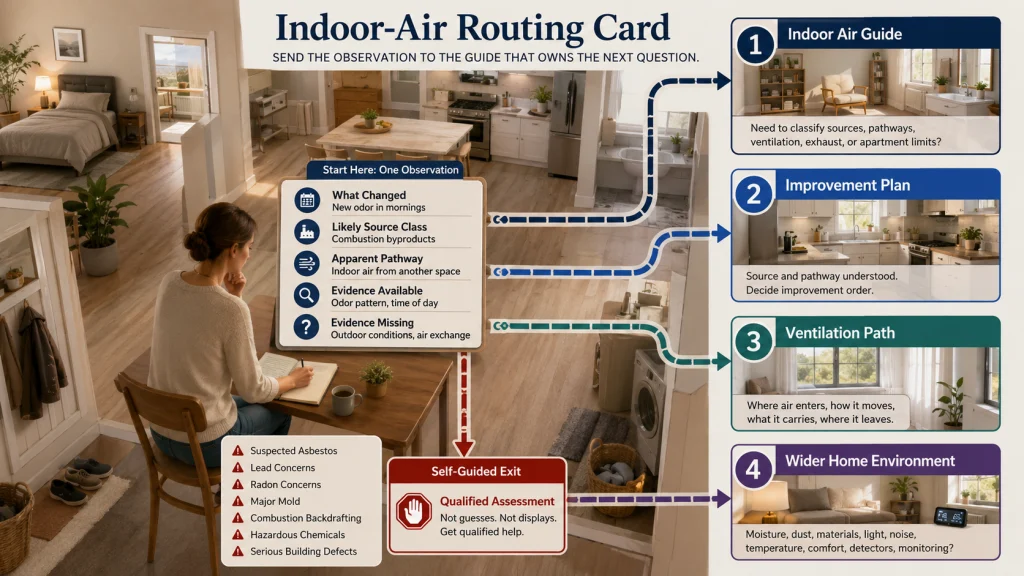
Indoor air problems become harder to solve when every concern is pushed into the same shopping or cleaning decision. The next article should match the part of the system that remains unclear.
- Use the indoor air quality guide for the broader set of household air topics and decision paths.
- Use the home air improvement guide when the source class is understood and the next question is which action should come first.
- Use the house ventilation guide when the question is how outdoor air enters, travels through, and leaves the building.
- Use the healthy home environment overview when air concerns overlap with moisture, water, cleanliness, lighting, noise, or broader home-comfort conditions.
Some situations should leave the self-guided route. Suspected asbestos, lead, radon, major mold, combustion backdrafting, hazardous chemicals, or building-system defects require appropriately qualified assessment. The goal is not to guess more precisely from a smell or display. It is to recognize when the evidence and risk exceed ordinary household troubleshooting.
Follow the Change Through the Home
When indoor air feels different, begin with the change rather than the product shelf. Ask what activity started, what material or condition could be acting as a source, and which doorway, opening, duct, or pressure path could carry it.
Then decide what kind of evidence you actually have. A smell provides sensory context. A symptom record belongs in a medical conversation. A monitor reports selected variables. Humidity and temperature describe part of the setting. Each clue has a role, and each leaves something unanswered.
That approach turns indoor air quality from a vague score into a practical sequence: identify the source class, trace the pathway, name the observed variable, respect the evidence limit, and open the article that owns the next decision.
FAQs
🌬️ What is indoor air quality in simple terms?
Indoor air quality describes changing characteristics of air inside a building. It is shaped by sources, airflow pathways, activities, outdoor conditions, moisture, temperature, and the controls used in the home.
🏠 Can indoor air quality change even when the room looks the same?
Yes. Occupancy, cooking, cleaning, open doors, outdoor air, humidity, and building systems can change air conditions without changing the visible room. One room may also be affected by a source located elsewhere in the home.
👃 Does a bad smell always mean the air is dangerous?
No. Odor can help identify timing, location, or a possible source, but smell alone cannot determine safety or identify every substance. Urgent signs such as an alarm, visible smoke, or a suspected gas leak require appropriate emergency action rather than an odor comparison.
📟 Can one monitor tell me whether my whole home has good air?
No. A consumer device reports only the variables its sensors are designed to measure or estimate at its location. It cannot represent every pollutant, room, hidden moisture condition, or building defect.
💧 Is humidity the same as indoor air quality?
No. Humidity is one indoor condition that affects comfort, moisture behavior, and other air-related factors. It does not identify every source or describe all characteristics of indoor air.
🩺 Can symptoms tell me which pollutant is in my home?
No. Many symptoms have multiple possible causes, and indoor conditions can produce overlapping complaints. Persistent or worsening symptoms need qualified medical guidance, while emergency symptoms require immediate appropriate help.