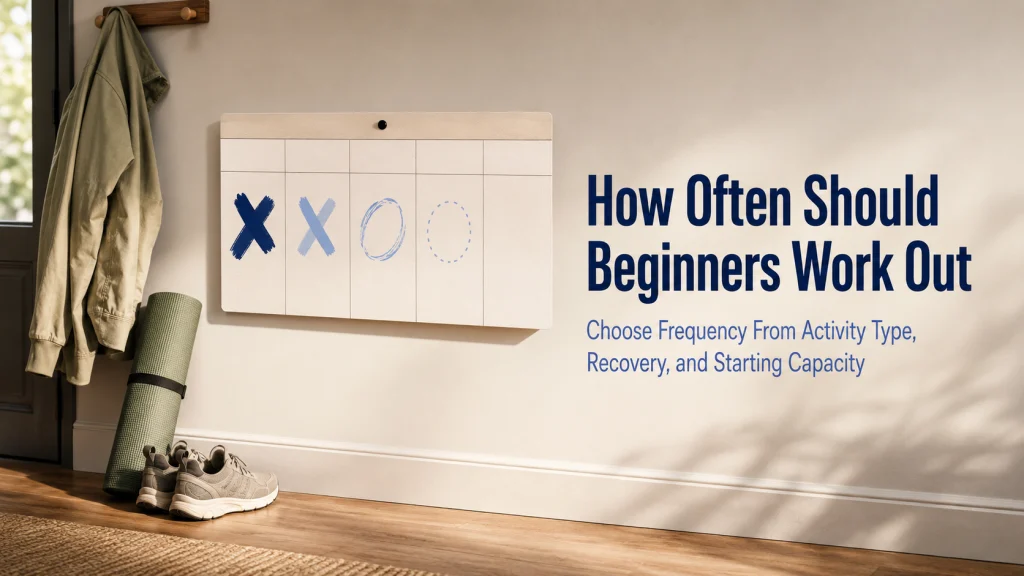
How often beginners should work out depends on the activity, current capacity, recovery, and the amount of work inside each session. Four days of walking, four full-body strength sessions, and four mixed mobility and cardio days do not create the same demand. Start with a frequency that fits the calendar and can be repeated without worsening soreness, sleep, energy, joint comfort, or ordinary daily function. Increase only one variable at a time, then review the result before adding more.
Four Workout Days Can Mean Three Very Different Weeks
Three beginners can all say they exercise four days a week while following schedules that place very different demands on recovery.
| Person | Four-day pattern | What changes the recovery demand |
|---|---|---|
| Person A | Four comfortable walking sessions | The sessions use a familiar activity and may be spread across the week with modest setup. |
| Person B | Four full-body strength sessions | The same major muscle groups may be challenged repeatedly with limited spacing. |
| Person C | Two mobility sessions and two cardio sessions | The days are not equal because the activity types and demands differ. |
The number four does not explain the week. Activity type, session length, effort, recent experience, and recovery spacing determine whether the pattern is manageable. A walking pad, a set of dumbbells, and a demanding video routine should not share one frequency rule simply because each can be used at home.
Use the broader guide to exercise at home with a practical setup when you are still deciding how space, equipment, and household routines affect the plan. For the full starting process, review how to start working out at home before choosing a weekly frequency.
Define Workout Days, Activity Days, Strength Days, and Recovery Days
Frequency becomes clearer when the calendar uses more specific labels than “workout.” A day with a short walk, a demanding strength session, and a few mobility movements should not be treated as if each creates the same training load.
- Workout day: A planned session with a defined activity, duration, and intended effort.
- Activity day: A day that includes purposeful movement but may not contain a formal workout.
- Strength day: A session that challenges one or more muscle groups against resistance.
- Recovery day: A day without another demanding session for the same areas, while suitable daily movement may still occur.
These labels prevent two common mistakes. The first is counting every movement opportunity as a hard workout. The second is treating a day without formal training as if no useful movement can happen. The calendar should show both the activity type and the recovery demand.
Start From Current Capacity and Recent Activity
A workable starting frequency comes from what the person can repeat now, not from the most ambitious plan they can complete once. Someone who has been walking regularly, doing household lifting, or following a recent routine may tolerate a different starting pattern than someone returning after a long inactive period.
Review four practical questions before choosing the first week:
- What movement has been happening consistently during the last several weeks?
- Which activity types are familiar, and which are new?
- How many reliable calendar windows exist after setup and travel time are included?
- What happens to energy, soreness, sleep, and ordinary responsibilities after a demanding day?
Choose the lowest frequency that can answer these questions through real experience. The goal of the first schedule is not to prove maximum capacity. It is to create enough repetition to observe how the activity fits the body and the week.
A long period of inactivity can make a generic starting pattern less appropriate, especially when health conditions, disability-related limitations, recent surgery, pregnancy, or persistent symptoms are involved. Individualized guidance may be needed before increasing frequency.
Once that starting point is clear, the next question is not simply how many days are open. It is how the selected activity can be spread across them without making the week harder to repeat.
Distribute Aerobic Activity in More Than One Way
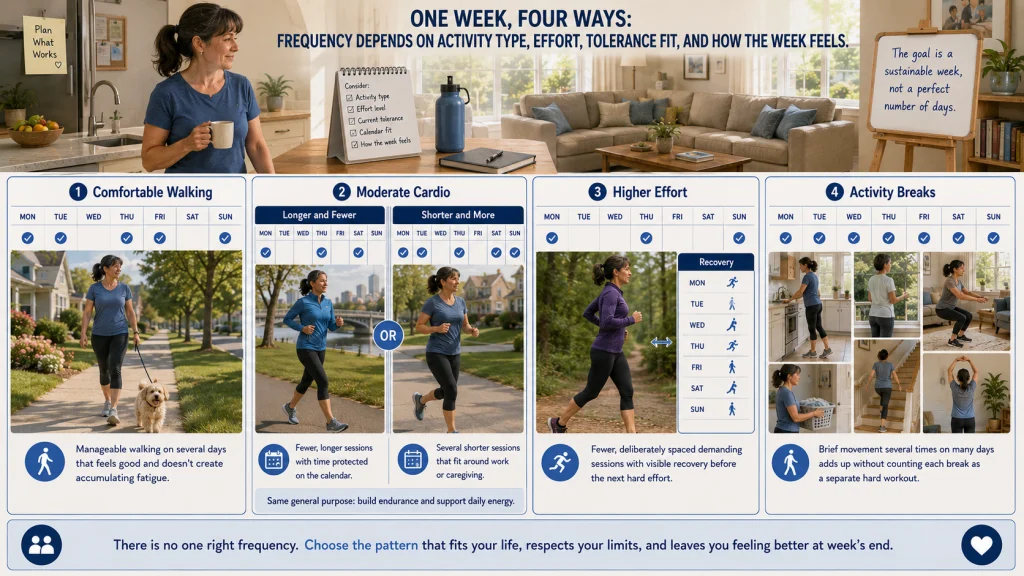
Aerobic activity can be arranged in longer sessions on fewer days, shorter sessions on more days, or a mixed pattern. The better choice depends on the activity, the person’s current tolerance, the calendar, and how the total week feels.
| Activity type | Possible frequency approach | Main scheduling question |
|---|---|---|
| Comfortable walking or similar light aerobic movement | May appear on several days when it remains manageable. | Can the movement fit the day without creating accumulating fatigue or discomfort? |
| Moderate cardio session | May be distributed across fewer longer sessions or more shorter sessions. | Which pattern supports consistency without making each session too difficult to repeat? |
| Higher-effort cardio | Usually needs more deliberate spacing and review than light movement. | Does the next demanding session begin after energy and performance have recovered? |
| Short activity breaks | Can occur within several days without being counted as separate hard workouts. | Are the breaks adding movement without creating an unrealistic streak requirement? |
The same weekly amount can be divided in several ways. One person may prefer fewer protected sessions, while another may find shorter blocks easier to place around work or caregiving. The frequency should support the total plan rather than becoming a goal by itself.
Detailed activity selection belongs in the guide to cardio workouts at home. This article only decides how often a selected activity might reasonably appear in the starting week.
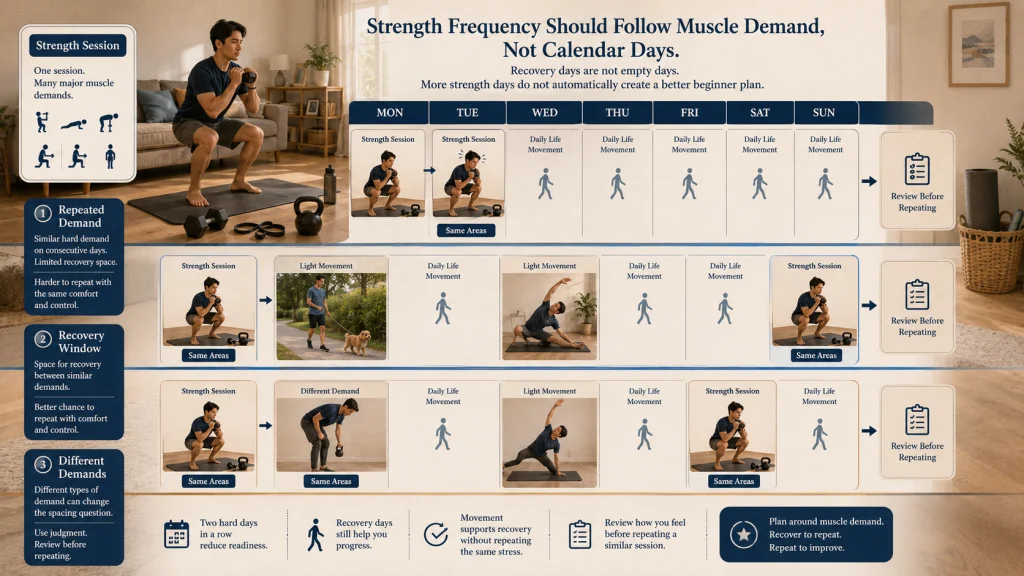
Space Strength Sessions by Repeated Muscle Demand
Strength frequency should be planned around which muscles are being challenged, not only around the number of calendar days. Two sessions may need more separation when they repeat similar full-body work than when they focus on clearly different demands.
A beginner does not need a complex body-part split to use this principle. The calendar can simply record whether the next strength session repeats much of the same muscle work. If it does, place a recovery window between those sessions and review how the person feels before repeating the pattern.
More strength days do not automatically produce a better starting plan. A higher frequency can reduce the time available for recovery, increase setup friction, and make missed sessions harder to rearrange. A lower, repeatable frequency may provide a clearer view of technique, comfort, and recovery.
The guide to strength training at home covers exercise selection and progression. Use the separate article on rest days for beginners when deciding whether the spacing between demanding sessions is sufficient.
That spacing does not require the days between strength sessions to feel empty. It only means the next activity should not recreate the same demand without enough recovery.
Do Not Equate Mobility and Light Movement With Hard Training
Mobility work, an easy walk, household movement, and short activity breaks may fit on days without a formal workout. Their presence does not turn every day into a hard training day.
The activity still needs context. A mobility session can be gentle or demanding. A walk can be comfortable or challenging because of pace, hills, heat, duration, or current capacity. The label alone does not determine the effort.
Use three checks:
- Does the activity leave the person ready for the next planned demanding session?
- Does it support ordinary movement, or does it create another performance target?
- Can it be skipped or reduced when energy, soreness, or joint comfort changes?
Daily movement can be useful without becoming a daily workout requirement. This distinction allows the schedule to include movement opportunities while protecting recovery from repeated hard sessions.
With those activity types separated, the calendar can now answer a more practical question: which sessions truly need protected space?
Choose the Minimum Frequency the Calendar Can Support
The first useful frequency is the smallest number of planned sessions that gives the week a clear structure and can survive ordinary disruption. A schedule that depends on every open evening is less reliable than one built around a few protected windows.
Mark each proposed session as one of three types:
- Anchor: A session that defines the week and receives the most reliable window.
- Optional: A useful session that can happen when time and recovery allow.
- Minimum version: A smaller version of an anchor for a day when the full session no longer fits.
Frequency should count the anchors first. Optional movement does not need to become a hidden requirement, and a minimum version should not create a make-up session later.
The guide to a beginner workout schedule can help place those sessions into actual days, including missed-session rules and recovery windows.
Even after the days are chosen, the number alone still does not describe the full week. Session length and effort can quietly change the demand without changing the calendar.
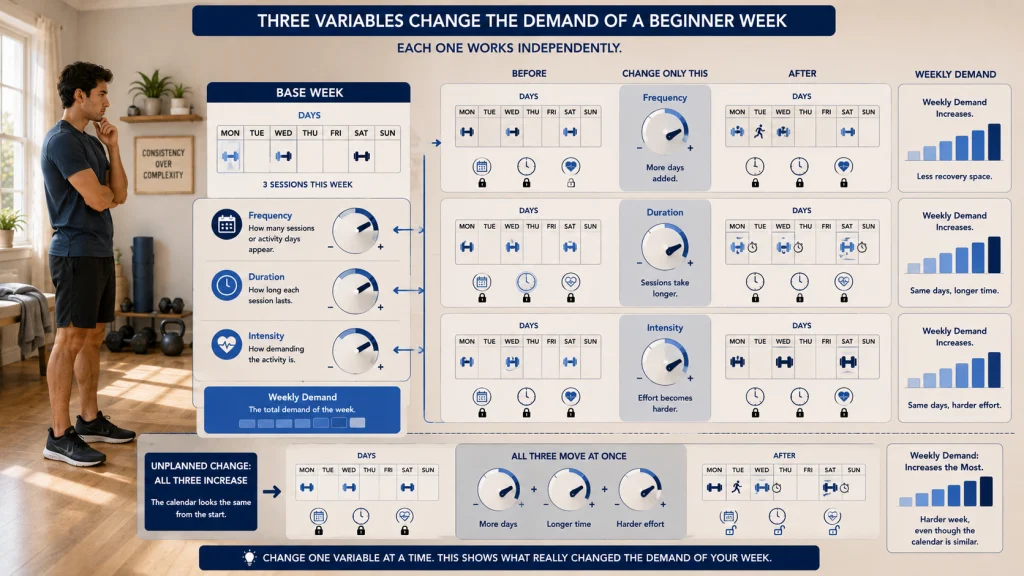
Separate Frequency From Duration and Intensity
Frequency answers how often an activity appears. Duration answers how long each session lasts. Intensity describes how demanding the work is. Changing any one of these can change the total weekly load.
| Variable | Question | Example change | What can happen if it changes unnoticed |
|---|---|---|---|
| Frequency | How many sessions or activity days are planned? | Add one more cardio day. | Recovery windows shrink even when each session stays the same length. |
| Duration | How long does each session last? | Extend two sessions by ten minutes. | The weekly amount rises without adding another day. |
| Intensity | How demanding is the activity? | Use a faster pace or more challenging resistance. | The same calendar can require more recovery. |
A person can keep the same three workout days while making the week much harder by extending each session or increasing effort. That is why “three days a week” is not a complete recommendation.
Use the article on choosing workout duration when session length is the unclear variable. For help describing effort without turning it into a medical test, review exercise intensity for beginners.
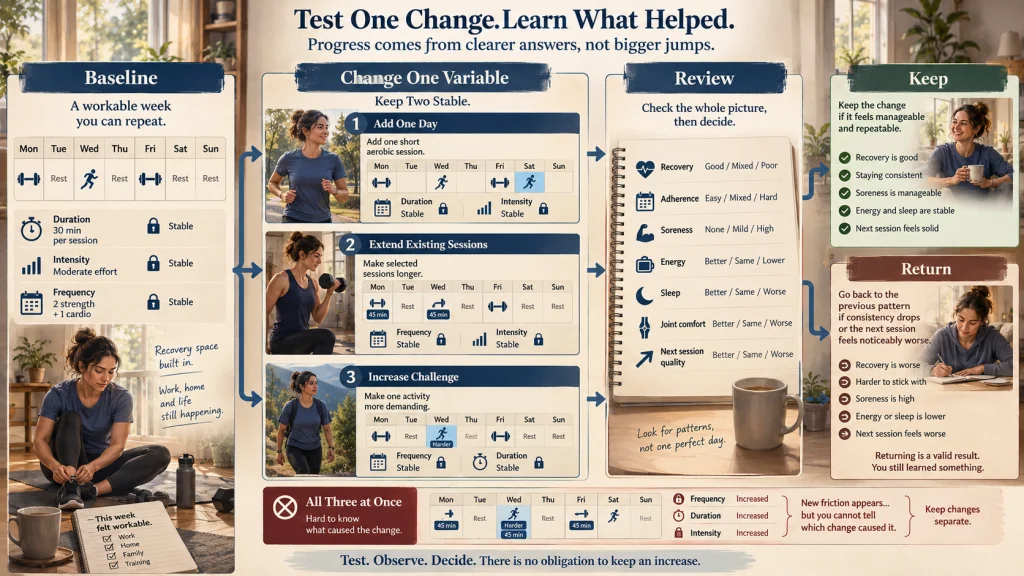
Increase One Variable at a Time
When the starting pattern feels manageable, change only one part of the plan. Adding days, extending sessions, and increasing effort at the same time makes it difficult to identify which change caused new fatigue, soreness, joint discomfort, sleep disruption, or missed workouts.
Increase-one-variable rule: Keep two variables stable while changing one. Test the new pattern long enough to observe recovery and adherence before making another change.
Examples include:
- Add one short aerobic session while keeping the other sessions at the same duration and effort.
- Extend one or two existing sessions while keeping the same number of workout days.
- Increase the challenge of one selected activity while leaving frequency and duration unchanged.
If the new version reduces consistency or makes the next session noticeably worse, return to the previous workable pattern. Progress does not require keeping every increase once it has been tested.
The review should therefore focus less on whether every box was checked and more on what the new pattern changed across the rest of the week.
Review Recovery and Adherence Before Adding Days
A frequency works when the person can complete the planned sessions with reasonable comfort and return to ordinary responsibilities. Review the pattern instead of judging one isolated day.
| Review area | Useful question | Possible frequency adjustment |
|---|---|---|
| Soreness | Does soreness settle before similar muscle work returns? | Add more spacing or reduce repeated demand. |
| Energy | Is ordinary daytime energy stable enough for work and household tasks? | Reduce one demanding day or replace it with lighter movement. |
| Performance | Can the person complete the planned activity with similar control and comfort? | Hold frequency steady before increasing another variable. |
| Sleep | Has the schedule begun to reduce sleep opportunity or disturb the usual wind-down? | Move the session, shorten it, or reduce the number of demanding days. |
| Motivation | Does the plan feel repeatable, or does each session require increasing pressure to begin? | Protect fewer anchors and keep optional sessions truly optional. |
| Joint comfort | Is discomfort new, increasing, persistent, or changing movement? | Stop the aggravating activity and seek appropriate guidance when needed. |
Do not wait for every review area to become a problem. A repeated drop in one area can be enough to hold or reduce frequency while the cause is considered.
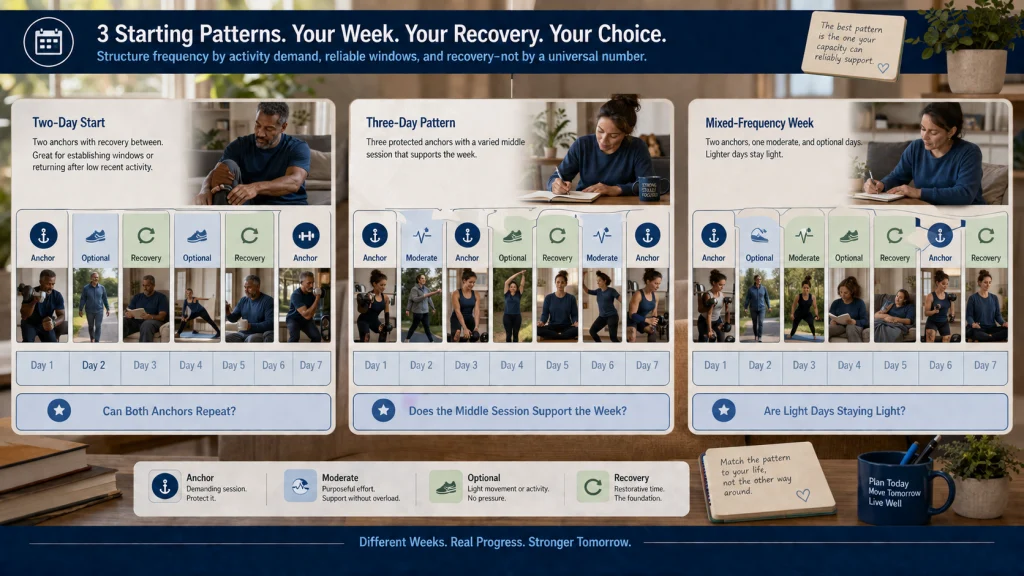
Compare Three Starting Frequency Patterns
These examples show how activity type changes the meaning of the week. They are not universal prescriptions. Each pattern needs to be adjusted for current capacity, session length, effort, and recovery.
| Starting pattern | Example structure | Best use | Review point |
|---|---|---|---|
| Two-day start | Two mixed or strength-focused anchor sessions with recovery between them, plus optional light movement. | A person who needs to establish reliable windows or is returning after low recent activity. | Can both anchors be repeated without crowding recovery or daily responsibilities? |
| Three-day pattern | Three anchors distributed across the week, with the activity type chosen to avoid repeating the same hard demand too closely. | A person with three dependable windows and a manageable response to the first sessions. | Does the middle session support the week, or does it reduce the quality of the next one? |
| Mixed-frequency week | Two demanding anchors, one moderate session, and one or more optional light-activity days. | A person who wants movement on more days without treating every day as hard training. | Are the lighter days staying light, and are the demanding sessions still well spaced? |
Select the pattern that leaves the clearest recovery rule. A schedule is easier to adjust when each day has a defined purpose rather than the same “workout” label.
Know When a Generic Frequency Is Not Appropriate
This framework is intended for generally healthy adults arranging ordinary home activity. It does not diagnose an injury, prescribe rehabilitation, create a disease-specific program, or replace advice from a physician, physical therapist, or qualified exercise professional.
Persistent joint or muscle pain, neurological symptoms, pregnancy, recent surgery, chronic conditions, disability-related limitations, or a long period of inactivity may require individualized guidance before selecting or increasing workout frequency.
Stop exercise and seek appropriate help: Chest pain or pressure, extreme shortness of breath, fainting, severe dizziness, sudden weakness, a serious injury, or severe pain require prompt attention. Do not use a lighter session, an extra recovery day, or a lower frequency as a substitute for appropriate evaluation.
Choose the Activity, Frequency, Recovery Rule, and Review Date
Start by naming the activity type. Then choose the lowest frequency that fits reliable calendar windows, leaves suitable recovery between repeated demands, and can be completed without reducing ordinary daily function.
Write one recovery rule and one review date before increasing the plan. When the starting pattern remains manageable, change frequency, duration, or intensity one at a time. The right number of workout days is the number that supports useful activity and can still be repeated next week.
FAQs
📅 Do beginners need to work out a fixed number of days?
No. The starting frequency depends on the activity type, current capacity, session length, effort, recovery, and available time. A repeatable two-day pattern can be more useful than a five-day plan that quickly breaks down.
🚶 Can beginners move every day?
Daily movement is not the same as daily hard training. Comfortable walking, mobility, household movement, or short activity breaks may fit on more days when they remain manageable and do not interfere with recovery.
🏋️ Can I do full-body strength training on consecutive days?
Repeated work for the same major muscle groups usually needs deliberate spacing. A beginner should review soreness, performance, joint comfort, and the demands of the exact sessions rather than relying only on the weekday labels.
⏱️ Is frequency more important than workout length?
Neither variable works alone. Three long or demanding sessions can create more weekly load than several short, comfortable sessions, so frequency, duration, and intensity should be reviewed together.
➕ When should I add another workout day?
Add a day only after the current pattern is consistent and recovery remains manageable. Keep duration and intensity stable while testing the extra day so the effect is easier to judge.
🛌 Does a recovery day mean complete inactivity?
Not necessarily. A recovery day can include suitable daily movement or a lower-demand activity, provided it does not recreate the same hard training demand or worsen symptoms.
🚩 When should I ask for individualized guidance?
Seek appropriate guidance when persistent pain, neurological symptoms, pregnancy, recent surgery, chronic conditions, disability-related limitations, or a long inactive period makes a generic frequency uncertain. Urgent warning signs require prompt help rather than a schedule adjustment.