The best time to nap depends on where the nap sits between wake time, intended bedtime, and the task that follows it. A 2 p.m. nap can be early, mid-day, or late depending on whether the person woke at 5 a.m., 8 a.m., or noon. Choose the nap window by purpose, available sleep opportunity, time before nighttime sleep, and the level of alertness required afterward. Persistent or dangerous daytime sleepiness needs qualified evaluation rather than a more aggressive nap schedule.

See why the same 2 p.m. nap can mean three different things
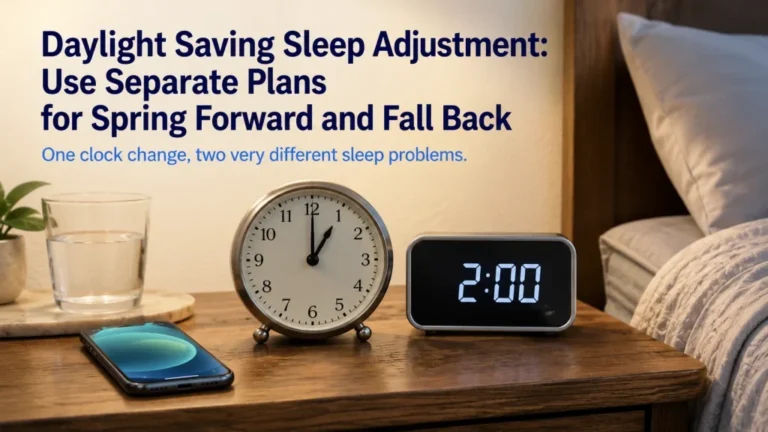
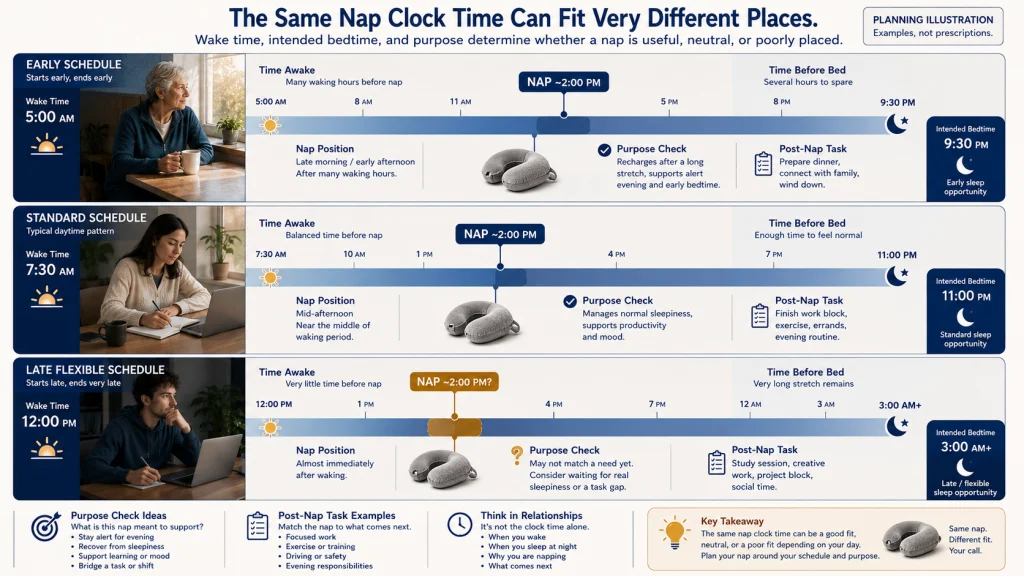
Three adults all plan to lie down at 2 p.m. The clock time is identical, but the nap sits in a different place inside each person’s day.
🕔 Wake at 5:00 a.m. → 🕑 Nap at 2:00 p.m.
The nap arrives nine hours into the waking day, so the main question is whether it supports the afternoon without crowding an early bedtime.
🕗 Wake at 8:00 a.m. → 🕑 Nap at 2:00 p.m.
The nap falls six hours after waking, making sleepiness, purpose, and the next task more important than the clock time alone.
🕛 Wake at 12:00 p.m. → 🕑 Nap at 2:00 p.m.
The nap appears only two hours into the day, so it may be unnecessary or likely to push nighttime sleep later.
The same travel pillow could support a lunch-break nap for the early riser and interfere with nighttime sleep for the person who woke at noon. The object has not changed, but its place in the schedule has.
Nap timing should be relative to wake time and bedtime, not copied from a universal clock.
Separate nap timing from nap duration
Nap timing asks when the nap belongs in the day. Nap duration asks how long it should last and how likely the person is to feel groggy afterward. Those decisions affect each other, but they are not interchangeable.
A well-placed nap can still be too long for the next task. A short nap can still occur too close to bedtime. Keep the first decision simple: identify the earliest realistic start, the latest acceptable end, and the responsibility that follows waking.
This article stays focused on placement. Use the nap duration guide when the main question is length, sleep inertia, or how much recovery time to leave after waking.
Identify the job the nap needs to do
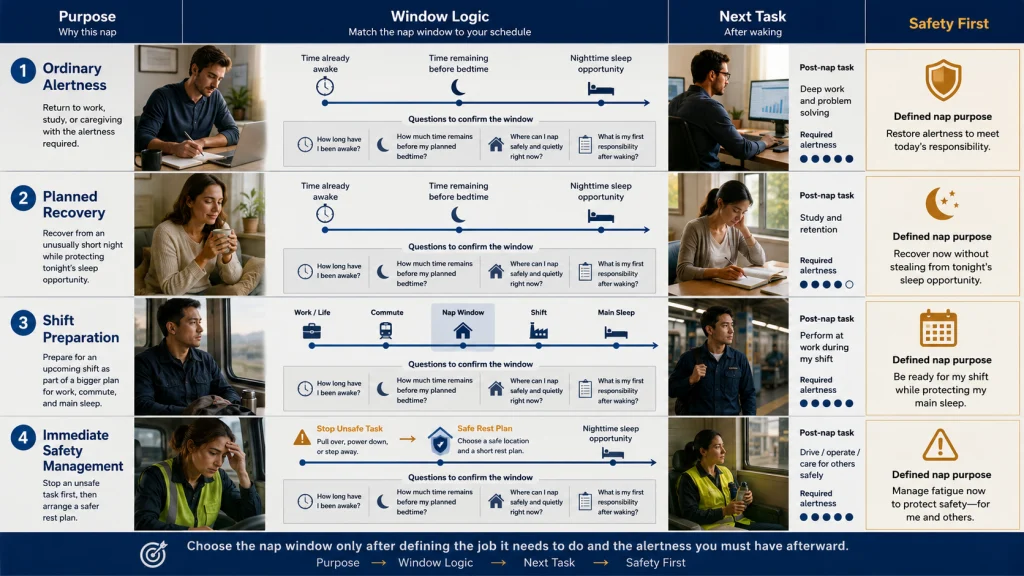
A nap should solve a defined scheduling problem. “I feel tired” is a starting observation, but the planned window depends on what kind of help is needed and what must happen afterward.
| Nap purpose | Window logic | Post-nap question |
|---|---|---|
| Ordinary alertness | Place the nap after enough waking time has passed for sleepiness to be meaningful, while preserving a clear buffer before bedtime. | Does the person need to return to routine work, caregiving, or study? |
| Planned recovery | Use a window that fits after an unusually short night without turning the nap into a substitute for repeated inadequate nighttime sleep. | Can the following night still begin near its intended time? |
| Shift preparation | Place the nap inside the larger work and sleep plan rather than borrowing a daytime rule. | What level of alertness is required during the shift and commute? |
| Emergency fatigue management | Stop the unsafe task first, then use a safer rest plan rather than trying to push through dangerous sleepiness. | Is the person safe to drive, operate equipment, or work afterward? |
The purpose should be written in one sentence. For example: “This nap is meant to support alertness for the second half of the workday,” or “This rest period is part of a planned overnight-shift schedule.” If the purpose remains vague, the nap window will usually remain vague too.
Check whether nighttime sleep opportunity is adequate
A planned nap can be useful, but it should not hide a schedule that repeatedly leaves too little time for nighttime sleep. Review when the person goes to bed, when they must wake, how much time is available, and whether evening obligations consistently shrink that window.
If the nap is needed because work, caregiving, commuting, or late household tasks shorten every night, the first problem may be the main schedule rather than the nap itself. A nap can support a difficult day without solving the pattern that creates it.
Planning boundary: A nap is a temporary alertness tool, not a replacement for adequate nighttime sleep. Repeated reliance on naps to remain functional deserves a closer look at the full schedule.
Use the broader sleep schedule decision guide when timing, workdays, weekends, naps, or recovery periods are interacting in a larger pattern.
Place the nap on the wake-to-bed timeline
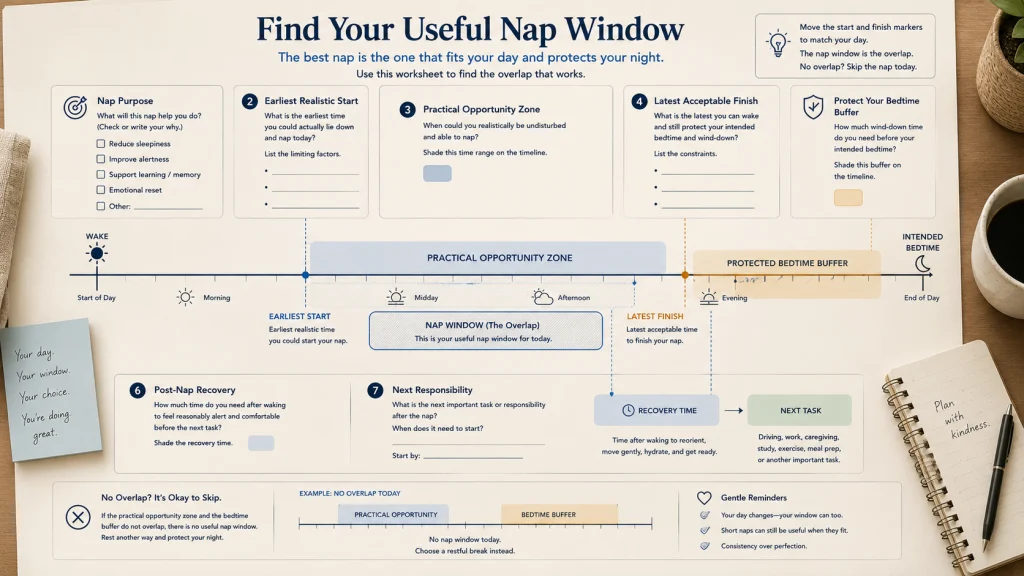
Write the day as a line from wake time to intended bedtime. Then place the nap between the earliest realistic start and the latest acceptable finish.
| Worksheet item | Your entry |
|---|---|
| Wake time | The time the main waking period began. |
| Intended bedtime | The time the main nighttime sleep opportunity should begin. |
| Nap purpose | Ordinary alertness, planned recovery, shift preparation, or immediate safety management. |
| Earliest realistic start | The first time sleepiness, schedule, and location make the nap practical. |
| Latest acceptable finish | The latest time that still protects the intended nighttime sleep window and next obligation. |
| Required post-nap task | Driving, work, caregiving, exercise, study, meal preparation, or another responsibility. |
| Recovery time after waking | The time available to become fully alert before the next task. |
The useful nap window is the overlap between practical opportunity and schedule protection. If no overlap exists, forcing a nap into the day may create more friction than benefit.
Protect a buffer before intended nighttime sleep
The closer a nap moves toward bedtime, the more carefully it should be evaluated. A late nap may reduce the sleepiness that would otherwise build toward the main sleep period, particularly when the person woke late or has not been awake for long.
Do not copy a fixed cutoff without looking at the actual day. Someone who wakes before dawn and goes to bed early has a different late window from someone who works into the evening and sleeps later. The buffer should be judged by the person’s intended bedtime, not by a universal afternoon label.
If the nap repeatedly leads to lying awake later than intended, move the nap earlier before changing caffeine, meals, exercise, alarms, room setup, and several other variables at once.
Account for lunch, caffeine, medication questions, commute, and workplace rules
A nap window must fit the day around it. Lunch may be the only available break, but a heavy meal can make the timing feel different. Caffeine use can alter the person’s perception of sleepiness and may complicate the test when its timing changes at the same time as the nap.
Medication questions should be directed to a qualified professional. This article does not advise changing medication timing, sedatives, stimulants, or any prescribed routine to create a nap window.
Commute and workplace rules also matter. A person who needs to drive immediately after waking has a different post-nap requirement from someone who can sit quietly before returning to a task. Workplace rest spaces, break limits, privacy, alarms, and safety policies may determine whether the planned nap is possible at all.
Editorial observation: Nap products and alarms are often marketed around a clock time, but real fit depends on the workday, caregiving, commute, and next required task. The object can be convenient while the schedule placement is wrong.
Compare early-day, mid-day, and late naps as tradeoffs
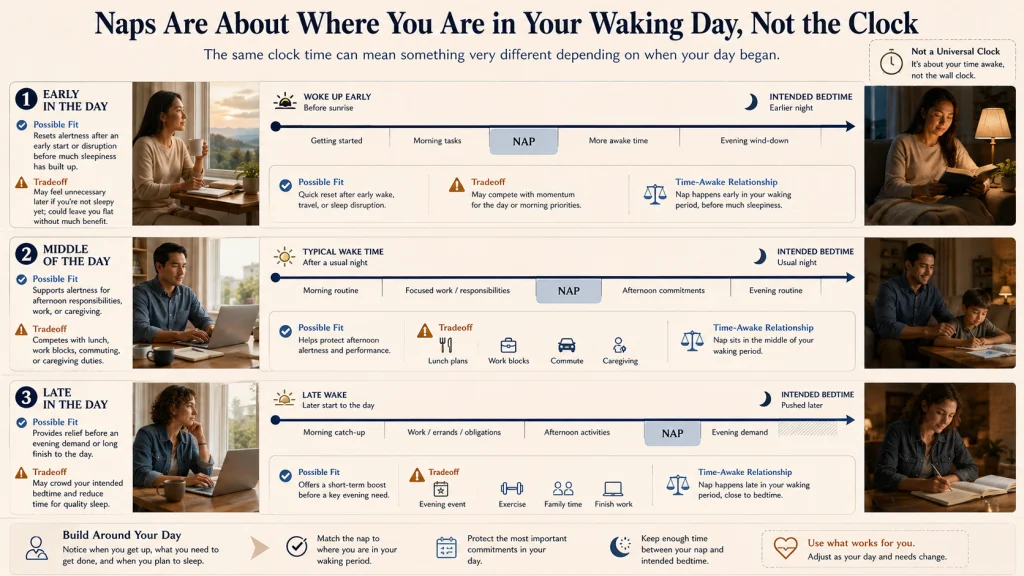
Clock labels can be misleading, so treat these as positions inside the waking day rather than fixed hours.
| Nap position | Possible advantage | Possible tradeoff |
|---|---|---|
| Early in the waking day | May fit after a very early start, travel disruption, or planned shift schedule. | The person may not have built enough sleepiness, especially after a normal night. |
| Middle of the waking day | May support alertness while leaving more separation from bedtime. | The window may conflict with lunch, work, caregiving, or commuting. |
| Late in the waking day | May provide short-term relief before an evening demand. | It is more likely to crowd the intended nighttime sleep opportunity. |
An early-afternoon window may fit many conventional daytime schedules, but the useful label is the nap’s position between waking and bedtime. Choose by that relationship rather than by the wall clock alone.
Treat shift work as a separate planning problem
Shift workers may use planned naps at times that look unusual on a daytime schedule. The nap may prepare for an overnight shift, protect alertness before a commute, or fit between split sleep periods.
Do not apply a standard early-afternoon recommendation to an overnight schedule. The correct placement depends on the full work period, main sleep period, commute, safety demands, and opportunity to recover.
Use the night-shift sleep planning guide when the nap is one part of an occupational schedule rather than an isolated daytime choice.
Treat travel and jet lag as another exception
Travel can change wake time, bedtime, light exposure, meals, and required performance at once. A nap that fits the departure day may interfere with the intended schedule at the destination.
Use local destination timing and the next required task when deciding whether a nap belongs in the travel plan. Avoid treating one nap as a complete solution to a larger time-zone shift.
Use the jet-lag sleep planning guide when the schedule is being moved across time zones rather than adjusted within an ordinary day.
Set the alarm, room, light, and noise without building a product list
The nap setup should support the planned window and make waking predictable. Use the alarm already available, confirm that it can be heard, and leave enough time after waking for the next task.
Choose a location that is safe, permitted, and reasonably quiet. Reduce unnecessary light and noise when possible, but do not make the setup so elaborate that the nap cannot happen outside one perfect room.
Keep personal belongings, transportation, workplace access, and the return to activity in mind. A comfortable setup is useful only when the person can wake, orient, and move into the next responsibility safely.
Compare three schedules with different wake times
These examples show how the nap moves with the day. They are planning illustrations, not prescriptions.
| Schedule | Wake time | Intended bedtime | Example nap window | Reasoning |
|---|---|---|---|---|
| Early daytime schedule | 5:00 a.m. | 9:30 p.m. | Early afternoon, before the late part of the waking day. | The person has already been awake for many hours and still preserves separation from bedtime. |
| Standard daytime schedule | 8:00 a.m. | 11:30 p.m. | Mid-afternoon if sleepiness and the workday allow it. | The nap sits near the middle of the waking period and leaves a later nighttime window. |
| Late flexible schedule | 12:00 p.m. | 3:00 a.m. | Later than a conventional lunch-break nap, if a nap is needed at all. | A 2 p.m. nap would occur too soon after waking to copy the daytime examples. |
The times are less important than the relationship between wake time, bedtime, purpose, and post-nap task. A fixed recommendation can only become useful after it is placed on that timeline.
Adjust nap timing before changing five other variables
If nighttime sleep begins later after a nap, change the placement first. Move the nap earlier, move it farther from bedtime, or remove it from a day when it no longer serves a clear purpose.
Keep the rest of the schedule stable enough to interpret the result. Changing caffeine, lunch, exercise, alarms, room temperature, light, and bedtime at the same time makes it difficult to know whether the nap timing was the real issue.
Review several ordinary days rather than judging the plan from one unusual afternoon. If the nap repeatedly delays bedtime despite a reasonable timing adjustment, the person may need to reconsider whether the nap belongs in that schedule.
Respond to persistent or dangerous daytime sleepiness
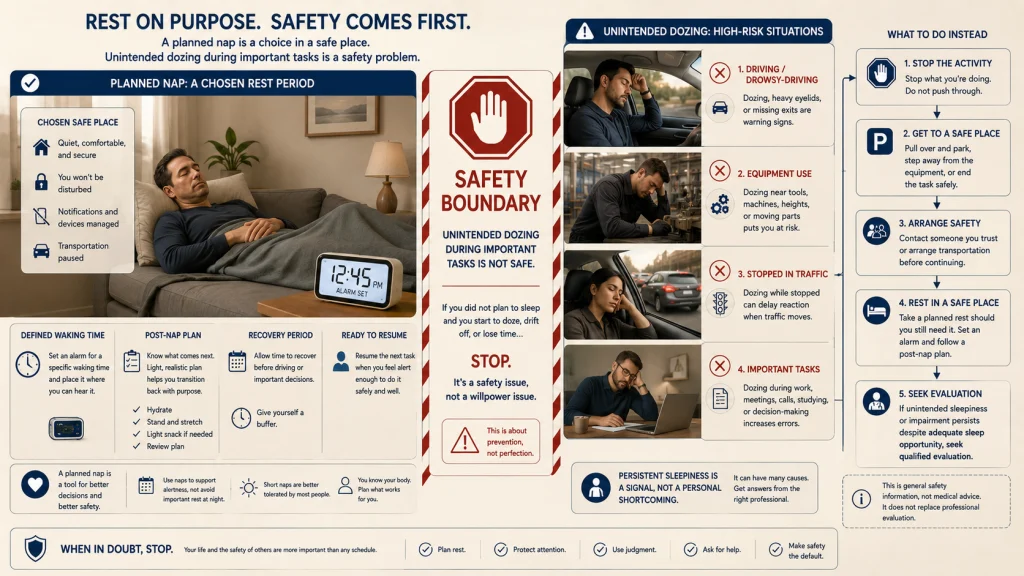
Planned nap versus unintended dozing: A planned nap occurs in a chosen safe place with a defined waking time and a post-nap plan. Unintended dozing while driving, working, sitting in traffic, using equipment, or performing another attention-sensitive task is a safety problem, not a scheduling technique.
Do not drive or continue an attention-sensitive task when you are struggling to stay awake, having unintended sleep episodes, or unable to maintain attention. Stop the activity and arrange a safer alternative.
Persistent daytime sleepiness, repeated unintended sleep, or impairment despite adequate sleep opportunity requires qualified evaluation. This article does not diagnose a sleep disorder or prescribe medication, stimulants, sedatives, or clinical treatment.
Write the purpose, earliest time, latest time, and post-nap task
Complete the nap plan in four lines:
- Purpose: State the exact job the nap needs to do.
- Earliest realistic time: Identify when the schedule, sleepiness, and location first make the nap practical.
- Latest acceptable time: Set the outer boundary that protects the intended bedtime.
- Post-nap task: Name the first responsibility after waking and the alertness it requires.
A complete example might read: “The nap is meant to support afternoon alertness after an unusually early start. The earliest practical time is after lunch, and the latest finish must leave a clear buffer before bedtime. I will not drive until I am fully alert after waking.”
Use the broader sleep improvement guide when nap timing is only one part of the problem. The useful nap window is the one that supports the next task without quietly pushing the main sleep period out of place.
FAQs
🕑 Is 2 p.m. always the best time to nap?
No. A 2 p.m. nap occurs at a different point in the day for someone who woke at 5 a.m., 8 a.m., or noon. Place the nap relative to wake time, bedtime, purpose, and the task that follows it.
🌅 How long after waking should I wait before napping?
There is no single interval that fits every schedule. Consider how long you have been awake, whether nighttime sleep was adequate, how sleepy you feel, and how much time remains before bedtime.
🌙 How late is too late for a nap?
A nap is too late when it repeatedly delays the intended nighttime sleep period or leaves too little separation from bedtime. Judge lateness by your actual bedtime rather than by a universal clock cutoff.
😴 Can a nap replace a short night of sleep?
A nap may provide temporary alertness or recovery, but it does not replace an adequate nighttime sleep opportunity. Repeated short nights require attention to the main schedule.
☕ Should I change caffeine timing when testing a nap?
Keep caffeine timing reasonably stable while testing nap placement so the result is easier to interpret. Medication or stimulant questions should be discussed with a qualified professional.
🌃 Do night-shift workers need a different nap time?
Yes, the nap must fit the full shift, commute, main sleep period, and safety demands. A daytime early-afternoon rule should not be copied into an overnight work schedule.
✈️ Should I nap during jet lag?
The decision depends on destination timing, the next required task, and the larger adjustment plan. A nap that helps during travel may also delay the intended sleep period at the destination.
🚗 When is daytime sleepiness a safety issue?
It is a safety issue when you struggle to stay awake while driving, using equipment, working, or performing another attention-sensitive task. Stop the activity, arrange a safer alternative, and seek qualified evaluation for persistent or unintended sleep episodes.