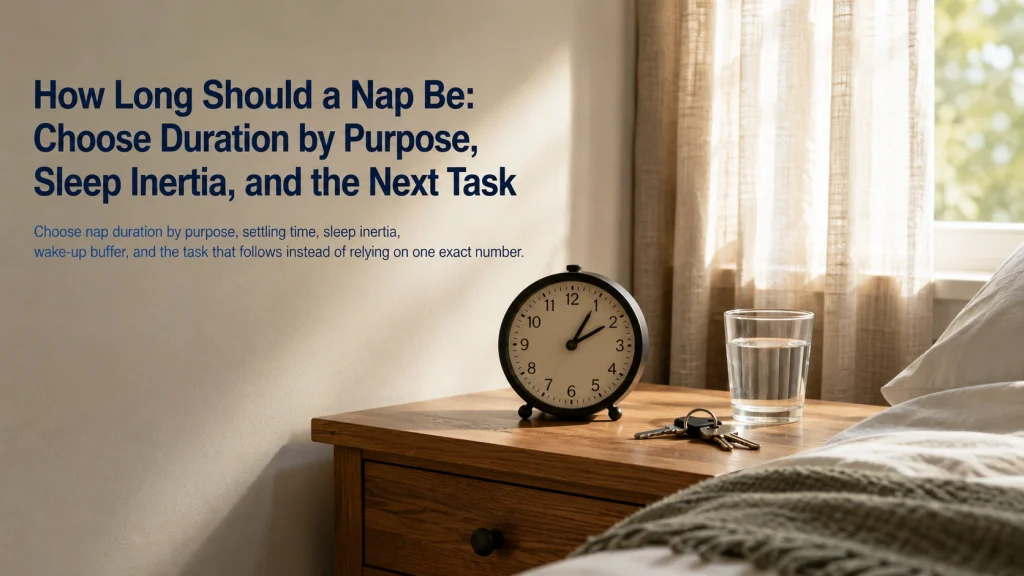
Nap duration should be chosen by purpose, expected time to fall asleep, the chance of post-nap grogginess, and the task that follows waking. Time in bed is not the same as time asleep, so the alarm must account for settling time as well as the wake-up buffer. Brief naps can fit quick alertness goals, while longer naps need more room for recovery and may interfere more with nighttime sleep. Dangerous sleepiness, unintended dozing, or persistent impairment requires qualified evaluation and immediate safety action where appropriate.
Compare two alarms set for the same duration
Two adults set identical nap alarms. The first person plans to drive five minutes after waking. The second has thirty minutes before a quiet household task.
| Same alarm duration | Wake-up buffer | First task | Practical difference |
|---|---|---|---|
| Alarm A | Five minutes | Driving or another safety-sensitive task | Almost no time to orient, stand, gather belongings, and reassess alertness. |
| Alarm B | Thirty minutes | A quiet household routine | More time to sit up, move, enter brighter surroundings, and begin with a low-risk task. |
The alarm duration is the same, but the post-nap risk is not. Waking from a nap and still feeling mentally heavy can be frustrating, especially when the next obligation cannot wait. A stronger alarm may wake someone on time, yet it cannot create the cognitive buffer needed before driving or operating equipment.
Nap duration cannot be chosen without the wake-up buffer.
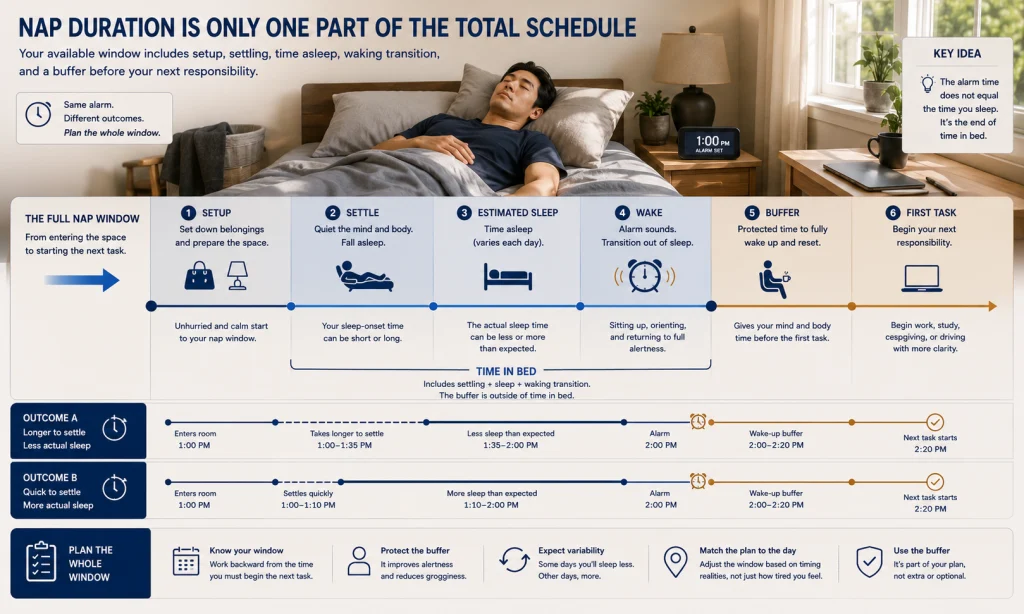
Separate duration, time in bed, estimated sleep time, and wake-up buffer
“A twenty-minute nap” can mean several different things. It may describe twenty minutes in bed, twenty minutes after falling asleep, or twenty minutes from lying down until the alarm sounds. Those are not the same plan.
Available nap window
Setup → Settling time → Estimated sleep time → Waking transition → Wake-up buffer → First task
Time in bed covers settling time, estimated sleep time, and the waking transition. The wake-up buffer comes after the alarm and before the next responsibility.
If someone usually needs time to settle, setting the alarm for the desired sleep duration alone can shorten the actual nap. If the person falls asleep quickly, the same setting may produce more sleep than expected.
The wake-up buffer begins when the alarm sounds and ends when the next responsibility starts. It belongs inside the total schedule, not as an afterthought.
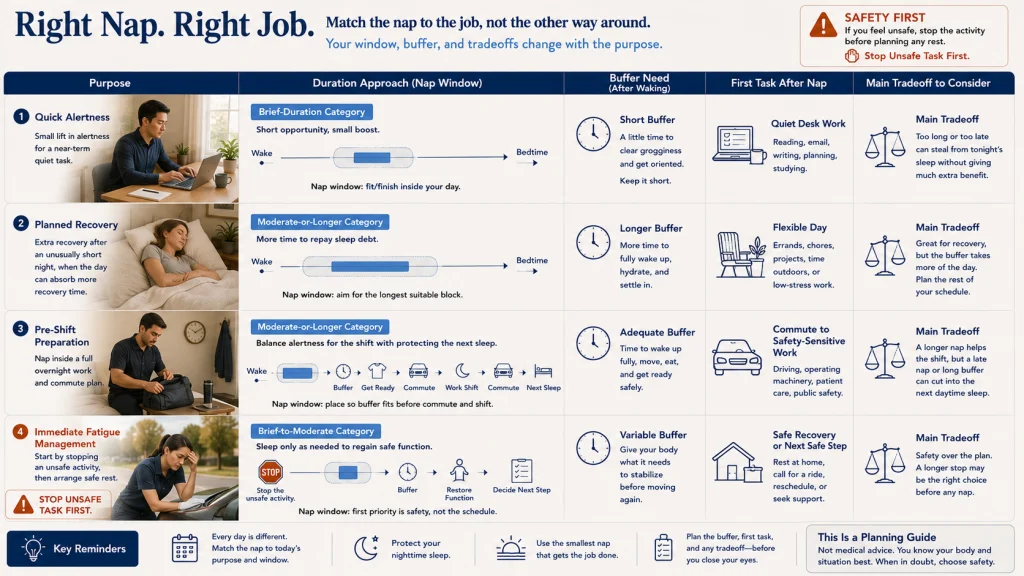
Decide the purpose before selecting a duration
A nap should have one primary job. The person seeking a small lift before routine desk work has a different decision from someone preparing for an overnight shift or recovering after an unusually short night.
| Purpose | Duration approach | Buffer need | Main tradeoff |
|---|---|---|---|
| Quick alertness | Begin with a brief nap window rather than assuming more sleep is better. | Leave enough time to feel fully oriented before the next task. | The nap may provide limited recovery if prior sleep was very short. |
| Planned recovery | A moderate or longer window may be considered when the schedule has room for it. | Allow more recovery time because grogginess may be stronger or less predictable. | The nap can crowd nighttime sleep or consume a large part of the day. |
| Pre-shift preparation | Choose duration inside the full work, commute, and main-sleep plan. | Protect a clear transition before driving or safety-sensitive work. | Daytime nap rules may not fit an overnight schedule. |
| Immediate fatigue management | Stop the unsafe activity first and use a safe rest plan. | Do not resume critical tasks until alertness is adequate. | A nap does not explain or treat persistent excessive sleepiness. |
Write the purpose in one sentence before setting the alarm. “I need enough alertness for a quiet afternoon task” leads to a different plan from “I need to prepare for several hours of overnight work.”
Use a brief nap when the goal is a small alertness lift
A brief nap can fit when the available window is narrow, the next task is routine, and the person wants to reduce the chance that the nap extends deep into the day. As a planning example, this may mean roughly 10 to 20 minutes of intended sleep, with separate time added for settling and waking. That range is context, not a universal prescription.
The limitation is that time in bed may include several minutes of settling. Someone who takes longer to fall asleep could receive very little actual sleep from a short alarm setting. Someone who is severely sleep-deprived may fall asleep quickly and wake feeling more disoriented than expected.
Do not treat a brief nap as guaranteed protection from grogginess. The person’s prior sleep, timing, environment, and individual response still matter.
Use moderate or longer naps only when the schedule can absorb the cost
A moderate or longer nap window may offer more opportunity for sleep after a short night or before an unusual work period. For planning purposes, some people compare a moderate window of about 30 to 60 minutes with a longer window of about 60 to 90 minutes. These ranges are examples for organizing time, not promises about sleep stages, recovery, or how any individual will feel.
The tradeoff is not simply “more recovery versus less recovery.” A longer nap also requires more time in the room, a larger wake-up buffer, and a safer transition before driving, work, caregiving, or exercise.
When the day cannot provide that full window, shortening the nap may be more practical than compressing the recovery period. A longer alarm setting is not useful if the person must rush directly into a demanding task.
Planning boundary: A longer nap does not replace adequate nighttime sleep. Repeatedly needing long daytime recovery deserves a closer look at the main sleep schedule.
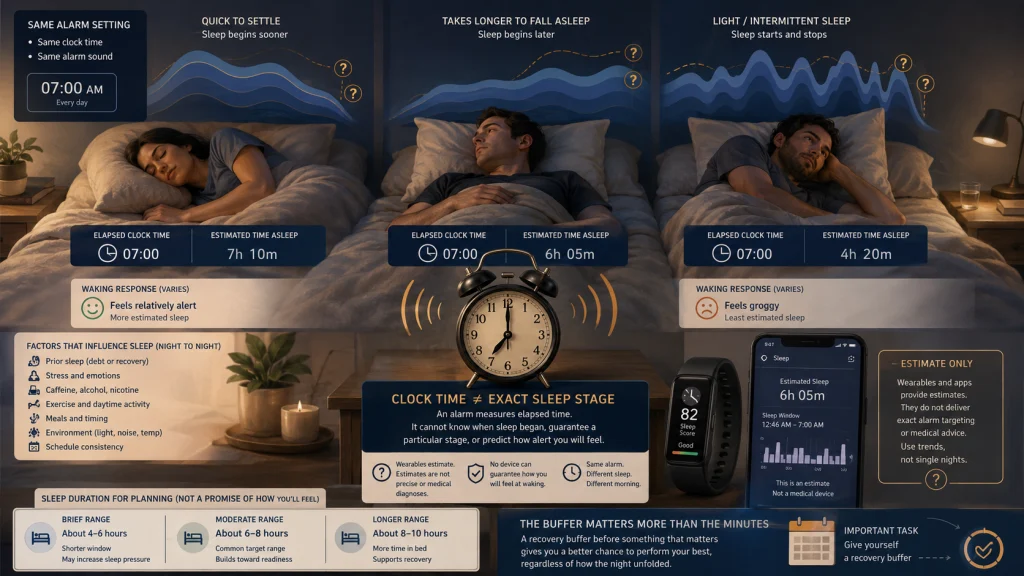
Understand why an alarm cannot guarantee a particular sleep stage
Sleep does not begin at the moment the head touches the pillow, and it does not progress on an identical timer every day. Prior sleep, stress, timing, environment, age, and other factors can change how quickly a person falls asleep and how sleep develops.
An alarm can control elapsed clock time. It cannot confirm the exact moment sleep began or guarantee that waking will occur from a particular stage. Consumer wearables and apps may estimate sleep, but their labels should not be treated as a precise alarm-setting tool or a diagnosis.
Use duration categories as planning ranges rather than promises. A brief 10 to 20 minute example, a moderate 30 to 60 minute example, or a longer 60 to 90 minute example cannot guarantee a particular sleep stage or waking response. The more safety-sensitive the next task, the more important the wake-up buffer becomes.
Add realistic time for falling asleep
The nap plan begins before sleep. Include the time needed to reach the room, settle belongings, use the restroom, reduce noise, set the alarm, and become comfortable.
Then estimate how long it usually takes to fall asleep in that setting. A person who naps easily at home may need more time in a workplace rest area, hotel, airport lounge, or unfamiliar room.
Do not pad the alarm so generously that the nap becomes open-ended. Use an outer limit for time in bed, then evaluate whether enough actual rest occurred to justify repeating the same plan.
Editorial observation: Room-darkening tools, masks, sound devices, and timers should be judged by the post-nap task. A setup that helps someone fall asleep is incomplete if it makes waking, packing, or leaving on time harder.
Place the duration inside the available nap window
The available window begins when the person can realistically lie down and ends when the next task must begin. The nap itself occupies only part of that period.
| Window element | What to include |
|---|---|
| Setup | Travel to the space, alarm setup, comfort, and reduction of interruptions. |
| Settling | Realistic time to fall asleep in the actual environment. |
| Estimated sleep | The duration category chosen for the purpose. |
| Waking transition | Time to sit up, orient, stand, and leave the sleep space. |
| Wake-up buffer | Recovery time before driving, work, caregiving, exercise, or another task. |
If the total exceeds the available window, the plan does not fit. Reduce the duration, choose a different time, change the post-nap task, or skip the nap instead of removing the safety buffer.
Use the nap timing guide when the unresolved question is where the nap belongs between wake time and bedtime.
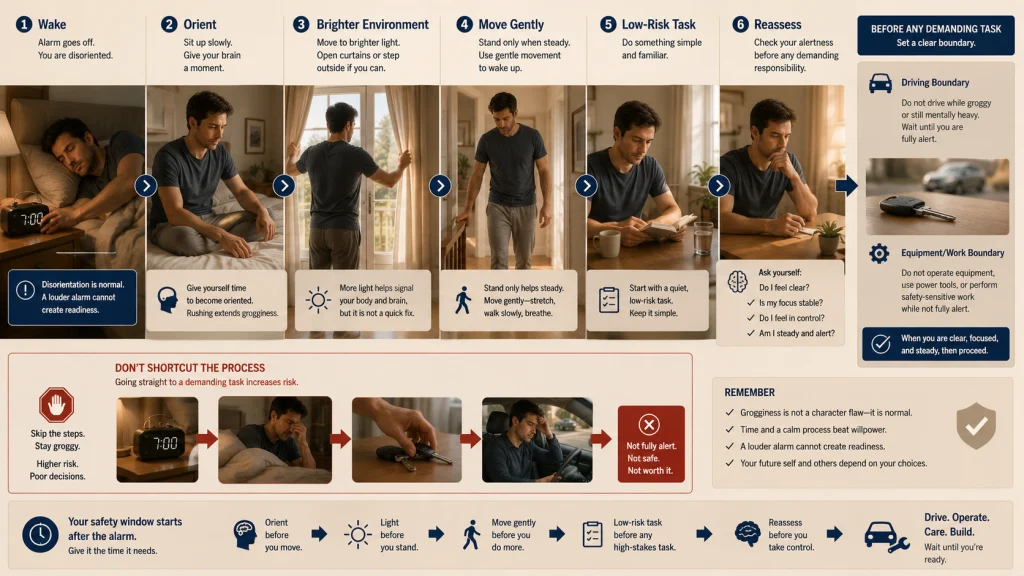
Plan the wake-up buffer with a low-risk first task
The first minutes after waking should not be assigned to the most demanding responsibility of the day. Leave room to become oriented before making decisions that depend on fast reactions or sustained attention.
Simple steps can support the transition without being presented as a cure:
- Move into brighter surroundings when practical.
- Sit up and stand only when steady.
- Use gentle movement rather than rushing immediately.
- Drink water if desired and appropriate.
- Begin with a quiet, low-risk task.
- Reassess alertness before driving or operating equipment.
Critical-task warning: Do not drive, operate equipment, or begin another safety-sensitive task while groggy, disoriented, struggling to stay awake, or unable to maintain attention. A louder alarm does not make the person ready for the task.
Treat caffeine-nap claims cautiously
Some controlled or occupational settings have studied caffeine combined with a brief planned nap. Those results do not make the approach appropriate for every person, schedule, health situation, medication routine, or bedtime.
This article does not prescribe caffeine, stimulants, medication timing, or a universal caffeine-nap method. Changing caffeine timing while changing nap duration also makes the result harder to interpret.
When testing a duration plan, keep other variables reasonably stable. Medication, stimulant, or health-specific questions belong with a qualified professional.
Place pre-shift naps inside the full shift plan
A pre-shift nap may be longer or placed differently from an ordinary daytime nap. The decision must account for the main sleep period, commute, work start, break opportunities, safety demands, and recovery after the shift.
Do not borrow a simple daytime duration rule and place it before overnight work without checking the full schedule. The wake-up buffer is especially important when the person must drive or begin safety-sensitive work soon after waking.
Use the night-shift sleep plan when the nap is one part of an occupational schedule rather than an isolated daytime choice.
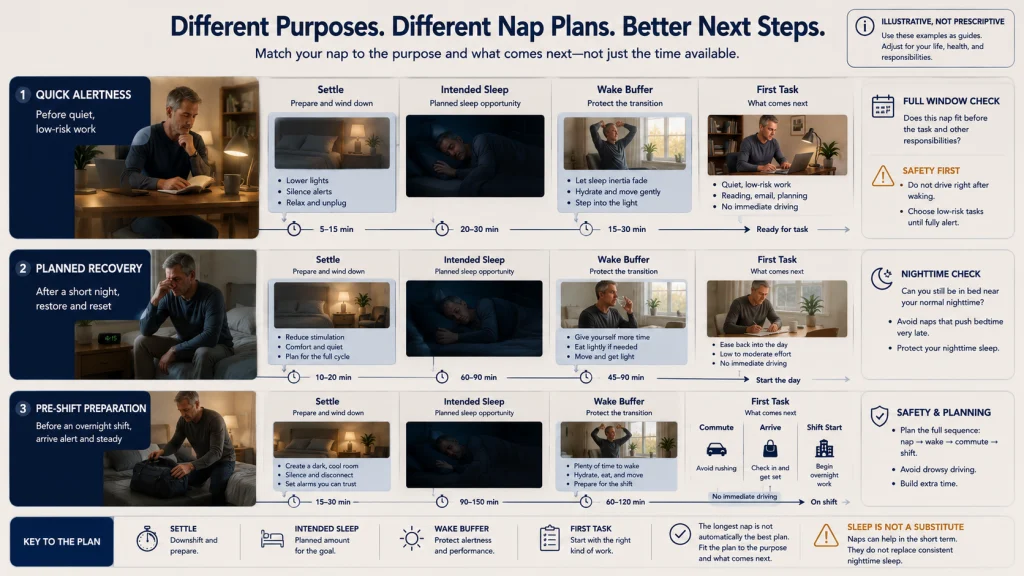
Compare three nap plans
These examples show how purpose and buffer change the plan. They are not universal prescriptions.
Quick alertness before a quiet task
The person has a limited afternoon window and plans to return to reading, desk work, or another low-risk activity. An illustrative plan might reserve 10 minutes for settling, 15 to 20 minutes for intended sleep, and at least 15 minutes for waking and a low-risk transition before work resumes.
Planned recovery after an unusually short night
The person has more time available and no immediate driving or equipment use. An illustrative plan might allow 30 to 60 minutes of intended sleep, then protect a larger recovery buffer and check whether nighttime sleep still begins near the intended time.
Pre-shift preparation
The person is preparing for overnight work. An illustrative longer plan might allow 60 to 90 minutes of intended sleep, but only when the full schedule also includes settling time, a generous wake-up buffer, the commute, shift start, and safety demands. Waking should not flow directly into driving or critical work.
The duration category changes because the job changes. The safest plan is not the one with the longest sleep opportunity, but the one that fits the available window and protects the next task.
Change timing and duration separately when the nap makes you feel worse
If the person wakes groggy, do not change the alarm length, clock time, caffeine, room, light, sound, and bedtime at once. That makes the cause impossible to identify.
First hold the timing steady and adjust the duration category or wake-up buffer. On a separate test, hold duration steady and move the nap earlier or later. Keep the post-nap task similar enough that the result can be compared.
If grogginess becomes the main recurring problem rather than a planning issue, the person may need a more focused evaluation of sleep inertia and overall sleep quality.
Respond to persistent excessive sleepiness or unsafe grogginess
Planned naps differ from unintended dozing. Falling asleep unexpectedly while driving, working, using equipment, or performing another attention-sensitive task is a safety problem.
Stop the activity when you are struggling to stay awake, unable to maintain attention, or experiencing unintended sleep episodes. Arrange a safer alternative rather than relying on an alarm, caffeine, music, open windows, or willpower.
Persistent daytime sleepiness, repeated unintended sleep, severe or prolonged grogginess, or impairment despite adequate sleep opportunity requires qualified evaluation. This article does not diagnose or treat a sleep or circadian disorder and does not prescribe medication, sedatives, stimulants, or clinical light therapy.
Choose the purpose, time in bed, alarm time, buffer, and first task
Finish the plan in five lines:
- Purpose: State whether the nap is for quick alertness, planned recovery, or shift preparation.
- Time in bed: Include setup, settling time, estimated sleep, and the waking transition.
- Alarm time: Set the outer limit without assuming it guarantees a particular sleep stage.
- Wake-up buffer: Protect enough time before driving, work, caregiving, exercise, or another demanding task.
- First task: Begin with something low risk and reassess alertness before critical activity.
A complete example might read: “This nap is for a small alertness lift before quiet desk work. My time-in-bed limit includes settling time, and the alarm leaves a clear recovery buffer. I will begin with a low-risk task and will not drive until I am fully alert.”
Use the broader sleep schedule guide when naps, workdays, weekends, and nighttime sleep are interacting as one pattern. Use the sleep improvement guide when nap duration is only one part of the problem.
The right nap is not defined by one perfect number. It is the duration that fits the purpose, leaves room to wake safely, and does not quietly displace the sleep the person needs later.
FAQs
⏱️ Is there one ideal nap length for everyone?
No. The useful duration depends on purpose, prior sleep, time needed to fall asleep, the available window, and the task after waking. Use duration categories rather than treating one exact number as universally correct.
🛏️ Does nap duration mean time asleep or time in bed?
Those are different. Time in bed includes settling, estimated sleep, and the waking transition. The total schedule must also include a wake-up buffer.
😵 Why do I sometimes wake from a nap feeling worse?
Grogginess can vary with prior sleep, timing, duration, and where waking occurs within sleep. An alarm cannot guarantee a particular sleep stage, so leave a recovery buffer and change timing and duration separately.
🔔 Can a stronger alarm prevent sleep inertia?
A stronger alarm may wake you at the planned clock time, but it does not guarantee immediate alertness. Do not schedule driving or equipment use immediately after waking.
🌙 Can a long nap affect nighttime sleep?
It can, especially when the nap is long, late, or used repeatedly. Evaluate the nap inside the full wake-to-bed schedule rather than by duration alone.
☕ Should I combine caffeine with a nap?
This article does not prescribe a caffeine-nap method. Caffeine effects, health considerations, medication questions, and bedtime impact vary, so discuss personal concerns with a qualified professional.
🌃 How should a pre-shift nap be planned?
Place it inside the full shift, commute, main sleep period, and safety plan. Leave enough time after waking before driving or beginning safety-sensitive work.
🚗 When is post-nap grogginess dangerous?
It is dangerous when you cannot maintain attention, struggle to stay awake, feel disoriented, or must drive or operate equipment. Stop the task, use a safer alternative, and seek qualified evaluation for persistent or severe impairment.