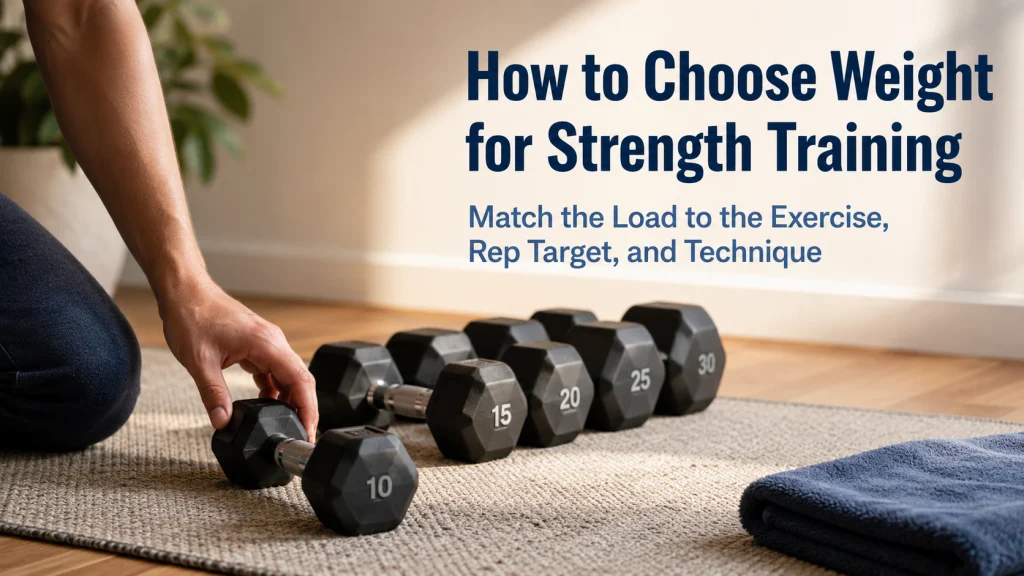
How to choose weight for strength training starts with the exercise and planned repetition range, not with a universal dumbbell chart. Use a conservative trial, watch whether the movement stays controlled, and stop with some clean repetitions still available instead of forcing a maximal effort. Different movements often need different resistance, even in the same workout. Record the setup and adjust the next set gradually based on technique, effort, and recovery.
One Dumbbell Can Produce Four Different Outcomes
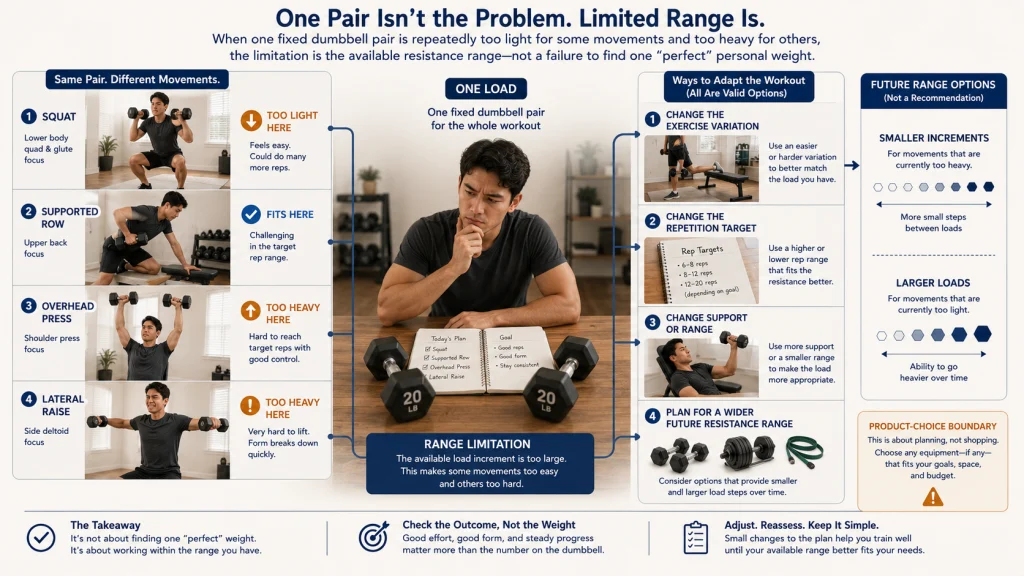
Set one dumbbell beside four exercises: a squat, an overhead press, a row, and a lateral raise. The number printed on the weight stays the same, but the result can change dramatically. It may feel easy during the squat, manageable during the row, challenging during the press, and too heavy to control during the lateral raise.
| Exercise | Possible outcome with the same dumbbell | What that tells you |
|---|---|---|
| Squat | Repetitions stay smooth with plenty of capacity left | The load may be too light for the planned dose. |
| Row | The final repetitions slow slightly but remain controlled | The load may fit the current target. |
| Overhead press | The torso leans back and the range shortens | The load may be too demanding for the chosen form standard. |
| Lateral raise | The arms swing and the shoulders shrug early | A lighter resistance or easier variation may be needed. |
A weight belongs to an exercise and a repetition target, not to a person in general. Asking “What dumbbell size am I?” hides the more useful question: “What resistance range do these planned movements need today?”
Understand What Counts as Resistance
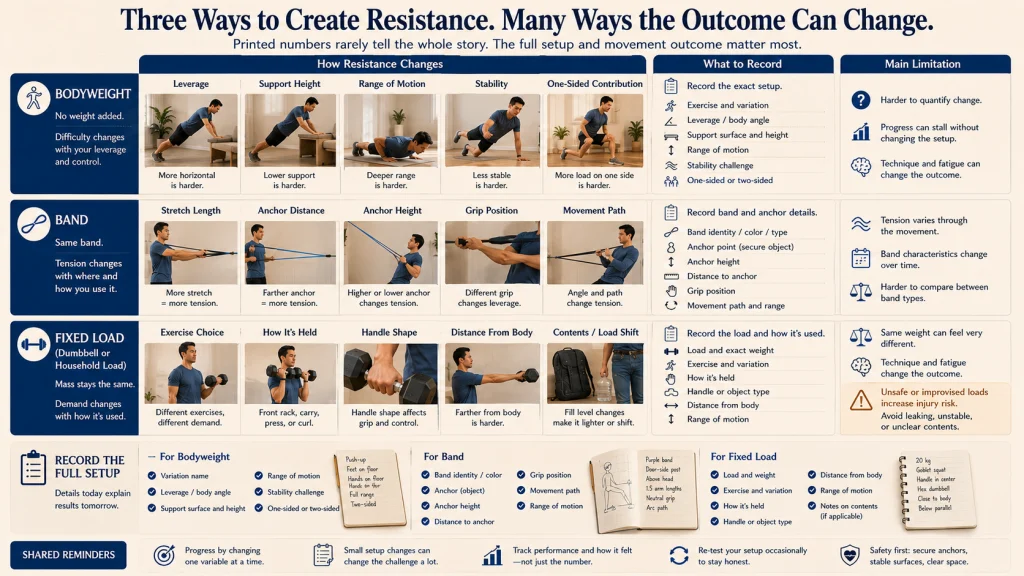
External load includes dumbbells, adjustable weights, weighted household items, and machine settings. Bodyweight difficulty comes from leverage, support, range of motion, and how much of your body mass the movement asks you to control. Elastic resistance comes from a band or tube whose tension changes as it stretches.
These methods do not produce identical sensations or perfectly comparable numbers. A band labeled with a resistance range may feel different depending on stretch length and anchor position. A bodyweight movement can become harder without any number changing at all. A dumbbell provides a clearer fixed mass, but the same load can still feel very different across exercises.
For a broader map of these methods, review strength training at home. The purpose here is narrower: selecting the resistance used for one exercise today.
Choose the Exercise and Planned Rep Range First
Load selection becomes much easier when the movement and repetition target are already defined. A resistance that fits six controlled repetitions may not fit twelve. A load that works for a supported row may be unsuitable for an overhead press. Changing the exercise, range, or support also changes the meaning of the same number.
Choose the movement variation you can perform with a repeatable setup. Then choose a practical repetition range that matches the rest of the session. The separate guide to sets and repetitions for beginners explains how to choose that dose without treating one range as universal.
Key decision: Do not select the weight first and force every exercise to fit it. Select the exercise and repetition target, then test a resistance against those conditions.
Begin With a Conservative Trial
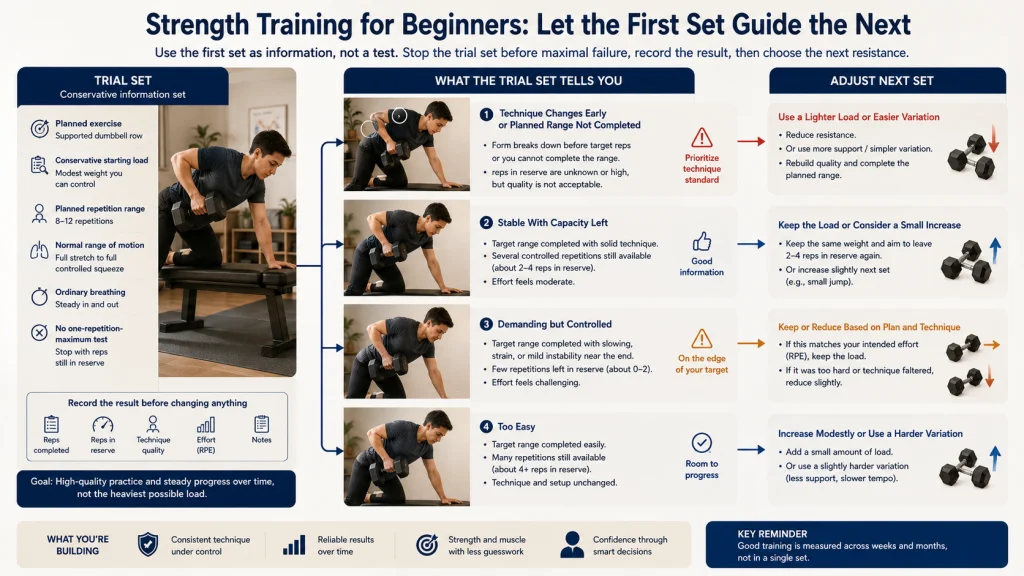
A first trial is an information set, not a performance test. Start lighter than the heaviest load you think you could move. Use the planned exercise, normal range of motion, and ordinary breathing. The goal is to learn how the resistance behaves before fatigue makes the answer harder to read.
| Trial result | What to do next |
|---|---|
| Technique changes early or the planned range cannot be completed | Reduce the resistance or choose an easier variation for the next set. |
| The target is completed with stable technique and several controlled repetitions still possible | The resistance may be workable, or slightly light depending on the session goal. |
| The target is completed but the final repetitions become slow, strained, or unstable | Keep the load only if technique remains acceptable and the planned effort allows it. Otherwise reduce it. |
| The target feels easy and the setup remains unchanged | Consider a small increase in the next set or a modestly harder variation. |
This process avoids maximal testing. You do not need to discover the heaviest possible single repetition to choose a useful starting resistance.
Check Range, Control, Breathing, Speed, and Technique
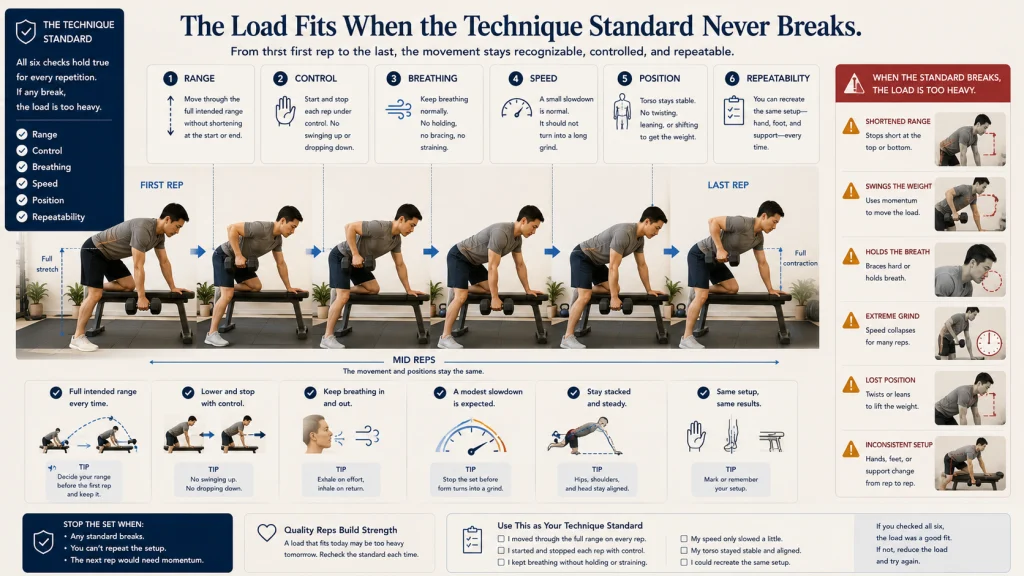
A load is suitable only when the movement still looks like the movement you intended to perform. Use the same technique standard from the first repetition to the last.
- Range: Can you complete the planned range without shortening it to escape the difficult portion?
- Control: Can you start, stop, and reverse the movement without swinging or dropping?
- Breathing: Can you keep breathing instead of holding your breath and straining?
- Speed: Does the repetition slow only modestly, or does it turn into a prolonged grind?
- Position: Does the rest of the body stay stable rather than twisting, leaning, or shifting to finish?
- Repeatability: Could you use the same setup again without guessing where your hands, feet, or support belong?
A harder load is not automatically better if it replaces the intended movement with compensation. Stable technique gives you a clearer base for future progression.
Estimate Remaining Controlled Repetitions Without Requiring Failure
After the planned repetitions, ask how many more clean repetitions you could probably perform with the same range and control. This is an estimate, not a demand for perfect accuracy.
If you finish with many repetitions clearly available, the load may be light for the chosen target. If you finish with one or two controlled repetitions still possible, the resistance may be demanding but manageable. If technique has already collapsed, the useful stopping point passed before the written rep count ended.
You do not need to test this estimate by continuing until the movement fails. The guide to training to failure explains why maximal effort is not required for every set and how to separate productive effort from an unnecessary loss of control.
Adjust the Next Set Instead of Making Large Jumps Mid-Repetition
Once a set has started, changing the load during the movement can create an awkward transition and make the result harder to interpret. Finish or stop the set safely, then change one variable before the next attempt.
A small adjustment may mean a lighter or heavier dumbbell, a shorter or longer band setup, a more stable bodyweight variation, or a slightly different range. Change only enough to answer the next question clearly.
Use Different Loads for Different Movements
The muscles, leverage, support, and range differ from exercise to exercise. Lower-body patterns often tolerate more external resistance than smaller upper-body movements, while a supported row may allow more load than an unsupported raise.
Using one pair for an entire workout can be convenient, but convenience does not make the load appropriate for every movement. One pair may be too light for a squat and too heavy for a lateral raise. The practical response is not to force both exercises into the same number. Adjust the load, variation, range, or support for each pattern.
Editorial observation: Fixed-weight packages encourage buyers to think in identities such as “my dumbbell size.” In practice, a useful home setup is a resistance range. The same pair can sit unused for lower-body work because it feels too light while also making a smaller upper-body movement difficult to control.
Handle Bands and Household Loads Without Treating Labels as Exact Resistance
| Method | How resistance changes | What to record | Main limitation |
|---|---|---|---|
| Bodyweight | Leverage, support height, range, stability, or unilateral contribution | Exact variation, support surface, range, and repetitions | No simple number captures the full difficulty. |
| Band | Band tension, stretch length, anchor distance, grip position, and movement path | Band identity, anchor, start position, and repetitions | The printed label may not equal the resistance felt through the whole movement. |
| Dumbbell or fixed load | The selected mass and how it is held | Weight, exercise, range, and repetitions | A fixed increment may be too large for a small adjustment. |
Band resistance changes as the material stretches. Two readers can use the same band and feel different demands because their starting distance, anchor height, range, and grip differ. A household item may have a known total weight, but the handle shape, shifting contents, and distance from the body can change control.
Do not compare these tools only by printed numbers. Record the full setup and test the movement itself. Avoid improvised loads that leak, break, shift unpredictably, or cannot be gripped securely.
Note: A resistance label helps identify the tool, but it does not replace the technique check or the remaining-capacity estimate.
For no-equipment progressions, review bodyweight strength training.
Treat Fixed Versus Adjustable Range as a Future Equipment Decision
Load selection can reveal what a future setup needs without turning this article into a buying guide. If one fixed weight is repeatedly too light for some movements and too heavy for others, the limitation is the available range, not a failure to find one perfect number.
Fixed-load limitation: A single fixed pair offers one external load. When exercises need smaller or larger steps, you may have to change the variation, repetitions, support, or available equipment rather than forcing the same load across the session.
Adjustable equipment can reduce storage and widen the range, while fixed weights can make transitions simple. Bands offer compact resistance but require careful setup tracking. These are product-fit questions for the home exercise equipment guide, not reasons to recommend one format universally.
Record the Exercise, Load, Repetitions, and Result
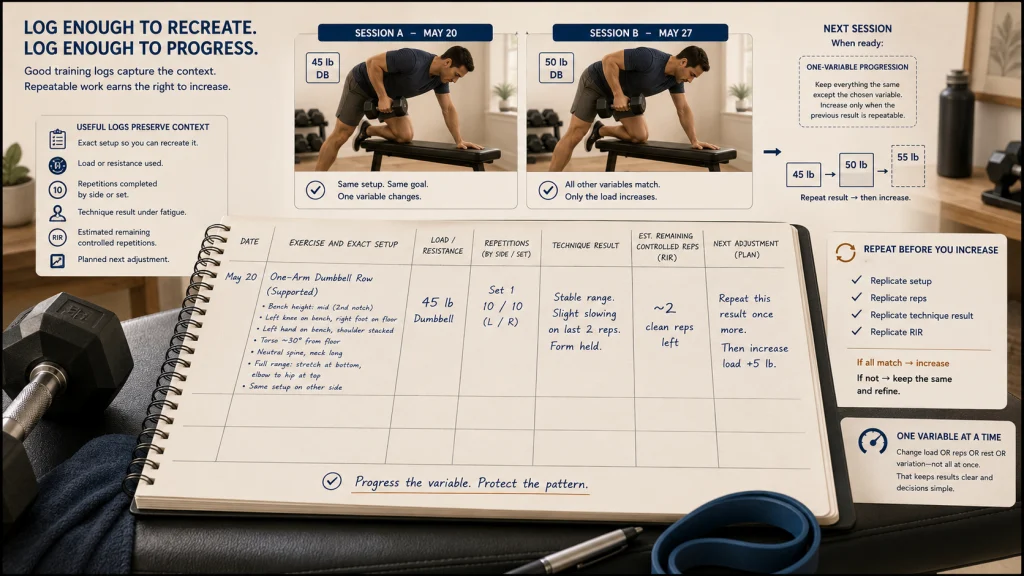
A number without context is hard to use later. Record enough detail to recreate the set and understand why the next adjustment was chosen.
| Date | Exercise and setup | Load or resistance | Repetitions | Technique result | Remaining controlled reps | Next adjustment |
|---|---|---|---|---|---|---|
| Example | Supported one-arm row, same bench height | Current dumbbell | 10 each side | Stable range, slight slowing at end | About 2 | Repeat once before increasing |
The next session becomes easier to plan when the log includes the variation and outcome. A future increase should come from a pattern of repeatable work, not from forgetting how the previous set actually looked.
The guide to progressive overload at home explains how to change resistance, repetitions, range, or another variable over time.
Respect Pain, Instability, Straining, Dizziness, and Other Boundaries
A challenging set can feel effortful, but severe pain, sudden weakness, loss of control, or dangerous instability is not a signal to keep testing the load. Stop the exercise when the setup becomes unsafe or symptoms appear.
Safety warning: Stop exercise and seek appropriate help for chest pain or pressure, fainting, severe dizziness, extreme shortness of breath, sudden weakness, serious injury, or severe pain. Do not hold your breath, grind through unstable repetitions, or lift through pain to prove that a load is manageable.
Persistent joint or muscle pain, neurological symptoms, pregnancy, recent surgery, chronic conditions, disability-related limitations, or a long period of inactivity may require individualized guidance from a physician, physical therapist, or qualified exercise professional.
Choose a Trial You Can Evaluate Clearly
Start with the exercise, repetition target, and technique standard. Choose a conservative resistance, complete a controlled trial, and estimate how many clean repetitions remained. Then make one small adjustment for the next set rather than searching for a universal starting number.
The useful load is specific to the movement and the day. Record the setup, watch how it changes over several sessions, and let repeatable technique guide the next increase.
For the broader movement path, review how to exercise at home.
FAQs
🏋️ What weight should a beginner lift first?
Begin with a conservative resistance for the specific exercise and planned repetitions. The first set should help you judge range, control, breathing, speed, and remaining capacity without requiring a maximal test.
🔢 Should I use the same weight for every exercise?
Usually not. Different movements use different leverage, muscle groups, support, and range, so one load may be too light for one exercise and too heavy for another.
📉 How do I know a weight is too heavy?
The load may be too heavy when the planned range shortens, the body swings or twists, breathing turns into straining, or control disappears before the target is complete. Reduce the resistance or choose an easier variation for the next set.
📈 How do I know a weight is too light?
If the target is completed with stable technique and many controlled repetitions clearly remain, the resistance may be light for that exercise and dose. Make a small next-set adjustment rather than a large jump.
🧪 Do I need a one-repetition-maximum test?
No. Beginners can choose a useful starting resistance with a submaximal trial, a planned repetition range, and a technique check. Maximal testing is outside the scope of this article.
🟠 Can band labels tell me the exact resistance?
They can identify the band or provide a range, but the felt resistance also depends on stretch length, anchor position, grip, and movement path. Record the setup rather than relying on the label alone.
📝 What should I record after a trial set?
Record the exercise and setup, load or resistance, repetitions, technique result, estimated remaining controlled repetitions, and the next planned adjustment. This creates a usable comparison for the next session.
🚩 When should I stop testing a load?
Stop when you lose control, feel severe pain, become dangerously unstable, or develop concerning symptoms such as chest pressure, fainting, severe dizziness, or extreme shortness of breath. Seek appropriate guidance when symptoms persist or your situation requires individualized advice.