Whether you can shower with a fitness tracker depends on the exact model, generation, band, activity, chemicals, heat, pressure, and current condition of the device. A water-resistance number does not grant permission for every activity at that depth, and the original resistance can diminish after age, impact, or damage. Check the current manufacturer instructions before exposure, then follow the model-specific rinse and drying process. Keep the charger dry, never charge wet contacts, and stop using a device that shows cracks, corrosion, seal concerns, or possible water intrusion.
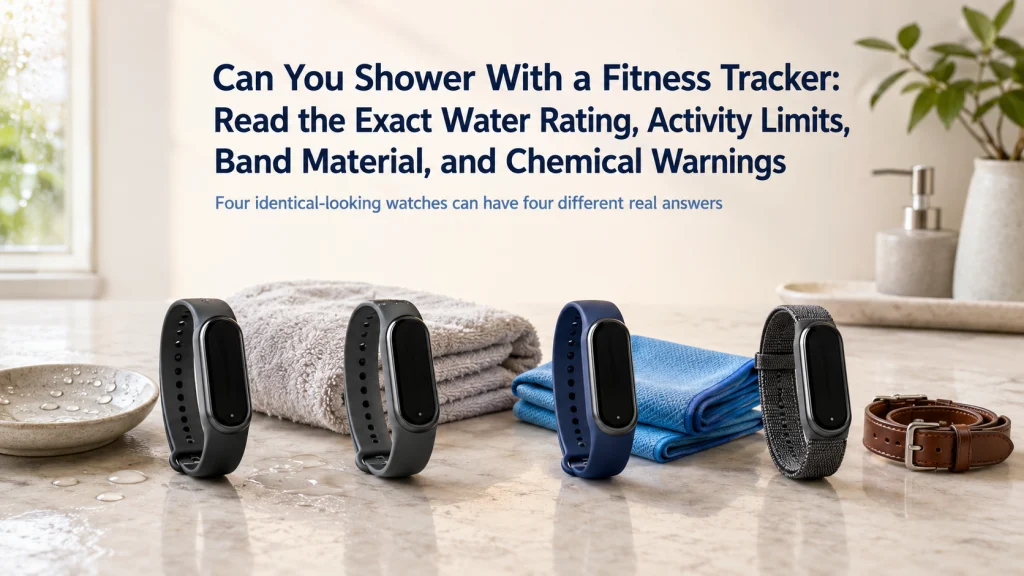
Four Identical-Looking Watches Can Have Different Water Limits
Place four similar-looking watches beside four activity cards: shower, pool, high-velocity water, and soap exposure. The cases may look equally sealed, yet the correct answer can differ because the models, bands, ratings, and permitted activities are not the same.
| Activity card | Question that decides it | Restriction people often miss |
|---|---|---|
| Shower | Does the exact manual permit showering, and what does it say about soap, shampoo, heat, and steam? | A case may tolerate fresh water while shower chemicals or the band remain restricted. |
| Pool | Is the exact model approved for pool swimming, and is the band suitable for water? | Swim tracking does not prove that every band or accessory belongs in the pool. |
| High-velocity water | Does the manufacturer permit water skiing, powerful jets, or another fast-water activity? | A shallow-water rating does not automatically cover pressure from fast-moving water. |
| Soap exposure | Does the exact guidance restrict personal-care products or other chemicals? | Fresh-water resistance does not automatically cover chemical exposure. |
Core rule: Water resistance is an activity-specific product claim, not a permanent promise for every wet environment.
That is why a quick yes-or-no answer can be misleading. The frustrating part is that the watch may look unchanged even when the activity, band, or exposure has crossed a limit hidden in another support page. Start with the exact hardware and activity, then check the remaining conditions before getting it wet.
The wearable technology guide explains the wider role of consumer devices. For pairing, settings, daily use, and routine decisions, use the guide to using a fitness tracker correctly.
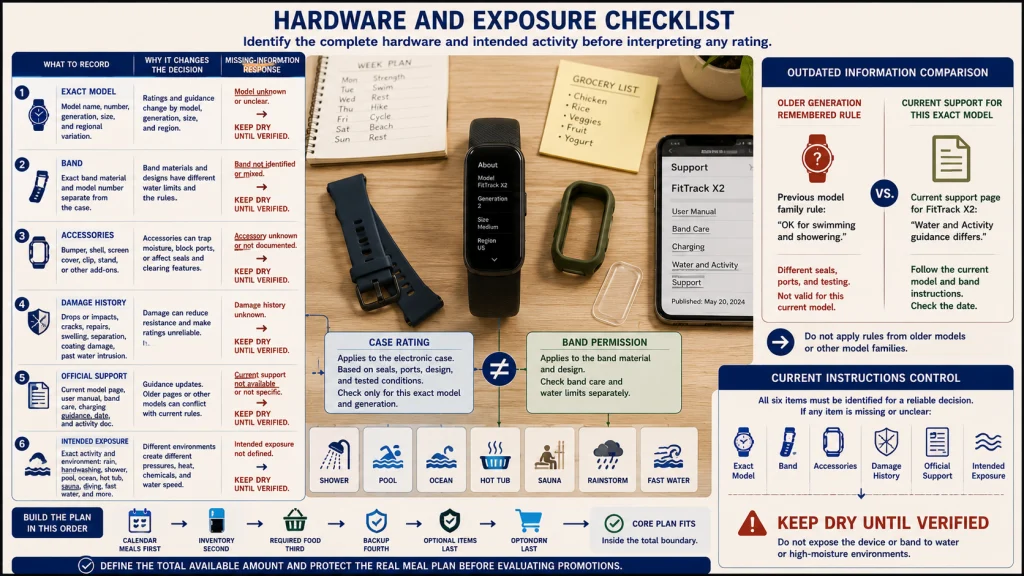
Record the Exact Model, Band, Damage History, and Support Page
A family name is not specific enough. Different generations can carry different ratings, activity permissions, water-lock behavior, speaker-clearing steps, and band restrictions.
| Device-and-band check | What to record |
|---|---|
| Exact device | Model name, generation, size, and any regional variation shown in settings or on the case |
| Band | Exact material and model name; detailed water limits are checked separately below |
| Accessories | Protective case, bumper, cover, screen accessory, or clip that may trap moisture or affect buttons |
| History | Drops, hard impacts, cracks, repairs, battery swelling, case separation, or previous water intrusion |
| Official instructions | Current model page, user manual, band-care page, and charging guidance |
| Intended exposure | Rain, handwashing, shower, pool, ocean, hot tub, sauna, diving, or high-velocity water |
Guidance reviewed July 30, 2026: Manufacturer instructions can change as new models, bands, and activities are added. Confirm the current publication before relying on an old product page or a rule remembered from a previous watch.
Editorial observation: A water-resistant watch can be paired with a band the manufacturer does not recommend for water or workouts. The case rating and the band decision belong on two separate lines of the checklist.
Separate Waterproof Marketing Language From the Actual Claim
Once the exact model is known, ignore broad sales shorthand and move to the current support documents. Informal product descriptions often use waterproof as a shortcut. The useful information is the manufacturer’s stated water-resistance rating, the named standard when provided, and the activities the company expressly permits or excludes.
Apple’s current water-resistance guidance states that Apple Watch is water resistant, not waterproof, and separates splash exposure, shallow-water activities, high-velocity water, and recreational diving by model. Google’s current Fitbit water guidance also directs readers to the exact model table and manual rather than applying one rule to every device.
Do not rely on these shortcuts:
- The product name sounds designed for sport.
- The device includes a swim workout.
- The display has a water-drop icon.
- A seller calls it suitable for all-day wear.
- A previous generation survived the same activity.
- Another person used it in water without visible damage.
None of those details replaces the exact model claim. A feature can record an activity without certifying every depth, speed, chemical, temperature, or band combination.
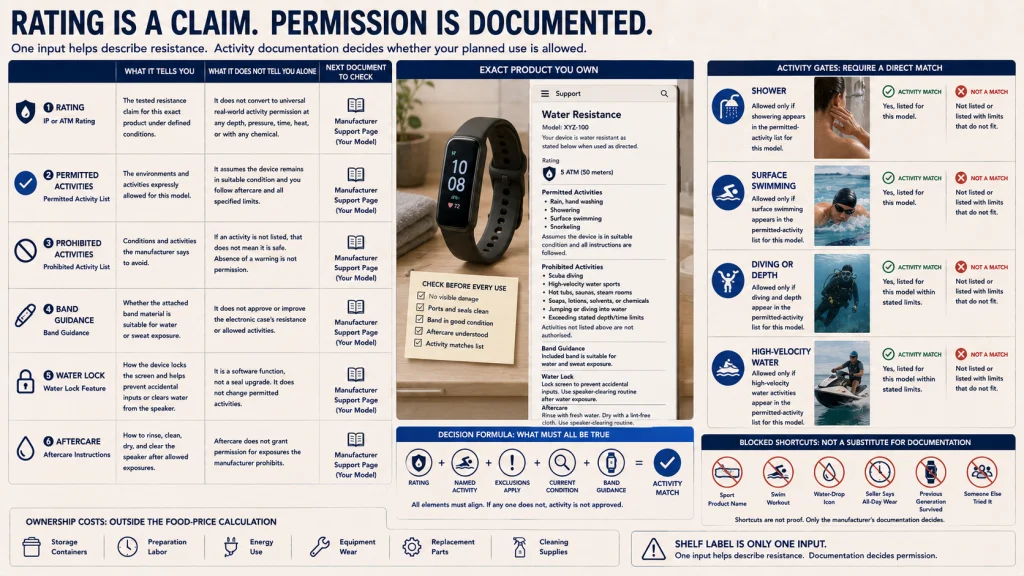
Read the Rating Together With Permitted and Prohibited Activities
A number such as 5 ATM or a statement such as water resistant to 50 meters must remain attached to the manufacturer’s activity guidance. Do not convert the number into permission to use the device in every activity at that depth.
| Information on the page | What it tells you | What it does not tell you by itself |
|---|---|---|
| IP or ATM rating | The tested resistance claim stated for the exact product | Permission for showering, diving, water skiing, hot water, steam, or chemicals |
| Permitted activity list | The environments the manufacturer names for that model | That a damaged or aging device still retains its original resistance |
| Prohibited activity list | Pressure, depth, heat, chemical, or use conditions to avoid | That an unlisted activity is automatically safe |
| Band guidance | Whether the attached material belongs in water | Whether the electronic case itself is approved for the activity |
| Water-lock feature | How the screen, buttons, or speaker routine behaves around water | Any increase in the physical water resistance of the case |
| Aftercare instructions | How to rinse, clean, dry, and clear the speaker when permitted | Permission to expose the device to a prohibited activity first |
A rating becomes useful only after it is paired with the named activity, exclusions, current condition of the device, and band instructions. Think of it as one line in the decision, not the final answer.
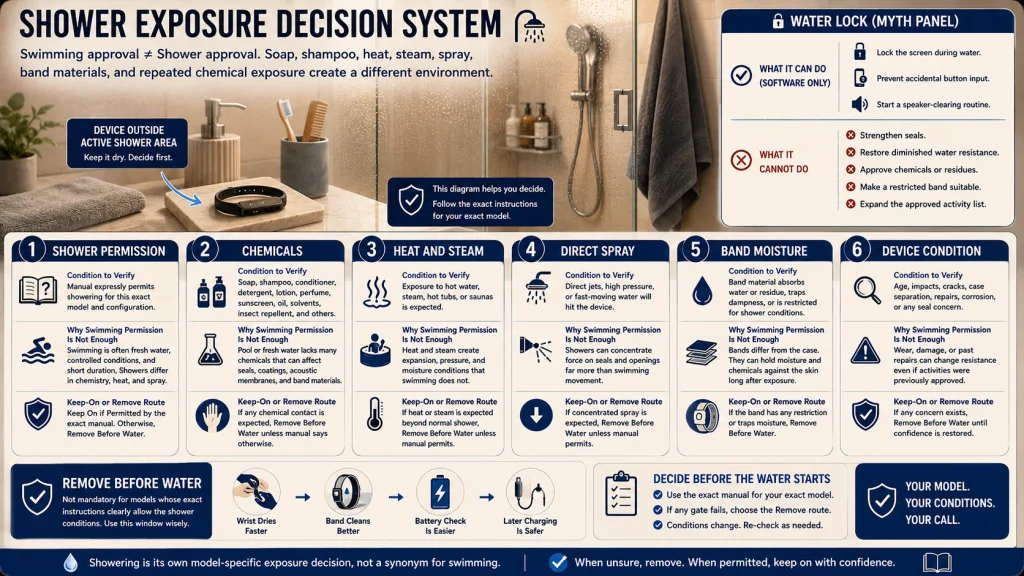
Evaluate Showering Separately From Swimming
Showering deserves its own decision because it adds conditions that ordinary swimming may not. Soap, shampoo, conditioner, heat, steam, repeated chemical exposure, and direct spray can make a device approved for pool use a poor fit for the shower.
Apple advises avoiding soap or soapy water and lists shampoo, conditioner, lotion, perfume, detergent, sunscreen, oil, and other chemicals as exposures that can affect seals and acoustic membranes. Google advises against wearing supported Fitbit devices in the shower to reduce repeated exposure to soap, shampoo, and conditioner.
Chemical and heat warning: Check the exact instructions before exposing the wearable to soap, shampoo, conditioner, detergent, lotion, sunscreen, perfume, solvent, oil, insect repellent, hot water, steam, a hot tub, or a sauna. Do not assume that fresh-water swim permission covers these conditions.
The practical issue is not only whether water enters during one shower. Repeated chemical and heat exposure may affect the device over time, and moisture can remain under the band against the skin.
If showering is not clearly permitted, remove the wearable before the water starts. That also creates a predictable window for cleaning the band, drying the wrist, or checking the battery.
Separate Pool and Open-Water Use From Diving and High-Velocity Water
Swimming near the surface, diving below shallow depth, cliff jumping, water skiing, powerful jets, and other fast-water activities do not create the same pressure conditions.
Apple currently permits shallow-water activities for Apple Watch Series 2 and later, while reserving recreational scuba diving and specified high-speed water activities for supported Ultra models. Google notes that high-velocity water can negatively affect Fitbit water resistance and directs users to model-specific tables and manuals.
Before a pool or open-water activity, confirm:
- The exact model is listed for that activity.
- The activity stays within the named depth and speed limits.
- The band and any protective accessory are suitable for water.
- The device has no crack, impact damage, loose part, or seal concern.
- The instructions explain how to rinse and dry after pool, salt, or other non-fresh water exposure.
Diving boundary: A consumer fitness tracker is not certified diving equipment unless the exact manufacturer documentation states that the exact model is approved for the intended diving activity. Do not infer diving permission from a meter number or swim mode.
Check Band Material and Accessory Water Limits
The case may be approved for water while the attached band is not. This is easy to miss because the watch and band are worn as one object, but they are often governed by different care pages. Leather, selected metal bands, woven materials, adhesives, decorative coatings, and third-party accessories can have separate rules.
| Part | Question before exposure | Possible problem |
|---|---|---|
| Sport-style band | Is the exact material approved for swimming, showering, or sweat? | Residue and moisture can remain around holes, loops, or the closure. |
| Woven or fabric band | Does the manufacturer permit soaking, pool water, or salt water? | The outside may feel dry while moisture remains in the weave. |
| Leather band | Is any water exposure permitted? | Water can alter shape, finish, color, or attachment strength. |
| Metal band | Is the material and finish approved for the intended water? | Water and chemicals may remain between links or around the clasp. |
| Protective case or cover | Can it trap water against the watch or block speaker clearing? | Moisture may remain hidden after the visible case is dry. |
| Charger or charging stand | Does the accessory have a separate water-resistance claim? | The wearable may tolerate water while the powered accessory does not. |
For tension, moisture under the band, and activity-specific fit, use the guide to wearing a fitness tracker correctly.
Understand What Water Lock Does and Does Not Do
Water Lock is a software behavior, not a physical seal upgrade. Depending on the device, it can prevent accidental screen or button input, start automatically with a swim activity, or trigger a speaker-clearing routine when the mode is turned off.
Water Lock myth: Turning on Water Lock does not strengthen the case, restore an aging seal, make a restricted band suitable for water, or expand the permitted activity list.
On supported Apple Watch models, Water Lock locks the screen and the unlock process plays tones to clear water from the speaker. On supported Fitbit models, Water Lock prevents screen or button activation. These functions improve operation around water; they do not change the hardware rating.
Turn the feature on or off only by the current instructions for the exact model and software version. Do not shake the device or insert anything into speaker, microphone, pressure, or sensor openings to remove water.
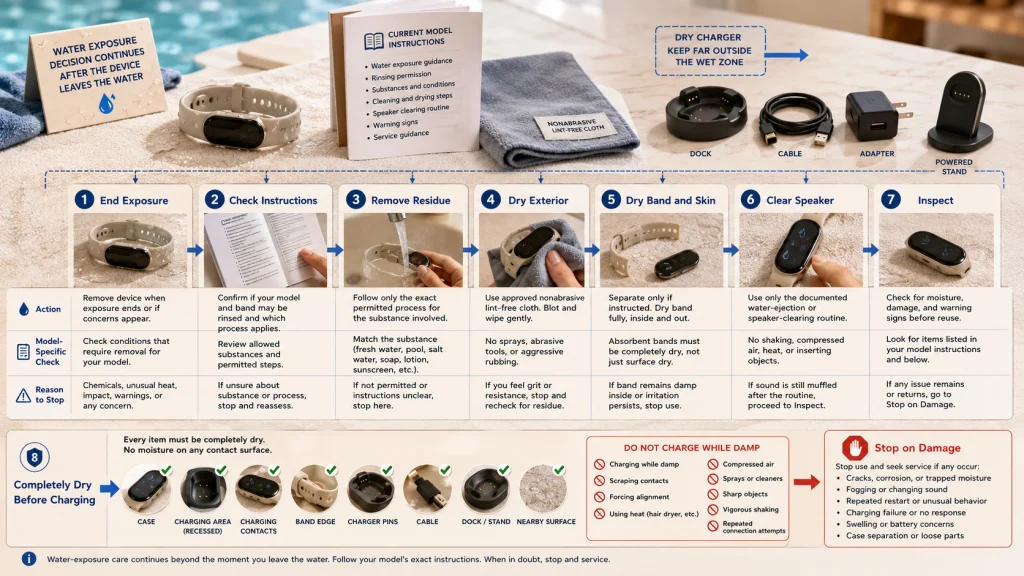
Rinse, Clean, and Dry Only as the Exact Instructions Allow
The decision does not end when the device leaves the water. Aftercare depends on what contacted it, and fresh water, pool water, salt water, soap, sunscreen, or another substance may require different responses.
- End the exposure: Remove the device when the activity is over or when a prohibited chemical, heat source, impact, or warning occurs.
- Check the model instructions: Confirm whether a gentle fresh-water rinse is permitted for that device and band.
- Remove non-fresh residue: Follow the exact process for pool water, salt water, soap, lotion, sunscreen, or another substance.
- Dry the exterior: Use an approved nonabrasive, lint-free cloth.
- Dry the band and skin: Separate removable materials when instructed and allow absorbent bands to dry completely.
- Clear the speaker correctly: Use only the model’s water-ejection or speaker-clearing routine.
- Inspect before reuse: Look for trapped water, corrosion, a lifted cover, display changes, muffled sound, or charging-contact moisture.
Do not use heat, compressed air, sprays, sharp objects, or vigorous shaking unless the exact instructions expressly permit the method. Drying may take longer than the few minutes required to wipe the display.
For material-specific cleaning methods, use the guide to cleaning a fitness tracker.
Never Charge While the Device or Contacts Are Wet
The wearable’s water-resistance claim does not automatically apply to its charger, cable, adapter, dock, or powered stand. Keep charging equipment away from the shower, pool edge, wet sink, damp towel, and post-workout cleaning area.
Charging rule: Do not place a wet wearable on a charger. Dry the case, recessed area, contacts, band edge, charger pins, cable, and nearby surface completely before connecting power.
When charging does not begin after water exposure, do not scrape the contacts, force the device onto the puck, or repeat the connection while moisture remains possible. Recheck dryness, alignment, compatibility, and visible damage.
The guide to charging a fitness tracker safely covers charger compatibility, magnetic debris, ventilation, heat, alignment, and stop-use warnings.
Stop After Cracks, Impact, Corrosion, Seal Concern, or Water Intrusion
Water resistance can diminish with time and can be affected by impact, cracks, case separation, repair history, damaged coatings, extreme conditions, or repeated chemical exposure. A used device cannot be assumed to retain the claim it had when new.
Stop-use card: Stop water exposure and charging if you find a cracked display or case, separated enclosure, loose button, damaged sensor window, corrosion, trapped moisture, fogging under the display, unusual heat, swelling, changing sound, repeated restart, charging failure, or another sign that water may have entered.
Do not open the case, press parts back together, apply adhesive, replace a seal yourself, or perform another improvised repair. Manufacturer water resistance may not be re-testable or restorable after damage.
If the device becomes hot, swells, leaks, smokes, sparks, or creates an immediate electrical or fire danger, move away and contact emergency services. For non-urgent damage, keep it disconnected and use the manufacturer or an authorized service route.
Check Model, Activity, Band, Chemicals, Damage, and Aftercare
Before water exposure, write down six answers: the exact model, intended activity, band material, chemicals or heat involved, current condition, and required aftercare.
If those answers line up with the current instructions, follow the rinse, drying, and charging steps exactly. If one answer is missing or the device has been damaged, keep it dry until the uncertainty is resolved.
A missed shower or swim session is temporary. Water damage inside a sealed wearable may not be.
FAQs
🚿 Can you shower with a fitness tracker?
Only when the exact model and band instructions permit the activity and the shower conditions fit their chemical, heat, steam, and pressure limits. Some manufacturers advise removing otherwise water-resistant devices to reduce soap and shampoo exposure.
🌊 Does 5 ATM mean I can use the watch at 50 meters?
Not automatically. Read the rating with the manufacturer’s permitted and prohibited activities. Do not convert a laboratory rating or meter statement into approval for every real-world activity at that depth.
🏊 Does swim tracking prove the device is safe for swimming?
No. A software activity can record motion without expanding the hardware claim. Confirm the exact model, water environment, depth, speed, band, and aftercare instructions.
💧 Does Water Lock make a watch more water resistant?
No. Water Lock controls screen or button input and may support a speaker-clearing routine. It does not strengthen seals, restore resistance, or make a prohibited activity acceptable.
🧼 Why do soap and shampoo matter?
Manufacturers may restrict soaps, detergents, shampoos, conditioners, lotions, sunscreen, oils, and similar chemicals because they can affect seals, acoustic membranes, coatings, or skin comfort over time.
⌚ Can the watch be water resistant if the band is not?
Yes. Case and band instructions are separate. Leather, woven, metal, or decorative bands may have restrictions even when the electronic device is approved for a water activity.
🔌 How long should I wait before charging after swimming?
Do not use one universal waiting time. Follow the exact drying instructions and charge only when the case, contacts, band edge, charger pins, cable, and surface are completely dry.
🚩 When should I stop using the tracker around water?
Stop after cracks, impact damage, case separation, corrosion, fogging, trapped moisture, seal concern, charging failure, or another sign of water intrusion. Keep the device disconnected and use the official service route.