Meal prep on a budget starts with a spending boundary, not a sale flyer. Set the amount available for groceries and meal-prep work, inventory what is already usable, estimate how many meals will actually be eaten at home, and assign perishable foods to specific uses before buying them. Compare package prices by the quantity the household can realistically use, not only by the shelf label. Keep food spending separate from containers, tools, subscriptions, delivery, and energy costs, then review the receipt, unused food, missing items, and unplanned purchases after the week.
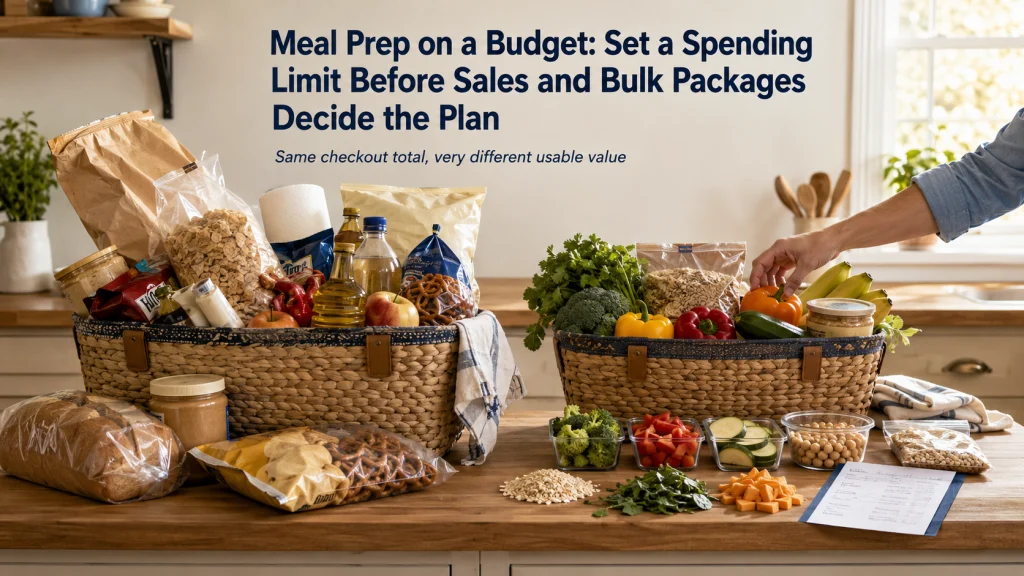
Two Grocery Baskets Can Have the Same Checkout Total and Very Different Usable Value
Imagine two baskets reaching the checkout at the same total.
The first basket is built from sale signs and large packages. It looks efficient in the moment, but several perishable items have no assigned meals, one bulk ingredient needs storage the household has not checked, and a few “money-saving” extras were never part of the plan.
The second basket looks less impressive. Every perishable item has at least one planned use, several ingredients appear in more than one meal, and a familiar backup covers a night when the intended cooking does not happen.
| Same checkout total | Sale-and-bulk basket | Assigned-use basket |
|---|---|---|
| Perishable food | Chosen because the package looked inexpensive | Mapped to specific meals or components |
| Ingredient overlap | Several one-recipe items | A few ingredients used across multiple meals |
| Storage demand | Extra freezer, refrigerator, or container space may be needed | Storage space is checked before purchase |
| Backup plan | Another purchase may be needed if the main prep fails | A familiar substitute is already included |
| Likely review question | Why was part of the package left unused? | Which assigned items were actually eaten? |
Wasting food can feel like a personal failure, especially when the original purchase was meant to save money. A better review separates guilt from information: the package was too large, the schedule changed, or the item never had a believable role.
A low unit price is not a saving when part of the package is discarded, forgotten, or replaced by another purchase. Budgeting works best when it stays connected to the full meal prep process, from planning and shopping through storage and later use.
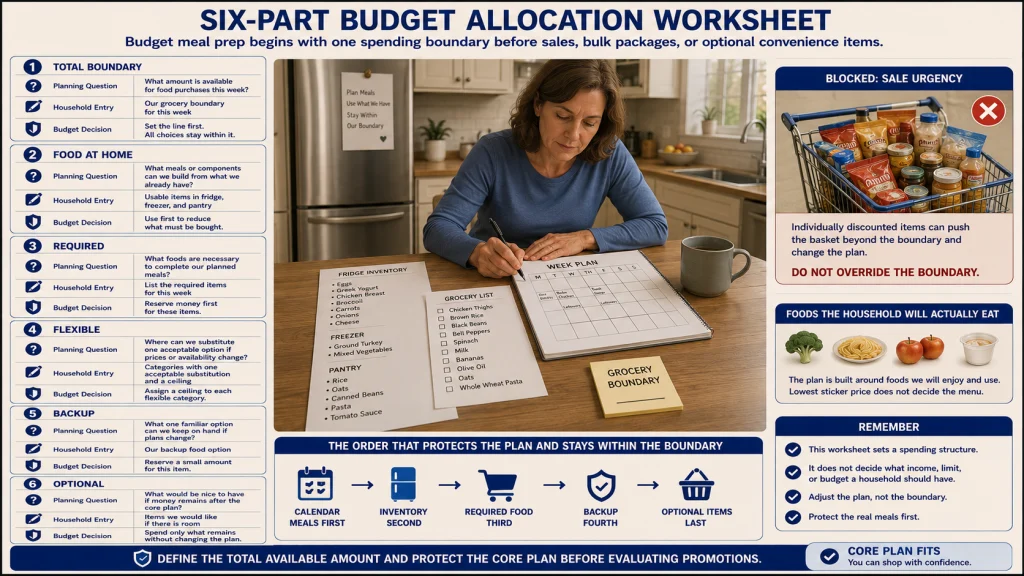
Set the Grocery and Meal-Prep Spending Boundary First
Sales create urgency. A spending boundary creates a decision. Without that boundary, each discounted package can look reasonable on its own while the full basket quietly moves beyond what the household intended to spend.
Begin with the amount available for the planning period. The number may come from a household budget, a regular grocery limit, or the money remaining after other required expenses. This article does not determine what that number should be. It helps divide a chosen limit into practical categories.
| Budget worksheet line | Planning question | Amount or note |
|---|---|---|
| Total grocery boundary | What amount is available for food purchases during this planning period? | Household-defined |
| Food already available | Which meals or components can be built partly from current inventory? | List usable items |
| Required purchases | Which foods are necessary for the selected meals? | Reserve first |
| Flexible purchases | Which categories allow a substitute without disrupting the plan? | Set a ceiling |
| Backup food | What familiar option prevents an extra purchase when plans change? | Reserve deliberately |
| Optional room | How much, if any, remains after required and backup items? | Spend only after the core list fits |
A boundary should leave room for foods the household will actually eat. It should not force a menu designed around the lowest sticker price or turn meal prep into a test of deprivation.
Before assigning money to ingredients, use the weekly meal-planning process to decide which meals genuinely belong on the calendar. A smaller first plan is also easier to budget, prepare, and review, which is why beginner meal prep starts with a manageable scope.
Separate Food Cost From Containers, Tools, Subscriptions, Delivery, and Energy
A money-saving project can become more expensive when every supporting purchase is folded into the grocery plan without being noticed. New containers, storage organizers, appliances, delivery fees, subscriptions, and extra energy use may all appear under the same “meal prep” label even though they solve different problems.
Use two ledgers:
Keeping them separate does not make ownership costs unimportant. It makes the tradeoff visible. A new container set may be useful for a repeated storage problem, but it should not make the grocery basket appear more affordable than it was.
Nora’s retail observation is that kitchen promotions often bundle bulk food, storage products, and appliances under one savings message. The larger package may look less expensive per unit while quietly requiring extra containers, freezer space, preparation time, cleaning, and storage for the equipment used to manage it.
The guide to meal prep tools and appliances should be used only after the repeated cost or time bottleneck has been identified.
Inventory Food Before Planning New Purchases
Inventory is not a full pantry reorganization. It is a short check for food that can reduce the next shopping list or needs to be used before another package is opened.
Look in four places:
- Refrigerator: Open produce, cooked components, dairy items, sauces, and foods that need an assigned use.
- Freezer: Prepared portions, proteins, vegetables, breads, and ingredients already divided for later use.
- Pantry: Grains, canned foods, shelf-stable ingredients, seasonings, and partially used packages.
- Meal-prep supplies: Containers, labels, bags, and storage space that affect what can be prepared.
Record usable quantity rather than writing only the product name. “Rice” is less helpful than “enough rice for one planned dinner and one lunch component.” The estimate can be rough, but it should support a real meal decision.
Also mark food that is available but unlikely to be used. Owning an ingredient does not create value unless it fits the current plan. When an open ingredient keeps returning to the inventory unchanged, planning around food at risk of waste can help decide whether to use it, freeze it, pass it on, or stop rebuying it.
Count Meals at Home and Choose a Small Number of Reusable Ingredients
A seven-day calendar does not automatically mean twenty-one meals need to be prepared. One lunch may already be covered at work, two dinners may happen elsewhere, and one evening may be better served by a backup than by a new recipe.
Start with the calendar, not the recipe list:
- Which meals are definitely at home?
- Which meals may be covered by leftovers?
- Which evenings have limited time or energy?
- Which meals are already planned elsewhere?
- How many backup meals are realistically needed?
For example, a household planning four dinners at home might choose one tray of roasted vegetables, one pot of grain, one protein or bean component, and two different sauces. The vegetables can appear beside the first dinner and later in a soup. The grain can support one bowl and one lunch. The sauces keep the meals from feeling identical even though the base ingredients overlap.
That is different from buying five unrelated vegetables for five recipes and discovering that two dinners never happened. Ingredient overlap should reduce unused food and duplicate preparation without forcing every meal into the same flavor or texture.
The number of portions still needs to match the real calendar. Use a practical prepared-food estimate after the meal count is clear, not before.
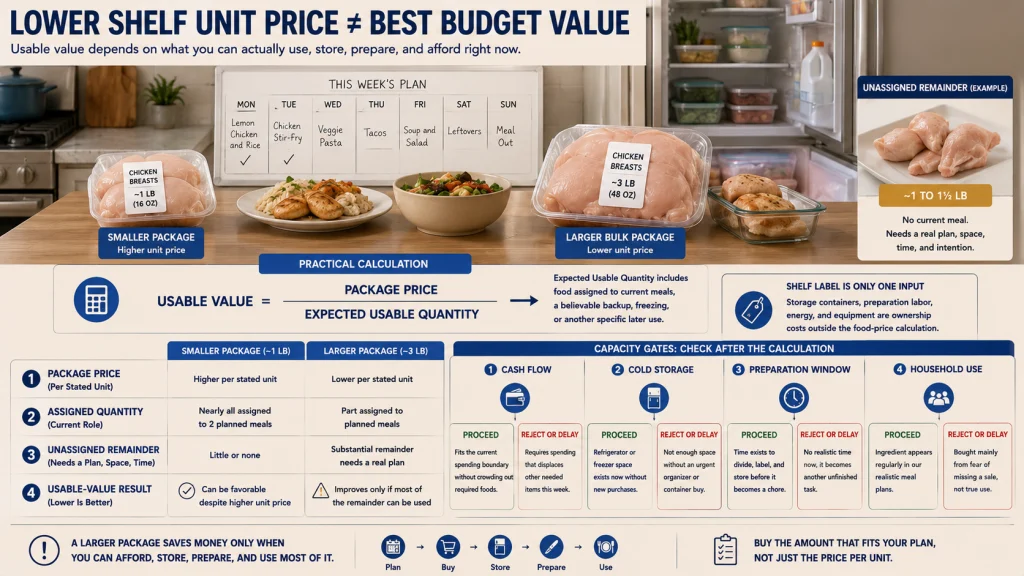
Compare Unit Price With Usable Quantity and Spoilage Risk
Unit price answers one narrow question: how much the package costs per stated unit. It does not show whether the household has assigned the quantity to real meals.
Usable value = package price ÷ expected usable quantity
The expected usable quantity is the portion assigned to current meals, backups, freezing, or another believable use. It excludes the part likely to be forgotten, discarded, or replaced.
Suppose a smaller package costs more per pound but covers two planned dinners with almost nothing left. A larger package has a lower unit price, yet only half fits the current meal count and the remainder has no freezer space or assigned use. The shelf label favors the larger package. The usable-value calculation may favor the smaller one.
| Calculation input | Smaller package | Larger package |
|---|---|---|
| Package price | Higher per stated unit | Lower per stated unit |
| Assigned quantity | Nearly all fits current meals | Only part fits current meals |
| Unassigned remainder | Little or none | Requires a credible later use |
| Usable-value result | Can be favorable despite the higher unit price | Improves only when the remainder is actually usable |
This is not exact household accounting. It is a brake on shelf-label optimism and a way to make likely waste visible before checkout.
Use Fresh, Frozen, Canned, and Shelf-Stable Foods According to the Plan
A budget plan does not need to rank food forms as morally better or worse. Fresh, frozen, canned, and shelf-stable options solve different timing, storage, preparation, and waste problems.
| Food form | Useful when | Concrete example | Planning limit |
|---|---|---|---|
| Fresh | The food has an assigned use soon and the household prefers it | Fresh spinach planned for two early-week meals | Higher spoilage risk when plans change |
| Frozen | The plan needs flexible timing or smaller withdrawals | Frozen peas used by the cup across several meals | Freezer space and package resealing matter |
| Canned | The ingredient supports backups or quick assembly | Canned beans reserved for a low-effort dinner | Opened portions still need a planned use |
| Shelf-stable | The household needs reliable ingredients with longer planning flexibility | Rice, pasta, or oats already available in the pantry | Duplicate packages can accumulate unnoticed |
One week might pair fresh greens for early meals with frozen vegetables for later meals and canned beans as a backup. That mix protects the plan when the schedule shifts without requiring every ingredient to last equally long.
The useful combination depends on available storage, preparation time, household preferences, and the likelihood that plans will change. Follow current food-specific guidance for cleaning, separation, cooking, cooling, storage, freezing, thawing, and reheating. People with higher food-safety risk may need stricter guidance from a qualified professional.
Treat Sales and Bulk Packages as Conditional Savings
The usable-value calculation tells you whether the quantity is likely to be used. The next decision is operational: can the household pay for, transport, divide, store, and prepare the package without disrupting the rest of the plan?
| Capacity check | Proceed when | Reject or delay when |
|---|---|---|
| Cash flow | The larger purchase fits the current spending boundary | It crowds out required foods for the rest of the week |
| Cold storage | Refrigerator or freezer capacity already exists | The purchase depends on buying more containers or reorganizing urgently |
| Preparation window | There is time to divide, label, and store the food safely | The package will remain crowded or unprocessed |
| Household use | The item appears regularly in realistic meal plans | The decision is driven mainly by fear of missing the sale |
This section stops at the budget boundary. The full decision to buy, split, transport, freeze, store, or reject a large package belongs in the bulk-grocery workflow.
Shopping-channel fees, substitutions, delivery minimums, transportation, and current service costs can change the total before food enters the kitchen. Compare those factors separately through online and in-store grocery shopping.
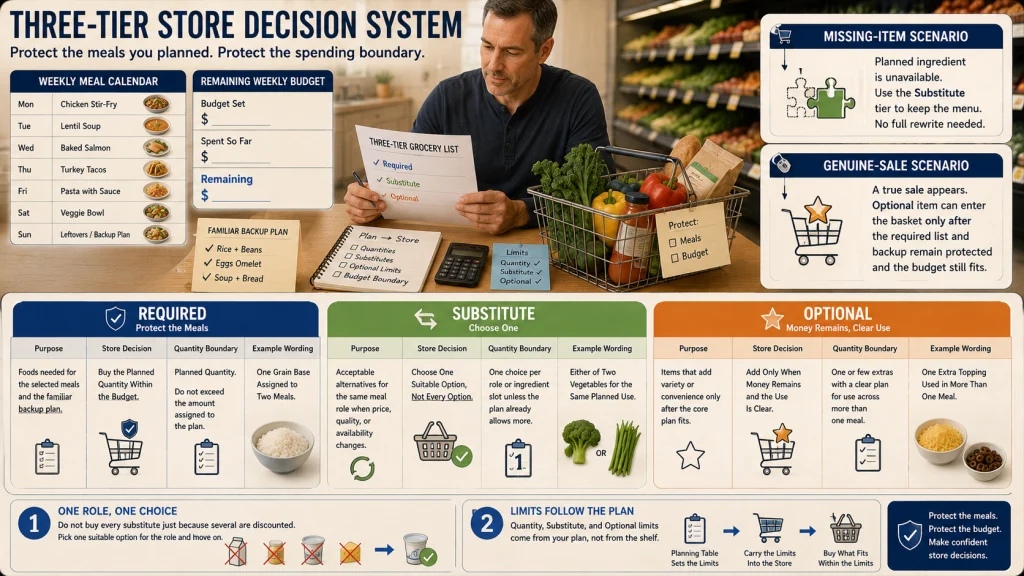
Build Required, Substitute, and Optional List Tiers
A flat shopping list treats every item as equally important. A tiered list protects the meals first and makes sale decisions less emotional at the store.
| List tier | Purpose | Store decision | Example wording |
|---|---|---|---|
| Required | Foods needed for the selected meals and backup plan | Buy within the planned quantity and budget | One grain base for two assigned meals |
| Substitute | Acceptable alternatives when price, quality, or availability changes | Choose one option, not every option | Use either of two suitable vegetables for the same meal role |
| Optional | Items that improve variety or convenience after the core plan fits | Add only when money remains and the use is clear | An extra topping with more than one planned use |
The substitute tier prevents one missing item from forcing a full menu change. The optional tier gives the household room to respond to a genuine sale without sacrificing required foods.
Once those priorities are clear, turn them into a meal prep grocery list that carries the quantity, substitute, and optional boundaries into the store.
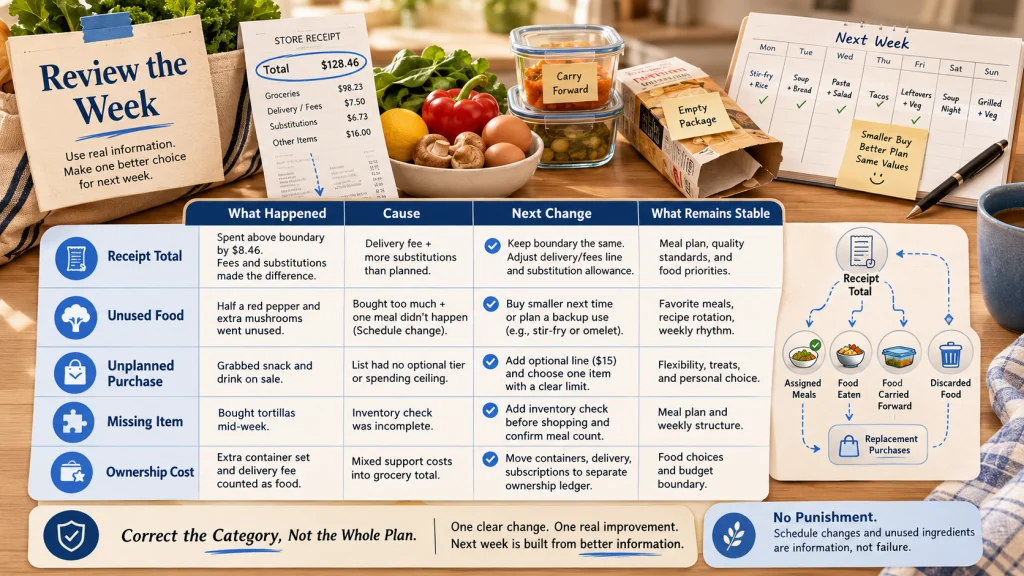
Review the Receipt, Waste, Unplanned Purchases, and Missing Items
A budget plan becomes useful after the week, when the household can compare intention with what actually happened. The review should be practical, not punitive. A changed schedule or unused ingredient is information for the next plan.
| Review area | What happened? | What caused it? | Next-plan change |
|---|---|---|---|
| Receipt total | Spending finished above or below the boundary | Required foods, optional items, substitutions, or fees changed | Adjust the category that moved, not the entire plan |
| Unused food | An ingredient remained without a meal | Too much was purchased or the assigned meal did not happen | Buy a smaller quantity or add a believable backup use |
| Unplanned purchase | A sale or convenience item entered the basket | The list had no substitute or optional boundary | Add a clearer tier or spending ceiling |
| Missing item | Another purchase was needed later | Inventory or meal count was incomplete | Add the missing task to the planning checklist |
| Extra ownership cost | Containers, delivery, or equipment added to the week | A support purchase was mixed into food spending | Move it to the ownership ledger and review its repeated value |
Keep the receipt long enough to identify which category changed the plan. Then note discarded food, food carried into the next week, and purchases made because the original plan became inconvenient.
When the same reminder, handoff, or shopping mistake repeats, it may be a routine problem rather than a discipline problem. That is the point where a clearer meal prep system becomes useful.
Decide Whether a Product Solves a Repeated Cost or Time Bottleneck
A product belongs in the budget conversation only after the household can name the repeated problem it is meant to solve.
Ask:
- Does food go unused because no suitable storage is available?
- Does one preparation task repeatedly create an extra purchase or abandoned plan?
- Would the product replace an existing recurring cost, or simply add another option?
- Does it require accessories, subscriptions, maintenance, replacement parts, energy, or storage space?
- Will the household use it across several realistic meal plans?
Do not count an advertised discount as savings before ownership costs and likely use are considered. A product can reduce one task while creating cleaning, storage, or replacement work elsewhere.
Product decision: Delay the purchase when the problem can be solved by reducing recipe count, using current containers differently, changing the list tier, buying a smaller package, or reorganizing an existing routine. Reconsider only if the same bottleneck continues across several normal weeks.
Package size, pantry capacity, shopping frequency, and household use meet in grocery shopping and pantry planning. Use that broader workflow when the repeated bottleneck begins before the food reaches the kitchen.
Set the Limit, Assign the Food, Calculate Usable Value, and Review the Week
Start with the amount available, then check what is already in the home and how many meals will actually be eaten there. Choose a manageable set of ingredients, assign perishable foods to specific uses, and protect the plan with familiar substitutes and backups.
At the store, compare usable quantity rather than shelf labels alone. A larger package is valuable only when the household can pay for it now, store it safely, prepare it, and use most of it without crowding out required foods.
After the week, compare the receipt with the spending boundary and review what was eaten, carried forward, replaced, or discarded. The goal is not a flawless low-cost basket. It is a budget system that becomes more accurate because each purchase has an assigned role and each week produces information for the next one.
FAQs
💵 How do I start meal prep on a budget?
Set the spending boundary first, inventory usable food, and count the meals likely to be eaten at home. Build the list around required meals, realistic substitutes, and a small backup rather than beginning with sale items.
🧾 Is the lowest unit price always the best value?
No. Unit price does not show how much of the package will be used. Compare the package price with the quantity assigned to realistic meals, storage, and backups.
📦 Does buying in bulk always save money?
No. A larger package can create extra storage, container, preparation, cleaning, and cash-flow costs. It fits the budget only when the household can use most of it without sacrificing required purchases.
🥫 Are frozen or canned foods worse for budget meal prep?
No single food form is automatically better for every plan. Fresh, frozen, canned, and shelf-stable foods offer different timing, storage, preparation, and waste tradeoffs.
🛒 How should I handle sales at the store?
Check whether the sale item replaces a required or substitute item and whether the usable quantity fits the meal count. Skip it when it crowds out planned food or depends on vague future use.
🍽️ What if my meal plan changes during the week?
Use a familiar backup or substitute before making another purchase. Record which food became unused or which item was missing so the next budget reflects the real schedule.
⚙️ Should I buy meal-prep equipment to save money?
Only consider equipment after identifying a repeated cost or time bottleneck. Count accessories, maintenance, energy, storage, cleaning, and likely use before treating the purchase as a saving.