An unhealthy coping mechanism is not defined by one imperfect evening or by whether a behavior looks respectable from the outside. The useful questions are what triggered it, what job it performed, how quickly it brought relief, and what cost or risk appeared later. Lower-risk patterns may improve when you replace the function, change the environment, and prepare support before the next trigger. When the pattern involves medical danger, self-harm, unsafe aggression, serious eating-related risk, or a person who may not remain safe, professional or emergency help takes priority over a self-directed habit experiment.
One Stressful Evening Can Produce Two Very Different Receipts
Imagine writing a two-column receipt for one difficult evening. The left column records what helped immediately: scrolling until the feeling faded, pouring another drink, buying something impulsively, skipping dinner, working long past exhaustion, or sending an angry message. For a few minutes, each action may create escape, numbness, stimulation, control, or release.
The right column is completed the next morning. It records unfinished work, poor sleep, regret, conflict, financial strain, isolation, physical discomfort, or a problem that has become harder to face.
| Immediate-Relief Receipt | Later-Cost Receipt |
|---|---|
| The feeling became quieter for a while. | The original stressor was still present. |
| A decision could be postponed. | The deadline, conversation, or uncertainty became more pressing. |
| There was a brief sense of control or reward. | Money, sleep, trust, health, or daily functioning carried the cost. |
| Attention moved away from the stressful moment. | Returning to the situation felt heavier. |
A behavior can work for ten minutes and still fail as a coping system. Replacement starts by identifying the job the habit is doing before asking it to disappear.
For the broader range of everyday responses, use the coping skills guide. The home stress management framework can help when several routines, environments, and responsibilities are contributing at once.
Define the Pattern by Consequence, Not Moral Judgment
An unhealthy coping mechanism is a repeated response that brings some immediate benefit but creates meaningful later cost, increases risk, delays necessary action, or narrows daily functioning. The pattern matters more than whether the behavior is socially praised or criticized.
Overworking may look productive while it removes sleep, relationships, or recovery. Isolation may look quiet while it cuts off needed support. A purchase may look ordinary while repeated spending creates financial danger. Distraction may be harmless during a short wait and costly when it becomes the only way to approach every uncomfortable task.
One occurrence does not establish a diagnosis or a permanent identity. Context, repetition, consequences, control, and safety all matter. The goal is to examine what the response is doing without calling the person weak, broken, lazy, or morally at fault.
Key decision: Ask whether the behavior solves the stressor, safely supports the response, or only transfers the cost to a later time.
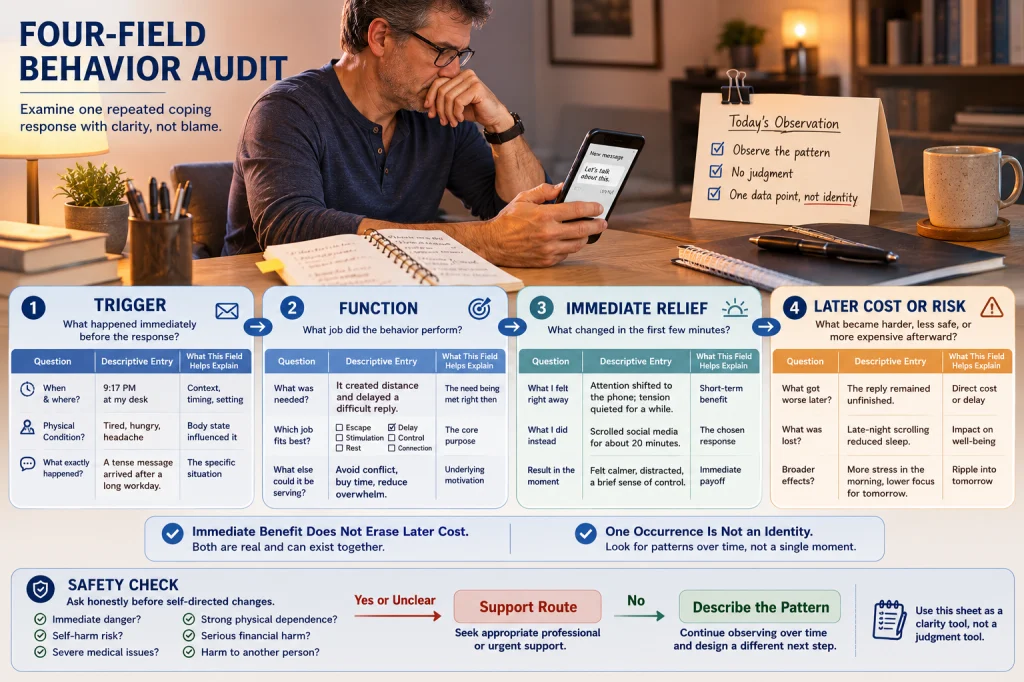
Use Four Fields: Trigger, Function, Relief, and Cost
A behavior is easier to understand when it is separated into four fields. This prevents the audit from becoming a vague promise to “do better” next time.
| Field | Question | Example Entry |
|---|---|---|
| Trigger | What happened immediately before the response? | A tense message arrived after a long workday. |
| Function | What job did the behavior perform? | It created distance and delayed a difficult reply. |
| Immediate relief | What changed in the first few minutes? | Attention moved away from the message and tension dropped temporarily. |
| Later cost or risk | What became harder, less safe, or more expensive afterward? | The reply remained unfinished and the late-night scrolling reduced sleep. |
Add a fifth question when safety is uncertain: “Could this behavior create immediate danger, physical dependence, a medical complication, self-harm risk, serious financial harm, or harm to another person?” If the answer is yes or unclear, stop treating the situation as a simple habit-redesign exercise and move to the appropriate support route.
When the trigger is difficult to name, the guide to identifying stress triggers can help separate the event, interpretation, body response, and coping action.
Name the Function Before Choosing a Replacement
The visible behavior may change while the underlying job stays the same. Someone may move from endless scrolling to impulse shopping and still be seeking stimulation, escape, or a delay from an uncomfortable decision.
- Escape: Create distance from a demand, thought, conversation, or feeling.
- Numbness: Reduce emotional or physical awareness for a while.
- Stimulation: Replace emptiness, fatigue, boredom, or low engagement with intensity.
- Control: Create a sense of certainty, order, power, or completion.
- Connection: Seek contact, attention, belonging, or reassurance.
- Rest: Stop effort when the person has no reliable recovery window.
- Reward: Mark the end of strain or create something pleasant after a difficult period.
- Delay: Postpone a decision, task, or interaction that feels too demanding right now.
Several functions can appear together. An angry message may release tension, demand recognition, and force an immediate response from another person. Overworking may offer control, delay a personal problem, and provide socially accepted escape.
The function is not an excuse for harm. It is the information needed to choose a safer response that can perform enough of the same job to be usable.
Notice When a Pause Becomes Repeated Postponement
A pause can prevent an impulsive reply, allow emotional intensity to settle, or protect attention until a better time. Avoidance becomes costly when the pause repeatedly replaces a needed decision, conversation, or task.
Signs of repeated postponement may include reopening the same task without beginning, moving from one distraction to another, waiting for complete confidence before acting, or creating new preparation steps after enough information is already available.
If cognitive load is the main barrier, a smaller first action from the guide to reducing overwhelm may be more useful than adding another distraction or demanding a complete solution.
Recognize Overworking as a Possible Coping Pattern
Avoidance does not always look like doing nothing. Sometimes it looks like doing more and more of the one task that feels controllable. Work can provide structure, competence, recognition, and a clear place to direct energy, which makes overworking difficult to identify when other people praise the output.
The pattern becomes concerning when work repeatedly replaces sleep, meals, relationships, medical care, recovery, or decisions outside work. It may also appear as endless polishing, accepting every request, checking messages during every break, or feeling unable to stop after the useful task is complete.
A lower-risk replacement depends on the function. If work provides control, a defined closing list may preserve order without extending the entire evening. If it provides escape, the next step may involve naming the avoided situation and choosing an appropriate support path. If it provides reward or identity, recovery needs something more meaningful than an empty instruction to stop working.
Note: This article does not provide workplace-policy, employment, or conflict-resolution advice. Formal workload, safety, harassment, or rights concerns require the appropriate workplace or qualified professional route.
Treat Anger, Unsafe Driving, and Conflict Escalation as Safety Issues
Some coping patterns hide inside activity that looks productive. Others arrive as heat, speed, and confrontation. Anger can signal that a boundary, loss, threat, injustice, or overload needs attention, while lashing out may create immediate release or force the moment to stop. The later result can be greater danger, damaged trust, and a harder problem to resolve.
Unsafe driving, threats, property damage, physical aggression, or behavior that places another person at risk is not a low-risk coping habit to redesign through reminders and friction alone.
Safety warning: If anger is creating immediate danger, threats, unsafe driving, violence, or fear that someone may be harmed, contact local emergency services or an appropriate urgent support service now. Do not rely on this article to manage an active safety crisis.
When there is no immediate danger, the practical next step may include leaving a heated exchange, delaying communication until it can be safer, and seeking qualified support for repeated escalation. This article does not teach conflict intervention or anger treatment.
Notice When Solitude Turns Into Disappearing From Support
After conflict, embarrassment, or overload, disappearing can feel easier than explaining. Time alone can provide quiet, privacy, and recovery. Isolation creates a different pattern when a person repeatedly avoids people who could offer support, stops responding to important contact, or withdraws from daily life because being seen feels too difficult.
The function may be escape from questions, protection from conflict, relief from social effort, or fear of disappointing someone. A useful replacement does not require immediate deep disclosure. It may begin with a lower-demand form of contact, a clearly limited conversation, or asking one trusted person for a specific kind of support.
Persistent withdrawal, marked changes in functioning, severe distress, or inability to meet essential needs requires qualified support. A social reminder or scheduled message is not a substitute for assessment or care when the pattern is serious.
Audit Impulsive Spending Without Turning It Into a Shopping Problem Alone
Not every escape is quiet. Some arrives through bright prompts, anticipation, and the small lift of choosing something new. Spending can create stimulation, reward, control, or a temporary identity shift, so the product may matter less than the emotional change created by browsing and completing the purchase.
Review the full path: the trigger, the app or site opened automatically, stored payment details, late-night prompts, promotional countdowns, and the feeling that followed checkout. Financial cost is one consequence, but secrecy, conflict, lost sleep, and repeated regret may also matter.
This article does not cover gambling services or provide treatment guidance for gambling-like behavior. Repeated financial danger, loss of control, borrowing, hidden transactions, or inability to stop despite serious consequences requires qualified financial and mental-health support.
Editorial observation: Automatic app access, stored payment methods, visible promotional prompts, and one-tap checkout can remove nearly every pause between urge and purchase. Adding a deliberate step may help with a lower-risk impulse pattern, but environment changes do not resolve dependence, serious loss of control, or financial crisis.
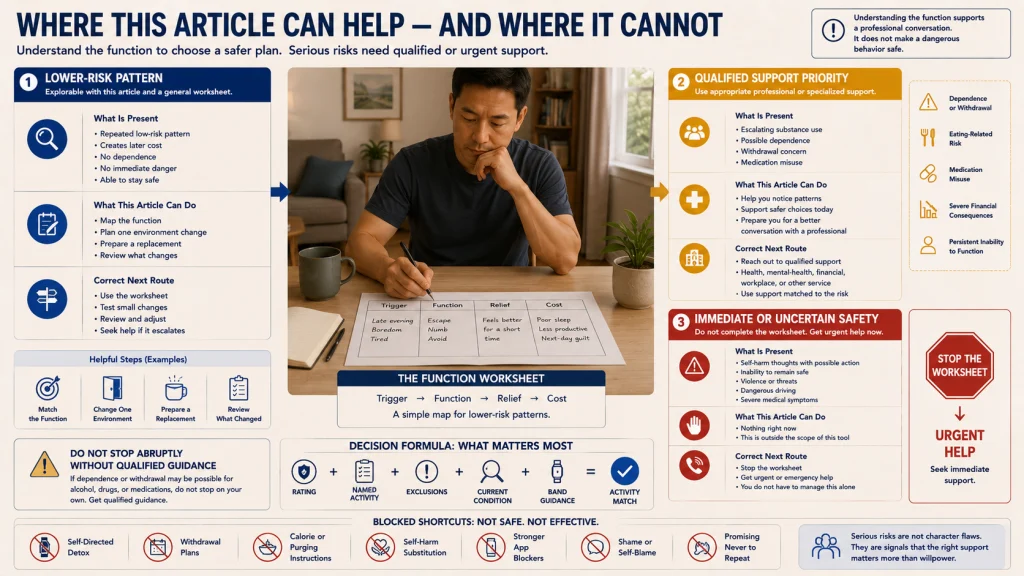
Use Strong Boundaries for Substances, Eating Behaviors, and Self-Harm
Alcohol use, drug use, smoking, food restriction, overeating, purging, medication misuse, and self-harm can involve medical risk, dependence, withdrawal, serious distress, or danger that cannot be evaluated through a general coping worksheet.
Safety warning: Do not abruptly stop alcohol, drugs, or medications based on this article. Do not use self-directed detox, withdrawal, calorie, purging, or self-harm substitution instructions. Escalating use, possible dependence, withdrawal concerns, eating-related danger, self-harm, or concern that a person may not remain safe requires prompt qualified care or emergency help appropriate to the situation.
A behavior may still have an understandable function, such as numbness, relief, control, or escape. Understanding that function can support a conversation with a qualified professional, but it does not make the behavior safe or suitable for a low-risk habit experiment.
One occurrence does not justify a diagnosis. At the same time, serious risk does not need a label before support is appropriate.
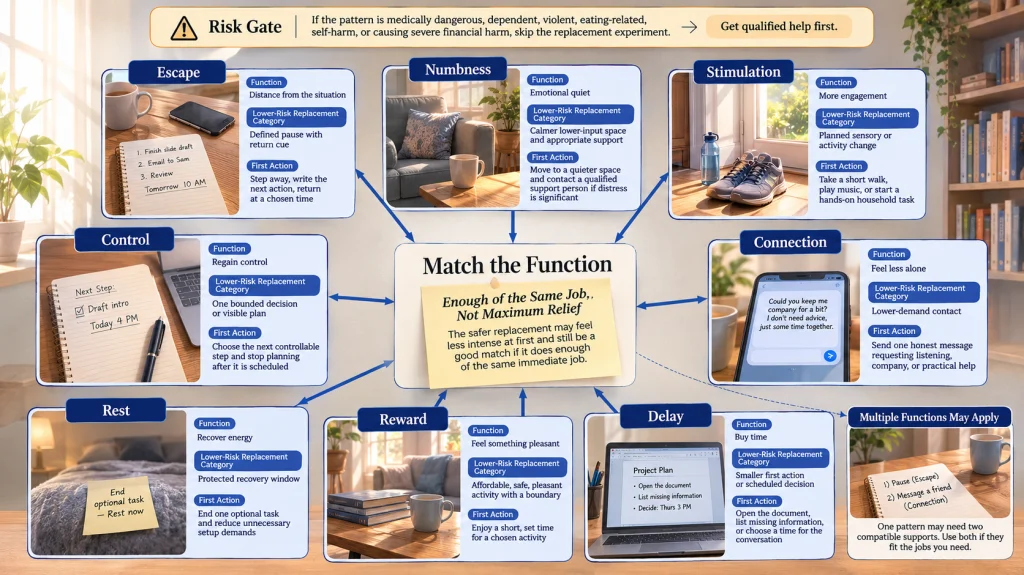
Replace the Function With a Lower-Risk Category
No single substitute works for every behavior because the same behavior can perform different jobs. Choose a replacement category that matches the immediate function and the level of risk.
| Function | Lower-Risk Replacement Category | Practical Example |
|---|---|---|
| Escape or distance | A defined pause with a return cue | Step away from the message, write the next action, and return at a chosen time. |
| Numbness or emotional quiet | Supportive settling and qualified support when distress is significant | Move to a calmer space, reduce input, and contact an appropriate support person. |
| Stimulation | Planned sensory or activity change | Use a short walk, music, a hands-on household task, or another safe source of engagement. |
| Control | One bounded decision or visible plan | Choose the next controllable step and stop planning after it is scheduled. |
| Connection | Lower-demand contact | Send one honest message asking for listening, company, or practical help. |
| Rest | A protected recovery window | End one optional task, reduce setup demands, and make rest an intentional part of the plan. |
| Reward | A planned pleasant activity with a clear boundary | Choose an affordable, safe activity that does not create the same later cost. |
| Delay | A smaller first action or scheduled decision | Open the document, list the missing information, or choose the time for the conversation. |
The substitute may provide less intense relief at first. That does not automatically mean it is a poor match. The goal is enough relief, connection, rest, stimulation, or control to make the safer path usable.
When the main question is whether to change the stressor or first regulate the response, use the comparison of problem-focused and emotion-focused coping.
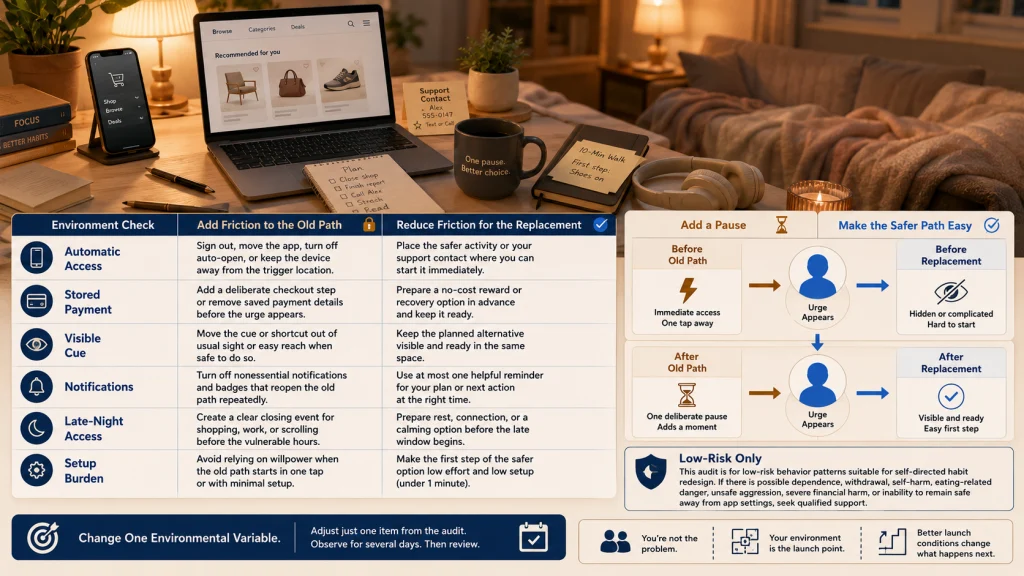
Add Friction to the Old Path and Remove It From the Replacement
Environment design can create a pause before a lower-risk unwanted behavior and make the safer alternative easier to begin. It is most appropriate when the pattern is not medically dangerous, dependent, violent, or otherwise beyond self-directed habit redesign.
| Environment Check | Add Friction to the Old Path | Reduce Friction for the Replacement |
|---|---|---|
| Automatic access | Sign out, move the app, disable automatic opening, or separate the device from the trigger location. | Place the safer activity or contact option where it can be started immediately. |
| Stored payment | Remove saved payment details or require a deliberate checkout step. | Prepare a no-cost reward or recovery option in advance. |
| Visible cue | Move a lower-risk unwanted cue out of the usual line of sight when safe and appropriate. | Keep the planned alternative visible and ready. |
| Notification loop | Turn off nonessential prompts that repeatedly reopen the old path. | Use one reminder for the support plan or next action. |
| Late-night access | Create a deliberate closing step for shopping, work, or scrolling. | Prepare the rest, connection, or calming option before the vulnerable time. |
| Setup burden | Do not rely on willpower alone when the unwanted path begins in one tap. | Reduce the safer alternative to a first action that takes little setup. |
Safety warning: Skip the environment experiment when the behavior may involve dependence, withdrawal, self-harm, eating-related danger, unsafe aggression, or severe financial consequences. Those signs call for the support pathway described below, not a stronger app setting or another barrier.
Make a Support Plan Before the Trigger Returns
A plan created during a calmer period is easier to use than a decision invented at the peak of stress. Keep it short enough to recognize and specific enough to begin.
- Trigger: Name the situation, time, place, or internal signal that often comes first.
- Function: Write the job the old behavior usually performs.
- First replacement: Choose one lower-risk action that can perform enough of that job.
- Environment step: Add one pause to the old path or prepare the alternative.
- Support person or service: Decide who is appropriate when the replacement is not enough.
- Escalation point: Name the sign that means self-management stops and qualified or urgent help is needed.
A repeatable version can be added to a broader stress management plan. The plan is not a promise that every trigger will be handled perfectly. It is a prepared route that reduces the number of decisions required under strain.
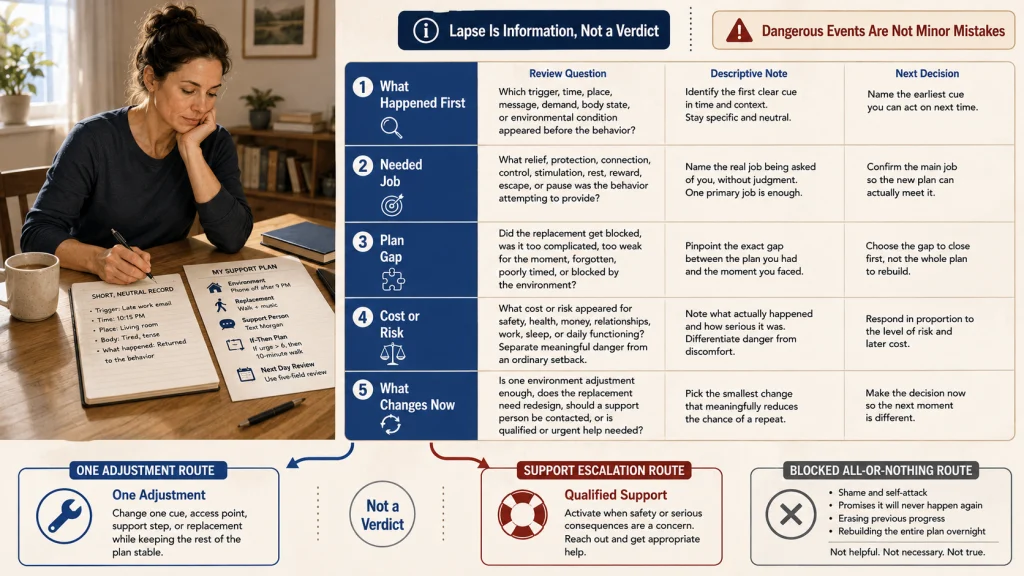
Review a Lapse Without All-or-Nothing Language
A lapse can produce shame quickly, especially when the person has promised that the behavior will never happen again. Shame may then become another trigger for the same coping pattern.
Use a short review card instead of a verdict:
| Lapse-Review Field | Question |
|---|---|
| What happened first? | What trigger, time, place, or condition appeared? |
| What job was needed? | What kind of relief, protection, connection, control, or pause was the behavior trying to provide? |
| Where did the plan fail? | Was the replacement unavailable, too complicated, too weak for the moment, or forgotten? |
| What cost or risk appeared? | Did the situation affect safety, health, money, relationships, work, sleep, or daily functioning? |
| What changes now? | Is one environment adjustment enough, or is qualified support needed? |
Do not use one lapse to erase every useful choice that came before it. Also do not minimize a dangerous event as a minor mistake. The response needs to match the actual level of cost, control, and risk.
A simple stress journal can help record patterns when writing does not increase distress or turn into repetitive self-criticism.
Know When Abrupt Change Can Be Unsafe
Some coping behaviors can involve physical dependence, withdrawal risk, medical complications, or serious psychological danger. In those situations, “remove access and stop immediately” is not responsible general advice.
Safety warning: Seek qualified medical or mental-health guidance before changing alcohol, drug, medication, eating, or self-harm-related behavior when stopping may cause withdrawal or other medical harm, or when the pattern carries serious psychological or safety risk. This article does not provide detox, withdrawal, treatment, or crisis-management instructions.
Professional support may also be necessary for repeated unsafe aggression, escalating financial harm, persistent inability to function, severe isolation, or a pattern that continues despite serious consequences.
The safest next step may be assessment, supervised care, a formal treatment plan, financial protection, workplace support, or another qualified service. The correct route depends on the behavior and risk, not on a generic coping label.
Use Urgent Help for Self-Harm Thoughts or Immediate Danger
Safety warning: If you are thinking about self-harm, believe you may act on those thoughts, cannot stay safe, or someone is in immediate danger, contact local emergency services or an appropriate crisis service now. Do not wait to complete a worksheet or try to manage the crisis with habit-design steps.
This article cannot assess immediate risk or replace crisis care. Urgent safety comes before analyzing the trigger, function, relief, or later cost.
Write the Behavior, Function, Cost, and Safest Next Support
Start with one specific behavior and name the trigger that came before it. Write the immediate function and relief without excusing harm or turning the response into a character judgment.
Then name the later cost and level of risk. For a lower-risk pattern, choose a replacement category that performs enough of the same job, add one pause to the old path, and prepare the safer option before the trigger returns.
If the pattern has crossed into medical risk, immediate danger, repeated inability to stop despite serious consequences, or a situation in which safety is uncertain, make professional or emergency help the next action. A stronger promise to stop is not a substitute for the right level of care.
FAQs
🧭 What makes a coping mechanism unhealthy?
Look for a repeated pattern of immediate relief followed by meaningful cost, increased risk, delayed action, or reduced functioning. One occurrence does not define a diagnosis or identity, but serious danger deserves support even before a label is known.
🔄 Why is replacing the function important?
The behavior may be providing escape, control, stimulation, rest, connection, or another immediate benefit. Removing it without another usable way to meet that need can leave the trigger and the job unchanged. The replacement needs to match the function and the level of risk.
📱 Is scrolling always an unhealthy coping mechanism?
No. Short distraction can be harmless or useful when no immediate action is available. It becomes costly when it repeatedly replaces sleep, responsibilities, support, or a needed decision and leaves the person worse off afterward.
💼 Can overworking count as an unhealthy coping pattern?
Yes, when work repeatedly provides escape or control while displacing sleep, relationships, recovery, health needs, or responsibilities outside work. High effort alone does not establish the pattern; function and consequences matter.
🛒 Can adding friction stop impulsive spending?
Removing stored payment details, prompts, or one-tap access may create a useful pause for a lower-risk impulse pattern. It is not a treatment when spending has become secretive, repeatedly uncontrollable, or financially dangerous; those signs need qualified support.
🌱 How should I respond after a lapse?
Review the trigger, the job the behavior was trying to perform, the missing support, and the actual cost without declaring the entire effort a failure. Change one part of the plan only when the risk is low. A lapse involving danger, substances, eating-related risk, self-harm, or serious consequences belongs with qualified help.
⚠️ Is it safe to stop alcohol or drugs suddenly?
Abrupt change can be unsafe when dependence or withdrawal may be involved. Do not use this article for detox or withdrawal decisions. Seek qualified medical guidance for a safe, individualized plan.
🆘 When do I need urgent help?
Use urgent help when self-harm thoughts may lead to action, safety cannot be maintained, violence or immediate danger is present, or there is severe medical risk. Contact local emergency services or an appropriate crisis service now rather than relying on a coping worksheet.