Chair exercises for seniors can support mobility, strength, circulation, and confidence when the chair is stable and the routine matches the reason for exercising. Begin with a safe setup, choose movements that fit the current purpose, and avoid changing positions so often that the routine becomes harder to follow. Progress range, control, or resistance one at a time rather than making every movement harder at once. Stop self-directed exercise when new, severe, persistent, worsening, or unexplained symptoms appear, and seek qualified evaluation when warning signs are present.

Compare a stable dining chair with a rolling office chair
Place two chairs side by side. One is a firm dining chair positioned against a wall. The other is a rolling office chair with wheels and a swivel base.
The movements performed beside them could be identical, but the setup is not. The dining chair stays where it was placed. The office chair can roll, turn, or move away when pressure is applied.
A chair can support movement only when the chair itself is not the hazard.
Chair-based exercise is not automatically easy, and seated exercise is not automatically safe for everyone. The useful routine begins with the purpose, the chair, the floor, the available space, and the person’s current tolerance for sitting, standing, and changing position.
Choose the purpose: mobility, strength, circulation, or confidence
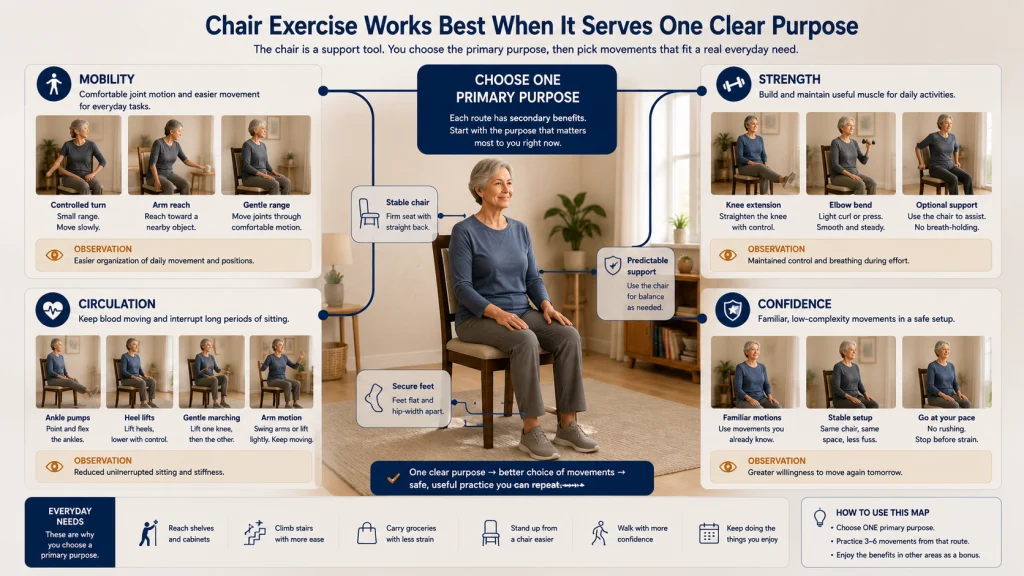
The chair is a tool, not the goal. A routine becomes more useful when each movement has a clear job.
| Routine purpose | Movement emphasis | What to notice |
|---|---|---|
| Mobility | Comfortable joint motion, turning, reaching, and controlled changes in position. | Whether everyday movements feel less stiff or easier to organize. |
| Strength | Repeated pushing, pulling, leg extension, heel raise, or chair-supported standing. | Whether the movement remains controlled without breath-holding or collapsing posture. |
| Circulation | Ankle movement, gentle marching, arm motion, and regular position changes. | Whether the routine reduces long periods of complete stillness. |
| Confidence | Familiar movements performed in a stable setup with predictable support. | Whether the person feels more willing to move without rushing or overreaching. |
One routine can include more than one purpose, but choose a primary one first. A mobility session may include some strength. A confidence-building session may include circulation. The purpose simply determines which movements deserve priority.
Use the broader mobility planning guide when the main difficulty might involve walking, balance, carrying, chair rise, or another daily movement domain.
Check chair height, arms, wheels, floor, and clearance
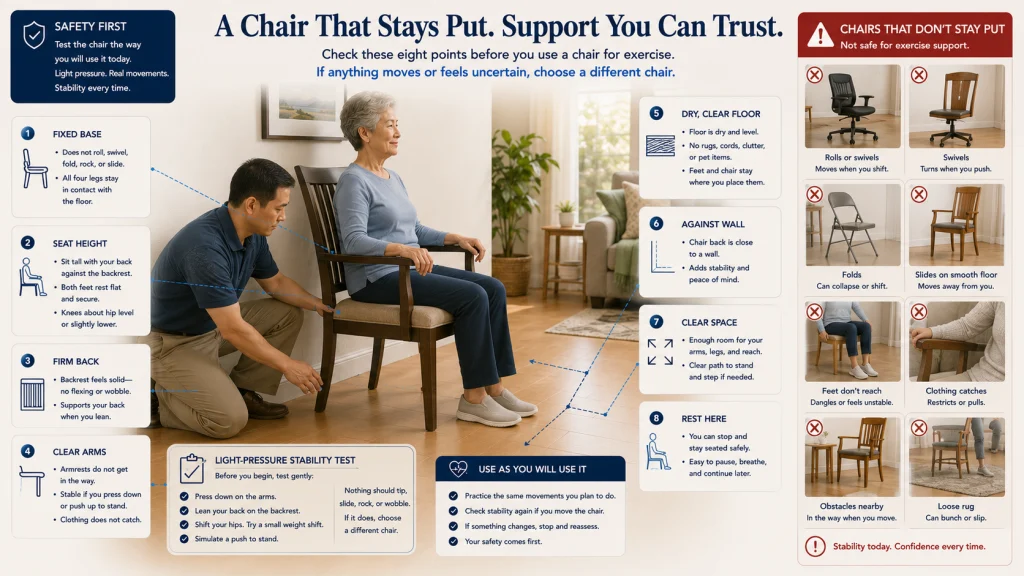
Before the first movement, examine how the chair behaves when weight shifts into it. A chair that feels fine for sitting may be poor support for pushing, pulling, or standing.
| Chair-safety check | What to confirm |
|---|---|
| Base | The chair does not roll, swivel, fold, rock, or slide under light pressure. |
| Height | The seat allows the feet to rest securely on the floor without excessive reaching or dangling. |
| Back | The backrest is firm enough for the intended seated position. |
| Arms | Armrests do not block movement, and they are stable if used for support. |
| Floor | The surface is dry, level, and free of loose rugs, cords, clutter, or pet items. |
| Wall placement | The chair can be positioned against a wall when added stability is needed. |
| Clearance | There is enough room for legs, arms, reaching, and supported standing without contacting furniture. |
| Rest access | The person can stop and remain seated without needing to cross the room. |
Do not use a rolling or swivel chair for exercises that involve pushing through the feet, leaning, reaching far, or rising. Locking wheels should not be assumed to provide the same stability as a chair designed to remain fixed.
Editorial observation: Household friction often hides in the setup. A chair that slowly slides on smooth flooring, an armrest that catches clothing, or a side table inside the movement path can disrupt an otherwise simple routine.
Warm up with comfortable range-of-motion movements
Begin with movements that allow the person to notice the chair, posture, breathing, and current comfort before adding effort. The range should be easy to control and should not be forced.
Options may include ankle pumps, gentle heel and toe lifts, small knee extensions, shoulder rolls, elbow bends, hand opening and closing, or a comfortable trunk turn within the chair. Keep both feet supported when possible and avoid reaching far behind the body.
The warm-up is also a check. Stop if a new or unexplained symptom appears, if the person feels faint, or if the movement creates sharp, severe, or worsening pain.
Select lower-body and upper-body movements by function
Choose movements that resemble the physical jobs the person wants to support. A long list is less useful than a small group connected to daily tasks.
- Ankle pumps or heel lifts: support repeated lower-leg movement during long sitting periods.
- Knee extension: practices straightening the leg from the chair.
- Seated marching: practices lifting one foot at a time while the trunk remains organized.
- Arm reach: supports controlled movement toward shelves, counters, or clothing.
- Elbow bend or press: connects to carrying, pushing, or pulling light household items.
- Gentle trunk turn: supports looking to the side or reaching within a comfortable base.
Use the functional exercise guide when the goal involves a wider group of daily movement jobs rather than a chair-based starting point.
Add chair-supported standing only when appropriate
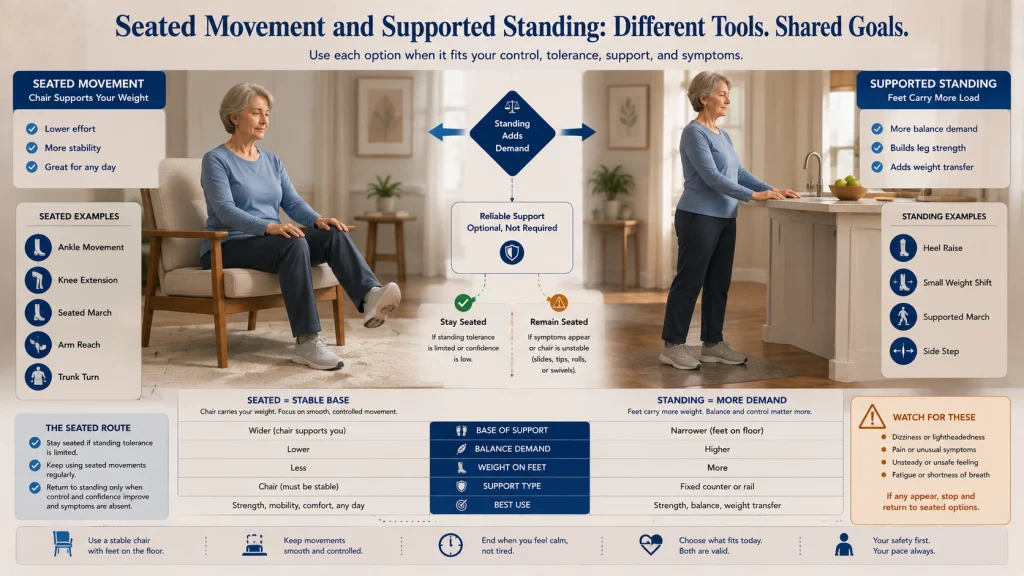
Seated and chair-supported standing movements solve different problems. Standing adds more demand to balance, leg strength, and weight transfer. It should not be treated as the automatic next step for every reader.
| Comparison point | Seated movement | Chair-supported standing |
|---|---|---|
| Base of support | The chair supports body weight throughout the movement. | The feet support more body weight while the chair provides nearby contact. |
| Balance demand | Usually lower, though trunk control and reaching still matter. | Higher because the person must organize posture while standing. |
| Chair requirement | The seat and back should remain stable and comfortable. | The chair must not slide, tip, roll, or swivel under hand pressure. |
| Movement examples | Marching, knee extension, ankle movement, arm reach, and trunk turn. | Heel raise, small weight shift, supported march, or controlled side step. |
| When to stay seated | Standing tolerance is limited, confidence is low, or the setup cannot safely support standing. | Only when the person can stand with control and no warning symptoms are present. |
A chair back is not always designed to carry strong downward or sideways pressure. When standing practice is appropriate, a fixed counter or rail may provide more reliable support than the chair itself.
Use the supported balance guide when the main goal is steadiness, weight shift, reaching, or planned stepping.
Control pace, breathing, and rest
Slow enough to stay organized is more useful than fast enough to feel difficult. The person should be able to notice the start, middle, and finish of each movement instead of swinging through it.
Breathing should continue without deliberate straining or breath-holding. If the movement causes the person to brace hard, rush, grip the chair, or lose the ability to speak comfortably, reduce the effort or stop.
Rest can happen between movements or earlier when needed. A short routine does not need to become continuous to be worthwhile. The purpose is to repeat useful movement without allowing fatigue to change technique or interfere with later daily tasks.
Build a six-movement routine without changing positions constantly
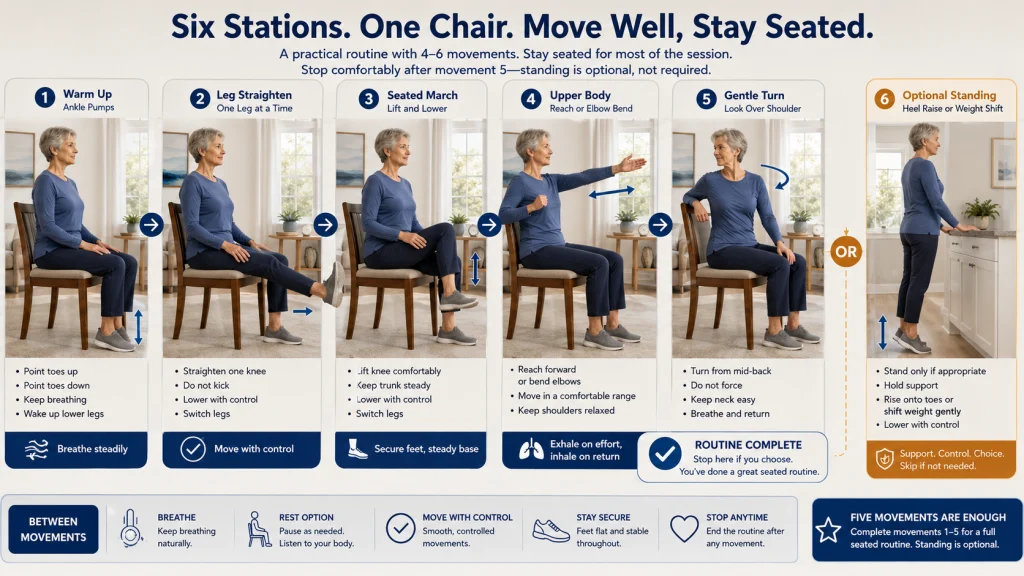
This template keeps the person seated for most of the routine and places any supported standing at the end. Replace or remove movements that do not fit the purpose or current tolerance.
| Order | Movement | Purpose | Setup cue |
|---|---|---|---|
| 1 | Ankle pumps | Lower-leg movement and warm-up | Keep heels or feet supported as needed. |
| 2 | Seated knee extension | Controlled leg straightening | Move one leg at a time without kicking. |
| 3 | Seated march | Alternating hip and leg movement | Keep the trunk steady and lift only as high as control allows. |
| 4 | Arm reach or elbow bend | Upper-body mobility or strength | Keep the reach inside a comfortable range. |
| 5 | Gentle trunk turn | Turning and visual orientation | Turn without forcing the neck or reaching behind the chair. |
| 6 | Supported heel raise or small weight shift | Optional standing practice | Use only when standing is appropriate and support is stable. |
The routine can also stop after the fifth movement and remain fully seated. The standing option is not required for the session to count.
Progress range, control, or resistance separately
A movement can become more demanding through a larger range, slower control, more repetitions, added resistance, less hand support, or a more challenging position. Changing several variables at once makes it difficult to know which change caused discomfort or loss of form.
Choose one progression:
- Range: move slightly farther while keeping the motion comfortable.
- Control: slow the movement and pause briefly at a stable point.
- Repetition: add a small amount only when the original routine remains comfortable.
- Resistance: add light resistance only when technique and breathing remain organized.
- Position: move from seated to supported standing only when appropriate.
Progress does not require using every variable. A smoother seated movement may be more useful than a harder standing version that creates fear, pain, or loss of control.
Avoid pain-chasing and breath-holding
Exercise does not need to hurt to matter. Mild effort or familiar stiffness can feel different from sharp, severe, worsening, or unexplained pain. Do not increase range or resistance just to create a stronger sensation.
Breath-holding often appears when the movement is too difficult, the person is bracing, or the pace is rushed. Reduce the range, remove resistance, return to the seated version, or stop the exercise.
This article does not diagnose the cause of pain, weakness, dizziness, or reduced function. It also does not prescribe rehabilitation, medication changes, or individualized exercise clearance.
Escalate after chest pain, faintness, new neurological symptoms, or severe shortness of breath
Safety warning: Stop self-directed exercise and seek qualified professional evaluation after a fall or when there is chest pain, fainting, severe shortness of breath, sudden weakness, new neurological symptoms, major functional decline, or symptoms that are new, severe, persistent, worsening, or unexplained. Emergency symptoms require immediate help.
Do not use a chair routine to test whether a serious symptom will improve with movement. Do not continue because the person has already started the session or wants to finish the planned number of exercises.
Qualified assessment is also appropriate when sitting tolerance is poor, the person cannot rise or reposition safely, another person must provide substantial physical assistance, or confidence and function are declining despite a stable setup.
Use the sit-to-stand guide when chair rise is the specific movement to examine rather than one element inside a broader routine.
Select the chair setup, routine purpose, four to six movements, and stop condition
Finish the plan in four lines:
- Chair setup: Name the stable chair, floor, wall placement, clearance, and resting position.
- Routine purpose: Choose mobility, strength, circulation, confidence, or one clear combination.
- Movement list: Select four to six movements without unnecessary position changes.
- Stop condition: Write the symptom, loss of control, fall, or change in function that ends self-directed practice.
A complete example might read: “I will use a firm dining chair against the wall on a dry, clear floor. The purpose is mobility and circulation. I will use ankle pumps, knee extensions, seated marching, arm reaches, and gentle turns. I will stop for chest pain, faintness, severe breathlessness, sudden weakness, a fall, or any new or worsening unexplained symptom.”
Use the broader healthy aging guide when chair exercise is one part of a larger plan for movement, routine, and independence. A chair should expand the number of ways a person can move, not define what the person is capable of becoming.
FAQs
🪑 What kind of chair is best for chair exercise?
Use a firm, stable chair that does not roll, swivel, fold, rock, or slide. The feet should reach the floor securely, and the surrounding area should be clear.
🛞 Can I use a rolling office chair?
A rolling or swivel chair can move when pressure is applied and is not appropriate for many chair-based or supported-standing movements. Choose a fixed chair instead.
🦵 Are seated exercises too easy to matter?
No. Seated movement can support mobility, circulation, controlled strength work, and confidence when matched to the person’s purpose. Difficulty should come from appropriate movement, not from removing safety margins.
🧍 When should supported standing be added?
Add standing only when the person can rise and remain organized without warning symptoms and when stable support is available. Staying seated may remain the correct choice.
🌬️ What if I hold my breath during a movement?
Reduce the range, resistance, or pace, and return to an easier position. Stop when normal breathing does not resume comfortably.
📈 How should I make the routine harder?
Change one variable at a time, such as range, control, repetition, resistance, or position. Keep the version that allows steady breathing and organized movement.
🧩 How many movements should a routine include?
Four to six well-chosen movements can create a practical short routine without constant position changes. Fewer movements are reasonable when energy, attention, or tolerance is limited.
🚩 When should chair exercise stop?
Stop after a fall or when chest pain, fainting, severe shortness of breath, sudden weakness, new neurological symptoms, major decline, or a new, severe, persistent, worsening, or unexplained symptom appears. Seek qualified evaluation, and get immediate help for emergency symptoms.