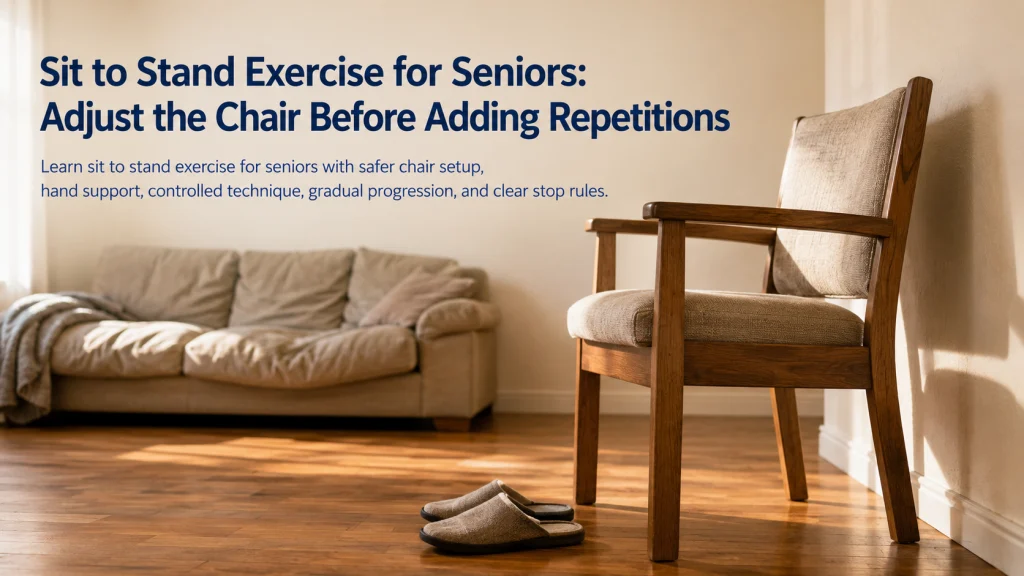
Sit-to-stand practice becomes easier or harder before strength changes at all because chair height, firmness, armrests, foot position, and hand support alter the task. Begin with a secure chair that allows a smooth rise and return, choose the permitted level of hand support, and test a small starting set. Progress only one variable at a time, such as seat height, hand support, pause, or repetitions. Sudden change, pain, repeated failed attempts, falls, fainting, chest pain, severe shortness of breath, sudden weakness, or major functional decline requires qualified evaluation.
Compare a low sofa, a firm dining chair, and a raised chair with arms
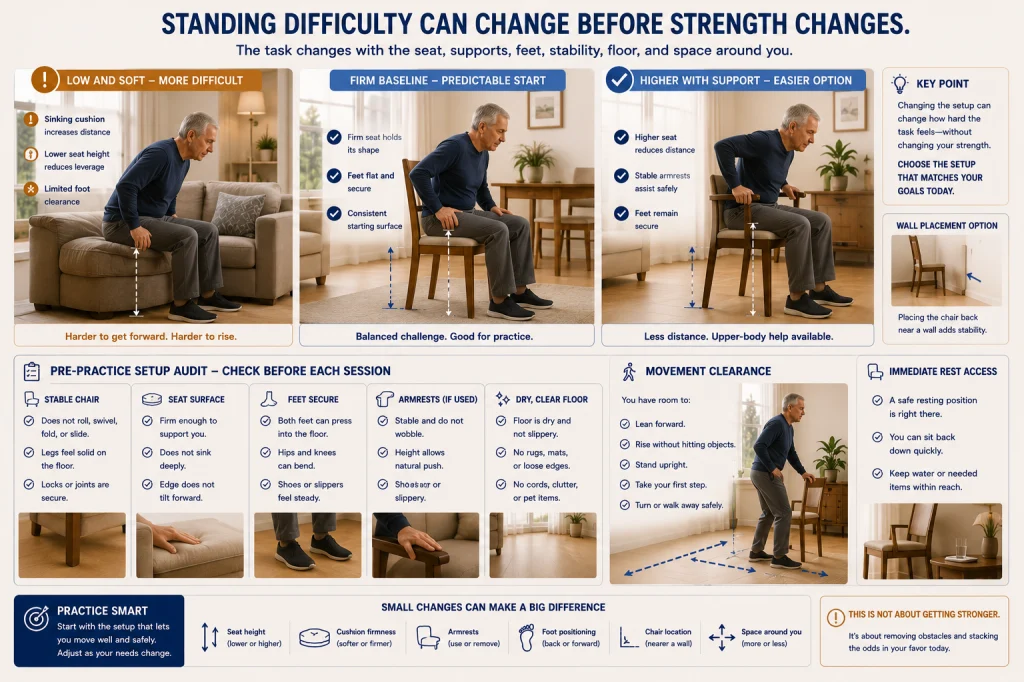
Picture the same person attempting to stand from three different seats. The first is a low, soft sofa. The second is a firm dining chair. The third is a raised chair with stable armrests.
| Surface | What changes | Likely effect on the task |
|---|---|---|
| Low soft sofa | Lower starting height, sinking surface, limited foot clearance | More forward effort, more momentum temptation, and a harder controlled return |
| Firm dining chair | Stable surface, predictable height, clearer foot placement | A more consistent setup for learning and testing the movement |
| Raised chair with arms | Higher seat and available hand support | Less distance to travel and more assistance from the upper body when needed |
The person has not become stronger or weaker between attempts. The task has changed because the chair changed. Struggling to rise can feel discouraging or exposing, especially in a public place, so the first response should be to examine the setup rather than blame the person.
Chair height can change the task before strength changes at all.
Understand why seat height, firmness, and armrests change difficulty
A lower seat asks the hips and knees to travel through a larger range before the body becomes upright. A soft cushion can sink, shift, or make it harder to position the feet. A firm seat provides a more predictable starting point.
Armrests can reduce the demand on the legs by allowing the hands to assist. That support is not cheating. It is one way to adjust the task while preserving a steady rise and return.
Chair width, edge shape, back position, and floor surface also matter. A seat that forces the feet too far forward or allows the chair to slide can turn a familiar movement into an uncertain one.
Editorial observation: Household friction often explains why the same person moves differently from room to room. The sofa compresses, the dining chair stays firm, and the restaurant chair may be lower than expected even though the movement looks identical from a distance.
Setup checklist:
- ☐ The chair does not roll, swivel, fold, slide, or sink deeply.
- ☐ The seat height allows both feet to press into the floor.
- ☐ Armrests are secure if they will be used.
- ☐ The floor is dry and free of loose rugs, cords, and clutter.
- ☐ There is room to lean forward, stand, and sit without hitting furniture.
- ☐ A resting place is immediately available if the attempt is stopped.
Use the broader mobility planning guide when chair rise is only one of several daily movements becoming more difficult.
Set foot position and forward trunk movement
Before standing, place both feet where they can press into the floor without sliding. The exact position varies by chair and body proportions, but the feet should not be so far forward that the person must pull against the chair or rock repeatedly.
Bring the trunk forward enough for body weight to move over the feet. This is different from throwing the head or shoulders forward quickly. The sequence should feel deliberate: feet set, trunk inclines, pressure moves into the floor, then the body rises.
Keep the path clear. Rugs, cords, pet items, side tables, and loose objects can interfere with foot placement or the first step after standing.
Choose hands-on-arms, light hand support, or no hands
Hand support should match the current task, not an idealized version of it.
| Hand option | When it may fit | What to watch |
|---|---|---|
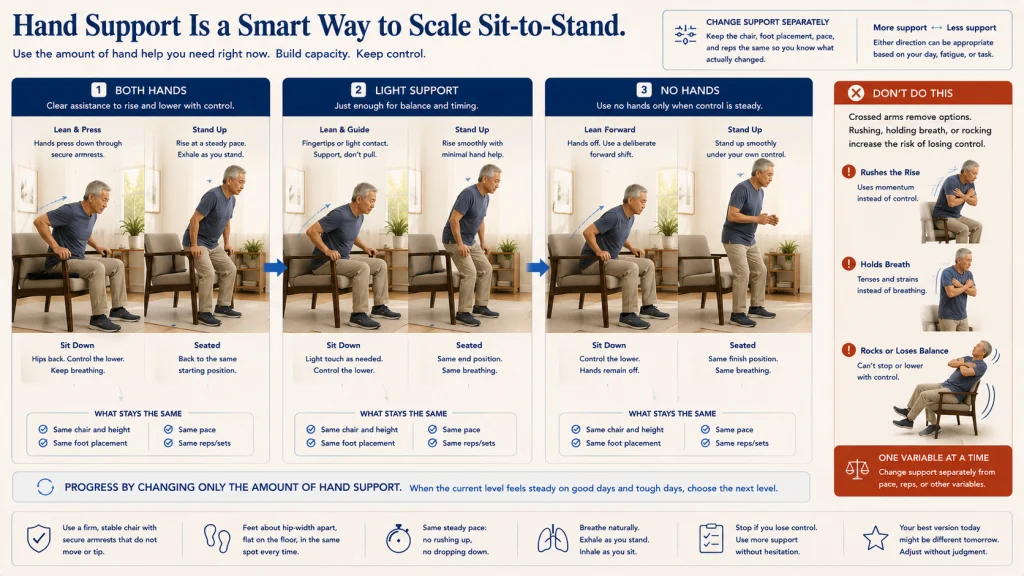
| Hands on stable armrests | The person needs clear assistance to rise with control. | Armrests must be secure and the chair must not slide. |
| Light hand support | The person can do most of the movement through the legs but benefits from balance or timing support. | Hands should guide rather than pull hard against unstable furniture. |
| No hands | The person can rise and return with steady control from the chosen chair. | Avoid crossing the arms if that causes rushing, breath-holding, or loss of balance. |
Changing from two hands to one hand or from light support to no support is a progression. It should not happen at the same time as lowering the chair or adding many repetitions.
Perform a smooth stand and a deliberate return
Begin near the front of the chair only when that position feels secure. Set the feet, choose the hand support, and lean the trunk forward without rushing.
- Press through the feet and permitted hand support.
- Rise without throwing the shoulders backward.
- Stand tall enough to feel stable before changing direction.
- Reach back for the chair only when needed and when the chair position is known.
- Move the hips backward and lower at a steady pace.
- Finish seated without dropping heavily into the chair.
The return matters as much as the rise. Dropping into the seat can hide fatigue, loss of coordination, or a chair that is too low for the current attempt.
Test a low-repetition starting set
Start with a small number of well-organized attempts rather than chasing fatigue. The goal is to learn whether the setup remains consistent from the first repetition to the last.
A reasonable test might be a few repetitions with full rest available, but no exact number fits everyone. Stop the set when the person begins to rock, pull hard on unstable furniture, lose foot position, collapse into the chair, hold the breath, or feel a new or worsening symptom.
Record the chair, hand support, and quality of the movement. “Five repetitions” is less useful than “five smooth repetitions from a firm dining chair with both hands on the arms and no loss of balance.”
Correct momentum, knee collapse, and unstable furniture
Momentum often appears as repeated rocking, a sudden head throw, or a fast launch from the chair. Slow the setup, move the feet, raise the seat, or allow more hand support before asking for another attempt.
If the knees move inward and the feet lose pressure, reduce the difficulty and restore a stable foot position. The correction should not be forced through pain or rigid alignment cues.
Furniture is part of the movement. A chair that rolls, swivels, slides, folds, or sinks should be replaced with a more stable surface before troubleshooting the person.
Setup warning: Do not practice from a rolling office chair, unstable stool, folding chair that can collapse, or a surface that shifts under pressure.
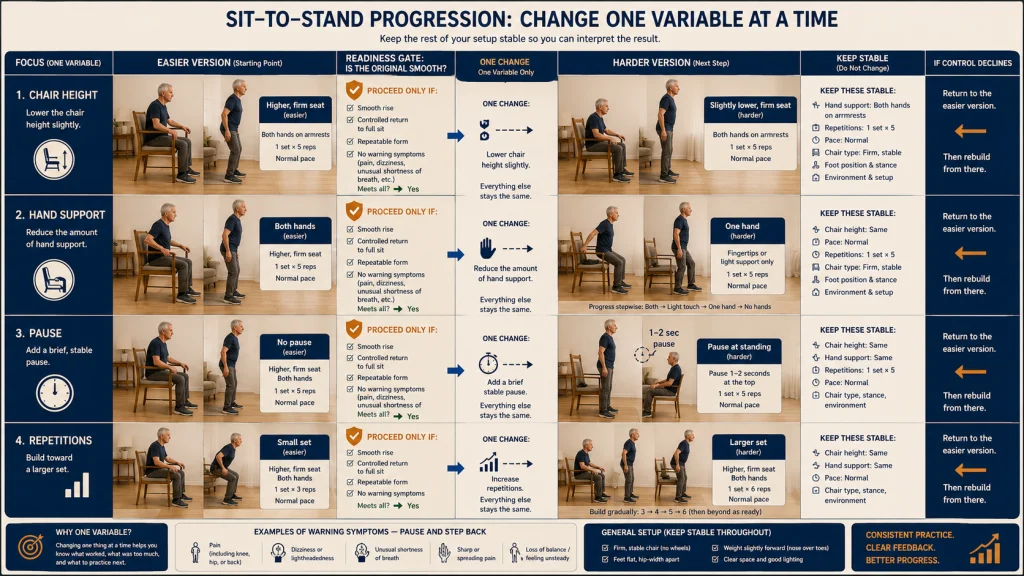
Progress chair height, hand support, pause, or repetitions one variable at a time
A harder version can come from changing the chair, the hands, the pause, or the amount of work. Changing all four together makes the result difficult to interpret.
| Progression variable | Easier version | Harder version | Keep stable |
|---|---|---|---|
| Chair height | Raised or naturally higher firm seat | Slightly lower firm seat | Hand support and repetition count |
| Hand support | Both hands on stable armrests | Light support, one hand, or no hands | Chair height and movement speed |
| Pause | Stand and sit without a deliberate hold | Brief stable pause at standing or just above the chair | Chair and hand support |
| Repetitions | Small controlled set | Gradually larger set | Chair height, hand support, and pace |
Progress only when the original version remains smooth, repeatable, and free from warning symptoms. Returning to an easier setup is a valid adjustment, not a failure.
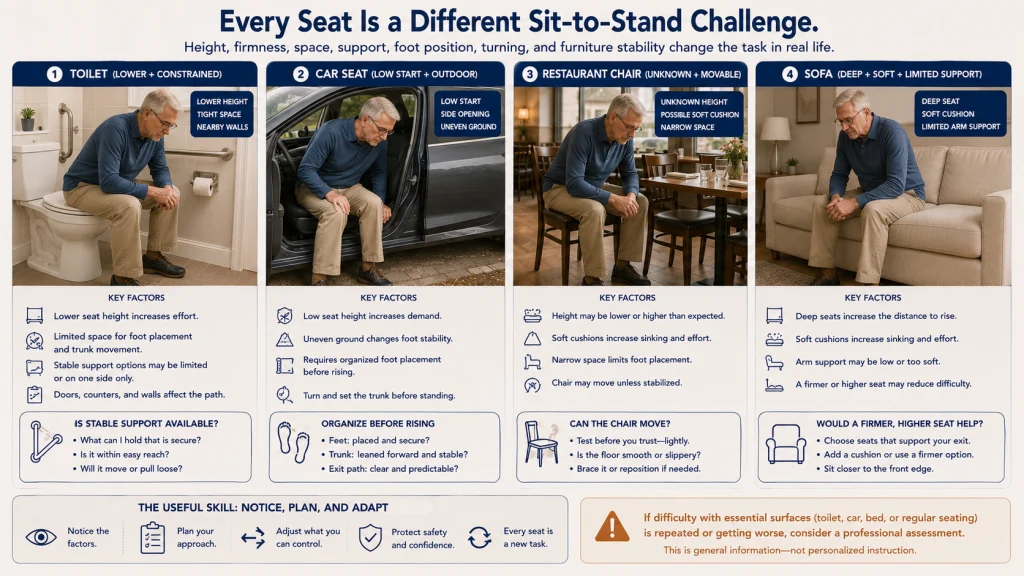
Apply the skill to toilets, cars, and restaurant chairs
Daily surfaces differ from the practice chair. The goal is not to turn each one into a formal exercise station. It is to notice which parts of the setup change the task.
| Real-life surface | What may change | Planning question |
|---|---|---|
| Toilet | Lower height, limited space, nearby walls, or available grab support | Is the surface height appropriate, and is stable support available? |
| Car seat | Low seat, side opening, uneven ground, and the need to turn before standing | Can foot position and trunk movement be organized before rising? |
| Restaurant chair | Unknown height, soft cushion, narrow space, or a chair that moves | Can the chair be stabilized and positioned before sitting or standing? |
| Sofa | Deep seat, soft cushion, and limited arm support | Would a firmer or higher seat reduce unnecessary difficulty? |
This comparison does not prescribe transfer training. Repeated difficulty with toilets, cars, or other essential surfaces may require professional assessment rather than endless home troubleshooting.
Use the chair exercise guide when the goal is a broader routine rather than one chair-rise pattern.
Track effort and consistency
Track the setup before tracking performance. Record the chair height or description, seat firmness, hand support, foot position, repetition range, and whether the return was controlled.
Use simple notes such as:
- Firm dining chair, both hands, four controlled repetitions.
- Same chair, light hand support, no rocking.
- Same setup, effort increased on the final repetition.
- Stopped because the chair began to slide.
Consistency matters more than an isolated best attempt. A movement that works once through momentum may be less useful than a slightly easier version that remains organized across ordinary days.
Use the functional exercise guide when tracking several daily movement patterns rather than one transfer.
Escalate after sudden change, pain, repeated failed attempts, or falls
Safety boundary: Stop self-directed troubleshooting and seek qualified evaluation after a fall or when there is sudden change, repeated failed attempts, new or worsening pain, fainting, chest pain, severe shortness of breath, sudden weakness, new neurological symptoms, major functional decline, or another severe, persistent, worsening, or unexplained symptom. Emergency symptoms require immediate help.
Do not keep lowering and raising the chair to test whether a serious problem will resolve. Difficulty that appears suddenly or progresses despite a stable setup may not be a simple exercise issue.
Assessment is also appropriate when another person must pull or lift the individual, when the person cannot control the return to the chair, or when falls and near-falls are becoming more frequent.
Use the balance exercise guide when steadiness, weight shift, or standing control is the primary issue rather than the chair-rise sequence itself.
Record the starting chair, permitted hand support, repetition range, and reassessment trigger
Finish the plan in four lines:
- Starting chair: Name the height, firmness, armrests, floor, and whether the chair is against a wall.
- Permitted hand support: Choose both hands, light support, one hand, or no hands.
- Repetition range: Set a small range that preserves controlled standing and sitting.
- Reassessment trigger: Write the symptom, fall, failed attempt, or loss of control that ends self-directed practice.
A complete example might read: “I will begin from a firm dining chair with secure arms on a dry floor. I may use both hands. I will stop the set before rocking, breath-holding, or dropping into the chair appears. I will seek evaluation after a fall, sudden decline, repeated failed attempts, or new, severe, persistent, worsening, or unexplained symptoms.”
Use the broader healthy aging guide when chair rise is one part of a larger plan for movement and independence.
Sit-to-stand practice should make the task more understandable, not turn every chair into a test. Adjust the chair first, then decide whether the movement is ready to progress.
FAQs
🪑 What chair is best for sit-to-stand practice?
Use a firm, stable chair that does not roll, swivel, fold, slide, or sink deeply. A higher seat with stable armrests can make the starting version easier to control.
🦶 Where should the feet go?
Place both feet where they can press securely into the floor without sliding. Avoid keeping them so far forward that repeated rocking is needed to stand.
🤲 Is using the armrests cheating?
No. Stable hand support is one way to adjust the task. Reduce support only when the current version remains controlled and repeatable.
⬆️ Should I lean forward before standing?
A controlled forward trunk movement helps shift body weight over the feet. It should not become a fast head throw or repeated rocking.
🔁 How many repetitions should I do?
Begin with a small set that preserves control rather than using one universal number. Stop when rocking, breath-holding, unstable foot position, or a heavy drop into the chair appears.
📉 How can I make the exercise easier?
Use a higher firm chair, allow stable hand support, reduce the repetition range, and slow the movement. Change one variable at a time.
📈 How can I progress the movement?
Progress seat height, hand support, pause, or repetitions separately. Keep the original version stable enough to compare the result.
🚩 When should difficulty standing be assessed?
Seek qualified evaluation after a fall, sudden change, repeated failed attempts, new or worsening pain, fainting, chest pain, severe shortness of breath, sudden weakness, neurological symptoms, or major decline. Emergency symptoms require immediate help.