Functional exercises for seniors should begin with the daily task that has become harder, not with a random equipment list. Standing from a chair, reaching a shelf, carrying groceries, turning in a narrow space, and stepping onto a curb each require a different movement pattern. Choose a supported starting version, use a comfortable range and controlled speed, then progress one variable at a time. Stop self-directed practice and seek qualified assessment when pain, dizziness, a fall, sudden weakness, severe breathlessness, or another unexplained decline appears.
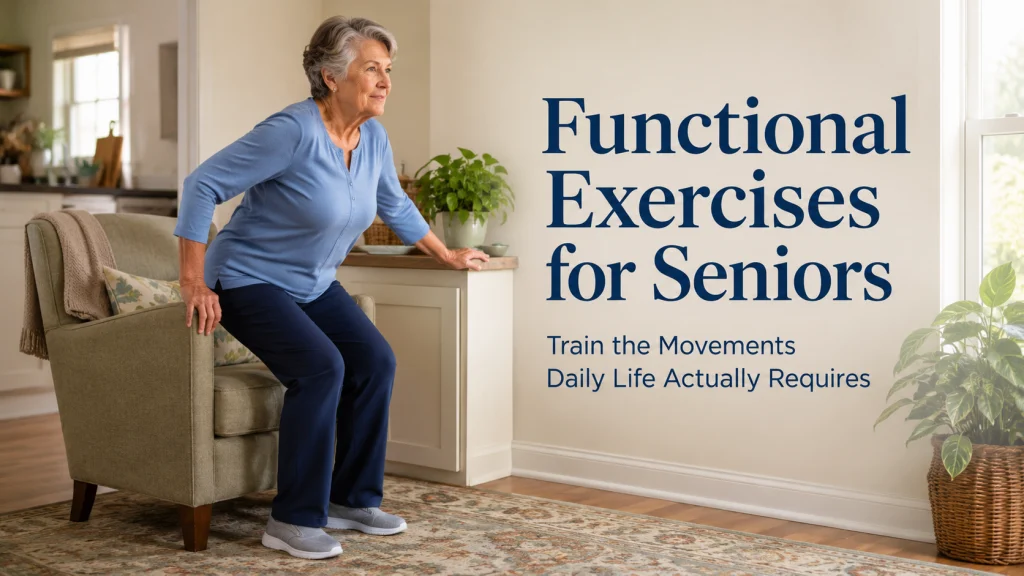
Start with the grocery bag, chair, stair, or shelf
A grocery bag asks the body to grip, carry, stay upright, and walk while one side is loaded. A low chair asks for foot placement, forward weight shift, leg effort, and control through standing. A stair adds a height change and the need to manage body weight through one side at a time. A high shelf combines reaching with trunk control and balance.
These objects are ordinary, but the movement demands behind them are different. A list of general exercises may miss that distinction. Someone who struggles to carry groceries does not automatically need the same starting task as someone who hesitates at a curb or has difficulty rising from a sofa.
Functional exercise begins with the task, not the equipment. The first step is to name what daily life requires, then work backward to a movement that can be practiced safely.
Define functional exercise without promising independence
Functional exercise rehearses movement patterns used in ordinary life. It may involve standing, reaching, carrying, turning, stepping, bending, or changing position. The purpose is to make practice relevant to a real task rather than to guarantee a particular health or independence outcome.
This guidance is for older adults who can perform some daily activities but notice that certain movements require more effort, support, recovery, or planning. It does not diagnose weakness, frailty, balance disorders, disability, or the cause of a new limitation.
A functional movement can resemble a gym exercise, but the selection process is different. Instead of asking which muscle to train first, ask which task is being limited, what movement the task requires, and which supported version is suitable now.
Key decision: Choose one daily task and one movement pattern before choosing repetitions, equipment, or progression.
Map five daily tasks to their movement patterns
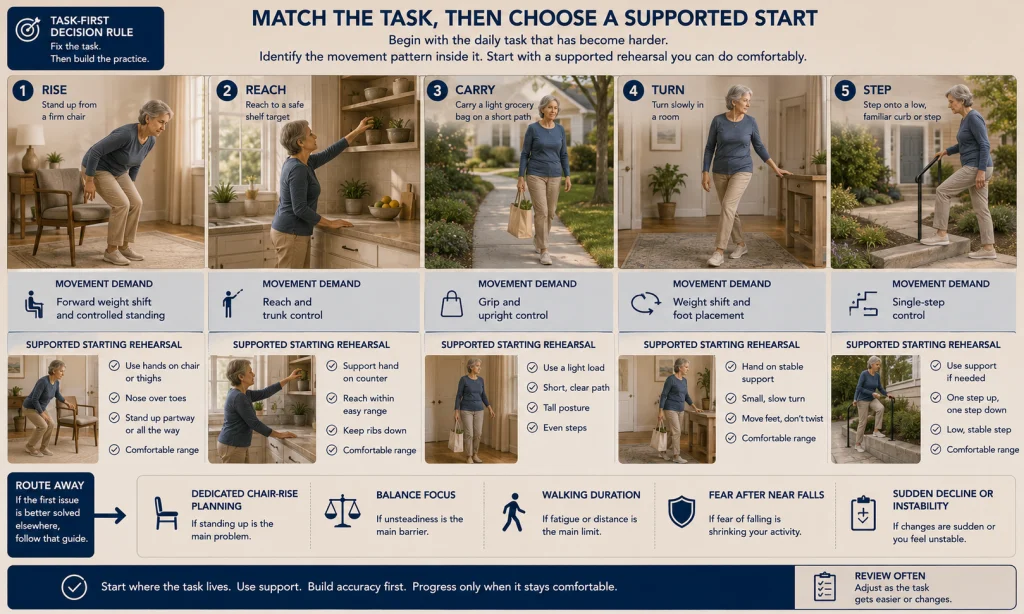
The matrix below helps separate broad functional movement from more specific balance, chair, walking, or sit-to-stand needs.
| Daily task | Main movement pattern | Possible starting rehearsal | Route elsewhere when |
|---|---|---|---|
| Rise from a chair | Forward weight shift, leg effort, and controlled standing. | Practice from a firm, suitable chair with the support already needed. | Chair rise is the only major concern and needs a dedicated plan. |
| Reach a shelf | Reach, trunk control, and position management. | Reach toward a safe target within a comfortable range while supported as needed. | Unsteadiness is the main limitation rather than the reach itself. |
| Carry groceries | Grip, upright control, load management, and walking. | Carry a light household object over a short clear path. | Walking duration or route difficulty is the first problem. |
| Turn in a room | Weight shift, foot placement, and controlled direction change. | Practice a slow direction change near stable support. | Fear, repeated near falls, or unexplained unsteadiness is present. |
| Step onto a curb or stair | Single-step control, leg effort, and height change. | Use a low, stable step with appropriate support only when the task is already safe and familiar. | There has been a fall, sudden decline, dizziness, or significant instability. |
The rehearsal does not need to copy the entire task on the first day. It only needs to preserve the movement idea while reducing unnecessary difficulty. A light carry can represent grocery handling. A controlled reach can represent shelf access. A supported direction change can represent turning in a tighter space.
Use the mobility decision guide when the first limitation is still unclear or when the concern may belong to balance, chair access, walking, endurance, or fear-related avoidance.
Choose support, range, and speed before repetitions
Repetition count is not the first decision. The starting version should be organized around three practical controls.
- Support: Use a stable surface, chair, rail, or other appropriate support already available for the task.
- Range: Work within a movement range that remains controlled and does not require forcing the body into a position.
- Speed: Move slowly enough to notice control, but not so slowly that the task becomes an artificial strain.
For example, a person practicing a reach may begin with one hand near stable support and a target below full shelf height. Someone rehearsing a carry may use a lighter object and a shorter path. A person practicing a step may reduce the height rather than adding more repetitions.
Editorial observation: Household friction often hides the real starting variable. A task described as “harder lately” may become manageable when the load is lighter, the path is clearer, the chair is firmer, or the target is brought within a more controlled range. That observation helps define practice, but it does not explain the medical cause of a limitation.
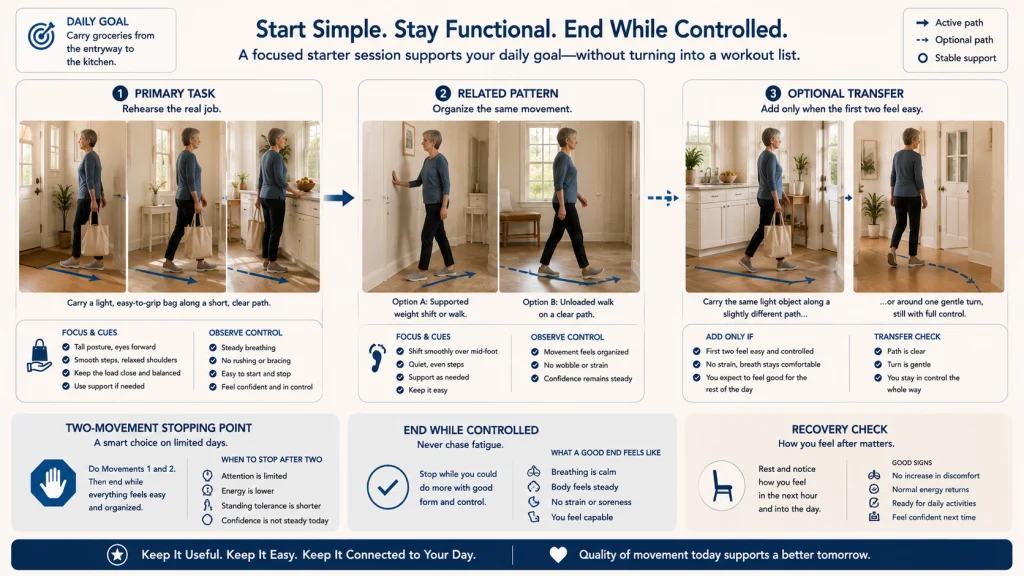
Build a two- or three-movement starter session
A starter session should be small enough to repeat and clear enough to evaluate. Choose movements linked to the same daily goal instead of collecting unrelated exercises.
| Starter element | Example movement | What to observe |
|---|---|---|
| Movement 1: primary task | A supported chair rise, controlled reach, light carry, slow turn, or low step that matches the daily problem. | Control, support used, effort, discomfort, and confidence. |
| Movement 2: related pattern | A simpler movement that supports the main task, such as standing weight shift before turning or an unloaded walk before carrying. | Whether the related pattern makes the primary task feel more organized. |
| Movement 3: optional transfer | A second daily-life version, such as reaching at another height or carrying along a slightly different clear path. | Whether control transfers without adding instability or excessive fatigue. |
Start with two movements when attention, energy, standing tolerance, or confidence is limited. Add a third only when the first two remain controlled and do not interfere with the rest of the day.
Practical tip: End the session while the movements still look organized. More repetitions are not useful when support becomes rushed, range becomes uncontrolled, or recovery begins to affect later tasks.
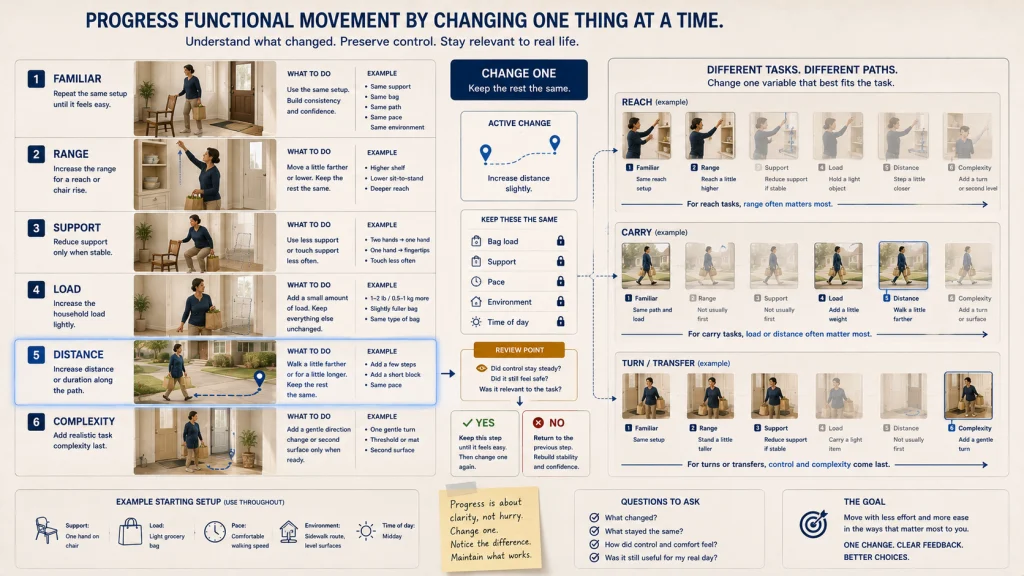
Progress one variable at a time
Functional practice becomes harder in several ways. Changing more than one at once makes it difficult to know which change caused the result.
| Progression step | Variable | Example |
|---|---|---|
| 1 | Consistency | Repeat the same supported version until the setup feels familiar. |
| 2 | Range | Reach slightly farther or use a slightly fuller chair-rise motion while keeping control. |
| 3 | Support | Reduce support only when the task remains stable and safe. |
| 4 | Load | Use a slightly heavier household object during a carry. |
| 5 | Distance or duration | Extend a clear walking or carrying path modestly. |
| 6 | Task complexity | Add a realistic direction change or second surface only after the simpler version is controlled. |
This is a progression ladder, not a rule that every person should climb through every step. The correct next change depends on the task. A reach may progress through range, while a carry may progress through distance or load. A turn may need better control rather than more speed.
Compare task rehearsal with a gym-style exercise
Both approaches can involve similar muscles, but they organize the decision differently.
A gym-style squat may help build lower-body capacity, but a difficult chair rise can also depend on chair height, foot placement, forward weight shift, hand support, pain, balance, or confidence. A loaded carry may build capacity, but grocery handling also involves grip, doorways, uneven loading, and the distance from car to kitchen.
Task rehearsal does not make general exercise unnecessary. It makes the reason for choosing an exercise clearer. Use the healthy aging guide for the broader independence context, and keep general workout programming separate from this task-based decision.
Adapt the plan for small spaces and limited equipment
Functional practice does not require a dedicated exercise room. Many useful starting versions can be built around a stable chair, a clear wall area, a short walking path, a low household object, and an item that is easy to grip.
- Use a short clear path instead of trying to create a long indoor walk.
- Use an empty bag or light household object before adding load.
- Place a safe target at an accessible height for reaching practice.
- Use a firm chair that does not slide for chair-related movement.
- Remove loose objects, pets, cords, and other obstacles from the practice area.
Limited space should simplify the task, not force awkward movement. If the room cannot provide a clear and stable setup, choose another location or another movement rather than squeezing the practice into an unsafe area.
Use the chair-based movement guide when standing tolerance or floor access makes a seated starting position more appropriate.
Track task confidence and effort instead of wearable scores
A functional plan should be judged by what happens in the task. A device score cannot show whether the chair feels easier to rise from, whether a grocery bag can be carried with better control, or whether a turn feels less rushed.
| What to track | Simple question |
|---|---|
| Support | Did the task require the same, more, or less support? |
| Control | Did the movement stay organized from start to finish? |
| Effort | Did the task feel manageable without straining or rushing? |
| Confidence | Did hesitation decrease, stay the same, or increase? |
| Recovery | Did the practice affect later activities in the day? |
| Transfer | Did the practiced movement help in the real daily task? |
Record a short note after practice and after the real task. The goal is not to produce a score. It is to notice whether the selected movement supports daily life without creating new problems.
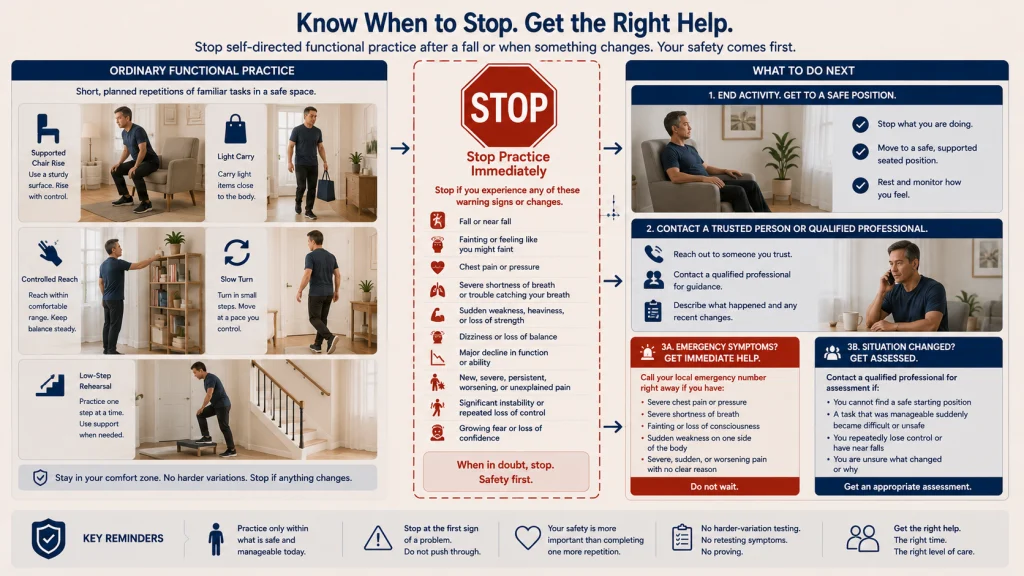
Stop and seek assessment when the situation changes
Safety warning: Stop self-directed practice and seek qualified evaluation after a fall, fainting, chest pain, severe shortness of breath, sudden weakness, dizziness, major functional decline, or new, severe, persistent, worsening, or unexplained pain. Emergency symptoms require immediate appropriate help.
Do not use a general article to diagnose the cause of difficulty, score disability, fit a mobility aid, or create rehabilitation after an injury. A movement that was previously manageable but suddenly changes needs review rather than a harder exercise version.
Assessment is also appropriate when the person cannot find a safe starting position, repeatedly loses control, becomes more fearful, or experiences symptoms that make the task uncertain. The purpose is to avoid guessing when the limitation may require individualized evaluation.
Use the balance practice guide when steadiness is the primary non-clinical concern. Use the sit-to-stand guide when chair rise is the single task that needs a dedicated workflow.
Write the task, movement, support, and reassessment condition
Finish with four short lines:
- Daily task: Name the exact activity that has become harder.
- Selected movement: Choose the rise, reach, carry, turn, or step pattern inside the task.
- Starting support: Record the stable surface, range, load, distance, or speed that makes practice manageable.
- Reassessment condition: State what change means the plan should pause or move to qualified assessment.
A complete example might read: “The task is carrying a grocery bag from the car to the kitchen. I will begin with a lighter household bag over a short clear path, keep the same support and route, and change only the load when the movement remains controlled. I will stop and seek guidance if pain, dizziness, instability, sudden weakness, or unusual breathlessness appears.”
The plan is useful when it connects directly to daily life, stays simple enough to observe, and includes a clear reason to stop. Functional exercise should make the movement decision more specific, not create false certainty about what the body should be able to do.
FAQs
🛒 What makes an exercise functional?
An exercise is functional when it rehearses a movement pattern used in a real task, such as rising, reaching, carrying, turning, or stepping. The daily task should explain why the movement was chosen.
🪑 Is a chair rise a functional exercise?
It can be when standing from a chair is the task being practiced. Chair height, foot position, hand support, control, pain, and balance all affect the starting version.
🧺 Do I need weights for functional exercise?
No. A stable chair, a clear path, a light household object, or a safe reaching target may be enough for a starting version. Equipment should support the task rather than define it.
🔁 How many movements should I start with?
Two movements may be enough when they relate clearly to the same daily goal. A third can be added when the first two remain controlled and do not create excessive fatigue or interfere with later tasks.
📈 How should I make the movement harder?
Change one variable at a time, such as range, support, load, distance, duration, or task complexity. Keep the new version only when control and safety remain acceptable.
⚖️ Are functional exercises the same as balance exercises?
No. Functional exercise can include balance demands, but balance practice deserves its own route when steadiness and weight shift are the main limitations. The first problem should determine the starting guide.
📱 Should I use a wearable score to track progress?
A wearable score is not necessary for this plan. Track what changes in the real task, including support, control, effort, confidence, recovery, and whether the movement transfers to daily life.
🚩 When should I stop exercising and seek help?
Stop after a fall or when movement brings chest pain, fainting, severe shortness of breath, sudden weakness, dizziness, major decline, or new, severe, persistent, worsening, or unexplained pain. Seek qualified evaluation, and get immediate help for emergency symptoms.