Whole body deodorant is a broad marketing category, not permission to apply one product to every part of the body. Start by confirming whether the product is a deodorant, antiperspirant, or combination, then read the exact allowed areas, warnings, fragrance information, and stop-use directions. Use it only on external skin specifically permitted by the label, and keep it away from mucosa, internal genital structures, wounds, broken skin, and significant irritation. Postpone product selection when the odor source is sudden, persistent, genital, urinary, wound-related, or otherwise unexplained.
A Broad Product Name Still Needs an Area-by-Area Check
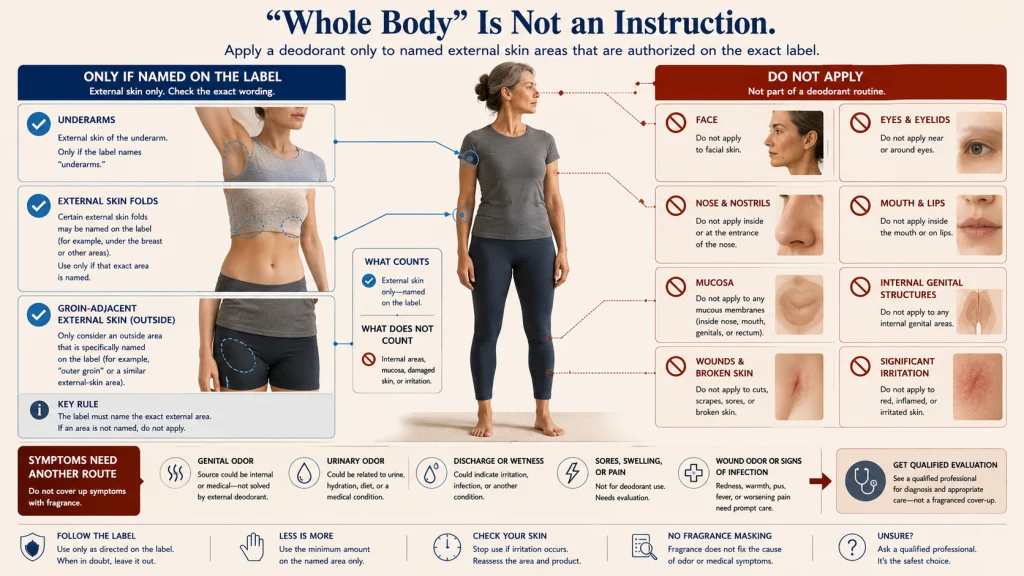
Picture a product labeled “whole body” beside a simple body outline. One large arrow points everywhere at once. Replace that arrow with separate checks for the underarms, external skin folds, feet, groin-adjacent external skin, face, mucosa, and broken skin. The package name may be broad, but the directions should be specific.
| Body area | What to verify | Default decision without clear permission |
|---|---|---|
| Underarms | Whether the product is deodorant, antiperspirant, or both | Do not assume sweat reduction from a deodorant claim alone. |
| External skin folds | Exact area wording, fragrance, and irritation warnings | Use only when the label clearly allows that external area. |
| Feet | Whether feet are listed and whether the question is odor, sweat, or skin symptoms | Route foot-specific concerns to dedicated foot hygiene guidance. |
| Groin-adjacent external skin | Whether the label names the external area and gives specific restrictions | Do not extend a vague “all over” claim into intimate anatomy. |
| Face, mucosa, internal genital structures | Whether the product explicitly permits the area | Avoid use unless the exact label clearly authorizes it. |
| Broken, wounded, or significantly irritated skin | Warnings and stop-use directions | Do not apply. |
A broad product name is not an anatomical direction. The label must still answer what the product does, where it belongs, and when it should not be used.
Define the Product, the Area, and the Type of Use
A whole-body deodorant is marketed for odor control beyond the underarms, often in a cream, stick, spray, or wipe format. “External use” generally refers to the outside surface of the body, but that phrase still does not replace a precise list of allowed areas.
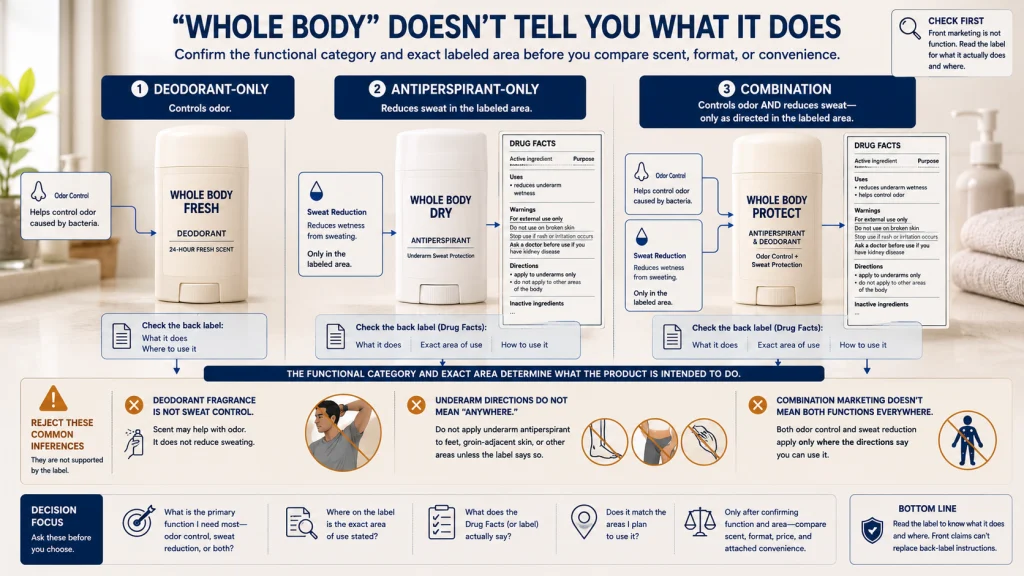
Deodorant is primarily an odor-control product. Antiperspirant is selected for sweat reduction and carries drug labeling when sold for that purpose. A combination product may provide both functions. “Sensitive area” is a vague phrase unless the package names the exact external location and explains the restrictions.
Mucosa refers to moist internal or semi-internal tissue, such as tissue inside the mouth or internal genital structures. Off-label use means applying a product in a way or area not covered by its directions. This article does not authorize that use.
For the broader decision between odor control and sweat reduction, review deodorant versus antiperspirant.
Confirm Whether It Is Deodorant, Antiperspirant, or a Combination
The front label may emphasize freshness, confidence, or broad coverage while leaving the functional category less obvious. Turn the package around and look for the actual claim. A deodorant claim addresses odor. An antiperspirant claim addresses perspiration and should be supported by the relevant Drug Facts information.
| Category clue | Primary function | What not to infer |
|---|---|---|
| Deodorant wording only | Odor control | Do not infer that sweating will be reduced. |
| Antiperspirant wording and Drug Facts | Sweat reduction in the labeled area | Do not extend underarm directions to other body areas. |
| Combination wording | Odor control plus sweat reduction as labeled | Do not assume every area named in marketing is approved for both functions. |
Check the category before comparing scent, format, or convenience. That single step prevents a deodorant from being mistaken for a sweat-control product and keeps underarm drug directions from drifting into other body areas.
Remember That Deodorant Does Not Automatically Reduce Sweating
Odor control and sweat reduction are separate functions. A deodorant may reduce or mask ordinary odor while perspiration continues unchanged. Fragrance, odor-neutralizing language, or a dry finish does not add an antiperspirant function that the label never claims.
This distinction matters when the reader’s main concern is dampness rather than odor. Reapplying fragrance to a sweaty area may add scent or residue without addressing the actual goal.
Key decision: Name the main problem before comparing products. Choose odor control for ordinary odor, sweat reduction only from a properly labeled antiperspirant, or both from a combination product whose directions cover the intended area.
Identify the Odor Source Before Covering It
Whole-body marketing can make the purchase feel like a simple coverage decision, but odor still comes from a particular area and situation. Ordinary underarm odor after a long day is different from odor returning immediately after washing, odor from damp clothing, foot odor, genital odor, urinary odor, wound odor, or a sudden unexplained change.
Start with location, timing, and pattern. Ask where the odor begins, whether it appears after sweating or after washing, whether clothing holds the smell, and whether there are symptoms such as rash, discharge, sores, swelling, or pain.
When odor returns after washing, use the separate guide to body odor after a shower rather than repeatedly layering fragrance over an unclear source.
Audit the Label Before the First Application
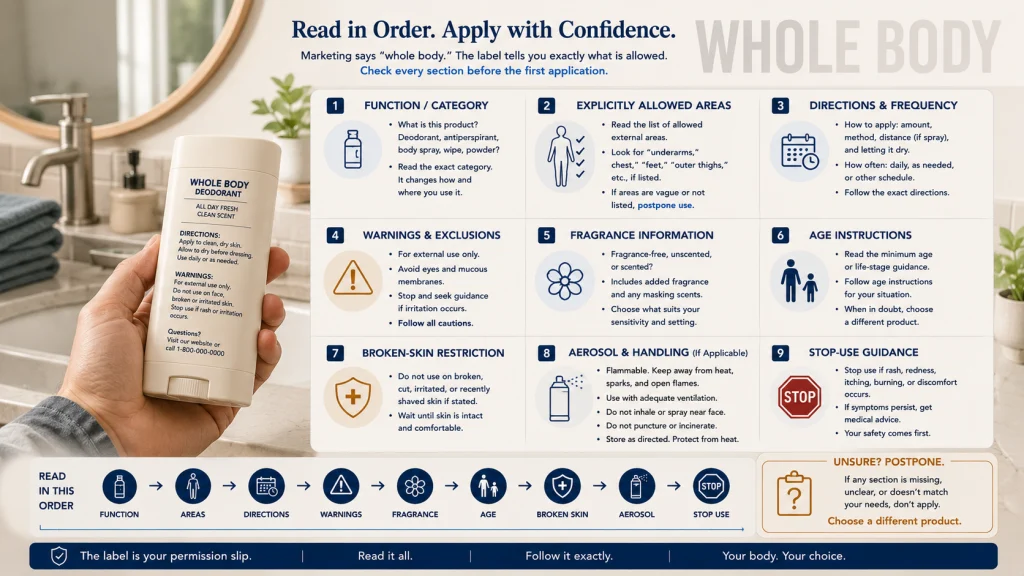
A useful label audit goes beyond the front claim. Read the package in a fixed order so one attractive phrase does not overshadow a restriction elsewhere.
| Label element | Question to answer |
|---|---|
| Product category | Is it deodorant, antiperspirant, or a combination? |
| Allowed areas | Which external body areas are named explicitly? |
| Directions | How should the product be applied, and how often? |
| Warnings | Which areas, skin conditions, or symptoms exclude use? |
| Fragrance information | Is the product scented, unscented, or fragrance-free, and does the label clarify the difference? |
| Age instructions | Does the package set an age limit or advise asking a professional? |
| Broken-skin wording | Does the label prohibit use on cuts, wounds, rash, or irritated skin? |
| Aerosol handling | Are there flame, ventilation, inhalation, pressure, or storage warnings? |
| Stop-use directions | Which reactions require stopping and seeking help? |
When the permitted area is unclear, postpone the application. Marketing should not fill a gap left by the actual directions.
Apply Only to External Areas Allowed by the Exact Label
External skin may include underarms or certain named folds, but each product can define its own permitted areas. A cream intended for one external location does not authorize use on every other external surface. A spray that reaches a wide area still follows the same area restrictions as a more precise stick.
Use the smallest amount and method stated by the package. Keep the product from drifting into the eyes, nose, mouth, or internal genital tissue. Wash hands after application when the directions call for it.
Note: Package design can imply coverage. A wide spray pattern, large wipe, or “all over” phrase may feel expansive, but permission still comes from the directions and warnings.
Keep It Away From Face, Mucosa, Internal Genitals, Wounds, and Irritated Skin
Face, mucosa, internal genital structures, wounds, and significantly irritated skin require a firm boundary. A broad name on the front of the package cannot expand the permitted anatomy listed in the directions.
Safety warning: Burning, swelling, severe itching, pain, discharge, sores, rash, or persistent symptoms require appropriate evaluation. Fragrance should not be used to cover a genital, urinary, wound-related, or infection-like odor.
This article does not diagnose infection, dermatitis, urinary conditions, or another cause of odor. Product selection should pause when the situation has moved beyond ordinary external odor control.
Use Extra Caution With Fragrance and Groin-Adjacent External Skin
Groin-adjacent external skin can be exposed to friction, moisture, hair removal, tight clothing, and repeated cleansing. Fragrance or a leave-on format may feel acceptable on one external area and irritating on another.
Look for the exact external area, application method, and stop rule. Words such as “gentle,” “natural,” or “pH-balanced” describe marketing or formulation choices, not proof of suitability for intimate anatomy or protection from infection.
Note: Questions about genital odor, discharge, sores, internal application, menstrual care, or urinary odor belong to intimate hygiene or qualified medical guidance, not to a general deodorant routine.
Treat Foot Odor as a Separate Hygiene Question
Feet combine sweat, enclosed footwear, socks, skin condition, and shoe care. A whole-body deodorant may list feet, but that does not settle whether the problem is odor, perspiration, damp footwear, skin irritation, or a symptom that needs evaluation.
Check the label first, then address footwear rotation, sock changes, drying, and any skin symptoms through foot-specific guidance. Avoid applying product between toes or onto broken or irritated skin unless the exact directions allow that use.
Keep Non-Underarm Antiperspirant Use Within Current Labeling
Expanded-area deodorant wording covers odor control only unless the package also carries a valid antiperspirant claim for that location. Sweat reduction remains a separate labeling and application decision.
When the product includes an antiperspirant function, read the Drug Facts and use only the labeled area. Do not transfer underarm timing, concentration, or application instructions to the hands, feet, groin, face, back, or another location.
For ordinary underarm use, follow the label-led workflow in how to apply antiperspirant.
Compare Cream, Stick, Spray, and Wipe Separately From Function
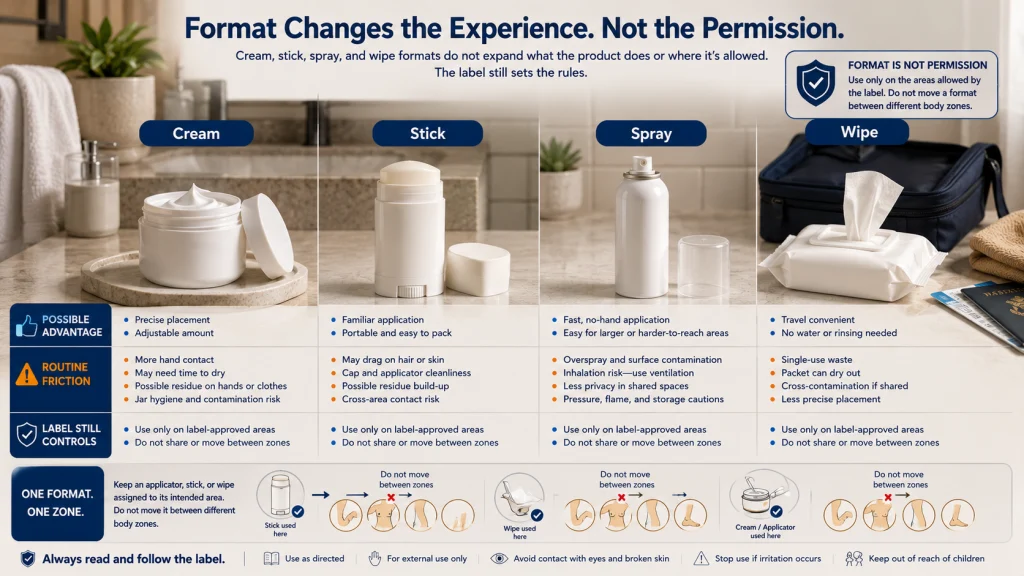
Format changes how the product is handled, not what the label permits. Compare the routine friction after confirming the category and allowed area.
| Format | Possible advantage | Practical friction to check |
|---|---|---|
| Cream | Precise placement and adjustable amount | Hand contact, drying time, residue, and package contamination |
| Stick | Portable and familiar application | Dragging on hair, residue, cross-area contact, and cap cleanliness |
| Spray | Fast coverage without direct hand contact | Overspray, inhalation, privacy, ventilation, and aerosol warnings |
| Wipe | Convenient for travel or temporary cleanup | Single-use waste, package drying, cross-contamination, and limited area precision |
Editorial observation: On a shelf, the largest words may say “whole body,” while the permitted areas sit in much smaller print. The package can create a second mismatch: a wide wipe appears suited to several zones, a cream jar invites repeated finger contact, and a stick can move from underarm to fold unless the user assigns it one clear area. That is why package hygiene and area discipline deserve the same attention as portability.
No format is a universal winner. Choose the one whose package, residue, privacy, portability, and contamination controls fit the allowed application.
Run a Small External-Area Trial According to the Label
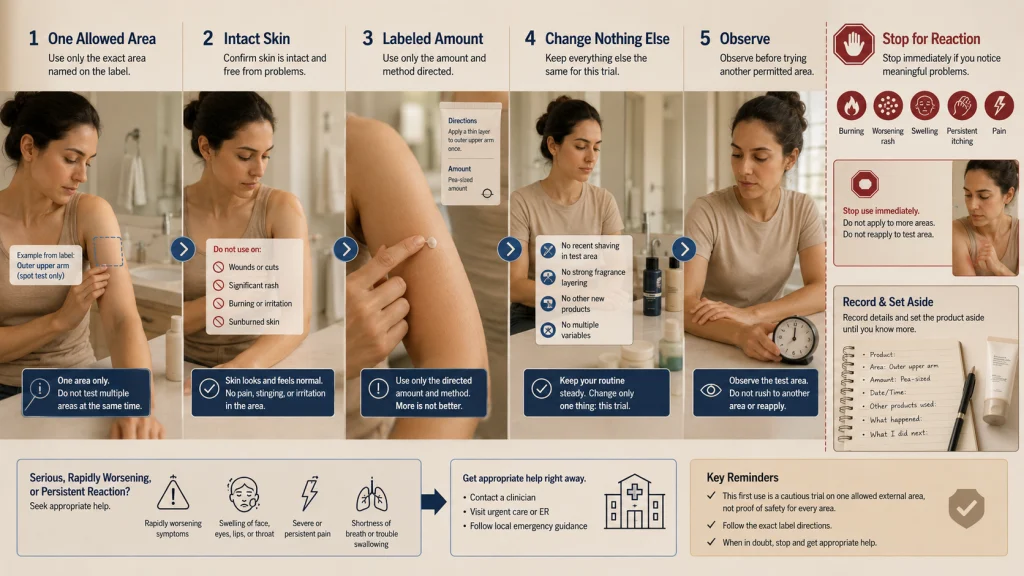
When the label permits ordinary external use and the skin is intact, begin with a small allowed area rather than broad coverage. Follow the stated amount and frequency, then observe how the skin responds before extending use to another permitted area.
- Choose one external area named on the label.
- Confirm the skin is not broken, wounded, or significantly irritated.
- Apply only the labeled amount and method.
- Keep the first trial separate from shaving, strong fragrance layering, or several new products.
- Stop at the first meaningful sign of irritation or pain.
A small trial cannot prove that a product is appropriate for every area. It simply limits the first exposure and makes an unexpected reaction easier to identify.
Stop for Burning, Rash, Swelling, Itching, or Pain
Residue, scent preference, and a true skin reaction call for different responses. End use when the area develops clear burning, swelling, persistent itching, pain, or a rash that continues to worsen. Adding another scented product can make the source harder to trace.
Safety warning: Seek appropriate help for a serious or rapidly worsening reaction, breathing difficulty, marked swelling, severe pain, or symptoms that do not settle. Do not reapply as a test.
Record the product, area, amount, timing, and other products used. That information can make a later evaluation more useful.
Do Not Cover Sudden, Changed, Persistent, Genital, Urinary, Wound, or Infection-Like Odor
Ordinary odor after heat, exercise, or a long day may fit a hygiene routine. A sudden change, persistent odor despite washing and clean clothing, genital or urinary odor, wound odor, discharge, sores, swelling, fever, or pain changes the decision.
Postpone fragrance and seek qualified evaluation when symptoms suggest that the source is not ordinary external body odor. Whole-body deodorant does not replace bathing, clean clothing, wound care, infection evaluation, or medical treatment.
Intimate and medical boundary: Do not use deodorant inside the vagina, on mucosa, inside genital structures, on wounds, or to cover discharge, urinary odor, sores, persistent rash, or infection-like symptoms. These situations require a different route.
Turn the Broad Claim Into Five Specific Checks
Before buying or applying, identify the function, name the exact external area, confirm label permission, run a cautious small-area trial, and decide what reaction or symptom would end self-selection. Keep deodorant and antiperspirant claims separate, and let the directions define the usable map.
The right product is not the one that promises the largest map of the body. It is the one whose function and permitted areas match an ordinary odor problem without covering symptoms that need another kind of care.
For the larger routine, use the bathing and body odor guide and the broader personal hygiene guide.
FAQs
🗺️ Can whole-body deodorant go on every body part?
No. Use it only on external areas specifically allowed by the exact label. Keep it away from mucosa, internal genital structures, wounds, broken skin, and any prohibited area.
💧 Does whole-body deodorant stop sweating?
Not automatically. A deodorant claim addresses odor, while sweat reduction requires a properly labeled antiperspirant function. Check the category rather than inferring it from fragrance or a dry finish.
🌸 Is a natural or pH-balanced claim enough to prove safety?
No. Those terms do not replace area directions, warnings, or stop-use guidance. Read the exact label and avoid any prohibited or irritated area.
🩲 Can I use it near the groin?
Only when the exact label clearly permits the named external area. Do not apply inside genital structures or on mucosa, broken skin, significant irritation, discharge, sores, or unexplained odor.
🧴 Which format is best?
There is no universal winner. Compare cream, stick, spray, and wipe by the allowed area, residue, drying, privacy, portability, contamination control, and package warnings.
🧪 Should I test it on a small area first?
A small trial can be useful when the label permits the external area and the skin is intact. Follow the labeled amount, avoid mixing several new products, and stop if burning, rash, swelling, itching, or pain develops.
🚿 Can it replace bathing or clean clothing?
No. Deodorant can support ordinary odor control, but it does not replace washing, changing damp clothing, laundering fabrics, or addressing the actual odor source.
🚩 When should I stop choosing deodorant on my own?
Seek qualified evaluation for sudden, changed, persistent, genital, urinary, wound-related, or infection-like odor, especially with discharge, sores, rash, swelling, fever, or pain. Stop the product for a significant reaction.