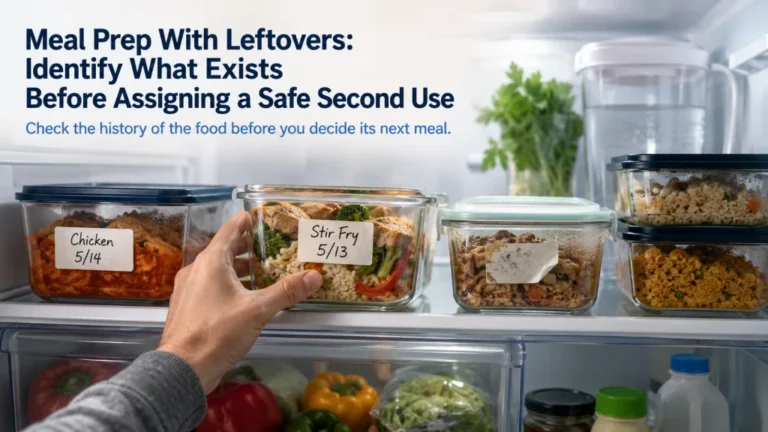
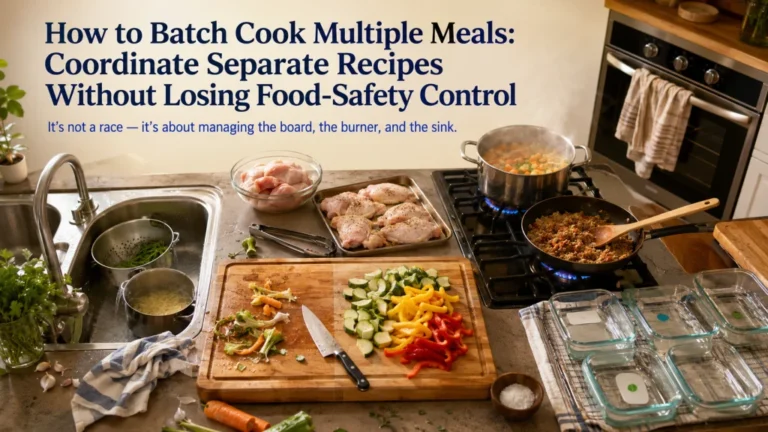
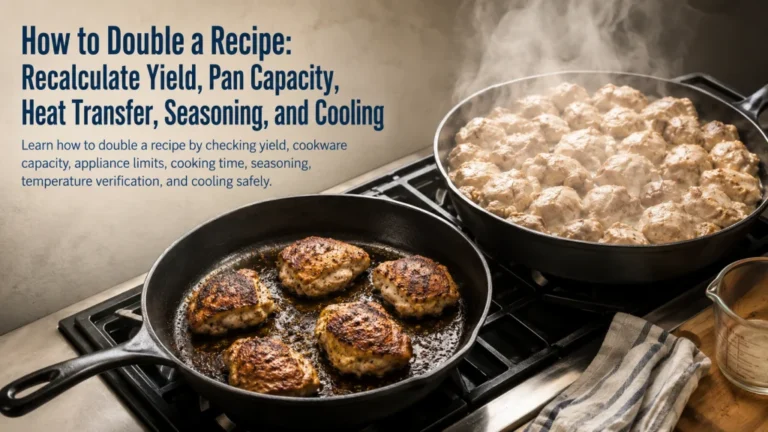
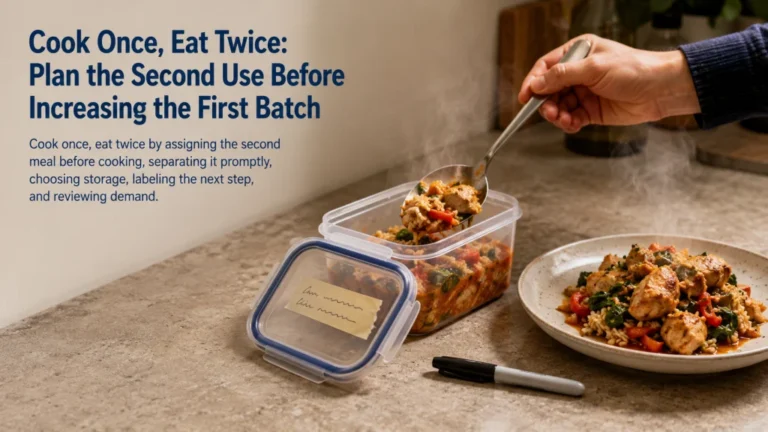
Meal prep without eating the same thing every day depends on how much of each meal is committed in advance. Complete meals offer the least weekday work but the least flexibility. Components, partial assembly, and two-path systems leave more decisions for later while adding containers, labels, refrigerator space, and assembly time. Choose one variation point, keep neutral elements only when later finishing is realistic, delay wet or fragile additions, and use fresh foods earlier with freezer or shelf-stable backups later. Review what was actually assembled before expanding the system.
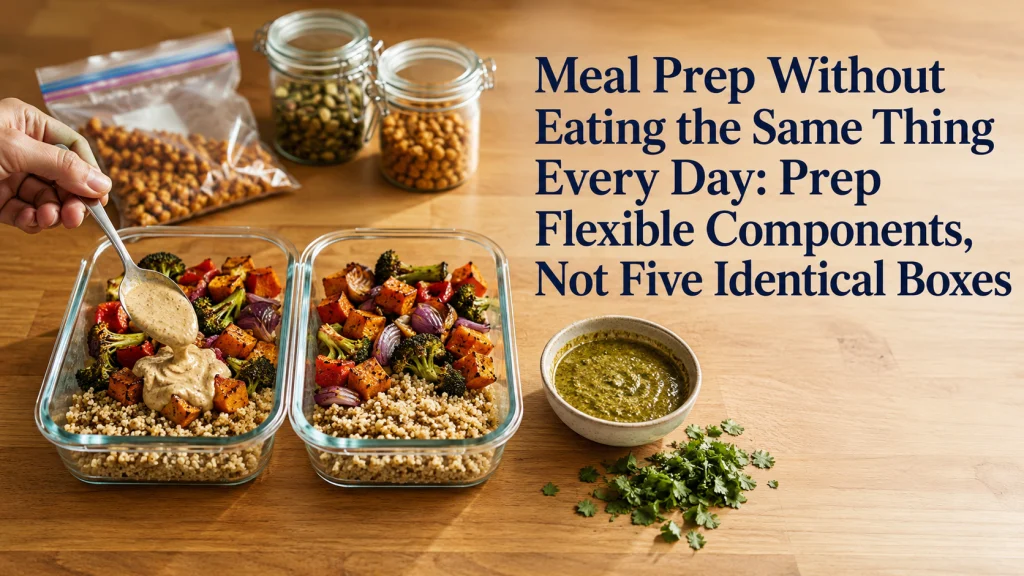
Five Identical Boxes and One Flexible Set of Components Solve Different Problems
Picture five finished bowls lined up in the refrigerator. At first, the neat rows can feel reassuring. By the third or fourth day, the same sauce, texture, and shape may begin to feel less like preparation and more like a decision that cannot be changed.
Now picture a smaller set of prepared components beside them: one neutral base, one cooked filling, two finishes, one crisp element, and one freezer backup. That setup preserves choice, but it also leaves someone with a little work to do later.
Cook → portion → finish → store
Weekday work: reheat or eat.
Variation later: low.
Main relief: almost no decisions remain.
Cook → cool → store separately
Weekday work: choose, assemble, and finish.
Variation later: higher.
Main tradeoff: the final step still has to fit the day.
Nora frames the difference in everyday terms: one system protects you from deciding when you are tired, while the other protects you from feeling locked into the same meal. Neither protection is free. The first spends flexibility; the second spends weekday effort.
Variety can be designed at the assembly stage instead of multiplying the number of recipes cooked in advance. The wider meal prep process still needs to connect planning, preparation, cooling, storage, and later use.
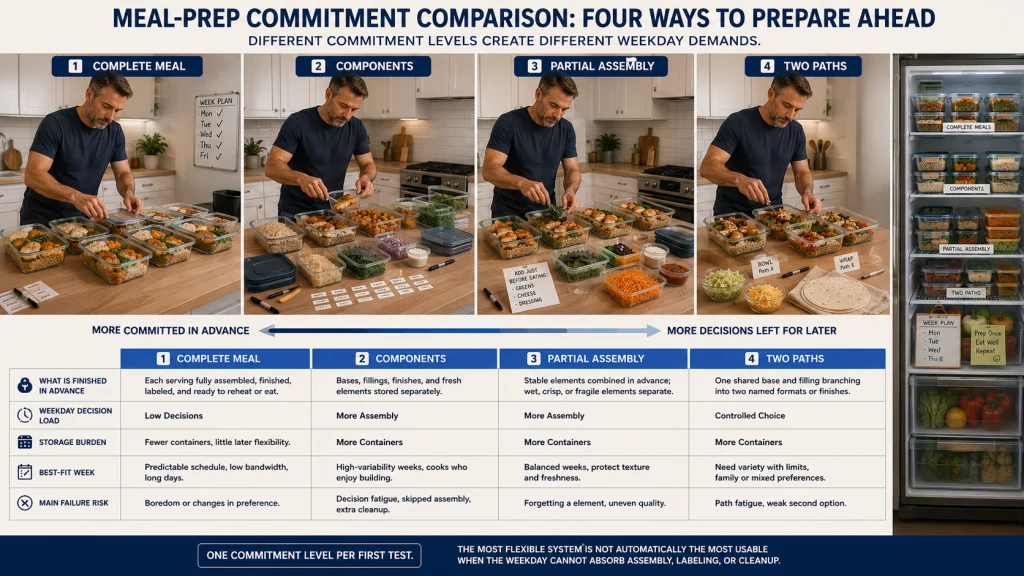
Define Complete-Meal, Component, Partial-Assembly, and Two-Path Prep
People often call every prepared container “meal prep,” but the commitment level can be very different. Naming the method makes the tradeoff visible before food is cooked.
| Method | What is finished in advance | Weekday decision load | Storage burden | Best fit |
|---|---|---|---|---|
| Complete-meal prep | Each serving is fully assembled | Low | Several finished portions | Busy days when predictability matters more than variation |
| Component prep | Several meal elements are stored separately | Higher | More separate containers and labels | Households willing to assemble later |
| Partial assembly | The stable parts are combined while selected elements stay separate | Moderate | A mix of finished and separate storage | Meals where texture or finishing matters |
| Two-path prep | One base branches into two planned formats | Moderate and controlled | Fewer branches than a full component matrix | People who want limited variety without daily improvisation |
Complete meals commit the most. Components commit the least. Partial assembly and two-path prep sit between them.
The right method depends on how much weekday effort the household can realistically absorb. A flexible system that regularly leads to another purchase or abandoned assembly is less useful than a simpler plan that gets eaten.
For a first attempt, beginner meal prep works best when only one commitment level is tested at a time.
Choose Which Elements Tolerate Advance Preparation
Flexible prep begins with the food, not the container layout. Some elements hold their usefulness after cooking, cooling, and storage. Others lose texture, release moisture, absorb sauce, or become harder to combine later.
Sort the planned meal into four roles:
- Stable base: A cooked grain, pasta, roasted vegetable, bean preparation, or another element that can support more than one assembly.
- Main filling: A cooked protein, legume, vegetable mixture, or other substantial component with a clear later use.
- Finish: A sauce, seasoning, garnish, or small flavor element added near serving.
- Fragile element: A crisp, wet, delicate, or freshly cut item better added later.
Then ask what happens after storage. Does the base stay pleasant when reheated? Does the filling release liquid? Does the sauce soak into the rest of the meal? Does the crisp element need to remain separate?
This is not a demand to prepare every role. One stable base and one filling may be enough. The goal is to preserve the parts that benefit from early work while leaving the vulnerable parts closer to serving.
Keep One or Two Components Neutral Only When Later Finishing Is Realistic
A neutral component can move in more than one direction. It can also feel like unfinished work when the weekday has no time, energy, or available ingredients for the final step.
Suppose a household prepares a lightly seasoned grain and a tray of roasted vegetables. One evening they become a warm bowl with a savory finish. Another day they are folded into a soup or paired with a different sauce. The variation comes from the finish, not from cooking two complete recipes.
That works only when the later step is small and specific. “Decide what to do with it later” is not a plan. “Add one of two labeled finishes and one fresh item” is a plan.
- Can the component be used in at least two already named assemblies?
- Are the finishes already available?
- Does assembly require only a short, familiar step?
- Will the component still be recognizable in the refrigerator?
- Is there a fallback use if the preferred assembly does not happen?
Nora puts the weekday reality plainly: “Flexible” food is not helpful when opening the refrigerator creates another planning meeting. The later step should feel smaller than the problem the prep was meant to solve.
Use Two Finishes or Formats Without Creating Separate Recipes
Variety does not require a different full recipe for every serving. One controlled branch can change flavor, texture, or serving format while most of the preparation remains shared.
Use one of these branch points:
- Two finishes: The same base and filling receive one of two sauces, seasonings, or garnishes.
- Two formats: The same components become a bowl on one day and a wrap, soup addition, or plated meal on another.
- One fresh addition: The stored portion stays stable while a fresh element changes the final experience.
For example, roasted vegetables and beans can become a grain bowl with one finish or a wrap filling with another. The household is not cooking two complete dinners. It is changing the last assembly decision.
Keep the branch count small. Three bases, four sauces, several toppings, and multiple formats may look exciting on paper but create a refrigerator full of unfinished choices. Two reliable paths are often easier to use than a large matrix of theoretical combinations.
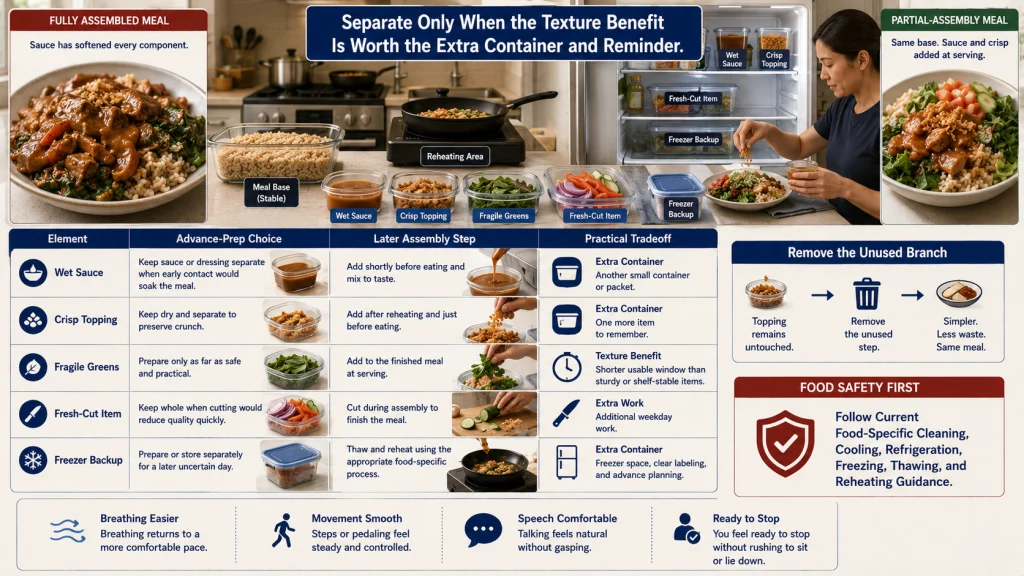
Preserve Texture by Delaying Wet, Crisp, or Fragile Elements
Repetition is not only about flavor. Five meals can taste different and still feel repetitive when every component becomes equally soft, wet, or reheated.
| Element | Advance-prep choice | Later assembly step | Tradeoff |
|---|---|---|---|
| Wet sauce or dressing | Store separately when early contact would soak the meal | Add before eating | More small containers or packets |
| Crisp topping | Keep dry and separate | Add after reheating | One more item to remember |
| Fragile greens or herbs | Wash and prepare only as far as safe and practical | Add to the finished meal | Shorter usable window than shelf-stable elements |
| Fresh-cut item | Delay cutting when quality drops quickly | Cut during assembly | More weekday work |
| Freezer backup | Prepare or store separately for later use | Thaw and reheat appropriately | Requires freezer planning and labeling |
Delaying an element is useful only when someone will remember and have time to add it. If a separate topping repeatedly stays unused, the system may need fewer parts rather than more reminders.
Follow current food-specific guidance for cleaning, separation, cooking, prompt cooling, refrigeration, freezing, thawing, and reheating. People at higher risk of foodborne illness may need stricter guidance from a qualified professional.
Account for Extra Containers, Labels, Refrigerator Space, and Weekday Assembly
Component systems look efficient when the food is shown neatly divided. The hidden cost appears later, in the number of lids, labels, shelves, decisions, and cleanup steps required to keep those parts usable.
- More separate components require more compatible containers and lids.
- Small finishes and toppings are easy to lose without clear labels.
- Several shallow containers may occupy more shelf area than finished meals.
- Later assembly creates another countertop and dishwashing step.
- Unclear dates or intended uses can turn flexibility into forgotten food.
- Mixed container shapes can make stacking and visibility harder.
Divided sets visually encourage finished portions because every compartment appears to need a final answer. Modular storage leaves the meal open, but it also asks the refrigerator to function like a clear workbench.
From Nora’s practical lens, the real test happens at the busiest point of the week. Can the person see the components, find the matching lids, understand the labels, and assemble the meal without emptying half the shelf? A flexible method should not become a storage project every evening.
Use Fresh Foods Earlier and Freezer or Shelf-Stable Backups Later
Variation can be scheduled across the week instead of created entirely through extra cooking. This matters on the days when enthusiasm is high at the start of the week but time and attention become less predictable later.
A simple sequence might look like this:
- Use delicate fresh elements in the first assemblies.
- Use sturdier refrigerated components in the middle of the plan.
- Hold a labeled freezer or shelf-stable backup for the final uncertain day.
This sequence does not prescribe which foods a household should eat. It simply places more fragile elements where they are more likely to be used and keeps a dependable option for a later day that may not go as planned.
A weekly calendar still determines whether those uses are realistic. Map the assemblies through the weekly meal-planning process before deciding how much should remain fresh, refrigerated, frozen, or shelf-stable.
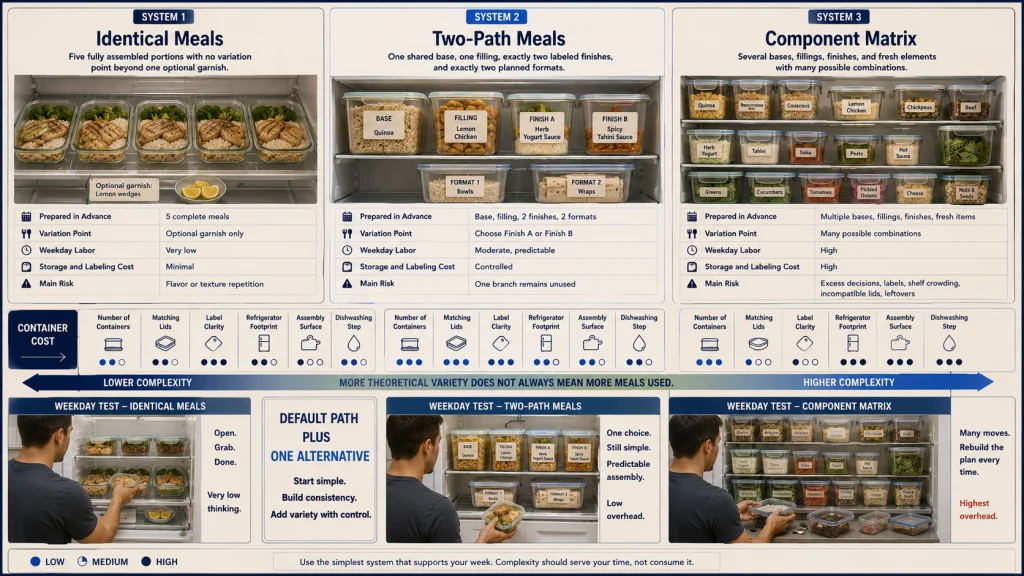
Compare Identical Meals, Two-Path Meals, and a Component Matrix
Three systems show how commitment and weekday labor move in opposite directions.
| System example | Prepared in advance | Variation point | Weekday labor | Main risk |
|---|---|---|---|---|
| System 1: Identical meals | Five fully assembled portions | None or one optional garnish | Very low | Flavor or texture repetition |
| System 2: Two-path meals | One base, one filling, two finishes, two planned formats | Choose one of two named paths | Moderate and predictable | One branch may remain unused |
| System 3: Component matrix | Several bases, fillings, finishes, and fresh elements | Multiple combinations | Highest | Too many containers, decisions, labels, and leftovers |
System 1 is useful when the week leaves almost no assembly time. System 2 adds a controlled amount of choice. System 3 offers the most theoretical variety but also the greatest chance that the household will not use every branch.
The two-path system is often the clearest test because it changes one decision without multiplying the number of full recipes. The amount prepared should still match the expected number of uses, which can be checked through a realistic meal-prep quantity estimate.
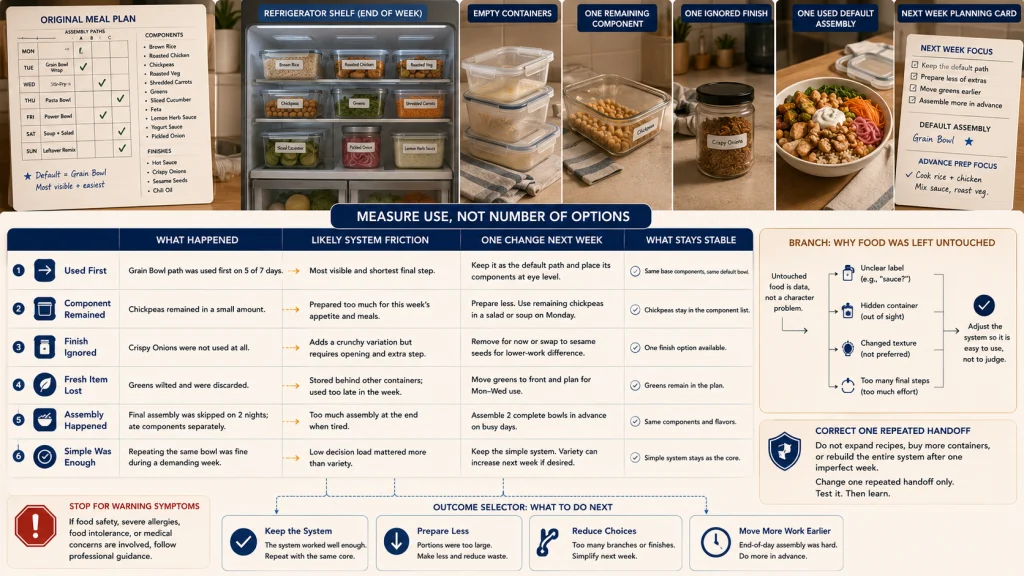
Review Which Choices Were Actually Used
End-of-week review should measure use, not the number of options that were created. A refrigerator can contain several possible meals while the household repeatedly chooses the easiest one.
- Which assembly was used first? Make the easiest or most visible path the default next time.
- Which component remained? Prepare less or give it one specific fallback use.
- Which finish was ignored? Remove the extra container or choose a lower-work variation point.
- Which fresh item was lost? Move it earlier in the week and improve visibility.
- Did weekday assembly actually happen? Move more work into advance prep when the final step was too large.
- Were identical meals acceptable that week? Keep the simpler system when low decision load mattered more than variety.
It is easy to feel disappointed when a carefully prepared option stays untouched. That does not automatically mean the household lacked motivation. The label may have been unclear, the container may have been hidden, the texture may have changed, or the final step may simply have asked too much of that day.
When the same choice or handoff fails repeatedly, a clearer meal prep system can reduce the number of decisions without removing every option.
Route Cooking and Storage Detail to the Right Workflow
This article chooses the commitment level. It does not teach the full production or storage process for every component.
Use the batch-cooking workflow when the question is how to produce a larger amount of one repeated component or dish efficiently.
Use meal prep storage guidance when the question is how to cool, label, refrigerate, freeze, thaw, or reheat prepared food appropriately.
Use a meal prep schedule when the preparation, cooling, storage, and weekday assembly steps need to fit into a realistic calendar.
If leftovers repeatedly remain without an assigned use, planning to reduce food waste can help move them into an earlier meal or a believable backup.
Choose the Commitment Level, Variation Point, Extra Labor, and Review
Begin with the weekday, not the container set. Think about the moment the refrigerator door opens after a long day. How much assembly, decision-making, refrigerator space, and cleanup can still fit comfortably?
Then choose one commitment level. Finished meals remove later work. Components preserve options. Partial assembly protects selected textures. A two-path system offers controlled variety without turning one preparation session into several full recipes.
Keep neutral components only when the finishing step is already named and available. Delay wet or fragile elements when the texture benefit is worth another container and another reminder. Use fresh elements earlier and hold a freezer or shelf-stable fallback for a less predictable day.
At the end of the week, review which path was used, which parts remained, and whether the weekday assembly really happened. The goal is not the maximum number of possible meals. It is enough flexibility to make the plan feel supportive rather than restrictive, without rebuilding dinner every night.
FAQs
🍱 How can I meal prep without eating the same thing every day?
Prepare one or two reusable components and choose a controlled variation point such as two finishes, two formats, or one fresh addition. Keep the later assembly step small enough to fit a normal weekday.
🧩 What is component meal prep?
Component prep stores meal elements separately so they can be assembled later. It preserves more choice than finished portions but requires additional containers, labels, space, and weekday decisions.
🥣 Is partial assembly different from component prep?
Yes. Partial assembly combines the stable parts in advance while keeping selected wet, crisp, fresh, or fragile elements separate. It reduces weekday work without fully committing the final texture.
🌶️ How many sauces or finishes should I prepare?
Start with one or two already assigned finishes rather than a large collection of options. More finishes add containers, labels, refrigerator space, and decisions that may not be used.
🥬 Which meal elements should stay separate?
Wet sauces, crisp toppings, fragile greens, and items whose texture changes quickly may benefit from later assembly. Keep them separate only when someone will remember and have time to add them.
🧊 How should freezer backups fit into a flexible plan?
Use a labeled freezer backup for a later or uncertain day rather than preparing another fresh branch. Follow appropriate freezing, thawing, reheating, and storage practices for the specific food.
📋 What should I review after the week?
Review which assembly was chosen, which component remained, whether the finishing step happened, and whether the container and labeling burden was worthwhile. Prepare less or reduce the number of paths when options repeatedly go unused.