Compound vs Isolation Exercises: Choose Movement Coverage Before Adding More Exercises
Compound Vs Isolation Exercises

Compound and isolation exercises solve different selection problems, so neither category is automatically better. Start by mapping the movement functions your program needs, then choose exercises that cover those functions with the equipment, time, and space you actually have. Multi-joint movements often cover more work at once, while single-joint movements can add focused volume, preference,

Training to Failure: Know What It Means Before Making Every Set Maximal

Training To Failure

Training to failure is not the same as finishing a hard set, losing technique, or stopping at a planned repetition target. The useful decision is where the set should end before it begins, based on the exercise, equipment, training experience, home setup, and the consequences of getting stuck or losing control. Current evidence does not

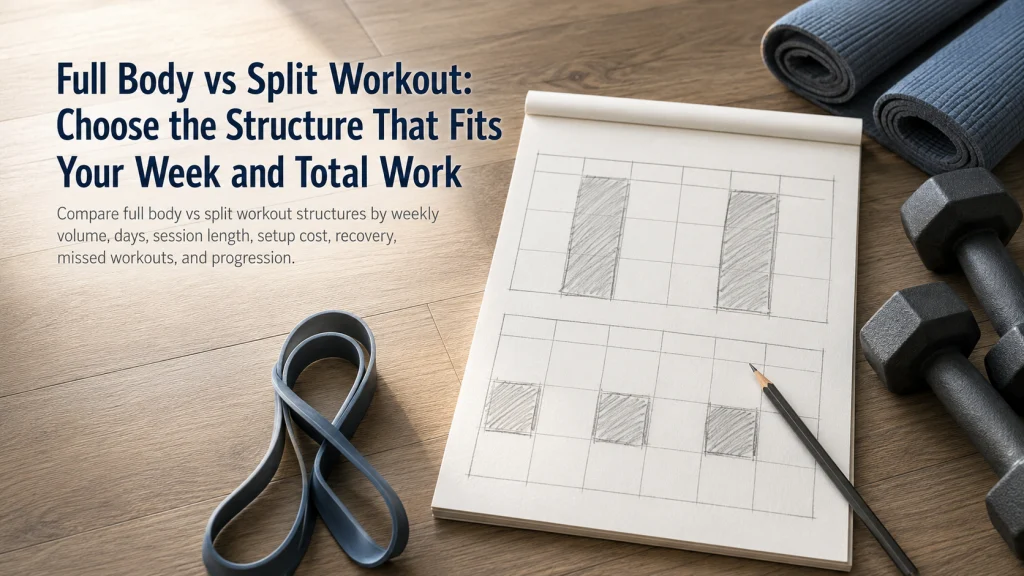
Full Body vs Split Workout: Choose the Structure That Fits Your Week and Total Work

Full Body Vs Split Workout

Full-body and split routines can both work when weekly training volume and effort are comparable. The better structure is the one that fits your available days, session limit, home setup, recovery, and tolerance for missed workouts. A full-body plan spreads several muscle groups across fewer sessions, while a split divides the same weekly work across

Progressive Overload at Home: Progress With More Than Just Heavier Weights

Progressive Overload At Home

Progressive overload at home means changing a stable routine in a way you can measure, not replacing the workout every time it starts to feel familiar. Begin with one repeatable exercise setup, choose a readiness trigger, and change only one variable such as repetitions, load, range, leverage, assistance, sets, or weekly exposure. Record the result

How to Make Exercise a Habit: Build a Repeatable Cue, Minimum Version, and Recovery Rule

How To Make Exercise A Habit

An exercise habit becomes easier to repeat when the launch conditions are stable. Choose one cue, one location, and a minimum version that can survive busy, noisy, low-energy, or interrupted days. Reduce the hidden setup burden, track starts before outcomes, and return at the next planned cue after a missed session. Significant distress, compulsive exercise,

Rest Days for Beginners: Match Recovery to the Activity Instead of Treating Rest as Doing Nothing

Rest Days For Beginners

Rest is relative to the work that came before it. A beginner may keep a daily movement habit while giving demanding strength, cardio, or unfamiliar sessions more recovery time. Use activity type, intensity, duration, soreness, energy, sleep, performance, and joint comfort to decide whether the next day calls for full rest, light activity, or another

Cool Down After Workout: Lower the Demand Gradually and Record How the Session Ended

Cool Down After Workout

A cool-down helps you move from workout effort toward ordinary movement instead of treating the final timer as an instant stop signal. Lower speed, resistance, range, or pace when that transition is practical, then restore the room and record how the session ended. Stretching is optional and serves a different purpose from the immediate reduction

Warm Up Before Workout: Rehearse the Activity Instead of Collecting Random Stretches

Warm Up Before Workout

A warm-up prepares you for the activity that follows rather than collecting unrelated stretches. Start by checking the space and equipment, then raise effort gradually, move the joints the session will use through comfortable ranges, and rehearse the main movement in an easier form. The sequence may be brief for easy work and longer for