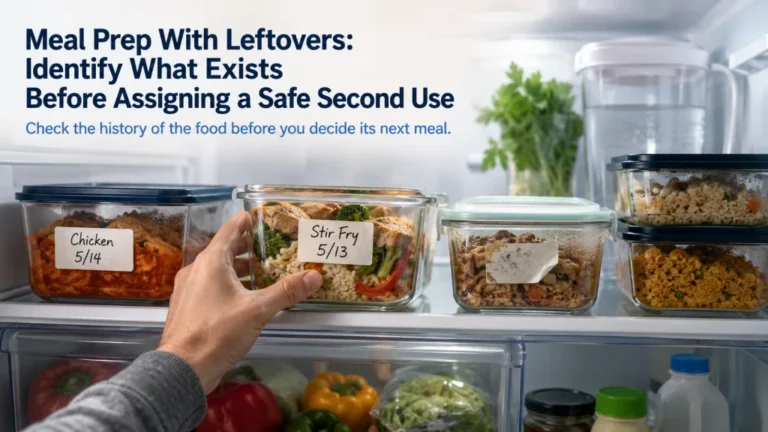
Recipe time and kitchen time are different measurements. A realistic meal-prep estimate includes active work, passive cooking, blocked equipment time, cooling, packing, cleanup, and a buffer for the parts that do not overlap cleanly. Build the estimate from the actual recipes and shared tasks, then check burner, oven, counter, sink, and container conflicts before committing the block to the calendar. When the estimate exceeds the available window, reduce the scope first rather than assuming a new appliance will solve the problem.
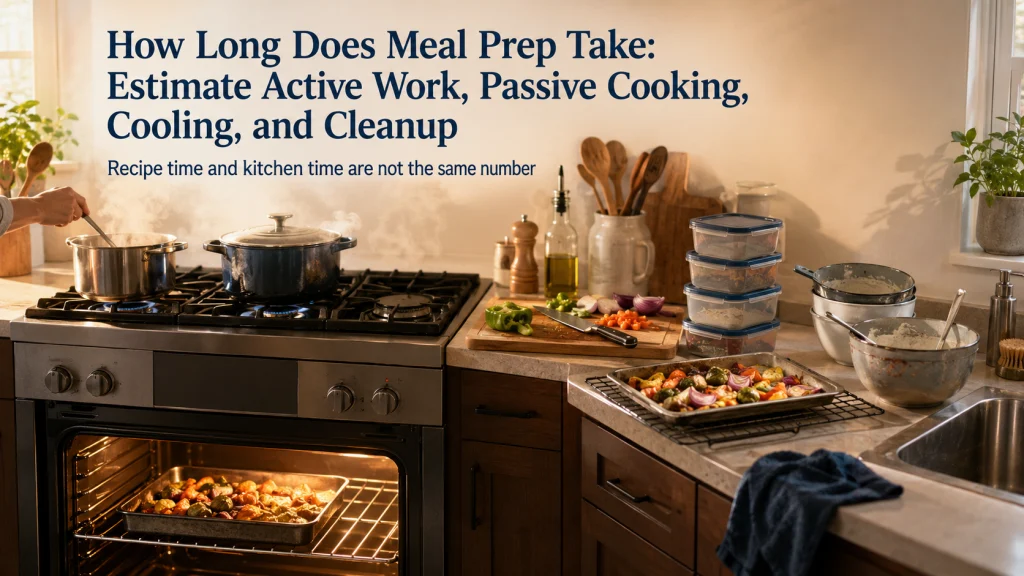
A Recipe Set Advertised as 60 Minutes Can Occupy a Much Larger Calendar Block
Imagine choosing three recipes whose listed preparation and cooking times appear to fit inside one hour. On paper, the session looks compact. In the kitchen, the clock starts before the first pan is hot and keeps running after the final burner is turned off.
The following timeline is an illustrative estimate for one specific recipe set, not a universal meal-prep duration:
| Timeline layer | What becomes visible | Calendar effect |
|---|---|---|
| Advertised recipe time | Listed preparation and cooking steps | 60 minutes appears sufficient |
| Kitchen setup | Clear a surface, gather tools, wash hands, locate containers, and begin preheating | The session starts before recipe timing begins |
| Duplicated preparation | Several recipes list their own chopping, measuring, and ingredient setup | Shared work may be repeated or missed in the original estimate |
| Equipment conflict | Two recipes need the same burner, oven setting, counter area, or appliance | One task waits even when it requires little active work |
| Post-cooking handoff | Food needs a planned cooling, packing, labeling, refrigeration, or freezing step | The block continues after cooking appears finished |
| Kitchen reset | Pans, utensils, counters, sink space, drying, waste, and container storage | The household workload extends beyond the recipe cards |
The sixty-minute label is not necessarily wrong. It is answering a narrower question. It may describe the recipe steps under expected conditions, while the household needs to know how long the entire kitchen remains committed.
This article estimates one planned prep block. The separate meal prep schedule decides which day or days should hold that block.
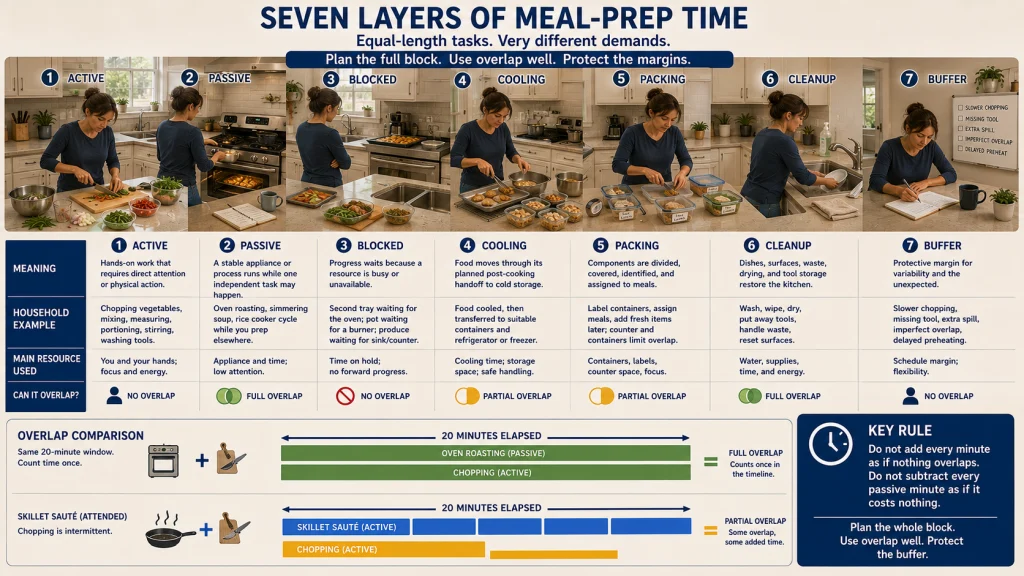
Separate Active, Passive, Blocked, Cooling, Packing, Cleanup, and Buffer Time
A useful estimate begins by naming the kind of time each task consumes. Two tasks can both last twenty minutes while placing very different demands on the cook and the kitchen.
| Time category | Meaning | Example | Can it overlap? |
|---|---|---|---|
| Active time | Hands-on work that needs attention or physical action | Chopping, mixing, portioning, stirring, or washing tools | Only with tasks that do not compete for attention |
| Passive time | A process continues with limited attention | Oven cooking, simmering, or an appliance cycle | Often, but only when the process is stable and safe to leave briefly |
| Blocked time | A task waits because equipment, space, or another dependency is unavailable | A second tray waits for the oven or a bowl waits for sink space | No, unless the wait is used for another independent task |
| Cooling time | Food moves through its planned post-cooking process before cold storage or packing is complete | Dividing food into suitable containers and completing the storage handoff | Sometimes, while other safe tasks continue nearby |
| Packing time | Components are assembled, divided, covered, and identified | Filling containers and marking what belongs to which meal | Limited when counter space or containers are shared |
| Cleanup time | The kitchen is returned to a usable state | Dishes, surfaces, waste, drying, and tool storage | Partly, during natural waits that do not require attention |
| Buffer time | Allowance for small delays and imperfect overlap | A missing tool, slower chopping, an extra spill, or a late oven preheat | It protects the total estimate rather than representing one task |
Do not add every category as though nothing overlaps. Do not subtract every passive minute as though it were free. The estimate should show which processes can run together and which ones still occupy the same equipment, surface, or attention.
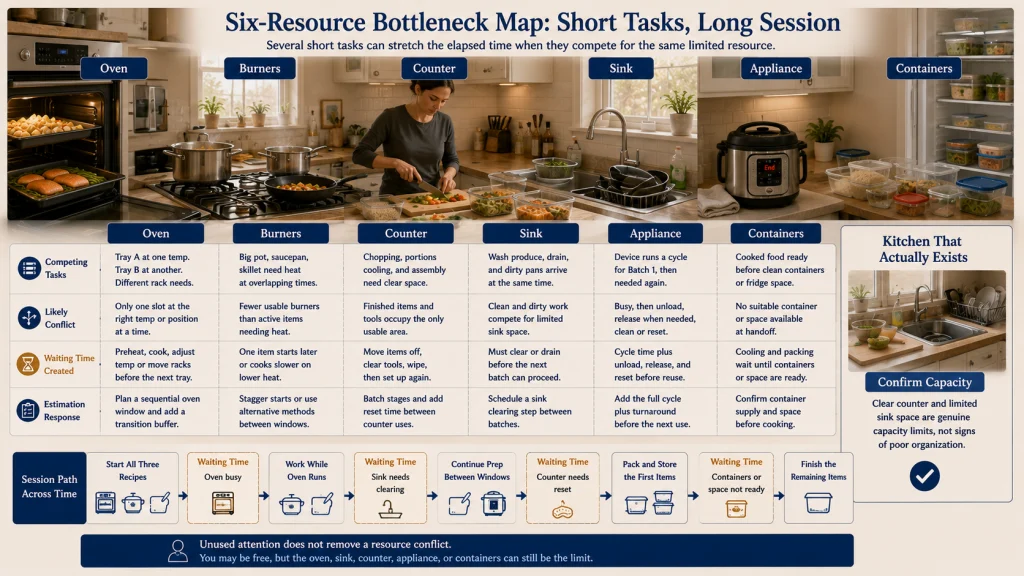
Find Appliance, Burner, Oven, Counter, Sink, and Container Conflicts
Several short tasks do not automatically fit into one short session. They may all depend on the same piece of equipment or the same clear surface.
| Resource | Competing tasks | Likely conflict | Estimation response |
|---|---|---|---|
| Oven | Two trays need different temperatures or positions | Sequential cooking or a temperature change | Add blocked time between compatible oven windows |
| Burners | A pot, saucepan, and skillet need the same available burner space | One item starts late or moves to another method | Map the maximum number of simultaneous pans |
| Counter | Chopping, cooling containers, and meal assembly need the same area | Finished items must be moved before the next task begins | Add a surface-reset or packing handoff |
| Sink | Produce washing, draining, and dirty pans arrive together | Clean and dirty work block each other | Reserve a clearing step before the next sink-dependent task |
| Appliance | One device must complete, unload, and reset before the next batch | Cook cycles cannot overlap as planned | Count loading, unloading, release, and reset between batches |
| Containers | Prepared food is ready before suitable containers are clean or available | Cooling and packing stop | Confirm container count before starting the cooking block |
The grid should be built around the kitchen that actually exists. A large recipe set in a small kitchen may be limited by one clear counter rather than by cooking speed. A session with enough burners may still stop because the sink is full when the next ingredients need washing.
The guide to kitchen organization for meal prep addresses recurring space and placement problems. Here, those problems are translated into waiting time before the session begins.
Estimate First-Time Work Differently From Familiar Recipes
You may know the feeling of starting a recipe that looked simple, then stopping three times to reread the next step, find a different bowl, or check whether the pan is large enough. None of those pauses means the plan failed. They are part of first-time work.
A familiar recipe carries fewer hidden decisions. The tools, sequence, visual cues, and likely cleanup are already known. A new recipe asks for more reading, checking, measuring, and tool changes, even when its printed timing looks similar.
Mark each recipe as one of three familiarity levels:
- Familiar: The tools, sequence, and expected result are known.
- Partly familiar: The method is known, but the recipe, quantity, or equipment setup is different.
- New: The sequence, visual cues, or equipment behavior still need active reading and checking.
Give new work a wider estimate. That extra room accounts for decisions that become faster only after repetition.
When several unfamiliar recipes land in the same session, keep one and replace the others with known components. The beginner guide to starting meal prep explains why a smaller first system is easier to repeat and review.
Separate Parallel Tasks From Tasks That Compete for Attention
Passive cooking creates opportunities for overlap, but only when the second task can be performed without neglecting the first. An oven cycle may leave time for chopping. A skillet that needs frequent turning may not.
Use three overlap labels:
- Safe to overlap: One stable process continues while an independent task uses different equipment and manageable attention.
- Partial overlap: The second task can begin, but the cook must stop periodically to check, stir, turn, drain, or change settings.
- Do not overlap: Both tasks require continuous attention, the same equipment, or incompatible clean and dirty work areas.
Suppose a grain simmers quietly while vegetables roast. Chopping herbs may fit inside that window. Starting a new skillet dish, washing delicate produce, and assembling containers at the same time may create too many attention changes even if each step looks short on paper.
Estimate the overlap that is dependable, not the overlap possible on the most organized day. A calendar block should survive ordinary interruptions, not require flawless timing from beginning to end.
Add Cooling, Labeling, Refrigerator Placement, and Dishes
The stove turning off is a midpoint for some sessions, not the finish line. Prepared food still needs a safe handoff into suitable containers and cold storage, and the kitchen still needs to become usable again.
Add a task line for each of the following when it applies:
- Prepare suitable containers and divide food as planned.
- Complete the cooling and cold-storage process according to current food-specific guidance.
- Label or identify containers so later decisions do not depend on memory.
- Move food into the intended refrigerator or freezer space.
- Wash, load, rinse, dry, or store the tools used in the session.
- Clear counters, sink space, waste, and packaging.
Cooling and storage needs vary by food, so do not apply one fixed time to everything. Reserve enough calendar space to follow current official guidance for the specific foods being prepared.
A refrigerator can also create blocked time. If shelves must be reorganized after food is ready, packing stops at the most inconvenient point. Check the intended storage area and container count before cooking.
The weekly prep schedule assigns this handoff to a day. This article only makes sure the time exists inside the planned block.
Compare Full-Meal, Component, and Ingredient Prep Time
Meal prep does not have to finish every meal to the same level. Changing the scope can remove an entire layer of cooking, packing, or later assembly without changing the weekly plan itself.
| Prep scope | Work completed now | Time pattern | Later work retained |
|---|---|---|---|
| Full-meal prep | Meals are cooked, divided, packed, and stored | More cooking and post-cooking work in one block | Primarily reheating or final small additions |
| Component prep | Several flexible bases, proteins, vegetables, sauces, or grains are prepared | Shared tasks may overlap, but assembly remains later | Combine components into meals during the week |
| Ingredient prep | Selected ingredients are washed, cut, measured, or organized | Less cooking now, with a shorter cold-storage handoff | Most cooking and assembly remain on eating days |
Full-meal preparation may reduce later decisions but demand more containers, refrigerator space, and kitchen-reset work. Ingredient preparation creates a lighter session while leaving more cooking for later days.
Component preparation often sits between those two ends. It can also connect naturally with batch cooking when several meals use the same base, but detailed production order remains outside this time-estimation article.
Time alone is not a nutrition score. A longer homemade session is not automatically more suitable, and a shorter method is not automatically less useful. The broader meal prep process connects scope with planning, shopping, preparation, and later use.
Reduce the Scope Before Buying Another Appliance
When the estimate is too long, removing one layer of work is often more reliable than adding equipment. Drop one recipe, repeat a familiar component, move a fresh item to later in the week, or prepare ingredients instead of finishing every meal.
Nora’s practical observation from reviewing kitchen products is that the headline usually centers on the cook cycle. The surrounding labor is quieter: warming the unit, loading it, waiting for a release step, working around batch capacity, washing removable parts, letting them dry, and finding somewhere to store them. That extra work can turn a shorter passive cycle into a busier session for the person using it.
- Name the bottleneck: chopping, cooking capacity, sink access, counter space, container readiness, or cleanup.
- Remove one recipe, batch, technique, or packing step.
- Recalculate the smaller session.
- Consider equipment only when the same bottleneck still controls the estimate.
- Count the appliance’s complete household workload, not only the advertised cycle.
This keeps the purchase question specific. A tool may be useful when it addresses a repeated, measured constraint. It is less likely to help when the real problem is too many recipes, a crowded refrigerator, or a sink that becomes blocked halfway through the session.
The guide to meal prep tools and appliances should be used only after the bottleneck is defined. The guide to lower-cost meal prep can help when reducing scope also needs to protect the grocery plan.
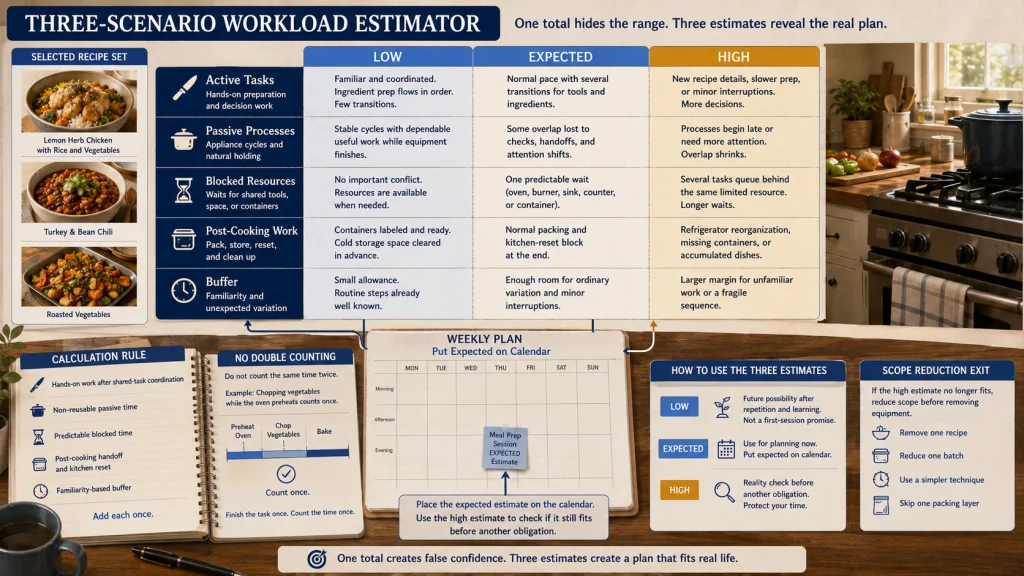
Build Low, Expected, and High Estimates
One total invites false confidence. Three estimates show what changes when the kitchen runs smoothly, when normal friction appears, and when the sequence becomes fragile.
| Estimator layer | Low estimate | Expected estimate | High estimate |
|---|---|---|---|
| Active tasks | Familiar pace and coordinated preparation | Normal pace with a few tool and ingredient transitions | New recipe reading, slower preparation, or minor interruptions |
| Passive processes | Most stable processes overlap with useful work | Some overlap is lost to checks and handoffs | Processes require more attention or begin later than planned |
| Blocked resources | No important equipment or surface conflict | One predictable wait for oven, burner, sink, counter, or containers | Several tasks queue behind the same limited resource |
| Post-cooking work | Containers and storage space are ready | A normal packing and kitchen-reset block | Storage must be reorganized or extra dishes accumulate |
| Buffer | Only a small allowance | Enough room for ordinary variation | A larger allowance for new work or a fragile sequence |
Put the expected estimate on the calendar. Use the high estimate to check whether the session still fits before another obligation. Treat the low estimate as a picture of what may become possible after the routine is familiar, not as the promise for a first attempt.
To calculate the block, total the hands-on tasks after coordinating repeated preparation. Add passive time that cannot carry useful work, predictable resource waits, the post-cooking handoff, the kitchen reset, and a buffer based on familiarity.
Do not subtract the same minute twice. If an oven period contains twenty minutes of chopping, the chopping sits inside that elapsed window instead of being added again in full.
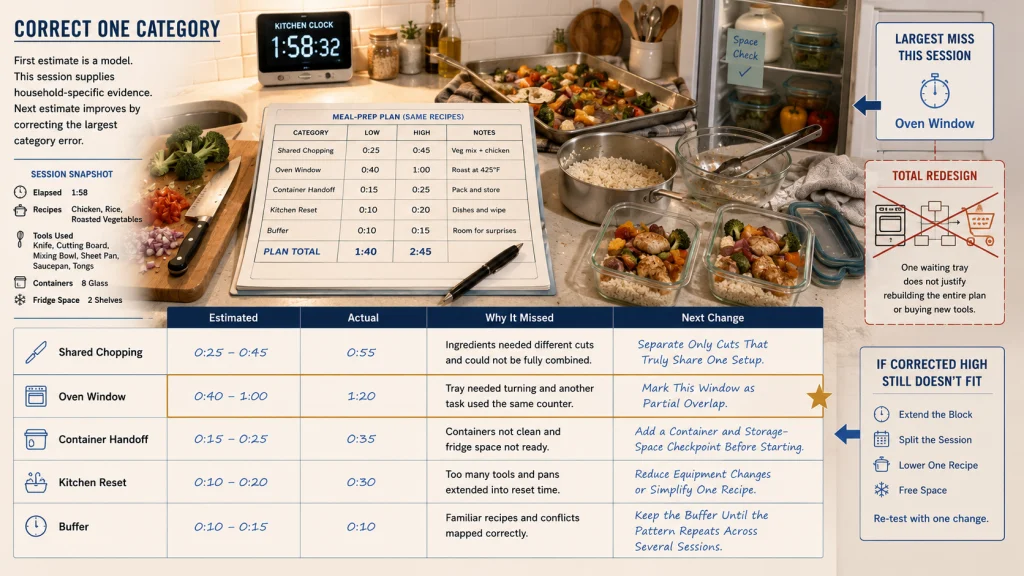
Compare the Estimate With Actual Time After the Session
The first estimate is a model. The session turns it into household-specific information. Record enough detail to identify the error without timing every hand movement.
| Estimated category | What actually happened | Why the estimate missed | Next-session change |
|---|---|---|---|
| Shared chopping | Preparation took longer than expected | Ingredients required different cuts and could not be fully combined | Separate only the cuts that truly share one setup |
| Passive oven window | Less useful work fit inside it | The tray needed turning and another task used the same counter | Mark the window as partial overlap |
| Container handoff | Packing stopped after cooking | Containers were not clean or the refrigerator was full | Add a container and storage-space checkpoint before the session |
| Kitchen reset | Dishes extended well beyond the planned block | Too many tools and pans were introduced | Reduce equipment changes or simplify one recipe |
| Buffer | The session finished comfortably inside the block | The recipe set was familiar and the conflicts were mapped correctly | Keep the buffer until the pattern repeats across several sessions |
Review the category with the largest miss. Do not redesign the entire session because one tray waited for the oven. Correct the conflict that actually changed the elapsed time.
If the same reminders, handoffs, or household responsibilities fail across several weeks, the meal prep systems guide can help turn the repeated problem into a clearer routine.
Calculate the Categories, Add the Conflicts, and Keep a Smaller Fallback
The calendar needs the whole kitchen block, not the cleanest number on the recipe card. Count hands-on work, waiting that cannot be reused, bottlenecks around equipment and space, the storage handoff, and the final reset.
Then protect the plan with a smaller version. One recipe can disappear. A full meal can become a component. An unfamiliar method can be replaced with something known. That fallback is not a failed session. It is the version that still fits when the high estimate no longer does.
The useful answer to “How long will this take?” is a model that shows where the time goes. Once the model is visible, the household can shorten the right part instead of rushing every part.
FAQs
⏱️ How long does meal prep take?
There is no universal duration. The total depends on recipe count, familiarity, preparation level, equipment conflicts, cooling and storage work, containers, cleanup, and how much work can overlap safely.
📝 Why is recipe time shorter than my actual kitchen time?
Recipe labels may focus on listed preparation and cooking steps. Your household block may also include setup, repeated tasks, equipment waits, packing, cold-storage placement, and restoring the kitchen.
🔥 Should passive cooking time count in the estimate?
Count passive time in the elapsed schedule, but subtract only the portion that contains dependable overlapping work. A process that needs frequent checks or shares equipment may provide less usable overlap than expected.
🍽️ Is full-meal prep always faster during the week?
It can reduce later cooking decisions, but it moves more cooking, packing, storage, and cleanup into the prep block. Component or ingredient prep may create a shorter session while leaving more work for later days.
🧑🍳 Should I add extra time for a new recipe?
Yes, use a wider estimate for unfamiliar work. Reading, checking equipment, finding tools, and learning the sequence create decision time that a familiar recipe may no longer require.
⚙️ Will another appliance make meal prep faster?
It may help when one repeated cooking constraint controls the session. Compare the complete workload around the appliance with the smaller prep plan before deciding that the headline cycle saves calendar time.
📊 How should I improve my estimate next week?
Compare the expected time with the actual session by category. Correct the largest miss, such as shared preparation, oven conflict, container readiness, or cleanup, instead of changing the entire routine.