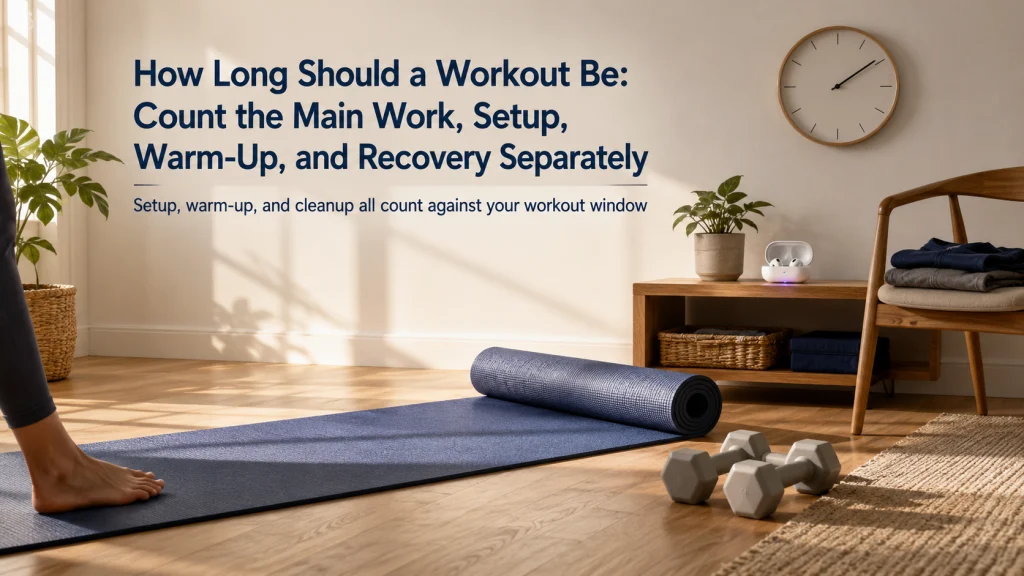
How long a workout should be depends on the activity, effort, experience, available time, setup cost, and recovery across the week. A thirty-minute calendar block may contain twenty-two minutes of movement in one home and only ten minutes in another. Map the full block into preparation, the transition into movement, focused activity, the transition out, and the time needed to reset the space before deciding whether it fits. Build a minimum version for low-time days, then review the whole week instead of judging one workout in isolation.
Two Thirty-Minute Blocks Can Deliver Very Different Workouts
Two people both reserve thirty minutes for exercise at home. The first person changes clothes before the block begins, keeps the floor clear, and uses an activity that starts quickly. The second person moves furniture, finds equipment, pairs a device, waits for an app to load, changes an attachment, and puts everything away afterward.
| Part of the block | Low-friction block | High-friction block |
|---|---|---|
| Setup | 3 minutes | 9 minutes |
| Warm-up | 3 minutes | 4 minutes |
| Main movement | 22 minutes | 10 minutes |
| Cool-down and cleanup | 2 minutes | 7 minutes |
| Total calendar time | 30 minutes | 30 minutes |
Scheduled time and exercise time are not the same number. This difference matters when the reader compares a ten-minute routine, a thirty-minute session, and a longer workout without counting what happens before and after the main work.
A fifteen-minute workout video can require more than fifteen minutes when pairing, loading, changing attachments, moving furniture, and storage are included. The advertised duration describes only one part of the household task.
Use the broader guide to exercise at home with a workable setup when space and household friction are still unclear. For the full starting process, review how to start working out at home before selecting a session length.
Define Every Part of the Calendar Block
A useful duration plan gives each part of the session a name. Otherwise, setup disappears from the estimate, warm-up is treated as optional extra time, and cleanup is pushed into the next household commitment.
| Time component | What it includes | Why it matters |
|---|---|---|
| Calendar time | The full protected block from starting preparation to returning the space to normal. | This is the amount of time the household schedule must actually provide. |
| Setup time | Changing clothes, clearing space, preparing water, loading a routine, and arranging equipment. | High setup can consume a short session before movement begins. |
| Warm-up time | The transition into the selected activity. | It prepares the session without being confused with the main work. |
| Main work | The walking, strength, cardio, mobility, or mixed activity chosen for that session. | This is the movement time most people mean when they compare workouts. |
| Cool-down time | The transition out of the activity when one is appropriate for the session. | It prevents the session estimate from ending abruptly at the final work interval. |
| Cleanup time | Drying, wiping, storing, folding, reconnecting the room, and handling used items. | Ignoring cleanup can make the routine collide with the next obligation. |
Count the whole block before deciding whether the routine fits. Detailed preparation belongs in the guide to warming up before a workout, while the guide to cooling down after a workout covers the transition after the main work.
Do Not Turn a Weekly Activity Goal Into One Session Length
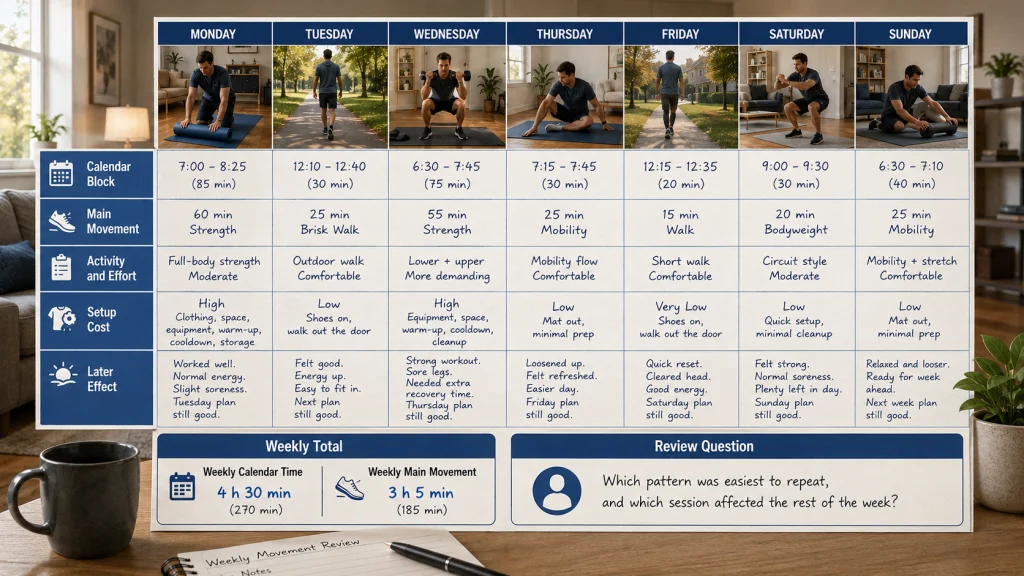
A weekly activity target describes accumulated activity across several days. It does not require the entire amount to happen in one workout, and it does not create one ideal duration for every session.
The same weekly amount can be distributed in different ways. One person may prefer several shorter sessions that fit between work and caregiving. Another may have fewer reliable windows and use longer blocks. Both plans still need to account for activity type, effort, recovery, and the practical cost of starting each session.
Short activity bouts can contribute to the week. They do not need to meet an outdated ten-minute minimum before they are worth recording. This does not mean every brief session has the same purpose or effect as a longer one. It means the minutes can be counted honestly instead of being dismissed because they happened in smaller pieces.
| Day | Calendar block | Main movement | Activity and effort note | Setup or transition cost | Later or next-day effect |
|---|---|---|---|---|---|
| Monday | _____ minutes | _____ minutes | ________________ | ________________ | ________________ |
| Tuesday | _____ minutes | _____ minutes | ________________ | ________________ | ________________ |
| Wednesday | _____ minutes | _____ minutes | ________________ | ________________ | ________________ |
| Thursday | _____ minutes | _____ minutes | ________________ | ________________ | ________________ |
| Friday | _____ minutes | _____ minutes | ________________ | ________________ | ________________ |
| Saturday | _____ minutes | _____ minutes | ________________ | ________________ | ________________ |
| Sunday | _____ minutes | _____ minutes | ________________ | ________________ | ________________ |
| Weekly total | _____ minutes | _____ minutes | Which pattern was easiest to repeat, and which session affected the rest of the week? | ||
The two totals answer different questions. Calendar time shows what the week had to make room for, while main movement shows how much activity occurred inside those blocks. The notes explain why two weeks with the same movement total may feel very different.
The guide to choosing beginner workout frequency can help decide how many sessions should hold that weekly activity.
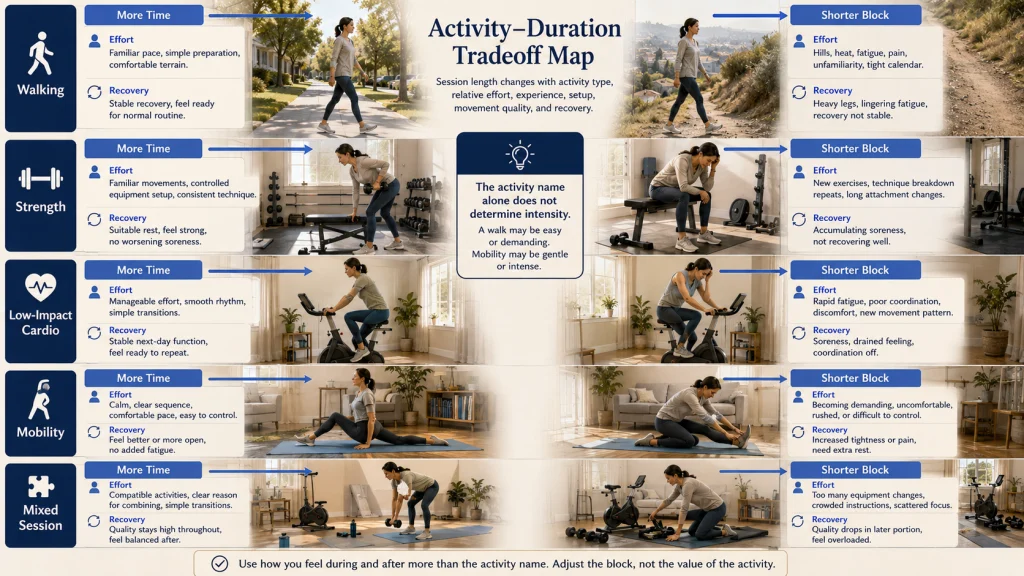
Choose Duration by Activity Type and Relative Intensity
A session length that feels manageable for comfortable walking may be too long for unfamiliar strength work or higher-effort cardio. Duration should therefore follow the activity and the person’s current response, not a single number copied from another routine.
| Activity type | What can support a longer block | What can make a shorter block more appropriate |
|---|---|---|
| Walking | Familiar pace, easy setup, comfortable terrain, and stable recovery | New activity, hills, heat, pain, fatigue, or a tight calendar window |
| Strength | Familiar movements, controlled setup, suitable rest, and consistent technique | New exercises, repeated technique breakdown, long equipment changes, or accumulating soreness |
| Low-impact cardio | Manageable effort, simple transitions, and stable next-day function | Rapid fatigue, poor coordination, discomfort, or a new activity pattern |
| Mobility | A calm routine with clear movements and little setup | A session that becomes demanding, uncomfortable, or difficult to control |
| Mixed session | Simple transitions and a clear reason for combining activities | Too many equipment changes, crowded instructions, or reduced quality in the later portion |
The activity label is not enough by itself. A walk can be easy or demanding, and a mobility session can be gentle or intense. Use the guide to understand beginner exercise intensity when effort is the unclear variable.
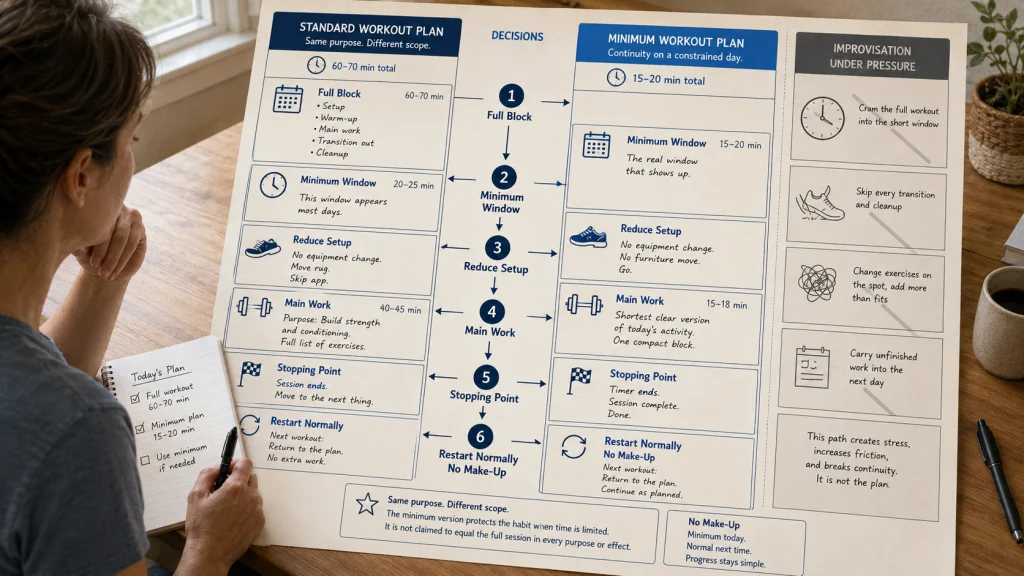
Create a Minimum Version for Low-Time Days
A minimum version is a smaller session decided before the calendar becomes crowded. It protects the routine without pretending that the full workout still fits.
| Worksheet field | Decision |
|---|---|
| Full calendar block | How much total time does the standard session require, including setup and cleanup? |
| Minimum available block | What shorter window appears often enough to plan for? |
| Setup reduction | Which preparation step can be removed without making the activity unsafe or confusing? |
| Main work | What is the smallest clear version of the selected activity? |
| Stopping point | What marks the end so the session does not expand into the next obligation? |
| Restart rule | Does the next session return to the normal plan without make-up work or doubling? |
The minimum version should be understandable without redesigning the workout under pressure. It might use a shorter walking route, fewer planned strength movements, a reduced cardio block, or a compact mobility sequence. The exact activity remains appropriate to the person’s plan and current capacity.
A minimum version is not evidence that every short workout equals a longer one. It serves a narrower purpose: preserving a useful movement opportunity when the standard block is unavailable.
Use Short Bouts as Part of the Weekly Pattern
Short bouts can make activity easier to place around a desk day, caregiving, household transitions, or an unpredictable schedule. They can also reduce the cost of waiting for a large uninterrupted window that rarely appears.
Count them honestly. A five-minute movement break is five minutes of activity, not a thirty-minute workout because it happened several times in the same room. At the same time, those minutes do not disappear simply because they were accumulated in smaller pieces.
A short-bout strategy works best when:
- The activity starts with little setup.
- The purpose is clear, such as breaking up sitting or adding manageable movement.
- The bouts do not become repeated high-effort sessions without recovery.
- The total pattern remains easy to track.
- The person does not use short bouts to ignore pain, dizziness, or another concerning change.
When several short bouts appear in the same day, record the total main movement and the number of separate starts. This reveals whether setup remains small or whether the routine is creating more interruption than benefit.
Know When a Longer Session Adds Value or Friction
A longer session can be useful when the activity benefits from sustained practice, the setup cost is high, the person has enough time, and recovery remains manageable. It may also allow several compatible parts of a session to happen without repeated starts.
Length adds friction when the later portion loses purpose or quality. Warning signs include rushed technique, wandering attention, repeated equipment changes, skipped cooldown or cleanup, and a schedule that regularly pushes meals, sleep, work, or caregiving aside.
Longer is not automatically more effective, and shorter is not automatically more efficient. The right comparison asks what the added time changes in movement quality, setup efficiency, recovery, and the rest of the week.
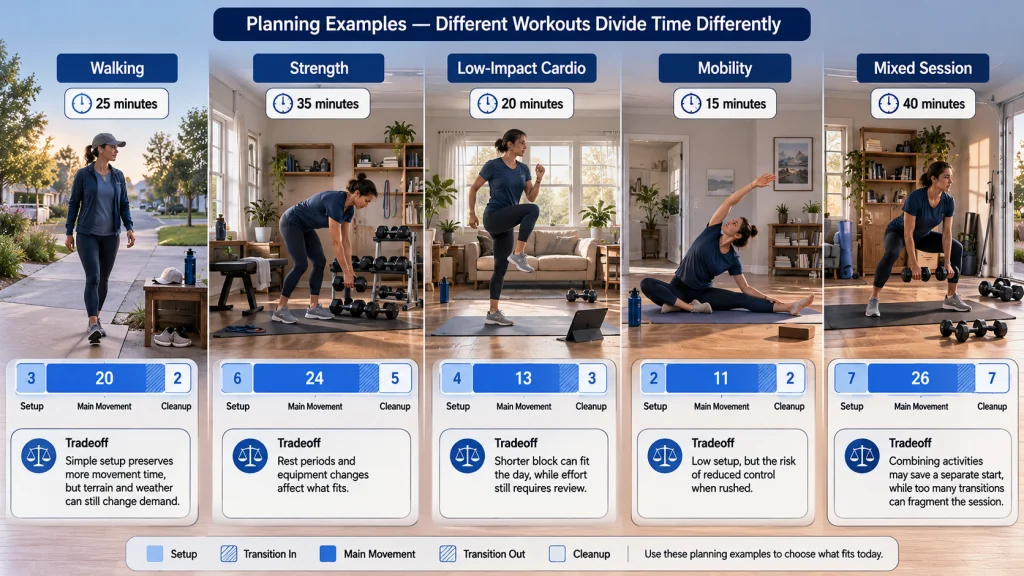
Compare Five Home-Workout Session Examples
These examples show how the same calendar length can be organized differently. They are planning examples, not universal prescriptions.
| Session type | Calendar block | Possible time structure | Main tradeoff |
|---|---|---|---|
| Walking | 25 minutes | 3 minutes preparation, 20 minutes walking, 2 minutes return and transition | Simple setup can preserve more movement time, but terrain and weather may change the demand. |
| Strength | 35 minutes | 6 minutes setup and warm-up, 24 minutes main work, 5 minutes cooldown and storage | Equipment changes and rest periods can reduce the number of useful movements that fit. |
| Low-impact cardio | 20 minutes | 4 minutes transition, 13 minutes main work, 3 minutes cooldown | A shorter block may fit the day, but effort still needs to remain manageable. |
| Mobility | 15 minutes | 2 minutes setup, 11 minutes movement, 2 minutes reset | Low setup helps, but a rushed sequence may reduce control and comfort. |
| Mixed session | 40 minutes | 7 minutes setup and warm-up, 26 minutes across two activities, 7 minutes cooldown and cleanup | Combining activities can save a separate start, but too many transitions can fragment the session. |
The examples are most useful when adjusted with real household timing. If the room takes ten minutes to reset, that time belongs in the calendar block. If the activity begins immediately, the main work may occupy a larger share.
For broader session options, use the guide to cardio workouts at home. The beginner workout schedule can then place the chosen session lengths into a workable week.
Increase Duration Before Intensity Only When It Fits the Activity
Increasing duration before intensity can be a useful progression choice in some situations, but it is not a universal sequence. The activity, current experience, technique quality, available time, and recovery should determine which variable changes first.
For a familiar comfortable walk, adding a small amount of time may be simpler than increasing pace. For an unfamiliar strength session, extending the workout while technique is fading may add little value. In a mixed session, reducing transitions may improve the block before either duration or intensity changes.
One-variable rule: Keep frequency and intensity stable while testing a small duration change. Review how the new block affects technique, motivation, recovery, and the next day before making another change.
If the extra time causes later-session quality to drop, return to the previous workable duration. Progress does not require keeping a longer session simply because it was completed once.
Review Recovery, Technique, Motivation, and Next-Day Function
A session length works when the person can complete useful movement with reasonable quality and return to ordinary responsibilities. Review a repeated pattern rather than using one unusually good or difficult day as the verdict.
| Review area | Question | Possible adjustment |
|---|---|---|
| Recovery | Does soreness or fatigue settle before the next similar session? | Shorten the main work or leave more space before repeating it. |
| Technique quality | Does control remain stable near the end? | End the session earlier or simplify the later portion. |
| Motivation | Does the calendar block feel approachable enough to begin again? | Reduce setup or use a clearer minimum version. |
| Next-day function | Can the person manage work, caregiving, sleep, and routine movement as usual? | Reduce duration, effort, or repeated demand. |
| Weekly consistency | Did one long session make later planned sessions less likely? | Redistribute the weekly activity into shorter blocks. |
Hold the duration steady when the answer is unclear. A stable week provides better information than repeatedly changing the session length before the effect can be observed.
Know When a Generic Duration Is Not Appropriate
This framework is intended for generally healthy adults arranging ordinary home activity. It does not diagnose an injury, prescribe rehabilitation dosage, create a disease-specific program, or replace advice from a physician, physical therapist, or qualified exercise professional.
Persistent joint or muscle pain, neurological symptoms, pregnancy, recent surgery, chronic conditions, disability-related limitations, or a long period of inactivity may require individualized guidance before selecting or increasing session length.
Stop exercise and seek appropriate help: Chest pain or pressure, extreme shortness of breath, fainting, severe dizziness, sudden weakness, a serious injury, or severe pain requires prompt attention. Do not respond by shortening the workout and continuing through the warning sign.
Choose the Calendar Block, Expected Movement Time, and Minimum Version
Write the full calendar block first. Then estimate what happens before movement, the transition into the activity, the focused work, the transition out, and the room reset so the session fits the real household schedule.
Choose an expected movement time that matches the activity, effort, experience, and recovery. Add a minimum version for low-time days, track the accumulated week, and change duration only after reviewing technique quality, motivation, and next-day function. The most useful workout length is the one that serves the activity and still leaves a workable week around it.
FAQs
⏱️ Is thirty minutes the ideal workout length?
No single duration is ideal for every activity or person. Count preparation, movement transitions, focused work, cleanup, effort, and recovery before deciding whether a thirty-minute block fits.
🚶 Do short workouts count?
Short bouts can contribute to weekly activity, and they do not need to reach an outdated ten-minute minimum before being recorded. Their purpose and training effect still depend on the activity, effort, and total pattern.
📅 Should I track calendar time or movement time?
Track both. Calendar time shows what the household schedule must provide, while movement time shows how much of the block was used for the selected activity.
🪶 What should a minimum workout include?
It should contain the smallest clear version of the selected activity that fits the available window. Reduce setup where appropriate, define the stopping point, and return to the normal plan at the next session without doubling.
📈 Should I make workouts longer before making them harder?
Sometimes, but not as a universal rule. The activity, technique quality, experience, recovery, and available time should determine whether duration or intensity changes first.
🧩 Why does a short video take longer than its listed time?
Pairing, loading, changing clothes, moving furniture, adjusting equipment, and storage can sit outside the advertised workout length. Include those steps in the calendar block.
🚩 When should I seek individualized guidance?
Seek appropriate guidance when persistent pain, neurological symptoms, pregnancy, recent surgery, chronic conditions, disability-related limitations, or a long inactive period makes a generic duration uncertain. Urgent warning signs require prompt help rather than a shorter session.